TL;DR: Yes, micro1 is a legitimate company that pays its contractors: it signs them through Deel, pays in US dollars twice a month, and raised a $35 million Series A at a $500 million valuation in September 2025. The real risk is idle time, not unpaid work, because passing its AI interview only makes you eligible and projects end when a client's work does.
micro1’s jobs board listed 326 open roles on September 11, 2026, from Mandarin transcription at $20 to $30 an hour to physics PhD work at $100 to $200.
At the start of 2025 the company was an AI recruiting product with about $7 million in annual recurring revenue.
- 1You sign as an independent contractor: either side can end the agreement on five business days’ notice, and disputes go to binding arbitration.
- 2Its 10,141 Trustpilot reviews mostly describe the AI interview, not paid work, and micro1 invites candidates to leave them.
- 3micro1 cannot hire residents of 20 countries and regions, including China, Hong Kong, Russia and Ukraine.
- 4Genuine micro1 email comes only from @micro1.ai, @micro1.io or @micro1.co.
Is Micro1 Legit?
Yes. micro1 Inc. was founded in 2022, according to CNBC, and it signs experts as contractors and pays them through Deel. Its founder and CEO, Ali Ansari, started it while at UC Berkeley, and he has named Microsoft among its customers.
The money behind it is on record, and it has grown fast:
The Series A is on micro1’s own announcement page. The two revenue figures come from TechCrunch: the December 2025 figure is the founder’s claim, and the August 2026 figure came from a source, not the company.
The $2.5 billion valuation appeared in a Forbes profile of Ansari.
The scam claims online are mostly about the interview, not about unpaid work.
In the most recent 1-star Trustpilot reviews, read on September 11, 2026, the repeated complaints were AI interview glitches, “Not Qualified” results with no feedback, and suspicion that the interviews exist to collect data.
None of them said completed work had gone unpaid.
What Micro1 Actually Does
micro1 sells human data to AI labs and enterprises: expert-written tasks, model evaluations and recordings used to train and test AI systems. Its contractor library sorts the work into three kinds:
- Frontier evals: expert reasoning, analysis and review for the big foundation models, in fields such as law, medicine, finance and engineering.
- Real-world robotics: contributors film everyday physical tasks so humanoid robots can learn generalist actions. A separate page recruits tradespeople to film real jobs, listing electricians at $20 to $50 an hour and plumbers at $20 to $30.
- Contextual evals: tests of enterprise AI agents inside a specific company’s workflows and constraints.
Most frontier-eval work is a form of the reinforcement learning from human feedback covered in our guide to RLHF and instruction tuning. The robotics side is newer.
TechCrunch reports micro1 is building a robotics pre-training dataset from hundreds of generalists recording object interactions in their homes.
The AI recruiter is still part of the product. Zara, micro1’s AI interviewer, screens applicants, and the company says human recruiters then review profiles and match experts to projects.
The business model is the one Mercor, Surge and Scale AI also run; our look at whether Mercor is legit covers the largest rival.
Clients stay hidden until you start. micro1’s onboarding FAQ says the client’s name is confidential until onboarding is complete, and the contract makes even the existence of the agreement confidential.
How Much Does Micro1 Pay?
Listed pay runs from $20 to $200 an hour. We grouped the 36 newest listings on micro1’s jobs board on September 11, 2026, and 23 of them top out at $100 an hour or more.
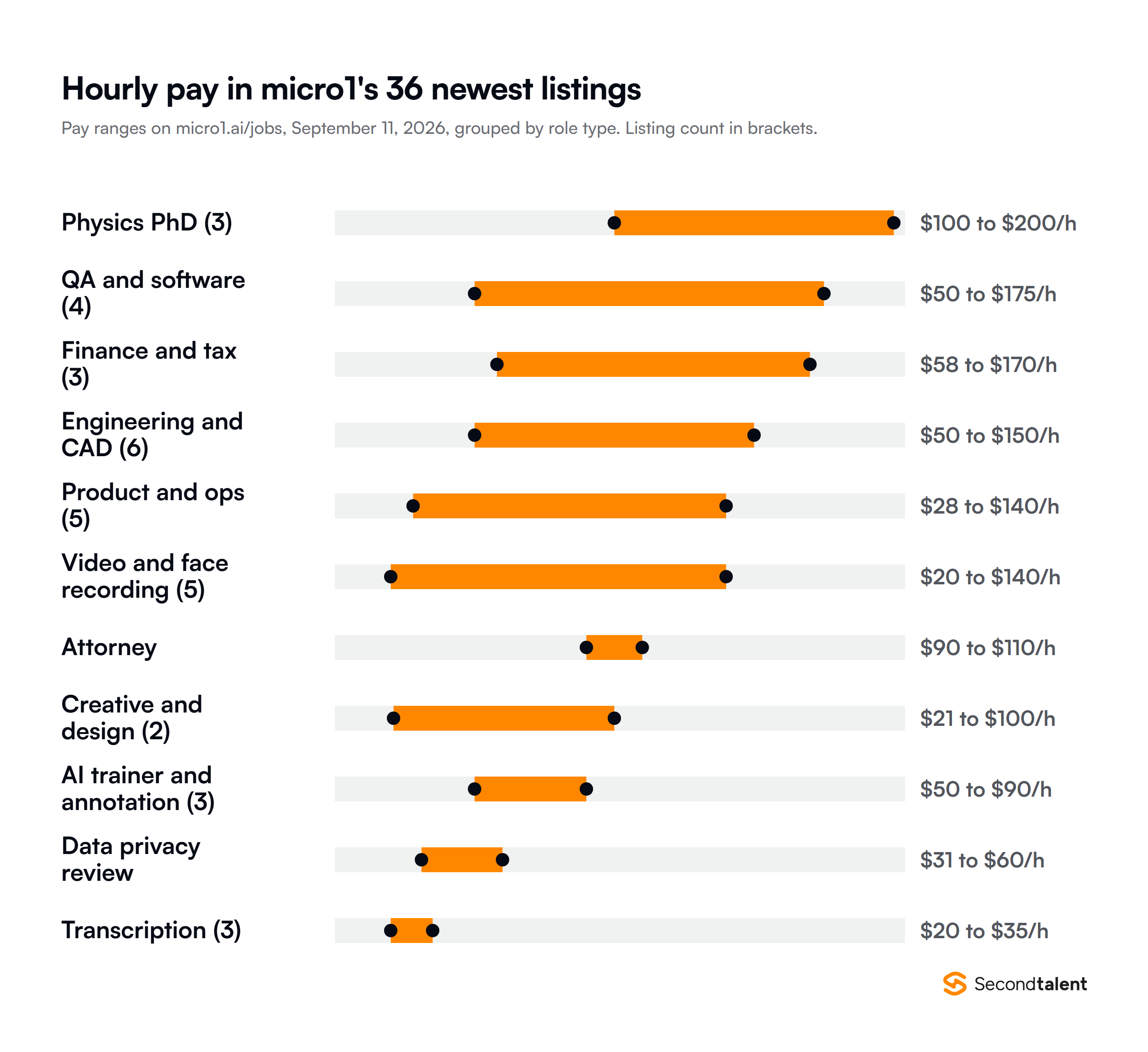
The recording row covers two different jobs. Three video-recording listings pay a flat $20 an hour, while two facial data collection listings pay $139 to $140.
The top of the range is real for some experts. CNBC saw a pay stub showing Utkarsh Amitabh earns $200 an hour, and a micro1 spokesman said he had earned nearly $300,000, including project completion bonuses, from January to December 2025.
He works about 3.5 hours a night.
Ansari’s own summary is lower than the listings suggest. He told TechCrunch in December 2025 that many experts earn “close to $100 an hour”. Our profile of the AI evaluator and trainer role covers the day-to-day work behind those rates.
The contract decides how the rate turns into pay. micro1’s onboarding FAQ lists three payout types, and only one applies to each project:
- Hourly: you are paid for hours tracked in Hubstaff and approved by the project team.
- Pay per task: each approved task pays your hourly rate times a payout multiple, however long it took.
- Flat fee: a fixed amount per approved task, and nothing for incomplete or rejected work.
The same FAQ puts the expected load at about 15 to 20 hours a week, with more when clients need it. You can keep a full-time job, and you supply your own laptop.
Approval is where pay is won or lost.
Under micro1’s quality process, each task passes peer reviewers, then the operations team, and in some pipelines the client. micro1 tracks task quality scores, time per task and how closely you follow the guidelines, and a pipeline lead contacts you when your numbers slip.
How to Get Hired: Zara, Certification and ID Checks
Getting in takes six steps, and the fourth is the one to plan around. Passing the AI interview puts you in a pool; it does not put you on a project.
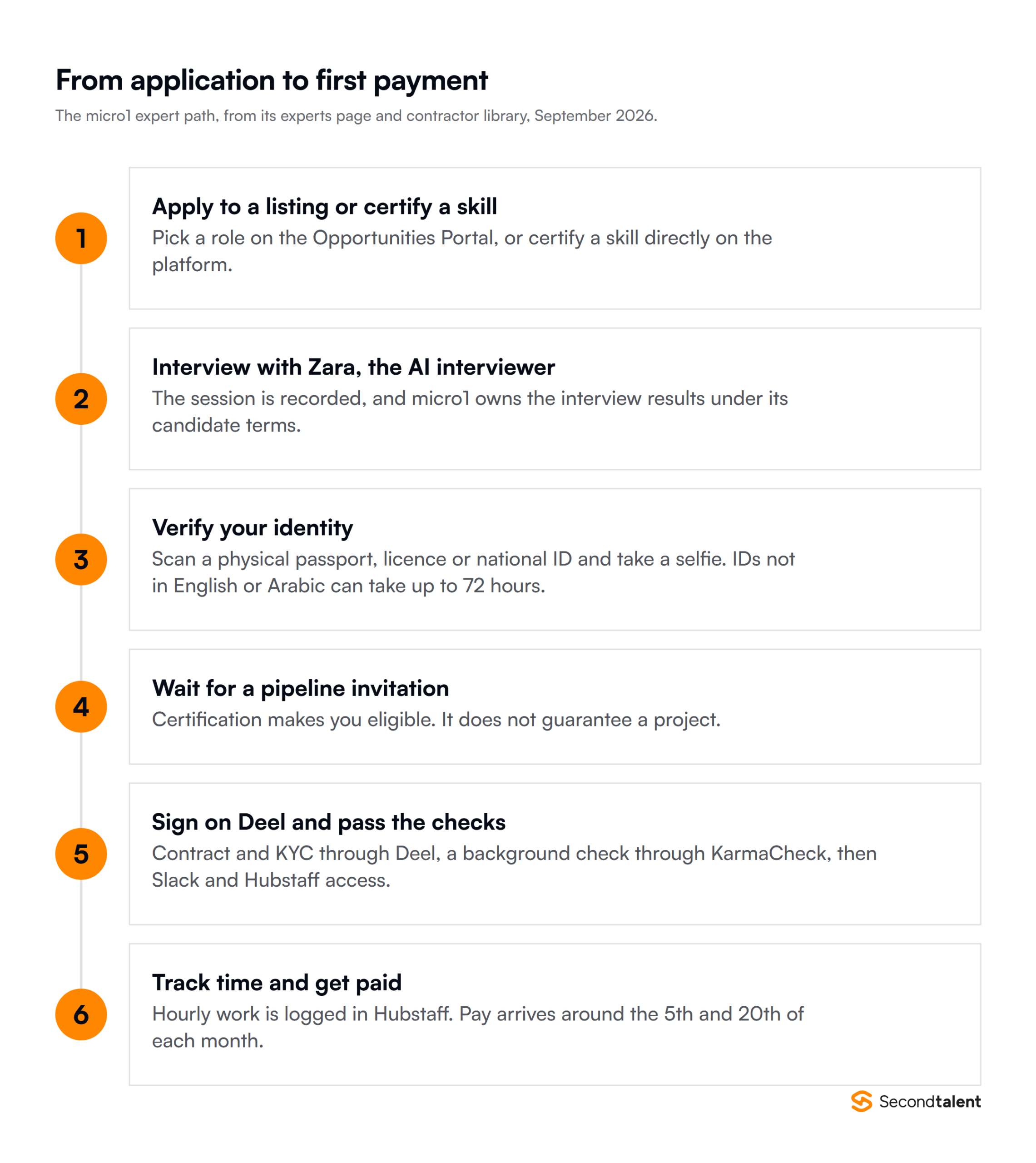
The Zara interview is on demand, so you can take it at any hour.
Per micro1’s AI interview guide, it mixes open-ended questions on your chosen role with scenario questions, adds a coding challenge for technical roles and a human data exercise for annotator roles, and shows a pass or fail result straight away.
Candidates who miss certification can request feedback, and the same guide points applicants to micro1’s Interview Prep tool for a practice run first.
micro1’s experts FAQ is plain about it: “Certification does not guarantee immediate placement.” Access to projects depends on what clients need, and your profile stays in the pool until a matching pipeline opens.
Read the interview terms before you start. Under micro1’s candidate terms, updated July 21, 2026, it records your answers, audio, video and platform activity, may share the recording and scores, and owns the interview results.
You may not copy or screenshot the interview, or get outside help unless the instructions allow it.
Location rules some applicants out. micro1 cannot hire residents of 20 countries and regions: Afghanistan, Belarus, China, Cuba, the Democratic Republic of the Congo, Hong Kong, Iran, Iraq, Libya, Macao, Myanmar, North Korea, Russia, Somalia, South Sudan, Sudan, Syria, Venezuela, Ukraine and Yemen.
micro1 also runs a referral program: its experts page offers up to $3,000 for each successful referral.
How Micro1 Pays You
micro1 pays twice a month, in US dollars, through Deel. Work from the 1st to the 15th is paid around the 20th, and work from the 16th to month-end around the 5th of the next month, per its payroll policy.
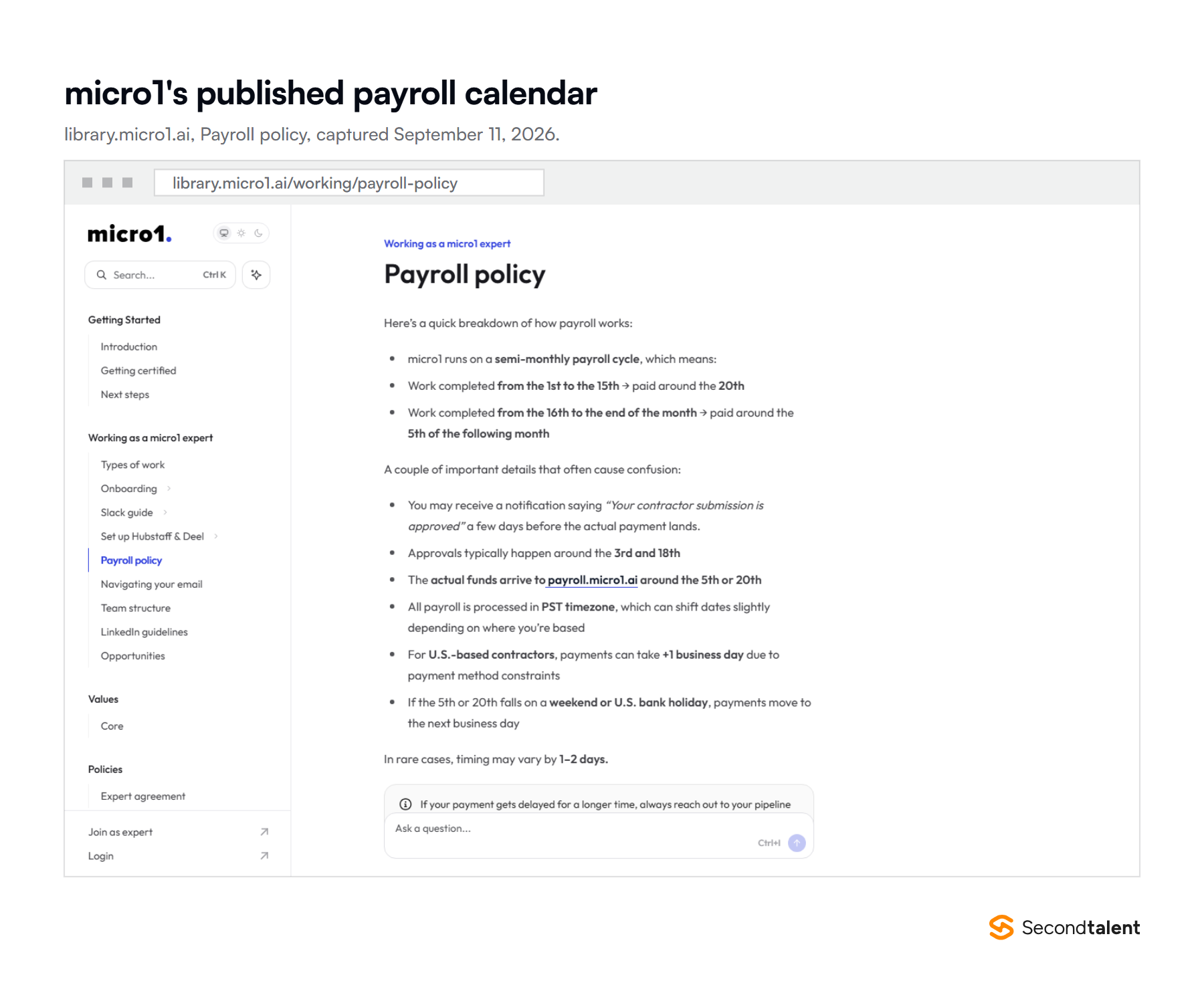
Two checks come with onboarding. You complete KYC identity verification inside Deel, and payments cannot be processed until it clears. You also get a background check from KarmaCheck, which the onboarding FAQ calls legitimate and mandatory.
US contractors find their Form 1099-NEC in Deel. That form matters because the relationship is contracting, not employment, and the expert agreement spells out what that means:
You also pay your own taxes and insurance, and the work product you create belongs to micro1. The agreement bars anyone currently employed by a foundation model company. The library adds one warning worth reading before you apply:
“Roles at micro1 are contracted and will continue as long as the client has work to be completed.”
micro1 contractor library, Understanding your expert agreement
When a pipeline closes, micro1 says it tries to move experts onto a similar one, if one exists, and to contact them when new work opens.
What Micro1 Reviews Say
On Trustpilot, micro1 scores 4.7 from 10,141 reviews, 9,829 of them posted in the last 12 months. micro1 claimed the profile in May 2023, pays for a Trustpilot subscription, and invites people to review it, according to the profile page.
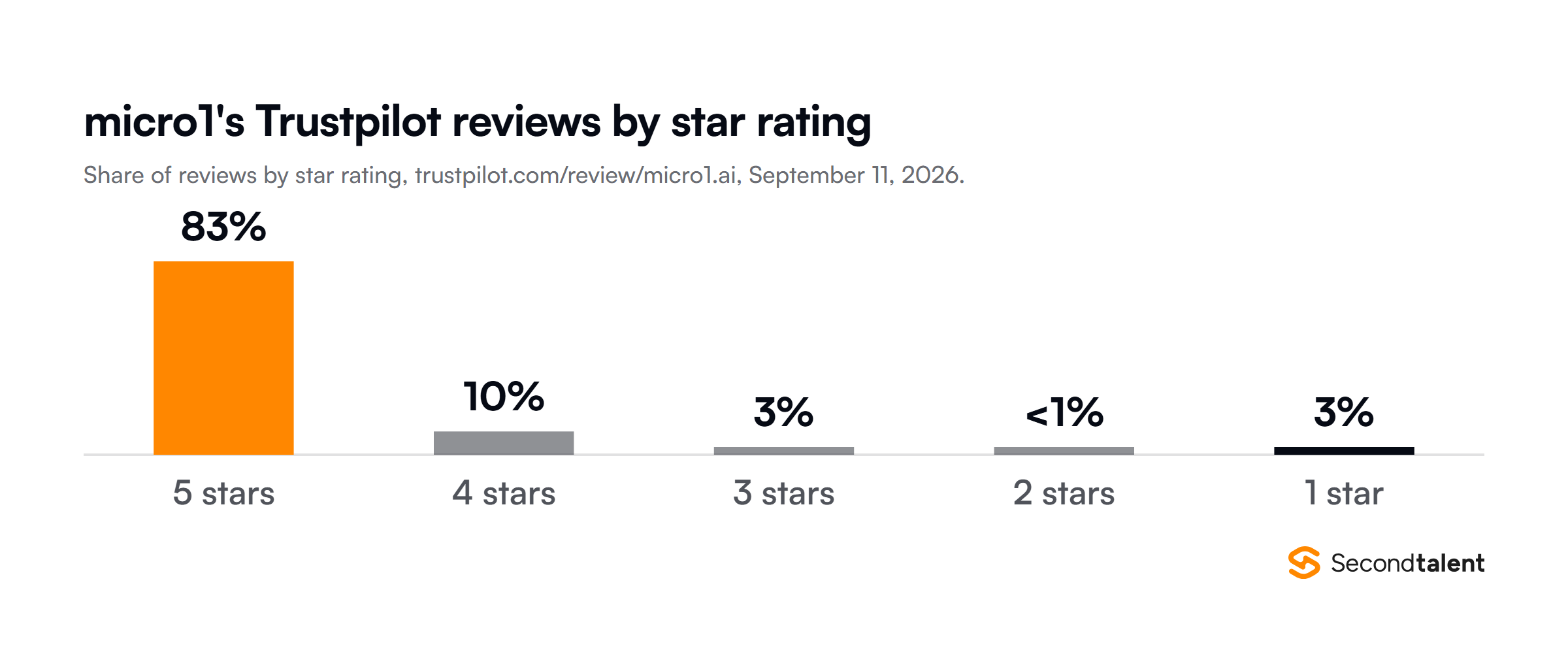
Read what the reviews describe as well as the score.
Trustpilot’s own summary says reviewers praise the interview process, and the newest 5-star reviews describe the Zara interview itself, written before any paid work. micro1 has not replied to its negative reviews.
- A smooth, well-structured AI interview
- Clear questions and quick responses
- Professional support and helpful staff
- An interviewer that lags, reconnects or cuts people off
- “Not Qualified” results with no feedback
- Suspicion that interviews are a way to collect free data
For the paid work itself, contractor reviews on Glassdoor and the micro1 subreddit sit closer to the source than Trustpilot, since their authors have held a contract.
How to Spot a Fake Micro1 Message
micro1’s experts FAQ names three email domains, @micro1.ai, @micro1.io and @micro1.co, and nothing else. A recruiter writing from any other address, or only on a chat app, is not micro1.
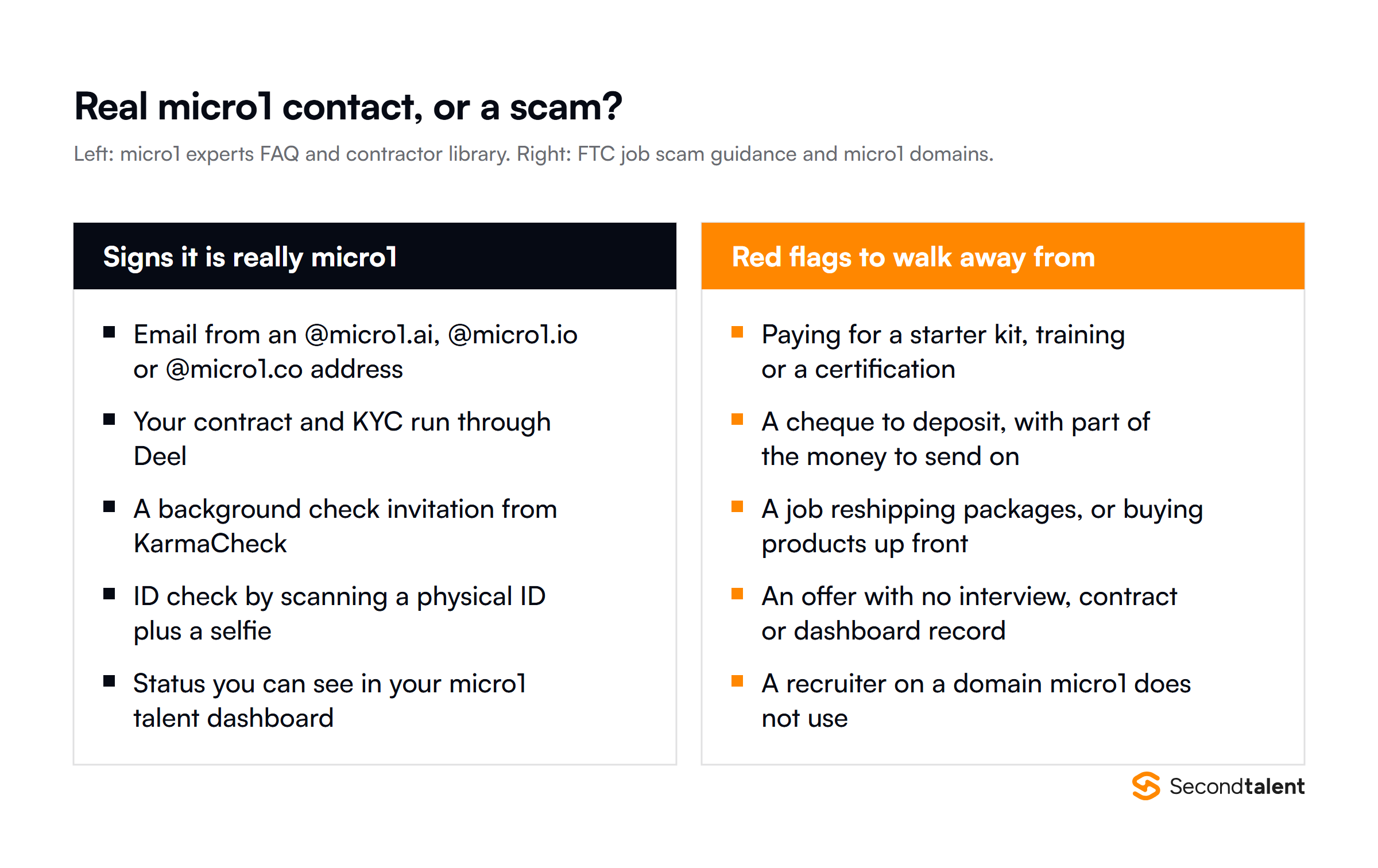
The right-hand column comes from the FTC’s job scam guidance, which warns about paying for starter kits or training and about cheques you are told to deposit and partly send back.
If a message looks off, check your micro1 talent dashboard or write to support@micro1.ai before you reply.
Hiring AI Trainers, or Looking for the Work?
If you are building an evaluation or data team, we recruit AI model training specialists and domain experts across Asia and match senior candidates within 24 hours.
Browse our AI training specialist roles, or tell us the role and we will send vetted profiles.
FAQs
Is micro1 the same company as Mercor?
No. They are rivals running the same model. TechCrunch put Mercor at $2 billion in gross annualized revenue in summer 2026, four times micro1’s figure. Our Mercor alternatives page compares the field.
Can I work for micro1 from the Philippines or India?
Yes. Neither country is on micro1’s list of excluded locations, and pay is in US dollars through Deel wherever you live.
Does micro1 charge applicants anything?
None of the steps micro1 publishes, from the interview to Deel onboarding, asks the applicant to pay. Treat any request for money as a scam, in line with the FTC’s guidance.