TL;DR: Companies are using AI to cut costs in three ways in 2026: handing support and back-office work to software, cutting staff to pay for AI spending, and paying outsourcing vendors less. US employers named AI in 116,175 announced job cuts from January to August, about 22% of the total.
On May 19, Standard Chartered told investors it would cut 7,800 or more jobs by 2030 from corporate functions run out of hubs such as Bengaluru, Chennai, Kuala Lumpur and Warsaw. Chief executive Bill Winters described the plan as replacing “lower-value human capital” with investment, then apologised for the phrase within a week. Two weeks after the investor event, Uber capped what each employee could spend on AI coding tools, having used up its 2026 budget for them in four months.
- 1Meta said its 8,000 job cuts would help it “offset the other investments we’re making”.
- 2Hiring less is doing more of the cutting than layoffs: New York Fed surveys found service firms using AI were almost four times as likely to hire fewer workers as to lay any off.
- 3Outsourcers feel it first. HCLTech’s chief executive says a $100 million services deal is “maybe $80 million” today.
- 4Gartner predicts half of the companies that cut customer service staff because of AI will rehire by 2027, under different job titles.
1. Companies Cut Staff to Pay for AI
Several of the biggest job cuts of 2026 pay for AI rather than use it. Meta’s chief people officer, Janelle Gale, told staff in April that about 8,000 layoffs, roughly 10% of the company, were “to allow us to offset the other investments we’re making,” NBC News reported. Meta also closed 6,000 open roles. Its second-quarter results booked $1.18 billion of severance for the May cuts.
Atlassian was blunter. Its March cut of about 1,600 jobs, 10% of staff, was “to self-fund further investment in AI and enterprise sales,” according to CNBC. Intuit cut about 3,000 in May to refocus on AI, and Cisco cut fewer than 4,000 on the same day it reported record revenue.
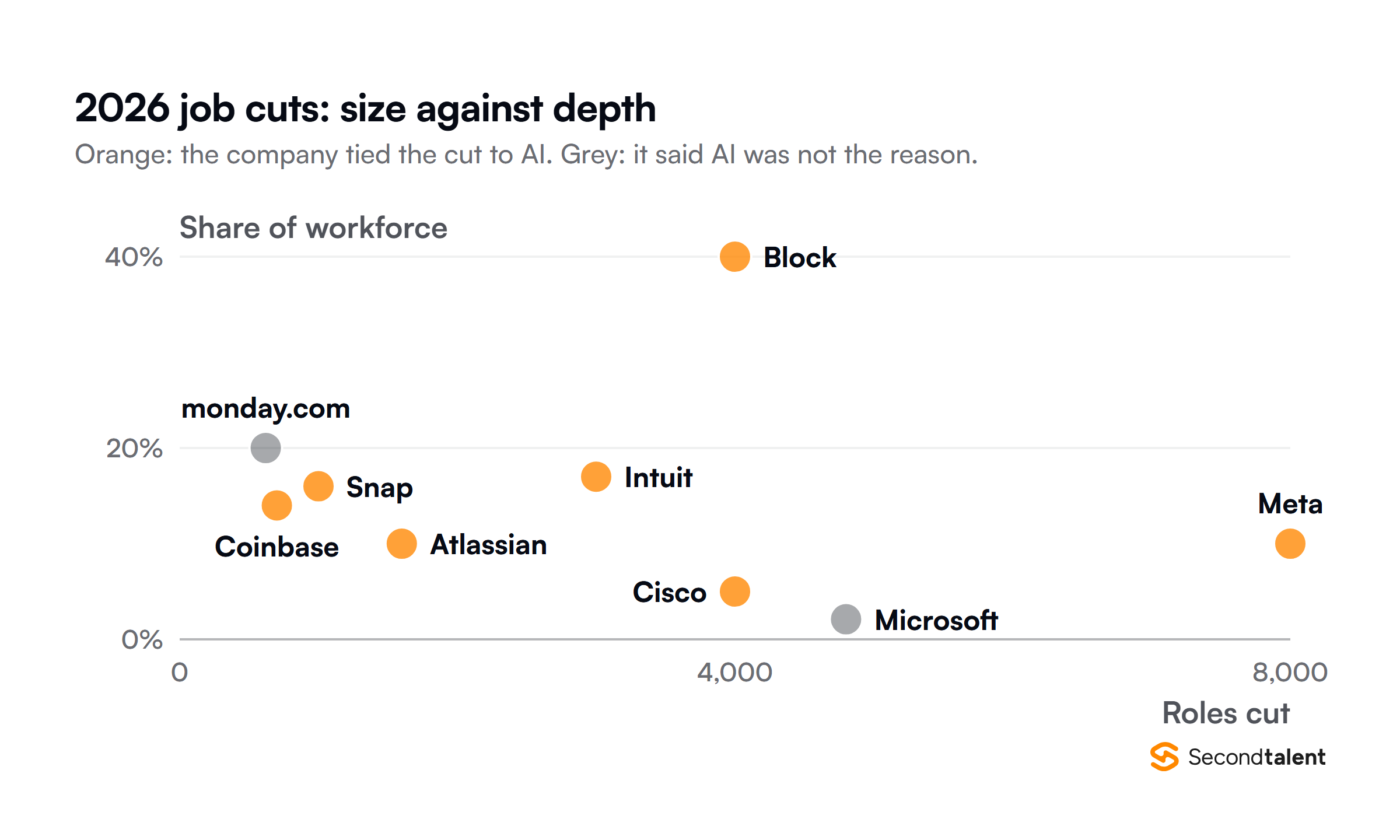
Block cut the deepest. Jack Dorsey’s February letter cut more than 4,000 employees and left the company with just under 6,000. Microsoft’s July cut of around 4,800 was 2.1% of its staff, and the company said AI was not replacing those roles.
Meta’s severance bill is small next to what the largest spenders now plan for data centres. All three companies set out these figures with their July 2026 earnings.
2. AI Takes Over Support and Back-Office Work
Customer support is where AI cost cutting has the longest record. Marc Benioff said on a September 2025 podcast that Salesforce had “reduced it from 9,000 heads to about 5,000, because I need less heads,” and a company spokesperson put the fall in support costs at 17%, Fortune reported. By April 2026 Salesforce was claiming $100 million in annualised support savings.
IBM runs its own business as “client zero” for its AI products. Arvind Krishna told analysts in January that IBM left 2025 with $4.5 billion of annual run-rate savings and expects $5.5 billion by the end of 2026. Those figures come from the earnings call, not the results release. Krishna had said months earlier that AI replaced several hundred HR roles, but that IBM’s total employment had gone up.
Banks are moving operations the same way. JPMorgan’s consumer chief, Marianne Lake, told its 2025 investor day that operations headcount would “trend down by about 10% over the next five years or so.” In July, Jamie Dimon gave a sharper figure:
“We have had discrete areas where we did reduce jobs by 30% or 40%. And most of those people were offered jobs elsewhere.”
Jamie Dimon, JPMorgan second-quarter 2026 earnings call, July 14, 2026
Middle management is the other named target. Cloudflare cut more than 1,100 employees in May, and Matthew Prince later said most were “measurers”: managers, finance, legal and internal audit. Coinbase cut about 14% of its staff two days earlier, with Brian Armstrong writing that it needed “AI at our core.”
Oracle went furthest in writing. Its annual report tells investors that “the adoption and deployment of AI technologies across our operations have resulted, and may continue to result, in reductions to our workforce.”
3. Hiring Freezes Do More Than Layoffs
Walmart has not laid off its way to AI savings. Doug McMillon told the Wall Street Journal last September that its global headcount of 2.1 million would stay flat for three years, CNBC reported. Bank of America and Wells Fargo are shrinking through attrition, and Salesforce stopped backfilling support roles as they emptied.
Survey data points the same way. The New York Fed’s August 2026 regional surveys found AI use among service firms jumped to 61%, but only 4% of those users laid anyone off because of it. About 15% hired fewer employees than they would have without AI, and 13% hired more.
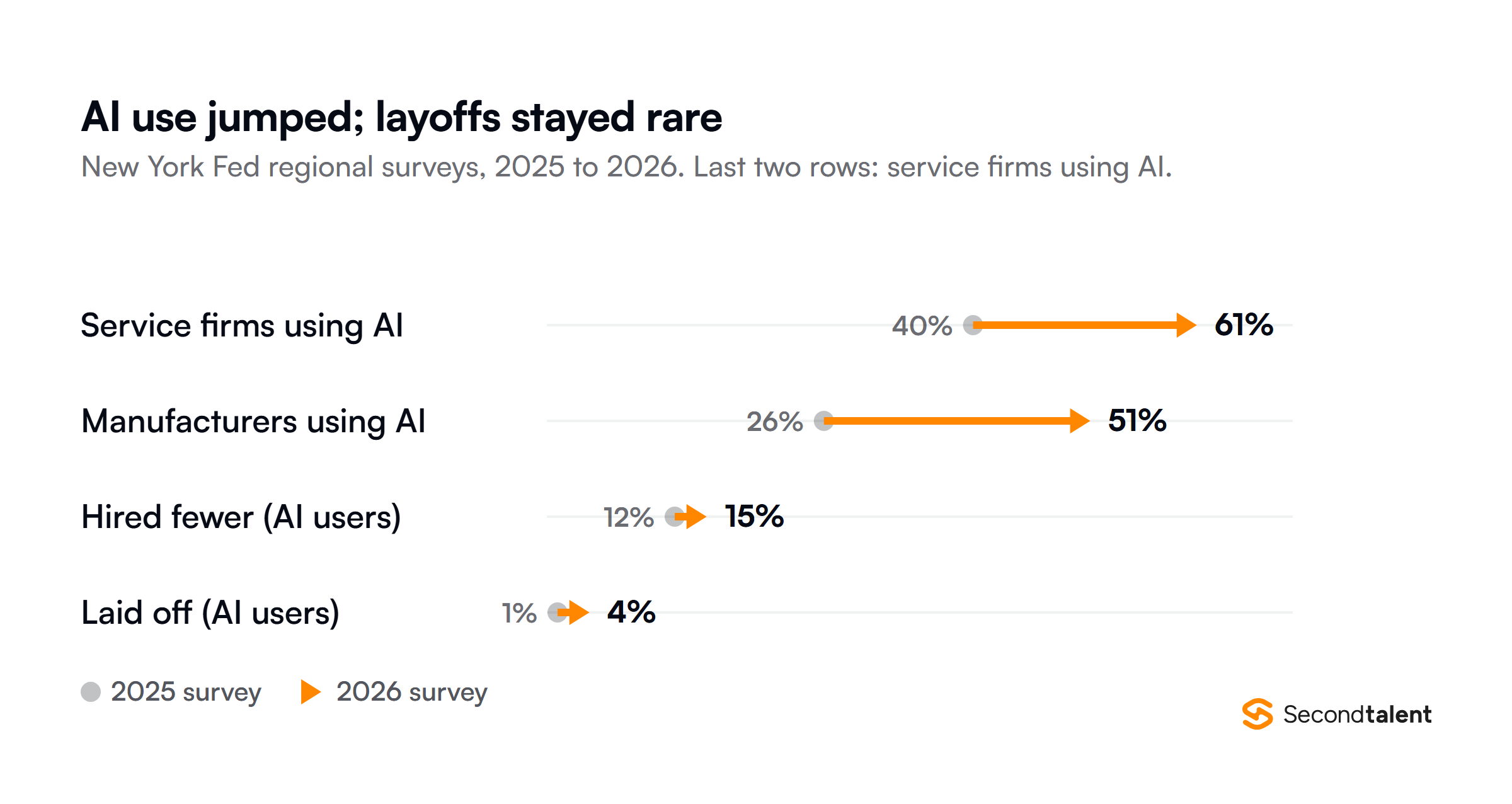
More than a third of those service firms retrained staff instead. The gap shows up at the entry level. Stanford’s Digital Economy Lab, working from ADP payroll records to June 2026, puts employment of 22 to 25 year olds in the most AI-exposed jobs about 19% below where it would be had it kept pace with less exposed peers. The researchers trace it to fewer hires, not more firings.
A role left unfilled costs no severance and does not show up in a layoff tracker. Our analysis of AI’s impact on the job market covers the demand side, and our enterprise AI adoption statistics track how many firms are past the pilot stage.
4. More Layoffs Get an AI Label, and More Companies Deny It
AI-cited job cuts in the US have more than doubled in eight months. Challenger, Gray & Christmas records the reason an employer gives for each announced cut, and in all of 2025 employers named AI in 54,836 of 1,206,374. In the August 2026 report, AI is the leading reason for the year so far, though it slipped to fourth in August alone with 3,462.
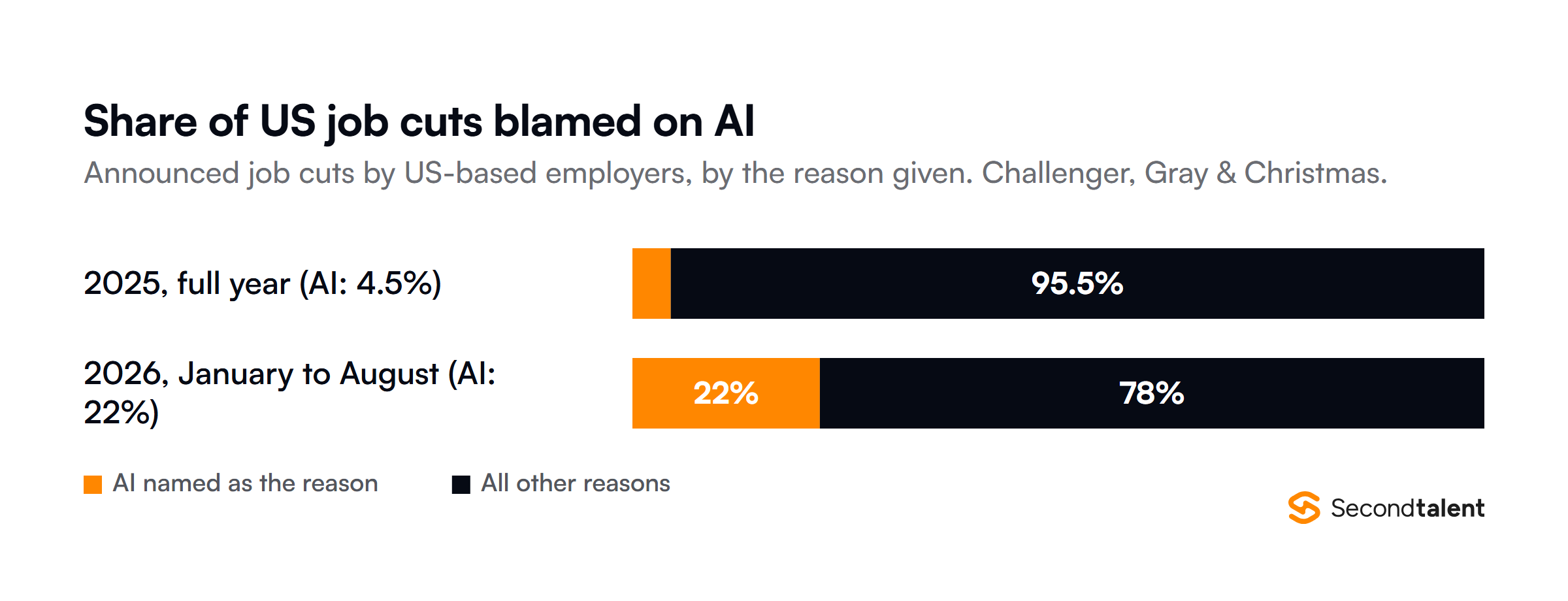
Oxford Economics doubts part of that rise. Its January note on the 2025 figures argued the AI-cited cuts were a small share of the total and added: “We suspect some firms are trying to dress up layoffs as a good news story.” A cut framed as AI efficiency reads better to investors than one framed as over-hiring or falling demand.
- Block, Feb: “a significantly smaller team, using the tools we’re building”
- Snap, Apr: 1,000 roles, citing “rapid advancements in artificial intelligence”
- Oracle, Jun: AI adoption named in its annual report
- Amazon, Oct 2025: “not even really AI-driven”
- Microsoft, Jul: roles “are not being replaced by AI”
- monday.com, Jul: “not made to reduce costs or replace people with AI”
The denials matter as much as the claims. Andy Jassy wrote in June 2025 that AI “will reduce our total corporate workforce,” then told analysts in October that the 14,000 corporate cuts announced that month were “not even really AI-driven. Really, it’s culture.” Uber’s September 2 memo cutting about 10% of staff does not mention AI at all. Our tech layoffs statistics break down how each tracker decides what counts as an AI layoff.
5. Outsourcing Vendors Take the First Cut
Before companies cut their own employees, they cut what they pay outside firms. MIT NANDA’s 2025 GenAI Divide research found that the measurable savings from enterprise AI came mostly from ended BPO contracts and lower agency fees. Klarna gave an early example in 2024, cutting its marketing agency spend by 25%.
Indian IT services firms now price that pressure into their guidance. HCLTech’s C Vijayakumar told Forbes India in May that a $100 million deal “would be much less today – maybe $80 million,” and HCLTech flagged 3% to 5% price deflation in its guidance for the year.
Wipro’s Srini Pallia said in July that clients’ savings from “cost optimization and vendor consolidation” were “getting reinvested by some of our clients into AI capabilities.” Cognizant is building “AI-infused rate cards” that include model inference costs.
Call centre operators are cutting forecasts too. Concentrix cut its 2026 earnings guidance in June and its shares fell 21.5% before the market opened. In the Philippines, the IT and business process association IBPAP cut its 2028 targets in July, citing faster AI adoption among other factors, BusinessWorld reported.
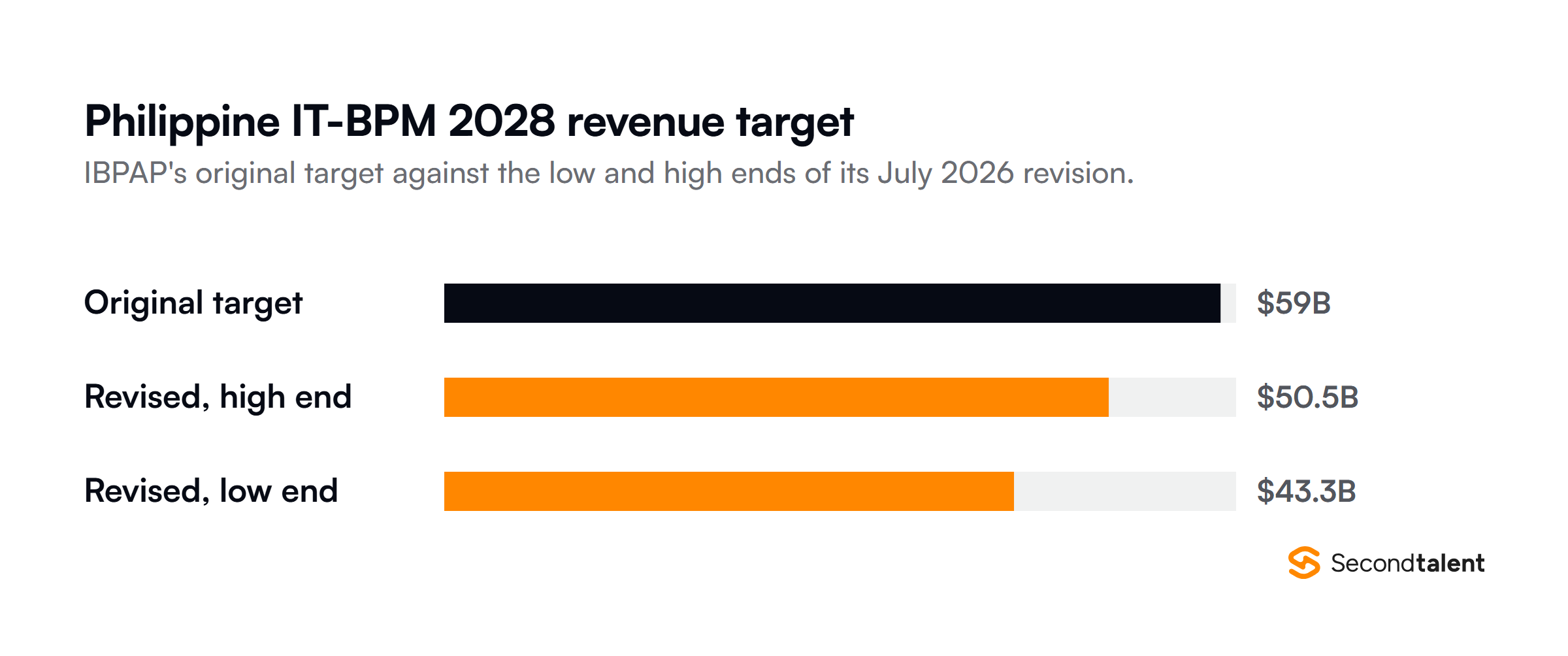
The headcount target fell with it, from 2.5 million full-time employees to between 1.85 million and 2.14 million. The work moving out of those contracts goes to AI, to smaller specialised teams, or both. Our list of AI outsourcing companies in the Philippines shows which local firms are moving into AI work, and our breakdown of AI workforce outsourcing shifts covers how buyers are rewriting contracts.
6. AI Bills Become a Cost Line of Their Own
Gartner forecasts worldwide AI spending of $2.59 trillion in 2026, up 47%. Inside companies, more of that bill now arrives as metered tokens, and the tool vendors have moved their pricing to match.
GitHub’s reason for the switch to usage billing was that “agentic usage is becoming the default, and it brings significantly higher compute and inference demands.” Uber’s cap, reported by TechCrunch, applies to Claude Code and Cursor. We compare what those two tools now cost in Cursor vs GitHub Copilot.
Finance teams have taken notice. The FinOps Foundation’s 2026 survey found 98% of its members’ teams now manage AI spend, up from 31% two years earlier, and that many organisations report “being asked to self-fund AI investments through efficiency gains.” In McKinsey’s 2026 survey, about 20% of respondents said AI operating costs, token costs included, constrained their AI use.
7. The Savings Come In Below Target
Most companies have not yet seen AI lower their costs. PwC’s January 2026 CEO survey asked 4,454 chief executives what AI had done to their company over the previous 12 months: 26% said it lowered costs, 22% said it raised them, and 30% saw more revenue.
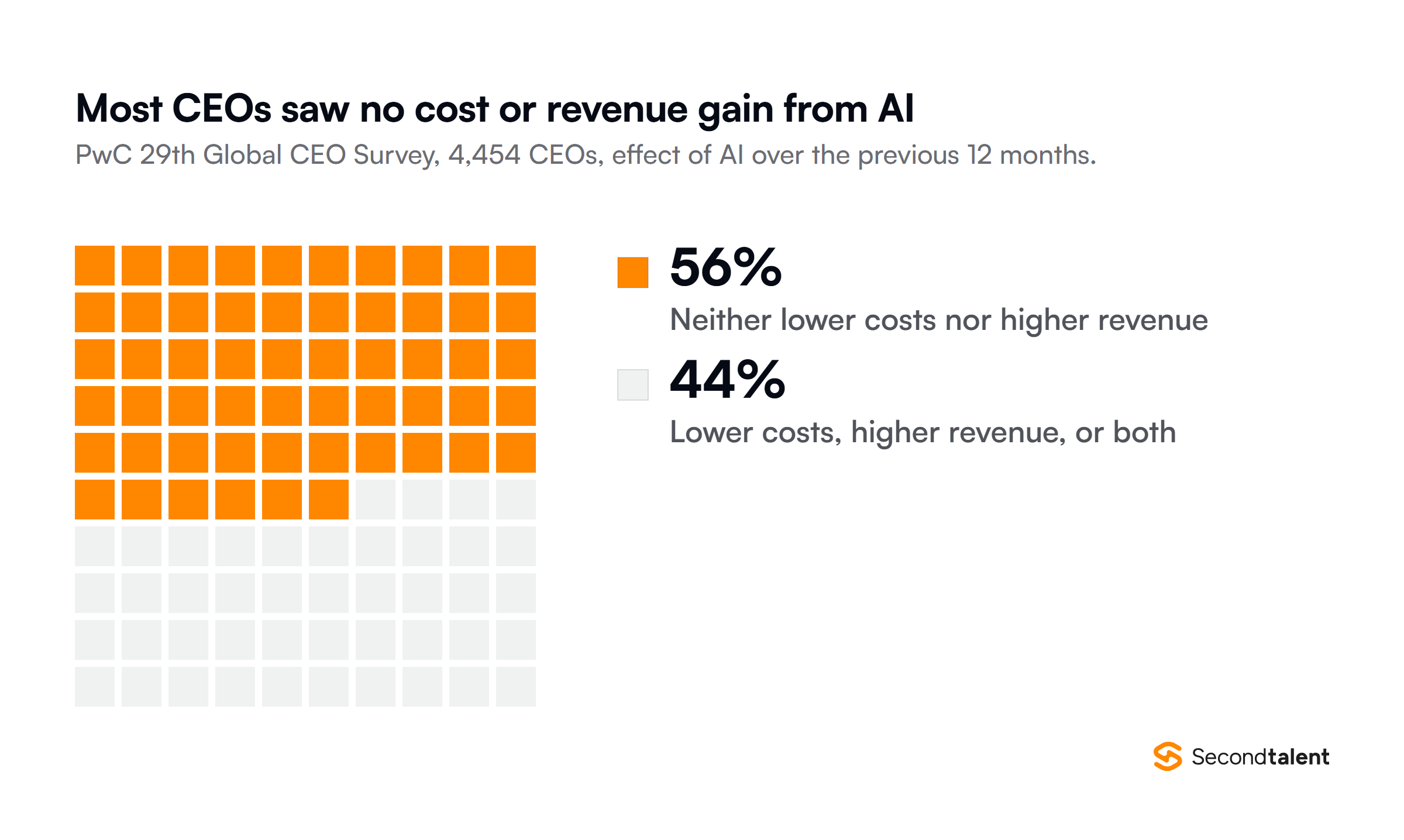
Bain’s June study of 951 companies shows the gap between plan and result. 37% targeted cost cuts of 11% to 20%, but nearly 40% of those that measured outcomes landed at 0% to 10%. KPMG’s second-quarter AI pulse found 49% of leaders had delayed or scaled back AI agent rollouts “when costs started outweighing benefits.”
“Workforce reductions may create budget room, but they do not create return.”
Helen Poitevin, Gartner, May 5, 2026
Some companies have already reversed their cuts. Commonwealth Bank of Australia reinstated 45 call centre roles in August 2025 after its voice bot pushed call volumes up, saying it “did not adequately consider all relevant business considerations,” ABC News reported. Klarna’s Sebastian Siemiatkowski said in May 2025 that cost had been “a too predominant evaluation factor,” leaving “lower quality,” and Klarna began hiring human agents again.
Gartner’s February survey of 321 service leaders found only 20% had cut agent staff because of AI. Forrester expects half of AI-attributed layoffs to be “quietly reversed, with jobs returning offshore or at lower wages.” Our guide to how enterprises measure ROI on AI sets out the metrics finance teams use to tell the difference.
Cutting Costs Without Losing the Work
The work that survives an AI cost review still needs employees, and location changes what it costs. A mid-level freelance developer runs $85 to $135 an hour in the US on our 2026 US rate data, against $22 to $58 in the Philippines for the same work.
Second Talent matches you with pre-vetted senior engineers from nine Asian markets within 24 hours and employs them under employer of record, and 92% of the talent we place stays. Tell us the role you need to fill, or see how we hire developers in the Philippines.
FAQs
Which business functions report the most AI cost savings?
Supply chain management, service operations and manufacturing. Respondents to McKinsey’s State of AI 2026 named those three most often when reporting cost reductions from AI. Deloitte’s 2026 enterprise survey found 40% of leaders had reduced costs with AI so far, against 66% reporting productivity gains.
Do CFOs expect AI to reduce headcount in 2026?
Slightly. Executives in the Duke, Richmond Fed and Atlanta Fed CFO Survey expected AI to reduce aggregate employment by less than 0.4% in 2026. A Gartner survey of 142 CFOs found 42% expect some AI-driven headcount reduction in SG&A or support functions.
How many companies expect AI to cut jobs next year?
39% of McKinsey’s 2026 respondents expect AI to reduce their headcount in the coming year, while 43% expect little or no change. In the 2025 survey, 32% expected AI to reduce headcount over the following year; in 2026, 14% reported that it had.




![Singapore AI Companies Leading Southeast Asia. Top 10 Singapore AI Companies Leading Southeast Asia [2026], by Second Talent.](https://www.secondtalent.com/wp-content/uploads/2026/09/singapore-ai-companies-featured-v2-768x403.jpg)
![AI Recruiting Tools. Top 7 AI Recruiting Tools in 2026 [Tried & Tested], by Second Talent.](https://www.secondtalent.com/wp-content/uploads/2026/09/top-ai-recruiting-tools-featured-v2-768x403.jpg)