TL;DR: Outsourcing in 2026 is not just about lower headcount costs anymore. Five real shifts, each backed by 2026 data below, are already changing who companies hire for AI work, how they engage that talent, and where they source it from. A sixth, quieter shift: the EU compliance deadline everyone quoted for August 2026 just got pushed back.
“AI workforce outsourcing” used to mean one thing: sending routine work to a cheaper location. In 2026 it means something bigger. Companies are changing how they engage AI talent, what they demand from outsourcing vendors, and which AI roles they even hire for anymore.
This is for founders, hiring managers, and operations leads who outsource any part of their AI or engineering work and want the real 2026 data behind the change, not just the buzzwords. Here are the five shifts already reshaping the market.
1. AI Now Runs Inside Outsourcing Delivery, Not Just the Work Being Outsourced
Outsourcing vendors are now expected to run AI inside their own delivery process, not just staff a team that uses AI tools when asked.
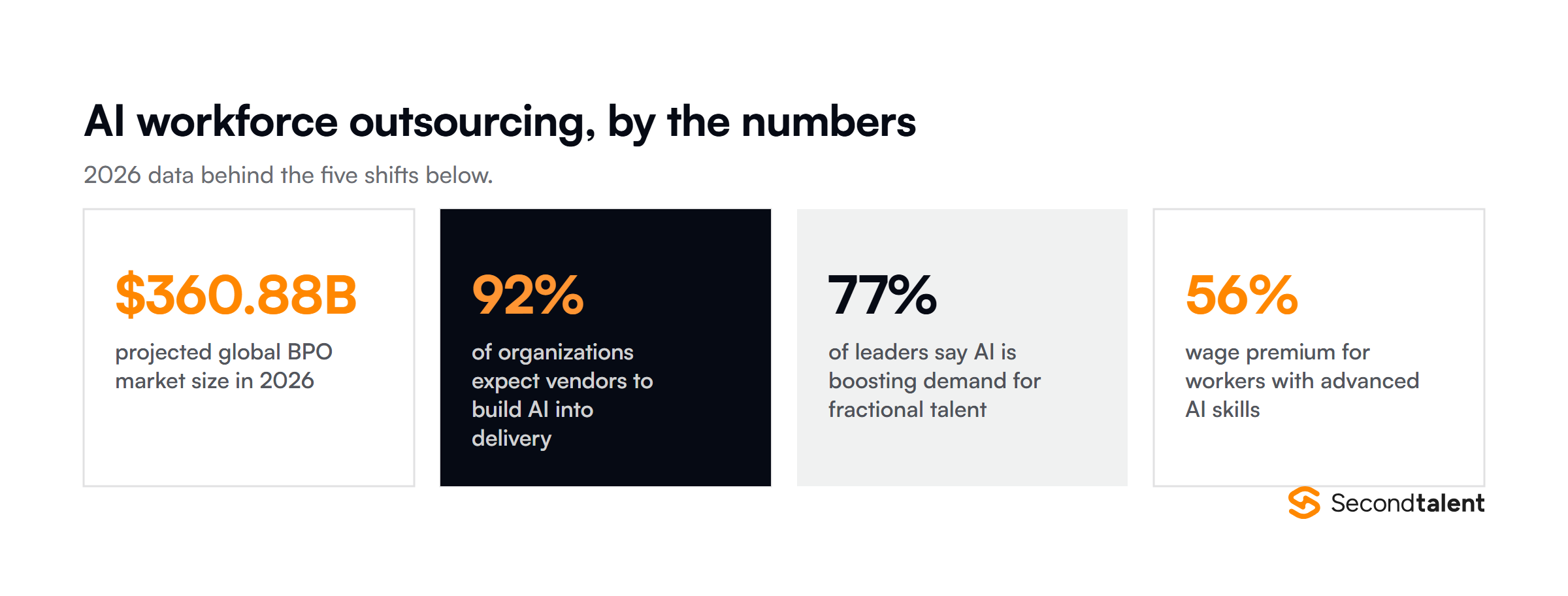
92% of organizations now expect their outsourcing vendors to build AI directly into service delivery. The market is growing to match: the global BPO market is on track to grow from $328.37 billion in 2025 to $360.88 billion in 2026, according to outsourcing market data for 2026.
For hiring teams, this changes vendor selection. Look for partners who already run AI-assisted workflows internally, not ones offering to bolt AI on after you ask for it. In practice that means asking a prospective vendor to show, not describe, how AI shows up in their own QA, project scoping, or code review process before you sign anything.
The gap between the two is not subtle once you look for it. A vendor running AI-assisted code review and test generation internally can usually quote a faster turnaround on the same scope of work, because their own delivery pipeline is doing part of the job before a human touches it.
A vendor still running a fully manual QA process against that same scope is quoting last year’s timeline on this year’s expectations, no matter how competitive the headline rate looks.
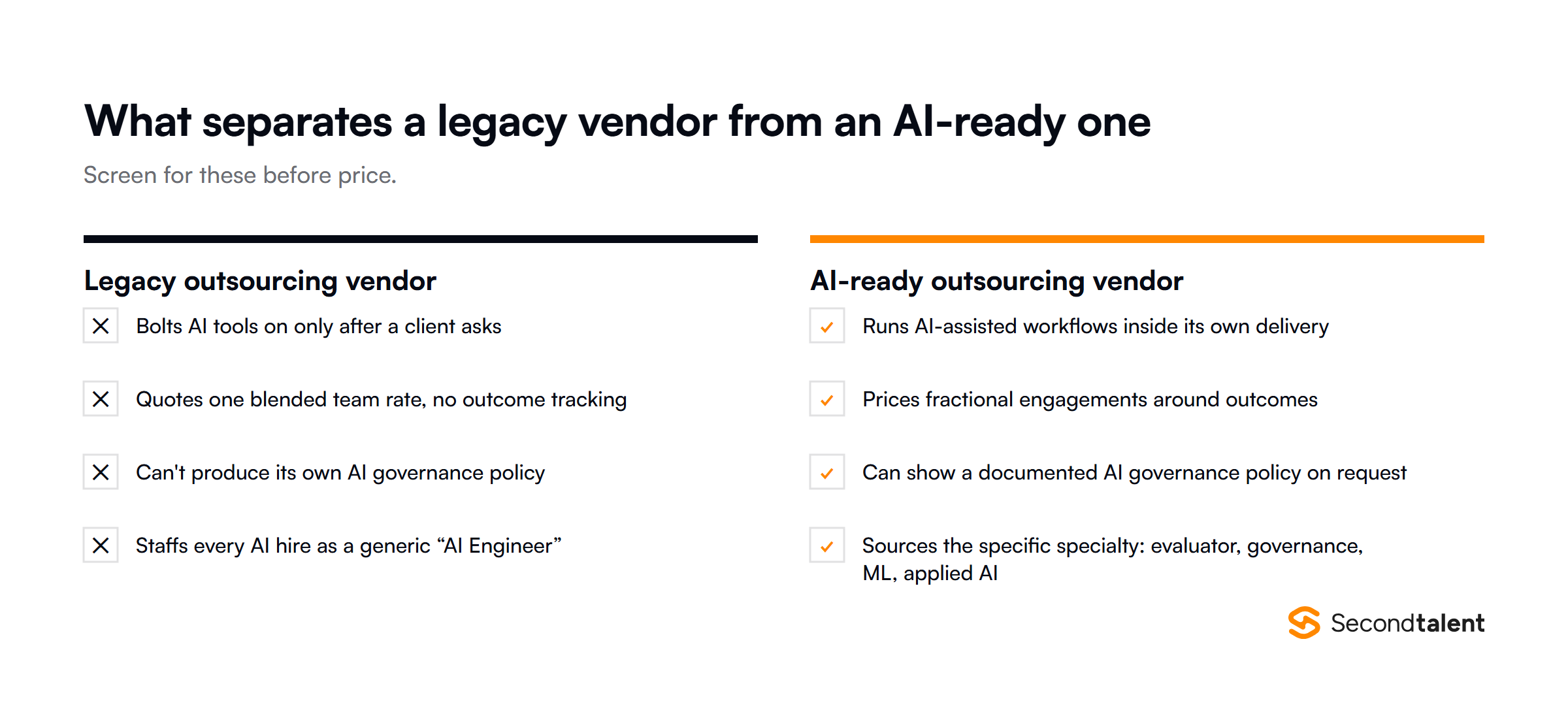
None of these four signals require taking a vendor’s word for it. Ask for a walkthrough of an actual project, a sample outcome-based statement of work, and their internal AI use policy, in that order, before the sales conversation moves to price.
2. Full-Time Hiring Is Giving Way to Fractional AI Engagements
Instead of hiring one full-time AI lead, more companies are bringing in fractional AI leadership and paying for outcomes instead of hours.
77% of business leaders say AI is boosting demand for specialized fractional talent, according to 2026 fractional hiring research. LinkedIn profiles mentioning fractional roles jumped from about 2,000 in 2022 to 110,000 in 2024, and Upwork logged a 109% year-over-year jump in demand for AI-related freelance skills in 2025.
The economics explain why. A full-time AI lead sits on payroll whether the roadmap needs deep model work that quarter or not. A fractional engagement scales down the moment the workload does, which matters more in 2026 than it did two years ago, now that AI tooling itself changes fast enough to make a rigid full-time org chart a liability rather than a stability play.
It is also why AI specialists increasingly get hired project by project instead of onboarded as full-time staff. It is cheaper to scale the engagement up and down as the work changes, and it sidesteps a full-time hire’s ramp time on a specialty that may look different again in six months.
Think of it as renting depth instead of buying headcount. A three-month fractional engagement to stand up a retrieval pipeline or fine-tune an evaluation harness gets the same expertise on the problem as a full-time senior hire, without the severance, benefits, or idle payroll cost once that specific piece of work is done. For a scope with a defined end date, that structural difference in cost usually outweighs whatever premium a fractional specialist charges per hour.
3. Compliance Posture Is Becoming a Vendor-Selection Filter, and the Timeline Just Moved
Outsourcing AI work does not outsource legal responsibility for it. That much has not changed. What did change, in mid-2026, is exactly when the EU AI Act’s toughest rules actually bite.
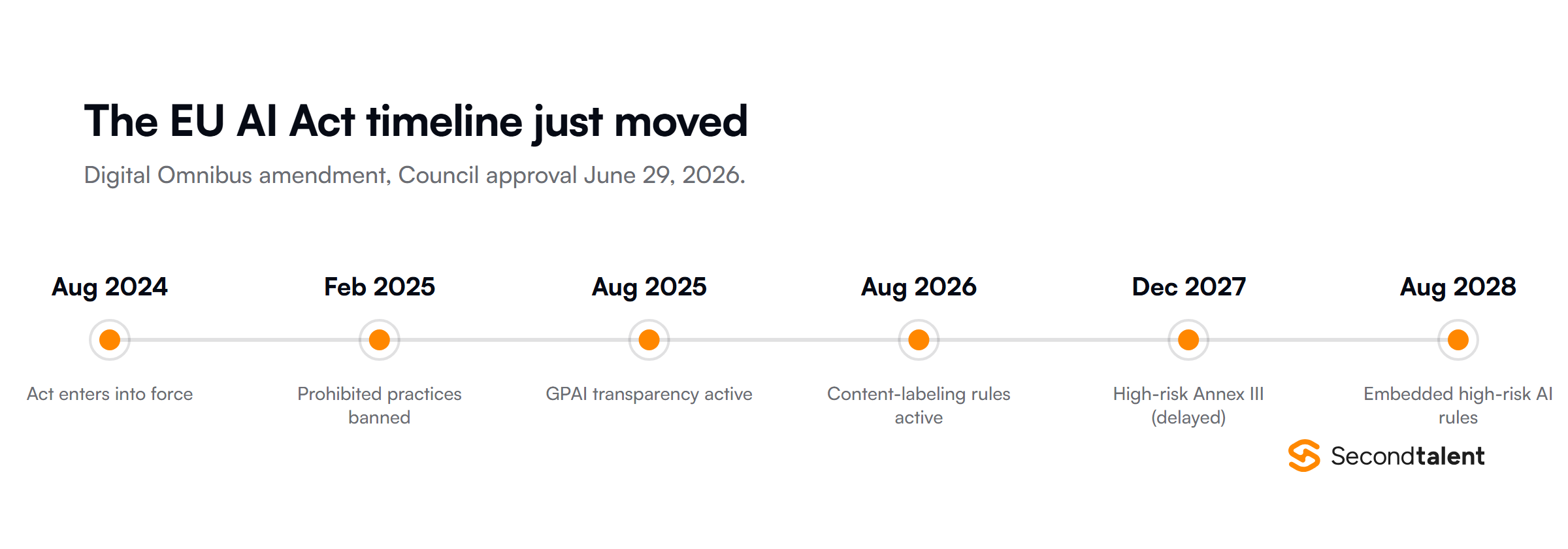
Prohibited AI practices and AI literacy obligations became active back in February 2025, and General-Purpose AI transparency rules followed in August 2025. Most coverage flagged August 2, 2026 as the date the Act’s high-risk system rules would kick in too. That is no longer accurate.
On June 29, 2026, the Council of the EU gave final approval to a Digital Omnibus amendment that pushes the high-risk obligations for standalone Annex III systems back sixteen months, to December 2, 2027, and to August 2, 2028 for AI embedded in already-regulated products, according to legal analysis of the Council’s approval. August 2, 2026 still matters, just for a narrower set of rules: chatbot disclosure, machine-readable marking of AI-generated content, and deepfake labeling were not postponed.
The accountability question is unchanged either way: the company placing an AI system on the EU market stays responsible even when a third-party vendor built or ran it, including staffing and outsourcing partners. An extra sixteen months is planning runway, not an exemption, and procurement teams that audit a vendor’s AI governance before signing are treating it that way.
A real audit does not need to be a legal review. Three questions cover most of the gap: does the vendor already log and document how their AI systems make decisions, who on their side owns AI risk if something goes wrong, and can they name which of your systems would fall under Annex III if built today. A vendor who cannot answer any of the three is not ready to absorb that risk on your behalf, regardless of what the contract says.
It is also why more companies route AI hiring through an Employer of Record instead of scattered contractors. One entity handles compliance, payroll, and worker classification instead of five different ones across five countries. See what an EOR actually costs before you budget for the next hire.
4. The Generic “AI Engineer” Role Is Fragmenting Into Specialized Functions
“Prompt engineer” as a standalone job title has mostly disappeared. It got folded into the broader AI Engineer role, according to a 2026 breakdown of AI job titles.
At the same time, more specialized functions underneath it are growing fast, and not just on the model-building side. Demand for human AI evaluators and trainers is growing 25% to 35% annually, work that a general AI Engineer or Machine Learning Engineer title does not fully cover.
Compliance-adjacent AI roles are growing even faster. Postings for AI governance roles are up 150% year over year and AI ethics roles are up 125%, according to 2026 AI governance hiring data citing LinkedIn’s Skills on the Rise report, against roughly 7% growth for tech job postings overall.
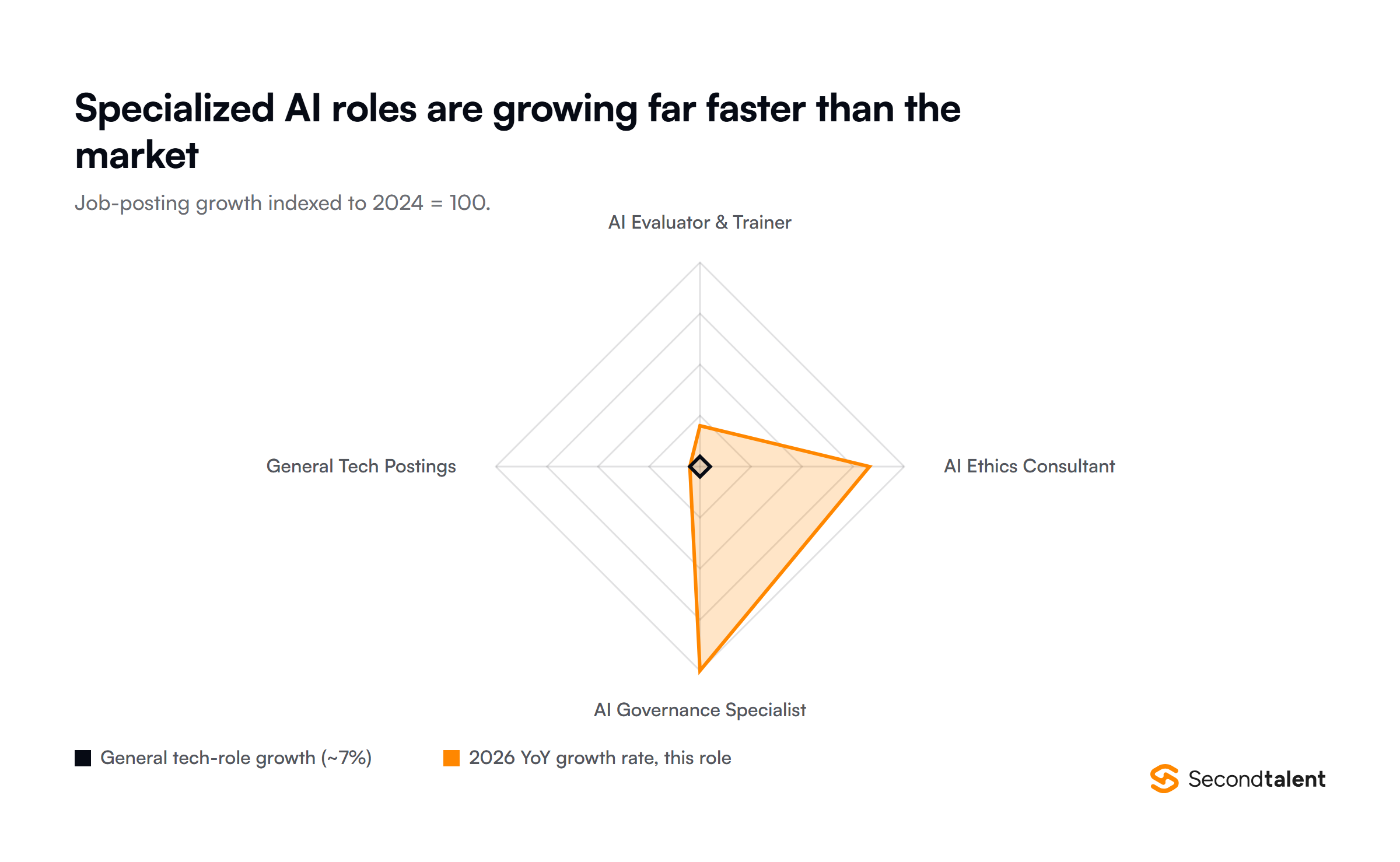
The lesson for hiring teams: a single “AI Engineer” job posting can no longer cover model training, evaluation, governance, and deployment at once. Write the role for the actual work, not the trendiest title, and expect to source evaluator, governance, and applied-AI talent as separately as you would source a backend engineer from a frontend one.
This shows up fastest in teams shipping an AI feature into a regulated market. The engineer who built the model, the evaluator who stress-tests its outputs, and the person who can document why it is or is not a high-risk system under Annex III are rarely the same hire anymore, and outsourcing partners that still offer one generalist to cover all three are the ones most likely to leave a governance gap nobody notices until an audit does.
5. The AI Skills Wage Premium Is Redirecting Sourcing
AI skills now carry a real price tag, and it is pushing sourcing decisions toward markets where that skill set is easier to find at a sustainable cost.
AI-related skills now appear in 2.5% of all US job postings, a 297% increase over the past decade, according to the Stanford HAI 2026 AI Index cited in 2026 AI workforce trend data. Workers with advanced AI skills earn 56% more than peers without them, per PwC’s analysis in the same report, and postings requiring AI skills grew 144% year over year as of April 2026, versus 7% overall job growth.
A 56% wage premium changes the sourcing math directly. Paying the domestic premium for one AI/ML engineer in a high-cost market can fund two to three vetted specialists with the same skill set sourced from a market where AI talent is abundant but the premium has not compounded onto every other cost of living and overhead.
This is the exact gap AI-native talent hubs across Asia are built to close: the same skill set, vetted and matched in as little as 24 hours, without paying the domestic wage premium on top. Combined with the compliance shift above, that also means sourcing decisions increasingly weigh a market’s AI talent depth alongside its AI regulatory posture, not cost alone: a hub that is both talent-rich and easy to run compliant hiring through wins the engagement even at a similar rate to one that only offers the first.
What the Five Shifts Add Up To
Put together, the five shifts point in the same direction. Outsourcing AI work in 2026 rewards vendors who already run on AI, pay for outcomes over headcount, take compliance seriously even as its timeline shifts, hire for the actual specialty, and source where AI-native talent is easiest to find.
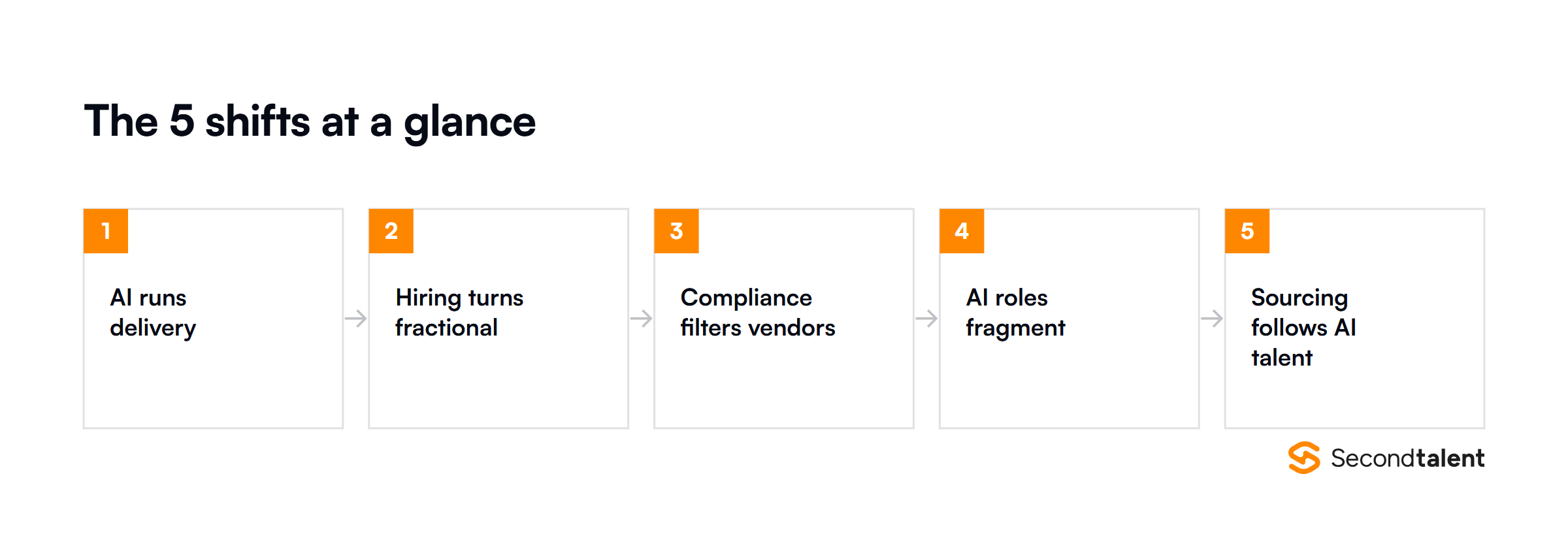
In practice, a team that acts on all five looks different from one that only chases the lowest headcount cost: it audits a vendor’s own AI workflow and governance policy before signing, structures the engagement around a deliverable instead of a headcount, and sources the specific AI specialty it actually needs from wherever that specialty is genuinely abundant, rather than wherever is simply the cheapest place to hire in general.
None of the five shifts are speculative. Each one is already visible in 2026 hiring and market data, not a prediction about where outsourcing is headed next year. Teams still budgeting and vetting vendors the way they did in 2023 are not wrong about the market getting cheaper in aggregate; they are just optimizing for a version of outsourcing that has already changed underneath them.
That is the same model Second Talent is built around: pre-vetted AI-native engineers, matched fast, with compliance handled instead of left to chance.
Hiring contractors rather than employees changes the arithmetic. The freelance developer rate index prices 14 roles across nine regions, benchmarked against North America and sourced from published wage data.

![Singapore AI Companies Leading Southeast Asia. Top 10 Singapore AI Companies Leading Southeast Asia [2026], by Second Talent.](https://www.secondtalent.com/wp-content/uploads/2026/09/singapore-ai-companies-featured-v2-768x403.jpg)