
In the 2025 Stack Overflow Developer Survey, 13.9 percent of respondents described themselves as an independent contractor, freelancer or self-employed. That is roughly one developer in seven, working for clients rather than for a single employer, and billing by the hour, the day or the project.
An independent contractor developer runs a one-person software business. The code is only part of the job. Contractors also price their own work, find and keep clients, pay their own taxes, and stay on the right side of worker classification rules that differ between the US, the UK and every other market they sell into.
What is an Independent Contractor Developer?
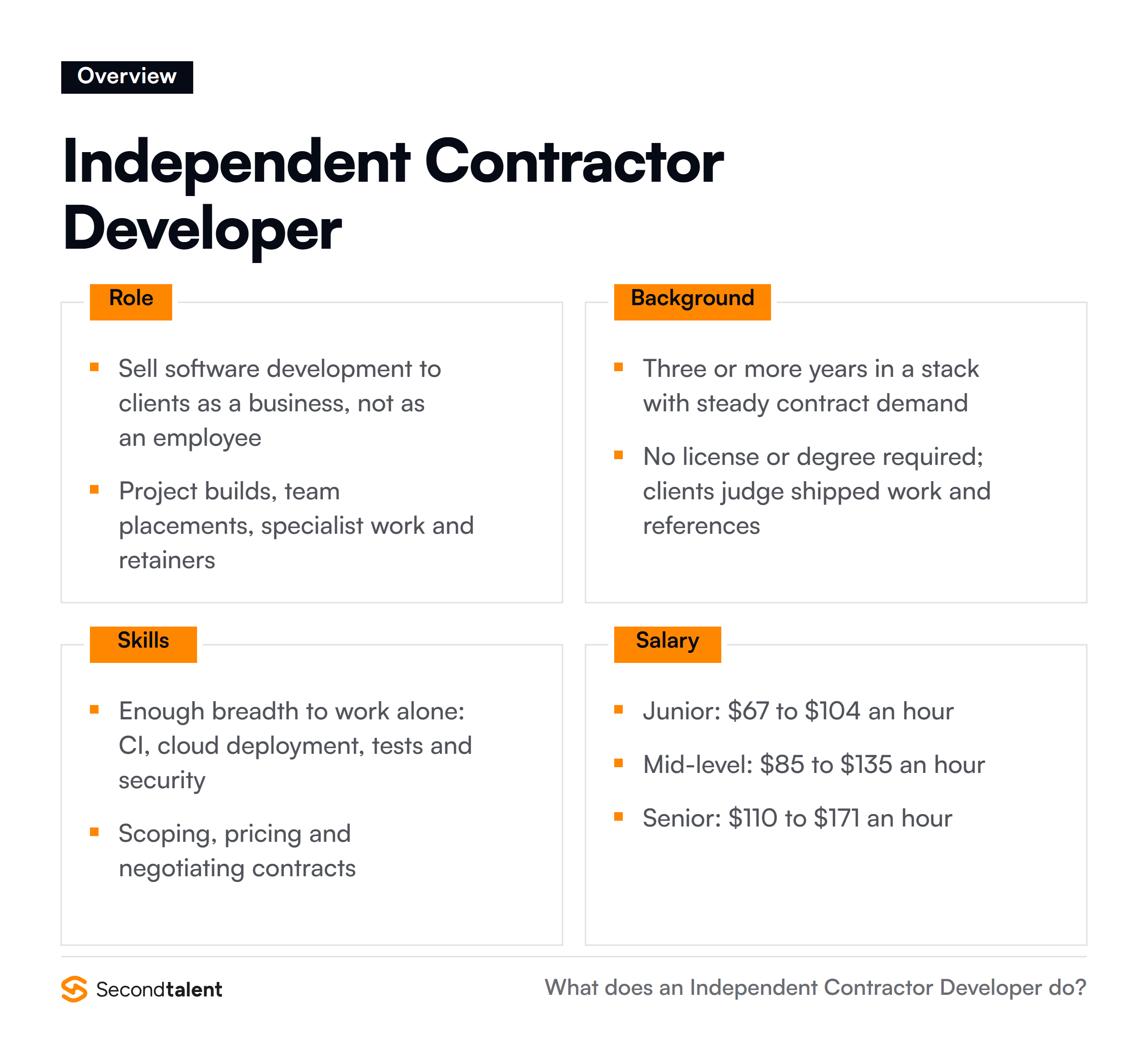
An independent contractor developer is a software engineer who sells development services to clients as a business, instead of working as a salaried employee. The contractor controls how the work gets done, uses their own equipment, sets their own rates and schedule, and usually works for more than one client over a year.
The title covers a wide range of engagements:
- Project builds: a fixed scope such as an MVP, a mobile app or a data migration, priced by milestone
- Staff augmentation: joining a client team for several months, usually billed hourly or daily
- Specialist work: short engagements a client does not hire for full time, such as a security review or an AI agent build
- Retainers: a set number of hours each month for maintenance on systems the contractor already knows
- Fractional technical leadership: a senior contractor acting as part-time tech lead for a startup
The work itself does not separate a contractor from an employee. The relationship does: who controls the work, who carries the financial risk, and whether it looks like a job or a business selling a service.
Independent Contractor Developer Job Market and Rates
Independent work is large and growing in the US. MBO Partners' 2026 State of Independence report counts a record 74.9 million Americans earning income independently, and almost 6 million of them earning more than $100,000 a year.
In the 2025 Stack Overflow Developer Survey, 69.8 percent of respondents were employed and 13.9 percent independent, and 32.4 percent worked fully remote.
US freelance rates for a back-end developer, from Second Talent's back-end developer cost guide (October 2026):
- Junior (1 to 3 years): $67 to $104 an hour
- Mid-level (3 to 6 years): $85 to $135 an hour, or $13,600 to $21,600 a month at 160 billable hours
- Senior (7 to 10 years): $110 to $171 an hour
For comparison, the US Bureau of Labor Statistics reports a median annual wage of $135,980 for software developers in May 2025. Contractor rates sit above employee hourly pay because the contractor covers their own tax, insurance, equipment, holidays and gaps between clients.
Mid-level rates by region for the same role are $50 to $80 an hour in Eastern Europe, $44 to $70 in Latin America, $37 to $59 in Southeast Asia and $19 to $30 in South Asia. On open marketplaces the spread is wider still: Upwork rates for back-end work run from $25 to $150 an hour. The agency vs freelance cost breakdown compares the channels.
Essential Skills and Qualifications
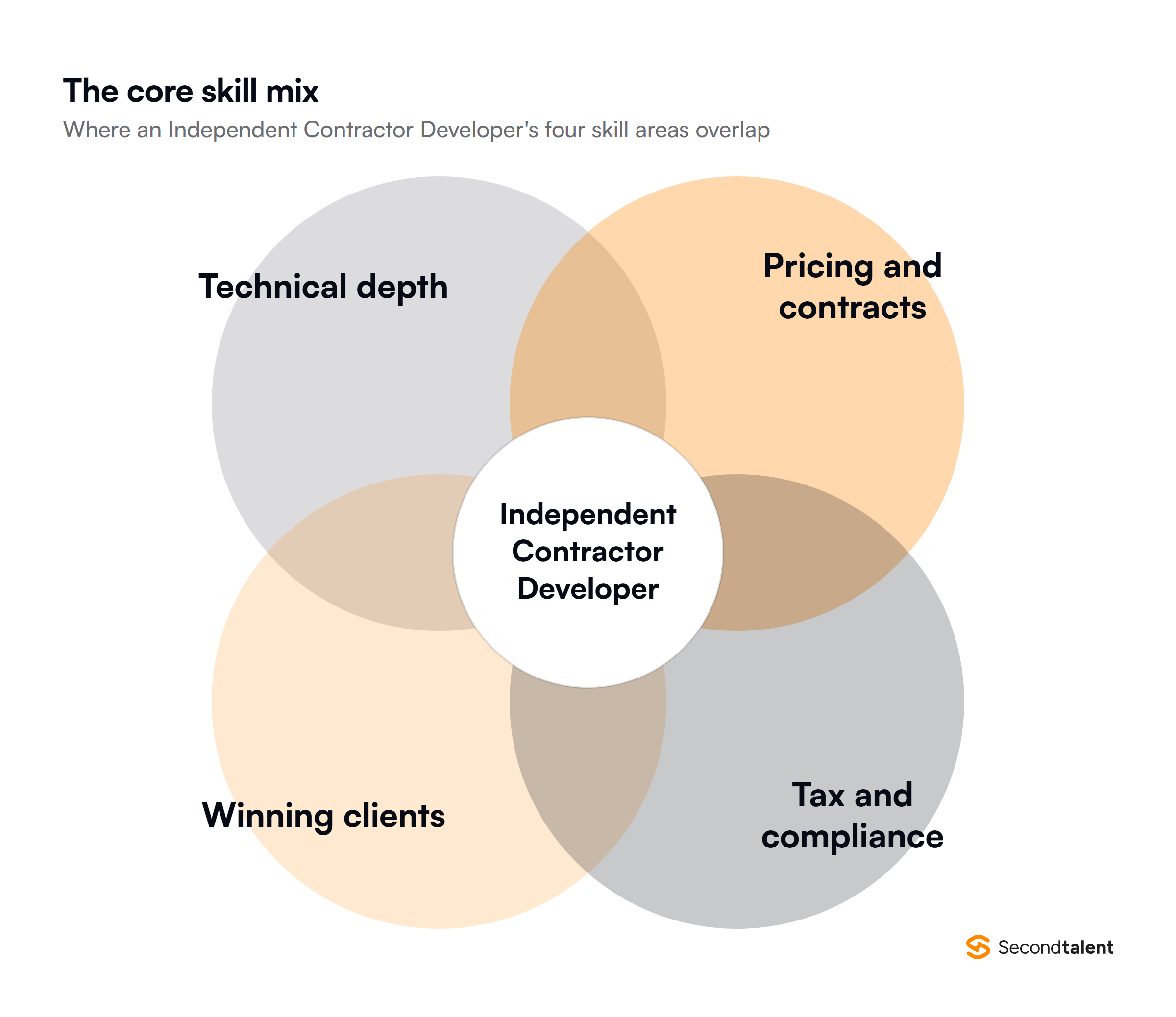
Technical Depth:
- Strong command of at least one production stack, such as TypeScript, Python, Go or Java, plus fluent use of AI coding assistants
- Enough breadth to work alone: CI, cloud deployment, tests and basic security without a platform team
- Fast ramp-up on unfamiliar codebases
Business Skills:
- Scoping and estimating work, then writing a proposal a non-technical buyer can approve
- Pricing: choosing between hourly, daily, fixed-fee and retainer models
- Written progress updates, and raising scope changes early with a cost attached
- Negotiating contracts, especially intellectual property, payment terms and termination, and setting money aside for tax
Qualifications: No license or degree is required to contract. Clients judge contractors on shipped work, references and how they handle the first call. A degree or cloud certification helps with enterprise buyers that screen on paper.
Career Paths and Progression
Common Routes In:
- From full-time engineering: usually after three or more years, often with a former employer as the first client
- From agencies: developers who learned client delivery at a dev shop
- From specialist roles: engineers in areas such as DevOps, integrations or AI, where companies often need short engagements
Progression Within Contracting:
- Marketplace freelancer: small jobs found on platforms, building reviews and a track record
- Direct contractor: repeat clients and referrals, with rates set by the contractor instead of the platform
- Specialist consultant: known for one niche, billing at the top of the market and turning work down
- Small studio owner: subcontracting to other developers on larger projects
Where It Leads: Some contractors return to full-time roles, often with a past client. Others move into fractional CTO work or client-facing roles such as forward deployed engineering.
Tools of the Trade
- Engineering: Git hosting inside the client's own organization, an AI-assisted editor such as VS Code, a JetBrains IDE or Cursor, and a personal cloud account for demos and test environments
- Time tracking and invoicing: hourly clients will ask to see logged time, and accounting software keeps tax set-asides visible
- Contract templates: scope, payment terms, intellectual property and termination agreed before work starts
- Access hygiene: a password manager and separate accounts per client, so access is removed cleanly when a contract ends
- Finding work: marketplaces and vetted networks, compared in this guide to freelance platforms for AI developers, plus a personal site with case studies
Contractor vs Employee: Classification and Compliance
The label in a contract does not decide whether a developer is a contractor. Tax authorities and courts look at how the relationship works in practice, and a client who gets it wrong can owe back taxes, penalties and benefits.
The IRS Common-Law Test
The IRS groups the evidence into three categories:
- Behavioral control: whether the company controls, or has the right to control, what the worker does and how they do it
- Financial control: whether the business side of the work, such as how the worker is paid, whether expenses are reimbursed and who provides tools and supplies, is controlled by the payer
- Type of relationship: written contracts, employee-type benefits such as a pension, insurance or vacation pay, and whether the work is a key part of the company's business
No set number of factors decides it. If status is unclear, either side can file Form SS-8 for an IRS determination, which may take at least six months.
No employer withholds tax for a contractor. Contractors with net earnings of $400 or more pay self-employment tax at 15.3 percent, made up of 12.4 percent for Social Security and 2.9 percent for Medicare, on top of income tax.
The Department of Labor Rule
Wage and hour law uses a separate test. The Department of Labor's 2024 independent contractor rule took effect on March 11, 2024. In May 2025 the Department said it would stop applying that rule's analysis in its own investigations, although, as Mayer Brown notes, the 2024 rule technically stays on the books until formally rescinded and can still be cited in private lawsuits.
On February 26, 2026, the Department proposed rescinding the 2024 rule and replacing it with an analysis close to its 2021 rule, in which a worker's control over the work and opportunity for profit or loss carry the most weight. The comment period closed on April 28, 2026. Until a final rule is published, clients face one standard in federal enforcement and another in private litigation.
States can be stricter. California applies the ABC test: a contractor must be free from the hiring entity's control, do work outside the usual course of its business, and be customarily engaged in an independent business of the same kind. A software company hiring a developer to build its core product will struggle with the second prong.
The UK: IR35 and the Off-Payroll Rules
In the UK, many contractors work through their own limited company. The off-payroll working rules, known as IR35, make sure a contractor who would be an employee if engaged directly pays broadly the same Income Tax and National Insurance as an employee. Since the rules changed from 6 April 2021, the client decides the contractor's status in most cases and must issue a status determination statement with its reasons. For small clients outside the public sector, the contractor's own company decides. If the rules apply, the fee payer deducts tax and National Insurance before paying.
Hiring Contractors Across Borders
Most countries ask the same question: is this a business selling a service, or an employee by another name? A developer who works full time for one foreign client for years, on that client's schedule and tools, can look like an employee under local law.
For companies hiring long-term developers in Asia, the cleaner option is to employ them properly through an Employer of Record. Second Talent runs EOR in 9 Asian markets through its own entities, so the developer is a local employee with statutory benefits and the misclassification question goes away. Teams that want one fixed price can use the all-inclusive Monthly plan on the pricing page: $4,999 a month for a senior engineer, with salary, payroll, EOR and equipment included. The EOR vs PEO vs contractor management guide sets out when each model fits.
Building a Portfolio and Winning Clients
Clients hiring a contractor are buying reduced risk, so a portfolio has to show similar work shipped recently without hand-holding.
- Write case studies, not screenshots: the problem, what you built, the stack and a result in numbers
- Pick a niche you can name in one line: "Shopify apps for subscription brands" wins more work than "full-stack developer"
- Collect references: a quote from a past client's engineering lead outweighs any badge
- Ask for referrals at the end of every good engagement: repeat clients and their referrals are the cheapest work to win
Pricing: Start from your annual income target, add self-employment tax, insurance, equipment and software, then divide by realistic billable hours. A full-time year is about 2,080 hours, and a contractor bills fewer than that once sales, admin and time between contracts are counted. Ask for a deposit on fixed-price work and invoice hourly work on a short cycle.
How to Become an Independent Contractor Developer
- Build three or more years of experience in a stack with steady contract demand
- Choose a niche and write a one-line description of the problem you solve and for whom
- Set up the business: a separate bank account, bookkeeping, a contract template, and an accountant's advice on entity type and quarterly tax
- Publish two or three case studies and a clear profile on the platforms your target clients use
- Land a first client through your network or a marketplace, deliver well, and ask for a reference and a referral
- Keep several months of expenses in cash before leaving a salaried job
Developers who want remote contract work without running the business side can join a talent platform. Second Talent places vetted developers from Asia with international companies on long-term engagements, at rates from $2,500 a month for mid-level engineers with 3+ years of experience and from $4,300 a month for seniors with 5+ years, with a senior median of about $4,600 a month.
Future of the Role
Demand for developers is not slowing. BLS projects 10 percent employment growth for software developers, quality assurance analysts and testers from 2025 to 2035, much faster than the average for all occupations.
Three shifts are shaping contract work:
- AI skills command the premium: clients who cannot hire AI engineers full time bring in contractors for agent builds, retrieval systems and model integrations
- AI tools raise output per developer: more output per billed hour favors fixed-price pricing over pure hourly billing
- Classification rules keep moving: the US Department of Labor rule is mid-revision and the UK puts status decisions on clients, which pushes long-term engagements toward an EOR or talent platform
The contractors who do best pair deep skill in one area with the habits of a small business: clear scope, a steady pipeline and careful contracts.
Frequently Asked Questions
What does an independent contractor developer do?
An independent contractor developer sells software development services to clients as a business rather than working as an employee. Typical work includes fixed-scope builds, multi-month team placements, specialist engagements and maintenance retainers, with the contractor setting their own rates and methods.
How much do independent contractor developers charge?
In the US, Second Talent's back-end developer cost guide puts freelance rates at $67 to $104 an hour for juniors, $85 to $135 for mid-level developers and $110 to $171 for seniors as of October 2026. Mid-level rates are lower in other regions, at $50 to $80 in Eastern Europe, $44 to $70 in Latin America and $37 to $59 in Southeast Asia.
How does the IRS decide if a developer is a contractor or an employee?
The IRS looks at three categories of evidence: behavioral control over how the work is done, financial control over the business side of the work, and the type of relationship, including contracts, benefits and whether the work is a key part of the business. No single factor decides it, and either side can file Form SS-8 for a ruling.
What taxes does an independent contractor developer pay in the US?
Contractors pay income tax plus self-employment tax of 15.3 percent, which is 12.4 percent for Social Security and 2.9 percent for Medicare, on net self-employment earnings of $400 or more. No client withholds these, so contractors set money aside and usually make quarterly estimated payments.
What is IR35?
IR35, or the off-payroll working rules, makes a UK contractor working through their own company pay broadly the same Income Tax and National Insurance as an employee when the engagement looks like employment. Since 6 April 2021, the client usually decides the contractor's status and issues a status determination statement, except for small clients outside the public sector.
What is the current US Department of Labor independent contractor rule?
The 2024 rule took effect on March 11, 2024. In May 2025 the Department stopped applying it in its own enforcement, and on February 26, 2026 it proposed rescinding and replacing it with a test that gives most weight to control and opportunity for profit or loss. The 2024 rule can still be cited in private lawsuits until it is rescinded.
Is it risky to hire overseas developers as contractors?
It can be when the engagement is long term and full time, because the developer may look like an employee under local law. Employing the developer through an Employer of Record removes that risk. Second Talent provides EOR in 9 Asian markets through its own entities and matches companies with vetted developers within 24 hours, with a 90-day, one-time replacement guarantee.
Related Roles
Explore related roles you can hire on Second Talent: API Developer, Integration Engineer, DevOps Engineer, AI Agent Developer, Forward Deployed Engineer, Platform Engineer.