Most programming languages optimize for productivity, popularity, or beginner-friendliness. OCaml optimizes for correctness. It is the language behind some of the world’s most demanding systems: the trading infrastructure at Jane Street, the Tezos blockchain, the Coq proof assistant, Meta’s static analyzers, and a long list of compilers and formal-verification tools that simply cannot afford to be wrong.
OCaml Developers are the engineers who choose this language on purpose. They use its powerful type system, pattern matching, and module system to build software where the correctness guarantees matter more than the speed of writing the first version. The demand for these engineers is small, specialized, and consistently well-compensated, because the work tends to live in the places where bugs are unusually expensive.
What is an OCaml Developer?
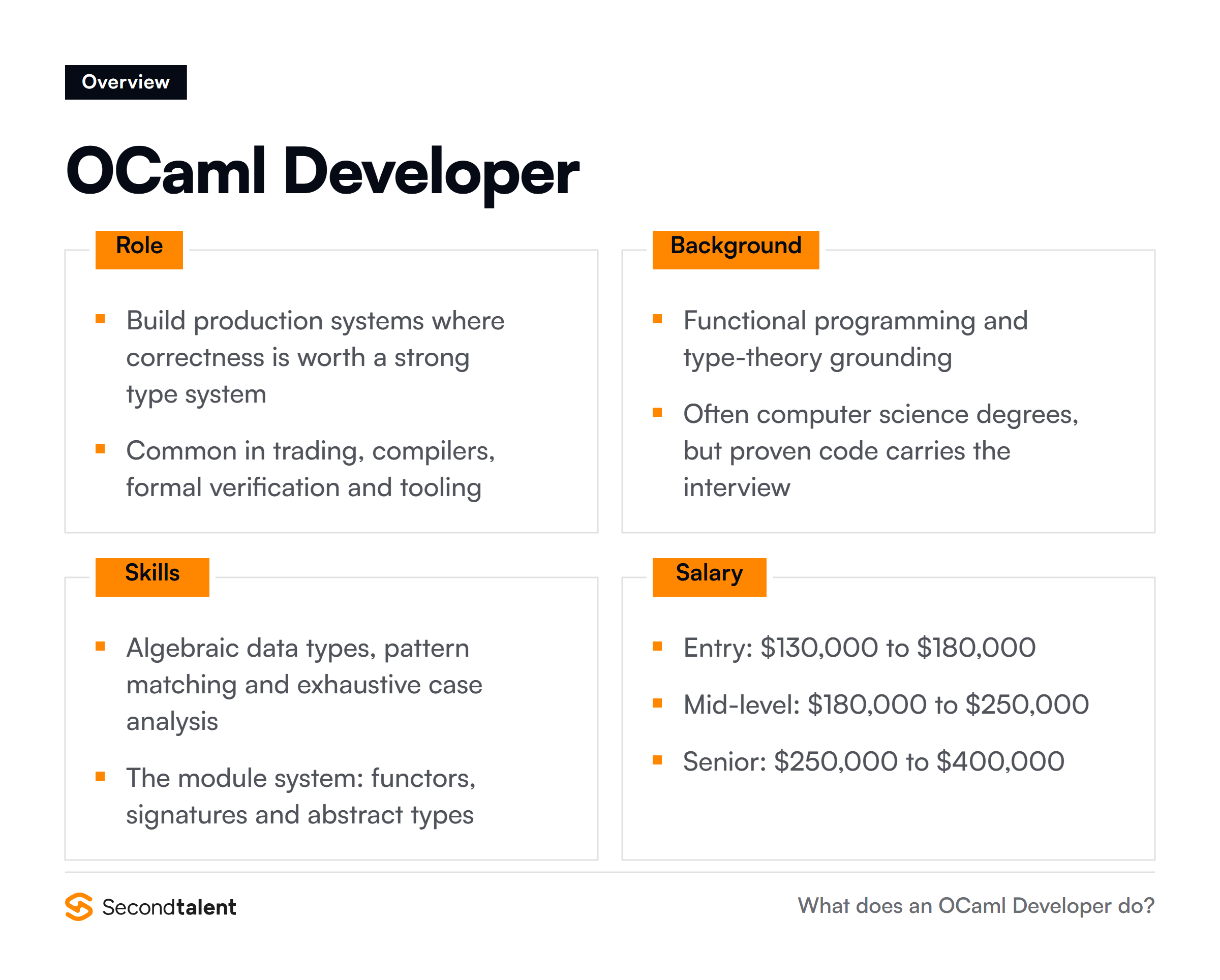
An OCaml Developer specializes in building production systems with OCaml, a statically-typed functional programming language with strong type inference, algebraic data types, and a sophisticated module system. The language has been in industrial use for over three decades and continues to power some of the most demanding software in finance, formal methods, and language tooling.
The role attracts engineers who care deeply about correctness, who enjoy thinking in types, and who appreciate the discipline of pattern matching across exhaustive cases. OCaml work tends to involve building compilers, interpreters, static analyzers, financial systems, blockchain protocols, and the internal tooling of organizations that have decided the upfront cost of a more rigorous language is worth paying.
OCaml Developer Job Market and Career Opportunities
OCaml occupies a small but resilient corner of the job market. The community is famously concentrated. Jane Street alone is one of the largest single employers, with hundreds of engineers writing OCaml every day. Meta uses OCaml internally for Flow, Hack, and Infer. The Tezos and MirageOS ecosystems run on it. Research institutions, formal-methods consultancies, and increasingly several developer-tooling startups round out the picture.
The market reality is that OCaml jobs are rarer than mainstream-language jobs, but the engineers who get them tend to stay for a long time and command unusually strong compensation, in large part because the screening bar is high and the supply of fluent OCaml engineers is structurally limited.
Average Salary Ranges (US-equivalent):
- Entry-level OCaml Developer: $130,000 – $180,000
- Mid-level OCaml Developer: $180,000 – $250,000
- Senior OCaml Developer: $250,000 – $400,000
- Principal OCaml Developer: $400,000 – $600,000+
The strongest demand sits in quantitative finance and trading, formal verification and static analysis tooling, compiler and programming-language work, blockchain protocol engineering (particularly Tezos), unikernel and systems research (MirageOS), and a growing set of developer-tools startups that have chosen OCaml for their core engine.
Essential OCaml Skills and Qualifications
Core Knowledge Areas:
- Algebraic data types, pattern matching, and exhaustive case analysis
- OCaml’s type inference, polymorphism, and the module system (functors, signatures, abstract types)
- GADTs and phantom types for additional static guarantees
- The OCaml object system and when not to use it
- Memory model, OCaml’s garbage collector, and performance tuning
- Concurrency models (Lwt, Async, OCaml 5 effect handlers, domains)
- Foreign function interface (FFI) for C interop
Technical Competencies:
- Hands-on fluency with the OCaml toolchain (opam, dune, utop, merlin)
- Experience writing nontrivial functorial code and abstract data types
- Comfort reading and writing parser combinators, type-directed code, and PPX preprocessors
- Working knowledge of Jane Street’s Core and Async libraries (or Lwt for non-Core teams)
- Familiarity with Menhir, OCamllex, and other parser-generator tools
- Strong general systems programming background, often including C, C++, or Rust
- Comfort with Git-based code review, particularly with the high standards typical of OCaml teams
Soft Skills:
- Patience for design discussions that prioritize type-level correctness
- Comfort with high code-review standards and the willingness to revise
- Curiosity about programming language theory and the why behind language features
- Clear technical writing for design docs and library documentation
OCaml Developer Career Paths and Specializations
The OCaml job market specializes by domain more than by seniority.
Quantitative Finance and Trading: Building order-management systems, market-data infrastructure, and analytics pipelines where correctness, latency, and a tight feedback loop between researchers and engineers matter. Jane Street is the flagship example, but the pattern recurs at several other quant firms and prop shops.
Compiler and Language Engineering: Working on the OCaml compiler itself, on adjacent compiler projects, or on language tooling like type-checkers, linters, and language servers.
Static Analysis and Formal Verification: Building tools that analyze, verify, or transform other software. Meta’s Infer, Facebook’s Flow and Hack, the Coq proof assistant, and the Frama-C platform all sit here.
Blockchain and Distributed Protocols: Tezos is the canonical OCaml blockchain project, with a substantial active developer base. Several other protocols use OCaml for parts of their stack where correctness arguments matter.
Systems and Unikernel Work: The MirageOS ecosystem and adjacent unikernel and embedded projects employ OCaml for systems-level work where the type system carries real safety value.
Developer Tools and Internal Platforms: Several developer-tools startups have chosen OCaml as the engine for build systems, code analyzers, refactoring tools, and infrastructure platforms.
OCaml Tools and Technologies
Core Toolchain:
- opam for package management and switch management
- dune for the build system, now the default across the ecosystem
- utop for the interactive top-level with syntax highlighting and completion
- merlin for editor integration with type-on-hover, jump-to-definition, and refactoring
- ocamlformat for consistent formatting across teams
Libraries and Frameworks:
- Jane Street’s Core and Core_kernel as a comprehensive standard-library alternative
- Lwt and Async for asynchronous concurrency
- Eio and the OCaml 5 effect-based concurrency story
- Mirage libraries for unikernel and protocol work
- Menhir for parsing
- Dream, Opium, Cohttp, and Httpaf for HTTP and web work
Editors and Development Environments:
- Visual Studio Code with the OCaml Platform extension
- Emacs with tuareg-mode and merlin
- Neovim with OCaml LSP and merlin integration
- Vim with vim-ocaml and merlin
Adjacent Ecosystems:
- The Coq proof assistant for formal verification
- The Tezos protocol stack
- Meta’s Hack, Flow, and Infer codebases
- The Frama-C analysis platform
Testing and Quality:
- Alcotest and OUnit for unit testing
- QCheck for property-based testing
- bisect_ppx for coverage
- Mdx for tested documentation
Building Your OCaml Developer Portfolio
OCaml hiring is unusually portfolio-friendly. The community is small, the open-source surface is visible, and code samples carry significant weight.
Project ideas that signal seriousness:
- A nontrivial interpreter or small compiler for a domain-specific language, with proper error handling and tested edge cases
- A library that uses the module system for something more interesting than namespacing, with functors that actually do work
- A parser combinator library or a Menhir-based parser for a real grammar, with property-based tests
- An Async or Lwt service that handles real concurrency in a production-shaped way
- A contribution to a recognizable OCaml project (the compiler, dune, Mirage, Tezos, or a popular library)
Open-source contributions are especially valuable in this community. The reviewers on major OCaml projects are some of the most rigorous code reviewers in any language, and a merged patch on a flagship project is a powerful credential.
OCaml Methodology and Best Practices
Make illegal states unrepresentable. The phrase is a community mantra for a reason. Use the type system to encode invariants directly, so that the compiler refuses to let your code reach states you do not want to handle.
Pattern match exhaustively. Treat the warning for non-exhaustive matches as a hard error. Add new variants to your sum types when the domain changes, then let the compiler tell you every site that needs to be updated.
Use the module system deliberately. Abstract types and signatures are not academic features. They are the mechanism for building libraries whose users cannot accidentally break invariants. Reach for them whenever a piece of state has rules.
Keep functors small and purposeful. A functor that parameterizes everything ends up parameterizing nothing useful. Functors shine when they capture a clear axis of variation, not when they exist for theoretical elegance.
Prefer composition over inheritance. OCaml has an object system, but most production OCaml code does fine without it. Records of functions, first-class modules, and plain functions usually compose more cleanly than objects.
Treat the type signature as the API. An OCaml type signature carries unusually rich information. Write the signature first, sketch the implementation second, and let the compiler check that they match.
Adopt the team’s library stack and concurrency model. The Core-and-Async universe is its own dialect. So is the standard-library-plus-Lwt dialect. Mixing them in one codebase is rarely worth the friction.
Future of OCaml Developer Careers
The OCaml job market is small, but several recent developments make it more interesting than it has been in years.
OCaml 5 introduced effect handlers and parallelism. The language now has structured-concurrency primitives that put it on a competitive footing with the modern crop of systems languages. Eio and the broader ecosystem are catching up quickly, and engineers fluent in the new concurrency story will have an outsized advantage as the rest of the community migrates.
Static analysis and formal methods are increasingly mainstream. Every large software organization is investing in tooling that catches bugs before they ship. OCaml is the language of choice for a large fraction of that tooling, and the demand for engineers who can build, extend, and maintain it continues to grow.
The Tezos and adjacent blockchain ecosystem keeps the protocol-engineering pipeline open. The protocol work tends to attract engineers who care about correctness, which keeps the talent pipeline healthy.
Industrial users continue to expand. Beyond the long-standing OCaml shops, several developer-tools startups have publicly chosen OCaml as their engine language. The hiring footprint of this segment is small but growing.
Getting Started as an OCaml Developer
Read Real World OCaml and work the exercises. The book by Yaron Minsky, Anil Madhavapeddy, and Jason Hickey is the canonical entry point. It uses the Core library set, which mirrors the dialect at Jane Street and several other shops.
Set up the standard toolchain. opam, dune, merlin, ocamlformat, and your editor of choice. Get the inner loop fast and pleasant before anything else. The OCaml developer experience is much better than its reputation suggests once the tooling is in place.
Ship one small interpreter or compiler. The exercise of building a parser, type checker, and evaluator for a small language is the fastest way to internalize the language’s strengths.
Contribute to an open-source OCaml project. Pick one with active reviewers and try to land a small but useful patch. The review feedback is some of the best free education available in software engineering.
Engage with the community. The discuss.ocaml.org forum and the OCaml Discord are active, welcoming, and densely populated with experienced practitioners. Most OCaml jobs surface here long before they appear on mainstream job boards.
Develop one specialization. Pick finance, compilers, formal methods, or blockchain, and go deep enough in that domain to have an opinion. The OCaml job market rewards combined fluency in the language and one demanding application area.
OCaml is not a language you pick up for fashion. It is a language you pick up because you want to write software that is exceptionally correct, and you are willing to invest in the discipline to do so. The career rewards are real, the engineering culture is unusually high-caliber, and the work tends to live at the parts of the industry where the bugs matter most.