66 percent of developers in the 2025 Stack Overflow survey said their biggest frustration with AI tools is code that is "almost right, but not quite."
Catching the "not quite" before customers do is the QA engineer's job, and AI coding tools have made that job bigger.
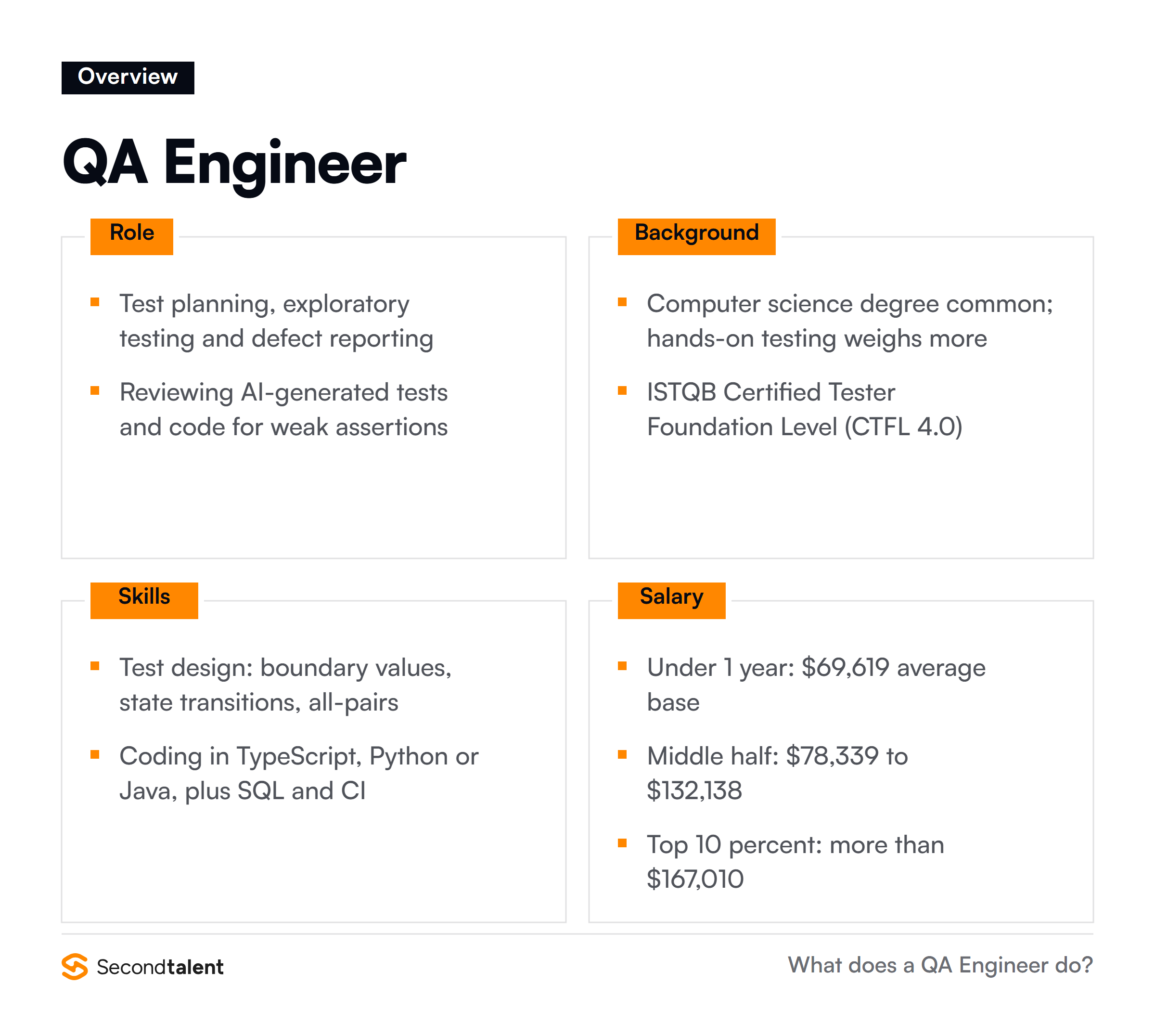
The pay reflects it. The Bureau of Labor Statistics puts the median wage for software quality assurance analysts and testers at $104,300 a year, with the top 10 percent above $167,010.
What is a QA Engineer?
A QA engineer (quality assurance engineer) makes sure software works the way users and the business expect before it ships, and keeps it working after.
The role covers deciding what to test, building and running those tests, reporting defects clearly, and pushing quality checks earlier into how a team designs and builds features.
The BLS groups the role with "software quality assurance analysts and testers" and lists the core duties: creating test plans and scenarios, identifying project risks, running manual and automated tests including exploratory testing, documenting defects, and giving developers feedback on usability and functionality.
In a US startup, a QA engineer usually works in one of three setups:
- Embedded: one QA engineer inside a product squad, reviewing tickets before work starts and testing as features land
- Central: a small QA team that owns the regression suite, release sign-off and test environments for several squads
- Quality coach: developers write most tests, and the QA engineer sets the strategy, reviews coverage and handles the risky areas
The title spans manual and automated work. Most QA engineer postings now expect both: the judgment to explore a feature by hand and the coding ability to automate the checks worth repeating.
QA Engineer Job Market and Salary in the US
The Bureau of Labor Statistics reports a median annual wage of $104,300 for software quality assurance analysts and testers in May 2025. The lowest 10 percent earned less than $61,440 and the highest 10 percent more than $167,010.
Employment and growth: 187,600 QA analyst and tester jobs in 2025, projected to reach 198,200 by 2035.
That 6 percent growth is double the 3 percent average for all occupations, though slower than the 10 percent projected for software developers on the same page.
Pay by industry (BLS median, May 2025):
- Manufacturing: $129,930
- Finance and insurance: $104,260
- Software publishers: $101,070
- Computer systems design and related services: $99,960
Junior, Mid-Level and Senior QA Engineer Salary
Self-reported data lines up with BLS. Built In puts the average QA engineer base salary at $100,262 and total compensation at $119,938. Its averages by experience:
- Junior (under 1 year): $69,619 average base
- Senior (7+ years): $116,834 average base
Glassdoor reports an average of $101,281 from 11,849 salaries, with the middle half earning $78,339 to $132,138 and the 90th percentile at $166,863.
Automation-heavy roles pay more: Second Talent's QA automation engineer cost guide puts US freelance rates at $85 to $135 an hour for mid-level engineers and $110 to $171 for seniors.
Responsibilities and Day-to-Day Work
A QA engineer's week is mostly prevention, not bug hunting. The earlier a defect is caught, at the ticket, in a pull request or in CI, the cheaper it is to fix.
- Reviewing requirements: reading tickets and designs before code is written, and asking what happens on empty states, slow networks, bad input and permission edges
- Test planning: deciding what to test at each layer (unit, API, end-to-end, manual) and what to skip, based on risk
- Exploratory testing: working through new features by hand to find what scripted tests miss
- Automation: writing and maintaining API and browser tests, and keeping the suite fast and free of flaky tests
- Defect reporting: clear repro steps, expected versus actual behavior, logs and screenshots, and a severity call
- Release checks: regression runs, smoke tests after deploys, and a go or no-go recommendation
- Reviewing AI-generated tests and code: checking that tests produced by coding assistants assert something meaningful, not just that the code runs
That last item is growing.
In the 2025 Stack Overflow Developer Survey, 84 percent of developers use or plan to use AI tools in development, only 33 percent trust the accuracy of the output, and 45.2 percent said debugging AI-generated code takes more time.
More code is reaching review, and less of it was written by someone who fully understands it.
The 2024 DORA report found the same pattern at team level: AI adoption was associated with a 7.2 percent drop in delivery stability and a 1.5 percent drop in throughput.
Faster code output without stronger testing tends to show up as more failed changes.
Essential Skills and Qualifications
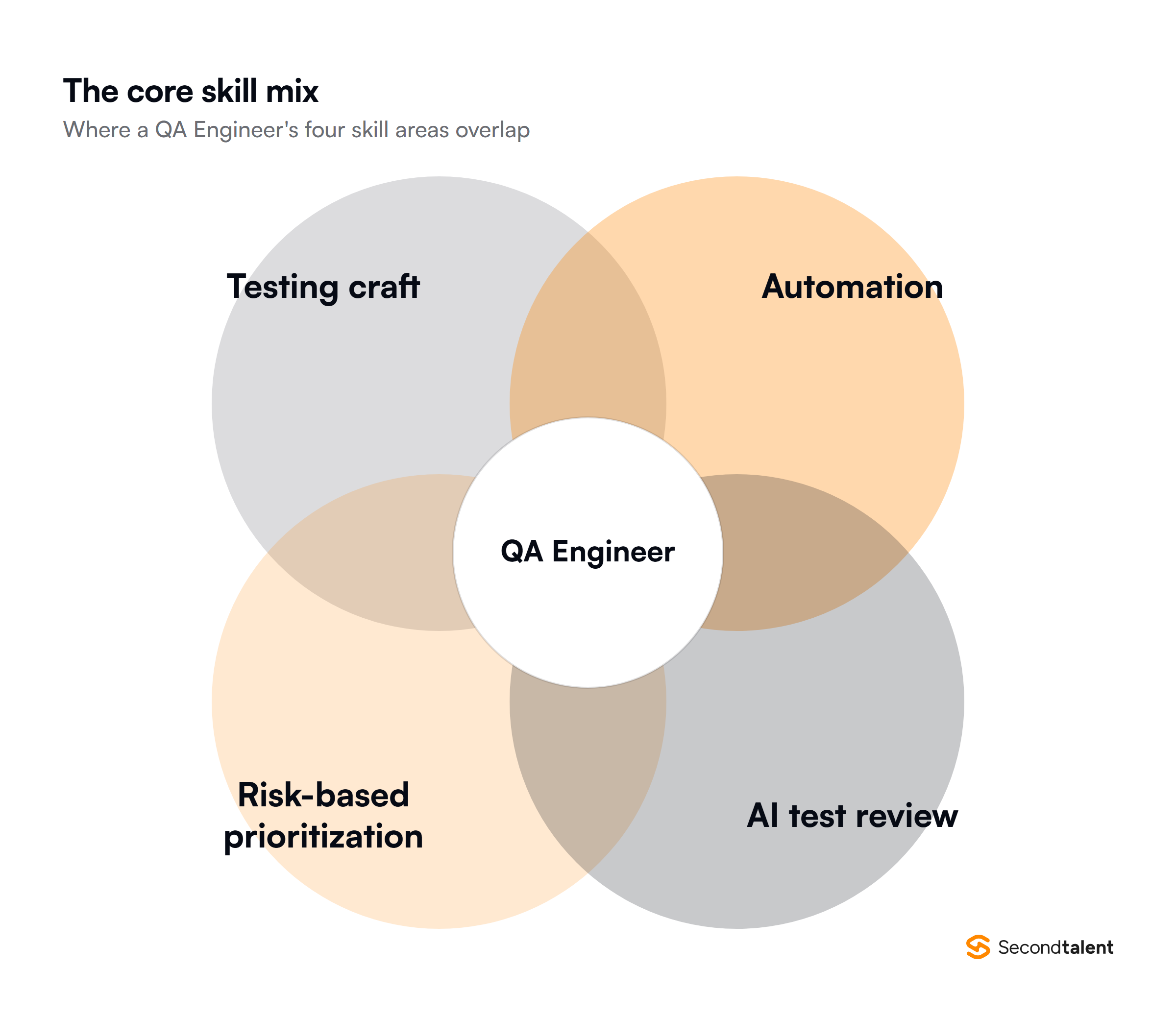
Testing Craft:
- Test design techniques: boundary values, equivalence classes, state transitions and all-pairs combinations
- Risk-based prioritization: knowing which 20 tests protect the checkout flow and which 200 add little
- Exploratory testing with written charters, so manual sessions produce findings others can act on
- Precise defect reports a developer can reproduce on the first try
Technical Skills:
- Coding in TypeScript, JavaScript, Python or Java, enough to write maintainable test code and read the application code
- API testing: HTTP, status codes, auth flows, contract checks, and the API security basics QA tends to catch first, such as broken authorization between accounts
- SQL for setting up test data and checking what actually landed in the database
- CI pipelines: running suites on every pull request, sharding, and reading failure logs
- Working with AI test tools: prompting for test cases, then reviewing the output for missing edge cases and weak assertions
Qualifications: No license is required. Many QA engineers hold a computer science or related degree, but employers weigh hands-on testing and automation work more.
The common certification is the ISTQB Certified Tester Foundation Level (CTFL 4.0); ISTQB reports more than 1.1 million certifications issued in over 130 countries. It shows shared vocabulary, not skill, so treat it as a tiebreaker.
QA Engineer Career Paths
Common Routes In:
- Manual testing or QA analyst roles: the most common start, moving up by learning automation
- Customer support or product operations: staff who already know where the product breaks
- Software development: developers who prefer finding failure modes to building features
- Bootcamps and computer science degrees, usually entering at junior QA or QA automation level
Typical Progression:
- Junior QA engineer: runs test cases, files defects, starts writing automated checks
- QA engineer: owns testing for a feature area, writes and maintains automation
- Senior QA engineer: sets test strategy for a product, mentors, decides what not to automate
- QA lead or QA manager: runs a QA team, release quality metrics and hiring
- Head of quality or director of QA: quality strategy across the engineering organization
Where It Leads: Strong coders often move into test automation or SDET roles. Others branch into performance testing, accessibility testing, AI model evaluation, release management or product management.
Senior QA engineers who know a product's failure history are also natural candidates for engineering manager roles on the teams they supported.
Tools and Tech Stack
Browser automation is where QA engineers spend the most tooling effort, and three frameworks dominate:
- Playwright: Microsoft's framework, which supports Chromium, WebKit and Firefox on Windows, Linux and macOS, with test code in TypeScript, JavaScript, Python, Java or .NET. It now ships three built-in test agents: a planner that explores the app and writes a Markdown test plan, a generator that turns the plan into tests, and a healer that reruns failing tests and suggests fixes such as locator changes
- Cypress: a JavaScript framework popular with front-end teams, with support for Chrome-family browsers, Firefox and WebKit
- Selenium: the longest-running option, with bindings in most languages; Selenium WebDriver is a W3C Recommendation, which is why large enterprise suites still run on it
The rest of a typical stack:
- Unit and component tests: Jest, Vitest, pytest or JUnit, usually owned by developers with QA reviewing coverage
- API testing: Postman or Bruno for exploration, and code-based tests in the main framework for CI
- Performance: k6, JMeter or Gatling for load and stress tests
- Mobile: Appium, Espresso for Android, XCUITest for iOS, and device clouds such as BrowserStack or Sauce Labs
- Test management and tracking: Jira, Linear, TestRail or Xray
- CI: GitHub Actions, GitLab CI or CircleCI running suites on every pull request
- AI assistants: Claude, ChatGPT and Copilot for drafting test cases and data; this guide to Claude for test case generation shows the review step that keeps the output useful
Playwright's healer reruns a failing test until it passes or its guardrails stop the loop, so its locator changes need the same review as any code change.
A healed test that now points at the wrong element passes without testing anything, and spotting that is QA work, not tooling work.
QA Engineer vs Adjacent Roles
Job titles in testing overlap, and US postings use them loosely. The split that matters is what each role owns.
- QA analyst or manual tester: runs test cases and exploratory sessions, with little or no code. BLS counts these roles in the same occupation as QA engineers. A QA engineer does this work too, plus automation and test strategy
- SDET or test automation engineer: a software engineer whose product is the test framework itself: harnesses, parallel runs, test data services and CI integration. A test automation engineer writes more code and does less exploratory testing than a QA engineer
- Release manager: owns the release process across teams: schedules, change approvals, rollbacks and communication. A release manager uses QA's sign-off as an input but does not test
- Site reliability engineer: owns uptime in production through monitoring, incident response and error budgets. A site reliability engineer catches failures after deploy; QA tries to stop them before
A quick test: if the main output is defects found and risk assessed, it is QA. If it is test infrastructure, it is SDET. If it is a release calendar, it is release management. If it is a production dashboard, it is SRE.
Early-stage startups often fold the first two into one hire.
How to Hire a QA Engineer
Decide first whether you need a tester or a builder. A product with a fragile UI and no tests needs a QA engineer who can explore, prioritize and automate the critical paths.
A team with good coverage and slow, flaky pipelines needs an SDET.
Interview Process:
- Test design exercise: give the candidate a real screen, such as signup or checkout, and 20 minutes to list what they would test and in what order. Strong candidates ask about users, risk and data before listing cases
- Bug report review: show a vague defect report and ask them to rewrite it
- Automation task: a short take-home or live session writing two or three browser or API tests against a demo app; the Playwright interview questions and unit testing interview guide help structure it
- AI review check: hand over an AI-generated test file with a weak assertion and a missing edge case, and see whether they spot both
- Pipeline discussion: how they would keep a 40-minute suite under 10 minutes; the CI/CD interview guide covers follow-up questions
Red flags: measuring success by bug count, wanting to automate everything, or no opinion on which tests to delete.
Second Talent helps US startups hire vetted AI-Native Engineers and Specialists from Asia, including QA and test automation engineers.
You are matched with vetted candidates in 24 hours, at $29 to $39 USD an hour, billed monthly (160 hours = $4,599 to $5,999 a month), with 4-6 hours of US time-zone overlap.
There is no cost until you hire, and every placement carries a 90-day, one-time replacement guarantee.
To start, tell us the QA role you need or browse all developer roles.
Frequently Asked Questions
What is the average QA engineer salary in the US?
The Bureau of Labor Statistics reports a median of $104,300 a year for software quality assurance analysts and testers in May 2025. Built In puts the average QA engineer base salary at $100,262, and Glassdoor at $101,281.
How much does a senior QA engineer make?
Built In reports an average base salary of $116,834 for QA engineers with 7+ years of experience. The top 10 percent of the occupation earned more than $167,010 in May 2025, according to BLS.
How much does a junior QA engineer make?
Built In reports an average base of $69,619 for QA engineers with less than one year of experience. The lowest 10 percent of the occupation earned under $61,440 in May 2025, according to BLS.
What is the difference between a QA engineer and an SDET?
A QA engineer owns test strategy, exploratory testing, defect reporting and automation of key flows.
An SDET, or test automation engineer, is a software engineer who builds the test framework itself, including harnesses, parallel runs and CI integration. Many startups combine the two in one hire.
Will AI replace QA engineers?
BLS projects 6 percent employment growth for QA analysts and testers from 2025 to 2035, double the average for all occupations.
AI tools such as Playwright's test agents draft and repair tests, but someone still has to decide what matters, check that assertions are meaningful, and test the AI-generated code those tools help produce.
Can I hire a remote QA engineer from Asia?
Yes. Second Talent matches US startups with vetted QA and test automation engineers from Asia in 24 hours, at $29 to $39 USD an hour billed monthly, with 4-6 hours of US time-zone overlap and a 90-day, one-time replacement guarantee.
There is no cost until you hire.
Related Roles
Explore related roles you can hire on Second Talent: Test Automation Engineer, Release Manager, Site Reliability Engineer, DevOps Engineer, Digital Accessibility Specialist, AI Evaluator and Trainer.