Enterprise AI has a delivery problem rather than a capability problem. The model works in the demo and stalls in the customer’s environment, where the data is messy, the workflow is undocumented, and nobody owns the change. The forward deployed consultant is the role companies invented to close that gap, and it is being hired faster than almost anything else in tech.
Lightcast data reported by Fortune in September 2026 put forward deployed job postings up more than 1,000 percent between January and August 2026 against the same period a year earlier, and more than 4,600 percent against 2023. Postings across the wider tech market grew 13 percent in the same window.
This guide covers what the consultant side of that role actually does, how it differs from the engineering side it is usually confused with, what the evidence says about pay, and what to look for when hiring one.
What is a Forward Deployed Consultant?
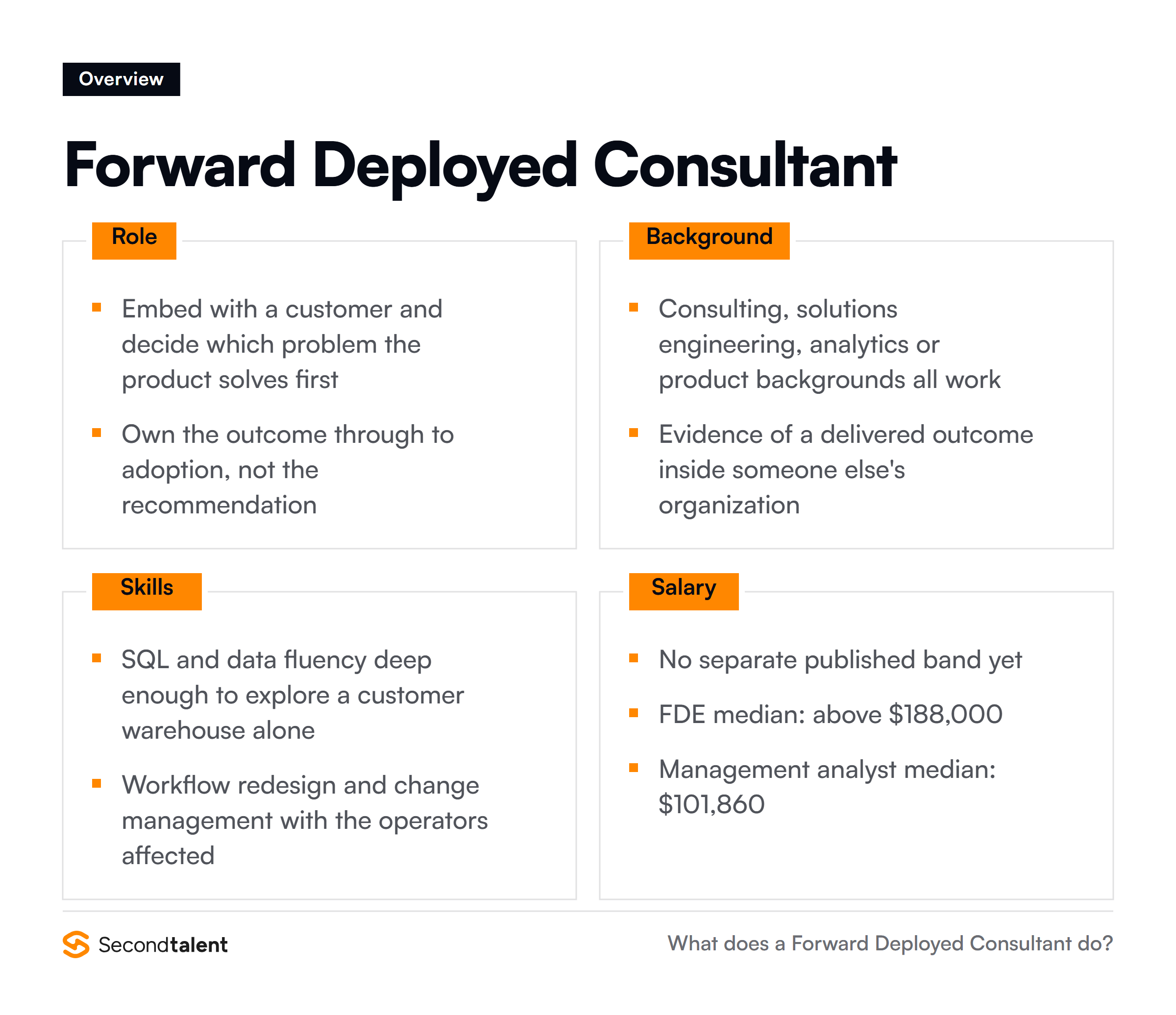
A forward deployed consultant embeds inside a customer’s organization to make a software or AI product produce a business result. They work on the customer’s site or inside the customer’s team, learn the workflow in detail, decide what the product should be pointed at first, and stay until the thing is in production and being used.
The distinction from ordinary consulting is ownership. A traditional engagement ends with a recommendation and a deck. A forward deployment ends when the customer’s people are doing their job differently, in the product, without help. The consultant carries that outcome rather than the analysis behind it.
Forward Deployed Consultant Job Market and Salary Ranges
The demand signal is unusually strong, and it is worth being precise about what the published numbers cover.
What the growth data says. Lightcast, reported by Fortune in September 2026, found forward deployed postings up more than 1,000 percent between January and August 2026 versus the same period in 2025, and more than 4,600 percent versus 2023, against 13 percent growth for tech postings generally. Those figures track the “forward deployed” family as a whole rather than the consultant title alone.
What the pay data says. The same Lightcast analysis put median advertised pay for forward deployed engineers above $188,000, against roughly $145,000 for a traditional software engineer, according to Paul Farnsworth, president of the tech career platform Dice. Fortune noted Anthropic advertising some forward deployed roles reaching $400,000.
The caveat that matters. Every one of those figures is engineer data. The consultant variant is too new to have its own published band, and quoting the engineering median for it would overstate the case. The honest position is that the consultant role sits between two anchors:
- Upper anchor: forward deployed engineer, median advertised pay above $188,000 (Lightcast, 2026)
- Lower anchor: management analysts, median $101,860 a year in May 2025, projected to grow 10 percent from 2025 to 2035 with about 94,100 openings a year (US Bureau of Labor Statistics)
- Deployment-facing consultant roles at AI companies and enterprise software vendors generally clear the lower anchor comfortably, and land below the engineering variant at equivalent seniority
Ask for the band in writing before you interview, because the same title covers a genuinely wide range depending on how technical the employer expects the person to be.
Geography is shifting too. Stanford HAI’s 2026 AI Index reports private AI investment up 127.5 percent and now 60 percent of total corporate AI investment, with newly funded AI companies up 71 percent. Its Lightcast data shows Singapore leading the world on the share of job postings requiring AI skills at 4.7 percent, with Hong Kong at 3.5 percent, both ahead of the United States. Second Talent recruits deployment and applied AI talent across nine APAC markets, with vetting, employment and payroll handled for you.
Essential Forward Deployed Consultant Skills and Qualifications
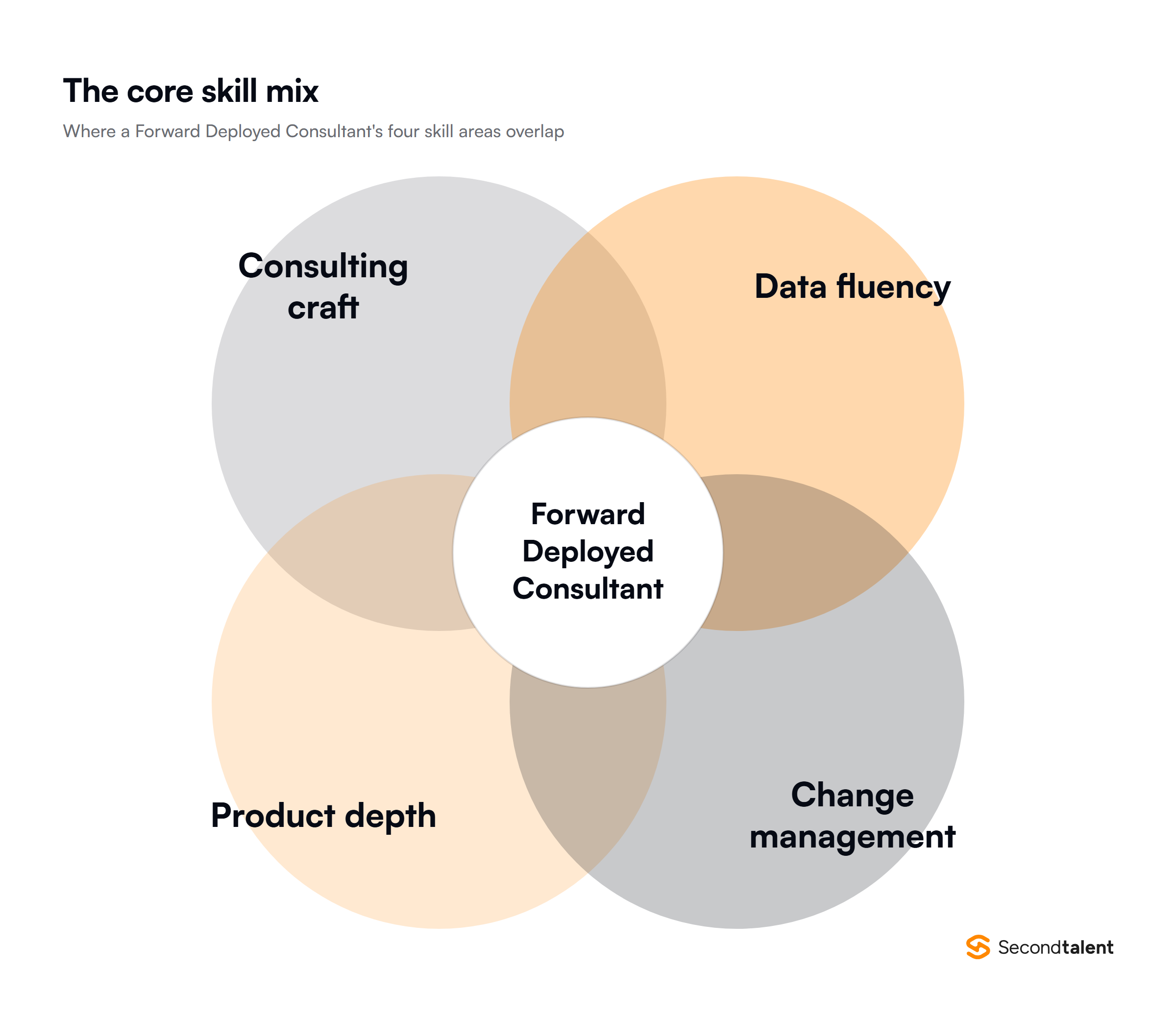
Technical Fluency:
- Enough SQL and data literacy to explore a customer’s data yourself rather than filing a request and waiting
- A working understanding of what current AI systems do reliably and where they fail, so you can scope a use case that will survive contact with production
- Comfort reading an API reference and a system diagram, and knowing when to stop and hand the problem to an engineer
- Enough scripting to prototype, without pretending the prototype is the product
Problem Definition:
- Finding the workflow that is actually costing the customer money, which is rarely the one they described in the sales cycle
- Scoping a first deployment small enough to ship in weeks and consequential enough that someone notices
- Saying no to use cases the product will handle badly, early, in front of the customer
- Instrumenting the outcome before the work starts, so value can be shown rather than asserted
Customer and Change Work:
- Earning trust from the people whose job is about to change, who are usually the ones who can quietly kill the deployment
- Running training and demonstrations that leave the customer’s team able to work without you
- Managing an executive sponsor and a skeptical operator in the same week, in different registers
Operating Style:
- Travel and onsite presence, in most versions of the role
- Working without a defined brief, on a problem nobody has fully written down
Background: There is no single path in. Strong candidates come from consulting, from technical customer-facing roles such as solutions engineering, from analytics, and from product. A bachelor’s degree is the typical entry requirement for adjacent consulting occupations, but what employers actually screen for is evidence of having taken something from ambiguity to a working outcome inside someone else’s organization.
Forward Deployed Consultant Career Paths and Progression
Common Routes In:
- From management consulting: strong on structure, stakeholders and executive communication; usually needs to build enough technical depth to keep the engineers’ respect
- From solutions engineering or presales: already customer-facing and technical, and the shift is from winning the deal to owning what happens after it
- From data or analytics: comfortable in the customer’s data from day one, and generally needs to develop the change-management half of the job
- From product: good at problem definition and prioritization, and has to adjust to owning one customer’s outcome rather than a roadmap
- From engineering: some forward deployed engineers move across when they find the interesting part was the problem rather than the code
Progression:
- Consultant: owns a workstream inside one deployment, under someone else’s problem definition
- Senior consultant: owns a whole deployment for one customer, including the first use case and the adoption plan
- Lead or principal: owns a portfolio of accounts, sets the delivery pattern others follow, and is the escalation path when a deployment goes wrong
- Head of deployment or delivery: builds the team, decides which customers get the model, and owns the economics of delivery
Where it leads: The role is unusually good preparation for several destinations. Product management, because you have watched real users fail with the product for months. Enterprise sales leadership, because you know what actually gets deployed. Founding a company, because you have seen a market’s problems from the inside of several customers. And AI enablement leadership on the buying side, which is the same job pointed inward.
Forward Deployed Consultant vs Adjacent Roles
The title overlaps four others, and job descriptions rarely draw the lines cleanly. The distinctions that hold up in practice:
Consultant vs forward deployed engineer: Same customer, same room, different deliverable. The engineer ships code, integrations and pipelines against the customer’s data. The consultant decides what should be built and makes the organization around it change. Small deployments give both jobs to one person, which is where the titles blur; at scale they separate, because the skills genuinely differ.
Consultant vs deployment strategist: The same job family under Palantir’s name for it, known internally as Echo and paired with the forward deployed software engineer. The substance matches, and the specifics do not: Palantir roles carry US Person requirements on government work, 25 to 75 percent travel, and an interview built around a decomposition exercise.
Consultant vs solutions architect: An architect designs how a system should fit together and hands the design to whoever builds it, usually across many accounts at once. A forward deployed consultant goes into one account and stays until the outcome exists. Architecture is a design function; forward deployment is a delivery one.
Consultant vs management consultant: A management consultant is product-agnostic and sells analysis. A forward deployed consultant works for the company whose product is being deployed, and is measured on whether that product produced value. The incentive is different, and so is the depth of technical understanding required.
Consultant vs AI enablement lead: Enablement is an internal role driving adoption inside your own company. Forward deployment is external, inside a customer’s. The work rhymes, the accountability does not.
How a Forward Deployment Actually Runs
Deployments vary, but the sequence that works is consistent, and the failure modes are consistent too.
- Get into the workflow, not the requirements document. Sit with the people doing the job. The written process and the real one differ, and the gap between them is usually where the value is.
- Find the data and check whether it is usable. Most stalled deployments are data problems wearing an AI costume. Establish this in week one rather than month three.
- Pick one use case with a named owner and a measurable outcome. Small enough to ship in weeks, important enough that its success is visible to someone senior.
- Build with the customer in the room. Working alongside a forward deployed engineer, ship something the customer’s team can use, and let them break it early.
- Instrument the result. Agree the number before you start. A deployment that cannot show what moved will not be renewed, whatever the customer says in the room.
- Hand over deliberately. Train the customer’s team, document the workflow, and plan your own exit. A deployment that depends on you permanently has not succeeded.
- Feed the product team. The pattern you just worked around by hand is the next feature. Routing that back is what separates a deployment function from an agency.
The common failure: choosing the use case that is easiest to build rather than the one that matters, shipping it, and finding nobody cares. The second most common: building something that works and never getting the customer’s team to change how they operate, which leaves a good product unused.
Tools and Best Practices
What the role uses day to day:
- Data: SQL, the customer’s warehouse, spreadsheets more often than anyone admits, and whatever BI tool the customer already trusts
- Product: the employer’s own platform, deeply, including its limits and its roadmap
- AI tooling: the model APIs, evaluation harnesses, and enough prompt and agent literacy to know what a given system will do reliably in front of a customer
- Collaboration: the customer’s tools rather than your own, because adoption starts with meeting them where they work
- Documentation: written workflow maps and handover notes, which are the actual artifact of the job
Practices that separate the good ones:
Ship in weeks, not quarters. Credibility inside a customer organization comes from something working, and it decays while you are still scoping.
Name the metric before the build. Agreeing what success looks like after the fact is a negotiation you will lose.
Win the operator, not just the sponsor. Executive support gets a deployment started. The people whose job changes decide whether it survives.
Say what the product cannot do. The consultant who scopes honestly gets a second deployment. The one who agrees to everything gets an escalation.
Getting Started as a Forward Deployed Consultant
If you are moving into the role:
- Build enough data fluency to be useful unaccompanied: SQL to a working standard, and comfort with a warehouse and a BI tool
- Learn one AI platform properly rather than five superficially, including where it fails
- Get evidence of a delivered outcome inside someone else’s organization, even a small one, because that is what employers screen for
- Practice explaining a technical constraint to a non-technical operator, which is most of the job
If you are hiring one:
- Decide whether you need the consultant, the engineer, or both, and write the job description for the one you actually need
- Interview on a real deployment problem rather than a case study, and watch how the candidate scopes it down
- Test for the change-management half explicitly. Technical candidates often fail here and it is rarely screened for
- Settle the travel and onsite expectation before the offer, because it is the most common reason these hires fall through
Second Talent sources and vets deployment-facing talent across nine APAC markets and employs them through our own entities, so you get the person without setting up a local entity to hire them. Tell us what you are hiring for and we will send a vetted shortlist within 24 hours.
Frequently Asked Questions
What does a forward deployed consultant do?
A forward deployed consultant embeds inside a customer’s organization to make a software or AI product deliver a business result. They learn the customer’s workflow in detail, decide which problem the product gets pointed at first, work with engineers to ship it, and stay until the customer’s team is using it without help. The job ends with a working outcome rather than a recommendation.
What is the difference between a forward deployed consultant and a forward deployed engineer?
Same customer, different deliverable. The engineer writes production code, integrations and data pipelines against the customer’s systems. The consultant defines which problem to solve, redesigns the workflow around what the product can do, and drives adoption. Small deployments often give both jobs to one person; at scale they separate because the skill sets genuinely differ.
Is a deployment strategist the same as a forward deployed consultant?
Yes, in practice. Deployment strategist is Palantir’s name for the role, paired with its forward deployed software engineer. Other companies use forward deployed consultant, applied AI consultant or AI solutions consultant for the same work. Read the responsibilities rather than the title.
How much does a forward deployed consultant earn?
There is no separate published band for the consultant title yet, so treat any single figure with caution. For context, Lightcast data reported by Fortune in September 2026 put median advertised pay for forward deployed engineers above $188,000, against roughly $145,000 for a traditional software engineer, and the US Bureau of Labor Statistics puts median pay for management analysts at $101,860 as of May 2025. Consultant roles at AI companies generally sit between those two anchors, below the engineering variant at equivalent seniority.
Is forward deployed consulting a growing field?
Sharply. Lightcast found forward deployed job postings up more than 1,000 percent between January and August 2026 against the same period in 2025, and more than 4,600 percent against 2023, while tech postings overall grew 13 percent. OpenAI built a forward deployed function in 2024 and Anthropic runs the equivalent inside its Applied AI group, both following the model Palantir established.
Do you need to be technical to be a forward deployed consultant?
Technical enough to be useful on your own, which usually means working SQL, comfort in a customer’s data warehouse, and a real understanding of what the product and the underlying AI systems can do reliably. You do not need to ship production code, which is the engineer’s half of the pair. Candidates who cannot explore data unaccompanied tend to stall, because the interesting problems are found in the data rather than in meetings.
How quickly can Second Talent place a forward deployed consultant?
We typically present a vetted shortlist within 24 hours and complete placements in two to four weeks, depending on your interview process and the candidate’s notice period. We employ placed candidates through our own entities across nine APAC markets, so you do not need a local entity to hire one. Get in touch for a current rate breakdown.
Related Roles
Explore related roles you can hire on Second Talent: Forward Deployed Engineer, AI Forward Deployed Engineer, Forward Deployed Product Manager, Forward Deployed Researcher, Forward Deployed Recruiter, Solutions Architect, AI Enablement Lead.