Deployment strategist is Palantir’s name for the person who owns whether a software deployment actually changes how a customer works.
It is one half of a pair: the strategist owns the problem and the organization around it, and a forward deployed engineer owns the code underneath.
The title has since spread well beyond Palantir, because every company selling enterprise AI has run into the same problem.
The product works in the demo and stalls inside the customer, where the data is messy, the workflow is undocumented, and nobody owns the change.
This guide covers what the role does, how it differs from the engineering roles it sits beside, what the published pay data says and why three sources disagree by more than double, what the interview actually tests, and what to look for when hiring one.
What is a Deployment Strategist?
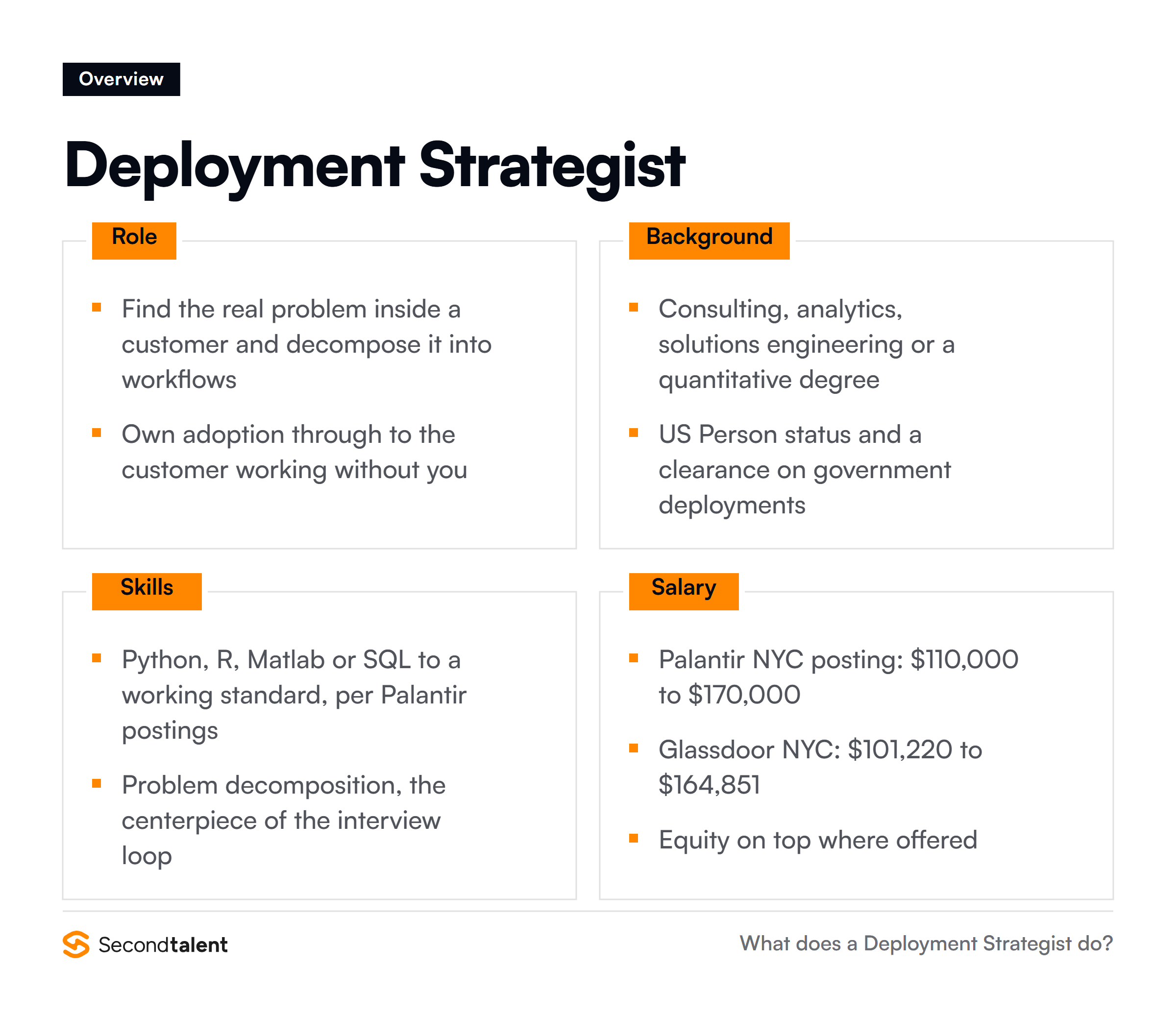
A deployment strategist embeds inside a customer’s organization to turn a software platform into an operational result.
They sit with the people doing the work, find the problem that is genuinely costing the customer money, decide which workflow the product gets pointed at first, and stay until the customer’s own team is using it without help.
Deployment Strategist Job Market and Salary Ranges
Demand for the whole forward deployed family is growing faster than almost anything else in tech.
Lightcast data reported by Fortune in September 2026 put forward deployed postings up more than 1,000 percent between January and August 2026 against the same period a year earlier, and more than 4,600 percent against 2023, while tech postings generally grew 13 percent.
Pay data, and why it conflicts. Three sources give three very different answers for this title, and the gap is instructive rather than a reason to average them:
- Palantir’s own New York posting: $110,000 to $170,000 a year in base salary, plus restricted stock units and a sign-on bonus
- Glassdoor, New York City: a typical range of $101,220 to $164,851, from 325 submitted salaries as of September 2026
- ZipRecruiter, United States: $82,000 at the 25th percentile to $94,500 at the 75th, with the 90th percentile at $114,000
The first two corroborate each other closely, which is the useful signal.
The third is measuring something different: a US-wide aggregate of listings using the words deployment strategist across many employers, most of which are neither Palantir nor located in New York.
Treat the first two as the band for this role at a major AI or data platform company, and the third as evidence that the title is now used loosely elsewhere.
Two further points about the money. Equity is a large share of total compensation at companies that pay this way, so a base-only comparison understates the offer.
And the band is wide because the same title covers a first deployment and a portfolio lead, so ask which end of it a specific role sits at before you interview.
Second Talent recruits deployment-facing and applied AI talent across nine APAC markets, with vetting, employment and payroll handled for you.
Essential Deployment Strategist Skills and Qualifications
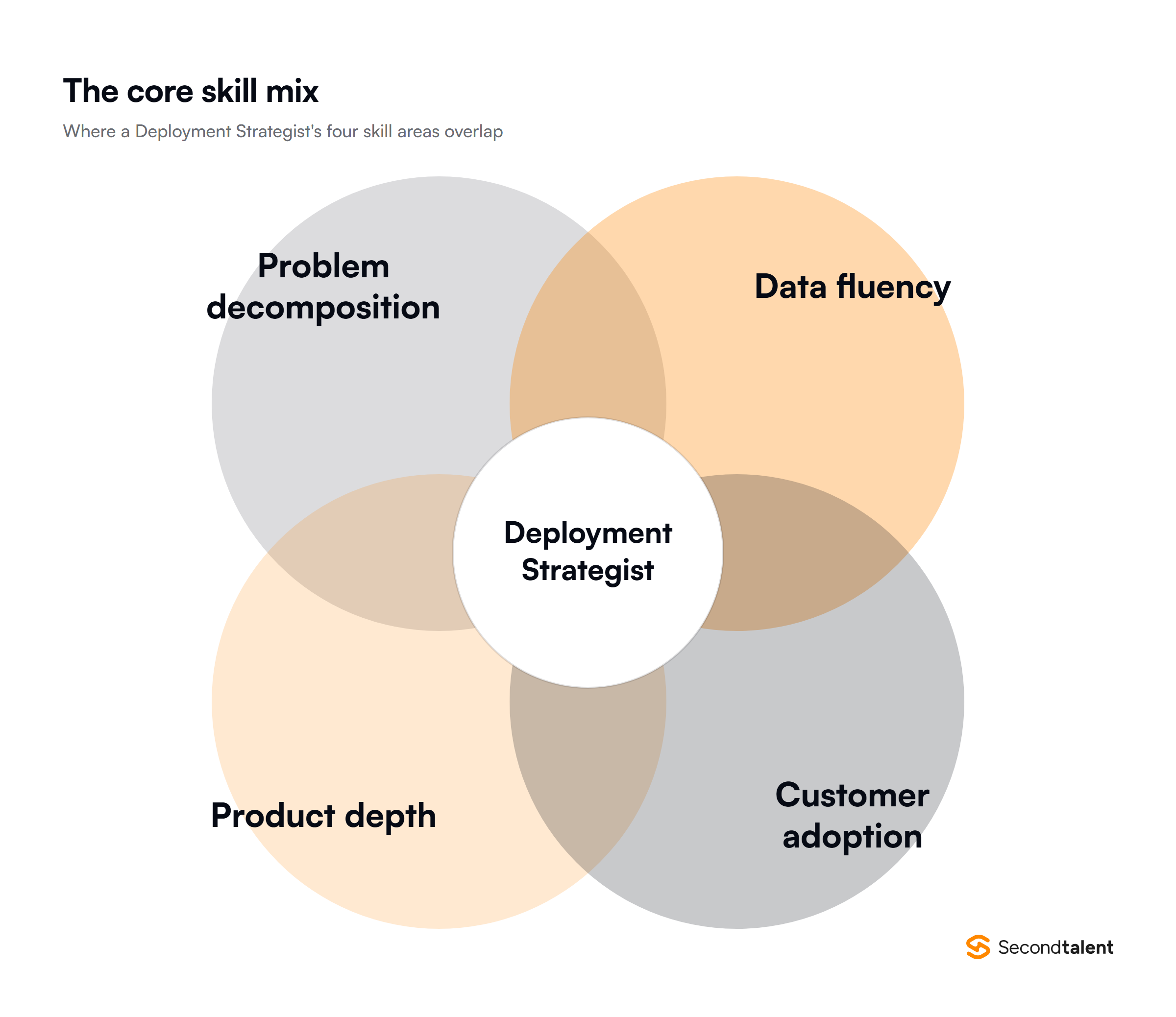
Technical Fluency:
- Palantir’s posting asks for experience with programming, scripting or statistical packages such as Python, R, Matlab or SQL
- Enough data literacy to explore a customer’s warehouse yourself rather than filing a request and waiting
- A working grasp of what the platform and any AI components do reliably, so you can scope something that survives production
- Knowing where your own build ends and an engineer’s begins
Problem Decomposition:
- Taking a vague operational complaint and breaking it into the workflows, datasets and decisions underneath
- Scoping a first deployment small enough to ship in weeks and consequential enough that someone senior notices
- Saying no early to use cases the product will handle badly
- Agreeing the metric before the build rather than negotiating it afterward
Organizational Navigation:
- Earning trust from the people whose job is about to change, who are usually the ones able to quietly kill a deployment
- Running training that leaves the customer’s team able to work without you
- Aligning an executive sponsor and a skeptical operator in the same week, in different registers
Eligibility and Practicalities:
- US Person status is required on Palantir’s US Government roles, and some positions add a security clearance
- Travel of 25 to 75 percent on the New York commercial posting, with onsite work as the norm
- Comfort operating without a written brief, on a problem nobody has fully documented
Background: There is no single path. Strategists arrive from consulting, analytics, solutions engineering, product and the sciences.
Palantir is explicit that it hires for strengths and interests rather than a fixed profile, and what employers screen for is evidence of having taken something ambiguous to a working outcome inside someone else’s organization.
The Deployment Strategist Interview Process
Palantir does not publish a standardized loop and describes the format as personalized to the candidate and the role.
Reported experiences converge on four stages, typically over three to four weeks, though candidates commonly report longer.
- Recruiter screen. Background, motivation, and whether the travel and eligibility requirements are workable for you.
- Conversation with a current strategist. Less an interview than a working discussion about how you think through an unfamiliar problem.
- The decomposition round. The centerpiece, and the one candidates underprepare. You are given a broad, messy problem and asked to break it into component workflows, identify what data would be needed, and decide what to do first. Interviewers are watching how you narrow scope and what you choose to ignore.
- Hiring manager conversation. Fit for the specific deployment, and how you handle the organizational side of the work.
How to prepare: Practice out loud on real operational problems rather than rehearsing consulting case frameworks, which fit this loop badly. Bring a genuine example of a project you scoped down and shipped.
Be ready to talk about SQL and data pipelines concretely, since a candidate who cannot explore data unaccompanied tends to stall in the job as well as the interview.
The common failure: answering the problem you were given rather than interrogating it.
The role exists because customers describe the wrong problem, so a candidate who accepts the brief at face value has demonstrated the opposite of the skill being tested.
Government and Commercial Deployments
Palantir posts deployment strategist roles separately for US Government and commercial work, and the two are meaningfully different jobs sharing a title.
Government deployments carry eligibility requirements before anything else: US Person status, and on some roles a security clearance that has to be sponsored and waited for.
The problems tend to be operational and high-consequence, the procurement cycles are long, and the customer’s constraints are legal as much as technical.
Commercial deployments move faster and are measured more directly in money.
The problems Palantir cites across both sides range from protecting troops and manufacturing quality to healthcare policy and delivering aid, which is a fair indication of how wide the surface is.
For candidates, the practical advice is to decide early which side you want. Clearance timelines shape a career, and moving between the two is easier in one direction than the other.
For employers copying the model, the relevant lesson is that eligibility requirements are a hiring constraint long before they are a compliance one.
Deployment Strategist Career Paths and Progression
Common Routes In:
- From consulting: strong on structure and stakeholders, and usually needs to build enough data fluency to keep the engineers’ respect
- From analytics or data science: comfortable in the customer’s data on day one, and generally needs to develop the change-management half
- From solutions engineering: already customer-facing and technical, and the shift is from winning the deal to owning what happens after it
- From the sciences or quantitative degrees: a well-worn route into the role, since the decomposition round rewards structured thinking over domain knowledge
- From engineering: some forward deployed engineers move across when they find the interesting part was the problem rather than the code
Progression:
- Strategist: owns a workstream inside one deployment, under someone else’s problem definition
- Senior strategist: owns a whole deployment, including the first use case and the adoption plan
- Lead: owns several accounts, sets the delivery pattern others follow, and is the escalation path when a deployment goes wrong
- Head of deployment or delivery: builds the team, decides which customers get the model, and owns the economics of delivery
Where it leads: The role is unusually good preparation for product management, because you have watched real users fail with a product for months.
It also feeds enterprise sales leadership, founding a company in a market you have seen from inside several customers, and AI enablement leadership on the buying side, which is the same job pointed inward.
Getting Started as a Deployment Strategist
If you are moving into the role:
- Get SQL to a working standard and be comfortable in a data warehouse, because this is the most common gap in otherwise strong candidates
- Practice decomposition on real operational problems, out loud, rather than rehearsing case frameworks
- Get evidence of a delivered outcome inside someone else’s organization, even a small one
- Settle the travel and eligibility questions before you apply, since both are hard requirements rather than preferences
If you are hiring one:
- Decide whether you need the strategist, the engineer, or both, and write the description for the one you actually need
- Interview on a real problem from your own deployments and watch how the candidate narrows it
- Test the change-management half explicitly, because technical candidates often fail there and it is rarely screened for
- Settle travel and onsite expectations before the offer, which is the most common reason these hires fall through
Second Talent sources and vets deployment-facing talent across nine APAC markets and employs them through our own entities, so you can hire without setting up a local entity first.
Tell us what you are hiring for and we will send a vetted shortlist within 24 hours.
Frequently Asked Questions
What does a deployment strategist do?
A deployment strategist embeds inside a customer’s organization to turn a software platform into an operational result.
They meet the people doing the work, identify the real problem and the datasets behind it, work with an engineer to build the workflow, run the training, and stay until the customer’s own team is using it without help.
The job ends with a working outcome rather than a recommendation.
Is a deployment strategist the same as a forward deployed consultant?
Same job family, different lineage. Deployment strategist is Palantir’s title, known internally as Echo and paired with the forward deployed software engineer, or Delta.
Forward deployed consultant, applied AI consultant and AI solutions consultant are what the rest of the market calls the same work.
The practical differences are specifics: Palantir roles carry US Person requirements on government work, 25 to 75 percent travel, and a decomposition-based interview.
What is the difference between a deployment strategist and a forward deployed engineer?
The engineer owns the technical build: pipelines, integrations and production code against the customer’s data. The strategist owns the problem definition, the workflow redesign and adoption.
At Palantir the pairing is explicit, with strategists called Echo and forward deployed software engineers called Delta. Both roles blur toward the middle on small deployments.
How much does a deployment strategist earn?
Palantir’s own New York posting advertises $110,000 to $170,000 a year in base salary plus restricted stock units and a sign-on bonus, and Glassdoor’s New York City page reports a typical range of $101,220 to $164,851 from 325 submitted salaries as of September 2026.
ZipRecruiter’s US-wide aggregate is much lower at $82,000 to $94,500, because it pools listings from many employers outside the AI and data platform market. Equity is a significant share of total compensation where it is offered.
Do you need to be technical to be a deployment strategist?
Technical enough to work unaccompanied. Palantir’s posting asks for experience with programming, scripting or statistical packages such as Python, R, Matlab or SQL.
You are not expected to ship production code, which is the forward deployed engineer’s half of the pair, but candidates who cannot explore a customer’s data on their own tend to stall, because the useful problems are found in the data rather than in meetings.
What is the deployment strategist interview like?
Palantir does not publish a standard loop and describes the format as personalized.
Reported experiences converge on four stages over roughly three to four weeks: a recruiter screen, a conversation with a current strategist, a decomposition round where you break a broad messy problem into workflows and decide what to do first, and a hiring manager conversation.
The decomposition round is the one candidates underprepare for.
Does a deployment strategist need a security clearance?
Only on government work. Palantir posts US Government deployment strategist roles separately, and those require US Person status with a security clearance needed for some positions.
Commercial roles carry neither requirement, though the New York commercial posting does ask for 25 to 75 percent travel.
How quickly can Second Talent place a deployment strategist?
We typically present a vetted shortlist within 24 hours and complete placements in two to four weeks, depending on your interview process and the candidate’s notice period.
We employ placed candidates through our own entities across nine APAC markets, so you do not need a local entity to hire one. Get in touch for a current rate breakdown.
Related Roles
Explore related roles you can hire on Second Talent: Forward Deployed Consultant, Forward Deployed Engineer, AI Forward Deployed Engineer, Forward Deployed Product Manager, Forward Deployed Researcher, Solutions Architect, AI Enablement Lead.