TL;DR: The fastest way is a talent platform or staff augmentation provider with a pre-vetted pool: several publish introductions within 24 hours, so an engineer who is free now can start in 5 to 14 days. A freelance marketplace can match that pace if you do the vetting yourself. A job post or contingency recruiter averages 53 days to an accepted offer for engineering, before any notice period.
Companies ran 39 interviews per engineering hire in 2024, against 20 across all roles, according to Gem's benchmarks. Candidates accepted 76% of engineering offers, the lowest rate of any department.
On short notice, skip that loop: hire someone who can start now, test them on paid work, and have their accounts ready before day one.
- 1Availability beats sourcing speed: an employed candidate in the UK owes at least one week's notice by law, and a contract can require more.
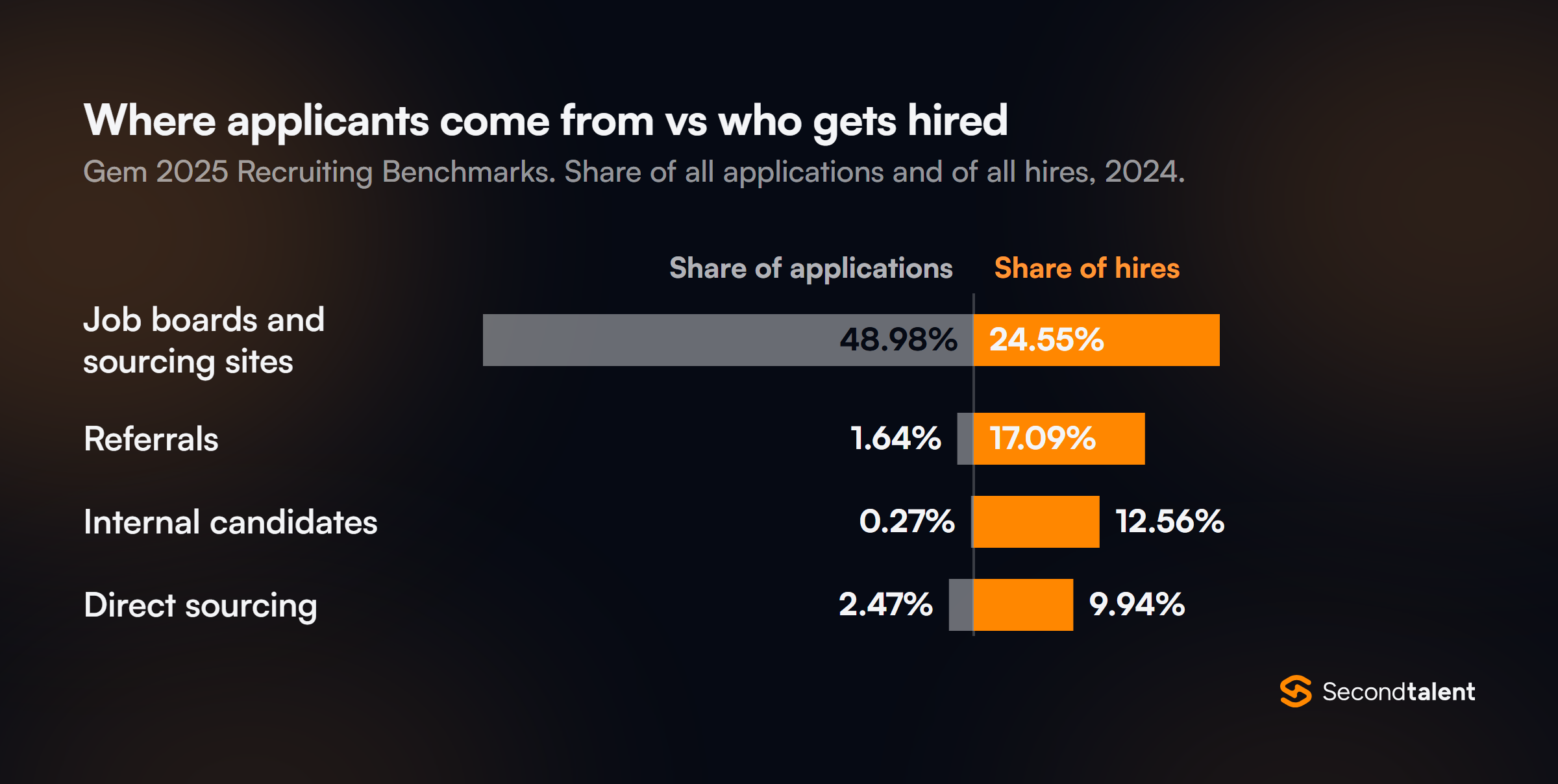
- 2Referrals made up 1.64% of applications but 17.09% of hires in Gem's data.
- 3A paid trial replaces most of the interview loop. Toptal starts engagements with a trial of up to two weeks and does not bill if you are not satisfied.
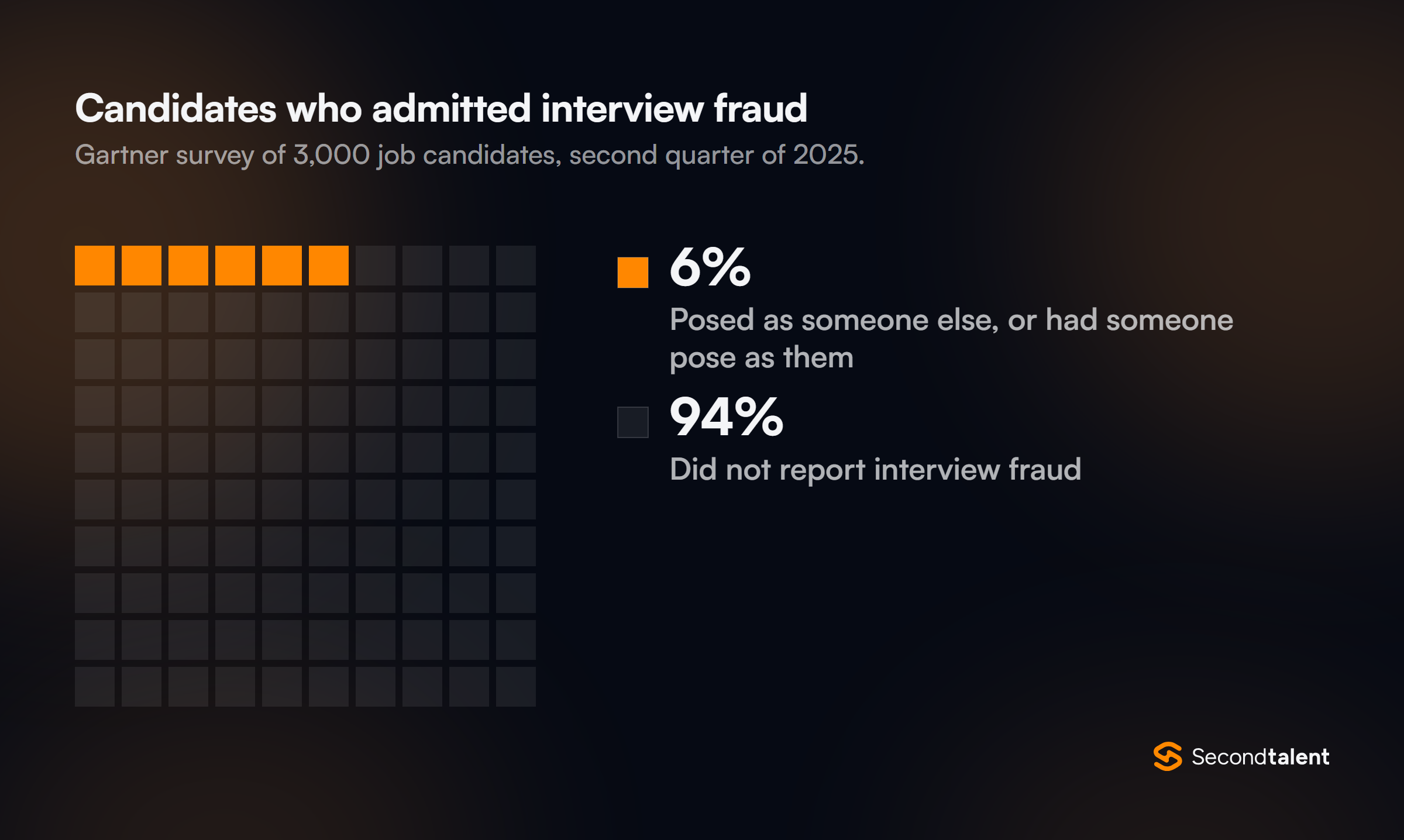
- 4Speed raises fraud risk: 6% of candidates told Gartner they had taken part in interview fraud.
The Fastest Routes, Ranked by Time to Start
Only three routes can put an engineer to work inside two weeks: a pre-vetted talent platform, a freelance marketplace, or an employer of record (EOR) for a candidate you have already picked.
Everything else depends on a candidate who is still employed somewhere else.
| Route | Realistic start | What you pay | Main risk | Use it when |
|---|---|---|---|---|
| Pre-vetted talent platform or staff augmentation | 5 to 14 days | Hourly or monthly rate with the margin built in | Pool may be thin for a rare stack | You need a strong engineer within two weeks |
| Freelance marketplace | 3 to 10 days | Freelancer rate plus a client fee (up to 7.99% on Upwork) | You do all the vetting | The task is scoped and short |
| Contract or contract-to-hire agency | 7 to 21 days | Hourly markup, often a conversion fee | Quality varies by recruiter | You may convert the hire later |
| Referral | 21 to 60 days | Referral bonus | Notice periods | Someone in your network is between jobs |
| Contingency recruiter | 40 to 80 days | 15% to 30% of first-year salary | Slow for anyone employed | A permanent senior hire that can wait a month |
| Job board | 50 to 90 days | Posting fees plus your screening time | Volume and fake applicants | You have time and a recruiter |
| EOR for a chosen candidate | 2 to 10 days | Monthly fee per employee ($599 on Deel) | You still have to find the person | You have picked someone abroad and need a legal employer |
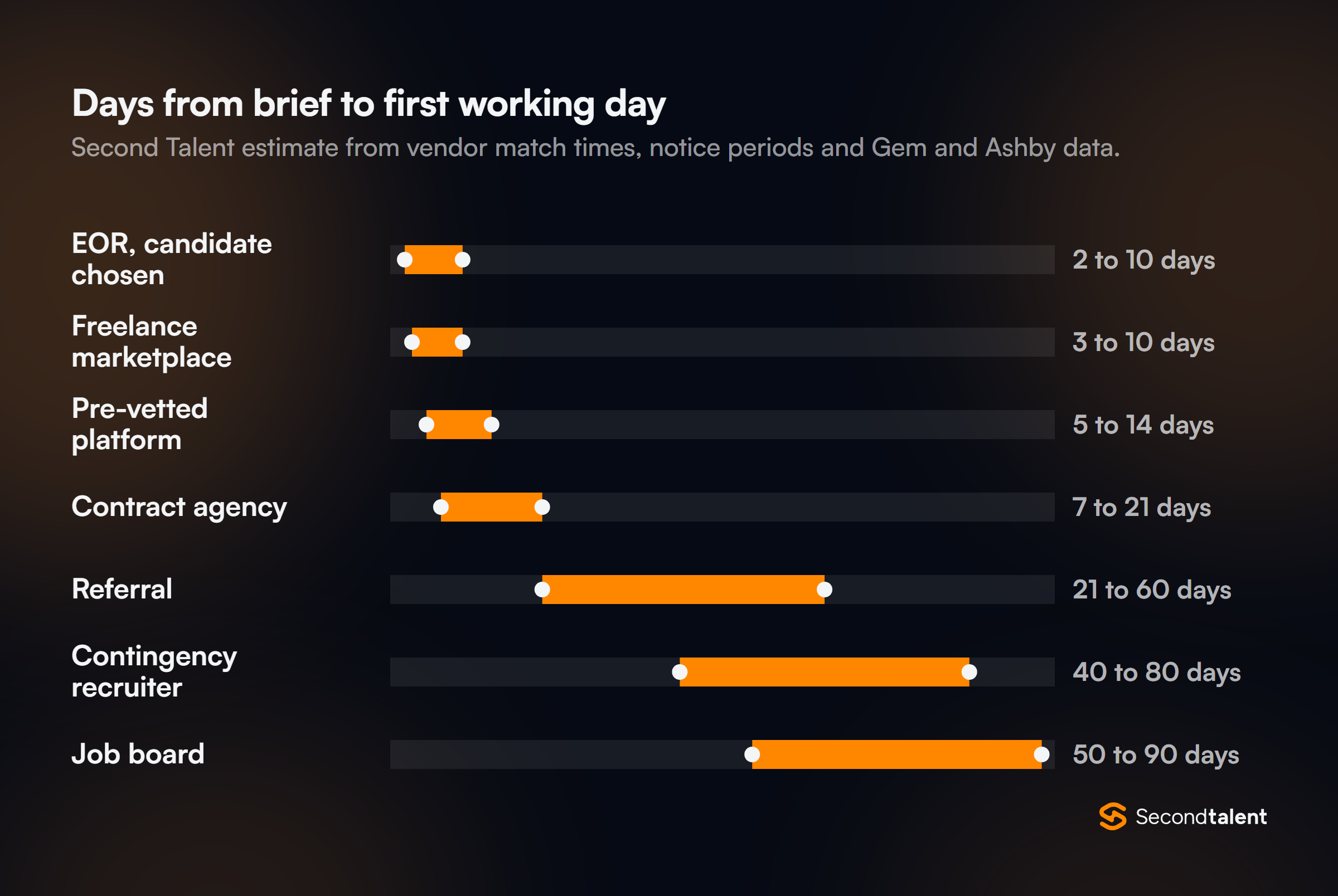
The pattern in the table comes down to one question: is the engineer free to start next week? Platforms and marketplaces keep lists of people who are.
Recruiters and job boards reach engineers who, for the most part, have a job, and UK law alone requires one week's notice after a month of service, and a contract can set a longer period.
The request I hear most from hiring leaders is a senior engineer who can start on Monday. The answer depends less on the channel than on whether that engineer has already left their last job.
Why a Normal Engineering Search Takes Two Months
All three trackers below put a standard hire past a month, and engineering sits at the slow end. The trackers measure different spans, so read them side by side rather than as one number.
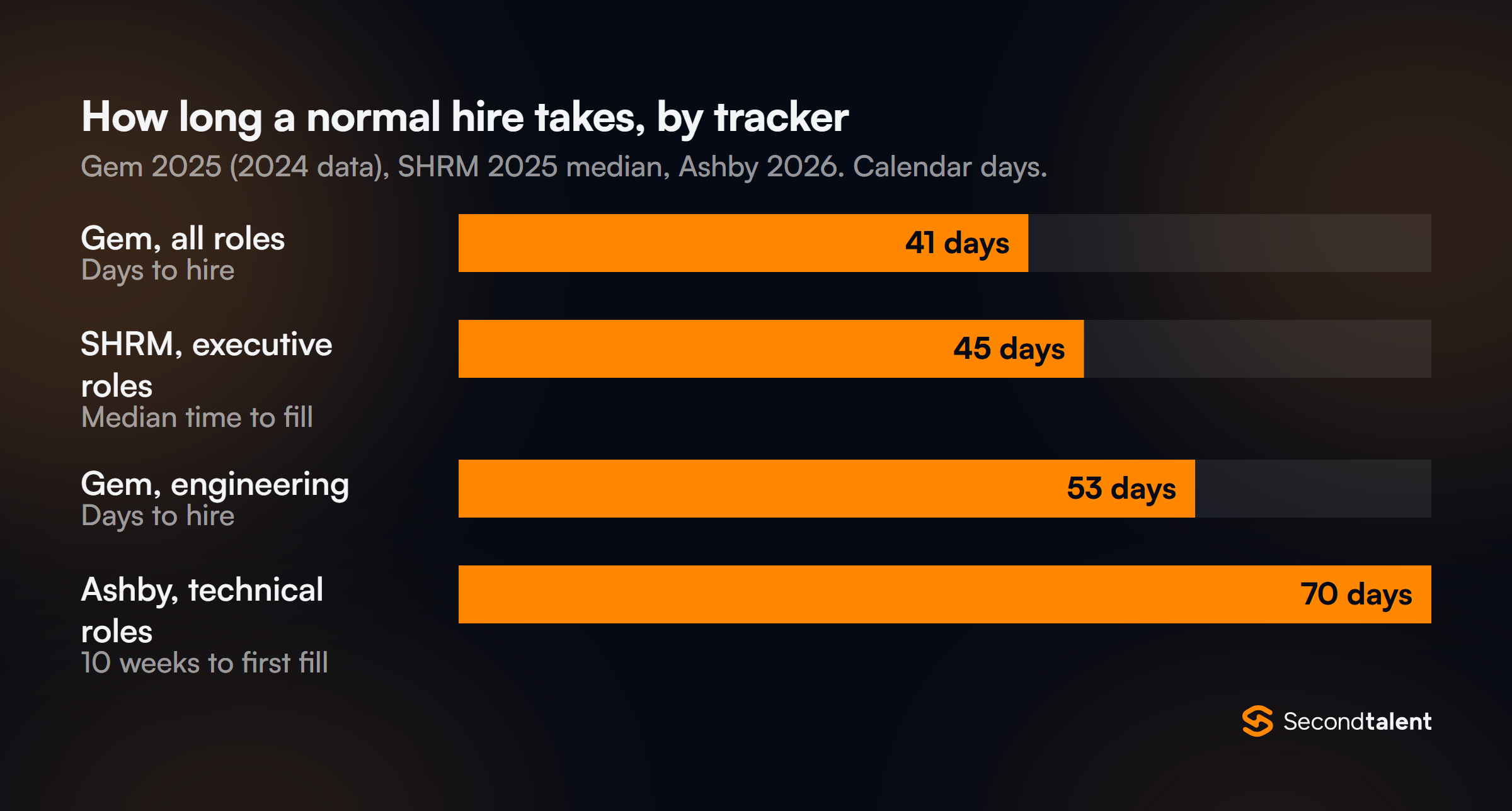
- Gem: the 2025 Recruiting Benchmarks report counts 41 days to hire across all roles in 2024 and 53 for engineering, from application to hire.
- SHRM: its 2025 benchmarking brief puts median time to fill at about a month and a half, measured from requisition to accepted offer. Executive roles took 45 days.
- Ashby: its 2026 data shows about 10 weeks to first fill for technical roles, against 8 for business roles, with more than 300 applications per hire.
None of those spans include the notice period. An engineer who accepts on day 53 and owes a month's notice under their contract starts around day 83. For a hire you needed yesterday, the route matters more than any fix to the loop.
- Interviews around a day job, so scheduling stretches
- Resigns only after a signed offer
- Owes notice: 1 week minimum in the UK, more if the contract says so
- Freelancer, contractor between engagements, or on a platform's bench
- Can do a paid trial this week
- Starts the day the contract is signed
Each Route: Speed, Cost and Risk
Pre-vetted talent platforms and staff augmentation
These providers screen engineers before a client asks, so the first shortlist arrives in a day or two instead of after weeks of sourcing. Several publish their match times on their own sites:
The start date depends on whether the matched engineer is free, which is why the realistic range runs to two weeks.
Toptal's FAQ also says 90% of its clients hire the first candidate introduced, and that clients can trial up to three people per position.
Staff augmentation works the same way with a longer contract: the engineer joins your standups and repo, and the provider handles employment. Our guide to staff augmentation costs and models covers the pricing structures.
The weak spot is a rare stack. Lemon.io says only 1% of applicants pass its vetting, and a small pool can be empty for a niche framework.
Freelance marketplaces
A marketplace is the quickest way to get proposals and the slowest way to get certainty. Proposals arrive fast, but the screening, the reference checks and the trial all fall to you.
On Upwork's free Basic plan, the Client Marketplace Fee is up to 7.99% of every payment, cut to 3% for qualifying U.S. clients who pay by bank account.
Use a marketplace for work you can scope in a paragraph, such as a migration, an integration or a bug backlog. For a core team member, the vetting burden erases the speed gain.
We compared the options in our list of freelance platforms for AI developers.
Contract and contract-to-hire agencies
Contract agencies keep contractors who roll off one client and need the next, so they can often fill a seat inside three weeks. Contract-to-hire adds an option to convert, for a fee set in the agreement.
It suits a team that needs output now and wants to judge fit on real work before a permanent offer. Our post on contract-to-hire for senior developers covers conversion terms and what to do when someone does not convert.
Contingency recruiters
A contingency recruiter can send CVs in a week, but most of the engineers on them have jobs. Dover's fee guide puts tech recruiter fees at 15% to 30% of first-year salary, or $18,000 to $36,000 on a $120,000 engineer.
That buys a permanent hire, not a fast one. See our breakdown of staffing agency fee structures for retained and markup models.
Referrals and internal moves
Referrals are the most efficient channel per application, and one of the slower ones per calendar day. In Gem's data, internal candidates were 0.27% of applications and 12.56% of hires, and referrals did almost as well.
Direct sourcing turned 2.47% of applications into 9.94% of hires.
The catch is timing. A referred engineer tends to be employed, so the notice period still applies.
The fast version is narrow: ask your team on day one who they know that is between jobs or freelancing right now, not who they rate in general.
Job boards
Job boards and sourcing sites brought in 48.98% of applications in Gem's data and 24.55% of hires. That is a lot of screening per hire, at a time when Ashby counts more than 300 applications for each one.
Post the role anyway if the hire is permanent, but do not count on it for a start date this month.
An employer of record for someone you already picked
An EOR does not find engineers. It employs the one you chose in a country where you have no entity, and it is fast once the candidate is free.
Deel says it can onboard a new employee "in as little as one day", and its pricing page lists EOR at $599 per employee per month, against $49 per contractor for contractor management.
Our comparison of EOR, PEO and contractor management explains when a contractor agreement is enough.
A 10-Day Playbook for an Urgent Engineering Hire
Ten working days is enough if each step overlaps the next. The chart shows who owns what; the steps below carry the detail.
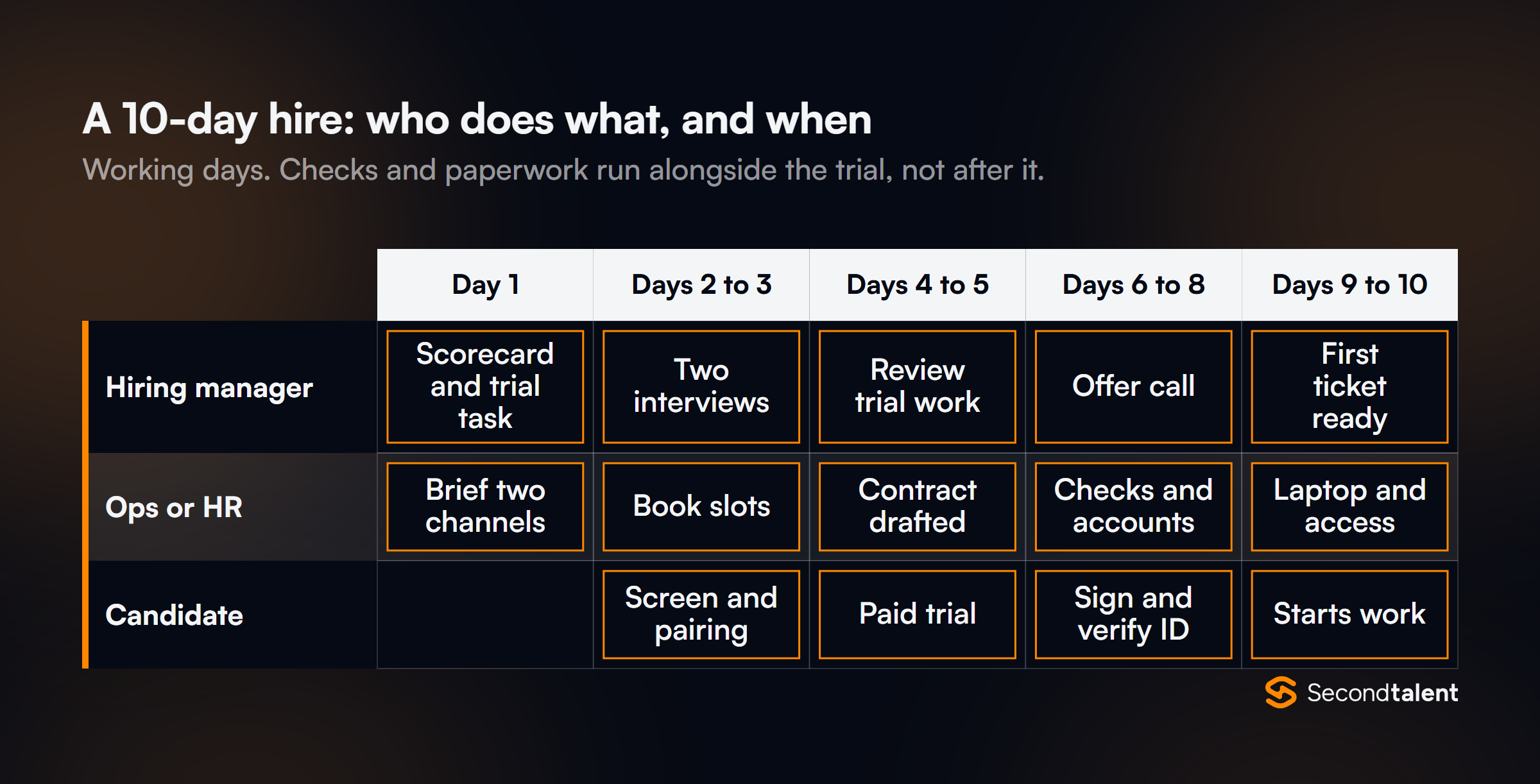
Day 1: Write a one-page brief and the trial task
The brief names the stack, the first two tickets the engineer will own, the time-zone overlap, the budget and the start date. Write the paid trial task the same day, from a real ticket.
Send the brief to two channels at most, for example one talent platform and your own team for referrals.
Most of the hiring leaders I talk to in a hurry have a start date and a budget but no written brief. Without one, each channel sends a different kind of engineer and the first week goes on sorting them.
Days 2 to 3: Two interviews, not five
Hold a 30-minute screen on scope, availability and rate, then one 60- to 90-minute pairing session on your own codebase.
Book both slots before candidates arrive, since scheduling is one of the largest delays Ashby found in technical hiring. For what to test in that session, see our guide on judging engineering quality in a remote hire.
Days 4 to 5: A paid trial on real work
Pay the finalist for 8 to 16 hours on the ticket you wrote on day one. Automattic requires a paid 5 to 40 hour trial on real work for all positions, so the model works past startup size.
A trial answers the questions a third interview cannot: how they ask for help, how they read unfamiliar code, and whether the pull request is mergeable. Draft the contract while the trial runs.
Days 6 to 8: Offer, checks and accounts together
Make the offer on a call the day the trial ends, and start background checks and account requests in the same hour.
Checkr says employment background checks take three to five days on average, while 89% of its criminal checks finish within an hour, so the check fits inside the gap before the start date.
For a U.S. employee, paperwork has a legal clock too. USCIS requires employers to complete Form I-9 Section 2 within three business days of the first day of paid work.
Days 9 to 10: Access ready before the first standup
Have the laptop, repo access, staging credentials and a named buddy ready before day one. A fast hire who then waits three days for permissions loses the time you saved. Size the first ticket to merge within the first week.
Our 90-day onboarding blueprint picks up from there.
Hiring Fast Without Hiring the Wrong Person
A compressed process removes the interviews where a fake candidate tends to slip up, so identity checks move up the list.
Gartner's 2025 survey of 3,000 candidates found 6% admitted to interview fraud, and Gartner predicts one in four candidate profiles worldwide will be fake by 2028.
- Verify identity at the offer, not after the start: a document check with a live video match, plus a quick call to one past manager.
- Keep the camera on in the pairing session and ask the candidate to explain a change they made a minute earlier.
- Put a replacement term in writing. A provider that trials, replaces or does not bill for a poor fit carries the risk you cannot vet away in five days.
- Start on a contract with a short notice clause if you are unsure, then convert. That keeps your exit cheap.
For other ways to add capacity without new full-time roles, see how to scale a development team without adding headcount.
Get Pre-Vetted Engineers Matched in 24 Hours
We run the first half of this playbook before you arrive. Second Talent keeps a pool of more than 100,000 developers across Asia, screened and tested on real code, and sends the top 6 to 8 profiles for your brief within 24 hours.
You pay nothing upfront and nothing until you hire, and engineers hired through us cost 50% to 70% less than a comparable U.S. hire. Send us the brief and you can be pairing with candidates this week.
Frequently Asked Questions
Can I hire a software engineer in one week?
Yes, if the engineer is available now and you use a pre-vetted platform or marketplace. Plan one screen, one pairing session and a short paid trial, with contract and accounts prepared in parallel.
Is a contractor or an employee faster to hire?
A contractor, because there is no payroll setup and, in many cases, no notice period. Our post on contract vs direct hire covers when to convert and the misclassification risk.
How much does a paid trial cost?
The candidate's hourly rate for 8 to 16 hours. On a platform with a no-risk trial, such as Toptal's, you may pay nothing if the fit is wrong.