TL;DR: Contract-to-hire reduces risk when hiring senior developers. You test fit before committing. But it has tradeoffs in cost, candidate pool, and relationship dynamics.
Hiring senior developers is expensive and risky. A bad hire costs 1.5-2x their annual salary according to research on hiring costs. What if you could test before committing? That is the promise of contract-to-hire.
Contract-to-hire means hiring someone as a contractor first, then converting them to full-time if things work out. It is increasingly popular for senior technical roles. But it is not right for every situation.
We help companies hire senior developers at Second Talent. We see contract-to-hire work well and fail badly. This guide covers when to use it, how to structure it, and what pitfalls to avoid.
What’s your hiring situation?
Select your situation below.
You need battle-tested senior talent without the 1.5-2x salary risk of a bad hire. Our developers come pre-vetted with proven track records in your tech stack. Start with confidence, not guesswork. Browse senior developers →
You’re building distributed teams and need developers who excel remotely. Vietnam offers senior full-stack developers at 50-70% lower costs than Western markets, with strong English and timezone overlap. See Vietnam developer rates →
You want the trial period benefits without contractor complications. Our Employer of Record service handles compliance, payroll, and benefits while you evaluate fit. Convert seamlessly when ready. Get EOR pricing →
You need accurate salary data to budget your contract-to-hire strategy. Our rate card shows what senior developers actually cost across Southeast Asia, broken down by role and seniority level. View developer rate card →
Contract-to-Hire Overview
Contract-to-hire sits between pure contracting and direct hiring. Here is how the models compare.
| Aspect | Direct Hire | Contract-to-Hire | Pure Contract |
|---|---|---|---|
| Initial commitment | Full employment | Trial period (typically 3-6 months) | Project or time-based |
| Risk level | High for employer | Medium for both parties | Low for employer |
| Cost structure | Salary + benefits | Higher hourly rate, then salary | Highest hourly rate |
| Candidate pool | Largest | Medium | Smallest for senior roles |
| Conversion expectation | N/A | Yes, if successful | No |
| Relationship dynamic | Employee from day one | Trial period mentality | Vendor relationship |
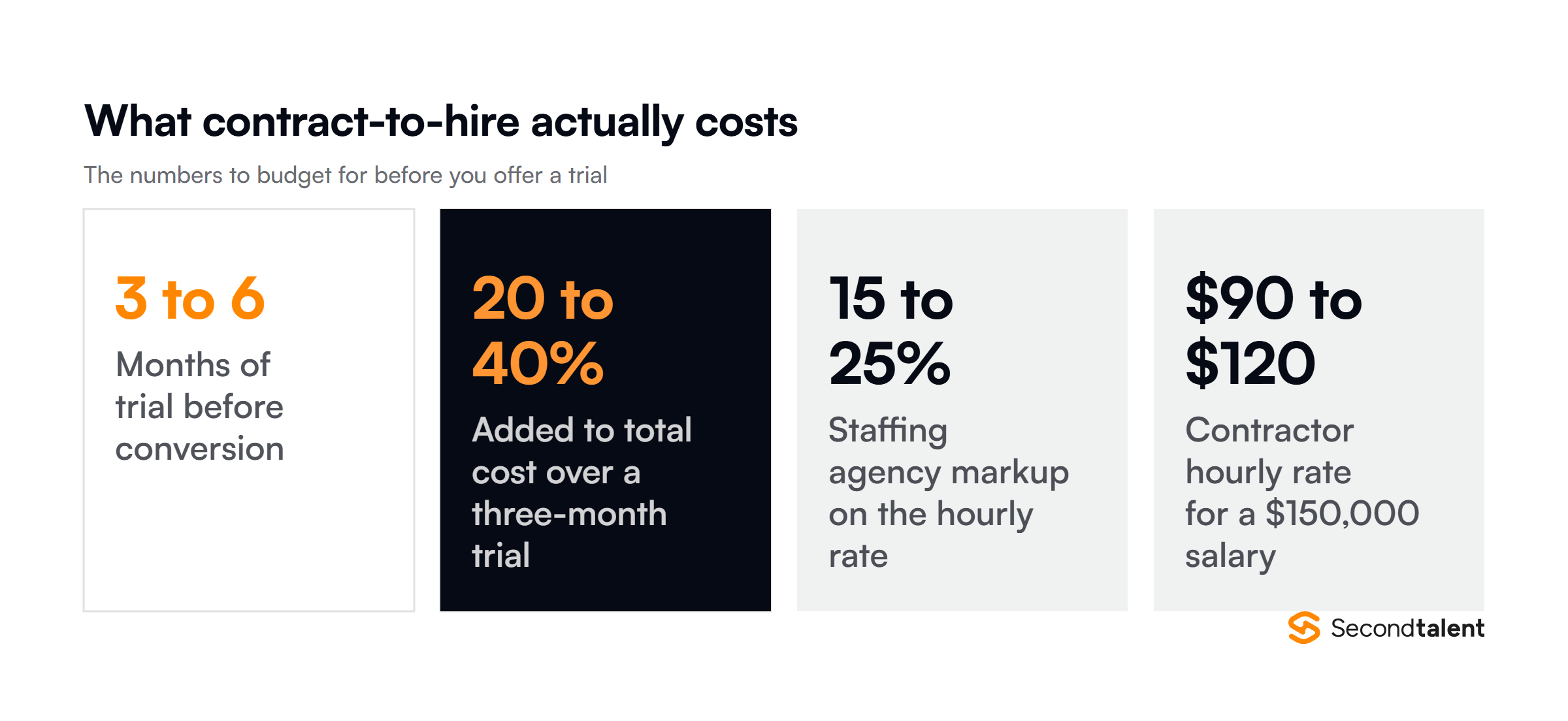
Contract-to-hire typically runs 3-6 months. During this period, the developer works as a contractor. If both parties are satisfied, they convert to full-time employment.
Pros of Contract-to-Hire
Contract-to-hire offers real advantages in the right situations.
Reduced Hiring Risk
The biggest benefit is risk reduction. Interviews reveal limited information. You learn much more by actually working with someone. Contract-to-hire lets you evaluate real performance before committing.
You see how they handle ambiguity. How they communicate under pressure. How they work with your specific team. How they respond to your codebase. These things are hard to assess in interviews.
According to SHRM’s 2024 Talent Trends research, companies using trial periods have significantly lower turnover in the first year compared to direct hires.
Better Culture Fit Assessment
Culture fit is notoriously hard to evaluate in interviews. People present their best selves. Real personality emerges over time.
A contract period reveals actual working style. Do they collaborate or isolate? Do they handle feedback well? Do they fit your communication patterns? You learn these things by working together.
Faster Initial Engagement
Contract engagements often start faster than full-time hiring. Less paperwork. Fewer approvals. Simpler negotiations. Some candidates can start within a week of agreement.
This speed helps when you need someone quickly but still want to evaluate fit before committing long-term.
Flexibility for Both Parties
The arrangement gives flexibility to both sides. The company can end the contract if things do not work. The developer can walk away if the job is not what they expected. Neither party is trapped.
This mutual flexibility actually improves outcomes. Both parties enter knowing they need to prove themselves. There is less complacency than in a guaranteed position.
Budget Flexibility
Contract workers come from different budget lines than employees. Some companies have contractor budget available when headcount is frozen. Contract-to-hire lets you bring in talent now and convert when headcount opens.
Cons of Contract-to-Hire
Contract-to-hire has significant downsides. Consider these carefully.
Smaller Candidate Pool
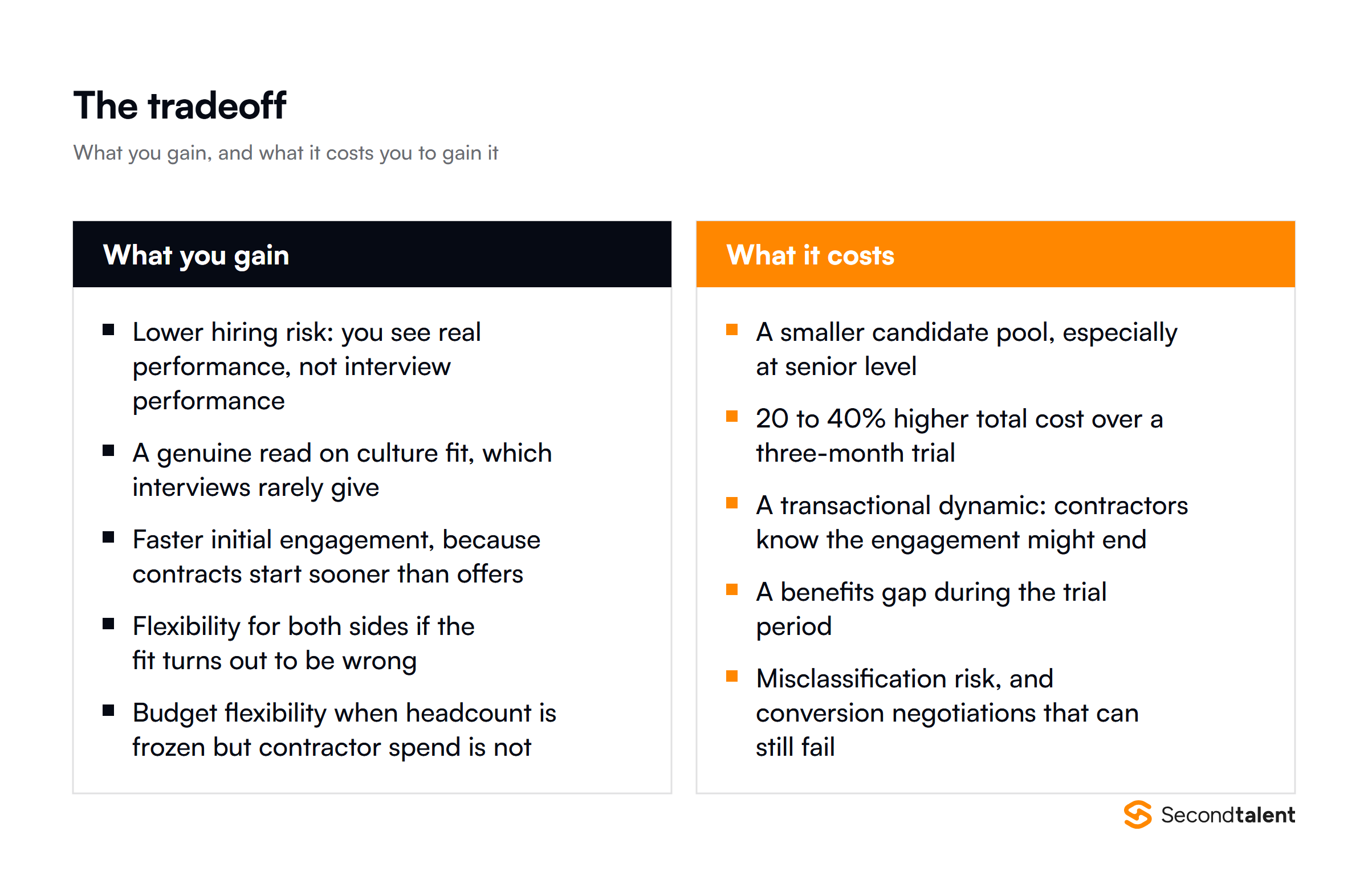
Many senior developers refuse contract-to-hire arrangements. They want job security. They want benefits from day one. They have enough options that they do not need to “prove themselves” again.
According to LinkedIn’s Global Talent Trends, many senior developers prefer direct hire over contract-to-hire. You lose access to a significant portion of the candidate pool by requiring a contract period.
The best candidates often have multiple offers. They will choose the company offering full employment over one requiring a trial.
Higher Initial Cost
Contractors cost more per hour than employees. A senior developer earning $150,000 in salary might cost $90-120/hour as a contractor. Over a three-month trial, the contractor rate adds 20-40% to total cost.
You also pay agency fees if using a staffing firm. These typically range from 15-25% markup on the hourly rate. The cost difference adds up.
Check our developer rate card for current contractor rates by experience level and region.
Commitment and Loyalty Issues
Contractors know the engagement might end. This affects their behavior. They might not invest deeply in the company. They might keep looking for other opportunities. They might hold back ideas they want to save for a permanent role.
The trial period creates a transactional dynamic. Both parties hedge their bets. This is the opposite of the engagement and loyalty you want from a senior hire.
Benefits Gap
Contractors do not receive employee benefits during the trial. No health insurance from you. No retirement contributions. No stock options vesting.
Some contractors maintain their own benefits. Others go without. Either way, this creates inequality if they work alongside full-time employees doing similar work.
Legal and Classification Risks
Misclassifying employees as contractors creates legal risk. If a contractor works like an employee (fixed hours, company equipment, long-term engagement), they might be reclassified legally. This creates tax and labor law exposure.
Contract-to-hire periods under 3 months are especially risky. Very short trials look like extended interviews rather than genuine contract work.
Conversion Friction
Converting from contractor to employee is not automatic. Salary negotiations reopen. Benefits must be set up. Paperwork must be completed. Some conversions fail at this stage.
The developer might want a higher salary than you planned. They might have found another offer during the trial. The conversion process adds another point of potential failure.
When Contract-to-Hire Makes Sense
Contract-to-hire works best in specific situations.
| Situation | Why Contract-to-Hire Fits |
|---|---|
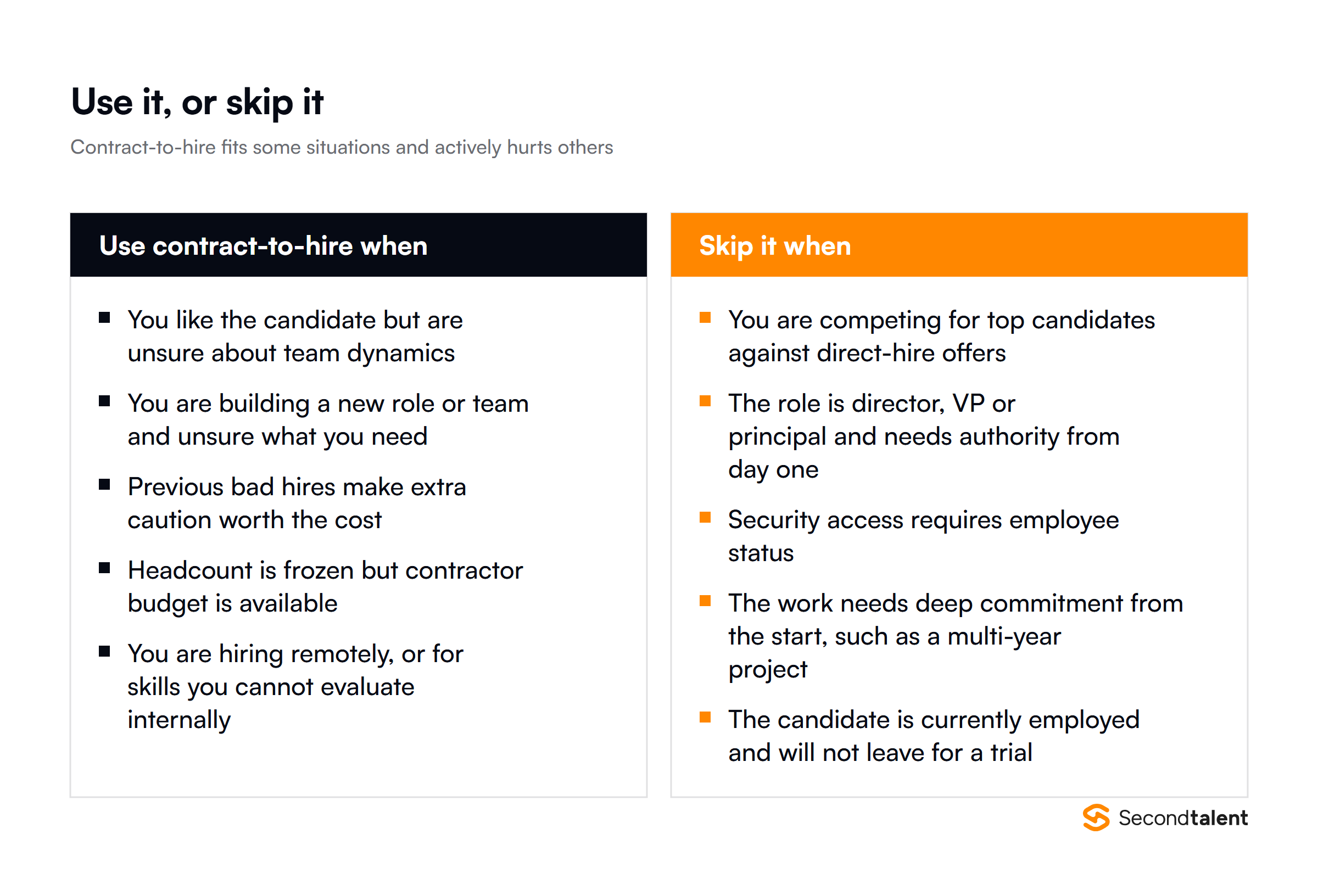
| Uncertain team fit | You like the candidate but worry about team dynamics |
| New role or team | You are building something new and unsure what you need |
| Previous bad hires | You have been burned before and want extra caution |
| Budget constraints | You have contractor budget but headcount is frozen |
| Candidate preference | The candidate prefers to try before committing |
| Remote hiring | Extra evaluation helps when you cannot meet in person |
| Specialized skills | You are hiring for skills you cannot evaluate well internally |
The common thread is uncertainty. When you are confident in the hire, direct employment is usually better. When you have doubts, contract-to-hire provides a safety net.
When to Avoid Contract-to-Hire
Contract-to-hire is wrong in these situations.
Competitive talent market. If you are competing for top candidates against companies offering direct hire, contract-to-hire puts you at a disadvantage. The best candidates will choose certainty.
Senior leadership roles. Director, VP, or principal engineer roles need authority from day one. A contract status undermines their ability to lead and make decisions.
Access requirements. Some systems and clients require employee status for security access. Contractors may be blocked from critical work.
Long-term commitment needed. If the role requires deep company investment from the start (reorganization, multi-year projects), the trial mentality works against you.
Candidate is currently employed. Asking employed candidates to leave their job for a trial position is a hard sell. They have security now. Why trade it for uncertainty?
Best Practices for Contract-to-Hire
If you use contract-to-hire, follow these practices to improve outcomes.
Set Clear Expectations Upfront
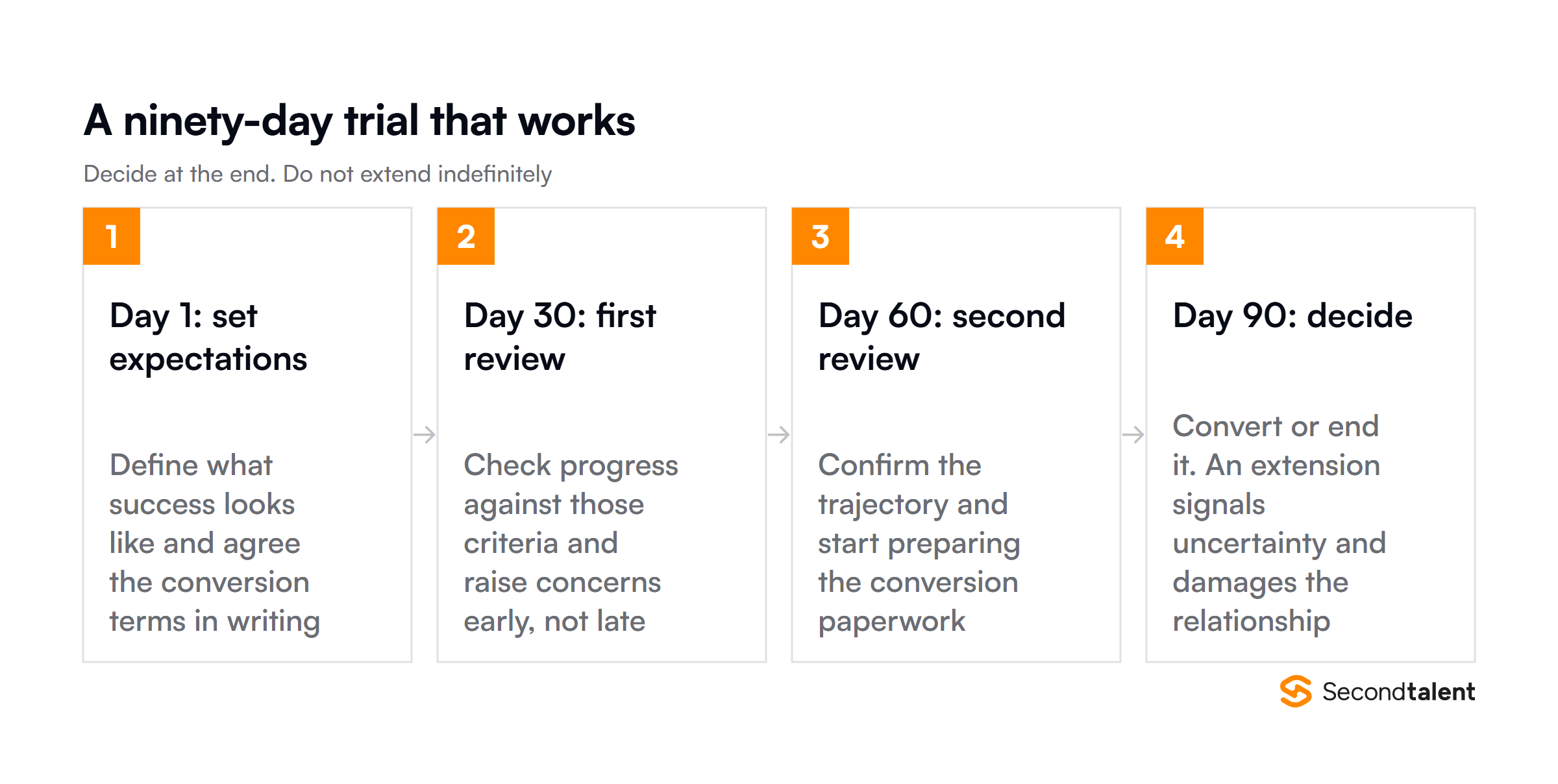
Define what success looks like. What must happen for conversion? What would cause the contract to end? Write these expectations down and share them with the candidate.
Vague criteria create anxiety. “We will see how it goes” is not a plan. Specific goals like “complete onboarding, ship two features, receive positive peer feedback” are better.
Agree on Conversion Terms Early
Discuss full-time salary, benefits, and start date before the contract begins. Do not leave these as surprises for later negotiation.
A common approach: agree on the full-time salary range upfront, with the exact number determined during conversion based on performance. This sets expectations while allowing flexibility.
Keep the Trial Period Reasonable
Three months is typical. Long enough to evaluate performance. Short enough to respect the candidate’s time and career.
Trials longer than six months are problematic. If you cannot decide in six months, something else is wrong. Either the evaluation criteria are unclear or you are using the candidate without commitment.
Treat Contractors Like Team Members
Include contractors in team meetings, planning sessions, and social events. Do not treat them as second-class citizens. The goal is to evaluate fit. You cannot evaluate fit if you exclude them.
Access appropriate information and systems. Within legal limits, give them what they need to do real work. Token tasks do not show how someone performs on real challenges.
Provide Regular Feedback
Do not wait until the end to share concerns. Weekly check-ins help catch issues early. If something is not working, say so. Give the person a chance to improve.
A good structure: weekly informal check-ins, formal reviews at day 30 and day 60, conversion decision at day 90.
Make a Decision and Commit
When the trial ends, decide clearly. Convert or end the contract. Do not extend indefinitely. Extensions signal uncertainty that damages the relationship.
If you convert, commit fully. Stop treating them as “the former contractor.” They are now an employee like anyone else.
Structuring the Contract
The contract itself needs careful attention. Key elements to include:
Duration. Specify the trial length. Include provisions for early termination by either party.
Rate and payment terms. Define hourly rate, payment frequency, and invoicing process.
Conversion terms. State the intention to convert and general terms. Specify what triggers the conversion discussion.
IP and confidentiality. Ensure work product belongs to the company. Include appropriate NDAs.
Termination clause. Define notice period for ending the contract. Two weeks is typical.
Work arrangements. Specify hours, location, equipment, and reporting structure.
Consider using an Employer of Record service for international contract-to-hire arrangements. This simplifies legal compliance across borders.
Contract-to-Hire for Remote Senior Developers
Contract-to-hire is especially popular for remote hiring. The extra evaluation period helps when you cannot meet in person.
We use contract-to-hire arrangements with many placements from Vietnam and Philippines. It gives both parties confidence when working across borders.
For remote contract-to-hire, pay extra attention to:
- Communication patterns during the trial
- Time zone overlap and availability
- Self-direction and initiative
- Quality of async communication
- Cultural alignment in remote context
These factors matter more for remote work than in-office roles.
Conversion Process
When the trial succeeds, execute conversion smoothly.
Step 1: Formal decision. Confirm with all stakeholders that you want to convert. Get necessary approvals.
Step 2: Offer presentation. Present the full-time offer. Include salary, benefits, start date, and role details. Make it a real offer, not a formality.
Step 3: Negotiation. Be prepared for some negotiation. The candidate now has leverage. They have proven their value. Fair negotiation strengthens the relationship.
Step 4: Paperwork. Complete employment agreements, benefits enrollment, and system transitions. Allow a few days for processing.
Step 5: Transition. Mark the transition clearly. Announce their new status. Update systems. Celebrate the conversion.
Handling Non-Conversion
Sometimes conversion does not happen. Handle this professionally.
If you choose not to convert, be direct and respectful. Explain the decision clearly. Provide feedback they can use elsewhere. Give appropriate notice per the contract.
If they choose not to convert, learn why. Their feedback helps improve your process and work environment. Do not take it personally.
Either way, maintain professionalism. The tech world is small. Today’s non-conversion might be tomorrow’s referral or client.
Conclusion
Contract-to-hire is a useful tool for reducing senior developer hiring risk. It lets you evaluate real performance before committing to full employment. This is valuable when you have uncertainty about fit.
But it has real downsides. Smaller candidate pool. Higher initial cost. Complicated relationship dynamics. These tradeoffs matter.
Use contract-to-hire when uncertainty justifies the cost. Skip it when you have strong conviction in the hire or when competing for top talent. Structure it carefully with clear expectations, reasonable duration, and defined conversion terms.
The goal is always the same: finding great senior developers who succeed in your organization. Contract-to-hire is one path to that goal, not the only path.
Hire vetted remote senior developers with Second Talent. We offer flexible engagement models including contract-to-hire to fit your needs.
Hiring contractors rather than employees changes the arithmetic. The freelance developer rate index prices 14 roles across nine regions, benchmarked against North America and sourced from published wage data.



![Workplace Diversity Statistics. Top 100+ Workplace Diversity Statistics [2026], by Second Talent.](https://www.secondtalent.com/wp-content/uploads/2026/09/workplace-diversity-statistics-featured-v2-768x403.jpg)

![Tech Industry Hiring Statistics. Top 50+ Tech Industry Hiring Statistics: Salaries, Skills Demand [2026], by Second Talent.](https://www.secondtalent.com/wp-content/uploads/2026/09/tech-industry-hiring-statistics-featured-v2-768x403.jpg)