TL;DR: Build intelligent AI agents with these 8 leading frameworks, from LangChain's flexibility to CrewAI's team-based orchestration and AutoGen's multi-agent collaboration.
The AI agents market has exploded from $5.40 billion in 2024 to $7.63 billion in 2025, with projections reaching $50.31 billion by 2030 at a remarkable 45.8% CAGR.
This growth reflects a fundamental shift from passive AI tools to autonomous systems capable of reasoning, planning, and executing complex tasks.
According to McKinsey, 23% of organizations are already scaling agentic AI systems, with another 39% actively experimenting.
For startups and development teams building the next generation of AI applications, choosing the right agent framework directly impacts development speed, system reliability, and long-term maintainability.
The wrong choice can result in architectural limitations that become painful as applications scale.
This guide examines the 8 leading frameworks for building AI agents in 2026, helping AI developers and technical leaders make informed decisions based on their specific requirements.
What’s your AI agent development need?
Select your situation below.
You need experienced developers who’ve shipped LangChain, AutoGen, or CrewAI projects. Our AI engineers average 5+ years in machine learning and cost 50-70% less than US hires. Pre-vetted, English-fluent, and ready in 2 weeks. Hire AI developers →
You’re targeting Southeast Asia’s fastest-growing tech hub. Vietnam offers 500,000+ developers with strong Python and ML expertise at $3,500-6,000/month for senior AI engineers. Lower costs than Singapore, higher English proficiency than Indonesia. Explore Vietnam AI talent →
You need accurate budget planning for your AI agent project. Our 2026 rate card shows LLM framework specialists earn $4,200-7,500/month in Philippines, $5,000-8,500 in Vietnam, and $6,500-12,000 in Singapore. Get real numbers from 2,000+ placements. View Asia salary benchmarks →
You want to hire in Vietnam, Philippines, or Singapore but don’t have a legal entity. Our EOR handles payroll, compliance, and benefits in 5 countries so you can onboard AI engineers in 7 days. 23% of companies now use agentic AI: don’t let admin slow you down. Get EOR pricing →
Quick Comparison: AI Agent Frameworks at a Glance
Before exploring each framework in detail, here is a summary table comparing their key characteristics and ideal use cases.
| Framework | Developer | Best For | Multi-Agent | Learning Curve |
|---|---|---|---|---|
| LangChain | LangChain Inc. | General-purpose, flexibility | Via LangGraph | Moderate |
| LangGraph | LangChain Inc. | Stateful, complex workflows | Yes | Steep |
| AutoGen | Microsoft | Multi-agent collaboration | Core feature | Moderate |
| CrewAI | CrewAI | Team-based orchestration | Core feature | Easy |
| LlamaIndex | LlamaIndex Inc. | RAG-centric agents | Limited | Easy |
| Semantic Kernel | Microsoft | Enterprise .NET/Python | Yes | Moderate |
| Haystack | deepset | Production NLP pipelines | Limited | Moderate |
| OpenAI Agents SDK | OpenAI | OpenAI-native development | Yes | Easy |
Why AI Agent Frameworks Matter
AI agents represent a paradigm shift from simple prompt-response interactions to autonomous systems that can plan, reason, use tools, and accomplish complex goals.
Unlike traditional chatbots, agents maintain state across interactions, decompose problems into steps, and adapt their approach based on intermediate results.
Building agents from scratch requires solving numerous challenges: managing conversation state, implementing tool calling, handling errors gracefully, coordinating multiple specialized agents, and ensuring reliable execution.
Agent frameworks provide battle-tested solutions to these problems, allowing teams to focus on application logic rather than infrastructure.
According to industry research, 85% of organizations have integrated AI agents into at least one workflow, with business process automation leading adoption at 64% of deployments.
The most in-demand AI engineering skills now include agent development expertise.
1. LangChain
Best for: General-Purpose Agent Development
LangChain launched in 2022 and rapidly evolved into the most widely adopted framework for building LLM-powered applications. Its modular architecture provides building blocks for chains, agents, memory, and tool integration.
The extensive ecosystem includes integrations with virtually every major LLM provider, vector database, and external service.
The framework excels at flexibility. Whether you need a simple chatbot with document retrieval or a complex multi-step agent, LangChain provides the primitives.
The LangChain Expression Language (LCEL) enables declarative composition of components, while LangSmith provides observability for debugging and optimization.
Pricing
| Plan | Price | Includes |
|---|---|---|
| LangChain (Open Source) | Free | Full framework, all features |
| LangSmith Developer | Free | 5K traces/month, 14-day retention |
| LangSmith Plus | $39/seat/month | Unlimited traces, 400-day retention |
| LangSmith Enterprise | Custom | SSO, advanced security, SLA |
Pros and Cons
| Pros | Cons |
|---|---|
| Extensive LLM and tool integrations | Steep learning curve for advanced features |
| Large community and documentation | Rapid API changes between versions |
| LangSmith for observability | Can be over-engineered for simple tasks |
| Production-ready with enterprise support | Abstraction overhead for simple use cases |
| Active development and updates | Complex debugging without LangSmith |
Use Cases
- RAG applications with complex retrieval logic
- Customer support agents with tool access
- Document processing and analysis pipelines
- Multi-step reasoning agents
- Chatbots with persistent memory
2. LangGraph
Best for: Complex Stateful Workflows
LangGraph models agents as finite state machines where each node represents a reasoning or tool-use step. This graph-based approach makes it especially powerful for multi-turn, conditional, and retry-prone workflows.
Built on top of LangChain, it adds the explicit state management that complex agents require.
The framework shines when agents need branching logic, parallel execution, or human-in-the-loop checkpoints. You define states, transitions, and conditions declaratively, making agent behavior explicit and debuggable.
For applications requiring auditability or regulatory compliance, this transparency proves invaluable.
Pricing
| Plan | Price | Includes |
|---|---|---|
| LangGraph (Open Source) | Free | Full framework, all features |
| LangGraph Platform Developer | Free | Self-hosted deployment |
| LangGraph Platform Plus | $39/seat/month | Cloud hosting, scaling features |
| LangGraph Platform Enterprise | Custom | Dedicated infrastructure, SLA |
Pros and Cons
| Pros | Cons |
|---|---|
| Graph-based control flow | Steeper learning curve than LangChain |
| Explicit state management | Requires graph theory understanding |
| Human-in-the-loop support | Overkill for simple agents |
| Parallel node execution | Debugging complex graphs can be difficult |
| Built-in persistence and checkpointing | Tied to LangChain ecosystem |
Use Cases
- Complex approval workflows with human oversight
- Multi-step business process automation
- Agents requiring audit trails and compliance
- Parallel task execution with synchronization
- Long-running agents with state persistence
3. AutoGen
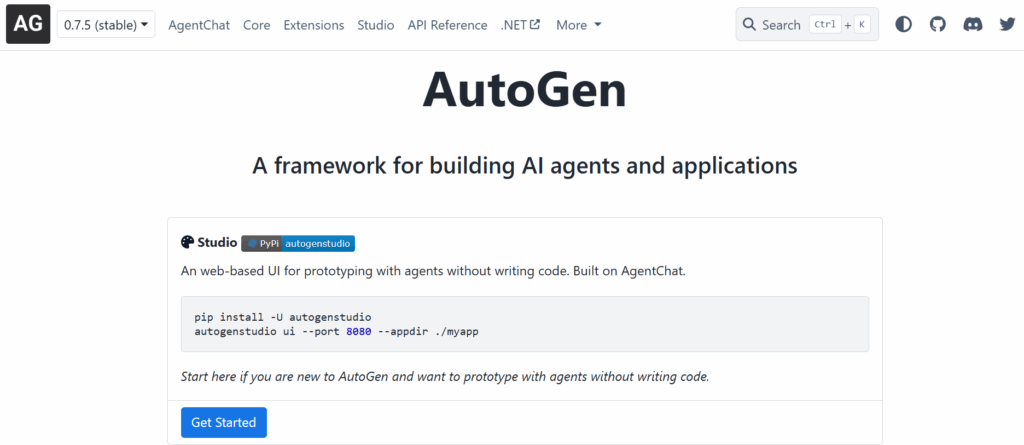
Best for: Multi-Agent Collaboration
AutoGen, developed by Microsoft Research, is built around collaborative reasoning through conversation. Agents interact via structured natural language messages in a group chat-style architecture.
Each agent receives a role, goal, and optional tools, enabling sophisticated collaboration patterns.
The framework excels at scenarios requiring multiple specialized agents working together: a researcher agent gathering information, an analyst agent processing findings, and a writer agent producing reports.
Human-in-the-loop oversight allows agents to coordinate while receiving guidance from developers or end-users.
Pricing
| Plan | Price | Includes |
|---|---|---|
| AutoGen (Open Source) | Free | Full framework, MIT license |
| Azure OpenAI Integration | Azure pricing | Enterprise Azure features |
| AutoGen Studio | Free | Visual agent builder interface |
Pros and Cons
| Pros | Cons |
|---|---|
| Conversational multi-agent architecture | Can be chatty between agents |
| Human-in-the-loop oversight | Token costs from agent conversations |
| Asynchronous task execution | Less mature than LangChain |
| Microsoft enterprise support | Debugging multi-agent flows complex |
| Code execution capabilities | Fewer integrations than competitors |
Use Cases
- Research teams with specialized expert agents
- Code generation and review workflows
- Content creation with editor/writer dynamics
- Complex problem-solving with debate patterns
- Enterprise automation with oversight requirements
4. CrewAI
Best for: Team-Based Agent Orchestration
CrewAI takes inspiration from human organizational structures, encouraging developers to define agents as specialized team members with distinct roles like Planner, Researcher, or Writer.
This mental model makes agent design intuitive for teams familiar with project management concepts.
The framework supports connections to various LLMs including GPT, Claude, and Gemini, plus a suite of RAG tools for accessing external data.
The role-based design naturally maps to real business workflows, making it easy to translate existing processes into agent teams.
Pricing
| Plan | Price | Includes |
|---|---|---|
| CrewAI (Open Source) | Free | Full framework, Apache 2.0 license |
| CrewAI Enterprise | From $200/month | Hosted platform, monitoring |
| CrewAI Enterprise Plus | Custom | Dedicated support, SLA |
Pros and Cons
| Pros | Cons |
|---|---|
| Role-based agent design | Less flexible than LangChain |
| Intuitive team metaphor | Smaller community |
| Multiple LLM support | Fewer integrations available |
| Built-in RAG capabilities | Less suitable for non-team patterns |
| Rapid development speed | Enterprise features require paid plan |
Use Cases
- Content creation teams (writer, editor, researcher)
- Sales automation with lead qualification
- Marketing campaign generation
- Business process automation
- Research synthesis and report generation
For teams that need execution beyond the AI agent layer, sales automation tools can centralize lead capture, follow-up reminders, and pipeline updates.
Where filling that pipeline from scratch is the bottleneck, B2B lead generation companies can source the leads for the agent crew to qualify and act on.
5. LlamaIndex
Best for: RAG-Centric Agent Applications
LlamaIndex started as a retrieval-augmented generation solution and evolved to include agent capabilities. The tooling around indexing data, chunking text, and bridging LLMs with knowledge bases remains best-in-class.
When your primary need is agents that act over documents, LlamaIndex provides unmatched depth.
The framework excels at enabling agents to query structured and unstructured documents intelligently.
Built-in support for various document formats, sophisticated chunking strategies, and multiple index types handles the complexity of real-world data.
Pricing
| Plan | Price | Includes |
|---|---|---|
| LlamaIndex (Open Source) | Free | Full framework, MIT license |
| LlamaCloud Starter | Free | 1K pages/week parsing |
| LlamaCloud Pro | From $500/month | Managed indexing, enterprise features |
| LlamaCloud Enterprise | Custom | Dedicated infrastructure, SLA |
Pros and Cons
| Pros | Cons |
|---|---|
| Best-in-class document processing | Agent features less mature |
| Multiple index types and strategies | Primarily focused on RAG |
| Query engines for complex retrieval | Multi-agent support limited |
| Seamless LLM integration | Smaller agent community than LangChain |
| Production-ready data connectors | Steeper learning for non-RAG use |
Use Cases
- Enterprise knowledge base Q&A
- Document analysis and summarization
- Research assistants over large document sets
- Legal and compliance document review
- Technical documentation search
6. Semantic Kernel
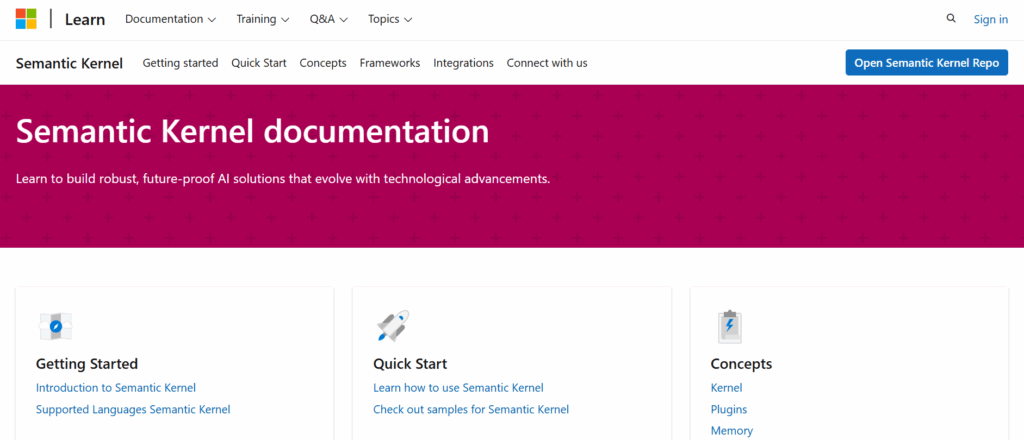
Best for: Enterprise .NET and Python Development
Semantic Kernel from Microsoft provides a lightweight SDK for integrating AI into existing applications. Available in both .NET and Python, it appeals to enterprise teams with existing Microsoft technology investments.
The framework emphasizes reliability, security, and integration with Azure services.
The plugin architecture allows packaging AI capabilities as reusable components that integrate with existing codebases. Planners enable agents to dynamically combine plugins to accomplish goals.
Pricing
| Plan | Price | Includes |
|---|---|---|
| Semantic Kernel (Open Source) | Free | Full SDK, MIT license |
| Azure OpenAI Service | Azure pricing | Enterprise Azure integration |
| Azure AI Studio | Azure pricing | Visual development environment |
Pros and Cons
| Pros | Cons |
|---|---|
| Native .NET and Python support | Smaller community than LangChain |
| Plugin architecture for reusability | Azure-centric design |
| Azure OpenAI integration | Fewer third-party integrations |
| Enterprise security features | Less suitable for non-Microsoft stacks |
| Microsoft support and documentation | Slower feature development |
Use Cases
- Enterprise .NET application AI integration
- Azure-based AI solutions
- Microsoft 365 automation
- Legacy system modernization with AI
- Corporate chatbots and assistants
7. Haystack
Best for: Production NLP Pipelines
Haystack by deepset provides an end-to-end framework for building production NLP applications.
Originally focused on question answering and search, it has evolved to support agent architectures while maintaining its emphasis on production readiness and enterprise features.
The pipeline abstraction organizes components into directed acyclic graphs, making complex workflows explicit and testable. Native support for evaluation and monitoring helps teams measure and improve agent performance over time.
Pricing
| Plan | Price | Includes |
|---|---|---|
| Haystack (Open Source) | Free | Full framework, Apache 2.0 license |
| deepset Cloud Starter | Free | Limited pipelines, community support |
| deepset Cloud Pro | From $500/month | Production pipelines, support |
| deepset Cloud Enterprise | Custom | Dedicated infrastructure, SLA |
Pros and Cons
| Pros | Cons |
|---|---|
| Pipeline-based architecture | Steeper learning curve |
| Built-in evaluation framework | Agent features less developed |
| Production monitoring tools | Smaller community |
| Extensive document processing | Less flexible than LangChain |
| Enterprise-ready deployment | Opinionated architecture |
Use Cases
- Enterprise search applications
- Production question-answering systems
- Document processing pipelines
- NLP applications requiring evaluation
- Regulated industry deployments
8. OpenAI Agents SDK
Best for: OpenAI-Native Development
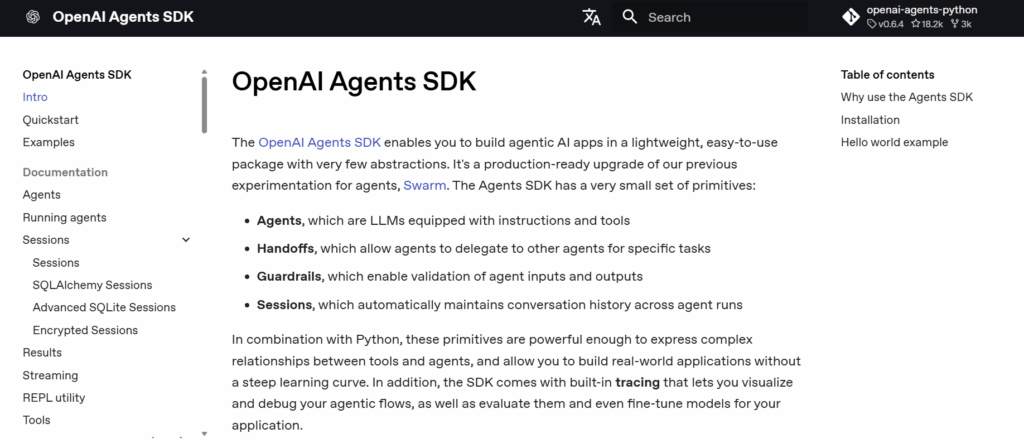
The OpenAI Agents SDK (formerly Assistants API) provides first-party support for building agents on OpenAI models.
With native function calling, code interpreter, and file search capabilities built directly into the API, it offers the most streamlined path to agent development for teams committed to OpenAI.
The managed infrastructure handles state persistence, tool execution, and conversation threading automatically. This dramatically reduces the code needed compared to building equivalent functionality with other frameworks.
Pricing
| Plan | Price | Includes |
|---|---|---|
| OpenAI API | Pay per token | GPT-4o: $5/1M input, $15/1M output |
| Code Interpreter | $0.03/session | Per session pricing |
| File Search | $0.10/GB/day | Vector storage for files |
| Enterprise | Custom | SSO, advanced security, SLA |
Pros and Cons
| Pros | Cons |
|---|---|
| Native OpenAI integration | Vendor lock-in to OpenAI |
| Managed state and threading | No model flexibility |
| Built-in code interpreter | Higher per-token costs |
| File search and retrieval | Limited customization |
| Minimal code required | Less control over execution |
Use Cases
- OpenAI-exclusive development shops
- Rapid prototyping with minimal code
- Code analysis and generation assistants
- Document Q&A with file search
- Internal tools where vendor lock-in is acceptable
Choosing the Right Framework
Selection depends on your use case, team expertise, and organizational constraints. The following table provides guidance based on common scenarios.
| Scenario | Recommended Framework | Reason |
|---|---|---|
| Quick prototyping | CrewAI or OpenAI SDK | Fastest time to working agent |
| Complex stateful workflows | LangGraph | Explicit state management |
| Document-heavy applications | LlamaIndex | Best-in-class retrieval |
| Multi-agent collaboration | AutoGen or CrewAI | Native multi-agent support |
| Enterprise .NET environment | Semantic Kernel | Native .NET support |
| Production NLP systems | Haystack | Enterprise features |
| Maximum flexibility | LangChain | Extensive integrations |
| OpenAI-committed teams | OpenAI Agents SDK | Simplest integration |
Conclusion
The AI agent framework landscape offers solutions for every team and use case.
From LangChain’s flexibility through CrewAI’s intuitive team model to OpenAI’s managed simplicity, the right choice depends on your specific requirements, existing technology stack, and team expertise.
For most teams starting agent development, CrewAI or LangChain provides the best balance of capability and approachability.
As applications mature and requirements become more sophisticated, frameworks like LangGraph or AutoGen offer the advanced features needed for complex production systems.
The rapid AI adoption across industries means agent development skills will only become more valuable.
Start experimenting with the frameworks that match your immediate needs, and build expertise that positions you for the agentic AI future.
Hire vetted remote AI developers with Second Talent to build intelligent AI agents and accelerate your automation initiatives.
Frequently Asked Questions
What is the difference between an AI agent and a chatbot?
Chatbots respond to individual messages without persistent goals or planning.
Agents maintain state, decompose complex tasks into steps, use tools to gather information or take actions, and work toward objectives across multiple interactions. Agents are goal-directed; chatbots are reactive.
Do I need a framework to build AI agents?
Technically no, but frameworks save significant development time by providing tested solutions for common challenges like state management, tool integration, and error handling.
Building production-quality agents from scratch requires solving many problems that frameworks have already addressed.
Which framework has the best performance?
Performance depends more on your LLM choice, prompt design, and architecture than framework selection. All frameworks in this guide add minimal overhead.
Focus on choosing the framework that best fits your use case and team, then optimize performance through prompt engineering and architecture.