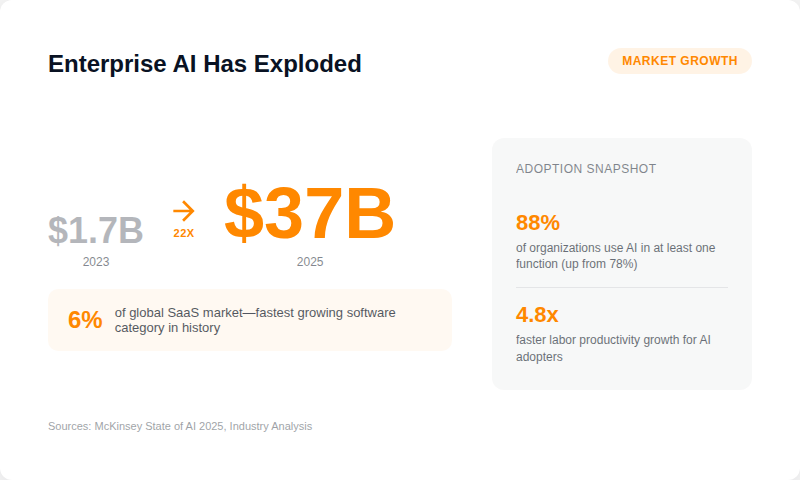
TL;DR: Healthcare leads AI adoption growth at 36.8% CAGR, followed by financial services and technology. Enterprise AI spending hit $37 billion in 2025, with 88% of organizations now using AI in at least one function.
Enterprise AI has surged from $1.7 billion to $37 billion since 2023, now capturing 6% of the global SaaS market and growing faster than any software category in history. According to McKinsey’s State of AI 2025 Survey, 88% of organizations now report regular AI use in at least one business function, up from 78% just a year ago.
But adoption rates vary dramatically across industries. While some sectors have integrated AI into core operations, others are just beginning their transformation journey. Understanding where AI adoption is accelerating fastest helps businesses benchmark their progress and identify opportunities to gain competitive advantage.
This guide examines the ten industries experiencing the fastest AI adoption in 2026, exploring what’s driving their transformation and what it means for companies looking to build AI capabilities.
What’s your AI hiring priority?
Select your situation below.
You need specialized AI talent to capitalize on the 36.8% industry growth rate. Our AI developers in Vietnam and Philippines cost 60-70% less than US hires while delivering enterprise-grade machine learning solutions. Start building your competitive advantage today. Hire AI developers →
You’re implementing AI across multiple business functions like the 88% of organizations already using it. Our full-stack developers integrate AI APIs, build custom interfaces, and deploy solutions faster. Get senior talent at $3,500-6,000/month in Southeast Asia. Compare full-stack rates →
Your AI adoption depends on clean, structured data pipelines. Our data engineers build the infrastructure that 88% of AI-using organizations rely on. Access senior talent in Vietnam and Philippines at rates 65% below Western markets while maintaining quality. Hire data engineers →
You’re planning your AI transformation budget in a market growing from $37 billion. Our 2026 salary data covers AI developers, data engineers, and ML specialists across Vietnam, Philippines, Indonesia, and Malaysia. Make informed hiring decisions with real market rates. View Asia salary index →
Industry Adoption and Growth Rate
The following table summarizes AI adoption rates and key metrics across all ten industries.
| Industry | Adoption Rate | Growth Rate (CAGR) | Primary Use Case | Avg. ROI |
|---|---|---|---|---|
| Healthcare | 78% | 36.8% | Clinical decision support | 3.2x |
| Financial Services | 71% | 19.6% | Fraud detection | 4.1x |
| Technology | 83% | 27% | Software development | 3.7x |
| Media/Telecom | 78% | 24% | Content recommendation | 3.5x |
| Insurance | 73% | 22% | Claims processing | 3.9x |
| Manufacturing | 77% | 18% | Predictive maintenance | 2.8x |
| Retail | 77% | 21% | Personalization | 3.7x |
| Aerospace | 85% | 16% | Design optimization | 2.5x |
| Agriculture | 80% | 23% | Precision farming | 2.3x |
| Legal Services | 65% | 31% | Document review | 4.5x |
1. Healthcare and Life Sciences
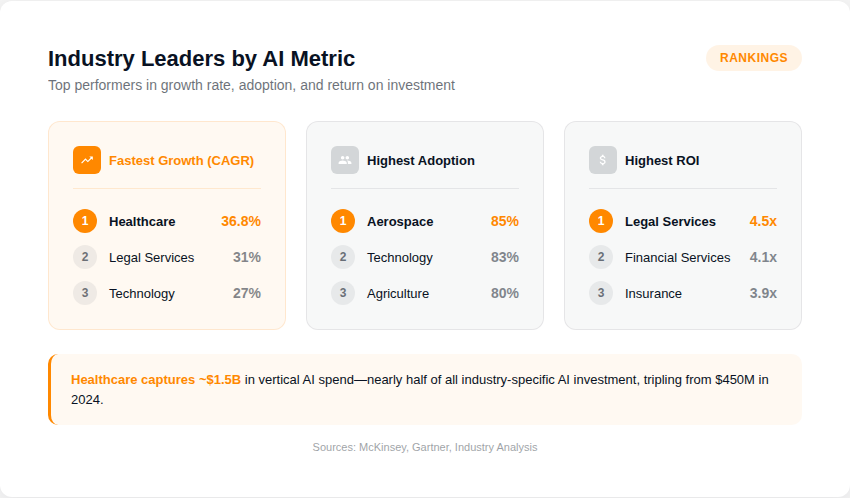
Healthcare stands out as the undisputed leader in AI adoption growth, with an impressive 36.8% compound annual growth rate. The sector’s rapid expansion centers on breakthrough applications in diagnostics, patient management, and clinical documentation.
Key Adoption Drivers
- Clinical Decision Support: AI systems analyze patient data to assist physicians with diagnosis and treatment recommendations
- Medical Imaging: Deep learning algorithms detect diseases in X-rays, MRIs, and CT scans with accuracy matching or precision targeted MRI imaging for enabling more accurate and focused scans.
- Drug Discovery: AI accelerates pharmaceutical research by predicting molecular interactions and identifying promising compounds
- Administrative Automation: Natural language processing handles clinical documentation, reducing physician burnout
Investment Scale
Healthcare captures nearly half of all vertical AI spend, approximately $1.5 billion in 2025, more than tripling from $450 million the previous year. This makes it the largest single industry for specialized AI solutions.
Despite rapid growth, only 1% of healthcare organizations describe their AI adoption as “fully mature.” Many health systems remain in pilot phases, struggling with integration into legacy systems. This gap represents significant opportunity for organizations that can accelerate implementation.
2. Financial Services and Banking
Financial services leads AI adoption by market share, with the BFSI (Banking, Financial Services, and Insurance) segment commanding 19.60% of the global AI market. The industry’s data-rich environment and clear ROI metrics make it ideal for AI implementation.
Key Adoption Drivers
- Fraud Detection: Real-time transaction monitoring identifies suspicious patterns before losses occur
- Algorithmic Trading: 68% of hedge funds now employ AI for market analysis and trading strategies
- Credit Scoring: Machine learning models assess risk more accurately than traditional scoring methods
- Customer Service: AI chatbots handle routine inquiries while routing complex issues to human agents
Investment Scale
Global annual AI spending in financial services exceeds $20 billion in 2025. Investment firms have been particularly aggressive adopters, using AI to gain millisecond advantages in trading and identify market patterns invisible to human analysts.
According to Gartner’s Finance Technology Report, 80% of independent software vendors are expected to embed GenAI capabilities in their enterprise applications by 2026, up from less than 5% in 2024.
3. Technology and Software
Technology companies have the highest absolute adoption rates, with 78% of firms using AI in at least one business function. The sector benefits from technical expertise, data infrastructure, and a culture of experimentation that accelerates implementation.
Key Adoption Drivers
- Software Development: AI coding assistants now write 41% of all code, with 50% of developers using AI tools daily
- Product Features: Companies embed AI capabilities directly into their software products
- Customer Success: Predictive models identify at-risk accounts before churn occurs
- Security Operations: AI systems detect and respond to threats faster than human analysts
Investment Scale
Coding tools represent the largest AI spending category at $4.0 billion, accounting for 55% of departmental AI spend. Technology companies investing in software development teams increasingly require AI proficiency as a core skill.
4. Media and Telecommunications
Media and telecommunications companies have caught up to technology firms in AI adoption, with respondents now equally likely to report AI use. The sector’s massive data volumes and real-time processing requirements drive aggressive implementation. Consequently, the move towards automated video generation has enabled these companies to transform their extensive datasets into tailored, high-quality content much faster than traditional production methods can achieve.
Key Adoption Drivers
- Content Recommendation: AI algorithms personalize streaming content, increasing engagement and retention
- Network Optimization: Machine learning predicts and prevents service outages before they impact customers
- Content Creation: Generative AI assists with writing, editing, and producing media content
- Ad Targeting: AI-driven advertising delivers higher conversion rates through precise audience segmentation
Investment Scale
The IT and telecommunications sector projects to add $4.7 trillion in gross value through AI implementations by 2035. Companies in this space are among the earliest adopters of agentic AI systems that can handle complex multi-step workflows autonomously.
5. Insurance
Insurance has emerged as a surprising leader in AI adoption, with companies now equally likely as technology firms to report regular AI use. The industry’s reliance on risk assessment and claims processing makes it a natural fit for machine learning applications.
Key Adoption Drivers
- Underwriting Automation: AI models assess risk factors and price policies more accurately
- Claims Processing: Computer vision and NLP automate damage assessment and documentation review
- Fraud Detection: Pattern recognition identifies suspicious claims before payment
- Customer Service: AI handles policy inquiries and guides customers through claims processes
Investment Scale
Insurance companies report significant ROI from AI implementations, with claims processing costs dropping 30-40% in organizations that have fully automated routine claims. The sector’s adoption of AI agents for customer interaction is among the most advanced across all industries.
6. Manufacturing
Manufacturing AI adoption reached 77% in 2024, up from 70% in 2023, according to industry surveys. The sector’s combination of sensor data, quality requirements, and operational complexity creates compelling AI use cases.
Key Adoption Drivers
- Predictive Maintenance: AI analyzes equipment sensor data to schedule maintenance before failures occur
- Quality Control: Computer vision systems inspect products faster and more accurately than human inspectors
- Supply Chain Optimization: Machine learning forecasts demand and optimizes inventory levels
- Process Optimization: AI identifies inefficiencies and recommends improvements to production workflows
Investment Scale
Manufacturing companies report productivity improvements of 15-30% from AI implementations. The sector is particularly active in edge AI deployment, running models directly on factory equipment for real-time decision making. Many of these deployments now combine predictive maintenance with downtime tracking software so plants can see exactly where availability losses occur and close the loop from detection to corrective action.
7. Retail and E-commerce
Retail AI adoption stands at 77%, with companies deploying AI across the entire customer journey from product discovery to post-purchase support. The sector’s direct consumer interaction generates massive datasets ideal for AI training.
Key Adoption Drivers
- Personalization: AI-driven product recommendations increase average order values by 10-30%
- Demand Forecasting: Machine learning improves inventory accuracy, reducing stockouts and overstock
- Dynamic Pricing: Real-time price optimization balances margins with competitive positioning
- Customer Service: AI chatbots handle 60-80% of routine customer inquiries
Investment Scale
Retail companies using generative AI report average ROI of 3.7x per dollar invested, with top performers achieving 10.3x returns. By 2026, over 95% of customer support interactions in retail are expected to involve AI in some capacity.
8. Aerospace and Defense
Aerospace leads all industries with an 85% adoption rate, driven by the sector’s engineering complexity and stringent quality requirements. Government defense spending on AI further accelerates adoption.
Key Adoption Drivers
- Design Optimization: Generative AI creates innovative component designs that reduce weight and improve performance
- Predictive Maintenance: AI monitors aircraft systems to prevent failures and optimize maintenance schedules
- Autonomous Systems: Machine learning powers unmanned vehicles and decision support systems
- Supply Chain Security: AI identifies risks and vulnerabilities in complex supplier networks
Investment Scale
Defense AI spending continues growing rapidly, with government contracts driving significant investment in specialized AI capabilities. The sector’s requirements for reliability and explainability are pushing advances in AI safety and interpretability.
9. Agriculture
Agriculture surprises many observers with an 80% AI adoption rate, as farmers and agricultural companies embrace precision farming technologies. The sector’s thin margins and weather-dependent operations create strong incentives for optimization.
Key Adoption Drivers
- Precision Farming: AI optimizes planting, irrigation, and fertilization based on soil and weather data
- Crop Monitoring: Computer vision detects diseases and pests before they spread
- Yield Prediction: Machine learning forecasts harvests to optimize logistics and pricing
- Autonomous Equipment: Self-driving tractors and harvesters reduce labor requirements
Investment Scale
Agricultural AI is growing rapidly as climate variability increases the value of data-driven decision making. Companies deploying AI report 10-20% improvements in crop yields alongside reduced input costs.
10. Legal Services
Legal services represents one of the fastest-growing sectors for AI adoption, with generative AI becoming a top priority for law firms. The profession’s document-intensive nature makes it ideal for AI-powered automation.
Key Adoption Drivers
- Document Review: AI analyzes contracts and discovery documents in a fraction of the time required for manual review
- Legal Research: Natural language processing finds relevant cases and precedents across vast legal databases
- Contract Analysis: Machine learning identifies risks and non-standard terms in agreements
- Billing Optimization: AI helps firms track time and ensure accurate client billing
Investment Scale
According to Gartner research, legal services ranks among the sectors with highest demand for generative AI, alongside healthcare, financial services, and the public sector. Law firms report 50-80% reduction in time spent on document review tasks.
As firms move from pilot to production with GenAI, legal oversight on data use, privacy, IP, and model risk becomes critical. Partnering with Axiom’s artificial intelligence lawyer can help structure AI governance, negotiate vendor contracts, and create compliant playbooks that speed adoption without increasing risk.
Investment by Sector
| Industry | 2025 AI Spend | 2026 Projected | % of IT Budget | Top Investment Area |
|---|---|---|---|---|
| Healthcare | $1.5B (vertical AI) | $2.1B | 8-12% | Clinical AI |
| Financial Services | $20B+ | $28B | 15-20% | Fraud/Risk |
| Technology | $4B (coding alone) | $6B | 20-25% | Dev tools |
| Media/Telecom | $3.2B | $4.5B | 12-16% | Network AI |
| Insurance | $2.8B | $3.9B | 14-18% | Underwriting |
| Manufacturing | $2.5B | $3.4B | 8-12% | IoT/Edge AI |
| Retail | $3.1B | $4.3B | 10-14% | Personalization |
| Aerospace | $1.8B | $2.4B | 10-15% | Autonomous systems |
| Agriculture | $1.2B | $1.7B | 15-20% | Precision farming |
| Legal | $800M | $1.2B | 8-12% | Document AI |
What’s Driving Adoption Across Industries
Several common factors accelerate AI adoption regardless of industry sector.
Proven ROI
Companies using generative AI report average returns of 3.7x per dollar invested, with top adopters achieving 10.3x. As case studies accumulate and success metrics become clearer, more organizations gain confidence to invest.
Labor Productivity Gains
Industries that have embraced AI see labor productivity grow 4.8 times faster than the global average. In tight labor markets, AI augmentation helps companies do more with existing headcount.
Competitive Pressure
As leaders in each industry demonstrate AI-driven advantages, competitors face pressure to match capabilities or risk falling behind. This creates adoption cascades within sectors.
Technology Accessibility
Pre-trained models, cloud APIs, and no-code AI tools lower the technical barrier to entry. Companies no longer need dedicated data science teams to implement many AI use cases.

Barriers to Faster Adoption
Despite rapid growth, several factors continue to slow AI adoption across industries.
Talent Shortage
The demand for AI expertise far exceeds supply. Companies struggle to hire data scientists, ML engineers, and AI architects with the specialized skills required for implementation. Strategic talent sourcing becomes critical for organizations competing for scarce AI expertise.
Data Quality Issues
Many organizations lack the clean, structured data required for AI training. Building robust data infrastructure often represents the largest investment in AI initiatives.
Legacy System Integration
Connecting AI capabilities to existing enterprise systems requires significant engineering effort. Healthcare organizations in particular struggle to integrate AI with legacy electronic health record systems.
Regulatory Uncertainty
Evolving AI regulations, particularly in healthcare and financial services, create compliance concerns that slow implementation. Organizations must balance innovation speed with risk management.
2026 Predictions
Looking ahead to 2026, several trends will shape AI adoption across industries.
- Customer Support Transformation: Over 95% of customer support interactions will involve AI
- Embedded AI: 80% of enterprise software vendors will have embedded GenAI capabilities in their applications
- Agentic AI Scaling: Organizations will move from experimentation to production deployment of AI agents
- Vertical AI Dominance: Industry-specific AI solutions will outpace horizontal tools in growth
- Global AI Spending: Total investment will reach $2 trillion globally
Industries that have already invested in AI infrastructure will accelerate ahead, while laggards face increasing pressure to catch up or risk competitive obsolescence.
Conclusion

AI adoption has moved from experimental to essential across virtually every industry. Healthcare leads in growth rate, financial services in absolute investment, and technology in overall adoption percentage. But the gap between leaders and laggards is widening.
Organizations that have built AI capabilities see labor productivity grow nearly five times faster than the global average. Those still on the sidelines face an increasingly difficult catch-up challenge as leaders compound their advantages.
The key differentiator is not technology access, since cloud APIs and pre-trained models are available to everyone. Success depends on the talent to implement AI effectively, the data infrastructure to support it, and the organizational readiness to adopt AI-driven processes.
Hire vetted remote AI developers with Second Talent to build the capabilities your industry demands and position your organization among the leaders driving AI transformation.

![Singapore AI Companies Leading Southeast Asia. Top 10 Singapore AI Companies Leading Southeast Asia [2026], by Second Talent.](https://www.secondtalent.com/wp-content/uploads/2026/09/singapore-ai-companies-featured-v2-768x403.jpg)


![AI Coding Assistant Statistics & Trends. AI Coding Assistant Statistics & Trends [2025], by Second Talent.](https://www.secondtalent.com/wp-content/uploads/2026/09/ai-coding-assistant-statistics-featured-v2-768x403.jpg)