TL;DR: A mid-level developer in the Philippines costs $3,100-$4,500/month fully loaded. The same hire in the US costs $10,000-$16,000/month. That is a 65-72% savings.
The Philippines has 1.9 million IT-BPM professionals. Over 200,000 are software developers. The country produces 200,000+ tech graduates every year. English proficiency ranks 2nd in Asia and 28th globally.
Those numbers matter if you are a startup in the US or Canada looking to stretch your engineering budget. A mid-level full-stack developer in San Francisco costs $132,000 per year in base salary alone.
The same skill set in Manila costs $42,000-$54,000 per year. Add benefits and taxes, and the gap gets wider.
We help startups hire remote developers from the Philippines and across Southeast Asia. This is our most requested comparison. US and Canadian founders want to know exactly what they will pay for a Filipino developer vs. hiring locally.
This guide covers every role, every experience level, and every hidden cost. Philippines vs. United States vs. Canada. Side by side. No guesswork.
Cost Overview: Philippines vs. US vs. Canada
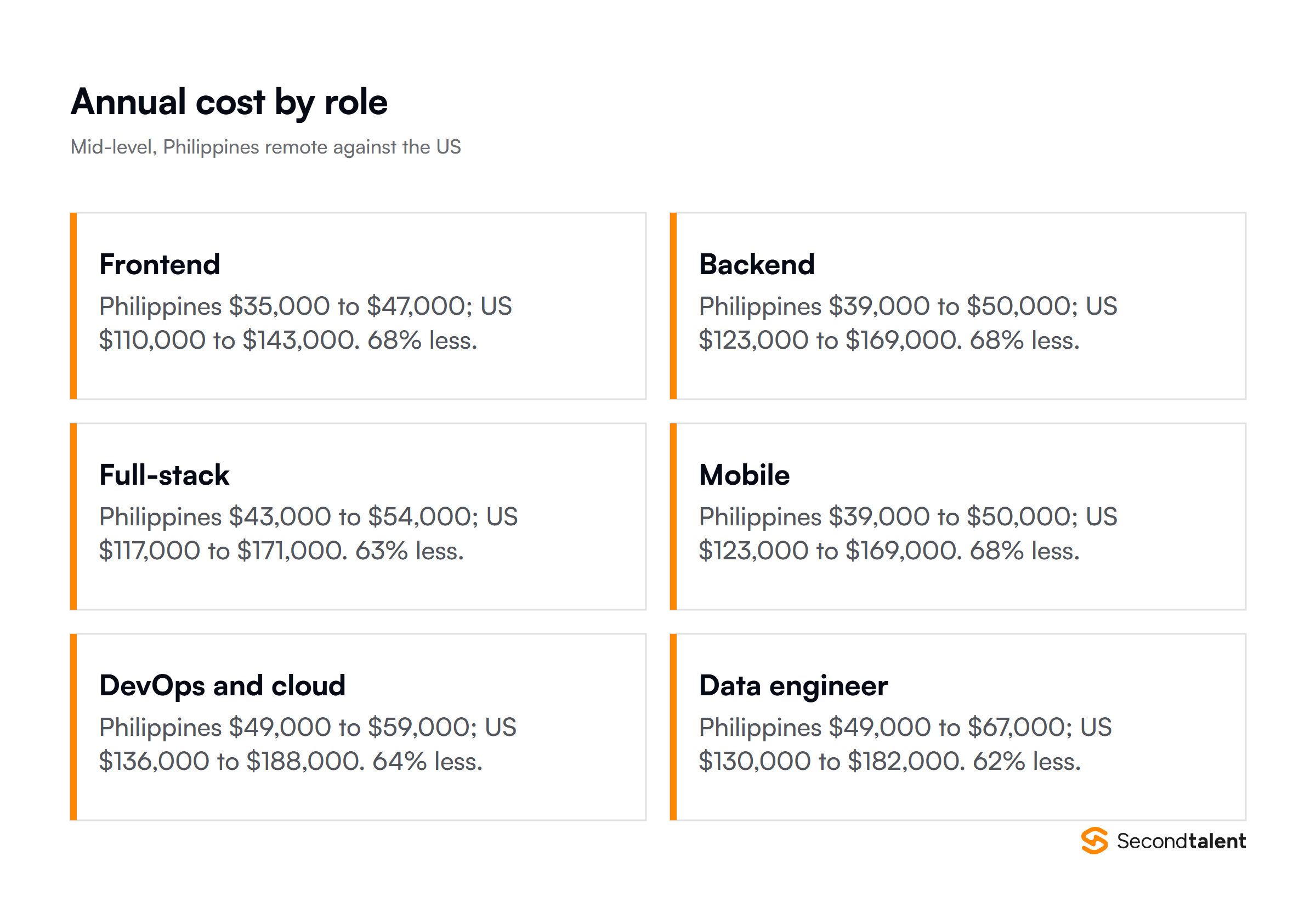
This table shows the fully loaded annual cost per developer. “Fully loaded” means base salary plus benefits, payroll taxes, insurance, and statutory contributions. Philippines figures reflect remote rates for US and Canadian companies.
| Role (Mid-Level, 3-5 Years) | Philippines (Remote) | United States | Canada (USD) | PH Savings vs. US |
|---|---|---|---|---|
| Frontend (React, Vue, Angular) | $35,000-$47,000 | $110,000-$143,000 | $66,000-$83,000 | 68% |
| Backend (Node.js, Python, Java) | $39,000-$50,000 | $123,000-$169,000 | $70,000-$92,000 | 68% |
| Full-Stack | $43,000-$54,000 | $117,000-$171,000 | $74,000-$97,000 | 63% |
| Mobile (iOS, Android, React Native) | $39,000-$50,000 | $123,000-$169,000 | $66,000-$87,000 | 68% |
| DevOps / Cloud Engineer | $49,000-$59,000 | $136,000-$188,000 | $85,000-$107,000 | 64% |
| Data Engineer | $49,000-$67,000 | $130,000-$182,000 | $74,000-$97,000 | 62% |
| ML / AI Engineer | $49,000-$67,000 | $156,000-$221,000 | $88,000-$120,000 | 69% |
| QA Engineer | $29,000-$42,000 | $97,000-$130,000 | $60,000-$74,000 | 70% |
| UI/UX Designer | $31,000-$47,000 | $97,000-$130,000 | $60,000-$79,000 | 68% |
Sources: Glassdoor 2026 US Salary Data, Robert Half 2026 Canada Salary Guide, Arc.dev Philippines Remote Rates, and Second Talent placement data. Canada figures converted to USD at 0.73 CAD/USD.
The pattern is consistent across every role. Philippines remote developers cost 62-72% less than US developers. They cost 40-50% less than Canadian developers.
The savings are largest for QA and frontend roles where the US talent pool commands premium rates.
Philippines Developer Rates by Role and Experience
These are monthly remote rates. This is what Filipino developers earn when working for US and Canadian companies. Local rates are 20-30% lower.
Frontend Developers (React, Angular, Vue)
| Experience Level | Philippines (Monthly) | US (Monthly) | Canada (Monthly, USD) |
|---|---|---|---|
| Junior (1-3 years) | $1,700-$2,500 | $5,700-$7,100 | $3,200-$4,300 |
| Mid-Level (3-5 years) | $2,500-$3,900 | $7,100-$9,200 | $4,300-$5,500 |
| Senior (5-8 years) | $3,900-$5,600 | $9,200-$12,100 | $5,500-$6,400 |
| Lead/Architect (8+ years) | $5,600-$7,700 | $12,100-$15,000 | $6,400-$7,900 |
React is the most in-demand frontend framework in the Philippines. Most Filipino frontend developers know React. Vue and Angular are common too.
The Philippines has a strong WordPress ecosystem that creates a pipeline of developers who transition into React and Vue. If your front end runs on either, you can hire Vue developers or Angular developers from Asia.
Backend Developers (Node.js, Python, Java, PHP, .NET)
| Experience Level | Philippines (Monthly) | US (Monthly) | Canada (Monthly, USD) |
|---|---|---|---|
| Junior (1-3 years) | $1,700-$2,800 | $6,300-$7,900 | $3,300-$4,600 |
| Mid-Level (3-5 years) | $2,800-$4,200 | $7,900-$10,800 | $4,600-$6,100 |
| Senior (5-8 years) | $4,200-$6,300 | $10,800-$13,800 | $6,100-$7,900 |
| Lead/Architect (8+ years) | $6,300-$8,400 | $13,800-$16,700 | $7,900-$9,700 |
Node.js and Python command the top of the Philippines range. PHP/Laravel sits 10-15% lower. Java and .NET fall in the mid-to-upper range.
According to PayScale Philippines data, the local median software engineer salary is PHP 480,000 per year ($8,400 USD). Remote rates for US companies are 2-3x higher.
Full-Stack Developers
| Experience Level | Philippines (Monthly) | US (Monthly) | Canada (Monthly, USD) |
|---|---|---|---|
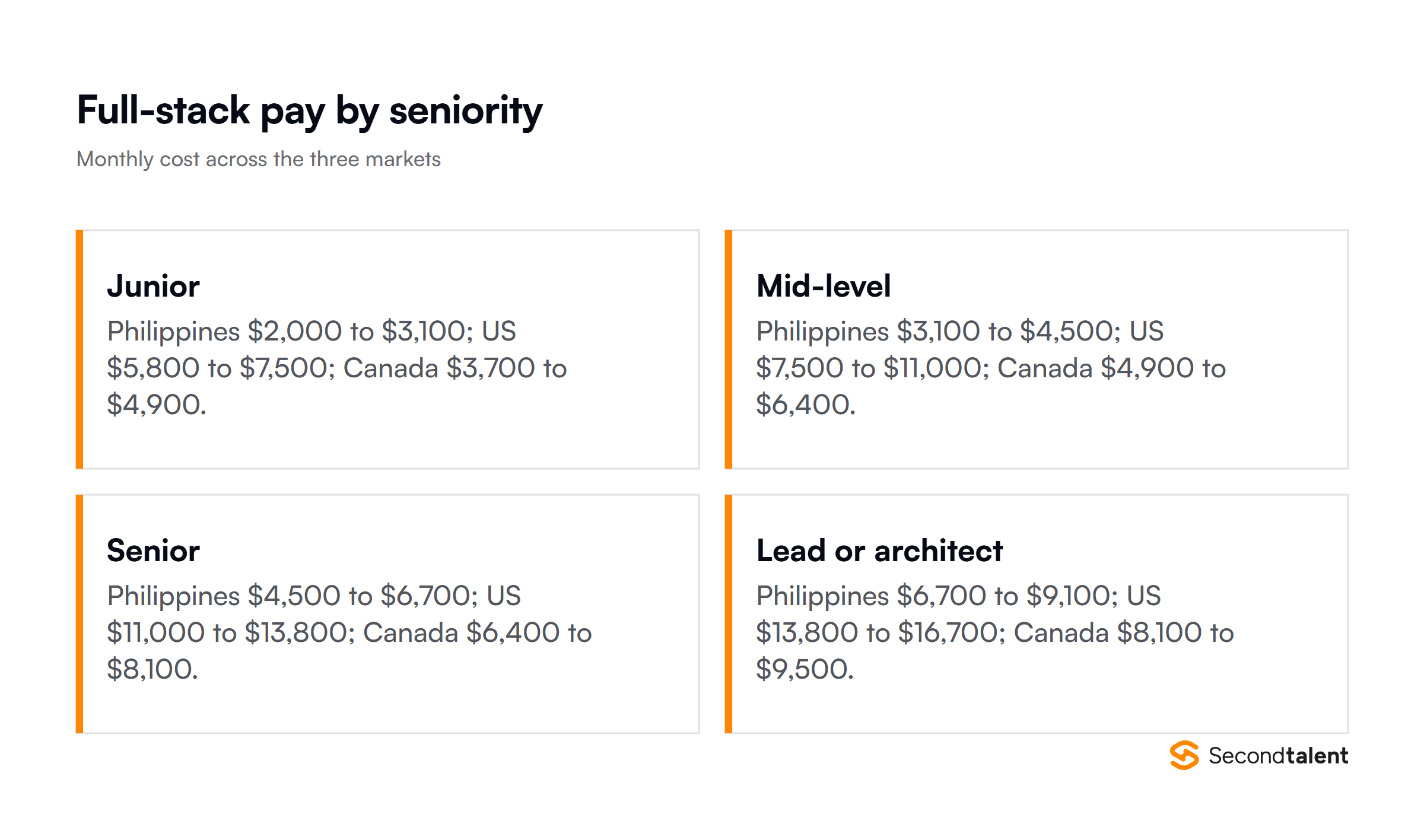
| Junior (1-3 years) | $2,000-$3,100 | $5,800-$7,500 | $3,700-$4,900 |
| Mid-Level (3-5 years) | $3,100-$4,500 | $7,500-$11,000 | $4,900-$6,400 |
| Senior (5-8 years) | $4,500-$6,700 | $11,000-$13,800 | $6,400-$8,100 |
| Lead/Architect (8+ years) | $6,700-$9,100 | $13,800-$16,700 | $8,100-$9,500 |
The most common full-stack combination among Filipino developers is React + Node.js + PostgreSQL. Full-stack developers earn 10-15% more than pure frontend or backend specialists.
Glassdoor reports the average US full-stack developer salary at $132,219. In the Philippines, a mid-level full-stack developer working remotely earns $37,000-$54,000 per year.
Mobile Developers (iOS, Android, React Native, Flutter)
| Experience Level | Philippines (Monthly) | US (Monthly) | Canada (Monthly, USD) |
|---|---|---|---|
| Junior (1-3 years) | $1,700-$2,500 | $6,000-$7,900 | $3,300-$4,400 |
| Mid-Level (3-5 years) | $2,800-$4,200 | $7,900-$10,800 | $4,400-$5,700 |
| Senior (5-8 years) | $4,200-$5,900 | $10,800-$14,400 | $5,700-$7,300 |
| Lead/Architect (8+ years) | $5,900-$7,700 | $14,400-$18,300 | $7,300-$9,100 |
Native iOS and Android specialists earn 5-10% more than cross-platform developers (React Native, Flutter) at the senior level. React Native is the most popular cross-platform framework in the Philippines. Flutter adoption is growing fast.
We placed a React Native developer from Manila with a Canadian fintech startup last year. He shipped their iOS and Android apps in 12 weeks at $3,500 per month.
DevOps and Cloud Engineers
| Experience Level | Philippines (Monthly) | US (Monthly) | Canada (Monthly, USD) |
|---|---|---|---|
| Junior (1-3 years) | $2,100-$3,100 | $6,700-$8,800 | $4,100-$5,600 |
| Mid-Level (3-5 years) | $3,500-$4,900 | $8,800-$12,100 | $5,600-$7,000 |
| Senior (5-8 years) | $4,900-$7,000 | $12,100-$14,900 | $7,000-$8,200 |
| Lead/Architect (8+ years) | $7,000-$9,800 | $14,900-$18,800 | $8,200-$12,500 |
DevOps is the highest-paying specialization in the Philippines after AI/ML. AWS is the most common cloud platform among Filipino DevOps engineers. GCP and Azure follow. The talent pool is smaller than frontend or backend.
Budget 3-4 weeks to find a strong DevOps hire in Manila vs. 1-2 weeks for a React developer.
Data Engineers and ML/AI Engineers
| Experience Level | Philippines (Monthly) | US (Monthly) | Canada (Monthly, USD) |
|---|---|---|---|
| Junior Data Engineer | $2,100-$3,500 | $6,500-$8,300 | $3,700-$4,900 |
| Mid-Level Data Engineer | $3,500-$5,600 | $8,300-$11,700 | $4,900-$6,400 |
| Senior Data Engineer | $5,600-$8,400 | $11,700-$14,400 | $6,400-$8,200 |
| Junior ML/AI Engineer | $2,500-$4,200 | $7,500-$10,000 | $4,300-$5,800 |
| Mid-Level ML/AI Engineer | $4,200-$6,300 | $10,000-$14,200 | $5,800-$7,900 |
| Senior ML/AI Engineer | $6,300-$9,800 | $14,200-$17,800 | $7,900-$9,700 |
AI and ML engineering is the fastest-growing specialization in the Philippines. The talent pool is still small compared to frontend or backend. But it is growing. Filipino universities are adding data science and AI programs.
Glassdoor reports the average senior ML engineer salary in the US at $212,524. A senior ML engineer in the Philippines working remotely earns $75,000-$118,000 per year. That is 44-65% less.
QA Engineers
| Experience Level | Philippines (Monthly) | US (Monthly) | Canada (Monthly, USD) |
|---|---|---|---|
| Junior (1-3 years) | $1,400-$2,100 | $4,600-$6,300 | $3,000-$4,000 |
| Mid-Level (3-5 years) | $2,100-$3,500 | $6,300-$8,300 | $4,000-$4,900 |
| Senior (5-8 years) | $3,500-$4,900 | $8,300-$11,400 | $4,900-$6,100 |
| Lead (8+ years) | $4,900-$6,300 | $11,400-$14,600 | $6,100-$7,600 |
QA automation engineers (Selenium, Cypress, Playwright) earn 15-20% more than manual QA testers. The Philippines has a strong QA talent pool. The BPO industry trained millions of professionals in quality processes and testing.
Many have transitioned into software QA. This is one of the best roles to hire for in the Philippines.
UI/UX Designers
| Experience Level | Philippines (Monthly) | US (Monthly) | Canada (Monthly, USD) |
|---|---|---|---|
| Junior (1-3 years) | $1,400-$2,200 | $4,600-$6,300 | $3,000-$4,000 |
| Mid-Level (3-5 years) | $2,200-$3,900 | $6,300-$8,300 | $4,000-$5,200 |
| Senior (5-8 years) | $3,900-$5,600 | $8,300-$11,300 | $5,200-$6,100 |
| Lead (8+ years) | $5,600-$7,700 | $11,300-$14,200 | $6,100-$7,900 |
Filipino designers have strong visual skills. The creative industry in the Philippines is large. Many UX designers started in graphic design or advertising before moving into product design. Figma is the standard tool.
Senior UX designers at top Manila companies earn PHP 75,000-100,000 per month locally ($1,300-$1,750). Remote rates for US companies are 2-3x higher.
The Real Cost: Benefits and Employer Taxes
Base salary is not what you actually pay. Every country adds mandatory benefits and taxes on top. Here is what employers owe in each market.
Philippines Employer Costs
| Contribution | Employer Rate | Details |
|---|---|---|
| SSS (Social Security) | 10% of salary | Max employer share: PHP 3,530/month. Increased from 9.5% in January 2025 |
| PhilHealth | 2.5% of salary | 5% total split equally. Income ceiling: PHP 100,000/month |
| Pag-IBIG (Housing Fund) | 2% of salary | Capped at PHP 200/month per employer |
| 13th Month Pay | 8.33% of annual salary | Mandatory. One full month’s salary paid before December 24 |
| Total Employer Add-On | 15-23% | Lower percentage for higher salaries due to SSS cap |
For a Filipino developer earning $3,500/month ($42,000/year), the employer pays roughly $5,500 per year in statutory costs. That brings the fully loaded cost to $47,500. Compare that to the US.
United States Employer Costs
| Contribution | Employer Rate | Details |
|---|---|---|
| Social Security (OASDI) | 6.2% of salary | Up to wage base of $176,100 in 2025 |
| Medicare | 1.45% of salary | No wage cap |
| Federal Unemployment (FUTA) | 0.6% | On first $7,000 of wages |
| State Unemployment (SUTA) | 1-5% | Varies by state |
| Health Insurance | $7,500-$23,000/year | Employer covers 70-80% of premium. Family plans cost more |
| 401(k) Match | 3-6% of salary | Common match: 50% of first 6% employee contributes |
| PTO / Paid Leave | 7-10% of salary | 15-20 days PTO is standard in tech |
| Total Employer Add-On | 25-40% | BLS data: benefits = 29.9% of total compensation |
According to the Bureau of Labor Statistics (Q4 2025), total employer compensation costs averaged $46.15 per hour. Wages made up 70.1%. Benefits made up 29.9%.
For a developer earning $130,000, the employer pays $163,000-$182,000 fully loaded.
Canada Employer Costs
| Contribution | Employer Rate | Details |
|---|---|---|
| CPP (Canada Pension Plan) | 5.95% | On earnings between $3,500 and $68,500. Max: ~$3,867/year |
| CPP2 (Second ceiling) | 4% | On earnings $68,500-$73,200. New since 2024 |
| EI (Employment Insurance) | 2.324% | Employer rate is 1.4x employee rate. Max: ~$1,245/year |
| Provincial Health Tax | 0-1.95% | Ontario EHT: 1.95%. Quebec QHSF: up to 4.26% |
| Extended Health Benefits | $3,000-$8,000 CAD/year | Not mandatory but standard in tech |
| Vacation Pay | 4-6% of salary | 2-3 weeks minimum by law |
| Total Employer Add-On | 15-25% | Mandatory costs: 10-14%. With benefits: 20-25% |
Canada sits between the Philippines and the US in employer costs. A developer earning $100,000 CAD costs $115,000-$125,000 CAD fully loaded. That is roughly $84,000-$91,000 USD. Lower than the US but still 40-50% more than the Philippines.
Side-by-Side: Fully Loaded Cost for One Developer
Here is what you actually pay per year for one mid-level full-stack developer in each market. Every cost included.
| Cost Component | Philippines (Remote) | United States | Canada (USD) |
|---|---|---|---|
| Base Salary | $42,000 | $132,000 | $68,000 |
| Payroll Taxes | $2,100 | $10,600 | $5,400 |
| Health Insurance | $590 | $10,000 | $4,400 |
| Retirement / Pension | $1,050 | $5,300 | $4,050 |
| 13th Month / Bonus | $3,500 | $0 | $0 |
| PTO Cost | Included | $10,100 | $3,400 |
| Other Benefits | $350 | $2,600 | $1,500 |
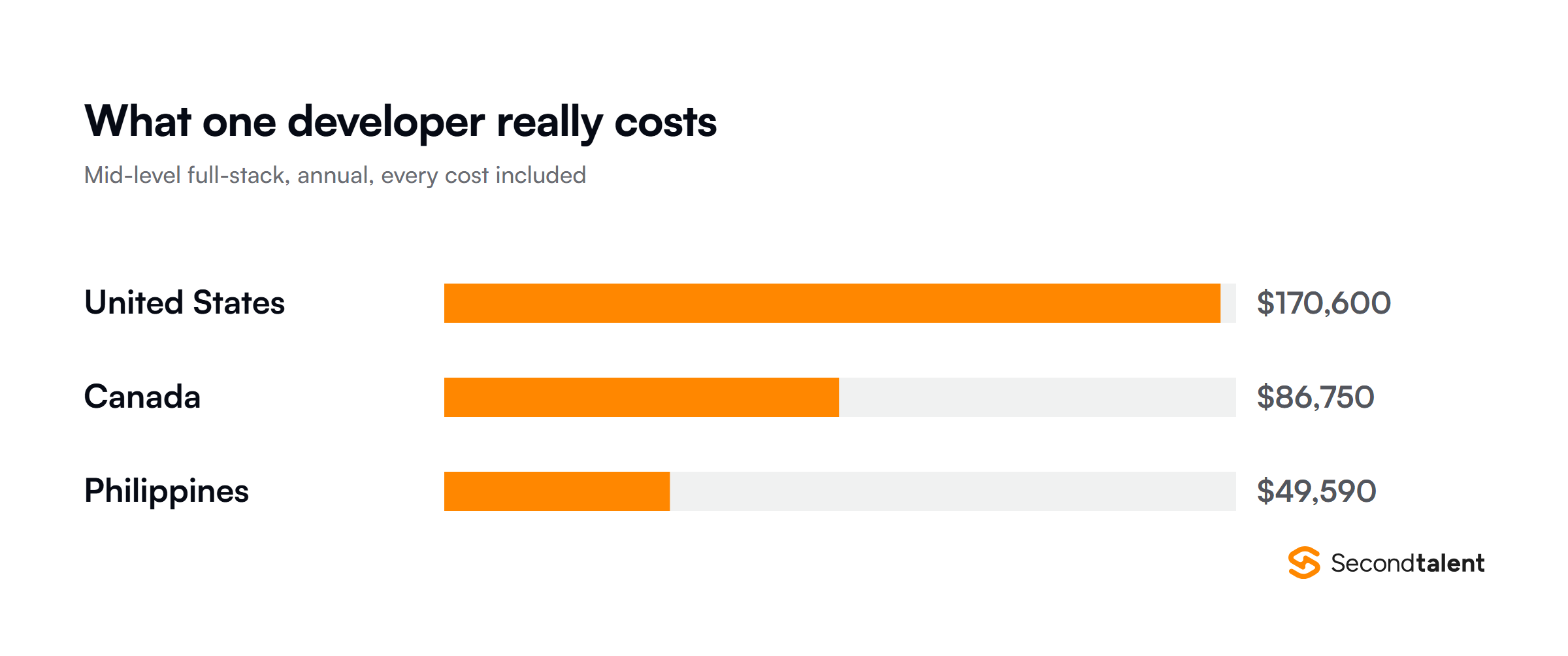
| Total Fully Loaded | $49,590 | $170,600 | $86,750 |
| Monthly Cost | $4,133 | $14,217 | $7,229 |
| Savings vs. US | 71% | Baseline | 49% |
The Philippines developer costs 71% less than the US developer. The Canadian developer costs 49% less than the US developer. But the Philippines developer still costs 43% less than the Canadian developer.
For startups in Toronto or Vancouver, hiring in the Philippines saves almost as much as it does for San Francisco startups.
5-Person Team Comparison
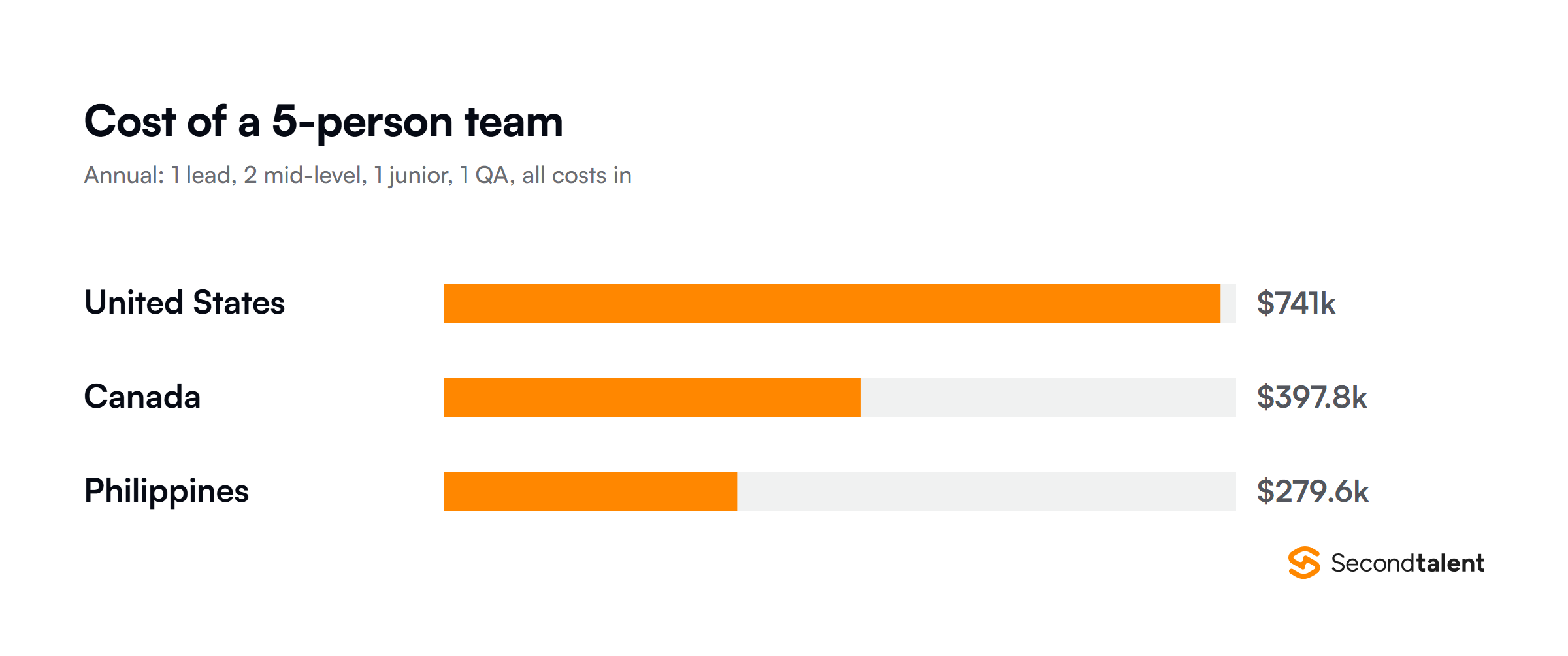
Most startups do not hire one developer. They build teams. Here is what a typical 5-person team costs in each market: 1 Tech Lead, 2 Mid-Level Engineers, 1 Junior Engineer, 1 QA Engineer.
| Line Item | Philippines | United States | Canada (USD) |
|---|---|---|---|
| Tech Lead (Senior, Full-Stack) | $5,600/mo | $14,200/mo | $8,200/mo |
| Mid-Level Engineer #1 | $3,500/mo | $10,000/mo | $5,700/mo |
| Mid-Level Engineer #2 | $3,200/mo | $9,500/mo | $5,400/mo |
| Junior Engineer | $2,000/mo | $6,300/mo | $3,700/mo |
| QA Engineer (Mid-Level) | $2,800/mo | $7,100/mo | $4,200/mo |
| Base Salaries Total | $17,100/mo | $47,100/mo | $27,200/mo |
| Benefits + Employer Taxes | $3,400/mo | $14,100/mo | $5,400/mo |
| EOR Fees (Philippines only) | $2,250/mo | N/A | N/A |
| Tools (GitHub, Jira, Slack, AWS) | $550/mo | $550/mo | $550/mo |
| Total Monthly | $23,300/mo | $61,750/mo | $33,150/mo |
| Total Annual | $279,600 | $741,000 | $397,800 |
| Savings vs. US | 62% | Baseline | 46% |
A 5-person Philippines team costs $279,600 per year. The same team in the US costs $741,000. That is $461,400 in annual savings. Enough to fund a product manager, a designer, and still have $200,000 left for infrastructure and marketing.
One Series A startup we worked with had a $3.5M raise. They budgeted $800,000 for engineering in year one. With a US team, that buys five engineers for 13 months.
With a Philippines team plus a US-based CTO, the same budget covers 18 months with money left for go-to-market.
Why Filipino Developers Cost Less (Without Lower Quality)
The cost gap is not about skill. It is about economics. Three factors explain the difference.
1. Cost of living is 3-5x lower. A one-bedroom apartment in Manila costs $350-$500 per month. The same apartment in San Francisco costs $3,200-$3,800. A meal at a restaurant costs $3-$5 in Manila vs. $22-$28 in SF.
According to Numbeo’s 2025 data, San Francisco’s cost of living is 175% higher than Manila (excluding rent). A Filipino developer earning $3,500/month has roughly the same purchasing power as a San Francisco developer earning $10,000/month.
2. Benefits cost less. US health insurance costs $7,500-$23,000 per employee per year. In the Philippines, PhilHealth contributions max out at PHP 5,000/month ($87). Total statutory benefits in the Philippines add 15-23% to salary.
In the US, they add 25-40%.
3. The talent pool is large. The Philippines produces 200,000+ tech graduates every year. The IT-BPM industry employs 1.9 million professionals. Supply keeps prices competitive. In the US, demand for developers far exceeds supply.
Companies bid against Google, Meta, and Amazon for the same candidates. That drives US salaries up.
Philippines vs. Canada: A Closer Look
Canadian startups often think they already save enough by hiring locally instead of in the US. And they do save 30-50% compared to US rates. But the Philippines offers another 40-50% on top of that.
| Factor | Philippines | Canada |
|---|---|---|
| Mid-Level Full-Stack (Monthly) | $3,100-$4,500 | $4,900-$6,400 |
| Senior Backend (Monthly) | $4,200-$6,300 | $6,100-$7,900 |
| Employer Benefit Costs | 15-23% | 15-25% |
| English Proficiency | High (EF EPI: 28th globally) | Native |
| Timezone Overlap with US East | 2-4 hours (with shift) | Same timezone |
| Timezone Overlap with US West | 2-3 hours (with shift) | 3 hours ahead |
| Talent Pool Size | 200,000+ developers | ~300,000 developers |
| Annual Salary Growth | 6-10% | 3-5% |
| EOR Required | Yes ($300-$700/mo per person) | No (if you have a CA entity) |
Canada wins on timezone and English. But the Philippines wins on cost. For async-first teams that use Slack, Linear, and Loom instead of meetings, the timezone gap matters less.
One Canadian startup we placed developers with runs two daily syncs: one at 9 AM Toronto (9 PM Manila) and one at 9 AM Manila (9 PM Toronto). Their Filipino engineers attend the morning Manila sync.
Their Canadian PM attends the evening one. It works.
The Philippines Advantage: Why Not Just India?
India is cheaper (our India vs US developer cost breakdown has the role-by-role numbers). Junior developers in India cost $400-$700 per month. Mid-level developers cost $700-$1,800. But cost is not the only factor.
English proficiency. The Philippines ranks 28th globally in the EF English Proficiency Index with a score of 569 (High Proficiency). India ranks 61st with a score of 485 (Low Proficiency).
Filipino developers write clear documentation, participate in code reviews, and communicate on Slack without translation friction. This saves hours of management time every week.
Cultural alignment. The Philippines has deep cultural ties to the US and Canada. American media, education, and business practices are part of daily life. Filipino developers understand US work culture intuitively. Meetings feel natural.
Feedback is direct. There is less cultural adjustment needed compared to other Asian markets.
Quality consistency. India has the world’s largest developer pool. That means a wider range of quality. Screening takes more effort. The Philippines has a smaller but more consistent talent pool.
The BPO industry created professional standards that carry over into software development. We spend less time filtering candidates in the Philippines than in any other market we source from.
Hidden Costs to Budget For
The salary comparison is only part of the picture. Here are the additional costs you need to plan for when hiring Filipino developers remotely.
- EOR fees: $300-$700 per employee per month. Required unless you set up a Philippine entity. For a 5-person team, budget $1,500-$3,500 per month. An EOR service handles payroll, benefits, and compliance.
- Hardware: $500-$1,500 one-time per developer. Most remote developers have their own setup. Some companies provide a laptop stipend.
- Internet stipend: $30-$50 per month. Philippine internet has improved but a stipend for fiber ensures stable connections for video calls.
- Onboarding: Budget 4-6 weeks for a new developer to reach full productivity. Filipino developers onboard faster than average because English documentation is not a barrier.
- Annual salary increases: Philippine tech salaries grow 6-10% per year. Budget for this. A developer you hire at $3,000/month today will expect $3,200-$3,300 next year. Still far below US rates but factor it into multi-year planning.
Even with all hidden costs included, a Philippines developer costs 60-65% less than a US developer and 35-45% less than a Canadian developer.
The Philippines IT-BPM Industry: Scale and Momentum
The Philippines is not a niche outsourcing destination. It is one of the world’s largest tech talent markets.
- $40 billion in IT-BPM revenue in 2025. Projected to reach $42 billion by 2026.
- 1.9 million IT-BPM professionals employed.
- 8% of GDP comes from the IT-BPM sector.
- 200,000+ tech graduates enter the workforce every year.
- The industry target is $59 billion in revenue and 2.5 million workers by 2028.
This scale matters because it means you are not hiring from a shallow pool. There is depth. If one developer does not work out, you can find a replacement in 2-3 weeks. In a small market, one bad hire can set you back months.
How to Hire Filipino Developers the Right Way
Pay Remote-Market Rates
Do not offer local Philippine rates to remote candidates. A mid-level React developer earns $1,200-$2,000/month locally. Remote employers pay $2,500-$3,900/month. Offering local rates attracts weaker candidates and leads to high turnover.
The best Filipino developers know their remote-market value.
Test English and Communication
Run a 30-minute English interview. Test written communication too. Ask candidates to explain a technical decision in writing. Most remote work happens asynchronously in Slack, PRs, and docs.
Strong writing matters more than accent-free speaking.
Use an EOR or Talent Partner
Setting up a Philippine entity (PEZA registration, SEC filing) takes 3-6 months and costs $15,000-$30,000. An EOR lets you hire in days. A talent sourcing partner finds and vets candidates so you do not spend weeks on job boards.
Check the developer rate card for current Philippines benchmarks across all roles.
Design for Async Work
The 13-16 hour timezone gap with the US means you get 2-4 hours of real-time overlap. That is enough for one standup and one pairing session. The rest of the day should be async. Write clear tickets. Use Loom for walkthroughs.
Document decisions in Notion or Confluence. Teams that master async work get more done than teams that rely on meetings.
The Bottom Line
A mid-level developer in the Philippines costs $3,100-$4,500 per month fully loaded. The same developer in the US costs $10,000-$16,000. In Canada, $5,500-$8,000.
The Philippines saves 62-71% compared to the US and 35-45% compared to Canada.
The savings are real. The talent is real. The Philippines has 1.9 million IT professionals, the 2nd highest English proficiency in Asia, and an IT industry that generates $40 billion in annual revenue. This is not a small freelance market.
It is a mature, scaled talent ecosystem.
For startups spending $500,000-$800,000 per year on US engineering, the Philippines offers a way to build larger teams, ship faster, and extend runway. The math is simple. The execution takes planning.
But the cost advantage is too large to ignore.
Hire vetted remote developers from the Philippines with Second Talent to build your engineering team at 50-70% lower cost than US or Canadian hires.
Hiring contractors rather than employees changes the arithmetic. The freelance developer rate index prices 14 roles across nine regions, benchmarked against North America and sourced from published wage data.