DeepSeek is one of the new-generation AI coding assistants designed to help developers write, debug, and optimise code across multiple programming languages. Unlike simple code generators, DeepSeek focuses on clarity, structure, and best practices.
In this guide, we will see what DeepSeek is, its features, and how it performs on real-world coding tasks.
Key Takeaways
- Open Source: DeepSeek V3 offers 671B parameters (37B active) with MIT license, providing enterprise-grade coding assistance without vendor lock-in
- Massive Context Handling: Supports 128K token context window, enabling analysis of large codebases and multi-file projects with sustained memory
- Multi-Language: Excels across 338+ programming languages with accurate translation, refactoring, and debugging capabilities
- Educational Value: Provides step-by-step explanations and transparent reasoning, making it ideal for both learning and professional development
- Production-Ready Outputs: Generates clean, structured code with proper commenting, unit tests, and best practices adherence
- Debugging Expertise: Quickly identifies logic errors, explains root causes, and provides working fixes with validation examples
- Performance Optimization: Offers practical performance improvements with trade-off analysis and benchmarking recommendations for real-world applications
How we tested:
To evaluate DeepSeek, we ran it across multiple real-world coding tasks: building a random password generator, debugging a buggy BMI calculator, writing unit tests, translating code between Python and JavaScript, and refactoring messy student grade logic.
These use cases helped us measure its efficiency, accuracy, and practical problem-solving ability for both learning and professional workflows.
What is DeepSeek?

DeepSeek is a next-generation large language model (LLM) built for coding, reasoning, and automation. It goes beyond basic text generation by helping developers write, debug, test, and optimise code across hundreds of programming languages.
The latest version, DeepSeek-V3, is a Mixture-of-Experts (MoE) model with 671 billion parameters, of which 37 billion are active per token. It supports a 128,000-token context window, making it powerful enough to handle long code files, multi-module projects, and extended technical documents.
DeepSeek is trained on trillions of high-quality tokens, including a strong mix of programming data, and is fully open source under the MIT license. This makes it accessible to both researchers and developers who want reliable performance without vendor lock-in.
DeepSeek is designed to support both beginners (with clear explanations and transparent reasoning) and professionals (with structured, production-ready outputs).
DeepSeek Features and Capabilities
- Massive Model Efficiency: Runs on a Mixture-of-Experts architecture (671B total, 37B active), delivering state-of-the-art performance at lower compute cost.
- Long Context Handling: Supports up to 128K tokens, enabling analysis of long codebases, large documents, and multi-step workflows without losing track.
- Coding Excellence: Excels at code generation, debugging, refactoring, and algorithm design, with support for 338+ programming languages.
- Advanced Reasoning Power: Incorporates distilled reasoning traces from DeepSeek-R1, improving step-by-step logic and accuracy on complex coding tasks.
- Structured Outputs: Generates clean, formatted responses, including JSON outputs, function calls, and inline documentation, ideal for integration into workflows.
- Transparent Thinking: Offers visible reasoning traces, letting developers see how the model arrives at solutions and improving trust in outputs.
- STEM and Problem-Solving Strength: Performs strongly in math, science, and logic benchmarks, making it useful beyond coding tasks.
- Open Source & Flexible: Released with open weights under the MIT license, DeepSeek can be used freely for research and enterprise development.
- Ecosystem Integration: Compatible with popular inference stacks like vLLM, SGLang, LMDeploy, TensorRT-LLM, and LightLLM, ensuring flexible deployment across hardware.
| Feature | Details |
| Model Type | Mixture-of-Experts (MoE) LLM |
| Total Parameters | 671B (with 37B active per token) |
| Context Window | Up to 128K tokens (ideal for large codebases and long conversations) |
| Training Data | Pre-trained on 14.8T tokens, with a strong code-heavy mix |
| Programming Support | 338+ languages, including Python, JavaScript, Java, C++ |
| Licensing | Open weights under MIT License (research + commercial use) |
| Key Strengths | Code generation, debugging, refactoring, testing, and cross-language translation |
Use cases of DeepSeek for coding
1. Create a Random Password Generator
Goal: Test basic logic, randomness, and string manipulation.
What to Test: Deepseek’s ability to use libraries (random, string), generate secure passwords, and allow customisation (length, special characters).
Prompt:
“Write a Python program that generates a random password.
The program should let the user specify the length and whether to include numbers and special characters.”
Output:
DeepSeek showed strong efficiency in coding by delivering more than the basic requirement. It structured the program well, used standard libraries effectively, and added input validation with user-friendly interaction. Its inclusion of both a detailed and a minimal version highlights flexibility, clarity, and practical problem-solving skills.
2. Debugging a Buggy BMI Calculator
Goal: Test Deepseek’s debugging ability on real-world logic errors.
What to Test: Detecting calculation mistakes, handling division by zero, and fixing incorrect conditions.
Prompt:
“Find and fix the bug in this Python BMI calculator.
It should calculate BMI = weight (kg) / (height in meters)^2.
def bmi(weight, height):
return weight/height
Input: weight = 70, height = 1.75
”
Output:
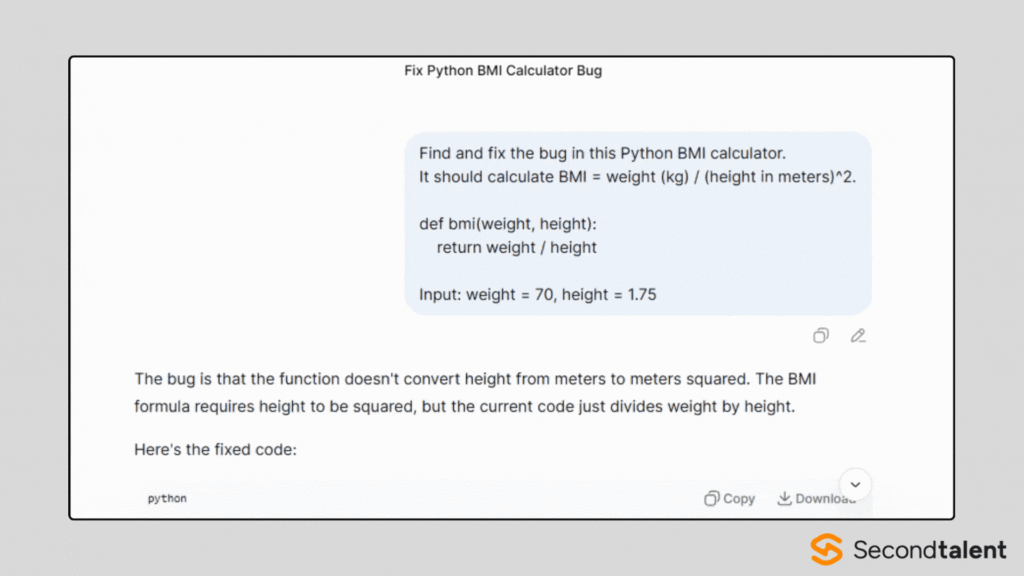
DeepSeek handled this debugging task efficiently and with clarity. It quickly identified the missing square in the BMI formula, explained the mistake in simple terms, and fixed it with two valid approaches. By testing the output and showing the correct result, it demonstrated accuracy, reliability, and practical problem-solving.
3. Writing Unit Tests
Goal: Test Deepseek’s ability to generate test cases.
What to Test: Coverage, edge cases, use of unittest or pytest.
Prompt:
“Write Python unit tests for this function:
def is_palindrome(s):
return s == s[::-1]
Input test cases: “madam”, “racecar”, “hello”, “””
Output:

DeepSeek produced thorough, well-structured unit tests using both unittest and pytest. It covered positive, negative, and edge cases, including empty strings, numeric and special-character inputs, and case sensitivity. It noted function limitations (no normalisation). Overall, it demonstrated strong testing coverage and clear, actionable suggestions, too.
4. Translating Code Between Languages
Goal: Test code generation across languages.
What to Test: Language syntax mapping, library substitution.
Prompt:
“Convert this Python function into JavaScript:
def square(n):
return n * n
Input: square(5)”
Output:
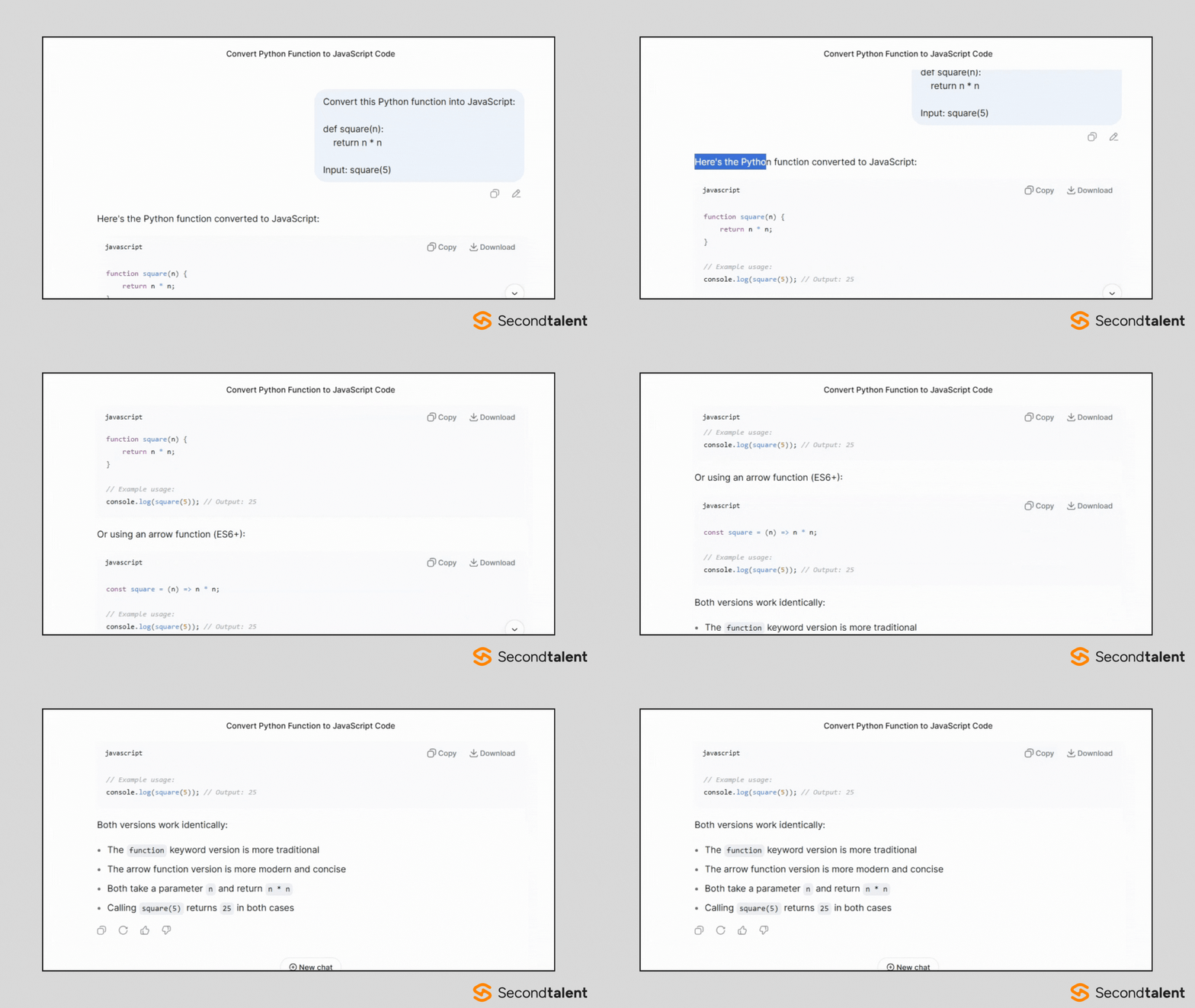
DeepSeek nailed this translation. The Python logic was mapped cleanly into JavaScript without any noise. It offered both the standard function and ES6 arrow syntax, showing awareness of real-world coding styles. The output was concise, correct, and production-ready, exactly what you’d expect from a capable coding assistant.
5. Refactoring a Messy Student Grade Processor
Goal: Test Deepseek’s ability to refactor multi-step logic into clean, maintainable code.
What to Test: Breaking down long functions, using meaningful variable names, and applying Python best practices.
Prompt:
“Refactor the following messy code into a clean, modular, and readable version.
The program should calculate the average grade, the highest score, and the pass/fail status for a list of student marks.
Add comments and meaningful function names.
def g(s):
a=0
for i in s:a+=i
avg=a/len(s)
h=0
for i in s:
if i>h:h=i
if avg>=40:p=”Pass”
else:p=”Fail”
print(“Average:”,avg,” Highest:”,h,” Status:”,p)”
Output:

DeepSeek refactored the grade processor into clear, modular components with sensible names and validation. It separated computation from presentation, added docstrings, and returned structured results for testing or API use. The design improves readability, testability, and extensibility, making it straightforward to adapt for per-student summaries or different grading rules seamlessly.
6. Explaining Code with Comments
Goal: Test Deepseek’s ability to generate developer-friendly documentation.
What to Test: Code commenting, readability, and inline explanation.
Prompt:
“Add meaningful comments to this code:
def fibonacci(n):
a, b = 0, 1
for _ in range(n):
print(a)
a, b = b, a+b
Input: n = 5”
Output:

DeepSeek’s commenting style feels professional and thorough. It didn’t just restate the code but explained intent, variable roles, and even complexity trade-offs. Adding example usage with expected output shows practical awareness. This is the kind of inline documentation that helps juniors onboard quickly and seniors maintain with confidence.
7. Optimising a Slow Algorithm
Goal: Check if Deepseek can suggest improvements for performance.
What to Test: Algorithm efficiency, time complexity, and memory usage.
Prompt:
“Optimise this code for better performance:
nums = [i for i in range(1, 1000000)]
squares = []
for n in nums:
squares.append(n**2)
What’s a faster version?”
Output:

DeepSeek offered practical, production-ready optimisations and sensible trade-offs. It prioritised idiomatic Python (list comprehensions), proposed memory-conscious generators, and recommended NumPy for intensive numerical work. The guidance demonstrated awareness of real-world constraints and developer workflows, while reminding teams to benchmark and avoid unnecessary list materialisation when streaming data is feasible.
What I liked about DeepSeek?
- Open Source and Accessible: DeepSeek is fully open source, which means developers can freely access model weights and code for both research and commercial projects.
- Coding-Focused Training: The model has been trained heavily on code data, so its outputs are accurate, structured, and relevant to real development tasks.
- Good for Learning: DeepSeek explains its outputs step by step, which makes it easier for beginners to understand and learn programming concepts.
- Reliable Debugging: It quickly spots logic errors in code, explains why the issue occurs, and provides clear fixes that actually work.
- Thorough Test Generation: The model creates well-structured unit tests that cover normal cases, edge cases, and even negative inputs.
- Cross-Language Skills: DeepSeek translates code cleanly between programming languages like Python and JavaScript while keeping syntax and style correct.
- Readable Refactoring: It can turn messy or repetitive code into modular, Pythonic functions with clear naming and better readability.
What are the limitations of DeepSeek?
- Context Length (Base LLM): The standard DeepSeek LLM only supports a 4K token window, which can be limiting for very large codebases. The DeepSeek Coder variant improves this with a 16K context window.
- Occasional Errors: Like most AI coding assistants, DeepSeek sometimes produces mistakes or incomplete code, so its outputs always need verification.
- No Native Agentic Features: Unlike some proprietary tools, DeepSeek does not yet include built-in system actions such as tool use or file execution.
- Hardware Requirements: Running the 67B parameter model requires strong GPU resources, which may not be feasible for many individual developers.
- Limited Optimisations: While the code is correct and clean, it may not include advanced design patterns or performance optimisations unless specifically requested.
Final Verdict: Is DeepSeek Good for Coding?
Yes, DeepSeek is a strong coding assistant that delivers reliable and well-structured outputs. Its open-source nature makes it accessible, while its training on code-heavy data helps it generate accurate programs, debug errors, and produce solid unit tests.
Beginners benefit from its clear explanations, and professionals can use it for real-world tasks like refactoring and cross-language translation.
However, users should review outputs carefully, as occasional mistakes or incomplete optimisations may occur.
With its balance of accessibility, coding expertise, and clarity, DeepSeek stands out as a practical tool for both learning and professional development.
FAQs
Is DeepSeek better than other AI coding assistants?
DeepSeek performs strongly on coding benchmarks like HumanEval and MBPP. Its open-source design makes it competitive with proprietary tools, while giving developers more flexibility and control.
Can beginners use DeepSeek to learn programming?
Yes. DeepSeek explains code in simple language, highlights mistakes, and provides corrected examples. This makes it a practical learning companion for beginners who want to understand both the solution and the reasoning behind it.
Does DeepSeek support large coding projects?
Yes. The base model handles shorter tasks with a 4K context window, while DeepSeek Coder-V3 extends this to 128K tokens, making it suitable for large codebases, multi-file projects, and extended workflows.
Which programming languages does DeepSeek support?
DeepSeek supports more than 338 programming languages, including Python, JavaScript, Java, C++, and many others. It can also translate functions between languages with accuracy and proper syntax.
Is DeepSeek free to use?
Yes. DeepSeek is fully open source and released under the MIT license. Developers can download the model weights from GitHub or Hugging Face and use them for both research and commercial projects.


![Singapore AI Companies Leading Southeast Asia. Top 10 Singapore AI Companies Leading Southeast Asia [2026], by Second Talent.](https://www.secondtalent.com/wp-content/uploads/2026/09/singapore-ai-companies-featured-v2-768x403.jpg)
![AI Recruiting Tools. Top 7 AI Recruiting Tools in 2026 [Tried & Tested], by Second Talent.](https://www.secondtalent.com/wp-content/uploads/2026/09/top-ai-recruiting-tools-featured-v2-768x403.jpg)