TL;DR: Ten Chinese AI companies worth knowing, what each one ships in September 2026, and what their open-weight releases change for anyone hiring engineers in Asia. Two listed in Hong Kong in January.
DeepSeek is raising at a reported $71 billion. China’s own AI hiring market is short about five million workers by 2030, on McKinsey’s estimate.
When DeepSeek released R1 in January 2025, most of the questions I got from clients were about price. A model near the frontier, trained for a fraction of the reported American budgets, made AI line items look negotiable overnight.
The more useful question now is what happened next. Ten labs ship on a regular cadence, most publish weights anyone can download, and two trade in Hong Kong.
They sit in three businesses: research labs judged on benchmarks, platform companies that own daily habits inside apps, and the compute layer that decides what either can train next.
The ten at a glance
| Company | Flagship now | Open weights | Why it is on the list |
|---|---|---|---|
| DeepSeek | V4-Pro | Yes | Set the price expectation the rest of the market works against |
| Alibaba | Qwen3.8 | Yes | The most downloaded open model family in the world |
| Moonshot AI | Kimi K3 | Yes, with conditions | 2.8 trillion parameters, the largest open-weight release to date |
| Z.ai (Zhipu) | GLM-5.3 | Yes | First of the new labs to ring the bell in Hong Kong |
| MiniMax | MiniMax-M3, Hailuo | Partly | Text, speech and video from one company, now listed |
| ByteDance | Doubao, Seed | Research only | The largest consumer AI distribution in China |
| Baidu | ERNIE 5.1 | Yes, since 2025 | The incumbent that switched to open weights under pressure |
| Tencent | Tencent HY, Yuanbao | Partly | Distribution through WeChat, plus open MoE releases |
| iFlytek | Spark X2.5 | Small models only | Trained end to end on domestic silicon |
| Huawei | Pangu, Ascend | Partly | The compute layer most of the others increasingly run on |
What changed in 2026
- Open weights became the distribution strategy, not a marketing gesture. Alibaba’s Qwen family passed 3 billion downloads in six months.
- The capital arrived. Z.ai and MiniMax listed in Hong Kong on 8 and 9 January 2026, days apart.
- Licences got more complicated. Moonshot’s K3 weights are public, but companies above $20 million in revenue have to negotiate before reselling them as a service.
- Compute went domestic. iFlytek trains on Ascend clusters, and over half of ByteDance’s 160 billion yuan 2026 AI budget is chip procurement.
- Hiring got harder for everyone. Chinese employers advertised 3.08 AI vacancies per qualified candidate between January and May 2026.
1. DeepSeek
Still the reference point, and still unusual. Its parent hedge fund paid for the early years, alongside founder Liang Wenfeng, who put about 20 billion yuan of his own money in, roughly $3 billion.
No outside capital arrived until June 2026.
That round raised $7.4 billion at a valuation north of $50 billion, and DeepSeek went back to the market at a reported $71 billion, targeting Shanghai’s STAR market as early as the second quarter of 2027.
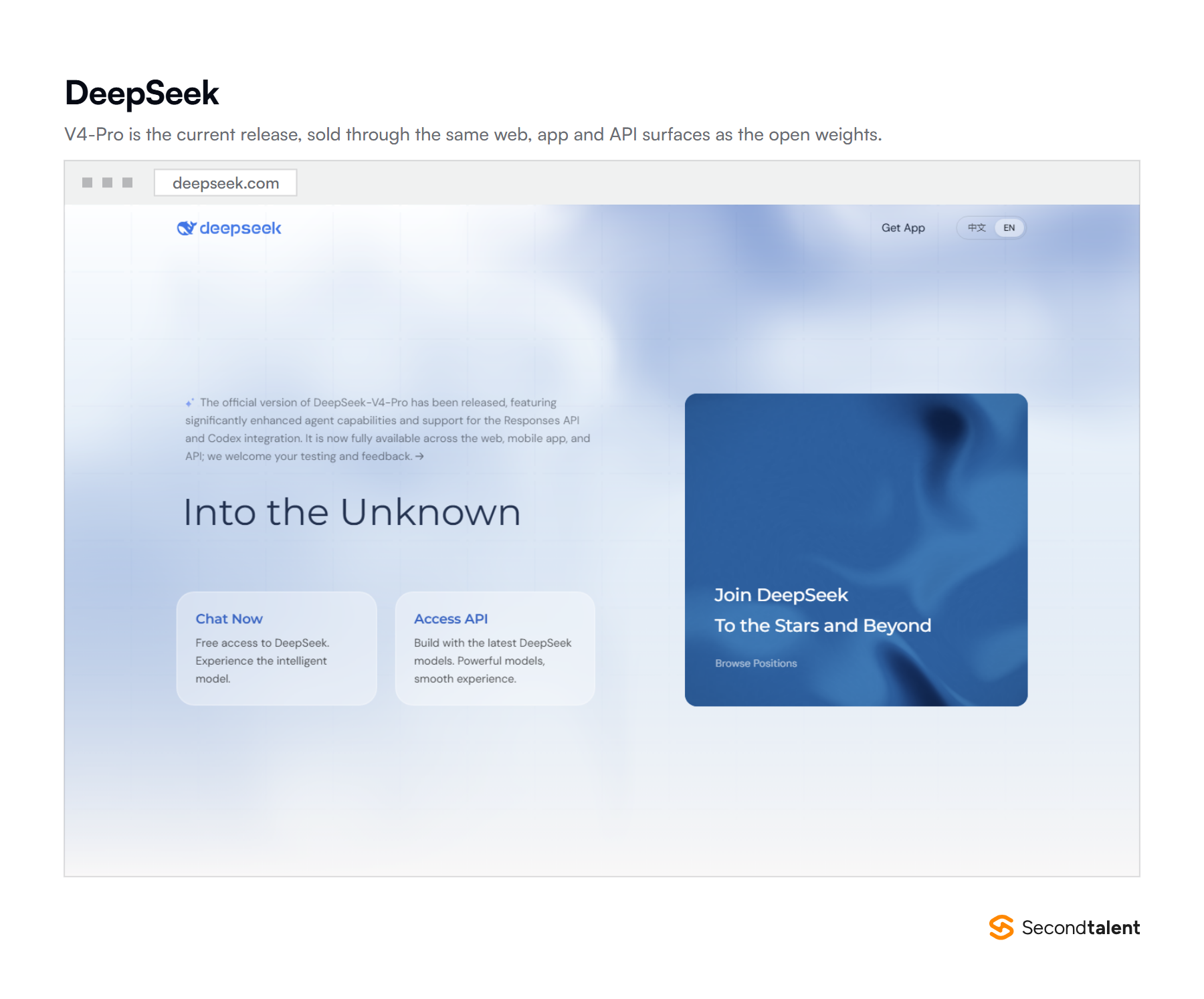
V4-Pro is the current release, sold across web, app and API, with agent behaviour and Responses API support as the headline additions.
The published weights match: DeepSeek-V4-Pro is a 1.7 trillion parameter model on Hugging Face, with V4-Flash at 304 billion for cheaper work.
The pricing is the part worth copying into a budget. DeepSeek lists V4-Pro at $1.32 per million input tokens on a cache miss and $3.96 per million output, halved during off-peak hours, against a one million token context window.
V4-Flash runs at a third of that.
- Flagship: V4-Pro, with V4-Flash and an experimental vision variant beneath it.
- Open weights: yes, published on Hugging Face alongside the hosted API.
- Use it when: you want frontier-adjacent quality at commodity prices and can either self-host or buy from a third-party host.
2. Alibaba (Qwen)
If you measure by adoption rather than headlines, Alibaba is the most important AI company in China. Qwen models passed 3 billion downloads in six months.
Hugging Face’s August state of open models report put Google at 418 million for 2026 and Meta at 227 million. Those are different counting windows, so treat the gap as directional rather than as a clean multiple.
The current line is Qwen3.8, and the range is what makes it the default.
Alibaba publishes 465 models, from a 2.4 trillion parameter flagship with 95 billion active down to a 27 billion model that fits on one machine, plus FP8 builds of both.
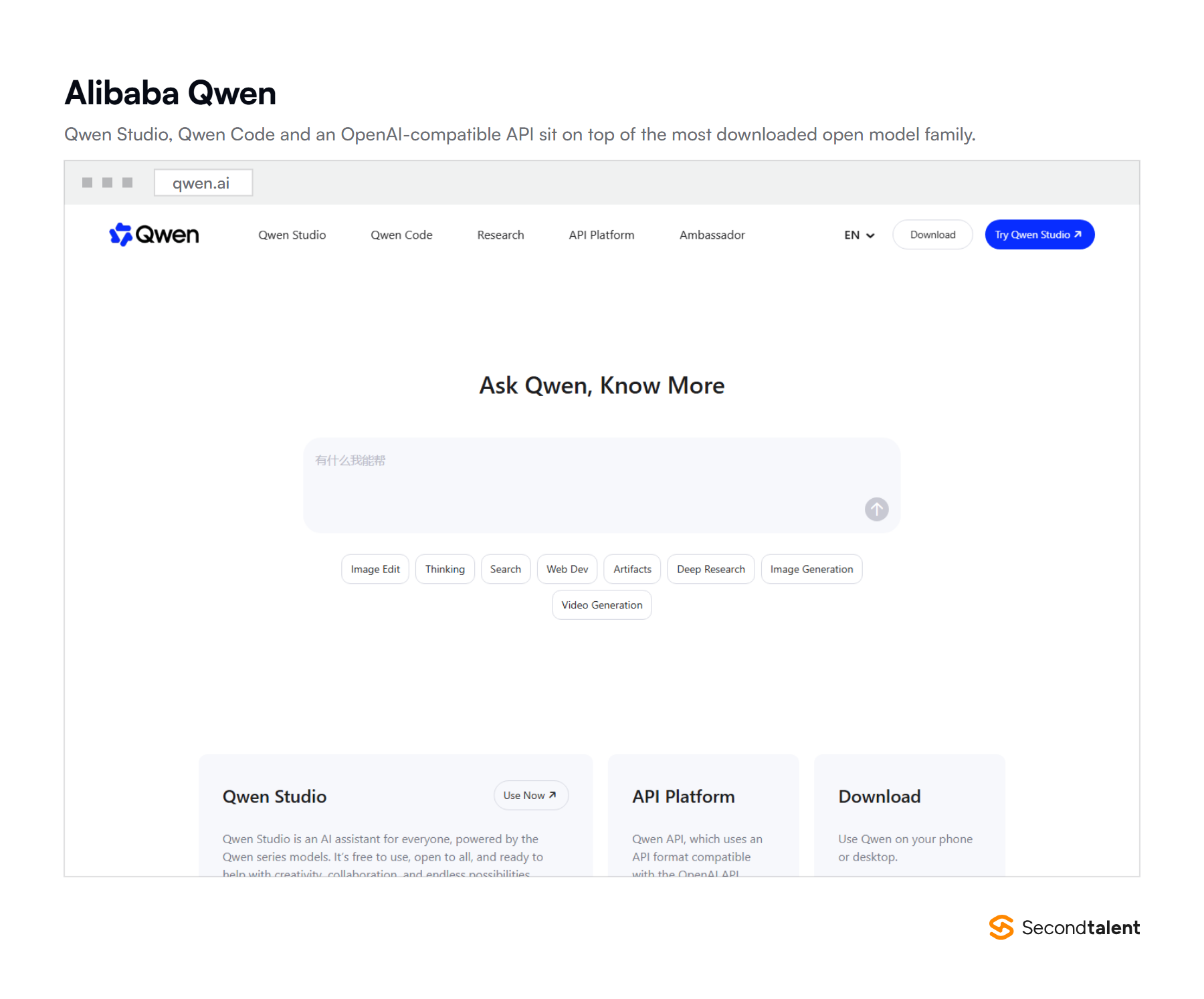
Around the weights sits an actual product surface: Qwen Studio for chat, Qwen Code for development, and an API that speaks the OpenAI format, so switching a service across costs a base URL and a key rather than a rewrite.
- Flagship: Qwen3.8, including a 2.4 trillion parameter open-weight model.
- Open weights: yes, and the widest size range of anyone on this list.
- Use it when: you are fine-tuning on your own data, or you want one family that scales from a laptop to a cluster.
Qwen experience now reads as a skill on an engineer’s CV rather than a novelty, which is worth knowing before you write the job description.
3. Moonshot AI (Kimi)
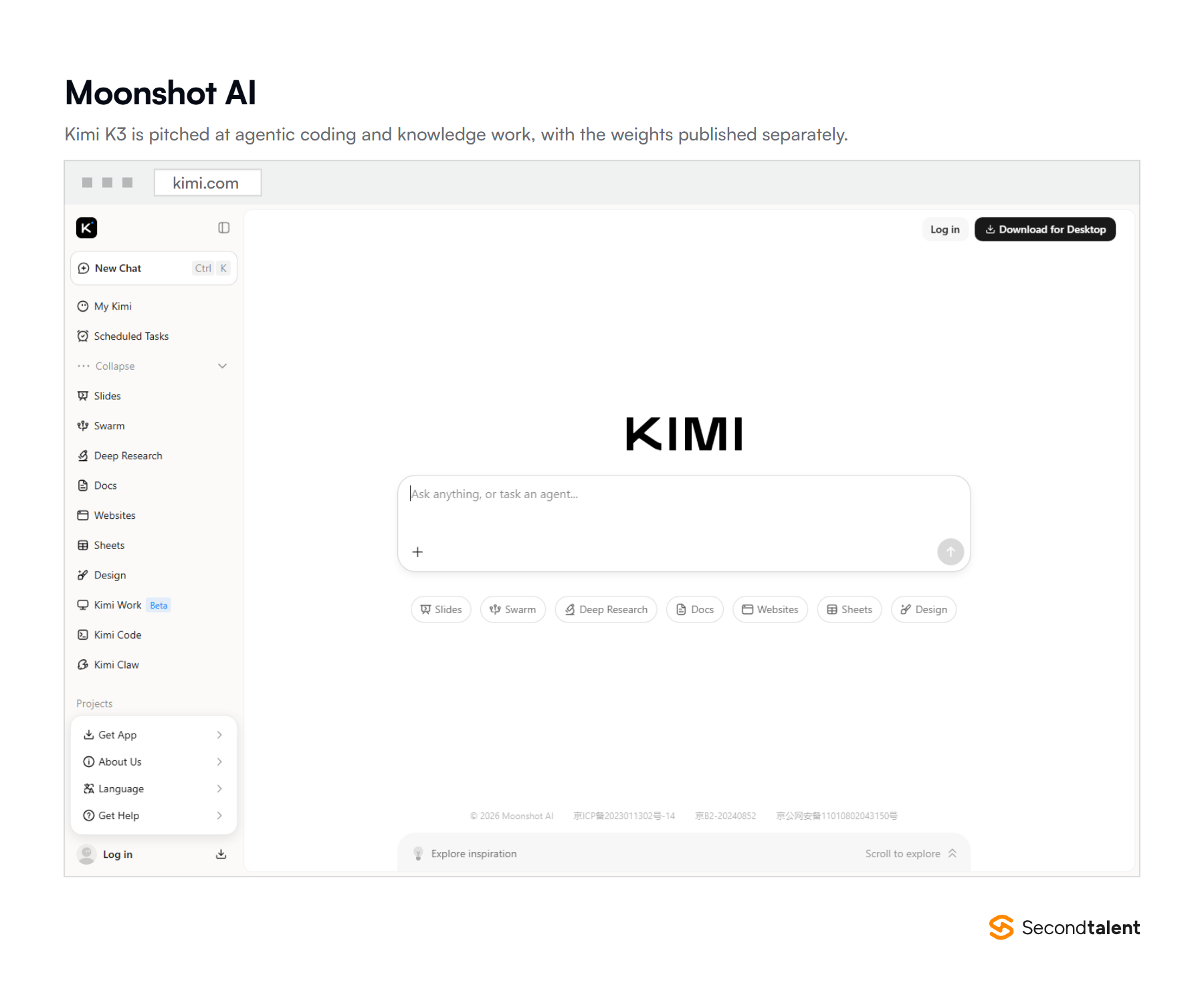
Moonshot shipped Kimi K3 on 16 July 2026: 2.8 trillion total parameters, 104 billion active, and a one million token context window. It entered the Artificial Analysis leaderboard at number three, and the weights followed on 27 July.
Bloomberg put the pre-listing valuation above $30 billion, with a Hong Kong float targeted within six months.
The product is pitched at agentic coding and knowledge work rather than chat, which is also where the K2 line landed: Moonshot’s model page still carries a trillion-parameter K2.7-Code build for teams that want the cheaper coding option.
Read the licence before you plan around it. A company above $20 million in annual revenue has to negotiate a contract with Moonshot before offering K3 to external customers as a service. Downloading is free. Reselling is not.
- Flagship: Kimi K3, 2.8 trillion parameters with 104 billion active.
- Open weights: yes, with a revenue-linked condition on resale.
- Use it when: the job is long-context agent work and you are running it for your own product, not selling it on.
4. Z.ai (formerly Zhipu)
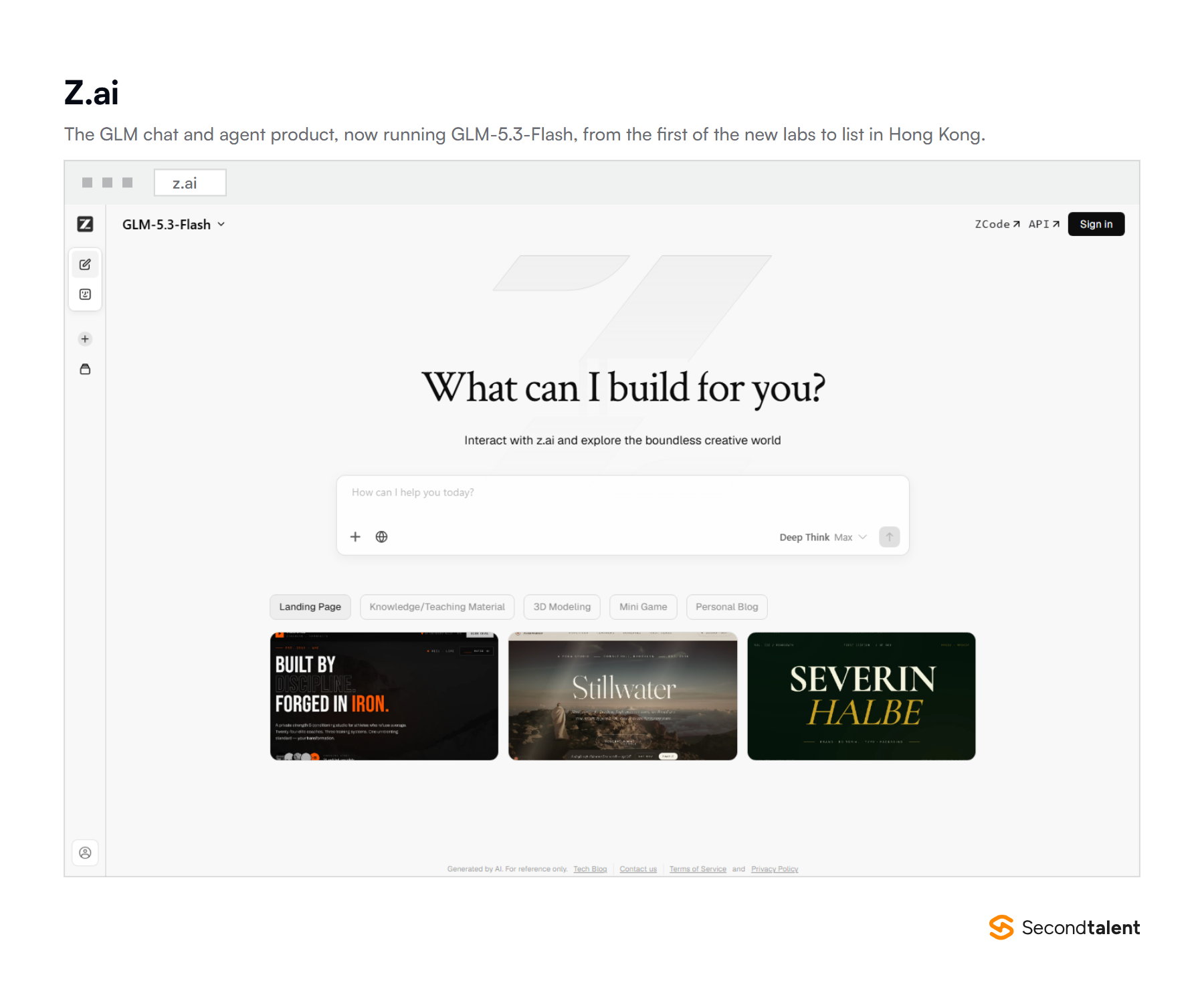
Founded in 2019 out of Tsinghua University and backed by Tencent, Meituan and Ant Group, Z.ai was the first of the new labs to go public. It listed in Hong Kong on 8 January 2026 at HK$116.20 a share, raising about US$558 million.
GLM has become the default second option for teams that want an alternative to Qwen without changing their tooling.
The current release is GLM-5.3 at 753 billion parameters, with a 321 billion Flash variant for cheaper serving, both open weight and both published within days of each other.
That cadence is the point. Z.ai ships a numbered upgrade every few weeks, which is good for capability and awkward for anyone who has pinned a version in production. Decide early whether you follow the releases or freeze on one.
- Flagship: GLM-5.3, with GLM-5.3-Flash beneath it.
- Open weights: yes, across 154 published models.
- Use it when: you want a second open family as a hedge against a single vendor, on the same serving stack.
5. MiniMax
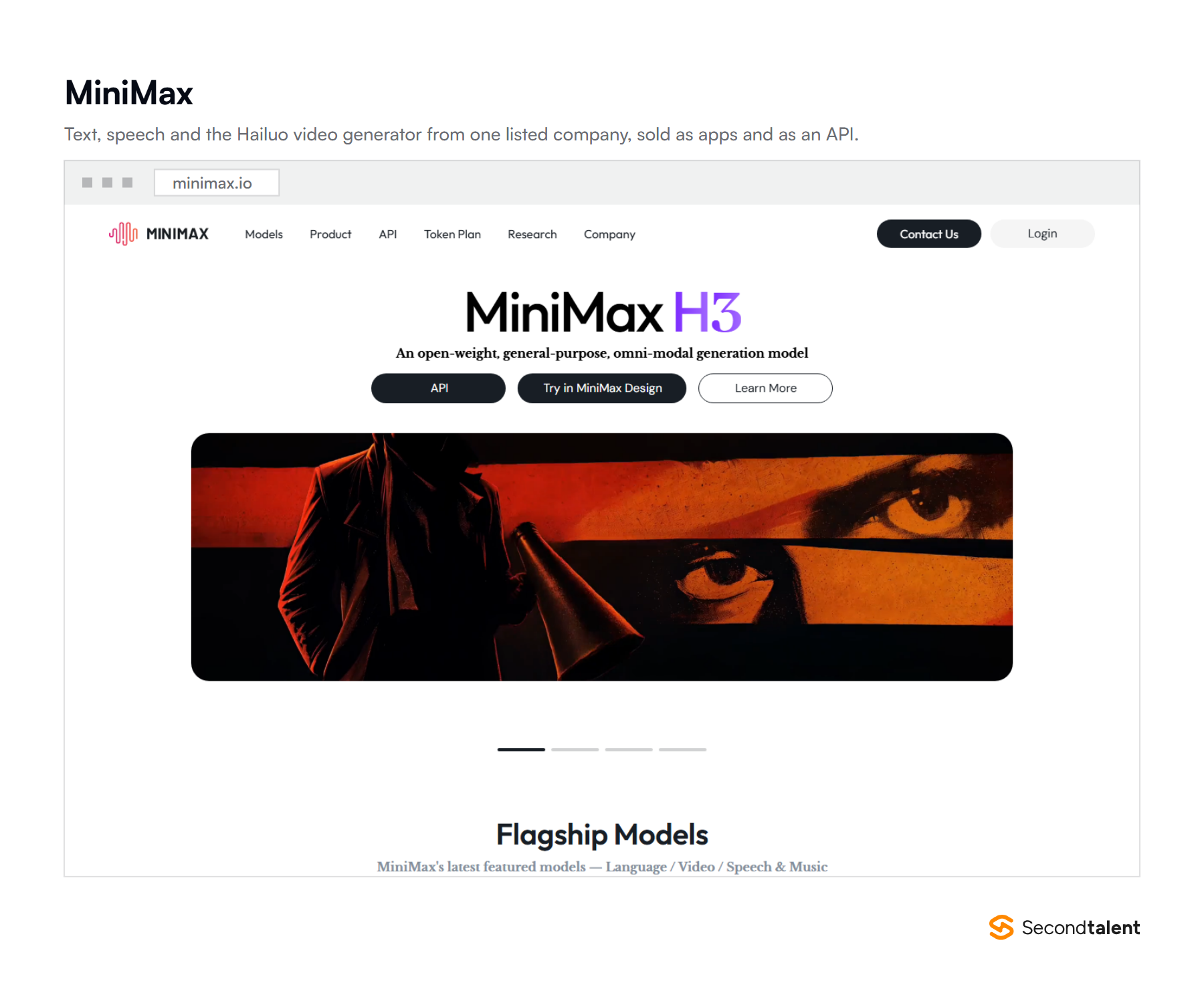
MiniMax listed the day after Z.ai and closed its debut up 109%, raising US$619 million.
It is the closest thing China has to a full-stack consumer AI company: text models, the Hailuo video generator, and speech, sold both as apps and as an API.
The open side is narrower than Qwen or GLM but covers more media. MiniMax publishes 21 models, led by M3 at 427 billion parameters, with a 33 billion H3 for smaller deployments and a music model alongside them.
Its listing document is the most useful public paper in the sector for anyone hiring. Average employee age: 29. More than 73% of staff in research and development.
That is the team shape these companies build, and the team shape they will outbid you for.
- Flagship: MiniMax-M3 for text, Hailuo for video.
- Open weights: partly. The text models are published, the consumer video product is not.
- Use it when: the product needs video or speech next to text and you would rather not stitch three vendors together.
6. ByteDance (Doubao and Seed)
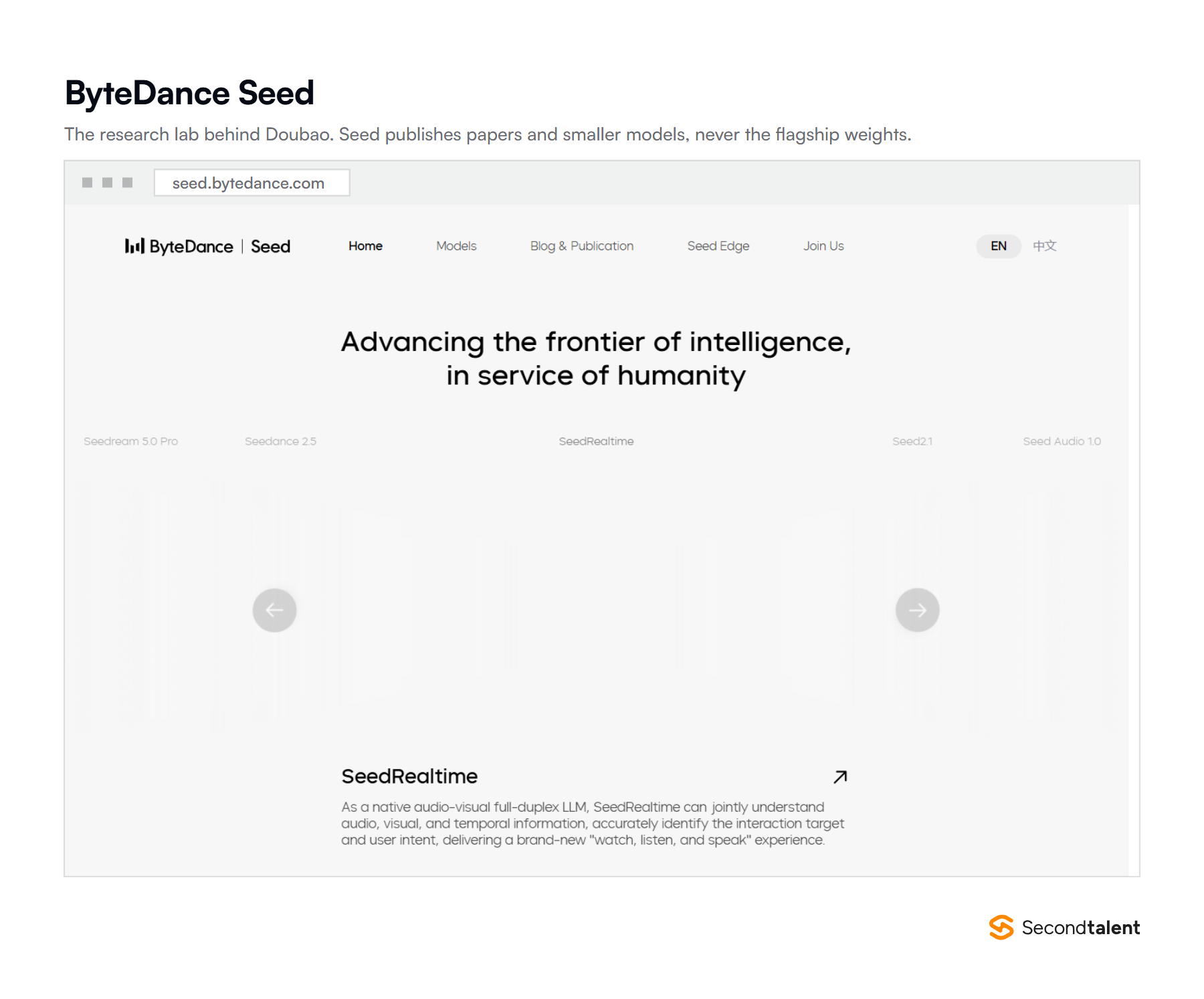
ByteDance does not publish its flagship weights and does not need to. Doubao reached 227 million monthly active users by December 2025, and JPMorgan reported it crossing 100 million daily users on 30 January 2026.
Distribution is the moat, not the model.
Behind the app sits a 160 billion yuan AI budget for 2026, about $23 billion, as reported by Caixin. Over half goes to chips.
Model work takes 20 billion yuan, and recruiting AI specialists takes 5 billion, which is close to $700 million set aside purely to hire researchers in a market already short of them.
What you can use is the research. ByteDance Seed publishes papers and 59 smaller models, covering coding, agent memory and diffusion work. Treat it as a window into the roadmap rather than as a supplier.
- Flagship: Doubao for consumers, Seed for research.
- Open weights: research models only, never the model behind Doubao.
- Use it when: you are studying where the field is going, or building for Chinese consumers where Doubao is already installed.
7. Baidu (ERNIE)
Baidu was first into Chinese generative AI and spent 2023 and 2024 defending a closed, paid model. DeepSeek ended that.
Baidu announced it would open-source ERNIE from 30 June 2025, and shipped the 4.5 family as ten models ranging from 0.3 billion to 424 billion parameters.
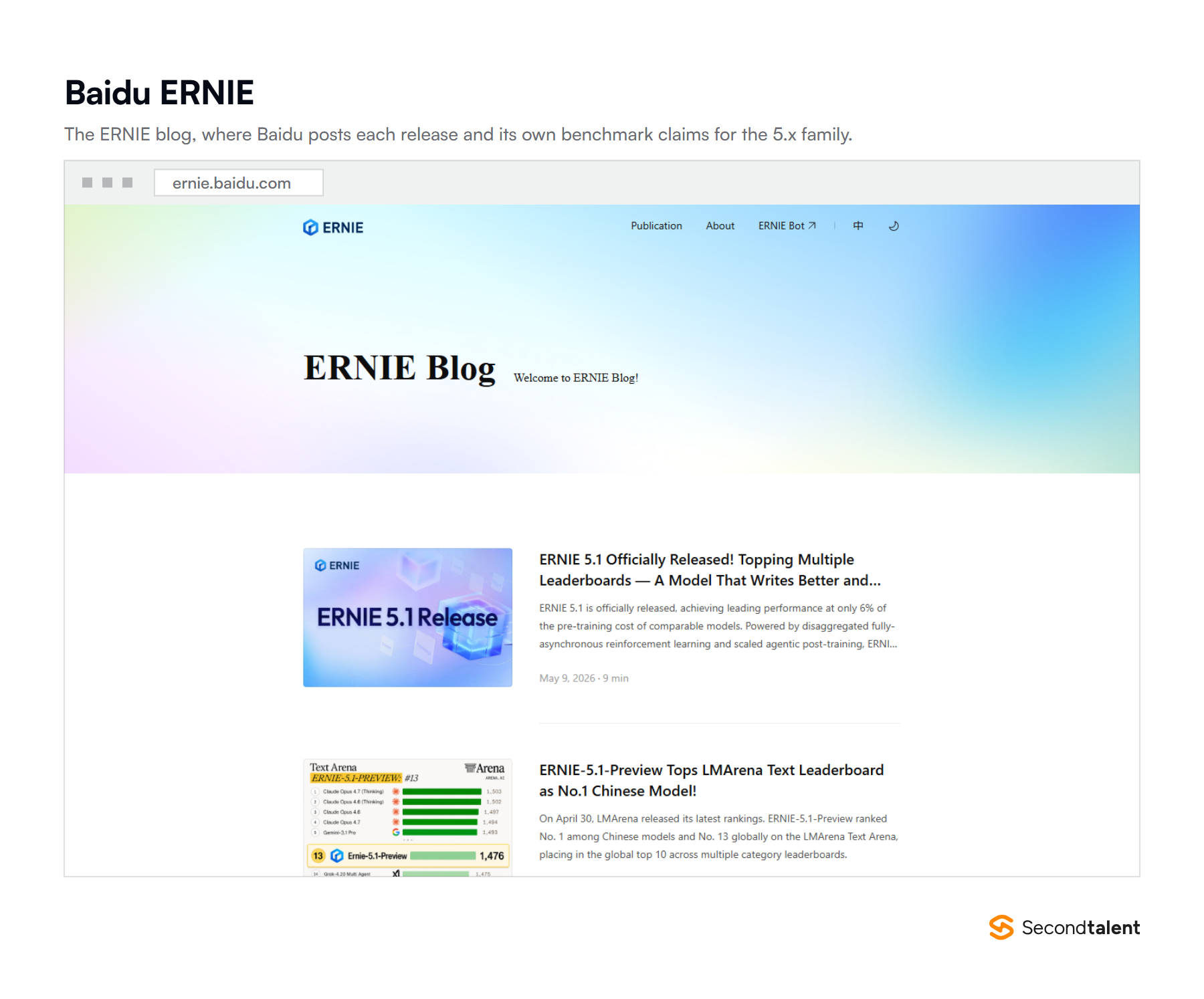
The 5.x line is where it recovered ground. Baidu released ERNIE 5.1 on 9 May 2026 and claims leading performance at 6% of the pre-training cost of comparable models.
The preview build had ranked first among Chinese models and thirteenth globally on the LMArena text leaderboard on 30 April.
Treat vendor benchmark claims as a starting filter rather than a verdict.
Baidu’s real strength is the enterprise stack around the model: search distribution, a mature API business, and a cloud that Chinese state buyers are comfortable purchasing.
- Flagship: ERNIE 5.1, with the open 4.5 family still available.
- Open weights: yes for 4.5, with the newest releases arriving through Baidu’s own channels first.
- Use it when: you sell into China and need a vendor procurement teams already recognise.
8. Tencent (Hunyuan and Yuanbao)
Tencent’s advantage is placement: its assistant, Yuanbao, sits inside WeChat, where Chinese consumers already are. No download, no new account, no habit to build.
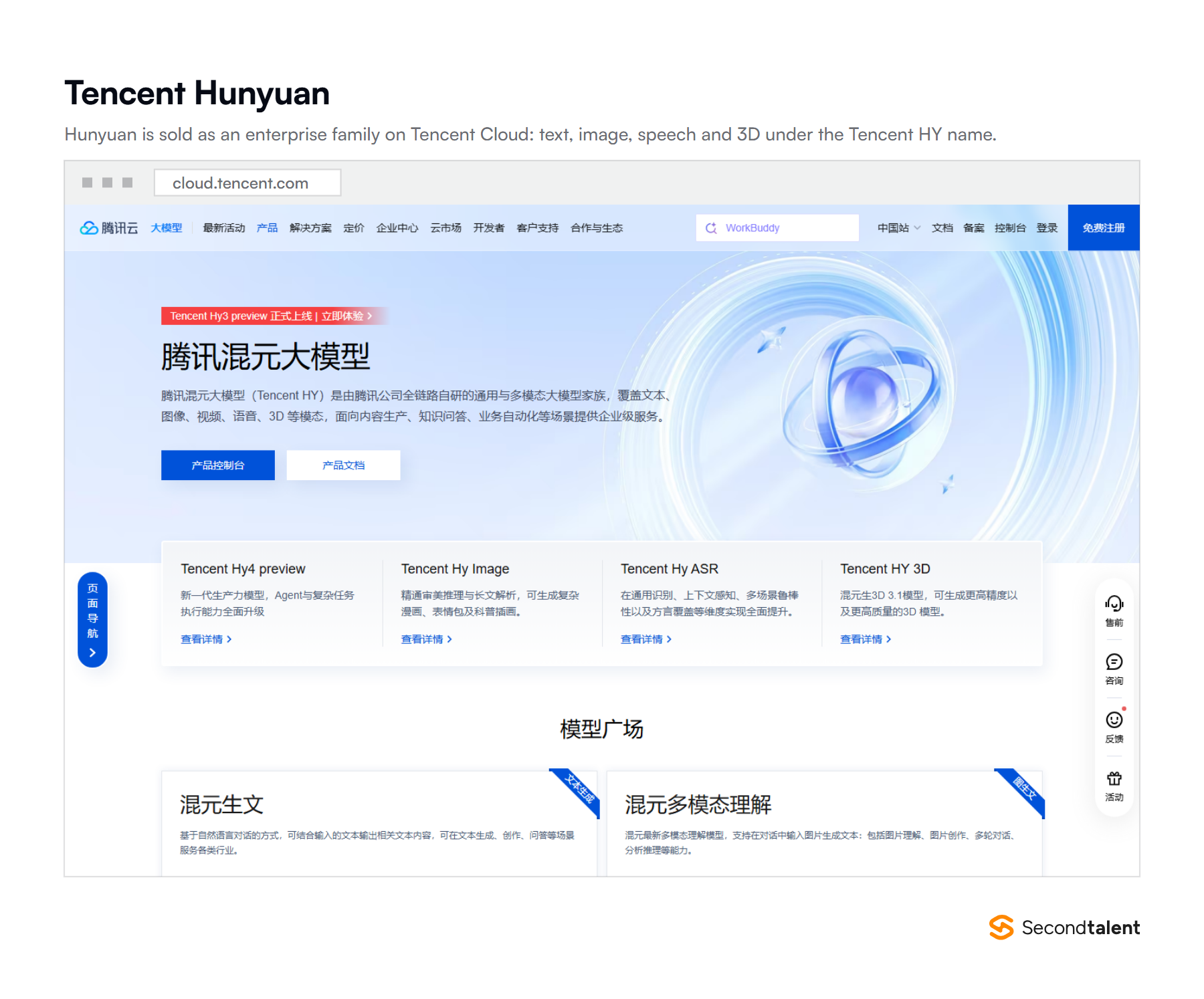
On the enterprise side the models are sold through Tencent Cloud under the Tencent HY name, spanning text, image, speech recognition and 3D generation, with HY3 live and HY4 in preview.
The open side runs in parallel: Tencent publishes 155 models on Hugging Face, including MoE releases and the Hunyuan3D line.
Tencent is also the quiet money in this list, holding positions in Z.ai and elsewhere. When a Chinese AI company raises, Tencent is frequently on the cap table.
- Flagship: Tencent HY for enterprise, Yuanbao for consumers.
- Open weights: partly, and skewed toward multimodal rather than the frontier text model.
- Use it when: you need 3D or image generation, or your users live inside WeChat.
9. iFlytek
The oldest company here by some distance, and the one with the clearest answer to the chip question. iFlytek trained its Spark X2 line on domestic compute alone, on Huawei Ascend silicon, in a cluster of ten thousand cards built with Huawei.
The line moved again this month. iFlytek released the 293 billion parameter Spark X2.5 base model on 7 September 2026, after open-sourcing two on-device models, X2.5-4B and X2.5-1.7B, on 1 September.
Both small models carry a one million token context window and target vehicles, smart hardware and IoT.
iFlytek will not top a global leaderboard. It does not need to. Its market is Chinese education, healthcare and public sector procurement, where “trained on domestic hardware” is a purchasing requirement rather than a talking point.
- Flagship: Spark X2.5, 293 billion parameters.
- Open weights: the small on-device models only, not the base model.
- Use it when: you ship on-device or into Chinese public sector buyers who ask what the model was trained on.
10. Huawei (Pangu and Ascend)
Huawei belongs on a list of AI companies for the same reason Nvidia does. Its Pangu models matter less than its Ascend accelerators, which now carry a growing share of Chinese training and inference.
Each tightening of export controls has strengthened that position.
Pangu itself is sold as an enterprise stack rather than a chatbot.
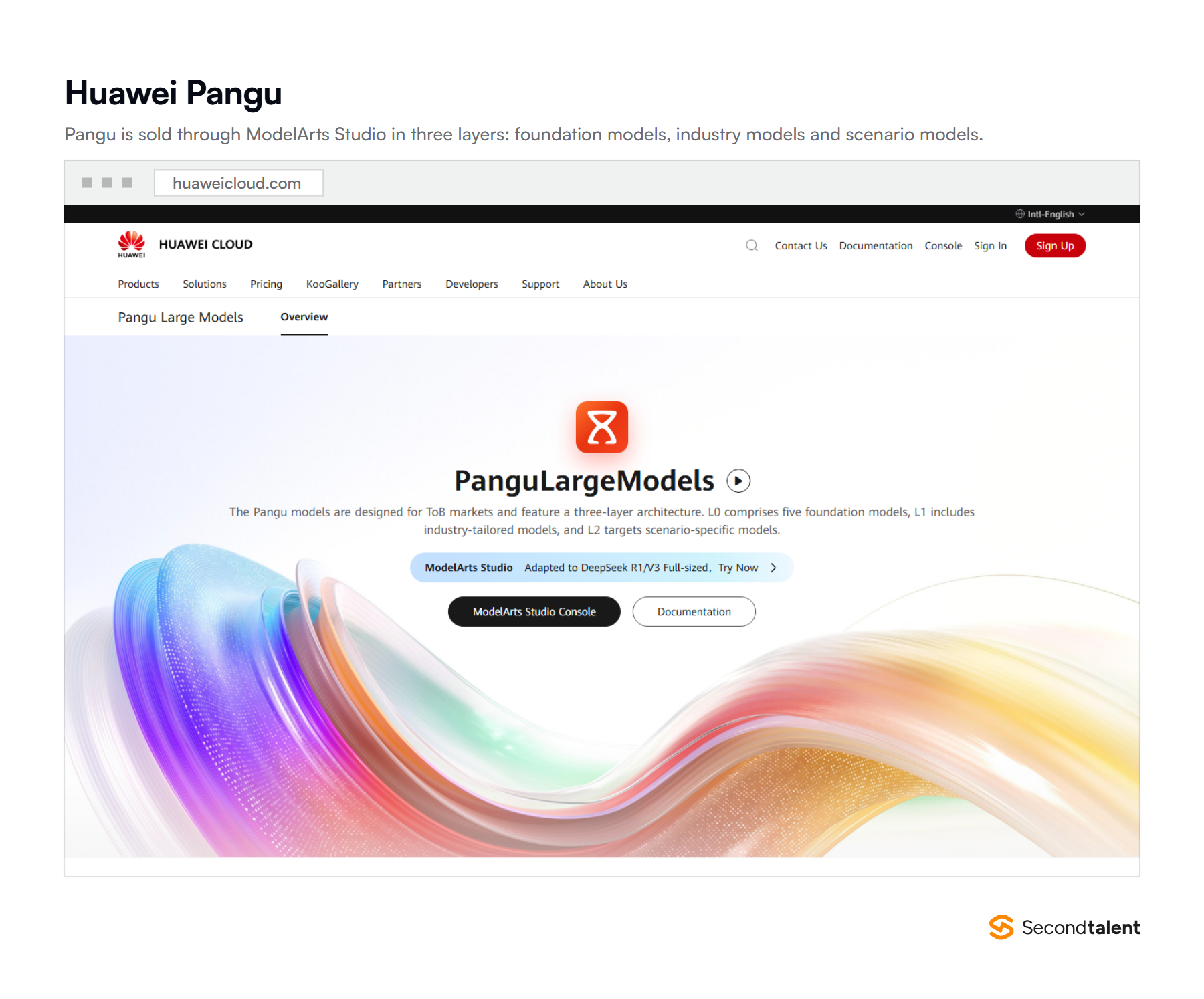
Huawei Cloud structures it in three layers: five foundation models covering language, vision, multimodal, prediction and scientific computing, then industry models, then scenario models, all reached through ModelArts Studio.
The practical consequence for a foreign team is one layer down.
A Chinese open-weight model now assumes a Chinese accelerator beneath it, so the reference serving stack was tuned for hardware you do not have, and porting it is where the engineering time goes.
- Flagship: Ascend accelerators, with Pangu as the model layer on top.
- Open weights: partly, and secondary to the hardware story.
- Use it when: you are budgeting a self-hosted deployment and need to know what the stack underneath assumes.
Open weights are not a free lunch
The phrase “open source” is doing a lot of work in this market. Separate what you get from what you still owe someone.
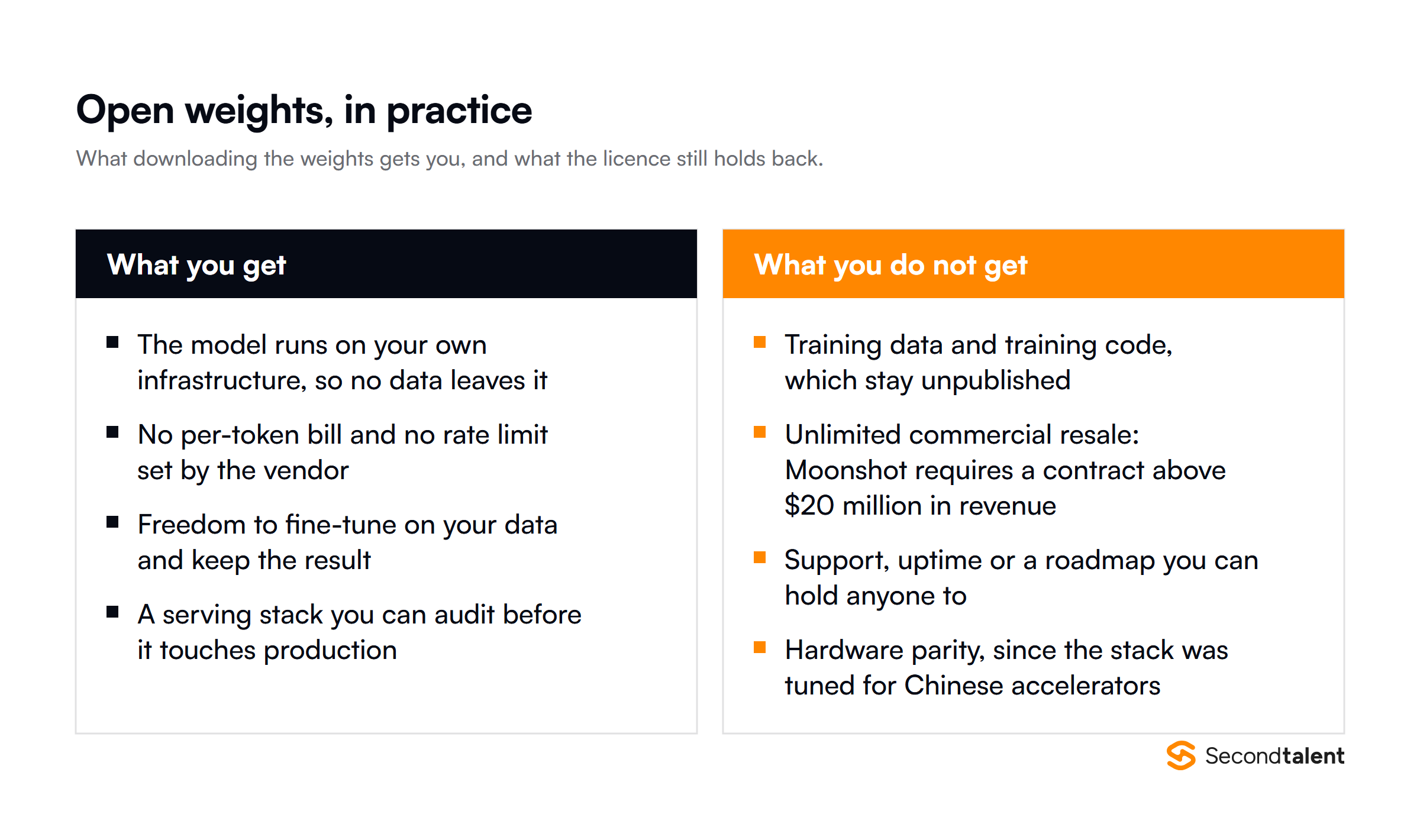
Two of the labs here have already moved toward revenue-linked terms for large commercial users.
Assume the direction of travel is more conditions rather than fewer, and read the licence for the specific model version you plan to deploy, not the family.
What this means if you are hiring
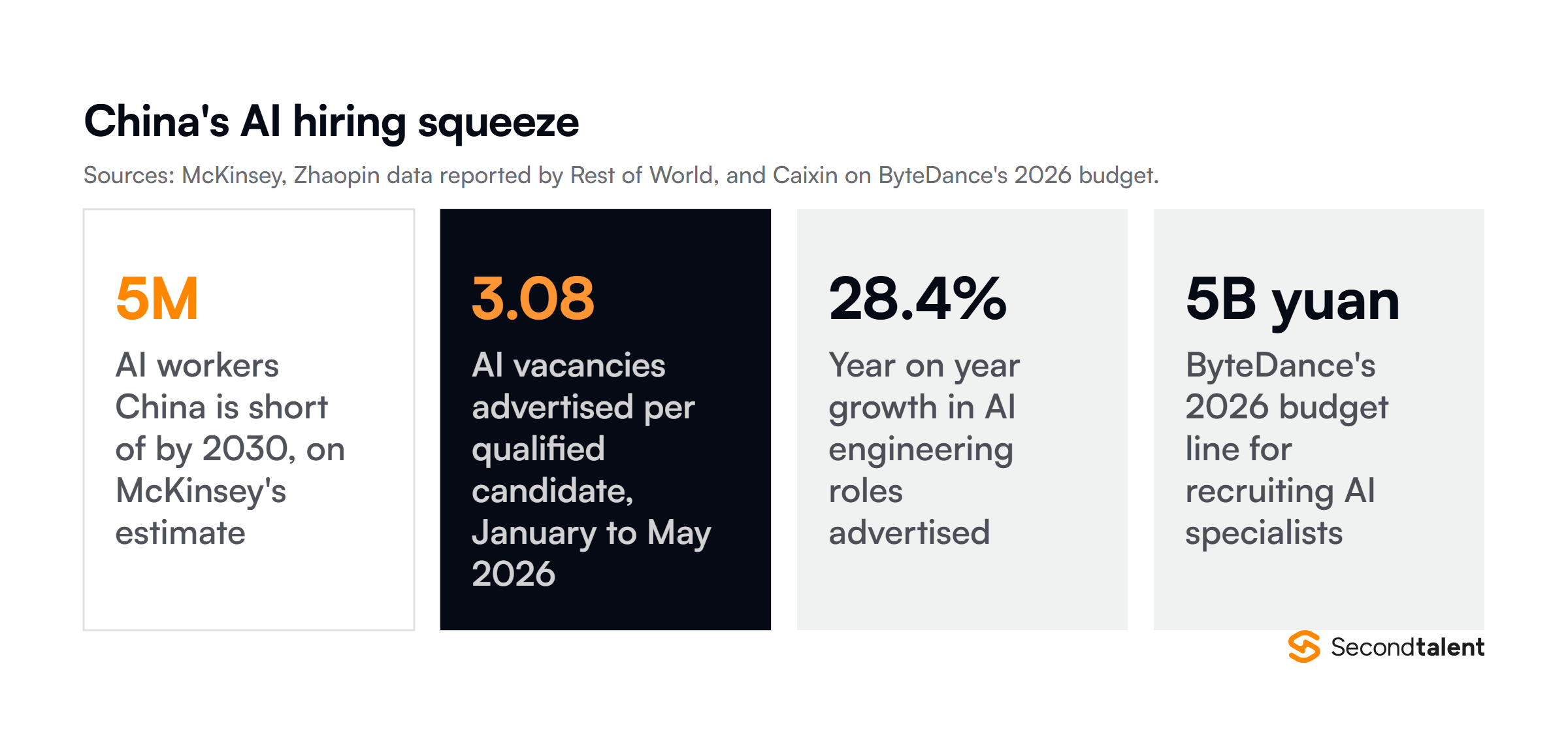
All ten compete for the same engineers. McKinsey estimates China faces a shortfall of about five million AI workers by 2030, with universities supplying roughly a third of demand.
Zhaopin data reported by Rest of World puts advertised AI vacancies at 3.08 per qualified candidate between January and May 2026, with AI engineering roles up 28.4% year on year. Tencent now runs summer camps for 13 to 18 year olds.
Competing head-on for Beijing or Hangzhou researchers is a losing trade at almost any budget.
The layer these labs are not fighting over is the one to hire: engineers who take an open-weight model and turn it into a product, across Vietnam, the Philippines, Singapore and Taiwan as well as mainland China.
We track what they cost in the AI engineer rate card for China, the Asia Tech Salary Index and our report on AI engineering talent in Southeast Asia.
Most companies need two or three engineers who can test an open-weight model against their own data, fine-tune it and keep the serving cost sane, not a research lab.
We place vetted AI and machine learning engineers across nine Asian markets, including engineers in China, with employer of record cover where you have no local entity. Tell us what you are building.
Common questions
Which Chinese AI company is the largest?
By market capitalisation and revenue, Alibaba, Tencent, ByteDance, Baidu and Huawei dwarf every pure-play lab here. By model adoption, Alibaba leads on downloads and DeepSeek leads on name recognition.
By valuation among the new labs, DeepSeek is reported around $71 billion, ahead of Moonshot at just over $30 billion.
Are Chinese AI models really open source?
Most are open weight rather than open source. You can download and run the model, but training data and code are usually not published, and several licences add conditions for large commercial users.
Moonshot requires companies above $20 million in revenue to negotiate before reselling K3 as a service.
Can a foreign company use these models legally?
Generally yes, subject to the model licence and to your own jurisdiction’s rules on data transfer and government procurement.
Self-hosting open weights on your own infrastructure removes the cross-border data question entirely, which is why regulated buyers tend to choose it over the Chinese cloud APIs.
We keep a separate list of the hottest Chinese AI startups for the tier below these ten.