Big data specialists top the World Economic Forum's list of the fastest-growing jobs through 2030 in percentage terms, ahead of fintech engineers and AI and machine learning specialists.
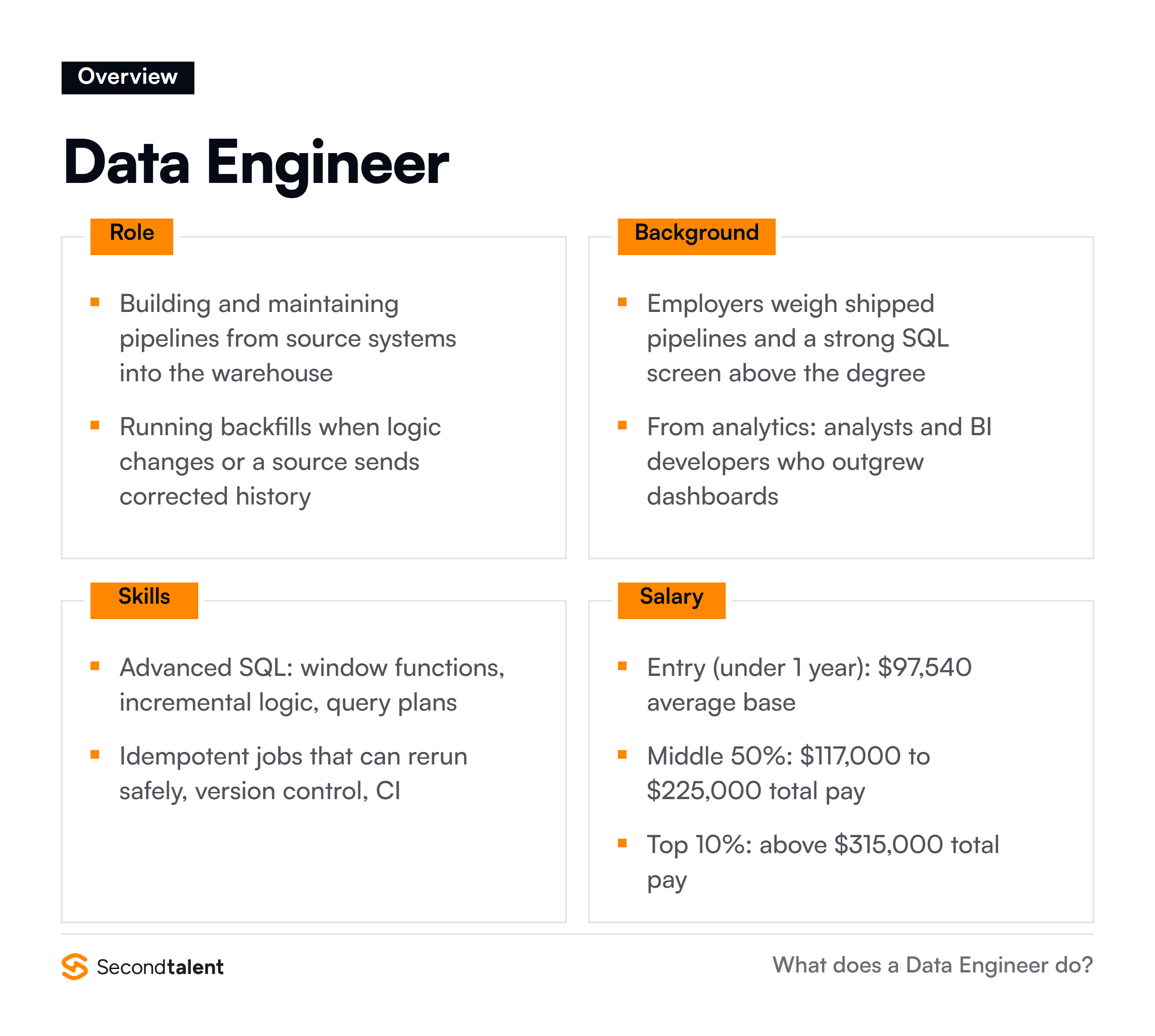
In the US, Levels.fyi puts median total compensation for a data engineer at $157,300, and the top 10 percent earn more than $315,000.
The pay reflects the dependency. Every dashboard, forecast and AI feature reads from the pipelines a data engineer builds, so late, duplicated or wrong data reaches the whole company at once.
What is a Data Engineer?
A data engineer designs, builds and runs the systems that move data from where it is created to where it is used. Sources include application databases, SaaS tools such as Salesforce and Stripe, event streams and files from partners.
Destinations include a cloud warehouse or lakehouse, BI dashboards, machine learning models and, increasingly, the retrieval layer behind AI products.
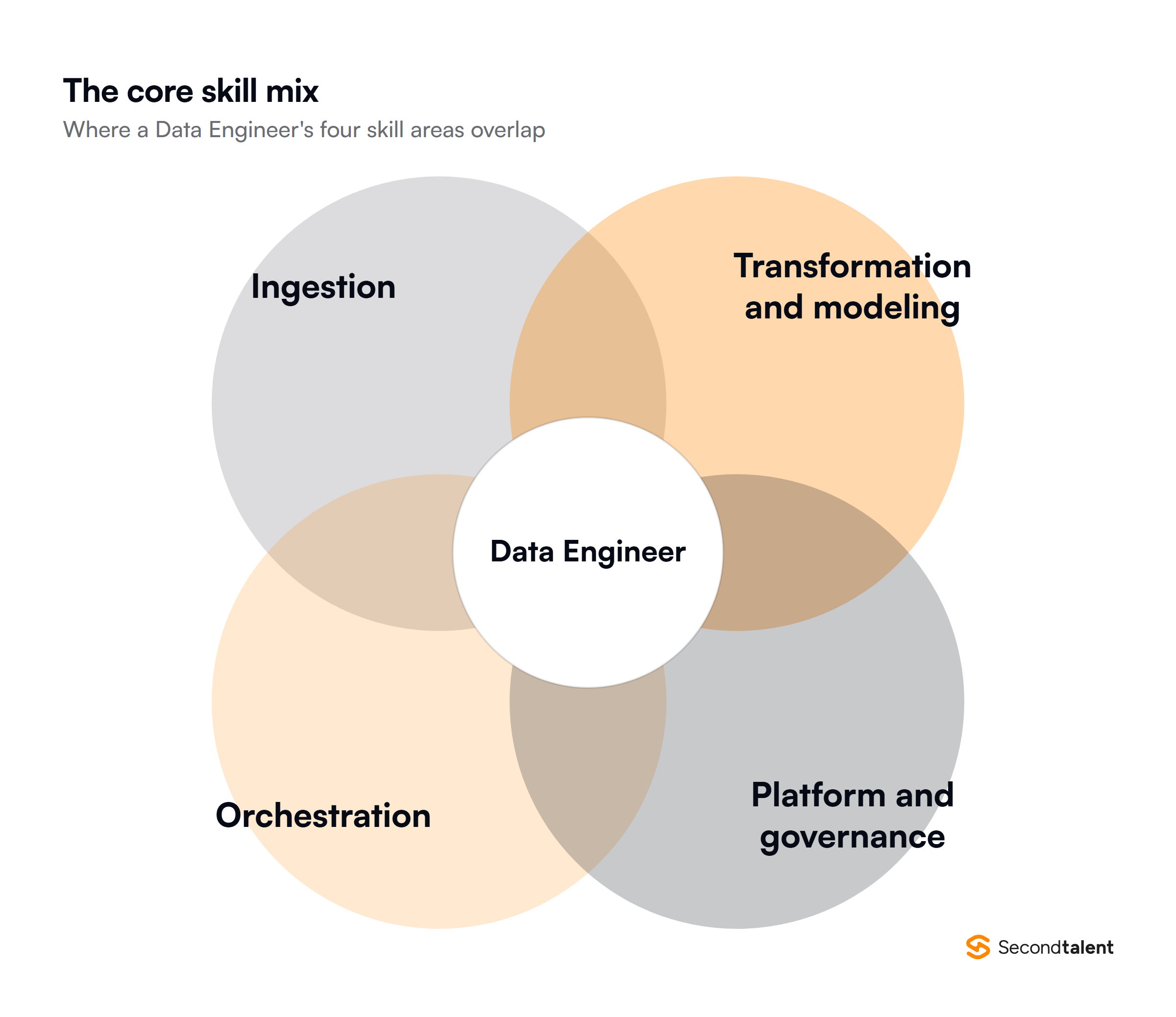
The job covers four kinds of work:
- Ingestion: pulling data out of source systems on a schedule or as a stream, without overloading production databases
- Transformation and modeling: cleaning raw records and shaping them into tables analysts and models can trust
- Orchestration: scheduling jobs, handling dependencies, retries and backfills when something upstream breaks
- Platform and governance: storage layout, access control, data quality checks, cost and handling of personal data
At a 20-person startup, one data engineer often does all four and sets up the first warehouse.
At a large company the work splits into specialist roles, which is why titles such as data pipeline engineer and data warehouse engineer exist alongside the general one.
Data Engineer Job Market and Salary in the US
The Bureau of Labor Statistics has no "data engineer" occupation, so official figures come from the closest proxies.
BLS reports a median annual wage of $139,500 for database architects in May 2025, with the lowest 10 percent under $86,240 and the highest 10 percent above $204,000. Database administrators earned a median of $104,620.
Database architect employment is projected to grow 9 percent from 2025 to 2035, against 0 percent for administrators, as cloud services let fewer DBAs serve more companies.
The broader proxy, software developers, had a median wage of $135,980 in May 2025 and projected growth of 10 percent over the same decade.
Salary Data From Named Sources
Once bonuses and equity are counted, pay sites put data engineer total compensation above both BLS proxies:
- Levels.fyi (updated October 16, 2026): median total compensation of $157,300. The middle 50% earn $117,000 to $225,000 total pay, and the 90th percentile is $315,000.
- Built In: average base salary of $125,983, plus $24,251 in average additional cash, for $150,234 total. Entry (under 1 year): $97,540 average base, and $141,418 at 7+ years.
Industry moves the proxy figures too. BLS puts the median for database architects at $152,560 in computing infrastructure, data processing and web hosting, and $146,470 in finance and insurance.
Senior data engineer salaries generally sit in the upper half of those ranges. Top 10%: above $315,000 total pay on Levels.fyi, a figure that includes stock grants.
Contract Rates
For contract work, Second Talent's data engineer cost guide puts US freelance rates at $73 to $112 an hour for juniors, $92 to $145 for mid-level engineers ($14,720 to $23,200 a month at 160 hours) and $120 to $184 for seniors.
Demand: In the WEF Future of Jobs Report 2025, surveyed executives ranked big data specialists first among the fastest-growing jobs in percentage terms.
AI projects add to it: a model is only as useful as the data feeding it, and that plumbing is data engineering work.
Data Engineer Responsibilities and Day-to-Day Work
The first hour of most days goes to checking overnight jobs. A failed load or a silent drop in row counts has to be caught before the 9am revenue dashboard goes out. The rest of the week typically covers:
- Building and maintaining pipelines from source systems into the warehouse or lakehouse
- Writing and reviewing SQL and Python transformations, with tests on keys, nulls and row counts
- Designing data models: fact and dimension tables, slowly changing dimensions, event schemas
- Running backfills when logic changes or a source sends corrected history
- Agreeing data contracts with application teams so a renamed column does not break reporting
- Tuning slow queries and expensive jobs, since warehouse spend scales with careless SQL
- Managing access, masking personal data and supporting audits such as SOC 2
- Taking on-call shifts for pipelines that feed customer-facing features
Requests come from analysts, data scientists, finance and product managers, so a good part of the job is turning "the numbers look off" into a specific, fixable defect.
Sample Data Engineer Job Description
A useful job description names the stack, the first project and how success is measured. A typical outline for a mid-level hire:
- Mission: own reliable, tested pipelines from our product database and SaaS tools into the warehouse
- First 90 days: migrate nightly scripts to the orchestrator, add tests to the ten most used tables, cut warehouse spend
- Requirements: 3+ years building production pipelines, advanced SQL, Python, one cloud warehouse, dbt or similar
- Nice to have: streaming with Kafka, change data capture, infrastructure as code
- Success measures: data freshness targets met, fewer broken dashboards, documented models with named owners
Essential Skills and Qualifications
SQL and Python dominate. In the 2025 Stack Overflow Developer Survey, 61.3 percent of professional developers used SQL and 54.8 percent used Python, and PostgreSQL was the most used database at 58.2 percent.
Core Technical Skills:
- Advanced SQL: window functions, incremental logic, query plans and cost-aware writing
- Python for ingestion, orchestration code, APIs and testing
- Data modeling: dimensional design, normalization trade-offs, event and change-data-capture schemas
- Distributed processing with Spark or a warehouse engine, including partitioning and file sizing
- Streaming fundamentals: ordering, late data, exactly-once versus at-least-once delivery
- Cloud basics on AWS, Google Cloud or Azure: storage, IAM, networking and infrastructure as code
Engineering Habits:
- Idempotent jobs that can rerun safely, version control, code review and CI for pipelines
- Data quality tests and alerting that catch problems before stakeholders do
- Clear written documentation of tables, owners and freshness expectations
Qualifications: BLS notes that database administrators and architects typically need a bachelor's degree in computer and information technology or a related field.
For data engineers, employers weigh shipped pipelines and a strong SQL screen above the degree. Cloud certifications such as Google Cloud's Professional Data Engineer help with enterprise buyers.
Data Engineer Career Paths
Common Routes In:
- From software engineering: back-end developers who already own databases and APIs
- From analytics: analysts and BI developers who outgrew dashboards and started writing the pipelines
- From database administration: DBAs moving from running databases to building data platforms
Typical Progression:
- Junior data engineer: maintains existing pipelines, writes transformations, fixes failed jobs
- Data engineer: owns pipelines end to end, from source to modeled tables
- Senior data engineer: designs the platform, sets modeling standards, leads migrations
- Staff or principal data engineer: sets architecture across teams and owns cost and reliability targets
- Head of data or data platform lead: manages the team, budget and roadmap
Where It Leads: Many data engineers branch into machine learning infrastructure as an MLOps engineer, into data architecture, or into platform engineering.
Analytics engineering is a common sideways move for those who prefer modeling over infrastructure.
Data Engineer Tools and Tech Stack in 2026
The core open-source projects have all moved on since 2024. Apache Kafka 4.0, released March 18, 2025, was the first major release to run entirely without ZooKeeper.
Apache Airflow 3.0 followed on April 22, 2025, and the 3.3 line was current by September 2026. Apache Spark 4.2.0 was released July 14, 2026.
- Languages: SQL and Python everywhere; Scala or Java for some Spark and Kafka work
- Warehouses and lakehouses: Snowflake, Google BigQuery, Databricks and Amazon Redshift
- Open table formats: Apache Iceberg and Delta Lake, which let several engines read the same files
- Transformation: dbt for SQL models, tests and documentation
- Orchestration: Airflow, Dagster or Prefect
- Ingestion: managed connectors such as Fivetran or Airbyte, plus Debezium for change data capture
- Streaming: Kafka, Flink and Spark Structured Streaming
- Real-time analytics: ClickHouse and similar column stores for sub-second queries
- Quality and observability: dbt tests, Great Expectations, Monte Carlo
- Infrastructure: Terraform, Docker and Kubernetes for self-hosted components
Most startups do not need all of it. A common first stack is managed ingestion, one cloud warehouse, dbt and a scheduler, with streaming added only when a product feature needs fresh data.
Data Engineer vs Adjacent Roles
The titles overlap, and job descriptions often mix them. The useful test is what the role is accountable for:
- Data scientist: answers questions and builds models from data. The data engineer makes sure that data exists, is fresh and is correct.
- Analytics engineer: owns the modeled layer in the warehouse, mostly in SQL and dbt, close to business definitions. Data engineers own ingestion, infrastructure and anything that is not SQL.
- Data warehouse engineer: a narrower specialist in warehouse design, performance and cost. Data engineers cover the warehouse plus everything feeding it.
- ML engineer: trains, deploys and serves models. Data engineers supply the training data and features, and the line blurs in small teams.
- Database administrator: keeps operational databases available, backed up and secure. Data engineers read from those databases and build the analytical side.
Two newer specialist titles split the pipeline work further. A data pipeline engineer focuses on ingestion and orchestration reliability.
An AI data pipeline engineer prepares unstructured data, such as documents and transcripts, for embeddings, retrieval and model training.
How to Hire a Data Engineer
Most startups hire a first data engineer when analysts spend more time fixing data than analyzing it, or when a product feature starts depending on fresh data.
Before that point, a managed connector, one warehouse and a few dbt models kept by an engineer with SQL depth usually cover the need.
Write down the first problem before writing the job description. "Build our first warehouse from Postgres, Stripe and HubSpot" calls for a generalist who has done it before.
"Our Spark jobs cost too much and miss their SLA" calls for a senior with distributed processing depth.
What to Test:
- A SQL exercise on messy data: duplicates, late-arriving rows and a slowly changing dimension. Watch how they check their own results.
- A pipeline design discussion: how they would load a large table incrementally, make it idempotent, backfill a year of history and alert on failure.
- A debugging scenario: a dashboard total dropped 30 percent overnight. Good candidates ask about source changes, row counts and job logs before touching code.
- A short take-home or live coding task in Python, capped at two hours, that reads from an API and writes clean, tested output.
- A cost question: how they would find and fix the most expensive queries in the warehouse.
Red flags include no tests on past pipelines, vague answers on backfills, and treating data quality as the analyst's problem. For the full cost picture by seniority and region, see the data engineer cost guide.
Second Talent helps US startups hire vetted AI-Native Engineers and Specialists from Asia.
You can hire data engineers at $29 to $39 USD an hour, billed monthly (160 hours = $4,599 to $5,999 a month), with vetted candidates matched in 24 hours, 4 to 6 hours of US time-zone overlap and a 90-day, one-time replacement guarantee.
There is $0 cost until you hire. Tell us what you need to see a shortlist.
Frequently Asked Questions
What does a data engineer do?
A data engineer builds and runs the systems that move data from applications, SaaS tools and event streams into a warehouse or lakehouse, then cleans and models it so analysts, data scientists and AI products can use it.
The work includes ingestion, transformation, orchestration, data quality checks, access control and cost management.
How much does a data engineer make in the US?
Levels.fyi reports a median total compensation of $157,300 for US data engineers, with the middle 50% earning $117,000 to $225,000 and the 90th percentile at $315,000. Built In reports an average base salary of $125,983.
BLS has no data engineer category; its closest proxy, database architects, had a median wage of $139,500 in May 2025.
What is the difference between a data engineer and a data scientist?
A data scientist analyzes data and builds models to answer questions or make predictions. A data engineer builds the pipelines and storage that supply that data and keeps it fresh and accurate.
Data scientists work mostly in notebooks and statistics; data engineers work in SQL, Python, orchestration and cloud infrastructure.
What skills does a data engineer need?
Advanced SQL and Python, data modeling, distributed processing with Spark or a cloud warehouse, streaming basics, cloud services and engineering habits such as version control, testing and idempotent jobs.
In the 2025 Stack Overflow Developer Survey, 61.3 percent of professional developers used SQL and 54.8 percent used Python.
Is data engineering a growing field?
Yes. The WEF Future of Jobs Report 2025 ranks big data specialists as the fastest-growing job in percentage terms through 2030. BLS projects 9 percent growth for database architects and 10 percent for software developers from 2025 to 2035.
How much does it cost to hire a data engineer from Asia?
Through Second Talent, a vetted data engineer from Asia costs $29 to $39 USD an hour, billed monthly, which is $4,599 to $5,999 a month for 160 hours.
Candidates are matched in 24 hours, work with 4 to 6 hours of US time-zone overlap and come with a 90-day, one-time replacement guarantee, with no cost until you hire.
Related Roles
Explore related roles you can hire on Second Talent: Data Warehouse Engineer, Data Pipeline Engineer, AI Data Pipeline Engineer, Database Administrator, MLOps Engineer, Platform Engineer.