
With enterprises worldwide adopting microservices to accelerate development velocity and improve system resilience, demand for experienced architects who can successfully guide these transformations has surged dramatically. This specialized field offers exceptional career opportunities for those who combine deep technical knowledge with strategic thinking and the ability to lead large-scale architectural initiatives.
What is a Microservices Architect?
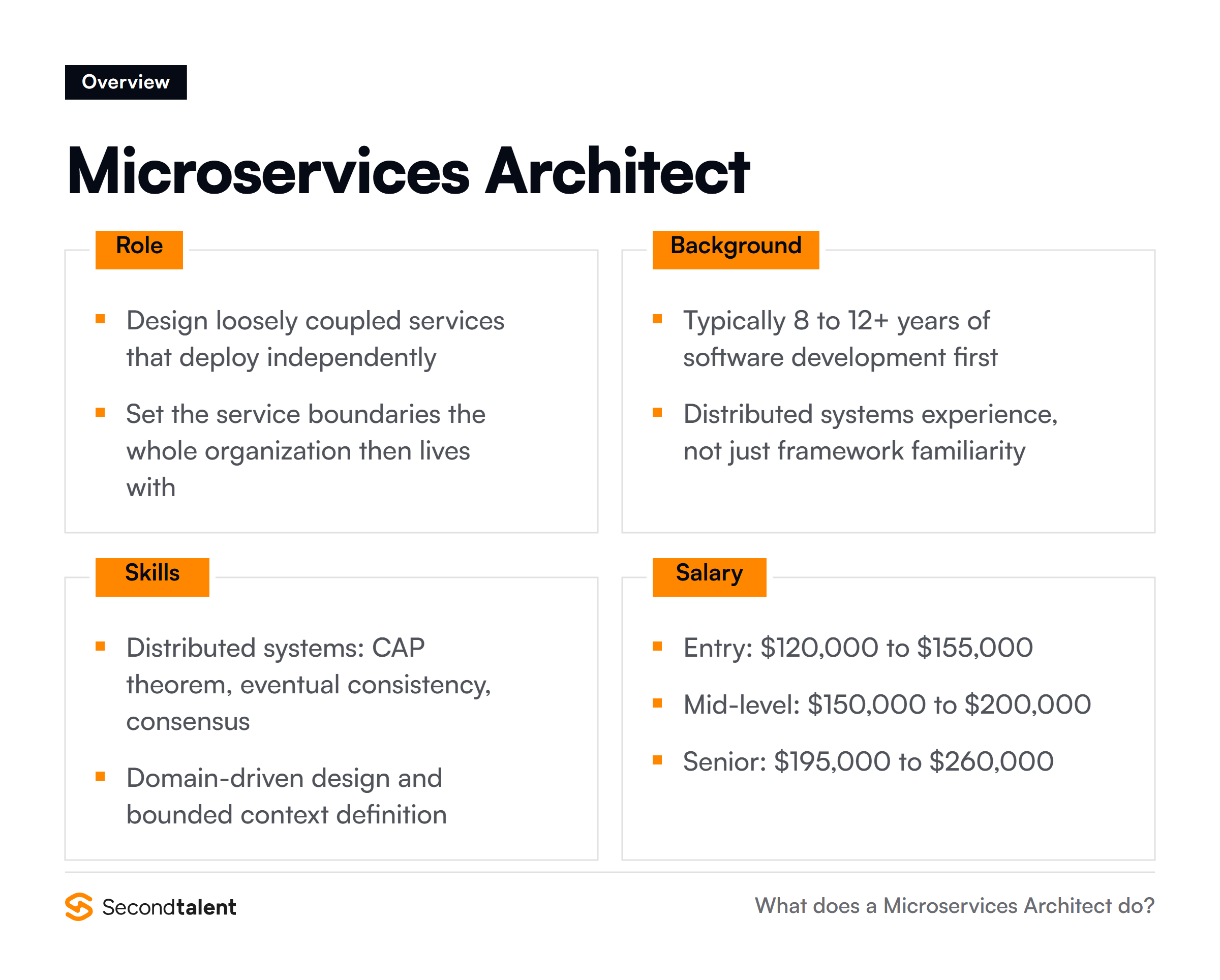
A Microservices Architect is a senior technical leader who designs distributed systems composed of loosely coupled, independently deployable services that work together to deliver business capabilities. They define the overall architecture, establish patterns for service communication, data management, and deployment, and guide development teams in building services that align with architectural principles while maintaining system cohesion.
These architects work at multiple levels: defining strategic architecture roadmaps, designing specific service ecosystems, establishing infrastructure and tooling standards, and mentoring teams on microservices best practices. They must balance autonomy for individual teams with consistency across the organization, ensuring services can evolve independently while the overall system remains manageable and observable.
The position requires deep expertise in distributed systems concepts including eventual consistency, service discovery, circuit breakers, API gateways, and observability. Microservices architects must understand container orchestration, cloud platforms, messaging systems, and the organizational changes required to support distributed development effectively.
Microservices Architect Job Market and Career Opportunities
The job market for Microservices Architects is exceptionally strong as organizations modernize legacy systems and adopt cloud-native architectures. Enterprises across all industries—from finance and healthcare to retail and technology—seek architects who can lead microservices transformations and build scalable, resilient distributed systems.
Salary ranges for Microservices Architects reflect the seniority and specialized expertise required:
- Entry-Level (0-2 years as architect): $120,000 – $155,000 annually, typically transitioning from senior developer roles and learning architectural patterns under guidance.
- Mid-Level (2-5 years): $150,000 – $200,000 annually, designing microservices systems independently and leading architectural decisions for teams.
- Senior-Level (5-10 years): $195,000 – $260,000 annually, defining enterprise architecture strategies and leading large-scale transformation initiatives.
- Principal/Distinguished (10+ years): $250,000 – $400,000+ annually, setting technical vision for organizations and influencing industry-wide architectural practices.
Major tech companies, cloud providers, consultancies, and enterprises undergoing digital transformation offer the most opportunities. Tech hubs command the highest salaries, though remote positions are increasingly common given the senior nature of the role. Architects with demonstrated success migrating monoliths to microservices or building large-scale distributed systems are particularly valued.
Essential Microservices Architect Skills and Qualifications
Success as a Microservices Architect requires comprehensive technical knowledge combined with strategic and communication skills:
- Distributed Systems: Deep understanding of distributed computing principles, CAP theorem, eventual consistency, and consensus algorithms.
- Service Design: Expertise in domain-driven design, bounded contexts, and defining appropriate service boundaries.
- Communication Patterns: Knowledge of synchronous (REST, gRPC) and asynchronous (messaging, event-driven) communication approaches.
- Container Orchestration: Proficiency with Kubernetes, Docker, and container orchestration patterns.
- Cloud Platforms: Experience with AWS, Azure, or GCP and their managed services for microservices deployments.
- API Design: Skills in designing robust, versioned APIs and managing inter-service contracts.
- Data Management: Understanding of database per service pattern, saga patterns, and managing distributed transactions.
- Observability: Expertise in distributed tracing, logging aggregation, and metrics collection across services.
- Security: Knowledge of service-to-service authentication, API security, and zero-trust architectures.
- DevOps Practices: Understanding of CI/CD pipelines, infrastructure as code, and automated deployment strategies.
- Resilience Patterns: Expertise in circuit breakers, retries, timeouts, bulkheads, and designing for failure.
- Organizational Skills: Ability to align architecture with team structures (Conway’s Law) and enable autonomous teams.
- Communication: Strong skills in explaining complex architectures to technical and non-technical stakeholders.
Most positions require extensive software development experience (typically 8-12+ years) with progression through senior engineering roles. Advanced degrees in Computer Science can be beneficial, and certifications in cloud platforms or architecture frameworks may strengthen credentials. Proven experience successfully implementing microservices architectures is essential.
Microservices Architect Career Paths and Specializations
Microservices Architects can specialize in various aspects of distributed systems or advance to broader roles:
- Cloud-Native Architect: Specialize in designing systems specifically for cloud platforms using managed services and serverless technologies.
- Event-Driven Architect: Focus on event streaming platforms, event sourcing, and building reactive microservices systems.
- Platform Architect: Build internal developer platforms that enable teams to build and deploy microservices efficiently.
- Service Mesh Specialist: Concentrate on service mesh technologies (Istio, Linkerd) for managing service-to-service communication.
- Enterprise Architect: Broaden scope to overall enterprise IT architecture beyond microservices.
- Solution Architect: Design specific solutions within microservices ecosystems for particular business problems.
- Technical Consultant: Advise multiple organizations on microservices adoption and architecture best practices.
- Engineering Director/VP: Transition to engineering leadership while maintaining architectural influence.
- Chief Architect/CTO: Lead technical vision for entire organizations at the executive level.
The role naturally progresses toward broader architectural responsibilities or technical leadership, with opportunities to shape organizational technology strategy.
Microservices Architect Tools and Technologies
Microservices Architects work with a comprehensive technology stack spanning infrastructure, development, and operations:
- Container Orchestration: Kubernetes, Docker Swarm, Amazon ECS, Azure Kubernetes Service, Google Kubernetes Engine.
- Service Mesh: Istio, Linkerd, Consul Connect for service-to-service communication management.
- API Gateways: Kong, AWS API Gateway, Azure API Management, Apigee, Ambassador.
- Message Brokers: Apache Kafka, RabbitMQ, Amazon SQS/SNS, Azure Service Bus, Google Pub/Sub.
- Observability: Prometheus, Grafana, Jaeger, Zipkin, Elastic Stack, Datadog, New Relic.
- Service Discovery: Consul, Eureka, etcd, Zookeeper for dynamic service registration.
- Configuration Management: Spring Cloud Config, Consul, etcd for distributed configuration.
- Databases: PostgreSQL, MongoDB, Cassandra, DynamoDB, and understanding of polyglot persistence.
- CI/CD: Jenkins, GitLab CI, GitHub Actions, ArgoCD, Spinnaker for continuous deployment.
- Infrastructure as Code: Terraform, CloudFormation, Pulumi, Ansible for reproducible infrastructure.
- Programming Languages: Familiarity with multiple languages including Java, Go, Python, Node.js for polyglot architectures.
- Architecture Tools: Draw.io, Lucidchart, C4 Model, ArchiMate for documenting architectures.
Staying current with this evolving ecosystem while understanding fundamental distributed systems principles is crucial for effective architecture work.
Building Your Microservices Architect Portfolio
A strong portfolio demonstrates your ability to design and implement complex distributed systems:
- Architecture Documentation: Create comprehensive architecture diagrams, decision records, and system design documents for projects you’ve led.
- Reference Architectures: Develop reference implementations of microservices patterns demonstrating best practices.
- Migration Case Studies: Document experiences migrating monolithic applications to microservices, including challenges and solutions.
- Open Source Contributions: Contribute to microservices frameworks, service mesh projects, or observability tools.
- Technical Writing: Publish articles, blog posts, or whitepapers on microservices architecture patterns and trade-offs.
- Speaking Engagements: Present at conferences, meetups, or internal tech talks on architectural topics.
- Demo Applications: Build polyglot microservices systems showcasing different patterns, technologies, and communication approaches.
- Performance Analysis: Document how you’ve optimized distributed system performance, reduced latency, or improved resilience.
- Architectural Decision Records: Maintain ADRs explaining why specific architectural choices were made and alternatives considered.
- Teaching Materials: Create workshops, tutorials, or training materials on microservices architecture concepts.
Focus on demonstrating strategic thinking, trade-off analysis, and the ability to balance competing concerns rather than just technical implementation details. Include metrics showing business impact when possible.
Microservices Architect Methodology and Best Practices
Successful microservices architecture follows established principles and practices:
- Domain-Driven Design: Use DDD to identify bounded contexts and define appropriate service boundaries aligned with business domains.
- Single Responsibility: Design services with focused responsibilities that can evolve independently.
- API-First Design: Define service contracts explicitly using OpenAPI or gRPC specifications before implementation.
- Decentralized Data Management: Give each service its own database to enable independent evolution and scaling.
- Design for Failure: Implement circuit breakers, timeouts, retries, and bulkheads assuming downstream services will fail.
- Observability by Default: Build comprehensive logging, metrics, and tracing into every service from the start.
- Automate Everything: Ensure CI/CD pipelines, testing, and infrastructure provisioning are fully automated.
- Evolutionary Architecture: Design systems that can evolve incrementally rather than requiring big-bang migrations.
- Smart Endpoints, Dumb Pipes: Keep business logic in services with simple communication protocols between them.
- Decentralized Governance: Allow teams autonomy in technology choices while maintaining architectural coherence.
- Backward Compatibility: Version APIs carefully and maintain backward compatibility to avoid breaking consumers.
- Infrastructure as Code: Define all infrastructure declaratively for reproducibility and version control.
- Security by Design: Implement authentication, authorization, and encryption throughout the architecture.
Following these practices while understanding when to make pragmatic trade-offs is essential for successful microservices implementations.
Future of Microservices Architect Careers
The future for Microservices Architects remains exceptionally promising as distributed architectures become increasingly mainstream:
Serverless and function-as-a-service will integrate more deeply with microservices architectures, creating hybrid systems that leverage both approaches. Service mesh technologies will mature and become standard for managing service-to-service communication at scale. AI and machine learning will be increasingly deployed as microservices, requiring architects skilled in ML system design.
Edge computing and IoT will drive new architectural patterns for distributed processing closer to data sources. Multi-cloud and hybrid cloud architectures will become standard, requiring expertise across cloud platforms. Platform engineering will emerge as a distinct discipline, with microservices architects designing internal developer platforms that abstract infrastructure complexity.
The focus will shift toward higher-level abstractions and business-aligned architectures as lower-level infrastructure management becomes commoditized through managed services. Architects will spend more time on domain modeling, organizational design, and business-technology alignment. The rise of WebAssembly may create new deployment models for microservices beyond containers.
Microservices architects who combine technical depth with business understanding, organizational design skills, and adaptability to new paradigms will thrive, often progressing to CTO or enterprise architecture roles.
Getting Started as a Microservices Architect
Becoming a Microservices Architect requires building extensive experience and expertise over many years:
- Master Backend Development: Spend several years building strong backend development skills in one or more languages.
- Study Distributed Systems: Deeply learn distributed computing concepts through books, courses, and hands-on experimentation.
- Build Microservices: Gain practical experience building and operating microservices in production environments.
- Learn Container Orchestration: Become proficient with Docker and Kubernetes through hands-on projects and certifications.
- Study Architecture Patterns: Read foundational books like “Building Microservices,” “Designing Data-Intensive Applications,” and “Domain-Driven Design.”
- Understand Observability: Gain experience with distributed tracing, logging, and monitoring complex systems.
- Learn Cloud Platforms: Achieve proficiency and potentially certification in at least one major cloud platform.
- Practice Architecture: Lead architectural decisions in your current role, even for smaller components or services.
- Contribute to Open Source: Engage with microservices frameworks and tools to understand their internals.
- Network and Learn: Attend conferences, join architecture communities, and learn from experienced architects.
- Document Decisions: Practice writing architectural decision records and design documents.
- Develop Soft Skills: Build communication, leadership, and stakeholder management abilities.
The path typically requires 8-12+ years of software development experience with gradual progression through senior engineering roles before transitioning to architecture. Continuous learning is essential as technologies and patterns evolve rapidly.
Microservices Architects play a pivotal role in modern software development, designing the distributed systems that enable organizations to build scalable, resilient applications. The position offers intellectual challenge, significant influence on technical direction, and exceptional compensation. As more organizations adopt microservices architectures and cloud-native approaches, skilled architects will remain in extraordinarily high demand.
For experienced developers who enjoy system design, strategic thinking, and guiding teams toward architectural excellence, the path to microservices architect offers a rewarding career with substantial impact on organizational success. The combination of technical depth, strategic influence, and leadership opportunities makes this one of the most prestigious and well-compensated specializations in software engineering.