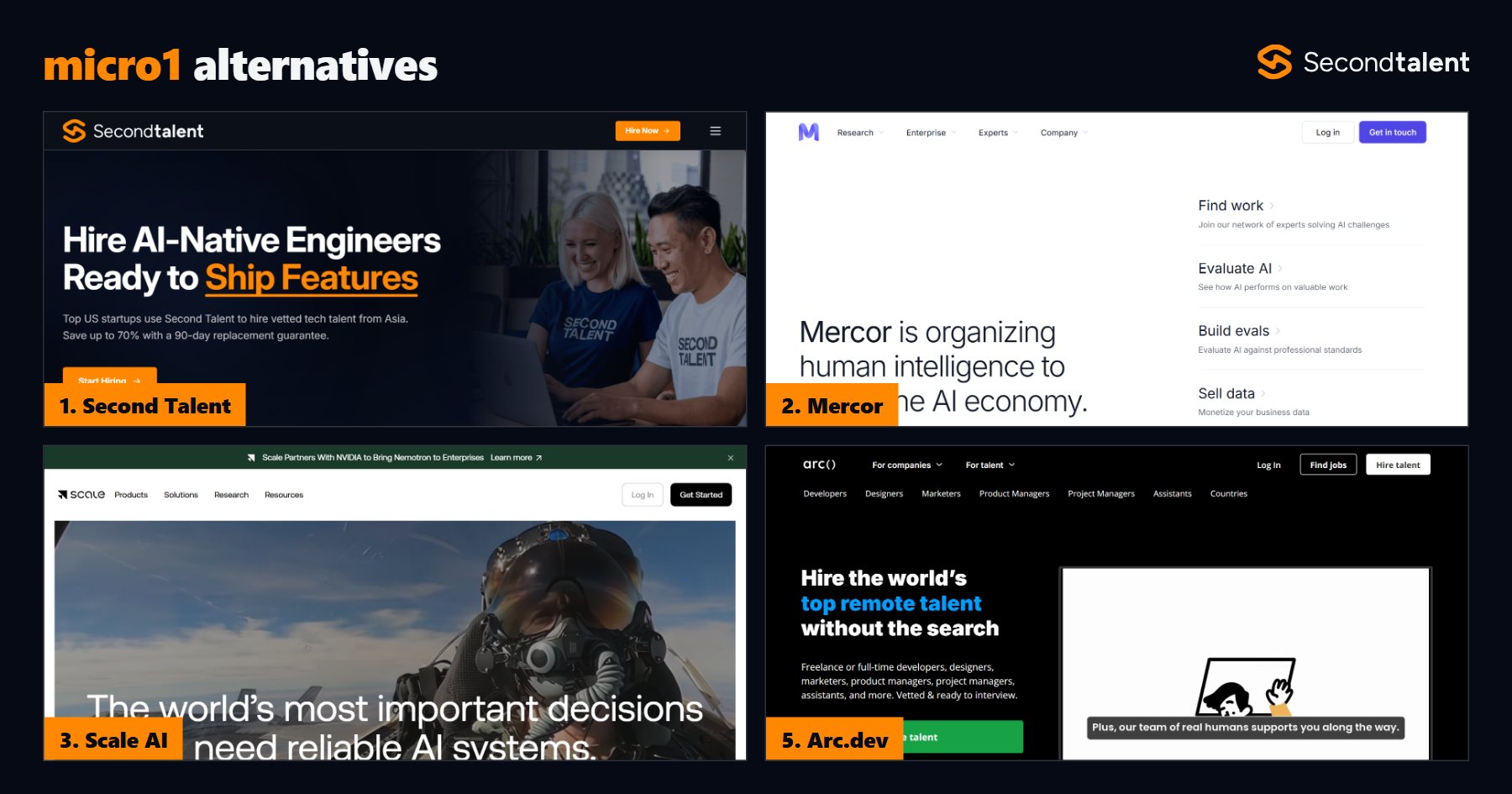
TL;DR: micro1 began as an AI recruiting company that placed vetted engineers, but in 2026 it sells expert data and evaluations to AI labs and enterprises. To hire an engineer for your product, use Arc.dev, Toptal or Second Talent. To buy training data or agent evaluations, Mercor, Scale AI and Turing are the direct competitors.
micro1 now calls itself a data lab that trains frontier models and evaluates agents.
Its gross annual run rate reached $500 million in August 2026, according to TechCrunch, up from $100 million eight months earlier, and Forbes reported in September that it raised over $100 million at a $4 billion valuation.
That growth came from AI labs, not from startups hiring developers. If you remember micro1 for Zara, its AI interviewer, and a bench of vetted engineers, the right alternative depends on which of those two jobs you need done.
micro1 alternatives compared
| Platform | What you get | Published client price |
|---|---|---|
| Arc.dev | AI-screened freelance and full-time developers | $15 to $110+/hr, or 20% of salary |
| Toptal | Senior freelance engineers and AI experts | $79 a month plus the expert’s rate |
| Second Talent | Full-time AI-native engineers and AI training specialists from Asia | $23 to $39 USD/hr, billed monthly |
| Mercor | Expert data, evals and enterprise AI deployment | Not published; sales-led |
| Scale AI | Training data and evaluations at lab scale | Not published; sales-led |
| Turing | Datasets, RL environments and experts for AI labs | Not published; samples on request |
| micro1 (baseline) | Expert data, RL environments, agent evals | Not published; sales-led |
- 1micro1’s Zara now vets experts for micro1’s own data projects; it is not sold as a recruiter for your open roles.
- 2For a product engineer, only Second Talent, Arc.dev and Toptal publish what you will pay.
- 3For AI training data, Mercor, Scale AI and Turing sell the same thing micro1 does, all through a sales call.
- 4A startup that needs a few trainers or evaluators, not a whole data program, can hire them as dedicated staff instead.
1. Arc.dev
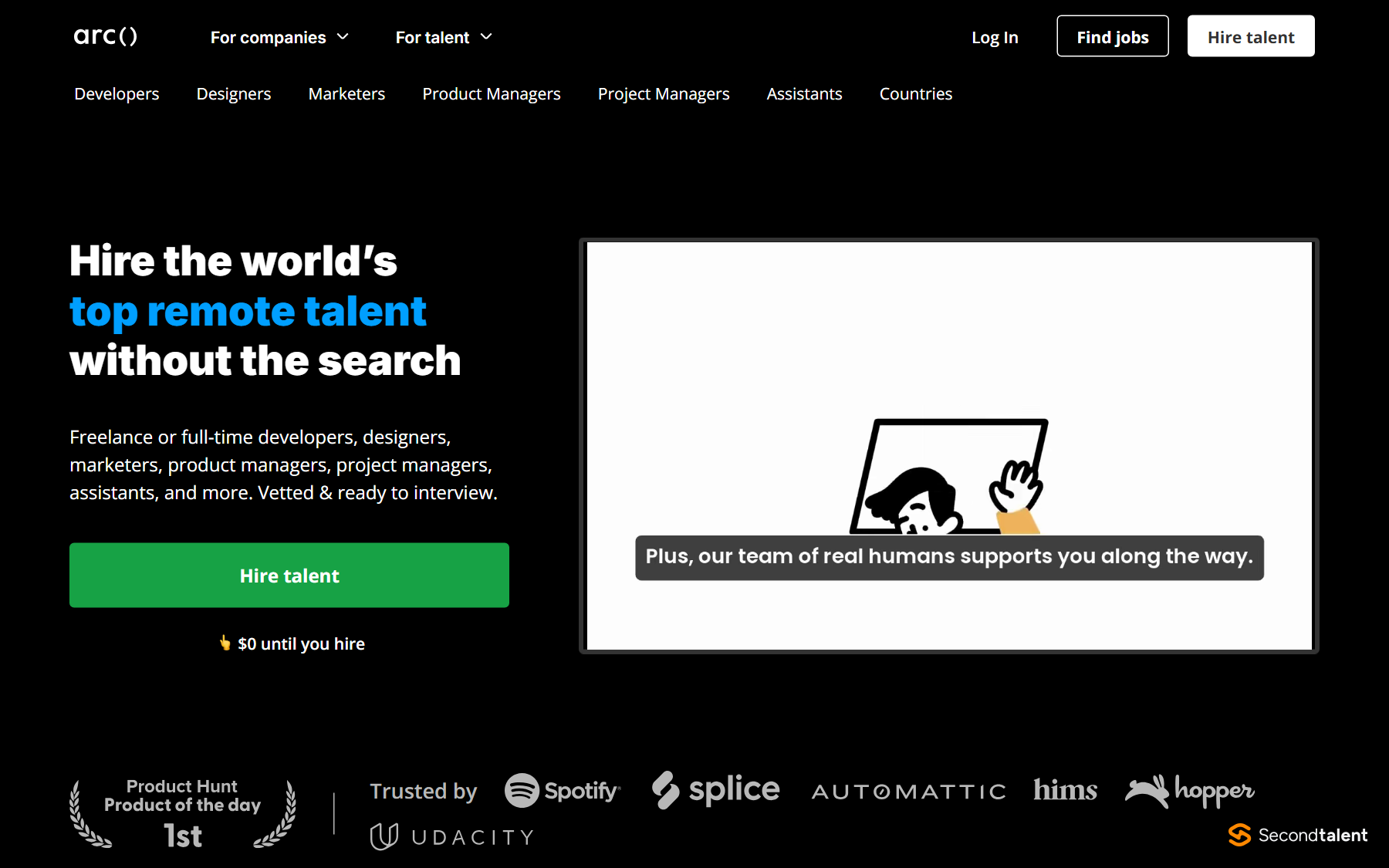
Arc.dev is the nearest thing to micro1’s original offer: AI that screens applicants, then a vetted shortlist you interview yourself.
Its HireAI tool screens incoming applications, highlights the strongest and sources matching candidates automatically, which is the job buyers once bought Zara for.
The network holds 450,000 developers and other remote talent in 190 countries.
Arc says 14% of applicants pass its communication assessment and 2% pass the one-hour technical interview, after which talent is reviewed and monitored on the job. Freelance hires take about 72 hours; full-time roles average around 14 days.
Pricing is published. Freelancers bill $15 to $110+ an hour depending on skill and location, and full-time hires cost 20% of the first annual salary, paid only when you hire.
Freelance engagements include a risk-free trial of up to two weeks, and if you are dissatisfied in the first three months, Arc matches you with another candidate free.
Full-time hires outside the US are employed through partner EORs, so check who the employer is in each country. Our Arc.dev alternatives page compares its fees in more depth.
- Best for: Teams that want AI screening plus a human-vetted shortlist and a published fee.
- Watch out: A full-time hire costs 20% of a year’s salary on top of pay.
- Published price: $15 to $110+/hr freelance; 20% of annual salary full time.
2. Toptal
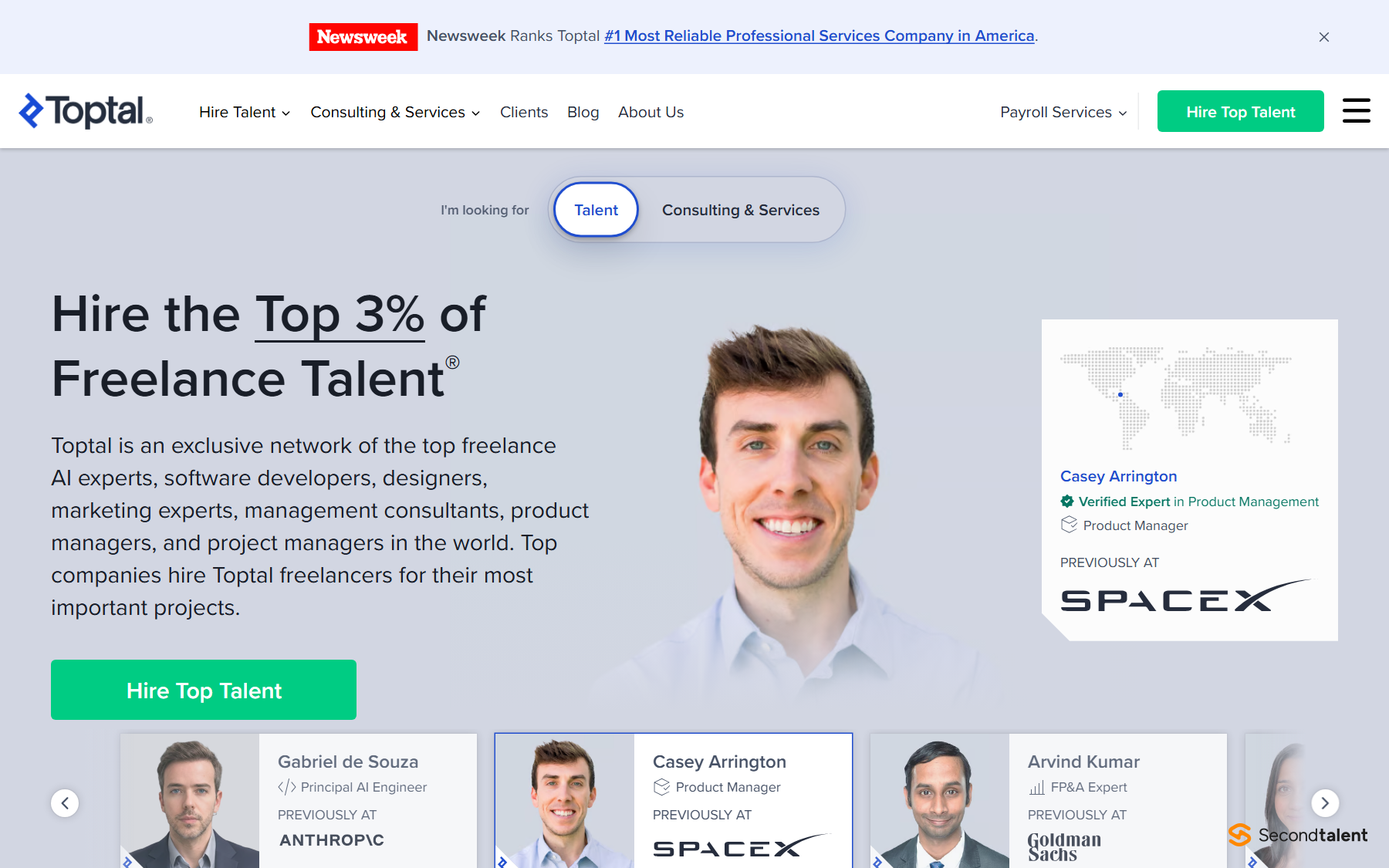
Toptal suits a startup that liked micro1’s promise of pre-vetted engineers but wants senior freelancers for a defined project.
Its homepage now leads with freelance AI experts alongside software developers, designers and product managers, and it lists principal AI engineers among its featured talent.
Toptal’s FAQ says about 3% of applicants pass its screening and that it introduces candidates within 24 hours in almost all cases.
You can trial up to three experts per position, and engagements start with a trial period of up to two weeks, so a weak match costs little.
The fee structure is a flat $79 monthly subscription, charged only when you proceed with matching, plus the expert’s hourly or full-time rate. Toptal does not publish those rates, so get them in writing before the trial starts.
Toptal’s experts work in more than 100 countries, and it sells payroll services for teams that want to convert a freelancer later.
Use Toptal for short, high-stakes work such as an architecture review or an agent prototype. For a long-term seat on your team, compare the yearly cost first. See our Toptal alternatives for numbers.
- Best for: Short senior engagements where speed and a trial matter most.
- Watch out: Expert hourly rates are not published.
- Published price: $79 a month subscription plus the expert’s rate.
3. Second Talent
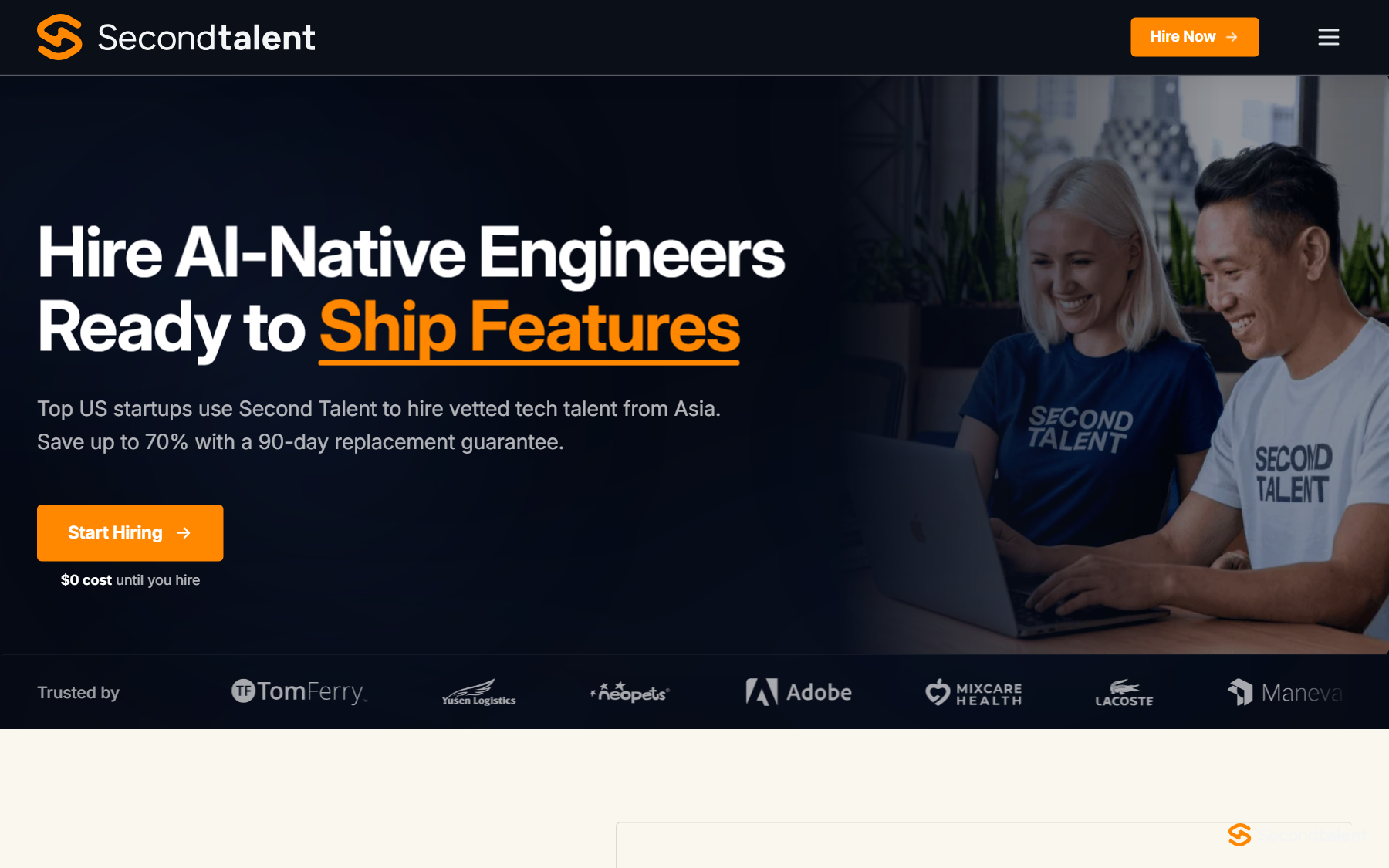
Second Talent helps US startups hire vetted AI-Native Engineers and Specialists from Asia, which is the job micro1 used to do for startups before it moved to AI data.
You get one dedicated engineer who joins your team full time, learns your codebase and ships features, rather than an expert booked by the task.
Engineers come from nine Asian markets, including Vietnam, the Philippines, Indonesia and Singapore, with 4 to 6 hours of overlap with US working hours.
Vetting is four human stages: a technical assessment, an AI-tooling assessment where candidates show how they build with Claude Code and Cursor, an English check and a behavioral interview.
Matching takes 24 hours, and 92% of placed talent stays.
The price is $23 to $39 USD an hour, billed monthly, which is $3,599 to $5,999 for a 160-hour month.
Employment, payroll and taxes run through our own employer of record, there is no cost until you hire, and a 90-day replacement guarantee covers a hire that does not work out.
You can search the vetted bench yourself or hand the brief to a recruiter.
If you came to micro1 for human data, Second Talent also places AI training specialists: RLHF raters, coding AI trainers, evaluators and multilingual trainers in Asian languages, hired as your own staff.
- Best for: US startups that want an engineer who stays and owns part of the product.
- Watch out: No PhD lawyers or physicians on tap; it is not a frontier-lab data vendor.
- Published price: $23 to $39 USD/hr, billed monthly; $0 until you hire.
4. Mercor
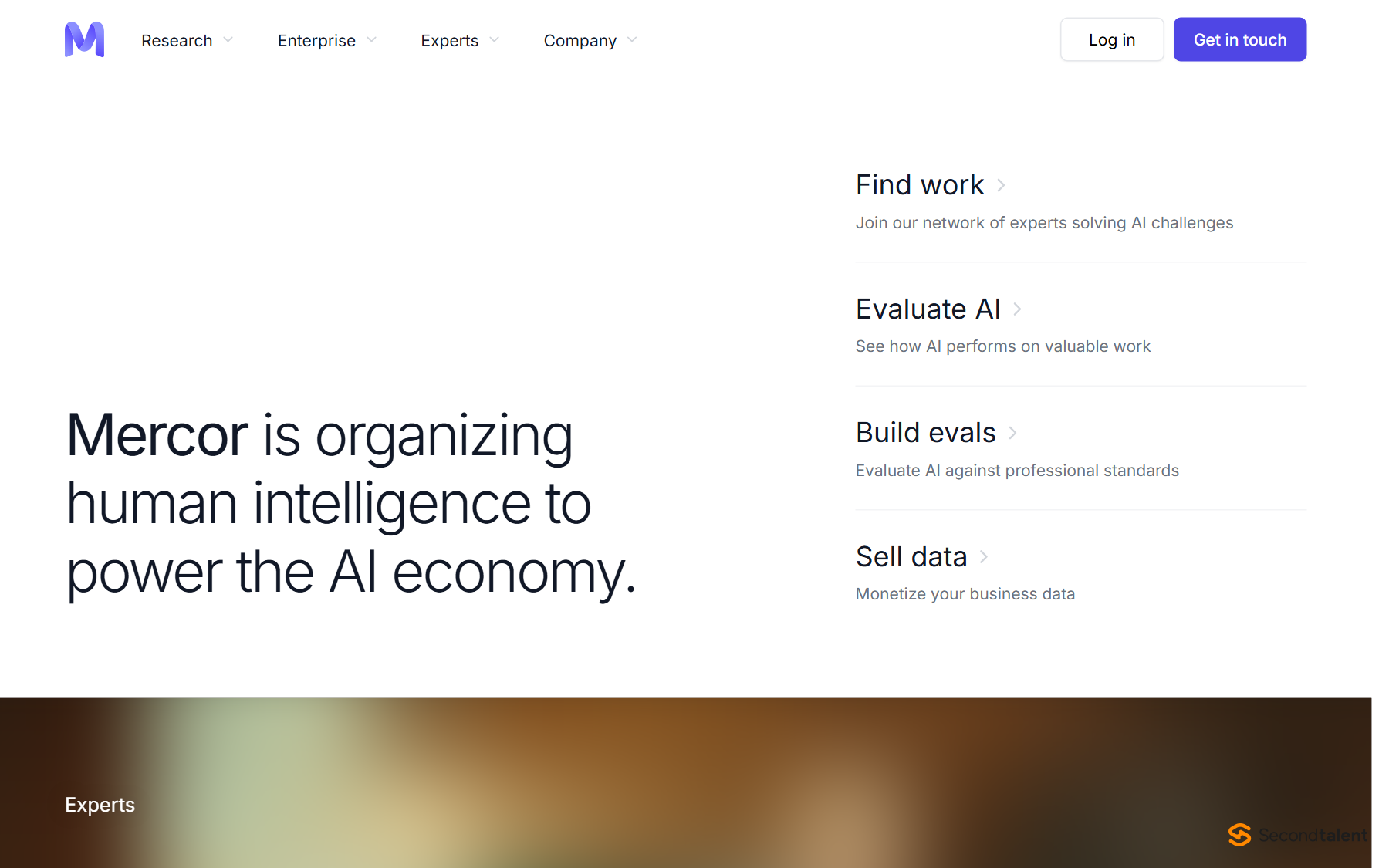
Mercor is the closest match to what micro1 sells today. Both began by using AI interviews to vet talent, and both now organize experts to produce training data and evaluations for AI labs.
Mercor is the larger of the two: TechCrunch put its gross annualized revenue at $2 billion in the summer of 2026, about four times micro1’s run rate.
Its homepage lists an average contracted expert rate of $102 an hour, 605,000 roles created and more than $4 million paid out a day.
It counts 5M+ experts, from physicians and lawyers to engineers and consultants, and recent roles ran from sales and marketing experts at $60 to $70 an hour to oncologists at $350 to $450, so it can staff domain-heavy evaluations that a software-only network cannot.
For companies outside the frontier labs, Mercor now sells an enterprise practice: forward deployed engineers who map workflows, build agents on a company’s own data and grade them with its expert network.
One published engagement had HR experts grade 132 agent runs before launch. You also see Mercor’s own APEX benchmarks on its site, which are useful when you want evals that match professional work.
Mercor does not publish client prices. Expect a scoped engagement and a sales cycle, not a self-serve sign-up. Our Mercor competitors page covers the rest of its market.
- Best for: Labs and enterprises that need domain experts to build or grade AI work.
- Watch out: Not set up to hire a developer for your product team.
- Published price: None for clients; experts average $102 an hour contracted.
5. Scale AI
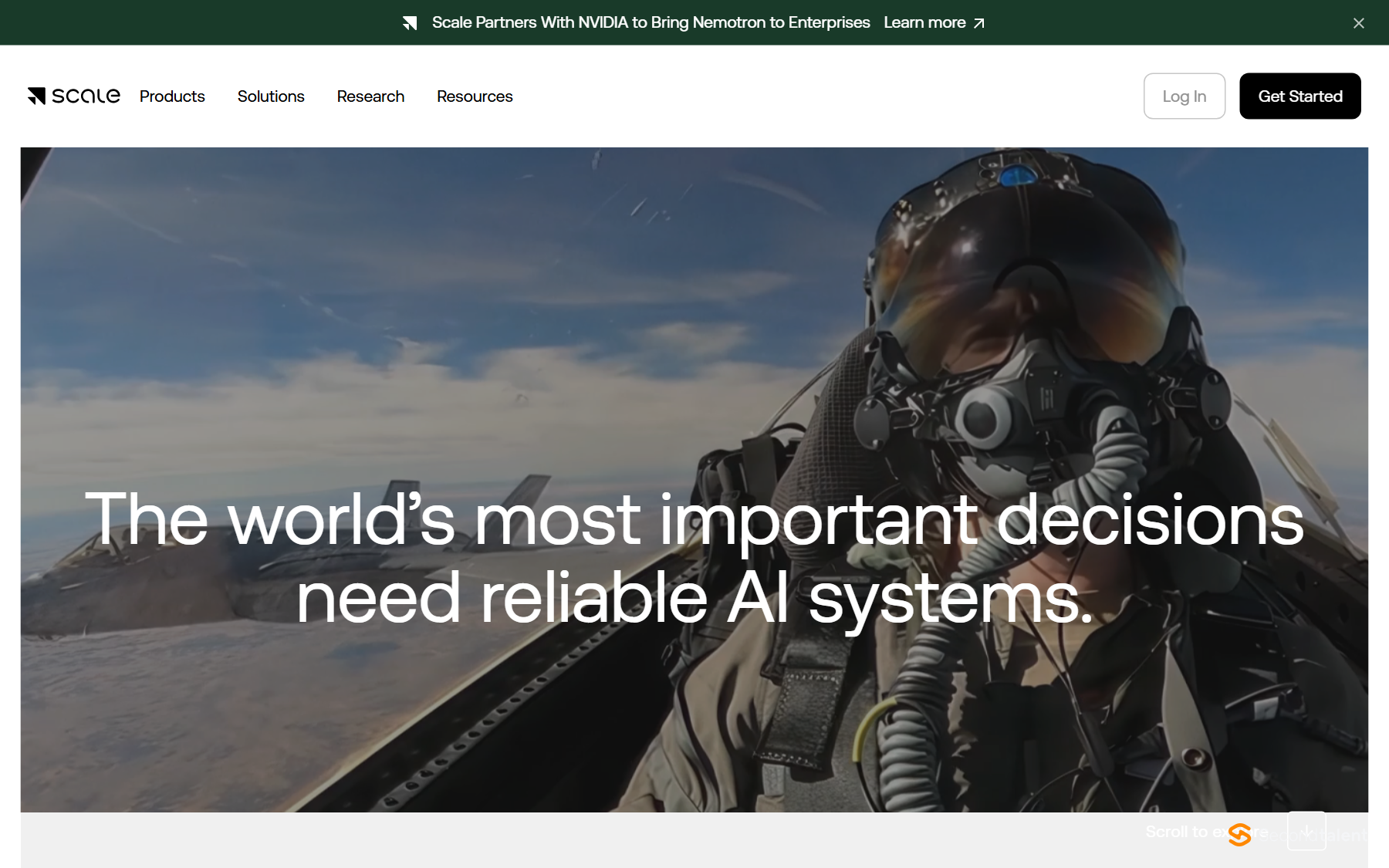
Scale AI is the company micro1 is most often measured against; TechCrunch headlined two of micro1’s funding stories as news about a Scale AI competitor.
Scale is the incumbent, and its homepage claims that 90% of the world’s leading generative AI model builders are powered by its data.
Its Data Engine covers the full post-training stack: prompt and response pairs written from scratch, RLHF preference ranking, red-teaming and expert evaluations.
Scale says 25% of its contributors hold advanced degrees, and it now sells beyond labs to government, defense and enterprise buyers, with physical AI data for robotics as a newer line.
The ownership changed in 2025. Meta invested $14.3 billion for a 49% non-voting stake, and founder Alexandr Wang left to lead Meta’s superintelligence effort.
Reuters reported that Google, then Scale’s largest customer, planned to end its work with Scale after Meta took a 49% stake in June 2025, and that it had begun talks with Scale’s rivals.
If your data is sensitive to a model maker’s competitors, ask how Scale separates customer work.
Scale suits programs with millions of tasks and their own ML team to specify them. A startup buying a few thousand labeled examples will find the minimums and the sales process heavy.
- Best for: Large post-training and evaluation programs that need volume and tooling.
- Watch out: Meta’s stake matters if you compete with Meta.
- Published price: None; quoted per program.
6. Turing
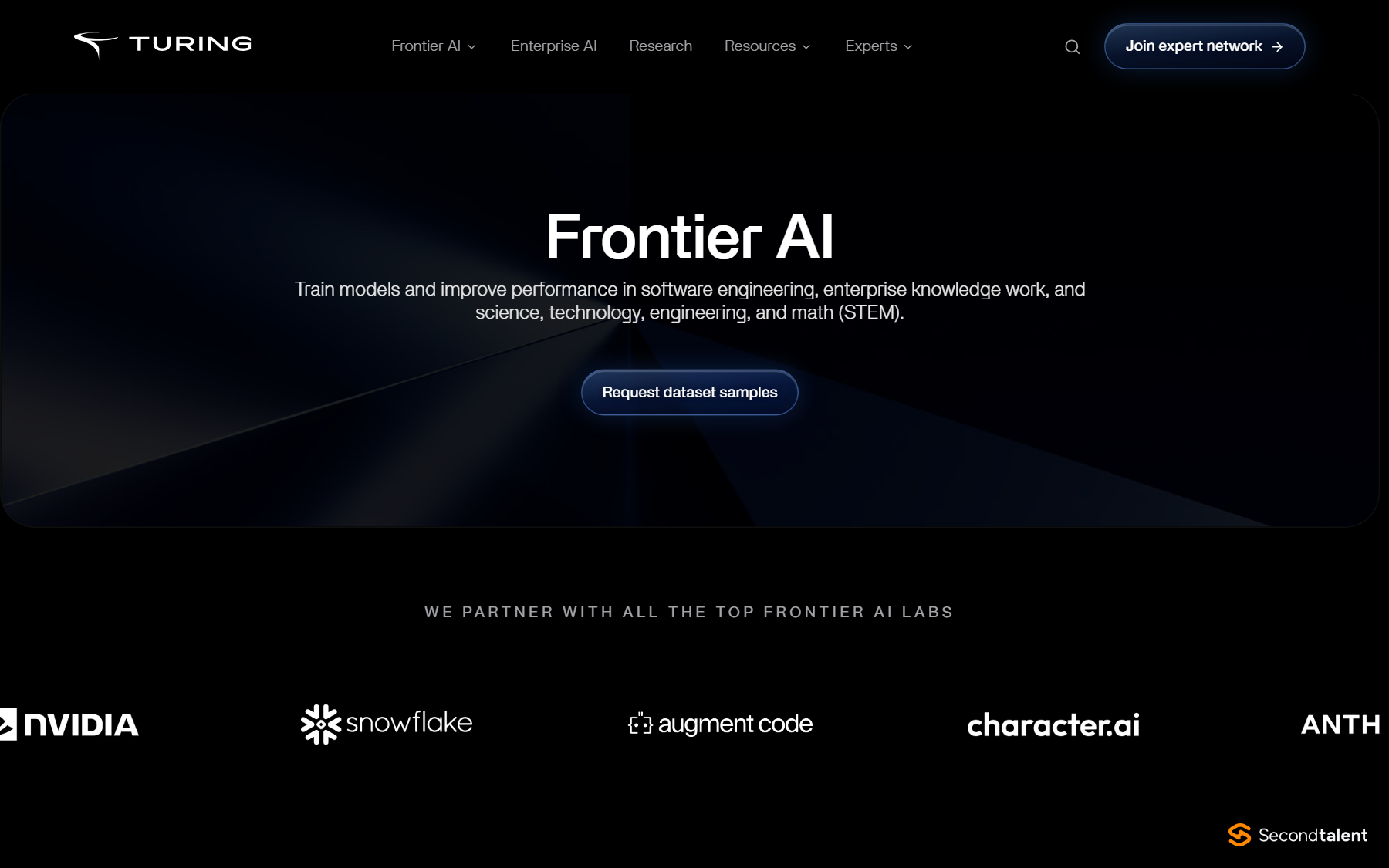
Turing made the same move micro1 did, from developer hiring to AI data, and finished it earlier.
Its old hire-a-developer pages now redirect to its expert network, and the site leads with Frontier AI: custom and off-the-shelf datasets, reinforcement learning environments and human experts in software engineering, enterprise knowledge work and STEM.
That lines up almost item for item with micro1’s Realm product.
Both sell RL environments and frontier evaluations, and both draw experts from a global network; Turing says its network spans 140+ countries, with bi-weekly payouts to experts.
Turing also publishes benchmarks and research, which helps a buyer judge its data before a contract.
The off-the-shelf datasets are the practical difference.
Turing lets you request samples first, so a team can test a coding or STEM dataset against its own model before committing to a custom build. micro1 sells off-the-shelf data too, per TechCrunch, but Turing puts it on the front page.
A second line, Enterprise AI, builds agentic systems for companies. As with micro1 and Mercor, there is no published pricing and no route to hire a single engineer for your startup.
Our Turing alternatives list covers that change in more detail.
- Best for: Labs testing coding, STEM or knowledge-work datasets before a custom order.
- Watch out: Developer hiring for startups has ended.
- Published price: None; dataset samples on request.
Hiring an engineer or buying AI data
micro1’s Realm page describes Zara as an AI recruiter agent that sources and vets domain experts for micro1’s own expert data, built with specialists across 100+ fields.
Its newest line pays companies $200,000 to $2 million+ to license operational data. Neither helps a startup fill an engineering role.
So start with the job. If the work is your product, compare Second Talent, Arc.dev and Toptal on yearly cost and how long the engineer stays.
If the work is model training, compare Mercor, Scale AI and Turing on domain coverage and data quality. If you were a micro1 expert checking whether it pays, our micro1 legitimacy review covers that.
Frequently asked questions
Does micro1 still help companies hire engineers?
Not as a product. Its site sells expert data, RL environments and agent evaluations, and Zara vets experts for micro1’s own projects.
Who are micro1’s main competitors?
Mercor, Scale AI and Turing, which all sell expert-made training data and evaluations to AI labs and enterprises.
What is the cheapest micro1 alternative for hiring a developer?
Arc.dev freelancers start at $15 an hour. For a full-time engineer, Second Talent is $23 to $39 USD an hour, billed monthly, with employment included.
Related comparisons: Mercor competitors · DataAnnotation alternatives · Turing alternatives · AI-native talent platforms · Arc.dev alternatives