TL;DR: AI screening helps employers filter large candidate pools, rank by real criteria, cut time to hire by up to 25%, and reduce bias. The human still makes the final call.
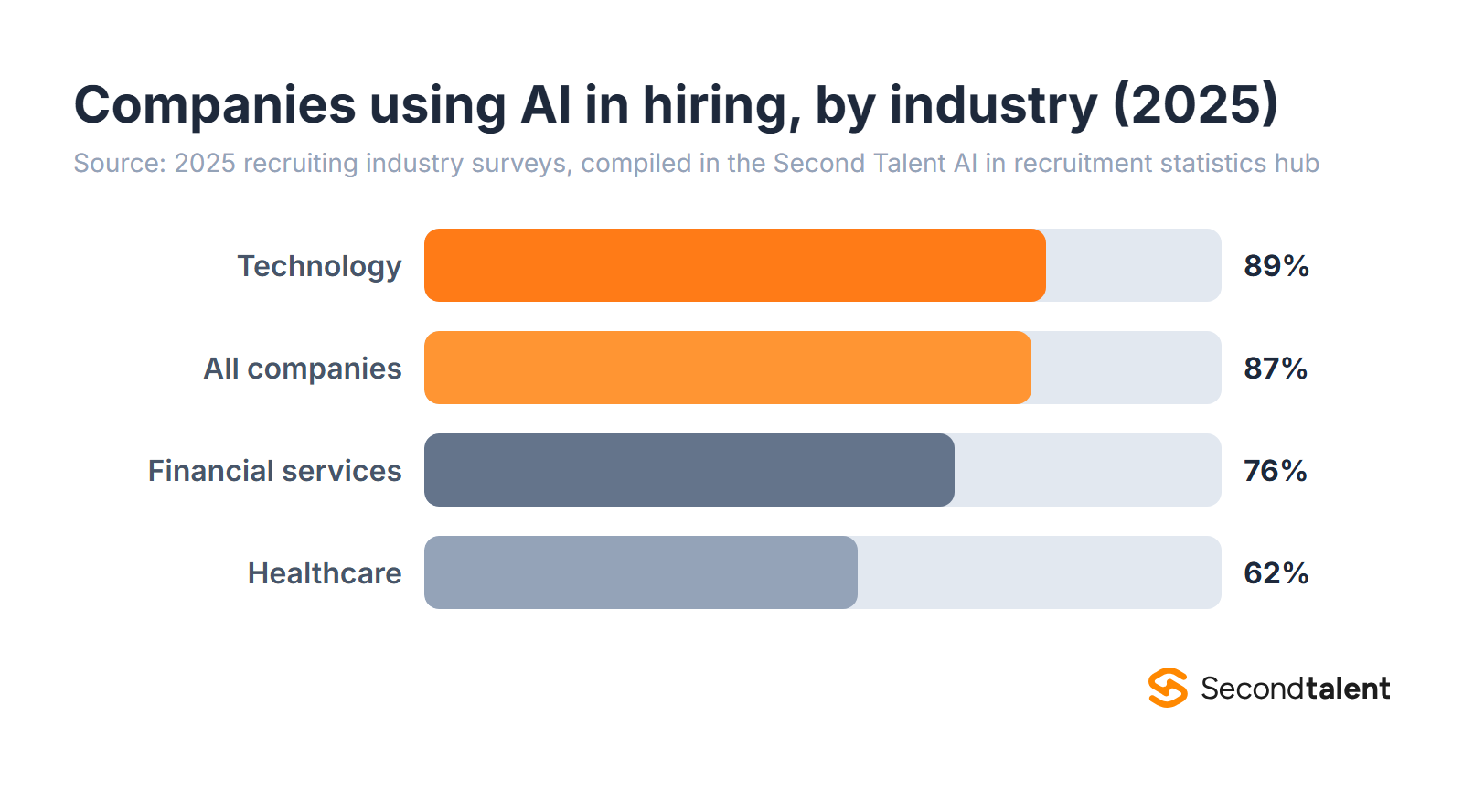
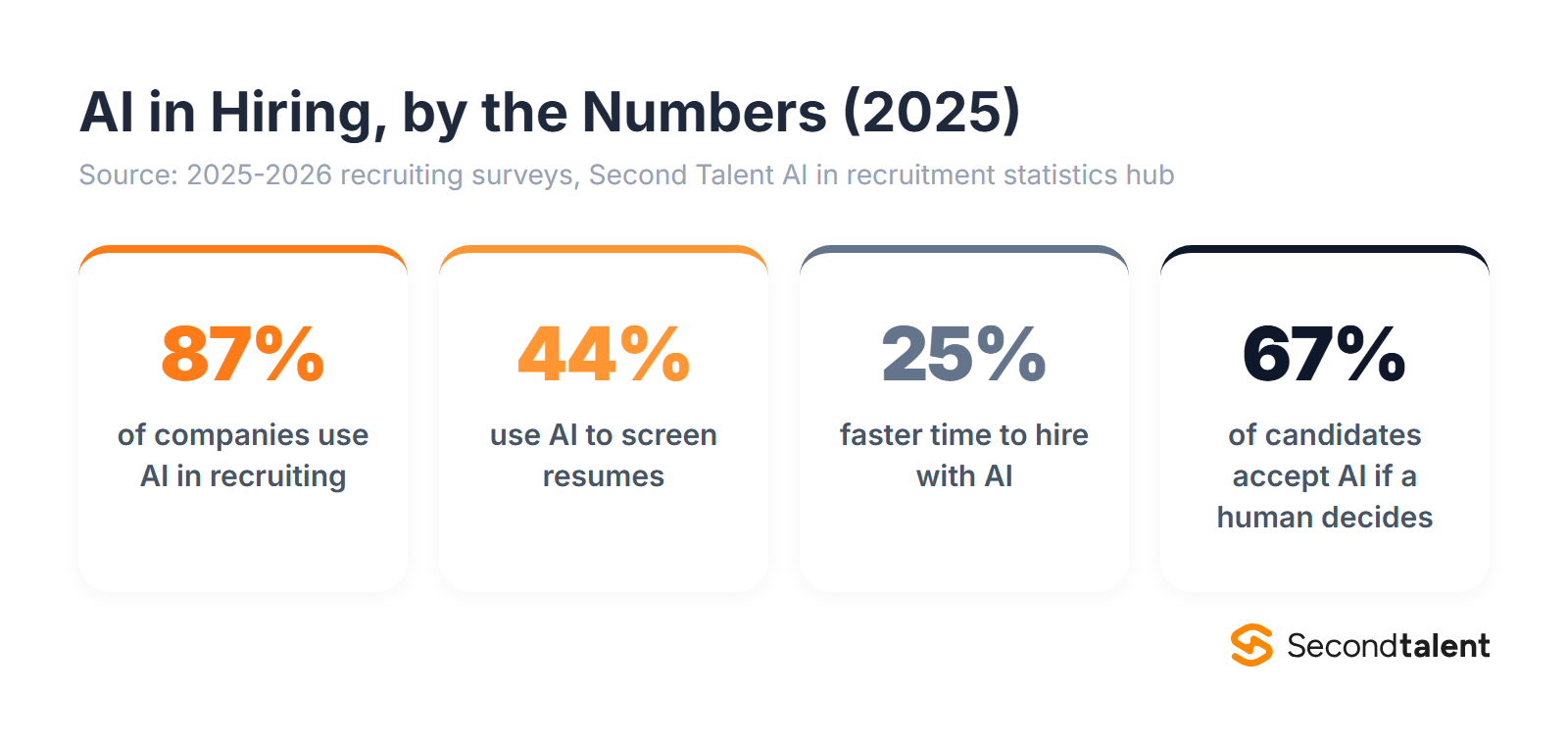
AI screening helps employers pick the best candidate by reading large volumes of applications fast, ranking people against clear criteria, and cutting human bias from the first pass. Industry surveys in 2025 show most companies that use AI in hiring apply it to resume review, and AI can cut time to hire by up to a quarter. It does not replace your judgment. It clears the noise so you spend your time on the people who actually fit.
Key takeaways
- AI screening filters large applicant pools and ranks candidates by skills, experience, and role-specific keywords.
- Clear criteria are everything. A vague job description gives you a vague shortlist, no matter how good the tool is.
- AI can cut time to hire by up to 25%, and most companies that use AI in hiring apply it to resume screening.
- AI can reduce bias, but only if its training data is clean. Amazon scrapped a tool in 2018 that penalized women.
- The human still decides. Around two-thirds of candidates accept AI screening as long as a person makes the final call.
AI screening at a glance: eight ways to use it
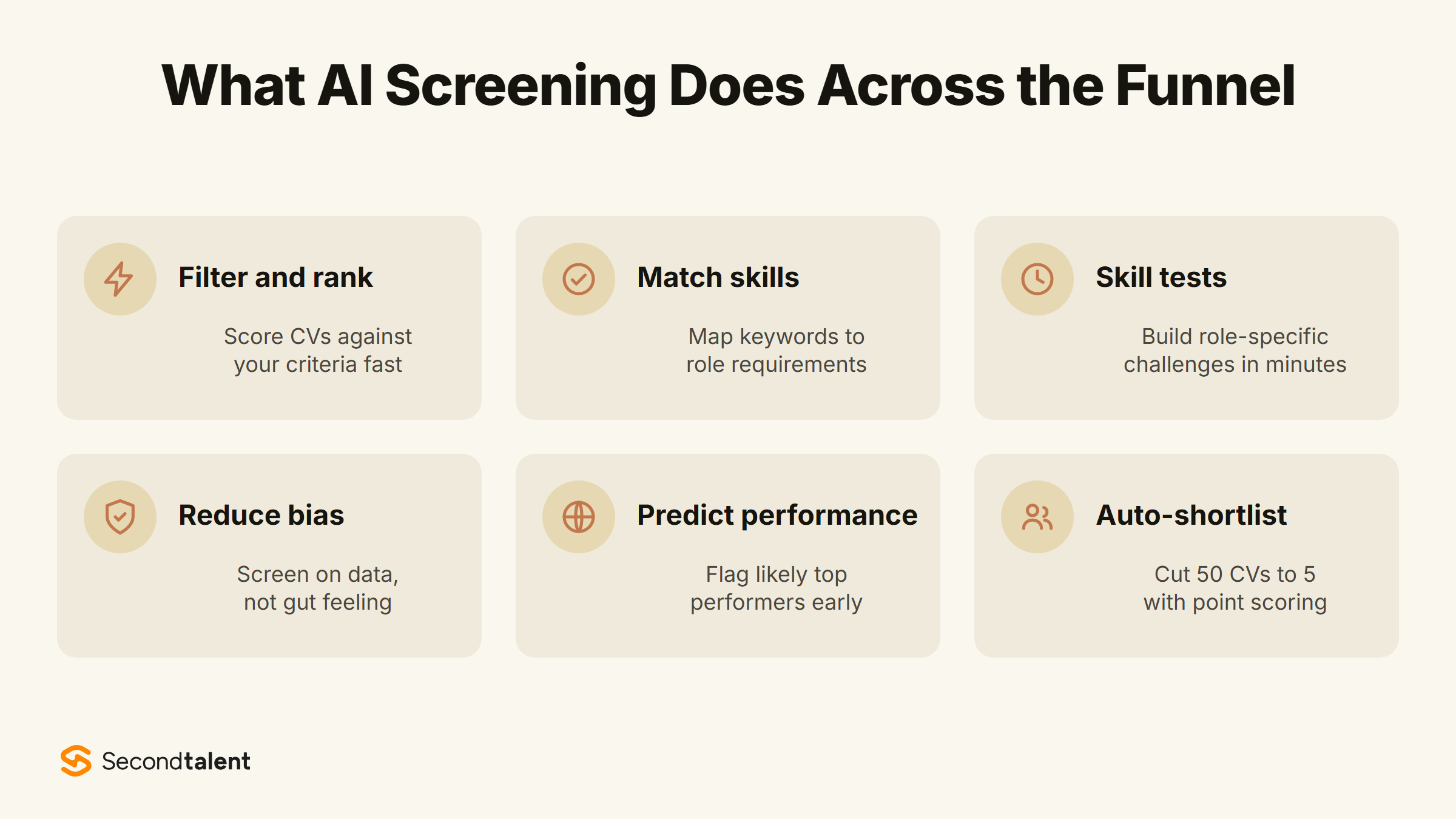
Here is the full picture before we go deep. Each row is one job AI screening can do for you, and the section below explains how to set it up. Use it as your checklist.
| Use AI to | What it does | Why it helps |
|---|---|---|
| Filter and rank | Reads CVs and scores them against your criteria | Handles big volumes in minutes |
| Define criteria | Turns the role into clear, measurable rules | Better input means a better shortlist |
| Match keywords | Maps skills in CVs to your requirements | Surfaces the right fit, drops the rest |
| Assess skills | Builds role-specific tests and challenges | Shows real ability, not just claims |
| Analyze behavior | Reviews answers and how people respond | Reveals what a CV hides |
| Reduce bias | Screens on data, not gut feeling | Fairer, more diverse hiring |
| Predict performance | Uses past data to flag likely top performers | Spots talent before the interview |
| Automate shortlisting | Scores and ranks for the next round | Cuts a 50-person list to 5 fast |
What is your biggest hiring headache?
Pick one to see where AI screening helps most.
Train your tool to pull key details from each CV and score them against your criteria. You go from a flood of applications to a ranked list in minutes.
Bias comes from bad training data, not the tool itself. Screen on measurable skills, add blind skill tests, and keep a human in the loop on the final call.
Stop hiring on the CV alone. Use AI to build role-specific tests and to flag who is likely to perform and stay, before the interview.
We pre-vet senior engineers so you skip the funnel entirely. Hire AI and machine learning engineers in about 24 hours, or tell us what you need.
1. Filter and rank candidates faster
Once the CVs start pouring in, your first job is to rank them. Teach your AI tool to extract key details from each application, then score them. You choose what matters. Common ranking factors are skill level, years of experience, education, and the keywords that fit the role.
This matters at volume. A single open role can draw hundreds of applications, and reading each one by hand takes days you do not have. A ranked list lets you spend your time on the top of the pile instead of the whole pile. This lets you shortlist on what is relevant to your company, not on manual judgment. You can also run an AI detector to check that applications are authentic. Candidates use AI to write their resumes too, so a quick check helps you drop the ones that do not fit the role or your values. The point is speed without losing accuracy.
2. Define clear hiring criteria before screening
An AI tool is only as good as the criteria you give it. If you are not clear about what you want, you will get a shortlist you are not happy with. Say you need an engineer but you are not sure where to find senior engineering talent or what to screen for. The tool cannot fix a fuzzy brief.
Before you screen, define the must-haves. List the skills you require, the minimum experience you will accept, the degrees that matter, and any role-specific competencies. You can even use AI to draft a job description that fits your needs, then feed that description back into the tool. When the applications come in, the AI matches people against the same clear standard every time.
3. Use keyword matching for initial screening
Screening tools rely on keywords to match a candidate to your requirements. So break your job description into things you can measure. Instead of “good communication skills,” write “experience in client presentations.” Now the tool can match people who actually list that skill.
Use terms that are standard in your industry. If you are hiring a marketing professional, you might look for digital marketing experience, SEO knowledge, and Google Analytics. Avoid vague language. Clear, well-known terms give the tool a fair chance to sort the right applications from the rest.
4. Use AI for skill assessment
Screening CVs alone is not enough. For the best results, add a skills layer. Use AI to build tests that are specific to the role you are filling. You can create them in minutes.
Good options include role-based online tests, coding challenges that are fun but real, and scenarios people solve with their own skills. These add a second layer beyond the interview. Sometimes a strong candidate does not shine one-on-one but proves excellent problem-solving in a test. You focus on true ability, not guesswork, and you can compare candidates fairly.
5. Analyze candidate behavior and communication
If you build a test with AI, you can go one step further. Have AI review answers in real time to see how a candidate works under pressure and how clearly they explain their thinking. A CV will not show you this. A hands-on task will.
Put several candidates through the same task and see how they work in a team, the approach they take to a problem, and how clearly they respond. If certain skills matter to you, the tool can flag the people who match. With preset answers in the model, you do not even have to mark everything by hand. You pick the best fit without burning hours on paper alone.
6. Reduce bias in hiring decisions
Even strong leaders second-guess themselves when choosing who to work with. History is full of biased hiring. People show gender and other preferences, often without meaning to. A male nurse once seemed odd, and a female engineer faced doubt. Screening on data instead of gut feeling removes a lot of that.
There is a catch. AI only reduces bias if its training data is clean. In 2018, Amazon scrapped an AI recruiting tool after it learned to penalize resumes that included the word “women’s” and graduates of two women-only colleges, as Reuters reported. The tool had learned from ten years of mostly male resumes. Screen on measurable skills, audit your data, and a fair process improves both your hiring and your reputation. Candidates and customers notice.
7. Use predictive analytics to identify top performers
Not every role needs it, but some need the best of the best. With predictive analytics, AI can flag who is likely to succeed before they ever reach the interview. The tool reviews past data and points to the candidates most likely to perform for you.
Some roles need more than one skill. AI can find which mix of skills points to the best fit. It can also flag who is likely to stay, which matters if you want people who will not leave inside a year. Doing this by hand would take days or weeks. AI does it in the background while you focus on the shortlist.
8. Automate candidate shortlisting
Shortlisting eats time. How do you pick five from fifty? Let AI rank candidates on the small differences in their skill sets and move the strongest forward.
Train the tool to score candidates on a point system. It compares each person against the role requirements, gives a score, and ranks the field. It can repeat this at every stage until you reach the best candidate for your company. For candidates who don’t make the cut, email automation can keep the process respectful, sending a timely, personalized response instead of leaving them without an update. You stay in control of the rules. The tool just does the heavy lifting.
What AI screening still gets wrong
AI screening is not perfect, and knowing its limits keeps you out of trouble. Keyword matching can miss a great candidate who describes the same skill in different words. It can also reward people who stuff their resume with the right terms but cannot do the work. So treat the keyword pass as a first filter, not the final word.
There is a candidate-trust gap too. Surveys show many job seekers are wary of AI in hiring, and a large share say they would not apply to a company that lets AI make the call alone. Lean too hard on automation and you can scare off the very people you want. Be open about how you use AI, give a human a clear role, and offer a way to ask questions.
Then there is the law. Some regions now require bias audits for automated hiring tools, and rules are tightening each year. Before you screen at scale, check what applies where you hire, keep records of how the tool scores people, and review the results for patterns. A tool that quietly filters out one group is a legal and brand risk, not a shortcut.
The human still makes the final call
AI screening does not take the decision out of your hands. It makes the process easier so you can make a better one. It helps from start to finish. Use it to draft the job post, rank applications as they arrive, build tests that go beyond a verbal interview, and predict behavior before the test.
Keep a person in the loop, though. Around two-thirds of candidates accept AI screening as long as a human makes the final decision. So let the tool clear the noise and surface a strong shortlist. Then you do the part only a person can do, which is judge fit, values, and potential. That balance is what good hiring looks like in 2026.
Skip the funnel: hire pre-vetted talent
AI screening is powerful, but it still needs someone to set it up, run it, and judge the results. For engineering roles, there is a faster path. We do the screening for you and hand you a shortlist of senior engineers who already passed a tough vetting process. You see how that works in our guide to how Second Talent works.
The cost gap is large. A senior engineer in the United States runs $12,000 to $18,000 per month all in. The same skill from a pre-vetted engineer in Vietnam or the Philippines often costs $3,000 to $6,000 per month. You can size any role on our developer rate card. Whether you screen with AI yourself or let us do it, the goal is the same. Hire the right person, fast, without bias.
Hire the best candidate, faster
AI screening filters big pools, ranks on real criteria, cuts time to hire, and reduces bias when you set it up well. The human still makes the final call. If you want to skip the screening work for engineering roles, we match you with pre-vetted senior engineers across Asia in about 24 hours, with no upfront cost and payroll handled.


![Singapore AI Companies Leading Southeast Asia. Top 10 Singapore AI Companies Leading Southeast Asia [2026], by Second Talent.](https://www.secondtalent.com/wp-content/uploads/2026/09/singapore-ai-companies-featured-v2-768x403.jpg)
![AI Recruiting Tools. Top 7 AI Recruiting Tools in 2026 [Tried & Tested], by Second Talent.](https://www.secondtalent.com/wp-content/uploads/2026/09/top-ai-recruiting-tools-featured-v2-768x403.jpg)