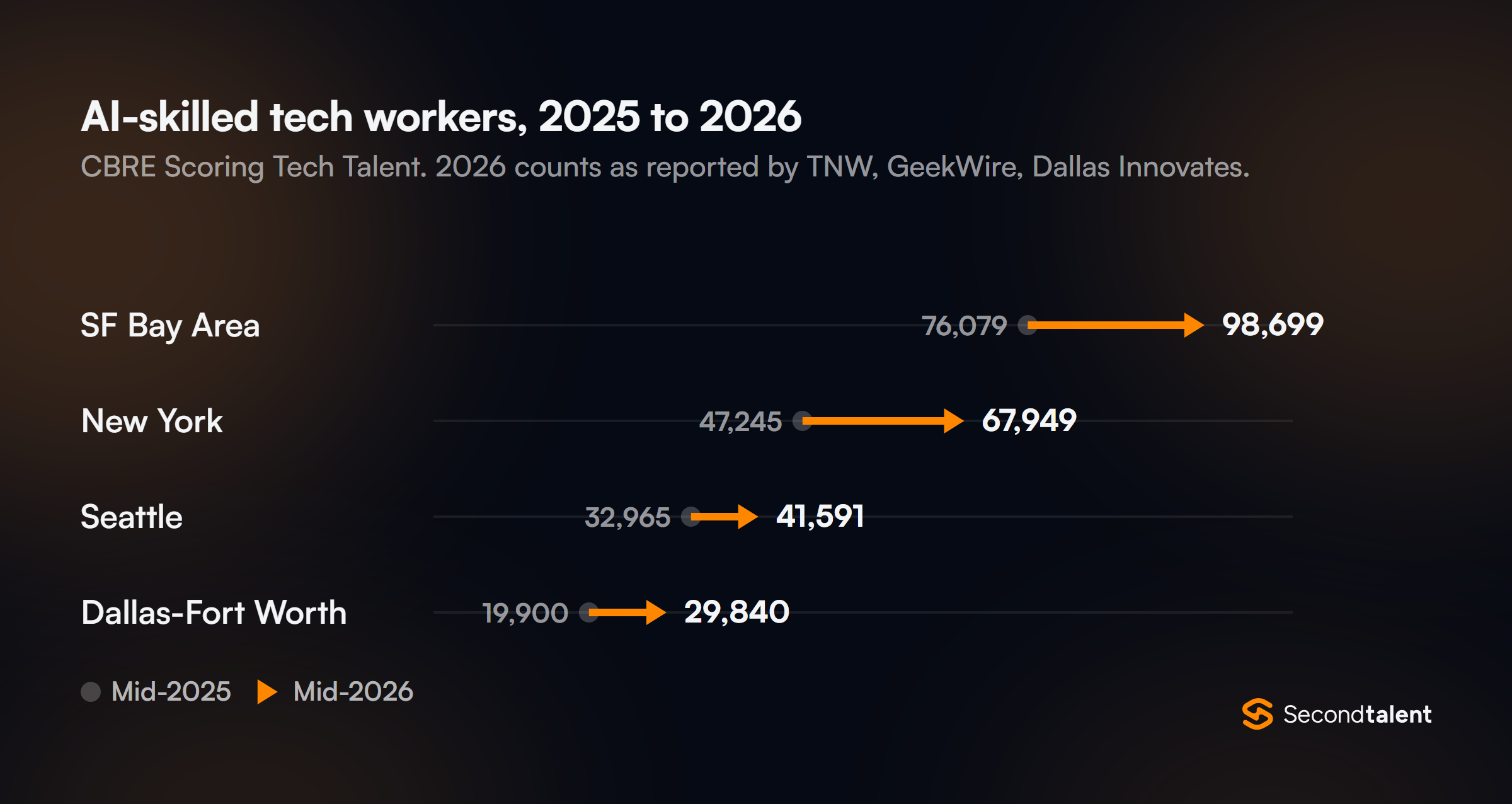
TL;DR: The San Francisco Bay Area is still the best U.S. city for AI talent and jobs: 98,699 AI-skilled tech workers in mid-2026, and 57% of its tech job postings now tied to AI. New York, Seattle, Washington DC, Boston, Dallas-Fort Worth and Austin complete the top seven.
New York overtook the Bay Area in 2025 as North America's largest tech workforce, 394,300 workers against 375,730, by CBRE's count.
The Bay Area shed 23,900 tech jobs between 2022 and 2025 and still drew 80% of U.S. AI venture funding since 2020. I ranked seven metros on where AI-skilled people work and where employers post AI jobs.
The 7 Cities Compared
Rank
Metro
CBRE 2026 tech talent rank
Job postings asking for AI skills
Open roles, Anthropic / OpenAI
Price level (U.S. = 100)
1
San Francisco Bay Area
1
SF 64,503; San Jose 59,245
459 / 589
115.6
2
New York
4
93,028
336 / 90
112.6
3
Seattle
2
40,905
174 / 89
111.1
4
Washington, DC
6
58,154
61 / 31
108.9
5
Boston
7
44,559
10 / 0
108.3
6
Dallas-Fort Worth
8
38,828
0 / 0
103.1
7
Austin
5
24,950
3 / 0
98.1
How the order works. Ranked on CBRE's count of AI-skilled tech workers and CompTIA's count of job postings asking for AI skills (January 2025 to January 2026). CBRE ranks all of North America, so Toronto holds 3rd. Lab roles come from Anthropic's and OpenAI's public job boards on September 22, 2026. Price levels are BEA's 2024 regional price parities.
What decides this ranking
1Of the metros we checked, OpenAI is hiring in only four: the Bay Area, New York, Seattle and Washington, DC.
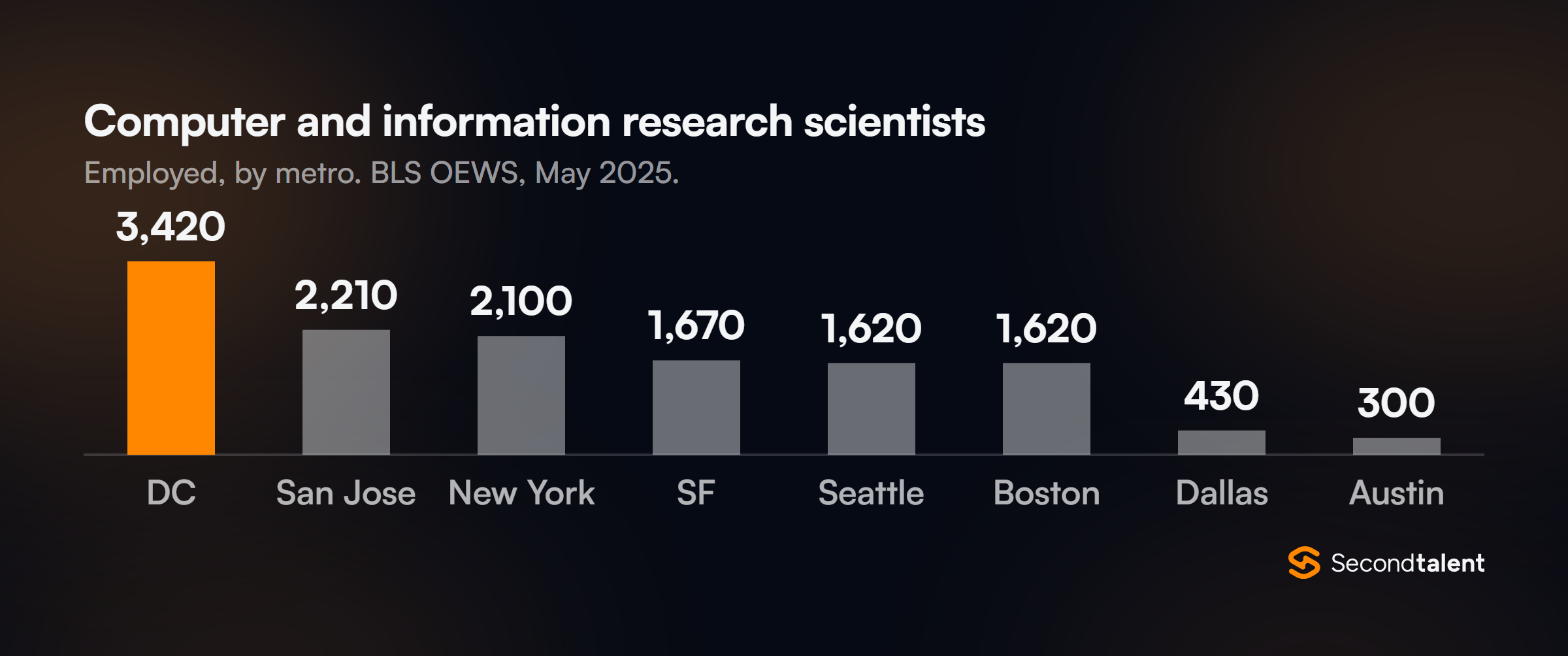
2Washington, DC employs 3,420 computer and information research scientists, more than any other metro on this list.
3Dallas-Fort Worth added 37,230 tech workers from 2022 to 2025, the second-largest gain in North America.
4Austin is the only city of the seven priced below the national average.
The 7 Best U.S. Cities for AI Talent and Jobs
1. San Francisco Bay Area: where the frontier labs hire
81.98 CBRE score, 1st of 507% of tech postings remote115.6 price level, highest in the U.S.
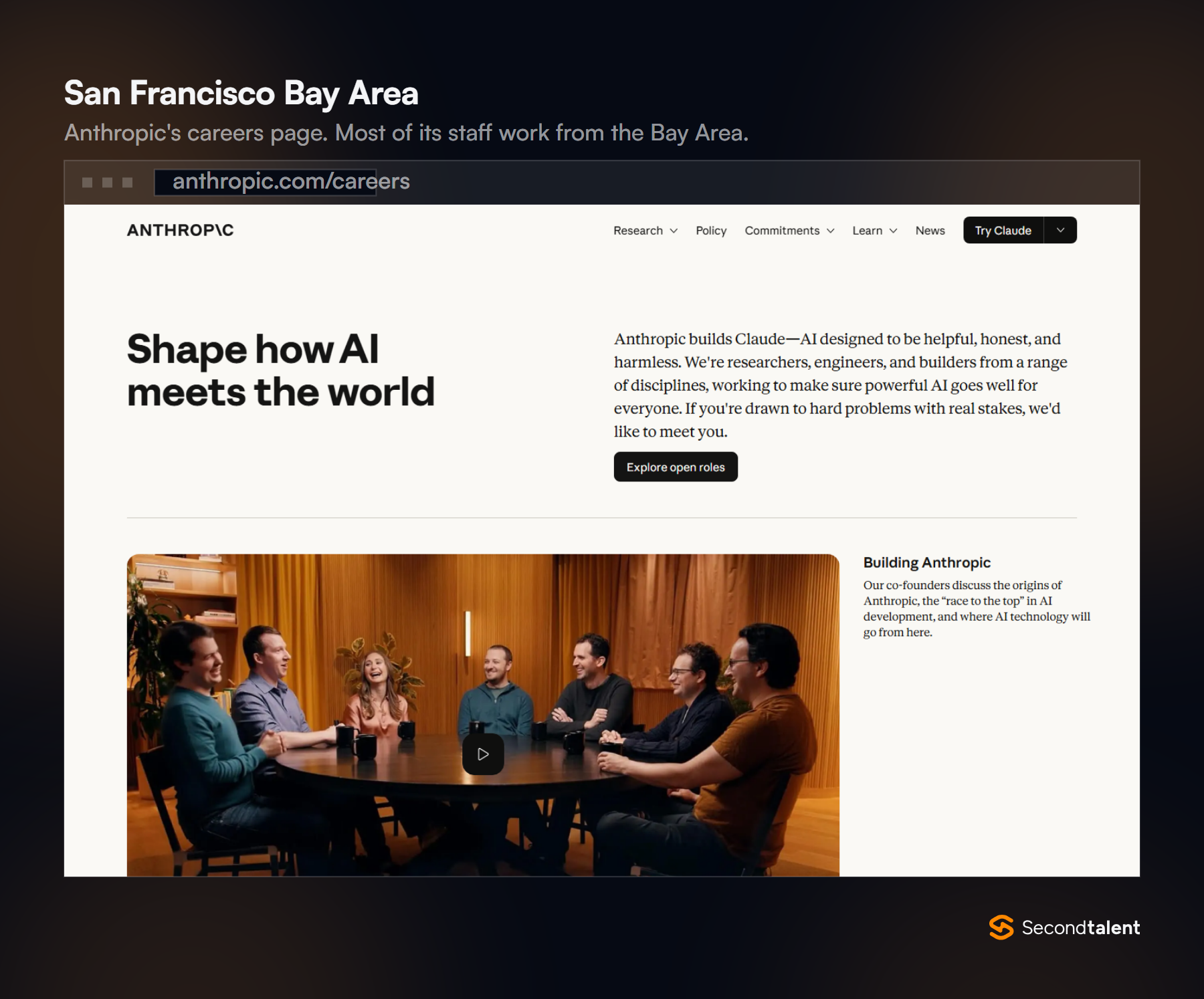
The Bay Area is for anyone who wants to work at, or hire away from, a frontier lab. On September 22, 2026, Anthropic listed 459 of its 621 open roles here, and OpenAI 589 of 811.
Anthropic's careers page says: "Most staff are in the Bay Area and come to the office regularly."
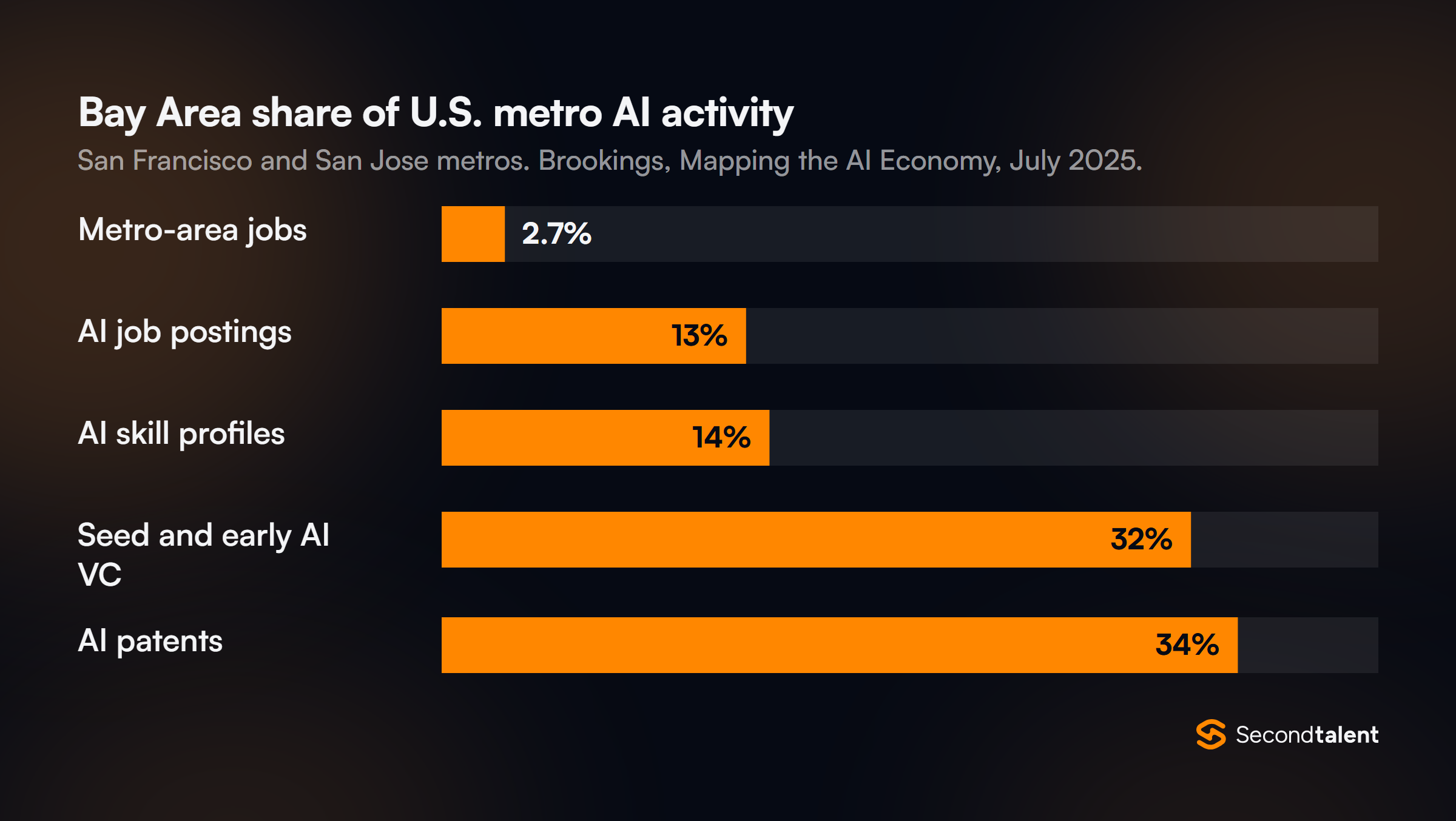
No other metro comes close on concentration. Brookings calls San Francisco and San Jose the only two AI "Superstars" in the country.
Together they hold 2.7% of U.S. metro-area jobs and about a third of AI patents and early-stage AI venture capital.
Employers pay for that depth. San Jose's median software developer earned $213,110 in May 2025, the highest of the metros here, and the area employs software developers at seven times the national rate.
CBRE puts the yearly cost of a 500-person tech company here at $91 million, the most in North America. For funding context, see our AI startup funding statistics.
Strongest in: frontier model research, AI infrastructure and venture-backed AI startups.
Cost: San Francisco has the highest price level of 387 metros, and San Jose the highest rents.
2. New York: the most AI job postings in the country
93,028 postings asking for AI skills613,950 tech workers112.6 price level
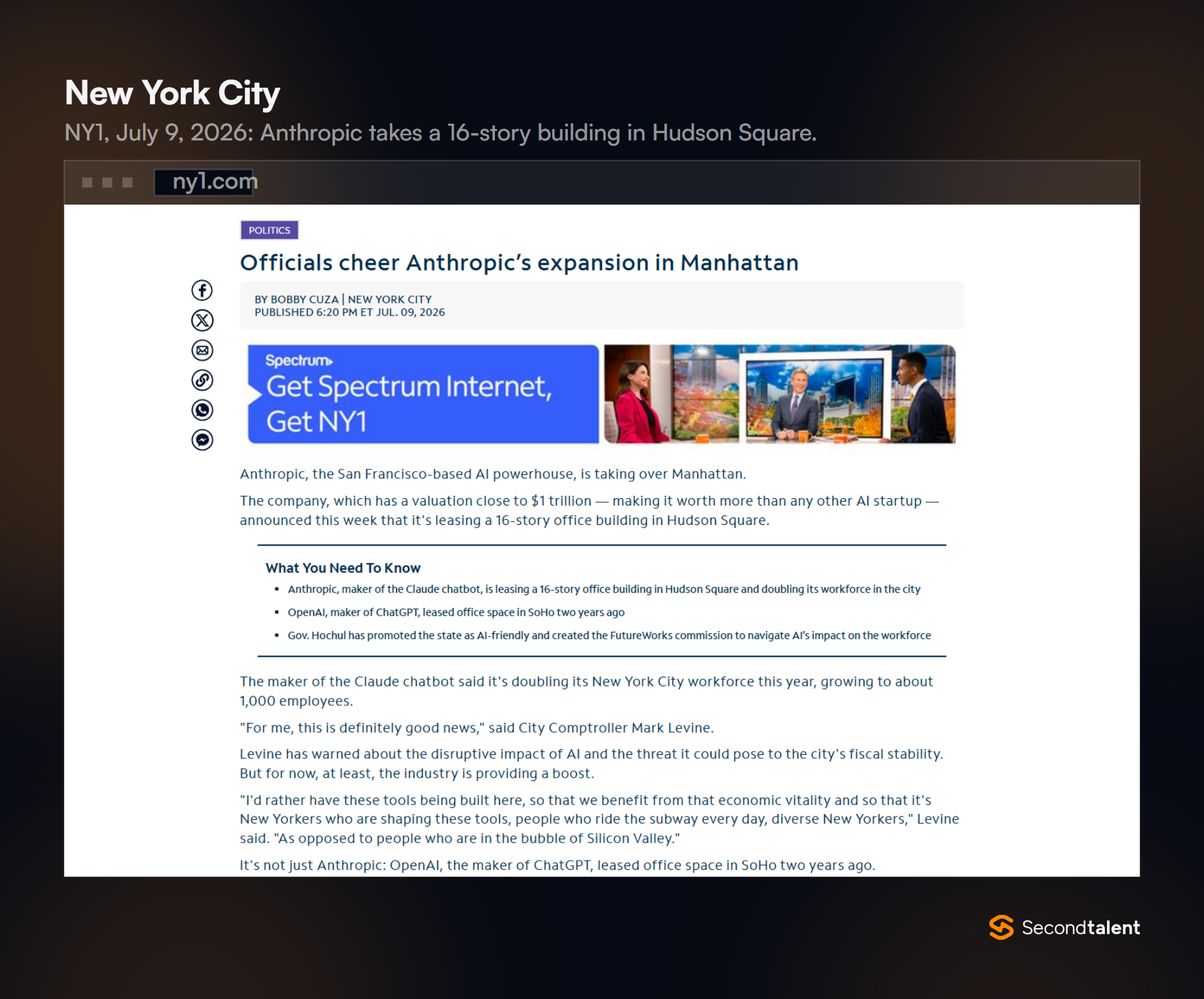
New York suits AI work that sits next to a customer, especially in finance. Anthropic is taking a 16-story building in Hudson Square and doubling its city workforce to about 1,000 this year.
It already lists 336 open New York roles, second only to San Francisco.
"I'd rather have these tools being built here, so that we benefit from that economic vitality and so that it's New Yorkers who are shaping these tools."
Mark Levine, New York City Comptroller, to NY1, July 9, 2026
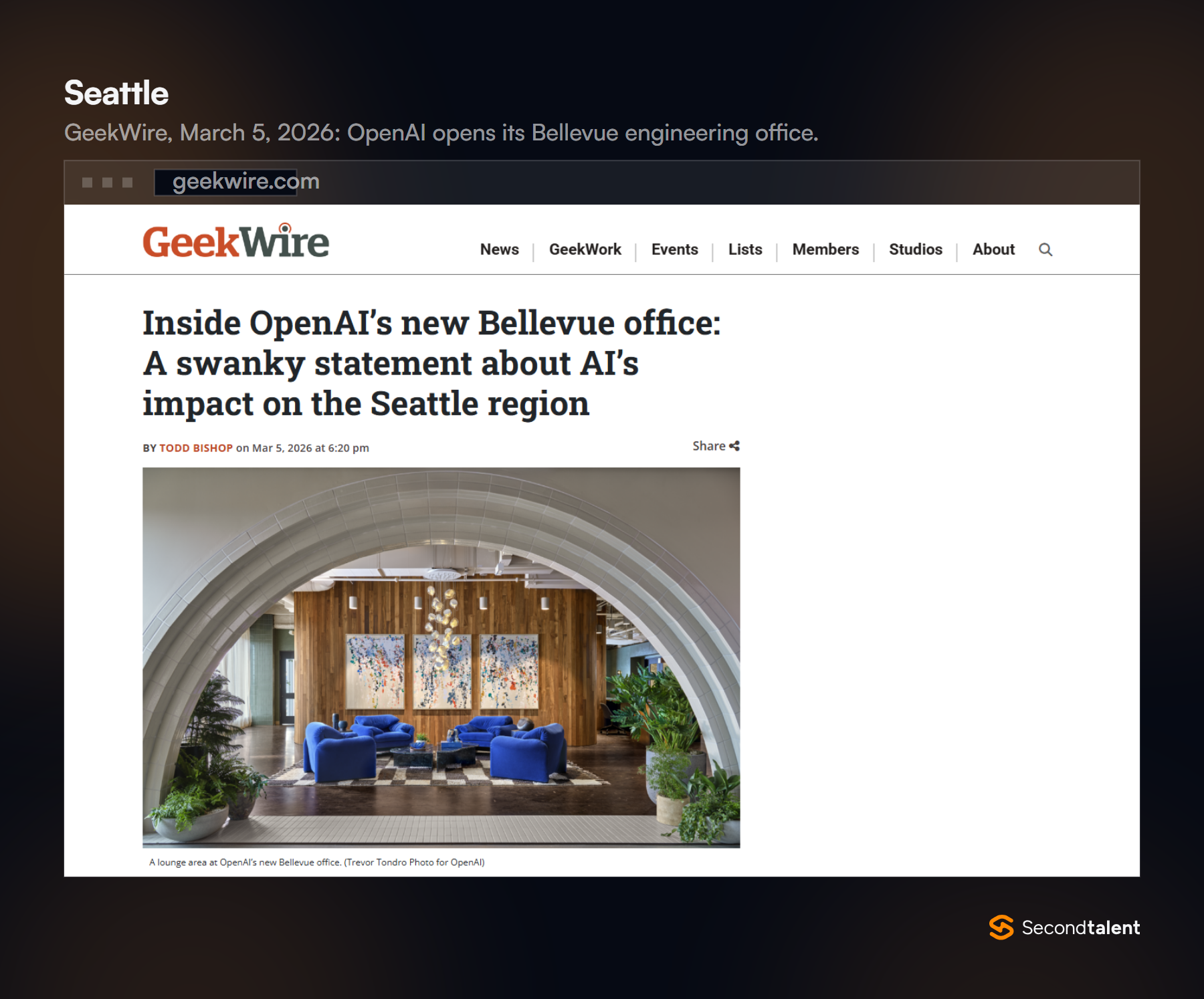
Seattle is for teams that want big-company engineers who already build AI at scale. OpenAI opened a Bellevue engineering office in March 2026 with 250 staff and room for 1,400.
In July, Anthropic leased 113,000 square feet in South Lake Union, while 28% of the city's offices sat empty.
The two labs list 174 and 89 open Seattle roles. They hire from a deep local pool: software developers are four times as concentrated here as in the U.S. overall. The city also has its own research base.
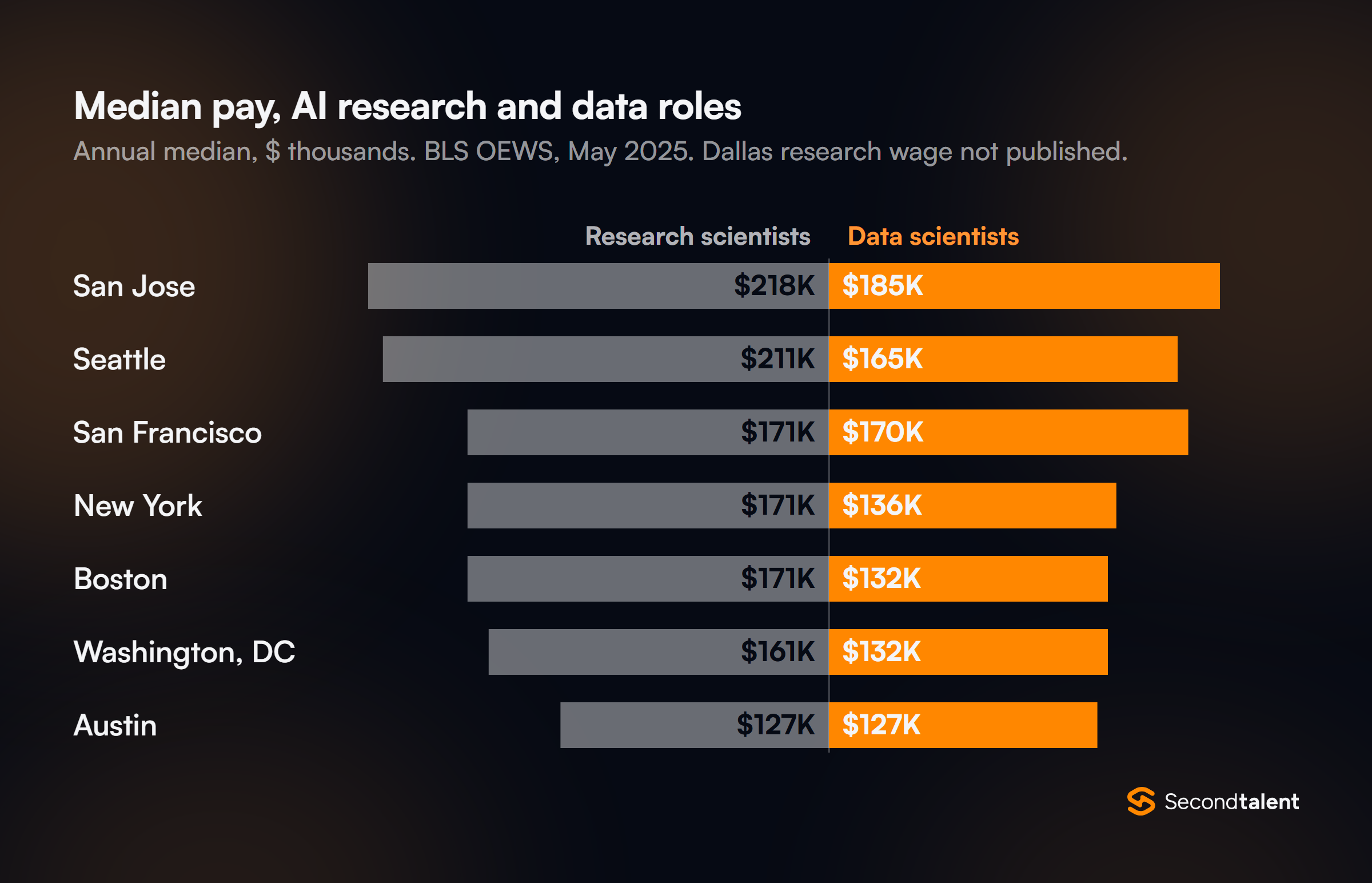
Research pay is where Seattle stands out. Its median computer and information research scientist earned $211,270 in May 2025, according to the BLS occupational wage survey.
That is second only to San Jose and about $40,000 above San Francisco. Our AI skills and salary ranges guide breaks pay down by specialty.
Those cuts put experienced engineers on the market, a pattern our tech layoffs statistics track nationally.
Strongest in: cloud-scale AI engineering, infrastructure and open research through Ai2 and the University of Washington.
Watch out: Amazon and Microsoft are cutting jobs while the labs expand.
Cost: price level 111.1, with rents 51% above the U.S. average.
4. Washington, DC: government AI and research scientists
58,154 postings asking for AI skills62.95 CBRE score, 6th108.9 price level
DC is for AI work that sells to, or answers to, the federal government. Employers here posted 181,796 tech jobs in the year to January 2026, the most of any metro CompTIA tracks, and 58,154 postings asked for AI skills.
Scale AI has 48 open roles here, Anthropic 61 and OpenAI 31.
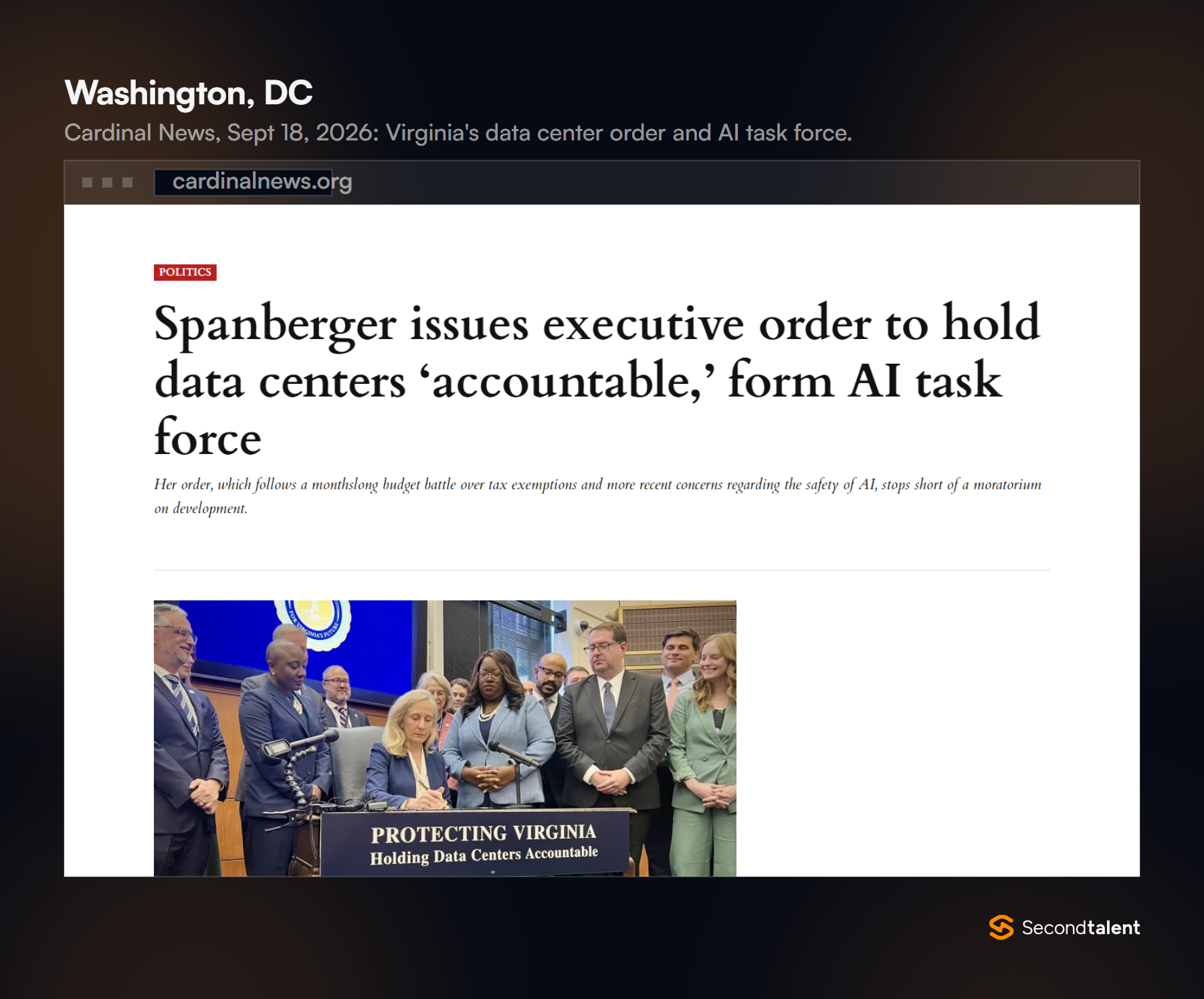
The labs are building policy teams too. Anthropic opened its first DC office in spring 2026 and is tripling its public policy team.
DC residents also use Claude more per person than anywhere else in the country, according to Anthropic's Economic Index.
DC leads every metro here on research scientists: 3,420 computer and information research scientists, about four and a half times the national rate.
Many work for agencies and federal contractors, where a security clearance can matter more than the paper you published.
Next door, Northern Virginia runs the servers. Loudoun County counts about 233 data center buildings, which paid $1.2 billion in taxes, 39% of its budget.
Strongest in: defense and civilian government AI, AI policy and data center operations.
Watch out: CBRE says DC lost tech jobs from 2022 to 2025.
Cost: price level 108.9, lower than the three cities above.
5. Boston: university research moving into industry
44,559 postings asking for AI skills7th in CBRE, up two places108.3 price level
Boston suits employers recruiting AI researchers out of MIT and Harvard. Anthropic signed a lease for 24,000 square feet at One Kendall Square in September 2026. That is room for 120 people, including about 50 already working in Cambridge.
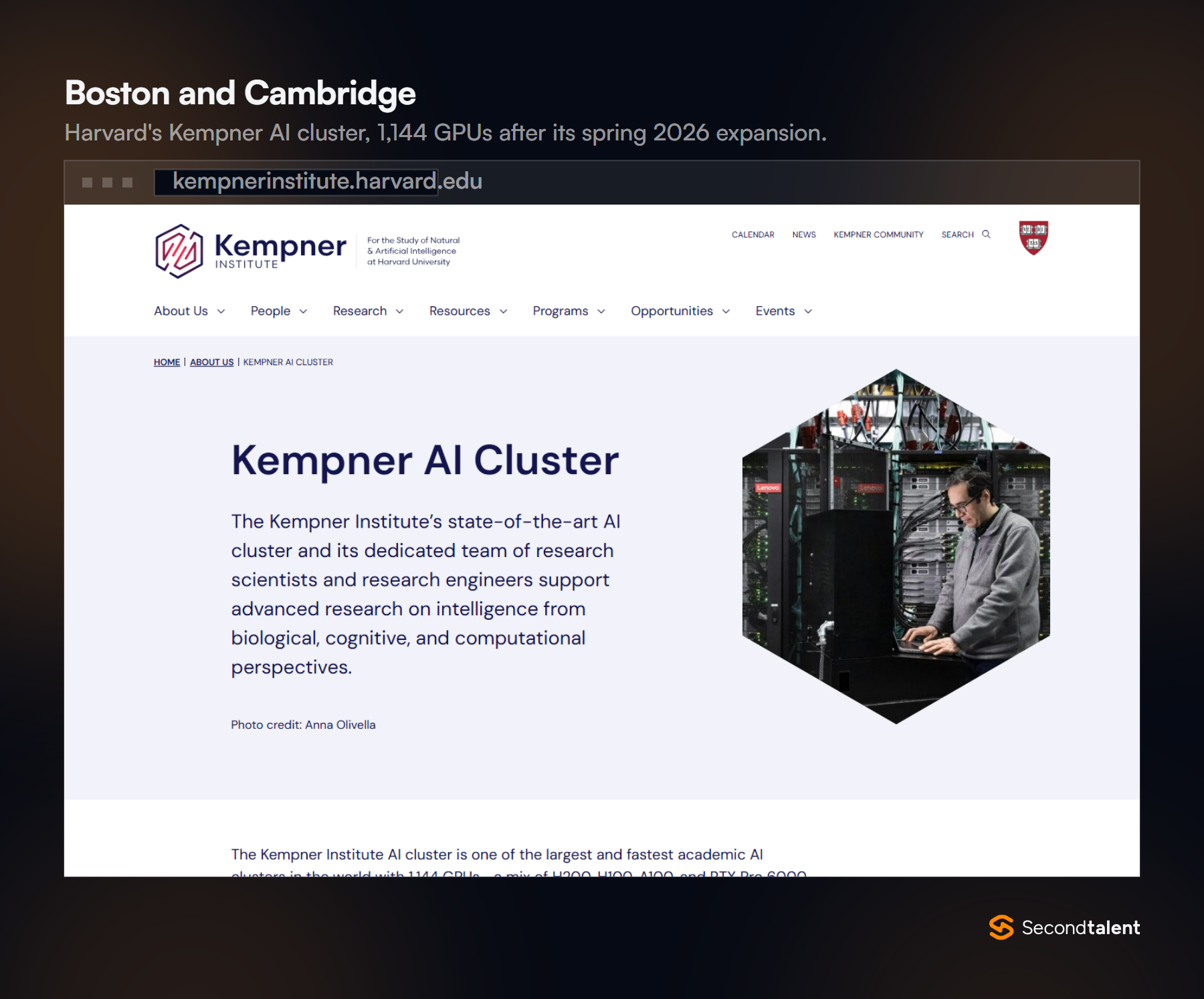
1,144
GPUs in Harvard's Kempner AI cluster, spring 2026
$31M
State grant for the Massachusetts AI Hub's shared compute
20,073
AI-skilled tech workers, CBRE 2025
Sources: Kempner Institute; MGHPCC, May 2025; CBRE, September 2025.
The research base is unusually well equipped. The Kempner cluster reaches 1.8 exaflops, and the state's AI Hub is building shared GPU compute with six universities.
Research scientists are two and a half times as concentrated here as nationally, with a median of $170,510.
Boston's gap is frontier lab hiring. OpenAI had no open Boston roles on September 22, and Anthropic had 10.
Its AI demand comes from employers outside the labs, which is why its postings count beats Seattle's while lab roles trail far behind.
Strongest in: academic AI research and the companies that recruit from it.
Watch out: few frontier lab roles, so senior model builders often leave for San Francisco or New York.
Cost: price level 108.3, the lowest of the five coastal hubs.
6. Dallas-Fort Worth: enterprise AI and the fastest job growth
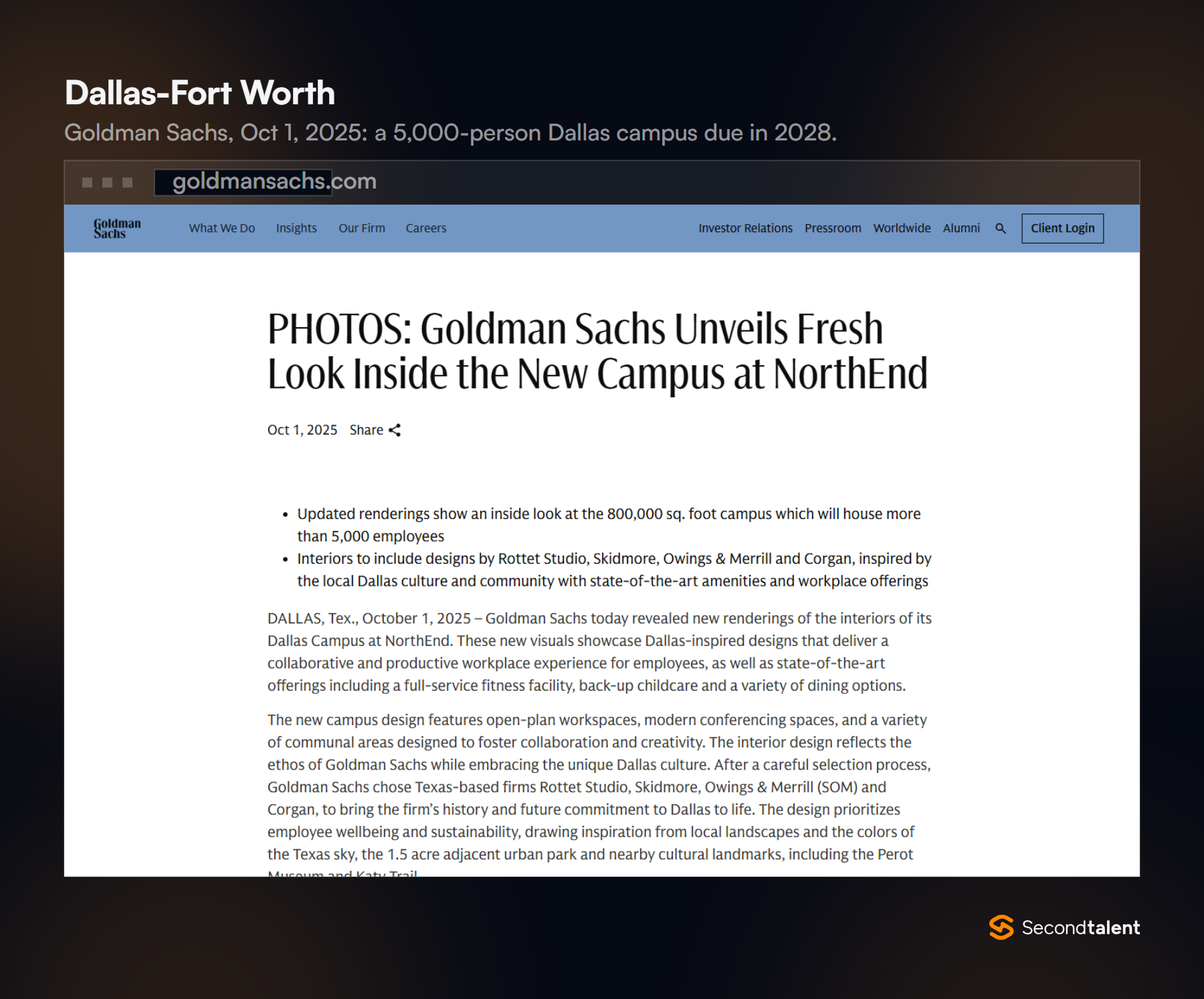
Dallas is for companies that apply AI inside large firms rather than build models. Goldman Sachs, whose second-largest U.S. office is here, is building an 800,000-square-foot campus for more than 5,000 employees, due in 2028.
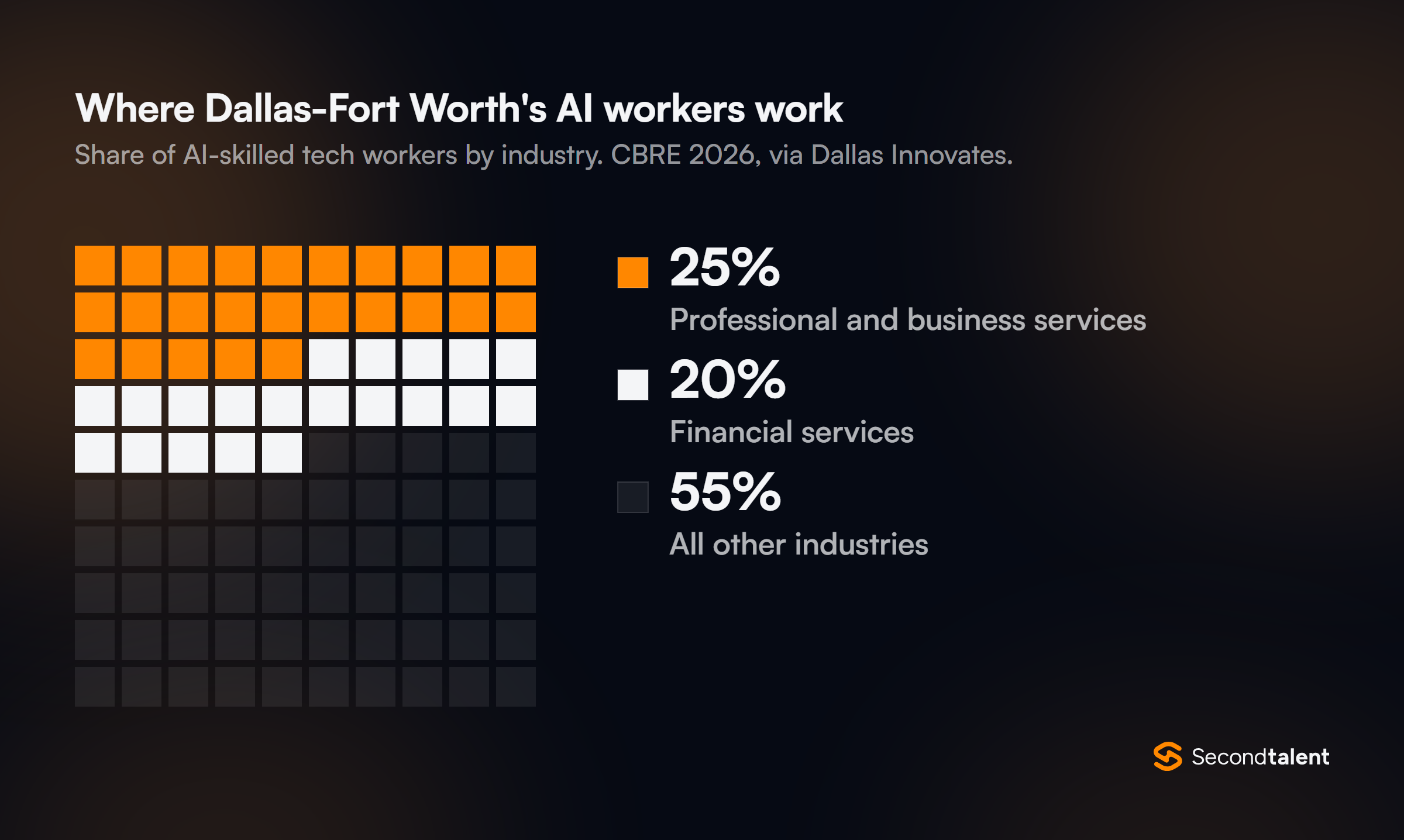
Its AI talent is growing faster than most. CBRE's 2026 figures, reported by Dallas Innovates, put AI-skilled workers at 29,840, sixth in North America and up by at least 45% in a year.
One in five works in financial services, the same share as New York.
The wider tech base is huge. CompTIA counts 377,013 tech workers, second only to New York, and projects Dallas will add 11,013 tech jobs in 2026, again second only to New York.
Tech degree output in the region grew nearly 53% from 2021 to 2024.
The frontier labs are missing, though. Neither Anthropic nor OpenAI had a Dallas opening on September 22. Databricks had 12, the most of the AI firms we checked.
The median software developer here earned $133,290, about $53,000 below San Francisco.
Strongest in: AI inside financial services and professional services firms.
Watch out: almost no frontier research roles, so model builders are harder to find here.
Cost: price level 103.1, and Texas has no state income tax.
7. Austin: university compute at a lower cost
64.26 CBRE score, 5th13% of workers in tech98.1 price level
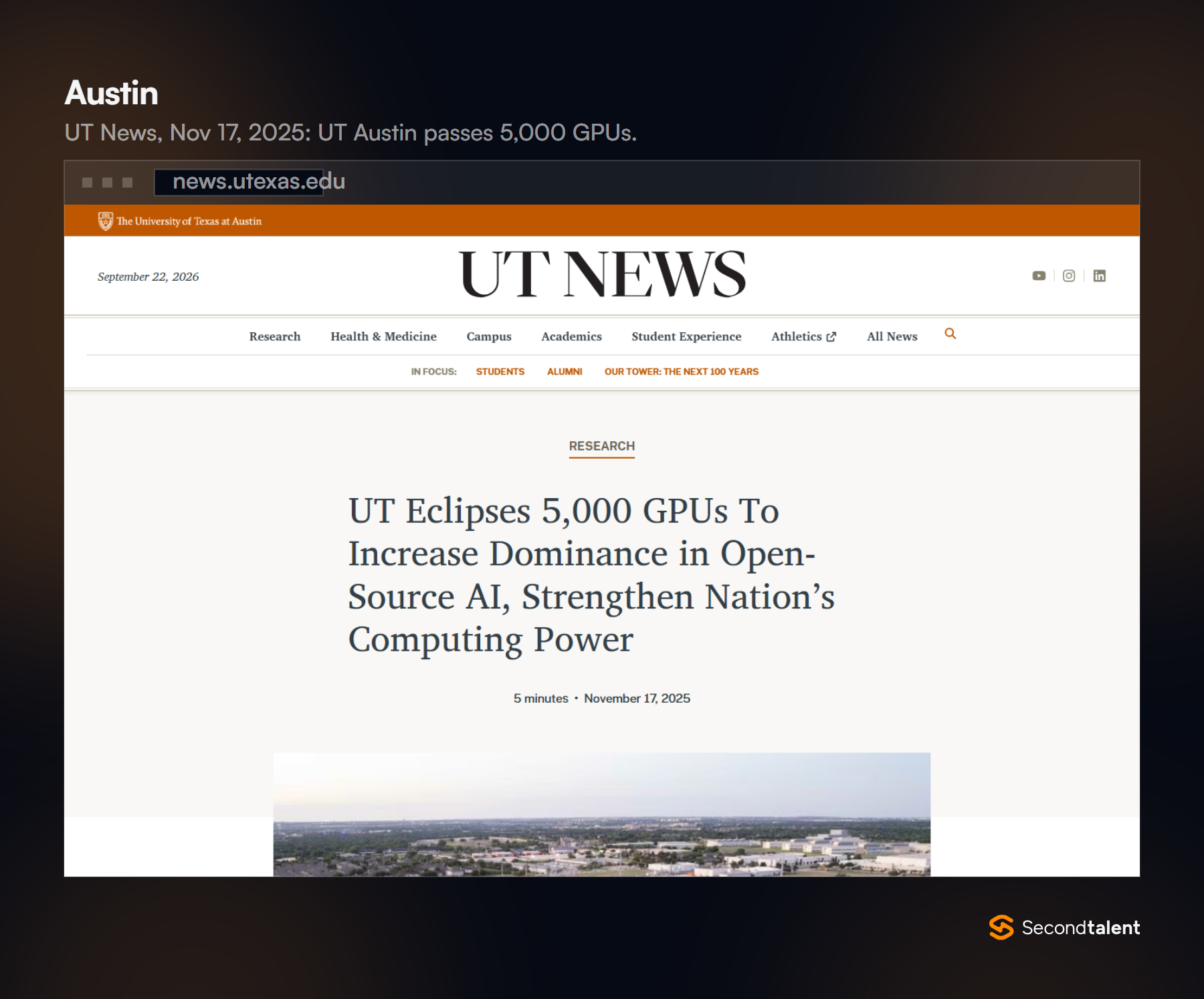
Austin suits teams that want strong engineers without coastal costs. The University of Texas passed 5,000 GPUs in November 2025.
Its Center for Generative AI alone has more than 1,000, and the TACC Horizon system adds over 4,000 NVIDIA Blackwell GPUs in 2026.
CBRE rates Austin's overall tech market fifth in North America, ahead of DC and Boston. Tech is 13% of the local workforce, one of the highest shares anywhere. Brookings found Austin's AI job postings grew more than 250% from 2018 to 2025.
AI demand is the weak spot. Austin had 24,950 postings asking for AI skills, the fewest of the seven, and the labs barely hire here: xAI had 11 openings, Perplexity 7 and Anthropic 3.
Texas's AI law, TRAIGA, took effect January 1, 2026, and gives employers 60 days to fix a violation before any penalty.
Strongest in: university AI research, public compute and startups watching their burn rate.
Watch out: fewer AI openings, so AI specialists have fewer local employers to move between.
Cost: the only city of the seven below the U.S. price level, with no state income tax.
Hiring AI Talent Beyond U.S. Metro Pay
Median research scientist pay runs from $161,090 in DC to $218,420 in San Jose, before benefits and office costs. One option is to keep senior AI leads in one of these cities and build the rest of the team in Asia.
New York, with 93,028 postings asking for AI skills from January 2025 to January 2026. San Francisco and San Jose, counted separately, come second and third. The Bay Area still has more AI-skilled workers and far more frontier lab roles.
Why is Los Angeles not on the list?
Los Angeles had 33,428 AI-skill postings, more than Austin, but it sits outside CBRE's top 10. Software developers are less concentrated there than nationally, and Anthropic and OpenAI had no open roles in the city.
Is there an AI talent shortage in the U.S.?
AI roles made up 31% of U.S. tech job postings in June 2026, up from 11% in mid-2022, according to CBRE. Demand is growing faster than the supply of experienced people.
Charmaine Tsang is VP of Demand Generation at Second Talent, where she connects engineering and hiring leaders with AI-native tech talent across nine APAC markets. A Y Combinator alum, she writes on global hiring, building remote teams and what it actually costs to staff engineering offshore. Second Talent is rated #1 in Global Hiring on G2, with 200+ companies served and 8,000+ engineers placed.