Data science teams now use AI assistants to speed up analysis, reduce manual work, and improve decision quality. Tools like Anthropic Claude and Google Gemini promise to support tasks across the full data science workflow. But feature claims do not show how these tools perform in real work.
This guide compares Claude and Gemini using practical data science tasks. We tested both tools with the same prompts, datasets, and evaluation criteria. The comparison covers data cleaning, EDA, feature engineering, modeling, SQL, Python, and business insight translation. The goal is to show which tool works better in real data science scenarios.
What’s your AI hiring priority?
Select your situation below.
You need engineers who can build and deploy Claude or Gemini integrations. Southeast Asia offers AI/ML developers at $3,500-$6,500/month—60% less than US rates. Your team gets production-ready talent without the Silicon Valley price tag. Hire AI developers →
Your data science workflow needs engineers who handle ETL, databases, and model deployment. Data engineers in Vietnam and Philippines cost $3,200-$5,800/month with strong SQL and Python skills. You get the infrastructure expertise without overspending. Find data engineers →
You need to turn data science insights into user-facing applications. Full-stack developers in Southeast Asia cost $3,000-$5,500/month and can integrate Claude or Gemini APIs into your product. Your AI features ship faster with lower overhead. Compare full-stack rates →
You’re budgeting for AI and data science hires across Asia. Our 2025 salary index covers 12 countries, 50+ roles, and real market rates for ML engineers, data scientists, and Python developers. Your hiring budget becomes accurate and competitive. View Asia salary data →
What is Anthropic Claude?

Claude helps users work with data, code, documents, and research tasks. It focuses on safety, accuracy, and clear reasoning. Claude can read large files, analyze complex information, and explain results in simple language. Data scientists use Claude for data analysis, Python and SQL tasks, model reasoning, and insight generation. It performs well in structured thinking, deep context understanding, and step-by-step problem-solving. Claude suits teams that need reliable outputs, clear explanations, and strong, data-driven logic for decision-making.
Key capabilities
- Reads and analyzes large datasets and files
- Writes clean Python and SQL for data analysis
- Explains insights in simple business language
- Supports feature engineering and model reasoning
- Handles long context without losing accuracy
What is Google Gemini?

Google Gemini is an AI model developed by Google. Gemini is designed to handle data, text, code, and reasoning tasks in one system. It supports data science workflows like data analysis, Python coding, SQL queries, and machine learning explanations. Gemini works well with structured data and integrates closely with Google tools. Data teams use it to explore datasets, generate insights, build models, and clearly explain results. Gemini focuses on speed, scalability, and strong analytical reasoning, making it useful for real-world, data-driven projects.
Key capabilities
- Analyzes structured and unstructured data
- Writes Python and SQL for data science tasks
- Supports machine learning and model logic
- Explains insights in clear and simple terms
- Integrates well with Google data tools
Task Parameters we selected to compare Claude with Gemini for data science purpose
Task 1. Data understanding and summary
Goal: Check how well the tool reads tabular data and explains patterns.
Prompt:
“ Analyze the dataset below.
Explain key trends, outliers, and business insights in simple words.
Month, Revenue, Users, ChurnRate
Jan,120000,1500,3.2
Feb,135000,1620,3.0
Mar,160000,1800,2.6
Apr,155000,1750,2.9
May,180000,2100,2.3 “
Anthropic Claude response:

Claude reads tabular data well and explains trends in very simple words. It clearly connects revenue, users, and churn with business meaning. The insights feel natural and easy to understand. It focuses more on storytelling and high-level reasoning than metrics or calculations.
Google Gemini response:

Gemini takes a more analytical approach. It correctly identifies trends and adds additional metrics, such as revenue per user. It also supports insights with charts and structured tables.

The language is clear but slightly more technical. Gemini feels stronger for analysts who want numbers and breakdowns.
Final Verdict:
For data science experts, Google Gemini is the stronger choice. It goes beyond surface-level trends and introduces derived metrics, structured tables, and visual analysis, all of which are criticalton real analysis workflows. Claude excels at clear explanations, but Gemini aligns better with how data scientists think, validate insights, and present evidence.
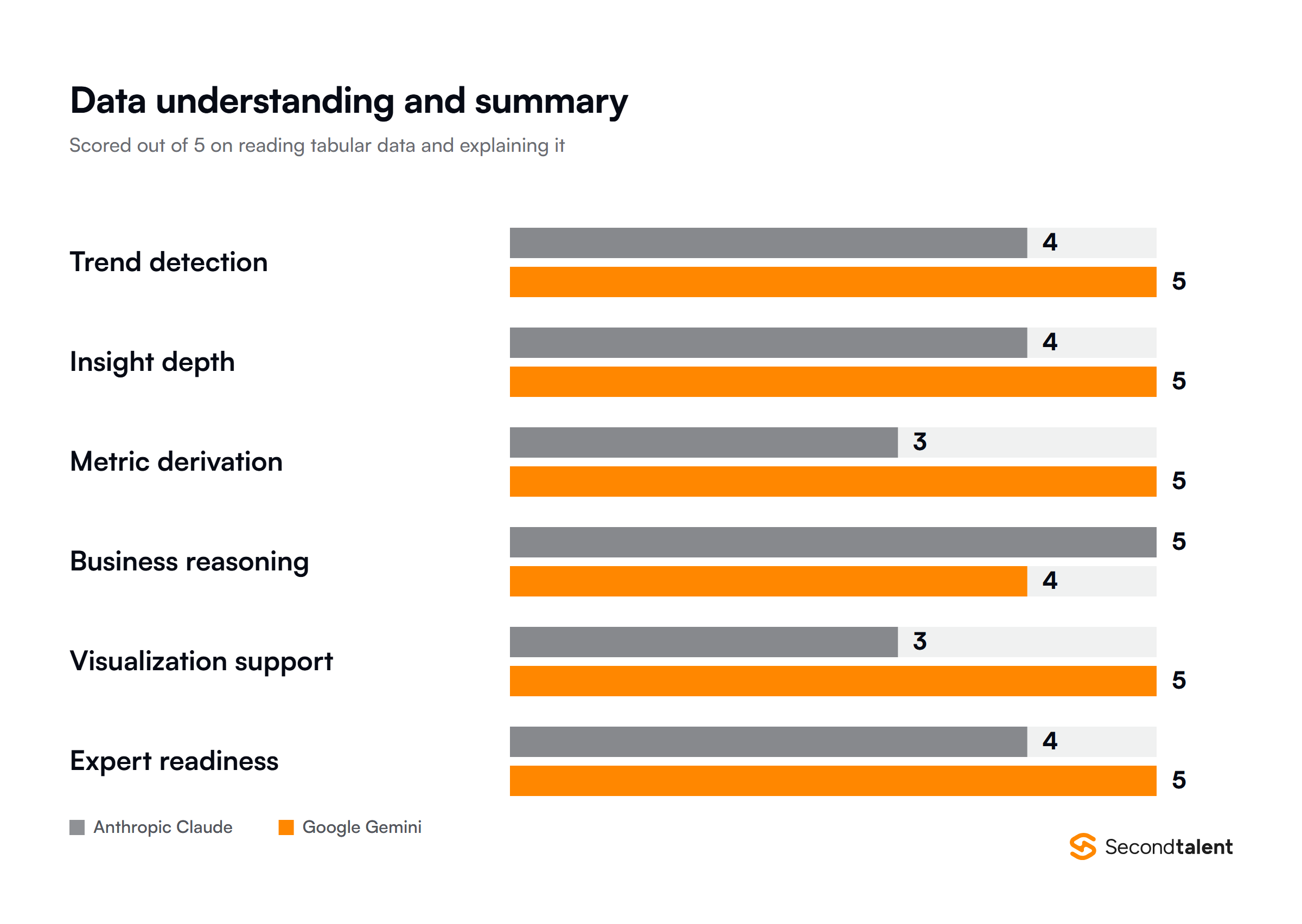
Data Understanding and Summary – Scorecard Table
| Metric | Anthropic Claude | Google Gemini |
| Trend Detection | 4 / 5 | 5 / 5 |
| Insight Depth | 4 / 5 | 5 / 5 |
| Metric Derivation | 3 / 5 | 5 / 5 |
| Business Reasoning | 5 / 5 | 4 / 5 |
| Visualization Support | 3 / 5 | 5 / 5 |
| Expert Readiness | 4 / 5 | 5 / 5 |
Task 2. Data cleaning logic
Goal: Test data quality checks and cleaning suggestions.
Prompt:
“Review the dataset below.
Identify data issues and show how to clean them using Python’s pandas.
user_id, age, income
101,25,45000
102,,52000
103,200,60000
104,30,not_available
105,28,48000 “
Anthropic Claude response:

Claude correctly spots all data issues and explains them in simple language. It provides clear pandas code with multiple cleaning options and strong best practice notes.

The approach is educational and beginner-friendly. However, it leaves decision-making to the user rather than enforcing a final, clean dataset.
Google Gemini response:

Gemini takes a more decisive and production-focused approach. It identifies all issues, applies clear rules, and outputs a finalized, clean dataset.

The pandas code is concise, practical, and ready to reuse. Gemini makes stronger assumptions that align with real data science workflows and save analysts time.
Final verdict:
For data science experts, Gemini is the better choice. It does not just explain cleaning steps but applies them cleanly and delivers an analysis-ready dataset. Claude is excellent for learning and review, but Gemini aligns better with real pipelines where speed, consistency, and clear data decisions matter.
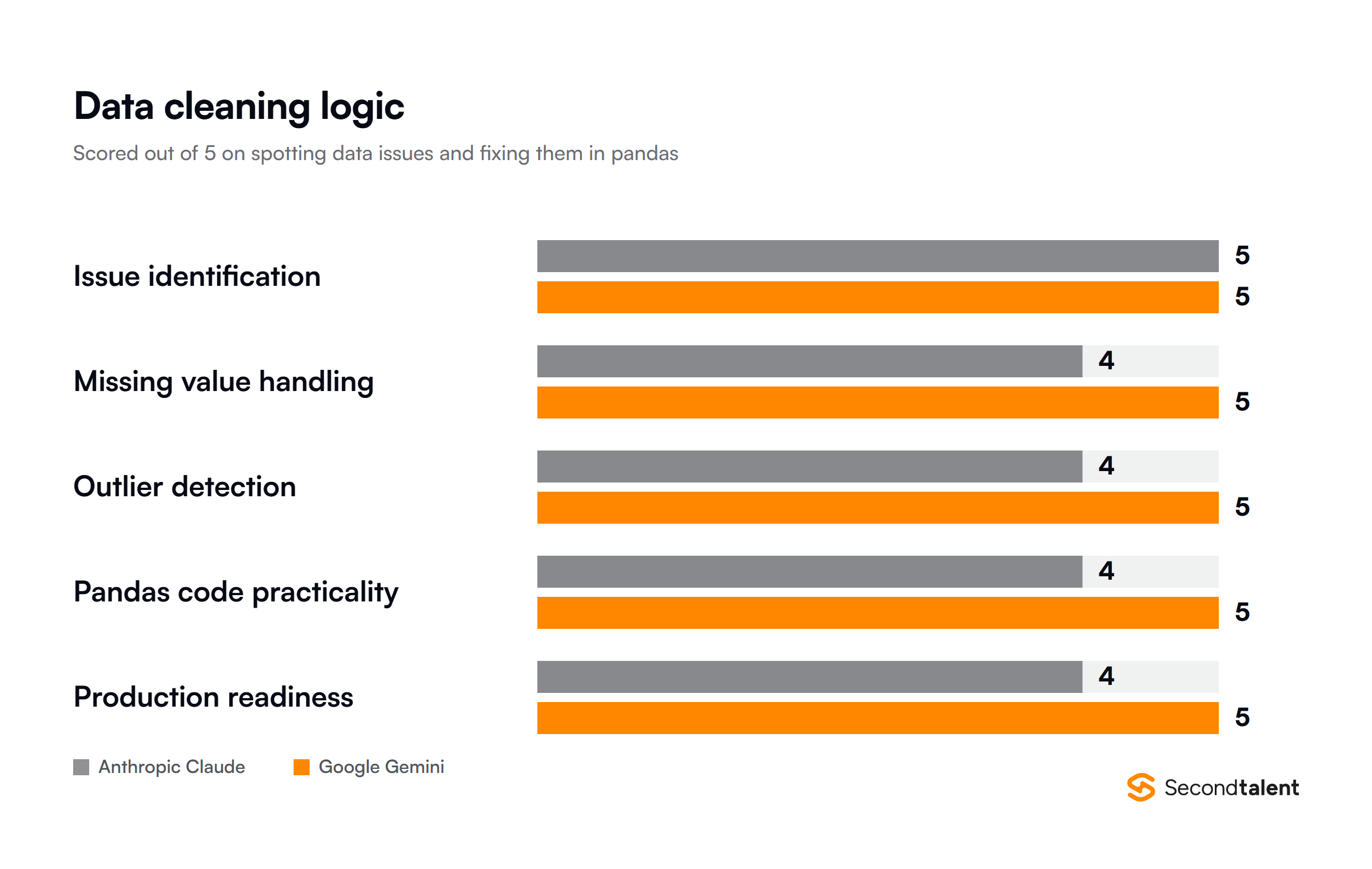
Data Cleaning Logic Scorecard
| Metric | Anthropic Claude | Google Gemini |
| Issue Identification | 5 / 5 | 5 / 5 |
| Missing Value Handling | 4 / 5 | 5 / 5 |
| Outlier Detection | 4 / 5 | 5 / 5 |
| Pandas Code Practicality | 4 / 5 | 5 / 5 |
| Production Readiness | 4 / 5 | 5 / 5 |
Task 3. Exploratory data analysis
Goal: Check EDA thinking and metric selection.
Prompt:
“Perform exploratory data analysis on this dataset.
List key statistics and insights.
Explain what charts you would use and why.
customer_id,region,order_value
1, North,1200
2,South,800
3, North,1500
4, East,600
5, West,900
6, North,1800 “
Anthropic Claude response:

Claude delivers a strong EDA breakdown with clear statistics and deep reasoning. It goes beyond totals and averages to explain variation, concentration, and possible outliers. The chart choices are well justified and show strong analytical thinking. This feels like an analyst explaining insights during a data review meeting.

Google Gemini response:

Gemini provides a clean and structured EDA with accurate metrics and a clear bar chart. The insights are correct, but stay closer to surface-level observations. Chart explanations focus on clarity rather than analytical depth. Gemini works well for quick reporting but offers fewer advanced insights compared to Claude.

Final Verdict:
For exploratory data analysis, Claude stands out for data science experts. It shows stronger statistical thinking, richer insights, and better reasoning behind chart selection. Gemini is reliable for summaries and visuals, but Claude better matches how experienced analysts explore data, question patterns, and explain business impact during early analysis stages.
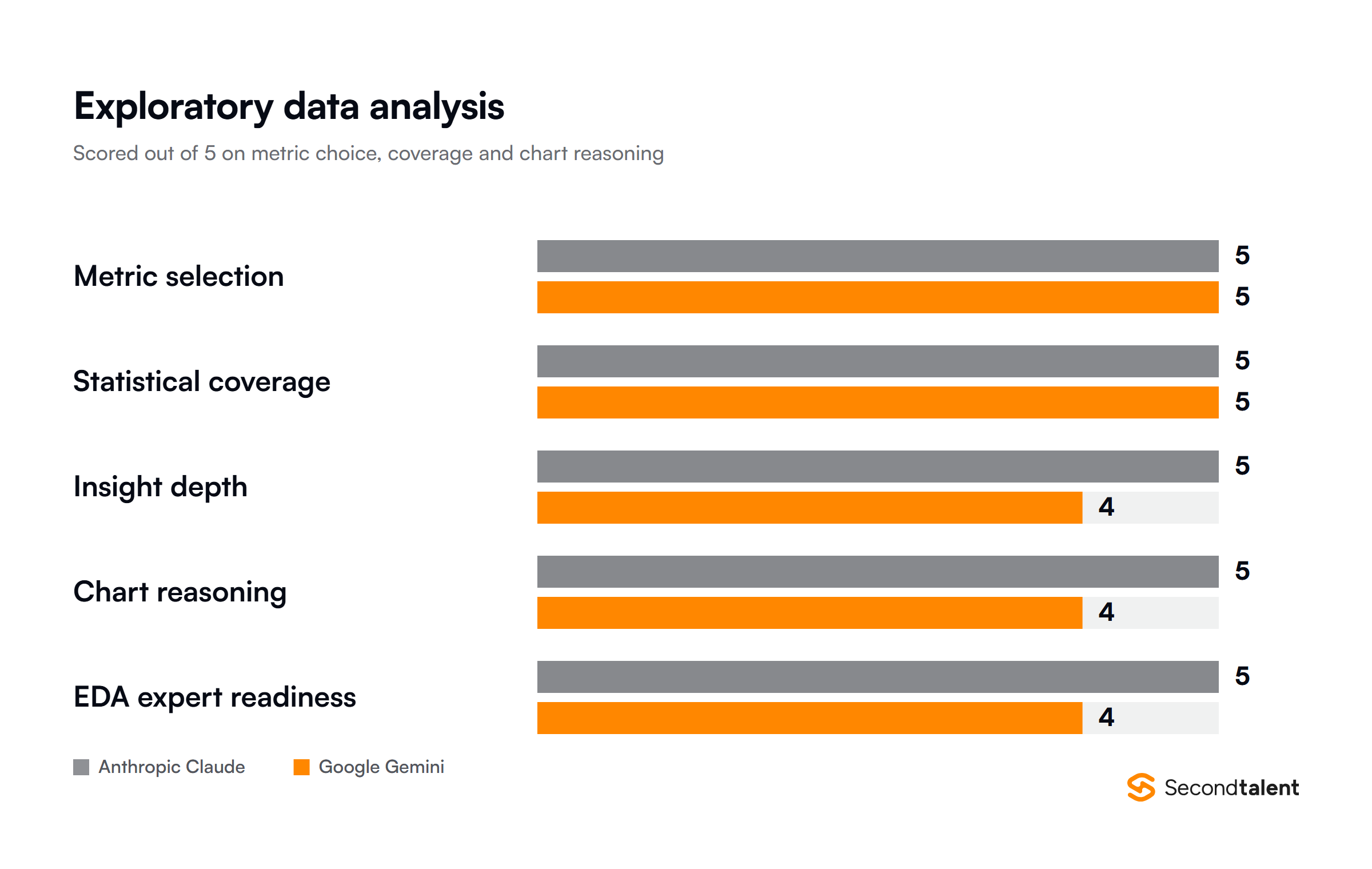
Exploratory Data Analysis Scorecard
| Metric | Anthropic Claude | Google Gemini |
| Metric Selection | 5 / 5 | 5 / 5 |
| Statistical Coverage | 5 / 5 | 5 / 5 |
| Insight Depth | 5 / 5 | 4 / 5 |
| Chart Reasoning | 5 / 5 | 4 / 5 |
| EDA Expert Readiness | 5 / 5 | 4 / 5 |
Task 4. Feature engineering
Goal: Test feature creation skills for modeling.
Prompt:
“Suggest useful features for a churn prediction model using this data.
Explain why each feature matters.
user_id,logins_last_30_days,avg_session_time,plan_type,monthly_spend
1,40,12, Premium,1200
2,8, 3, Basic,400
3,25,7, Standard,700
4,5,2, Basic,350 “
Anthropic Claude response:

Claude shows strong feature engineering depth. It suggests highly relevant engagement, value, and behavioral features with clear domain logic. The focus on ratios, composite scores, and threshold flags reflects real churn modeling experience. Explanations are clear and intuitive, making the features easy to justify during model reviews.
Google Gemini response:

Gemini proposes solid, practical features with clear business meaning. It focuses on engagement volume, cost efficiency, and normalized usage rates. The structure is clean and modeling-friendly. However, it remains slightly closer to standard patterns and offers fewer creative composite or proxy features than Claude.
Final Verdict:
For feature engineering, Claude has a slight edge for data science experts. It demonstrates deeper domain intuition and stronger feature creativity, especially around engagement scoring and value mismatch signals. Gemini remains very reliable and production-ready, but Claude better captures nuanced churn behavior that often improves model lift.
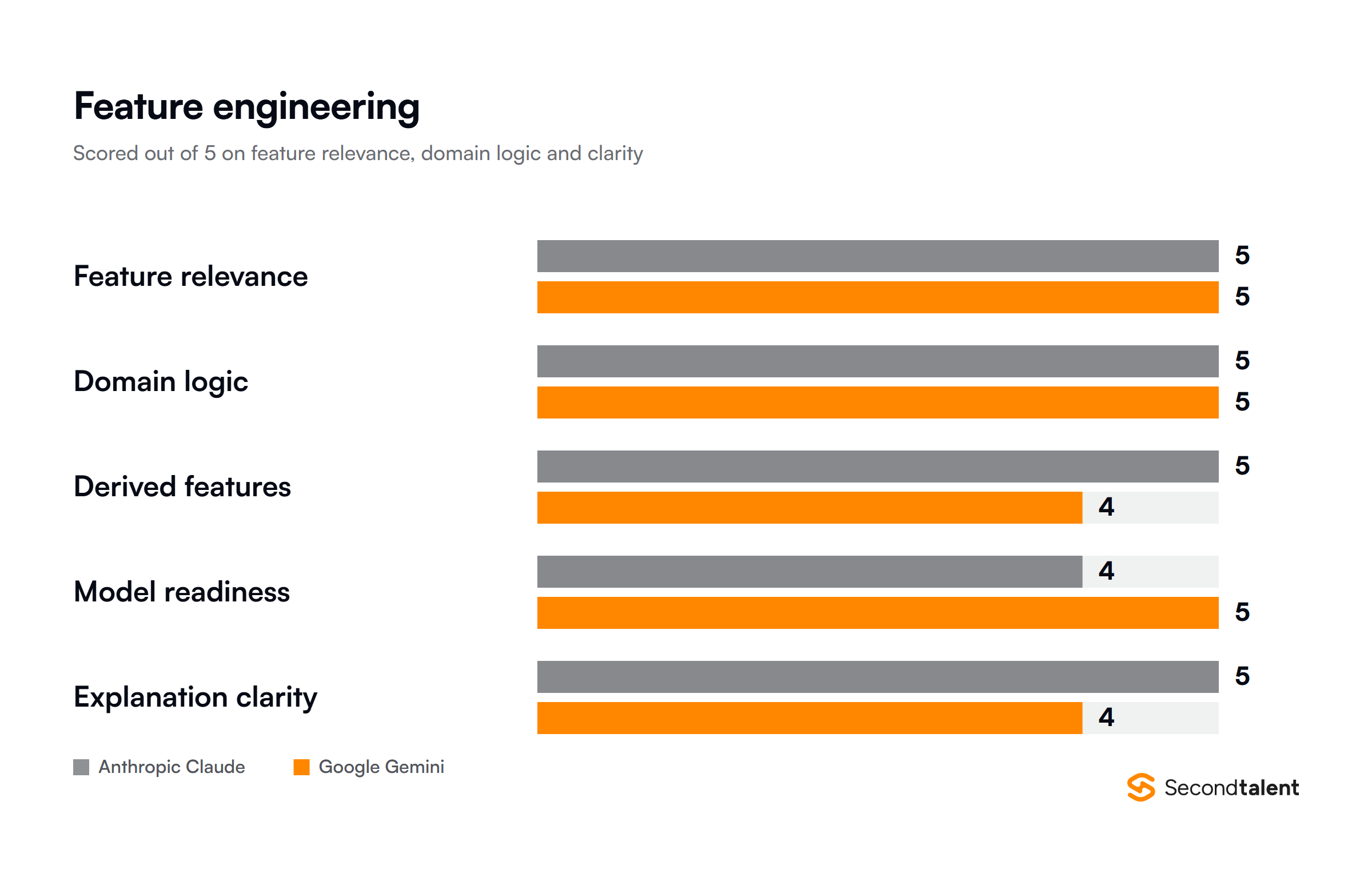
Feature Engineering Scorecard
| Metric | Anthropic Claude | Google Gemini |
| Feature Relevance | 5 / 5 | 5 / 5 |
| Domain Logic | 5 / 5 | 5 / 5 |
| Derived Features | 5 / 5 | 4 / 5 |
| Model Readiness | 4 / 5 | 5 / 5 |
| Explanation Clarity | 5 / 5 | 4 / 5 |
Task 5. Model selection and reasoning
Goal: Check ML model understanding and tradeoffs.
Prompt:
“Based on this dataset, suggest the best machine learning model.
Explain why.
Also, list one model you would avoid and why.
Rows: 50,000
Features: 25
Target: Binary churn label
Class imbalance: 70 percent no churn, 30 percent churn “
Anthropic Claude response:

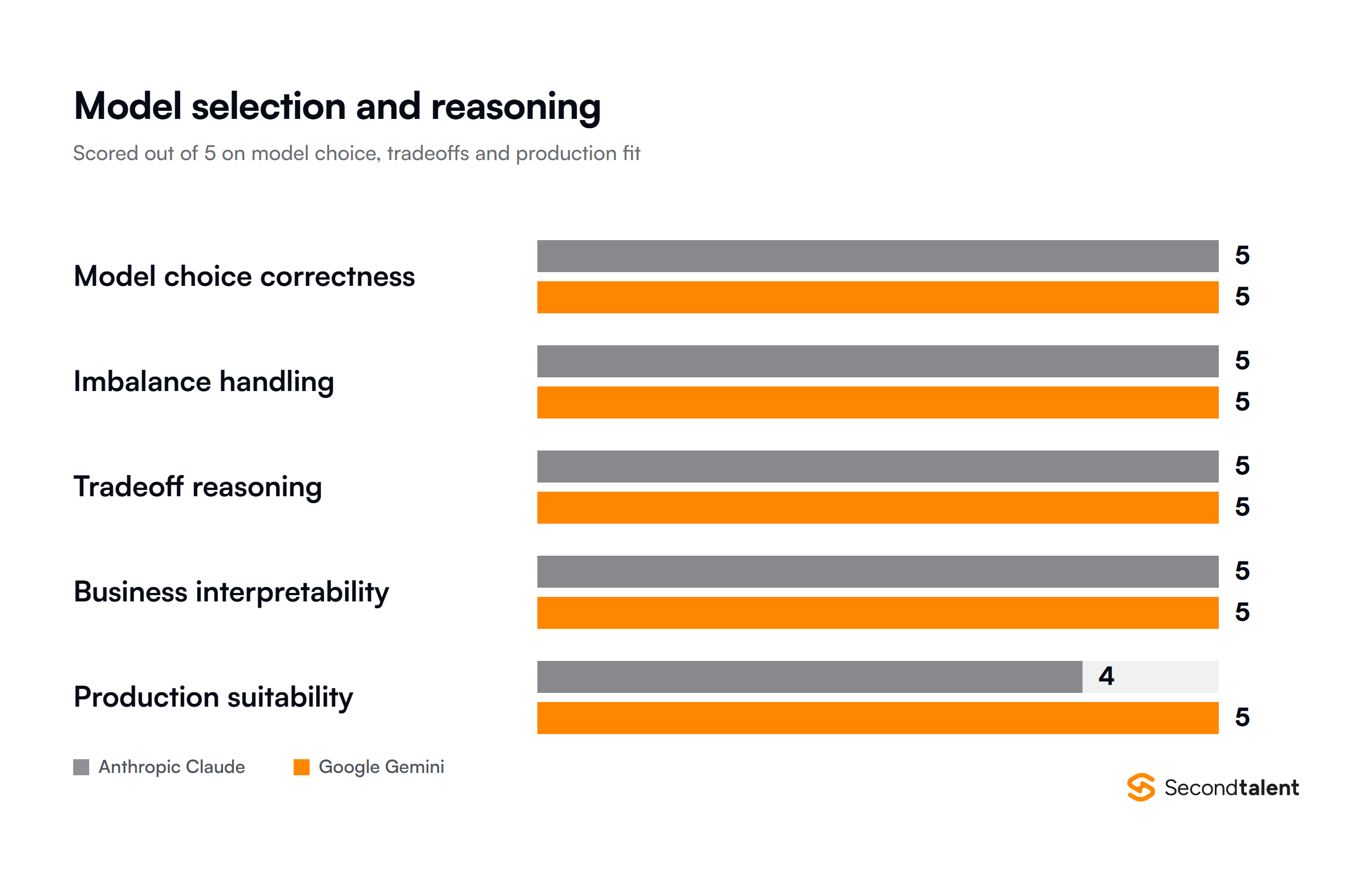
Claude makes a strong and correct model choice with gradient boosting and explains the reasoning clearly. It shows a solid understanding of class imbalance, tabular data strengths, and interpretability needs. The trade-off discussion is practical and business-aware, though slightly conservative on production-scale considerations.

Google Gemini response:

Gemini also selects the right model and adds sharper reasoning around non-linear interactions, recall, F1 impact, and imbalance sensitivity. The explanation feels closer to how data scientists justify model choices in real projects. The avoided model example is well-reasoned and technically accurate.

Final Verdict:
Both tools demonstrate strong machine learning judgment, but Gemini edges ahead for data science experts. Its explanation better balances model performance, class imbalance, and business outcomes like recall and interpretability. Claude is clear and correct, but Gemini aligns more closely with real-world ML decision-making and production-driven tradeoffs.
Model Selection and Reasoning Scorecard
| Metric | Anthropic Claude | Google Gemini |
| Model Choice Correctness | 5 / 5 | 5 / 5 |
| Imbalance Handling | 5 / 5 | 5 / 5 |
| Tradeoff Reasoning | 5 / 5 | 5 / 5 |
| Business Interpretability | 5 / 5 | 5 / 5 |
| Production Suitability | 4 / 5 | 5 / 5 |
Task 6. Model evaluation metrics
Goal: Test understanding of evaluation metrics.
Prompt:
“ Which evaluation metrics should be used for this problem and why.
Explain precision, recall, and AUC in simple words.
Problem: Credit risk prediction
False negatives are very costly “
Anthropic Claude response:

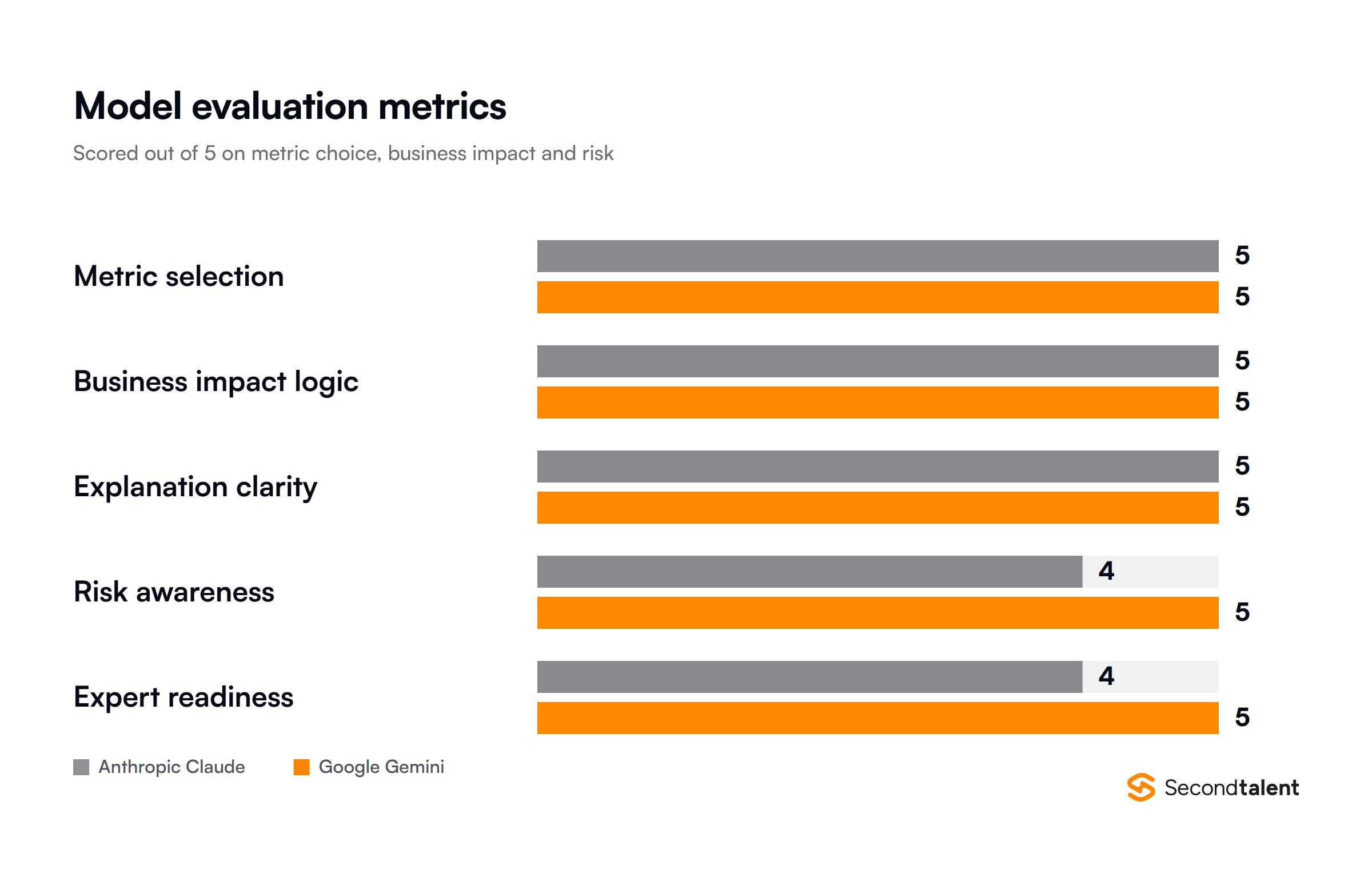
Claude selects the right metrics and clearly prioritizes recall based on business risk. The explanations of precision, recall, and AUC are simple and easy to follow. It connects false negatives to financial loss well. However, it focuses slightly more on teaching than decision reporting.
Google Gemini response:

Gemini delivers a strong, business-aligned explanation of evaluation metrics. It clearly links recall, precision, F2 score, and AUC to credit risk impact. The logic mirrors real banking risk discussions. Explanations are simple but are framed for decision-makers and model governance teams.
Final Verdict:
Both tools understand evaluation metrics well, but Gemini is better suited for expert and enterprise settings. It explains metrics through a risk management lens and aligns them with reporting needs and stakeholder decisions. Claude is excellent for learning and clarity, while Gemini fits regulated, high-risk modeling environments better.
Model Evaluation Metrics Scorecard
| Metric | Anthropic Claude | Google Gemini |
| Metric Selection | 5 / 5 | 5 / 5 |
| Business Impact Logic | 5 / 5 | 5 / 5 |
| Explanation Clarity | 5 / 5 | 5 / 5 |
| Risk Awareness | 4 / 5 | 5 / 5 |
| Expert Readiness | 4 / 5 | 5 / 5 |
Task 7. SQL for data analysis
Goal: Check SQL writing and optimization logic.
Prompt:
“ Write a SQL query to answer the question below.
Explain the logic step by step.
Table: orders
Columns: order_id, customer_id, order_date, order_value
Question:
Find total revenue and average order value per customer for 2024. “
Anthropic Claude response:

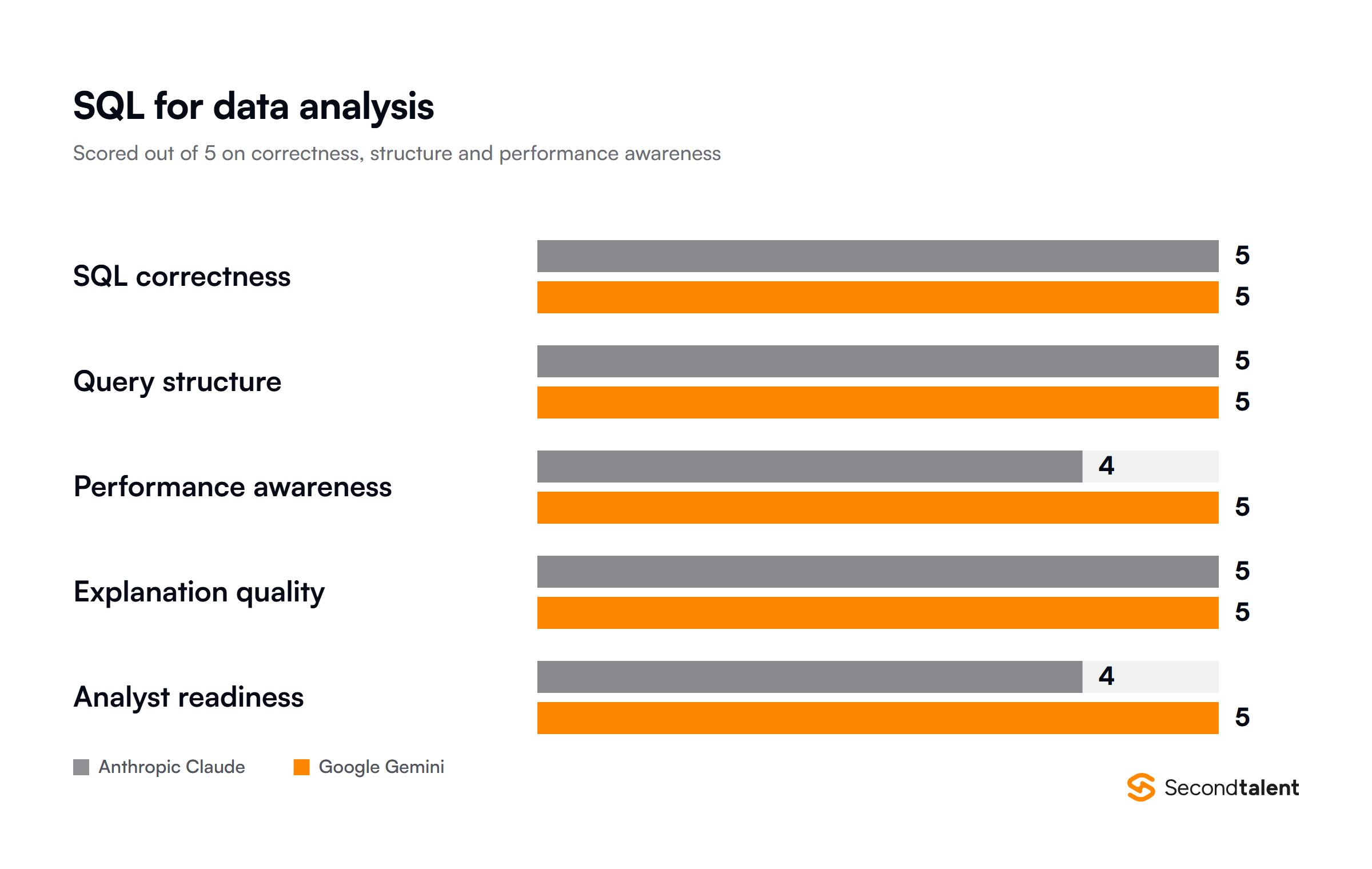
Claude writes correct and clean SQL with a clear step-by-step explanation. It explains grouping, filtering, and aggregation very well. The alternative date filter shows performance awareness. However, the query logic feels more instructional than analyst-focused, with less emphasis on real-world SQL tuning details.
Google Gemini response:

Gemini delivers production-ready SQL with strong performance awareness. It prefers index-friendly date filters and adds practical tips, such as type-casting for averages. The explanation is concise, clear, and aligned with real analytics work. This feels like how a data analyst would write and explain SQL.
Final Verdict:
For SQL-based data analysis, Gemini is the stronger choice. It combines correct syntax, clean structure, and real performance considerations that matter in large datasets. Claude is excellent for learning and clarity, but Gemini better reflects how SQL is written, optimized, and explained in real analytics and BI workflows.
SQL for Data Analysis Scorecard
| Metric | Anthropic Claude | Google Gemini |
| SQL Correctness | 5 / 5 | 5 / 5 |
| Query Structure | 5 / 5 | 5 / 5 |
| Performance Awareness | 4 / 5 | 5 / 5 |
| Explanation Quality | 5 / 5 | 5 / 5 |
| Analyst Readiness | 4 / 5 | 5 / 5 |
Task 8. Python for analysis
Goal: Test practical Python usage for data science.
Prompt:
“ Write Python code using pandas to calculate the monthly growth rate from this data.
Dummy input
Month, Revenue
Jan,100000
Feb,120000
Mar,150000
Apr,165000 “
Anthropic Claude response:

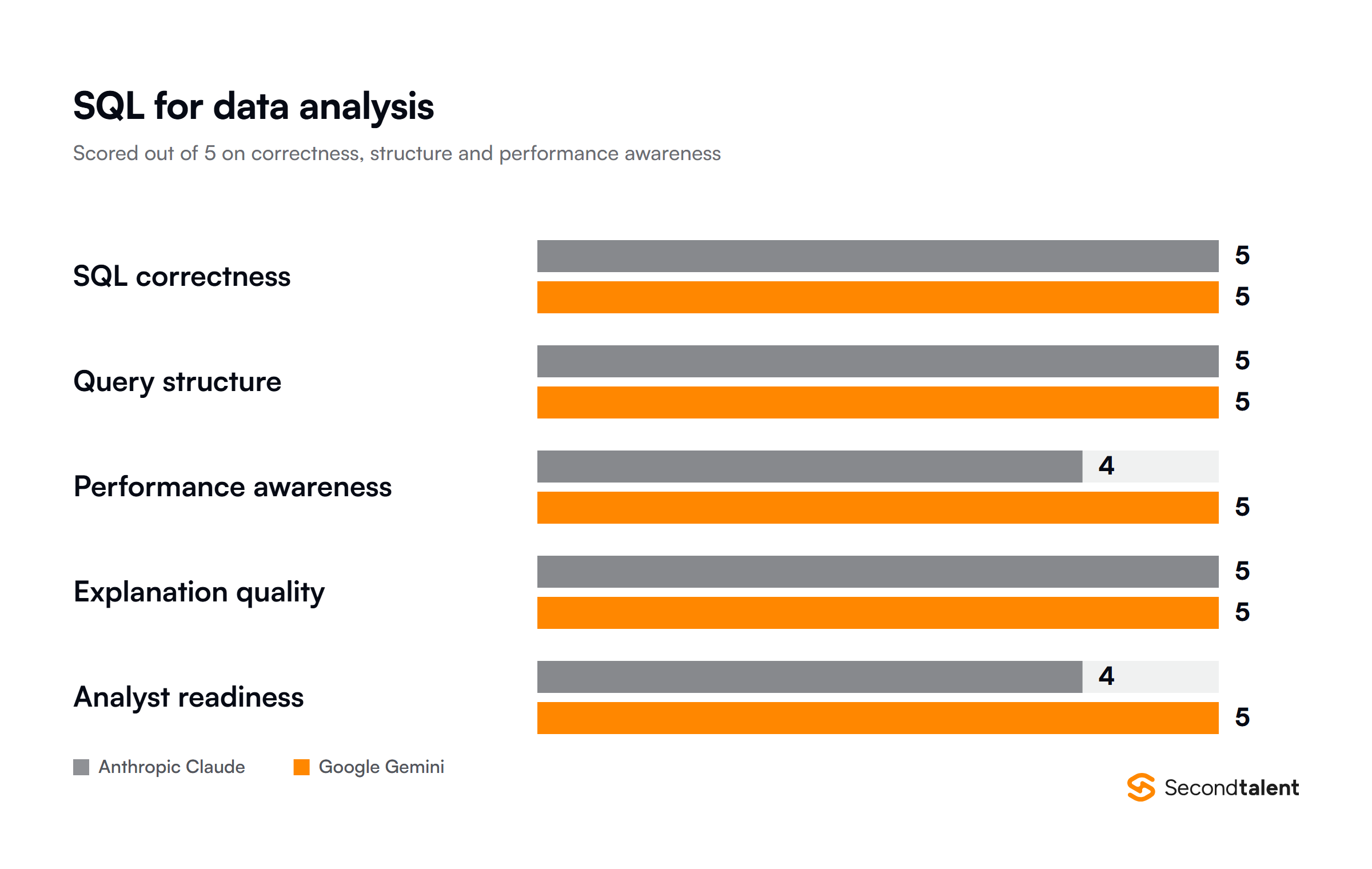
Claude writes correct and clean SQL with a clear step-by-step explanation. It explains grouping, filtering, and aggregation very well. The alternative date filter shows performance awareness. However, the query logic feels more instructional than analyst-focused, with less emphasis on real-world SQL tuning details.
Google Gemini response:

Gemini delivers production-ready SQL with strong performance awareness. It prefers index-friendly date filters and adds practical tips, such as type casting for averages. The explanation is concise, clear, and aligned with real analytics work. This feels like how a data analyst would write and explain SQL.
Final Verdict:
For SQL-based data analysis, Gemini is the stronger choice. It combines correct syntax, clean structure, and real performance considerations that matter in large datasets. Claude is excellent for learning and clarity, but Gemini better reflects how SQL is written, optimized, and explained in real analytics and BI workflows.
SQL for Data Analysis Scorecard
| Metric | Anthropic Claude | Google Gemini |
| SQL Correctness | 5 / 5 | 5 / 5 |
| Query Structure | 5 / 5 | 5 / 5 |
| Performance Awareness | 4 / 5 | 5 / 5 |
| Explanation Quality | 5 / 5 | 5 / 5 |
| Analyst Readiness | 4 / 5 | 5 / 5 |
Task 9. Business insight translation
Goal: Check how well insights turn into decisions.
Prompt:
“ Based on this data, suggest three actions a business should take.
Metric, Value
Customer acquisition cost,3200
Customer lifetime value,2800
Monthly churn rate,4.5 “
Anthropic Claude response:

Claude translates metrics into strong business actions with urgency and clarity. It clearly explains negative unit economics and ties churn, CAC, and LTV to profitability. The recommendations are concrete, prioritized, and realistic. This reads as advice from a growth or strategy leader focused on fixing fundamentals fast.
Google Gemini response:

Gemini delivers sharp, structured business reasoning grounded in standard SaaS benchmarks like LTV to CAC ratio. The actions are logical,data-backed, and easy to justify to leadership. The response feels board-ready and financially disciplined, though slightly more formal than Claude’s narrative-driven style.
Final Verdict:
Both tools perform equally well in translating business insights. Claude excels at urgency and storytelling that drive action, while Gemini shines in structured, benchmark-driven decision-making. For executives and strategy teams, Gemini feels more presentation-ready. For founders and operators, Claude’s framing may feel more motivating and direct.
Task 10. Explaining results to non-technical users
Goal: Test communication skills.
Prompt:
“ Explain the result below to a non technical manager in simple words.
Model accuracy: 82 percent
Recall for churn class: 61 percent “
Anthropic Claude response:

Claude explains the results in very simple, direct language. It avoids jargon and focuses on what the numbers mean for lost customers and money. The takeaway is clear and actionable. A non-technical manager can quickly understand the risk and why recall matters more than accuracy.
Google Gemini response:

Gemini gives a structured and business-friendly explanation using plain terms like catch rate and blind spots. It clearly separates accuracy from recall and ties both to retention actions. The explanation feels presentation-ready and easy for managers to repeat in meetings. Teams that want to push that presentation-ready output straight into a deck often pair Gemini with Google Slides AI, which lets you generate and rewrite slides directly inside the same workspace where the analysis already lives.
Final Verdict:
Both tools communicate well, but Gemini has a slight edge for non-technical audiences. Its framing, summaries, and clear labels make the message easier to absorb and reuse. Claude is very clear and direct, but Gemini feels more polished and executive-ready when explaining model results to managers.
Anthropic Claude vs Google Gemini for Data Science
| Area | Anthropic Claude | Google Gemini | 🏆 Winner |
| Data Understanding | Clear explanations and strong reasoning | Adds metrics and visuals | Gemini |
| Data Cleaning | Educational and flexible | Decisive and pipeline-ready | Gemini |
| EDA | Deeper insights and analysis | Clean but surface-level | Claude |
| Feature Engineering | Strong domain-driven features | Standard and safe features | Claude |
| Model Selection | Correct and clear logic | Better real-world tradeoffs | Gemini |
| Evaluation Metrics | Simple and accurate | Risk and business-focused | Gemini |
| SQL Analysis | Clean SQL, good teaching | Optimized and analyst style | Gemini |
| Business Insights | Action-driven and urgent | Structured and board-ready | Tie |
| Non-Technical Explanation | Very simple and direct | Polished and reusable | Gemini |
| Overall Fit | Great for reasoning and exploration | Strong for production DS | Gemini |
Final Words
This comparison shows that both Anthropic Claude and Google Gemini are capable data science assistants, but they excel in different areas.
Claude performs best in deep reasoning, exploratory analysis, feature creativity, and clear explanations. It works well when analysts need to think through problems and explore patterns.
Gemini performs better on production-focused tasks such as data cleaning, SQL analysis, model evaluation, and business reporting. Its outputs feel more structured, decisive, and ready for real pipelines.
For data science experts working on end-to-end workflows, Google Gemini is the stronger overall choice. Claude remains valuable for analysis, reasoning, and clarity during the early stages.

![Is Micro1 Legit?. Is Micro1 Legit? Pay, Reviews and How It Works [2026], by Second Talent.](https://www.secondtalent.com/wp-content/uploads/2026/09/is-micro1-legit-featured-v2-768x403.jpg)