TL;DR: Vietnam, the Philippines, Indonesia, Malaysia, and Poland give you strong developer talent at lower cost than the US, with better English or lower churn than India in most cases.
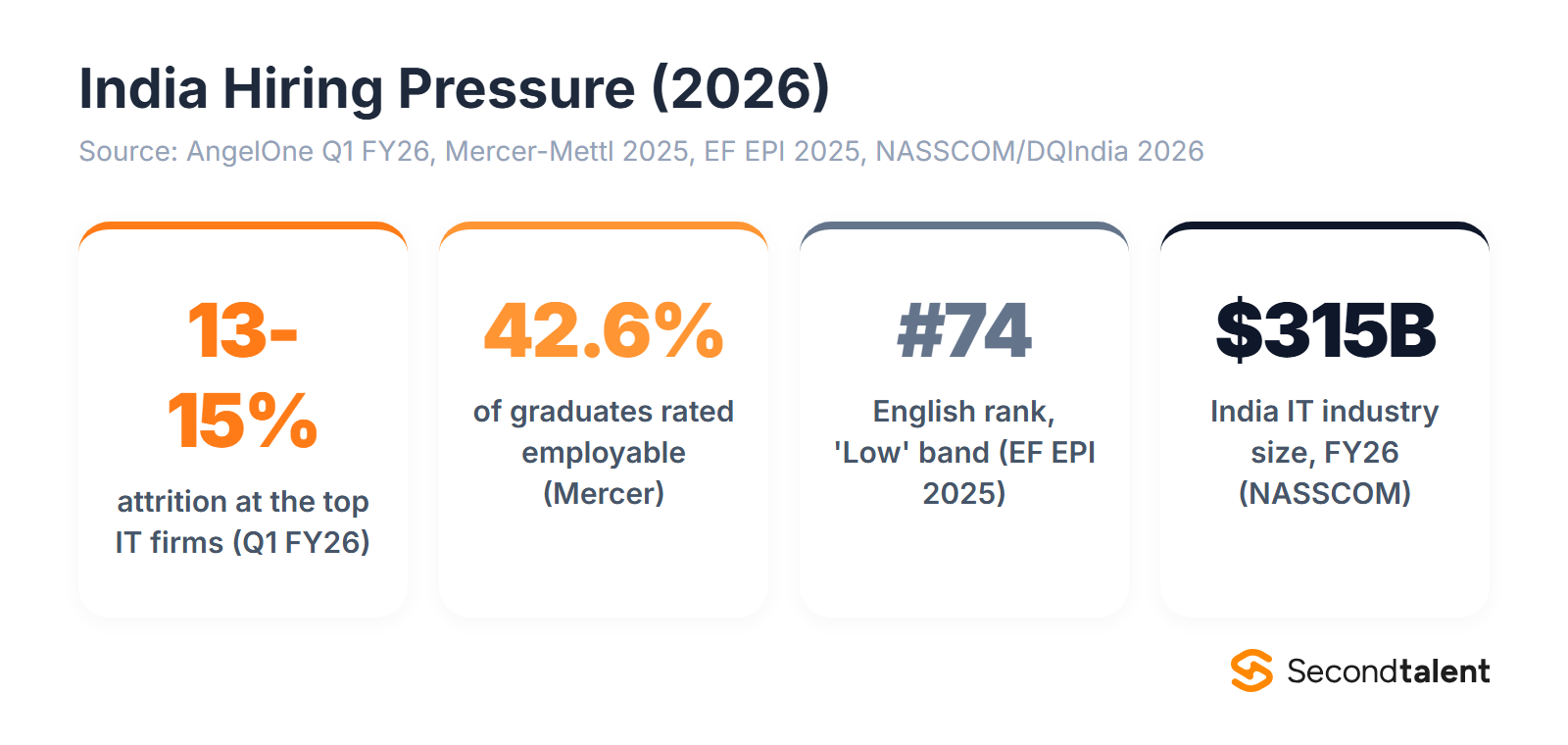
The best alternatives to India for hiring developers in 2026 are Vietnam, the Philippines, Indonesia, Malaysia, and Poland. Each one pairs senior engineering talent with a specific edge: Vietnam for backend cost, the Philippines for English, Indonesia for the lowest rates, Malaysia for compliance, and Poland for architecture. India is not a bad choice. Attrition at its top IT firms still runs 13% to 15%, only 42.6% of its graduates are rated employable, and its English proficiency sits in the “Low” band at rank #74 on the EF EPI 2025.
The smart 2026 move is “India plus one,” not replacement. India’s tech industry is still growing and crossed $315 billion in FY26. But wage inflation, quality gaps, and communication friction push teams to spread hiring across two or three markets. Here is how the top five alternatives compare.
Key takeaways
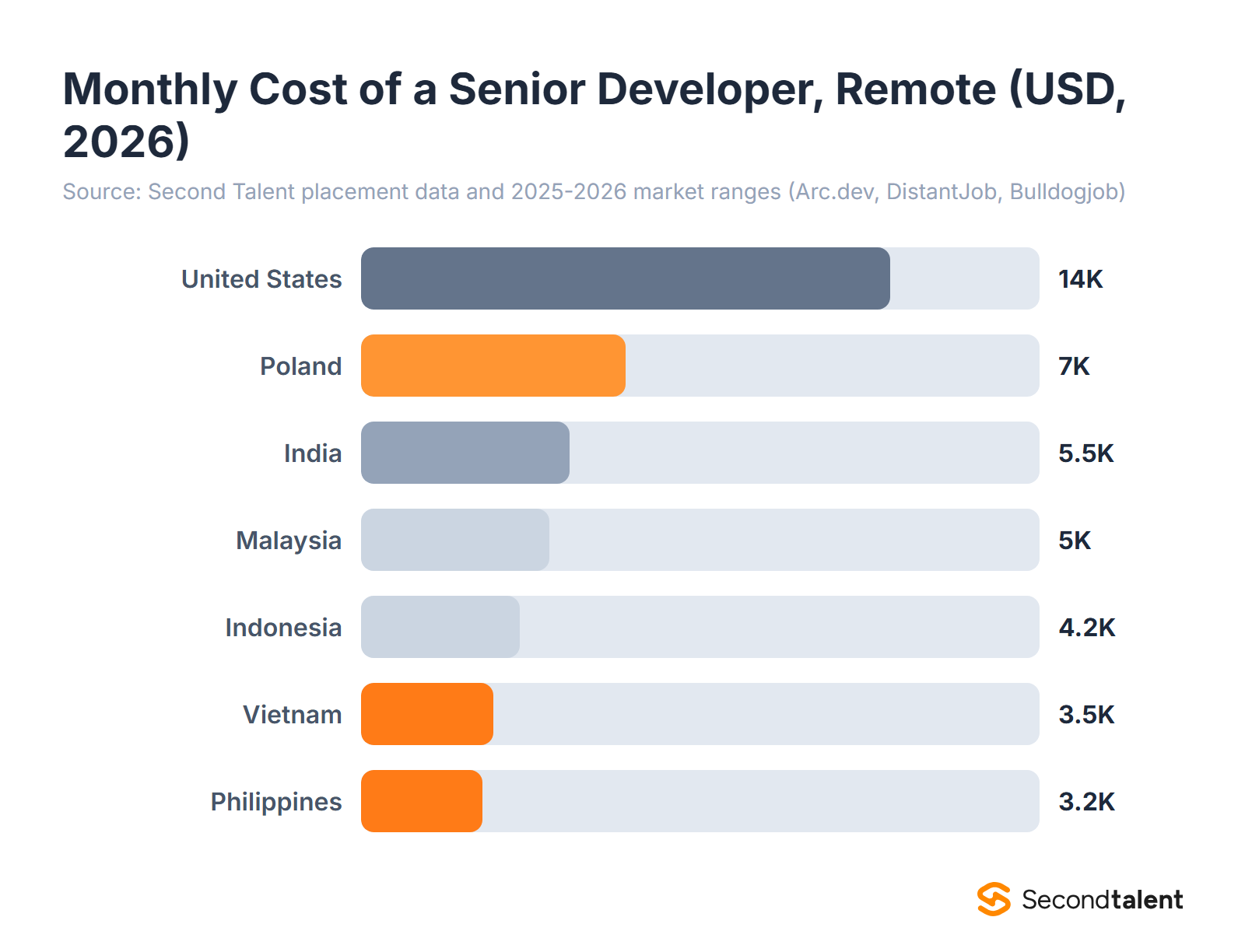
- Vietnam offers the best backend value, with senior remote developers near $3,500 per month and the fastest-rising English scores in Asia.
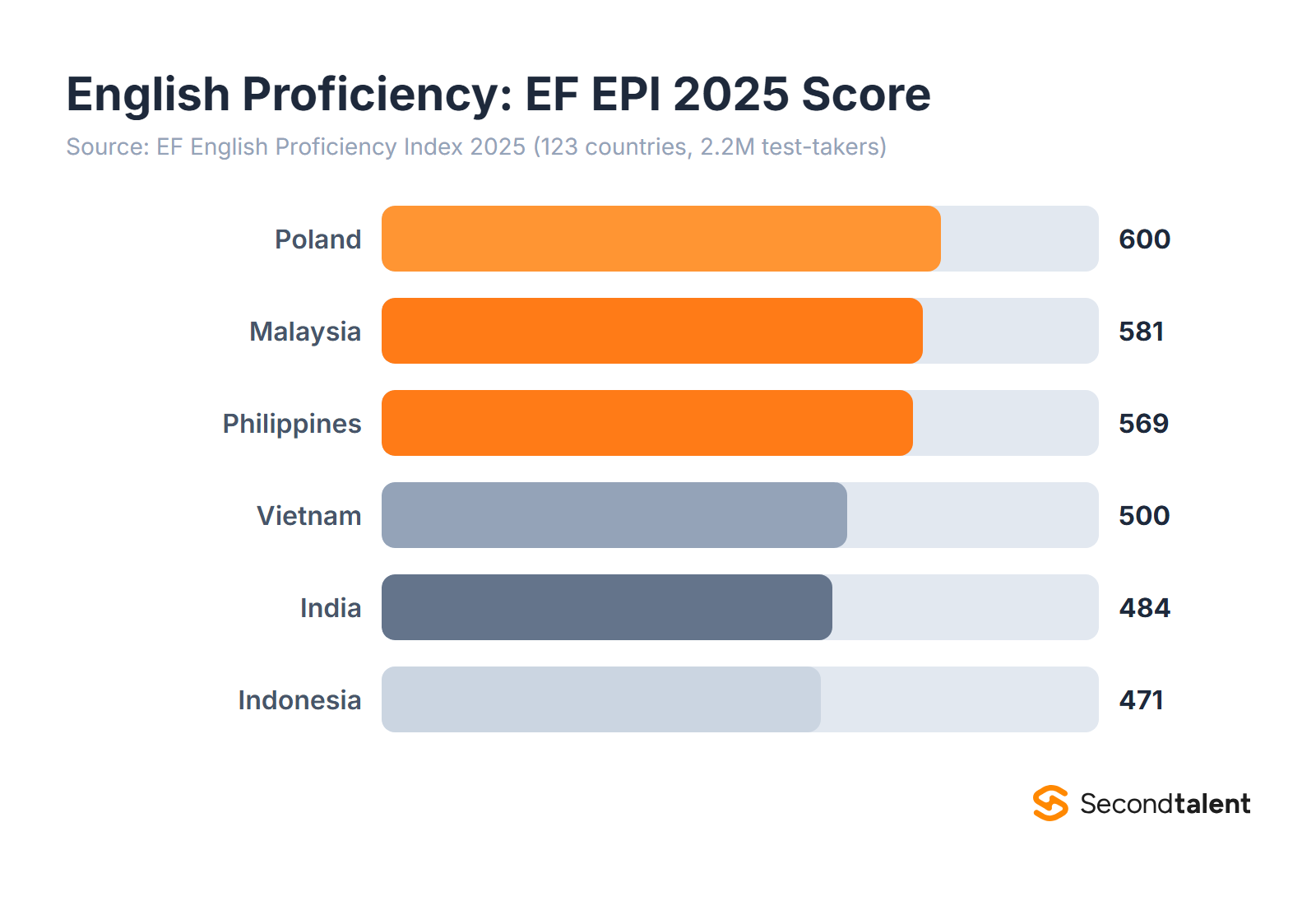
- The Philippines leads Asia on English (EF score 569, second in the region) and adds strong US time-zone overlap.
- Malaysia has the highest English proficiency of any Asian market (EF score 581) plus clean IP and compliance rules.
- Poland is the premium option: EF “Very High” band, top global coding, but senior rates near $7,000 per month.
- Treat this as India plus one. India’s IT sector still grew to $315B in FY26, so diversify hiring rather than replace it.
Full breakdown below.
| Country | Senior Dev (USD/month, remote) | Talent Pool | English (EF EPI 2025) | Key Strength |
|---|---|---|---|---|
| Vietnam | $3,000 – $4,500 | 560,000+ IT professionals | Moderate (500) | Backend and systems engineering |
| Philippines | $3,000 – $4,500 | 1.9M IT-BPM workers | High (569) | English fluency and US overlap |
| Indonesia | $3,000 – $5,000 | 6M+ digital talents | Low (471) | Lowest costs in the region |
| Malaysia | $4,500 – $6,000 | Mid-size, growing | High (581) | Compliance and IP protection |
| Poland | $6,000 – $7,500 | 600,000+ developers | Very High (600) | Architecture and EU compliance |
What is your biggest hiring challenge?
Select your situation below.
Vietnam and Indonesia deliver senior developers at $3,000 to $5,000 per month, well under US rates. Our team handles vetting and payroll so you skip the overhead. Hire developers in Vietnam →
The Philippines ranks second in Asia for English (EF score 569) and Malaysia ranks first (581). Both fit daily standups and client calls. Hire developers in the Philippines →
Vietnam and Poland run lower churn than India’s 13% to 15% top-firm attrition. A managed Employer of Record keeps contracts and retention on solid ground. See how EOR works →
Malaysia offers strong IP protection and a mature legal system for fintech and regulated work. Compare monthly rates across markets first. View the developer rate card →
Why Teams Are Diversifying Away from India
India still has the largest developer workforce in the world. GitHub counted 21.9 million developers there in 2025. Scale is not the problem. The problem is what happens after you hire.
Attrition at the big Indian IT firms ran 13% to 15% in the first quarter of FY26. TCS was 13.8%, Infosys 14.4%, and Wipro 15.1%. For a five-person startup team, that math means you lose someone most years. Retraining a replacement costs weeks of lost output each time.
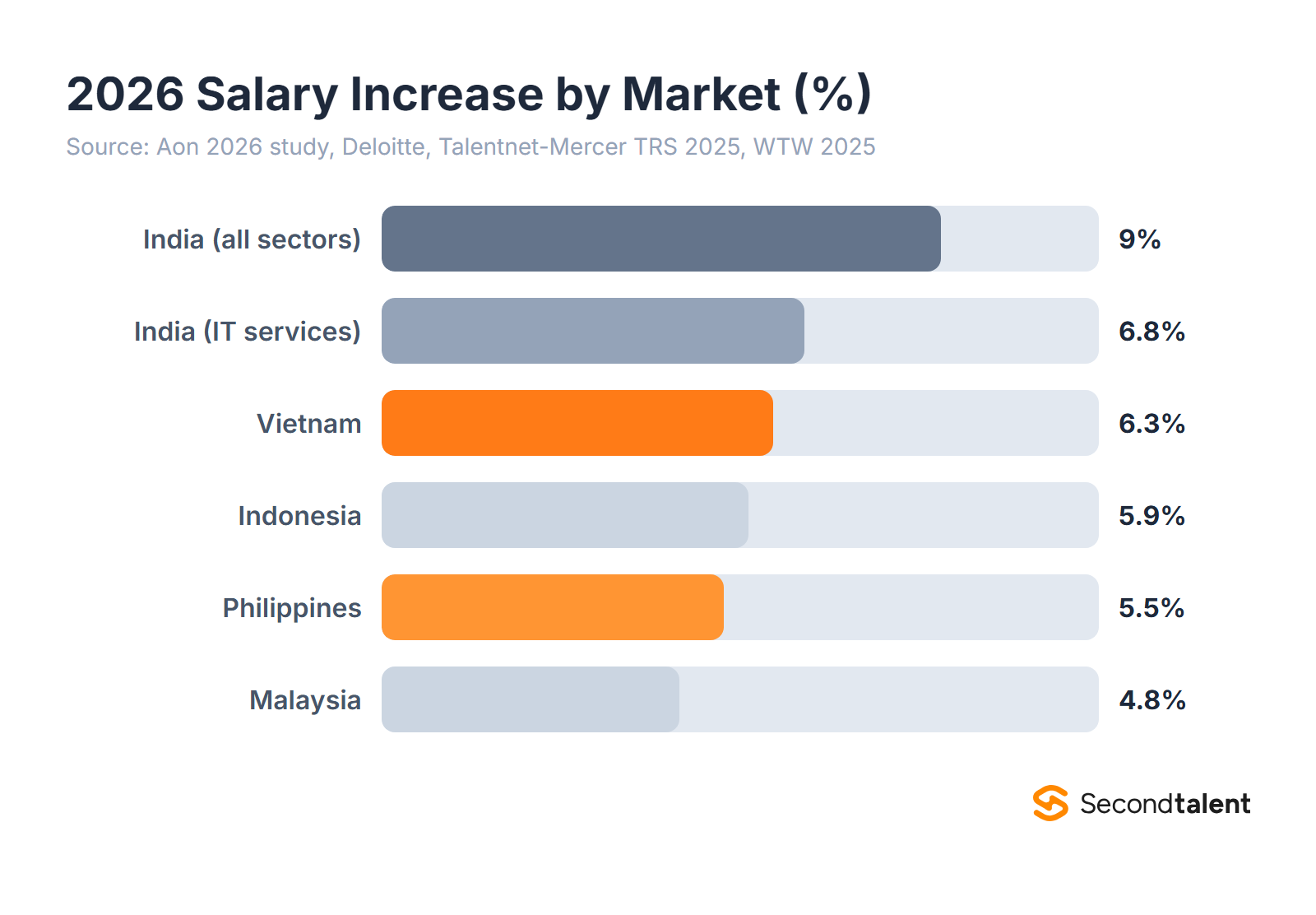
Salary inflation adds pressure. Aon projects a 9% average pay rise across India in 2026, though IT services sit lower near 6.8%. Deloitte’s own study puts the national figure at 9.1%. Quality is the other gap. Only 42.6% of Indian graduates are rated employable, down from 44.3% a year earlier. English scores also fell six points in 2025.
We worked with a Series A SaaS company that had four developers in Hyderabad. Within 18 months all four left for larger firms offering big raises. The CTO told us the real cost was not the salaries. It was the lost weeks each time someone quit. They did not leave India. They added a Vietnam team to balance the risk.
This is the pattern behind the whole shift. Very few companies pull out of India. The global capability centers there keep growing, and the talent pool is the deepest in the world. What changes is the mix. Teams that once put every engineer in one Indian city now spread the risk across two or three markets. When one market gets tight or expensive, the others keep delivery on track. That is what “India plus one” means in practice.
1. Vietnam:
Vietnam is the strongest single alternative to India for developer hiring. The numbers back this up.
The country has around 560,000 IT professionals, and its digital-tech exports grew 54% to $11.5 billion in 2024. English is improving faster here than anywhere else in the region. Vietnam gained 22 points on the EF EPI 2025 to reach a “Moderate” score of 500, the biggest jump of any market in this list.
Salary Ranges
| Role | Junior (USD/month) | Mid-Level (USD/month) | Senior (USD/month) |
|---|---|---|---|
| Backend Developer | $900 – $1,500 | $1,800 – $2,800 | $3,000 – $4,500 |
| Frontend Developer | $800 – $1,400 | $1,600 – $2,500 | $2,600 – $4,000 |
| Full-Stack Developer | $1,000 – $1,600 | $2,000 – $3,000 | $3,200 – $5,000 |
| DevOps Engineer | $1,100 – $1,700 | $2,200 – $3,200 | $3,500 – $5,200 |
| AI / ML Engineer | $1,200 – $1,900 | $2,400 – $3,600 | $3,800 – $5,500 |
Pay rises are cooling too. Vietnam’s 2025 salary increase was about 6.3%, the lowest in a decade. That means costs are more predictable when you plan a two-year budget.
Why Vietnam Works
Vietnamese developers rank near the top of Asia for programming skill. The workforce is young and grows by tens of thousands of graduates each year. Global companies like Samsung, FPT, and Bosch already run large engineering teams here, so the local talent has real product experience.
We placed a backend team of three developers in Ho Chi Minh City for a US dev-tools startup. The team shipped its first feature within three weeks. After a year, all three were still on the team. That kind of retention is harder to find in India.
The main trade-off is spoken English. Written English is usually solid. Spoken English varies. Plan for async tools like Slack and Loom. You can hire developers in Vietnam through Second Talent to reach this pool directly.
2. The Philippines:
The Philippines has one advantage no other Asian country matches at scale. English is an official language. Every developer you hire can join your standups without a language barrier.
It scores 569 on the EF EPI 2025, in the “High” band and second in Asia. The IT-BPM workforce reached about 1.9 million workers and over $40 billion in export revenue in 2025. Demand for advanced skills is climbing fast. Coursera reported a 383% year-over-year jump in generative AI course enrollments there.
Where the Philippines Shines
- Near-native English communication
- Strong overlap with US West Coast time zones (GMT+8)
- Growing demand in AI, data science, and cybersecurity
- Salary raises are stable, projected around 5.5% for 2026
- Cultural alignment with Western companies
We helped a seed-stage AI startup hire two full-stack developers in Manila. The founders said onboarding felt identical to hiring in San Francisco. No translation issues. No friction during code reviews. The developers joined sprint calls, gave demos, and wrote documentation without extra coaching.
The trade-off is cost. Filipino developers cost a little more than Vietnamese or Indonesian developers at the same level. You pay a premium for English fluency. For client-facing roles, that premium is worth it. You can hire developers in the Philippines for roles that need strong English and US overlap.
3. Indonesia:
Indonesia is the dark horse of offshore hiring. It has 280 million people, the largest population in the region. But most companies have not looked past India or Vietnam.
That is changing fast. Indonesia has around 6 million digital talents, and its digital economy is on track to grow from $100 billion in 2025 to $180 billion by 2030. The government runs a national scholarship program that trains about 400,000 new digital workers each year.
Cost Advantage
Indonesia offers the lowest developer costs in the region. Entry-level local salaries in Jakarta start low, and remote senior rates stay below most neighbors. A startup can build a small dev team here for the cost of one senior developer in the US.
What to Watch Out For
The Indonesian tech ecosystem is younger than Vietnam or the Philippines. The senior pool is smaller. Finding developers with five or more years in a specific framework takes more effort.
English is a real gap. The country scored 471 on the EF EPI 2025, in the “Low” band, though the capital Jakarta scored a “Moderate” 523. You will need async workflows and clear documentation. We placed a mobile developer in Jakarta for an e-commerce startup at a strong rate for three years of React Native work. For backend-heavy work with little client contact, Indonesia delivers real value. You can hire developers in Indonesia when budget is the top priority.
4. Malaysia:
Malaysia sits between the low-cost Asian markets and the premium European ones. It mixes strong English, cloud-native skills, and solid IP protection.
Its English is the highest of any Asian market in this list. Malaysia scored 581 on the EF EPI 2025, in the “High” band. Kearney also ranks it the third most attractive offshore destination in the world, behind only India and China. Software developers here earn $4,500 to $6,000 per month at the senior level.
Why Malaysia Stands Out
- English is widely spoken in professional settings
- Strong government support through the Malaysia Digital program
- Good IP protection compared to other Asian markets
- Tech-sector attrition of 17.1%, with the lowest salary rise in this list at 4.8%
- Cloud, AI, and cybersecurity skills are growing fast
Malaysia is more expensive than Vietnam, Indonesia, or the Philippines. But you get a more mature business environment. Legal frameworks are stronger. Its IT services market is forecast to grow from $12.3 billion in 2025 to $39.4 billion by 2030. If your startup handles sensitive data, Malaysia reduces risk.
We worked with a fintech startup that needed developers with PCI DSS experience. They started in Vietnam but switched to Malaysia for the regulatory fit. The two developers they hired in Kuala Lumpur had prior experience with local financial rules. That saved weeks of compliance training. You can hire developers in Malaysia when you need English, compliance, and a mature setup.
5. Poland:
Poland is not a low-cost option. Senior developers on business contracts earn around $7,000 per month. But that is still cheaper than the US or UK, with near-zero communication overhead.
Polish developers rank among the best coders in the world and score 600 on the EF EPI 2025, the “Very High” band and rank #15 globally. They work in EU time zones. That means real-time collaboration with European headquarters. Poland now exports more IT services than Japan or South Korea.
When Poland Makes Sense
- You need EU-compliant data handling (GDPR)
- Your team works in European time zones
- You need senior architects or tech leads, not just execution
- Quality matters more than the lowest cost
- You want developers who can lead technical decisions
Poland has 600,000 to 650,000 IT professionals, the largest pool in its region. Warsaw, Krakow, and Wroclaw are mature tech hubs. Many Polish developers have worked with US and European startups. They understand agile, CI/CD, and modern cloud infrastructure.
The trade-off is price. A senior backend developer in Warsaw costs about twice what the same role costs in Ho Chi Minh City. But the communication overhead is near zero. Polish developers join architecture discussions, challenge decisions, and propose alternatives. That is harder to find in markets where developers are trained to follow specs without question.
Poland fits a specific need. If you are hiring a tech lead who will own a system, set standards, and mentor junior engineers, the higher rate pays for itself. If you are hiring execution-focused developers to build against a clear spec, the Asian markets give you the same output for less. Match the country to the seniority of the role. Pay Polish rates for judgment and Asian rates for delivery, and your budget stretches further.
Full Comparison: India vs. Five Alternatives
| Factor | India | Vietnam | Philippines | Indonesia | Malaysia | Poland |
|---|---|---|---|---|---|---|
| Senior Developer (USD/month) | $4,500 – $6,000 | $3,000 – $4,500 | $3,000 – $4,500 | $3,000 – $5,000 | $4,500 – $6,000 | $6,000 – $7,500 |
| IT Attrition / Churn | 13–15% | Low, tight market | ~20% (national) | Moderate | 17.1% (tech) | Below 10% |
| English (EF EPI 2025) | Low (484) | Moderate (500) | High (569) | Low (471) | High (581) | Very High (600) |
| Time Zone (GMT) | +5:30 | +7 | +8 | +7 | +8 | +1/+2 |
| 2026 Salary Rise | 9% (IT 6.8%) | 6.3% | 5.5% | ~5.9% | 4.8% | 2.5–5% |
| Best For | Scale | Backend, systems | Client-facing roles | Budget-first hiring | Compliance, fintech | Architecture, EU work |
Common Mistakes When Hiring Outside India
We see startups make the same errors when they first add a new market.
Mistake 1: Choosing Only on Cost
The cheapest developer is rarely the best value. A low-rate developer who needs constant supervision costs more than a mid-rate developer who works alone. Factor in communication overhead, code review time, and ramp-up.
Mistake 2: Ignoring Time Zones
A four-hour overlap with your team is the minimum for good collaboration. If you are in the US, Asia gives you early-morning overlap. Poland gives European teams afternoon overlap. Plan your sprint rituals around these windows.
Mistake 3: Hiring Without Local Knowledge
Job boards in Vietnam work differently than in the Philippines. Salary norms vary. Labor laws affect contracts. Work with a partner who knows the local market. It saves time and reduces hiring failures.
How Second Talent Helps
We recruit developers across all five markets here. Our team is based in Asia. We vet candidates for technical skill, English, and cultural fit before you see a shortlist. Because we work in each country, we know the local salary norms, the strong universities, and the labor rules that shape contracts. That local knowledge is what keeps a hire from falling apart in month three.
We also run an Employer of Record service. You do not need a legal entity in Vietnam or the Philippines. We handle payroll, compliance, and benefits. You focus on building your product. For exact numbers, check our developer rate card or the Asia Tech Salary Index.
The Bottom Line
India is not a bad choice. It has the largest talent pool in the world and a growing $315 billion tech industry. But it is no longer the automatic default. Attrition, wage inflation, and quality gaps have narrowed its edge.
Vietnam offers the best overall value. The Philippines leads on English. Indonesia wins on pure cost. Malaysia adds compliance and business maturity. Poland delivers European quality at a fraction of US prices.
The best approach for most startups is to diversify. Do not put all your developers in one country. Build across two or three markets. Use each for what it does best. When you are ready to start, tell us what you need → and we will match vetted developers in 24 hours.



![Workplace Diversity Statistics. Top 100+ Workplace Diversity Statistics [2026], by Second Talent.](https://www.secondtalent.com/wp-content/uploads/2026/09/workplace-diversity-statistics-featured-v2-768x403.jpg)

![Tech Industry Hiring Statistics. Top 50+ Tech Industry Hiring Statistics: Salaries, Skills Demand [2026], by Second Talent.](https://www.secondtalent.com/wp-content/uploads/2026/09/tech-industry-hiring-statistics-featured-v2-768x403.jpg)