TL;DR: China's AI race entered a new phase in 2026: Zhipu AI (now Z.ai) and MiniMax both went public in Hong Kong, DeepSeek is reportedly raising its first outside funding at a $71 billion valuation, and Moonshot AI's Kimi more than tripled in value to $35 billion, all on top of a core AI industry that topped $173.9 billion in 2025.
In early 2025, a relatively unknown Chinese AI company called DeepSeek sent shockwaves through Silicon Valley. Its open-source model, DeepSeek-R1, matched or exceeded the performance of GPT-4 and Claude while costing significantly less to develop. Within days, it surpassed ChatGPT as the most downloaded app on the iOS App Store in the United States, triggering an 18% drop in Nvidia’s share price.
Private money followed. Stanford HAI’s AI Index 2026 counts $12.41 billion of private investment in Chinese AI companies in 2025, up 32.2% on 2024 and second only to the US. In June 2026 DeepSeek itself closed its first outside round, about 50 billion yuan, at a valuation above 350 billion yuan.
In this article, you will get to know the 10 most promising Chinese AI startups positioned to dominate 2026, their unique innovations, funding trajectories, and how they’re reshaping industries from healthcare to autonomous driving.
Comparative Analysis: The Chinese AI Startup
| Company | Valuation | Primary Focus | Key Differentiator | Target Market |
|---|---|---|---|---|
| DeepSeek | ~$71B (in talks) | Cost-efficient LLMs | MIT-licensed V4 models, nearing first outside funding | Global, developers |
| Moonshot AI | $35B | Long-context, agentic AI | Kimi K2.6 agent-swarm architecture, valuation up 10x in 2026 | Enterprise, professionals |
| Minimax | ~$10.8B (public, HKEX) | Consumer AI | Global reach with Talkie chatbot; Hong Kong-listed since Jan 2026 | Global consumers |
| Zhipu AI (Z.ai) | $100B+ (public, HKEX) | Foundational models | First “Six Tiger” IPO; stock up ~1,500% since debut | Enterprise, government |
| 01.AI | N/A | Enterprise AI infrastructure | Pivoted to “China’s Palantir”; fine-tunes open models | Enterprise, cross-border |
| Baichuan | N/A | AI healthcare | Pivoted fully from general LLMs to vertical healthcare AI | Healthcare providers |
| Stepfun | ~$2.5B raised (2026 round) | Multimodal AI | 11+ models across modalities; restructured for HK IPO | Enterprise |
| Infinigence AI | $251M+ raised | AI infrastructure | Heterogeneous computing, chip flexibility | Cloud providers, enterprises |
| ByteDance | Public | Consumer chatbot | Doubao leads China with 345M monthly active users | Mass market |
| Baidu | Public | Search + AI | Open-source Ernie 4.5 family; Ernie 5.0 unified multimodal model | Enterprise, developers |
The Top 10 Chinese AI Startups
1. DeepSeek:
Focus: Large Language Models & Cost-Efficient AI
2026 Valuation: In talks for its first-ever outside funding round at roughly $71 billion
Annualized Revenue: $400-500 million
Latest Model: DeepSeek V4 (April 2026); R2 still unreleased
DeepSeek’s disruption didn’t stop with R1. In April 2026 the company shipped DeepSeek V4 in Pro and Flash variants, both released under an MIT license with a 1 million token context window, while the long rumored R2 reasoning model still hasn’t shipped. Reports point to founder Liang Wenfeng holding it back over performance concerns. DeepSeek’s annualized revenue has climbed to roughly $400-500 million, and the company is reportedly negotiating its first-ever outside funding round at a valuation near $71 billion, with an IPO filing possible as early as late 2026 or 2027. The original R1 release still forced competitors like ByteDance, Tencent, Baidu, and Alibaba to cut prices on their own AI models.
Why it matters for business leaders: DeepSeek proves that cutting-edge AI doesn’t require massive budgets. This democratization of AI technology means even mid-sized companies can now access enterprise-grade AI capabilities. For HR leaders building AI teams, DeepSeek’s approach demonstrates the value of efficiency-focused engineering talent.
2. Moonshot AI:
Focus: Long-context AI chatbots & agentic models
Valuation: $35 billion (July 2026)
Key Product: Kimi K2.6, a 1 trillion-parameter model with a 262,000-token context window
Moonshot AI’s valuation has climbed sharply through 2026, from roughly $3.3 billion to $20 billion in May and then to $35 billion in July, on the strength of Kimi K2.6. Released in April 2026, the model is a 1 trillion-parameter Mixture-of-Experts system with a 262,000-token context window and an Agent Swarm architecture that can coordinate up to 300 specialized sub-agents, and it’s now the second-most-used LLM on the OpenRouter distribution platform.
Backed by tech giants Alibaba and Tencent, Moonshot’s annual recurring revenue passed $200 million in April 2026, and the company is now in early talks with Goldman Sachs and CICC about a Hong Kong IPO that could raise roughly $1 billion. For businesses dealing with legal documents, research papers, or extensive reports, Moonshot’s technology continues to offer practical solutions for document analysis and knowledge extraction.
3. Minimax:
Focus: Consumer-facing AI applications
Status: Public on the Hong Kong Stock Exchange since January 2026
Market Value: ~$10.8 billion (July 2026)
Key Product: Talkie companion chatbot
Founded by AI veteran Yan Junjie, Minimax stands out as one of the most successful consumer-facing Chinese AI startups in the global market. Its flagship product, Talkie, is a companion chatbot available worldwide. MiniMax went public on the Hong Kong Stock Exchange in January 2026, raising roughly $538 million; shares more than doubled on debut, and the company’s market value has held above $10 billion through the middle of 2026.
Minimax’s strategic pivot is particularly noteworthy. The company has shifted from costly foundational model training to building consumer-facing applications on top of existing models. This pragmatic approach reduced operational costs while accelerating time-to-market, a valuable lesson for startups navigating the AI landscape.
4. Zhipu AI (Z.ai):
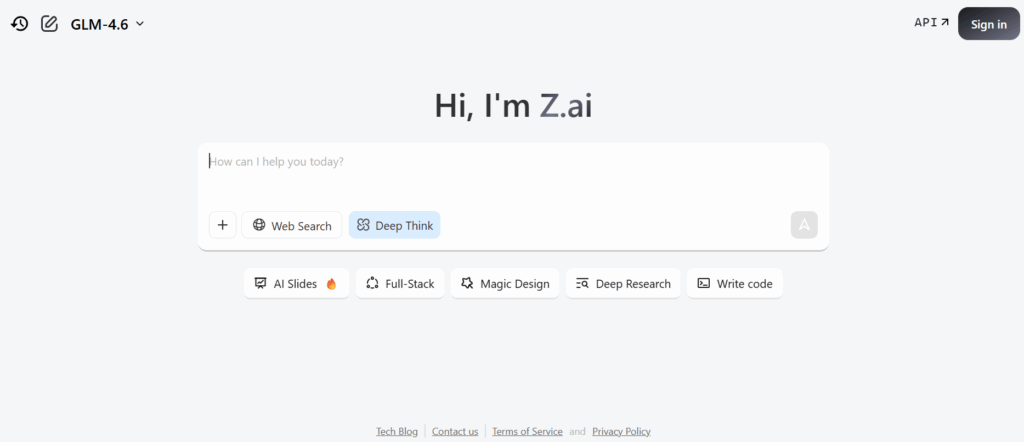
Focus: Foundational models and AI products
Status: Public on the Hong Kong Stock Exchange since January 8, 2026
Market Cap: Over $100 billion (July 2026)
Key Products: GLM model family, Ying (video generator)
Originating from Tsinghua University, Zhipu AI (marketed internationally as Z.ai) became the first of China’s so-called “Six AI Tigers” to go public, listing in Hong Kong on January 8, 2026 and raising about $560 million. The stock has since surged roughly 1,500%, briefly pushing the company’s market value past $160 billion in June before settling above $100 billion, and Zhipu is now pursuing a further $4 billion secondary share sale.
Zhipu’s public listing signals the maturation of China’s AI startup ecosystem, and its post-IPO rally shows just how much investor appetite there is for homegrown foundation-model companies. For business leaders, Z.ai’s GLM models remain a strong choice for firms bridging academic research and commercial applications, now backed by the stability of a public balance sheet.
5. 01.AI: Kai-Fu Lee’s Pivot to Enterprise AI Infrastructure
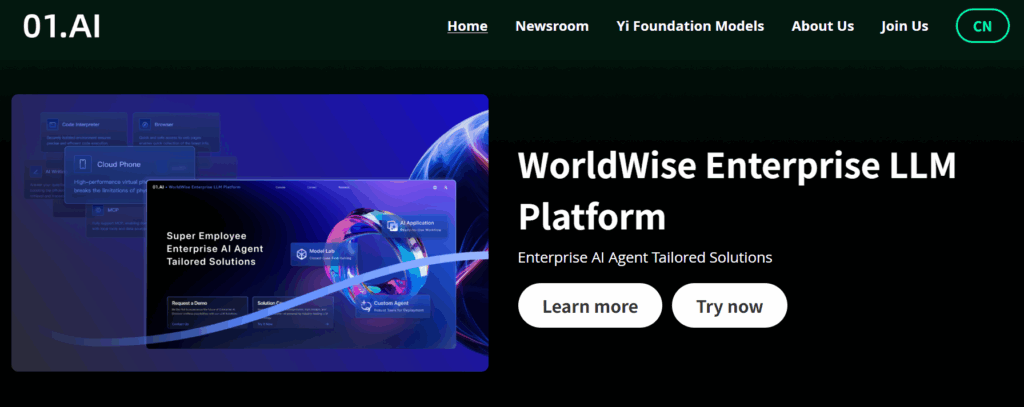
Founded: July 2023
Founder: Kai-Fu Lee (former Google China president)
Focus: Enterprise AI data infrastructure, branded “China’s Palantir”
IPO Target: Hong Kong, 2027
01.AI has pivoted away from the frontier-model race entirely. Rather than training its own large language models the way it did with the Yi series, the company now fine-tunes and packages open-weight models from DeepSeek, Alibaba’s Qwen, and Zhipu’s GLM into enterprise data infrastructure, positioning itself as “China’s Palantir.” Roughly half of its revenue now comes from outside China, and 2025 revenue reportedly grew several-fold year over year. Its earlier retail play, AI-generated live-streaming that cut hosting costs for stores by up to 90%, is now one product line within that broader enterprise platform rather than the company’s core bet.
This shift from model-builder to infrastructure and applications layer reflects a broader trend among second-tier Chinese AI labs. Rather than keep burning cash competing head-on with DeepSeek and the “Six Tigers” on raw model performance, 01.AI is targeting a 2027 Hong Kong IPO on the strength of enterprise deployments like its Wanzhi 2.5 multi-agent platform.
6. Baichuan Intelligence:
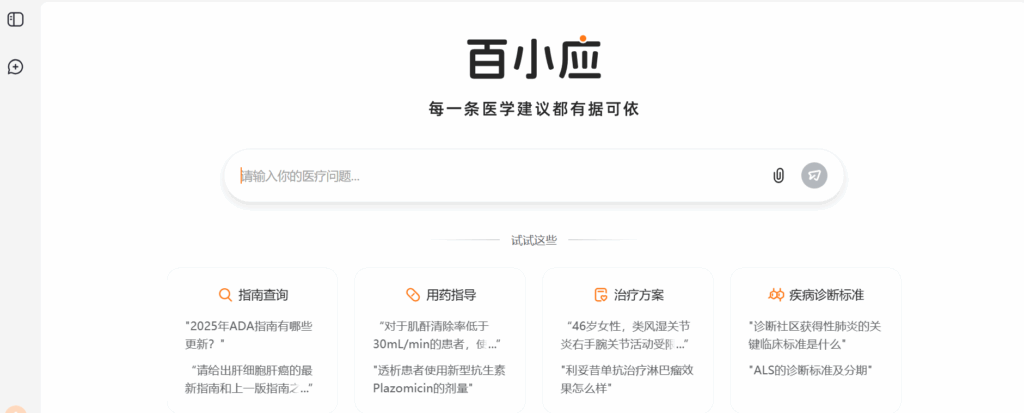
Founded: March 2023
Funding: ~$700 million Series A (Alibaba, Tencent, Xiaomi)
Focus: AI healthcare, pivoted away from general-purpose LLMs
IPO Target: 2027
Baichuan Intelligence assembled a dream team of talent from Microsoft and Chinese tech giants including Huawei, Baidu, and Tencent, and it made its name with the open-source Baichuan-7B and Baichuan-13B models. In 2026, founder Wang Xiaochuan confirmed the Beijing-based company is abandoning the general-purpose large model race entirely to focus exclusively on AI healthcare.
That pivot is a deliberate bet that a narrower, vertical focus beats competing head-on with better-funded generalist labs. For healthcare providers and health-tech companies, Baichuan’s shift means a dedicated AI partner rather than a general-purpose model vendor without vendor lock-in, backed by a ~$700 million Series A and a target Hong Kong IPO in 2027.
7. Stepfun:
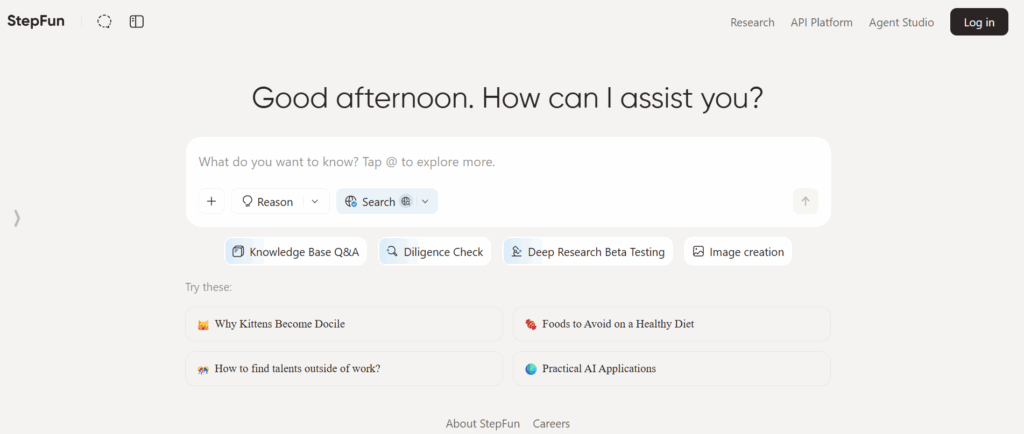
Founded: April 2023
Founder: Jiang Daxin (former Microsoft senior vice president)
2026 Funding: ~$2.5 billion round closed, restructured for a Hong Kong IPO
Portfolio: 11+ foundational AI models
Despite emerging relatively late on the AI startup scene, Stepfun has quickly become a contender and one of China’s “Six AI Tigers.” With backing from Tencent and Shanghai’s government, the firm has released 11 foundational AI models spanning language, visual, video, audio, and multimodal systems.
In 2026, StepFun closed a roughly $2.5 billion funding round and dismantled its VIE corporate structure, converting from a limited liability company into a joint-stock company, a standard preparatory step toward a Hong Kong IPO. Its Step-2 model’s 1 trillion-plus parameter count keeps it competitive with China’s largest models, and this multi-modal portfolio approach makes Stepfun an attractive partner for enterprises seeking integrated AI solutions rather than point solutions.
8. Infinigence AI:
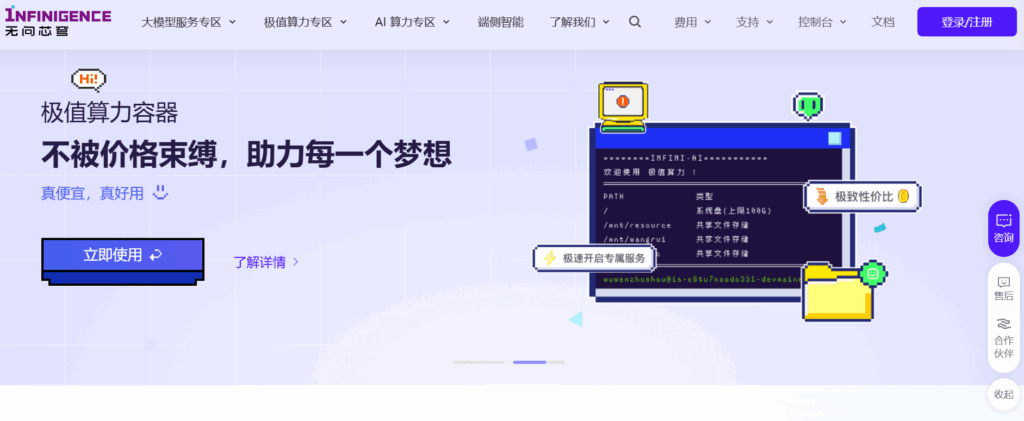
Founded: 2023
Funding: $251+ million raised to date, latest round closed in 2026
Focus: AI infrastructure and heterogeneous computing
Key Innovation: Multi-brand chip integration
Unlike most AI startups focused on model development, Infinigence AI tackles the infrastructure layer. The company’s main selling point is its ability to combine chips from different brands successfully to execute AI tasks, forming “heterogeneous computing clusters.”
This capability directly addresses challenges from US chip sanctions, making Infinigence strategically important for China’s AI ecosystem. For businesses operating in complex regulatory environments or seeking to optimize computing costs, Infinigence’s approach to hardware flexibility offers valuable resilience.
9. ByteDance (Doubao):
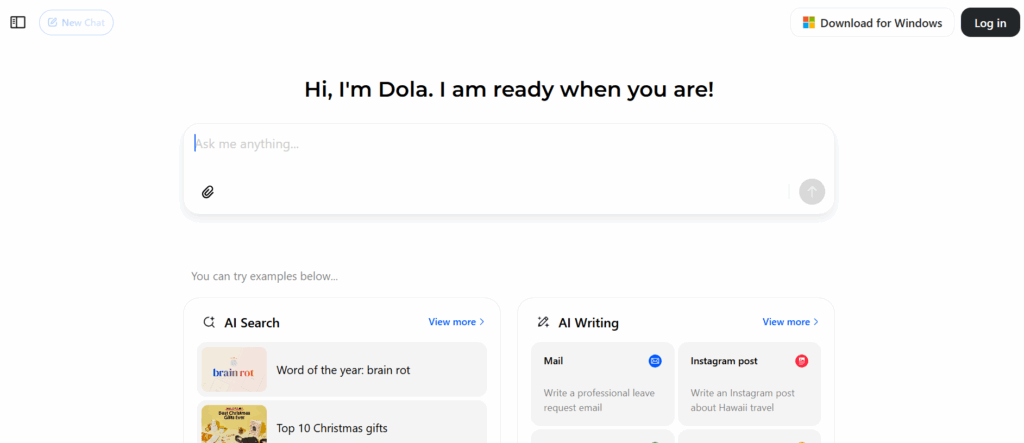
Parent Company: ByteDance (TikTok owner)
Key Product: Doubao, China’s most-used AI chatbot with 345 million monthly active users
Recent Launch: Doubao-Seed 2.1 (June 2026)
Scale: Over 200 million daily active users since early 2026
ByteDance, the powerhouse behind TikTok, has leveraged its massive user base and technical infrastructure to make Doubao China’s most-used AI assistant by a wide margin, with 345 million monthly active users by March 2026, well ahead of Alibaba’s Qwen (166 million) and DeepSeek (127 million). The company shipped a major architecture upgrade, Doubao-Seed 2.0, in February 2026, followed by Seed 2.1 in June, both built for the “agent era” of AI that executes real-world tasks rather than only answering questions.
ByteDance’s advantage lies in its distribution channels and ecosystem integration. With hundreds of millions of users across its platforms, ByteDance can rapidly deploy AI features and gather real-world usage data at scale. For businesses looking to hire AI developers with experience in large-scale systems, platforms like Second Talent can connect you with professionals who understand these complex environments.
10. Baidu (Ernie):
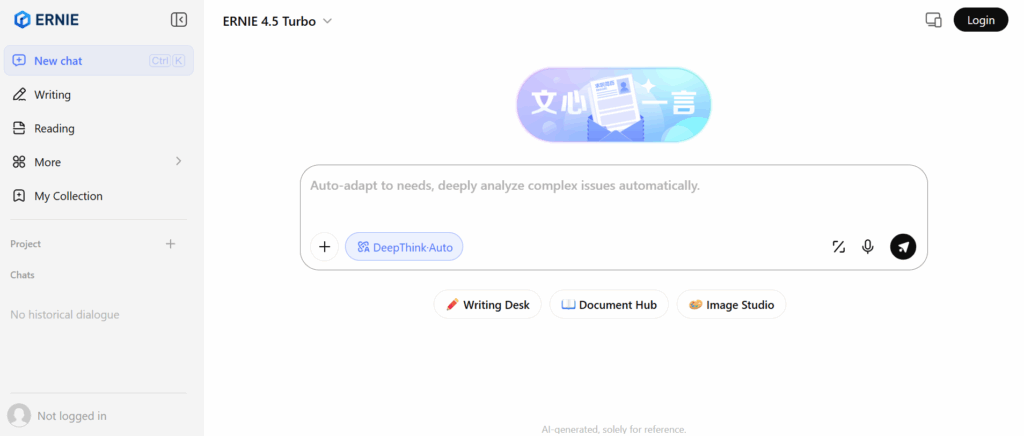
Company Type: Established tech giant (included for strategic importance)
Key Products: Ernie 4.5 (open source), Ernie 5.0 (2.4 trillion-parameter unified multimodal model)
Strategic Shift: Open-sourced the full Ernie 4.5 family, 10 model variants, under Apache 2.0 on June 30, 2025
While technically not a startup, Baidu’s aggressive AI pivot makes it essential to watch in 2026. The company followed through on its 2025 promise, open-sourcing the entire Ernie 4.5 family, ranging from a 0.3 billion-parameter dense model up to a 424 billion-parameter mixture-of-experts model, under an Apache 2.0 license. In 2026, Baidu went further with Ernie 5.0, a 2.4 trillion-parameter unified multimodal model trained from scratch to handle text, image, video, and audio in a single framework, a major strategic shift after DeepSeek’s rise.
Baidu’s open-source commitment could accelerate innovation across China’s AI ecosystem, providing startups and enterprises with powerful foundational models. For business leaders, this means increased options and competitive pricing for AI implementations.
Investment Trends
The rounds got larger in 2026. Moonshot AI raised $3.5 billion at a $35 billion valuation in July, with China’s national AI fund among the leads, and StepFun raised nearly $2.5 billion in May ahead of a Hong Kong listing.
The state is a growing investor. The National AI Industry Investment Fund was set up in January 2025 with 60.06 billion yuan, and government-linked investors did more than 140 AI deals in 2025, up from fewer than 10 a year before 2018, according to PitchBook data reported by Fortune.
Startup Ecosystem Maturation
Public markets opened up too. Zhipu AI and MiniMax listed in Hong Kong in January 2026, and Zhipu’s market value passed HK$1 trillion on June 22. For a deeper breakdown of where this capital is flowing, see our full rundown of Chinese AI investment statistics.
Conclusion:
As these startups continue to evolve and compete on the global stage, they’re creating opportunities for businesses worldwide. Whether you’re looking to implement AI solutions, build technical teams, or understand emerging technologies, keeping these Chinese AI innovators on your radar is essential for staying competitive.
Ready to scale your engineering team with world-class AI talent? Hire vetted remote developers with Second Talent to access top-tier AI engineers, data scientists, and full-stack developers who can help you implement cutting-edge AI solutions faster. Our rigorous vetting process ensures you work with professionals who have proven expertise in the technologies shaping the future.



![Singapore AI Companies Leading Southeast Asia. Top 10 Singapore AI Companies Leading Southeast Asia [2026], by Second Talent.](https://www.secondtalent.com/wp-content/uploads/2026/09/singapore-ai-companies-featured-v2-768x403.jpg)
![AI Recruiting Tools. Top 7 AI Recruiting Tools in 2026 [Tried & Tested], by Second Talent.](https://www.secondtalent.com/wp-content/uploads/2026/09/top-ai-recruiting-tools-featured-v2-768x403.jpg)