
TL;DR: Southeast Asian startups raised $12.8bn across 178 equity rounds in the first seven months of 2026. Capital is up 137% year on year and the number of companies raising it is down 30%, so the average round went from $21m to $72m.
Every quarter a founder shows me a regional funding headline and asks whether the market has turned.
The 2026 headline says capital is up 137%. The line underneath it says the number of companies raising that capital fell 30%. This report reconciles the two, then works out what each one changes about a hiring plan.
Three of the five largest rounds of the past two years are data center or AI infrastructure, and two of those are not Southeast Asian operating businesses at all. The consumer economy underneath kept growing 15% a year to $300bn of GMV.
For anyone building here, that combination argues for revenue on the round you already closed and engineering capacity bought at local cost.
The numbers at a glance
| Measure | 2025 | 2026 | Direction |
|---|---|---|---|
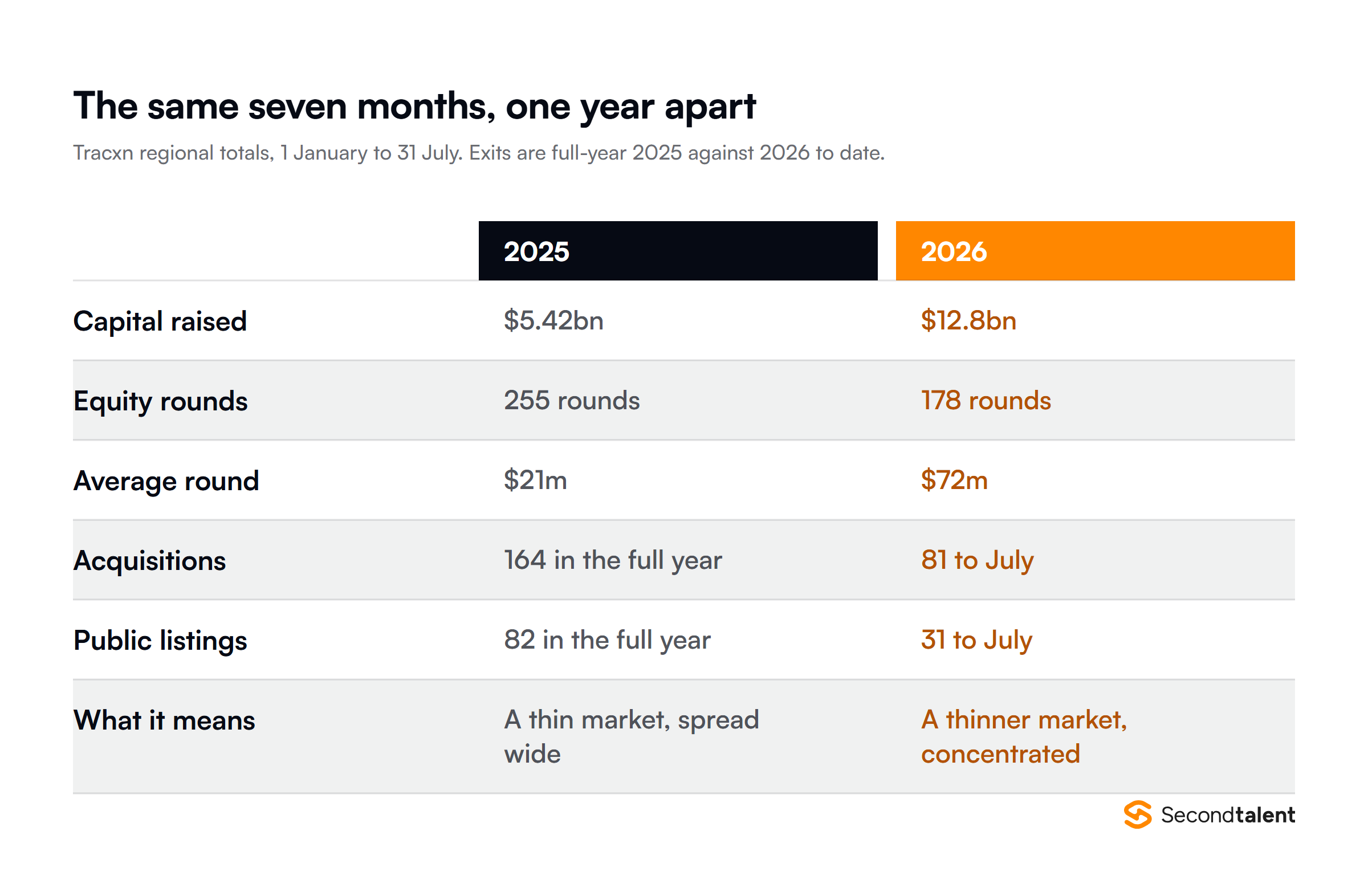
| Capital raised, January to July | $5.42bn | $12.8bn | Up 137% |
| Equity rounds, January to July | 255 | 178 | Down 30% |
| Average round size | $21m | $72m | Up 3.4x |
| Acquisitions | 164 in the full year | 81 to July | Flat |
| Public listings | 82 in the full year | 31 to July | Slowing |
| Unicorns created to date | 58 at mid-2025 (DealStreetAsia) | 67 (Tracxn) | Different definitions |
The five things that decide this
- Capital rose 137% and rounds fell 30%. The market got smaller and the checks got bigger.
- Three of the five biggest rounds are data center or AI infrastructure, not operating startups.
- Singapore booked two thirds of first-half 2025 capital and 60%+ of deals, much of it funding assets elsewhere.
- Consumer demand kept growing 15% a year to $300bn of GMV while venture capital pulled back.
- Plan for revenue on the round you have, and buy engineering capacity where it is cheapest.
Capital is up. The number of funded companies is down.
Both are true, and the second matters more if you are the company raising. Tracxn counts $12.8bn across 178 equity rounds between January and July 2026, against $5.42bn across 255 rounds in the same window of 2025.
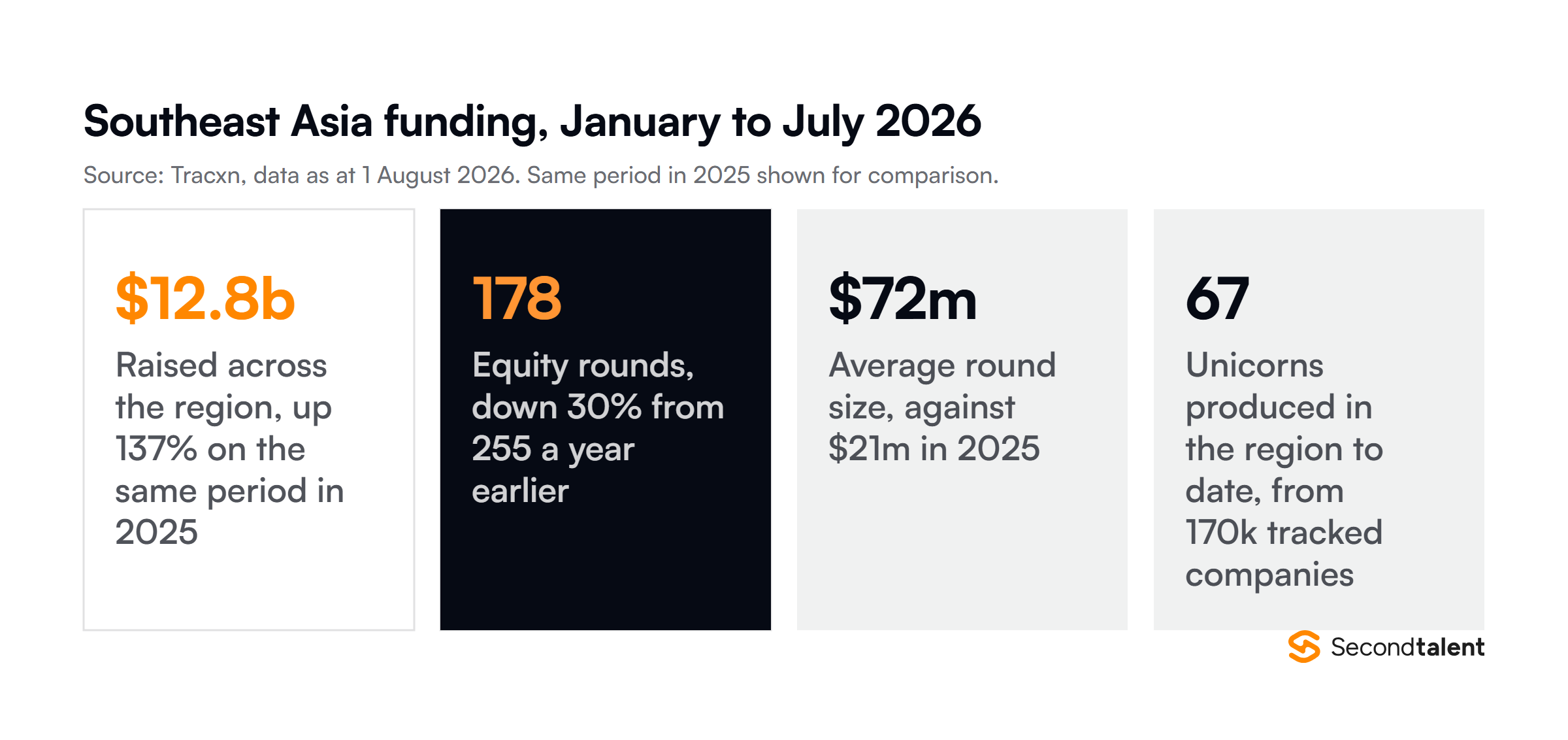
The average round went from $21m to $72m. A 3.4x jump in check size alongside a 30% drop in check count is a market where a small number of companies clear a high bar and the rest do not get to the table.
For the companies that do not get to the table, Singapore offers a route that does not depend on a venture round.
Enterprise Singapore’s Enterprise Financing Scheme lets an SME borrow up to S$500,000 in working capital through participating banks, with the agency sharing the default risk, provided the company has at least 30% local shareholding.
Bizsquare’s guide to government funding and business support resources in Singapore sets that loan scheme next to the Startup SG programs, the Enterprise Development Grant and the tax incentives open to local SMEs.
DealStreetAsia counts the same market quarterly, which shows the shape at a finer grain.
Q1 2026 brought $2.81bn across 98 equity deals, the lowest quarterly deal count in at least eight years, and a single round carried more than 70% of the capital.
Read the megadeals before you read the total
Five rounds carry most of two years of regional funding, and three of them are physical or AI infrastructure rather than operating startups. Two are not Southeast Asian businesses in any operating sense.
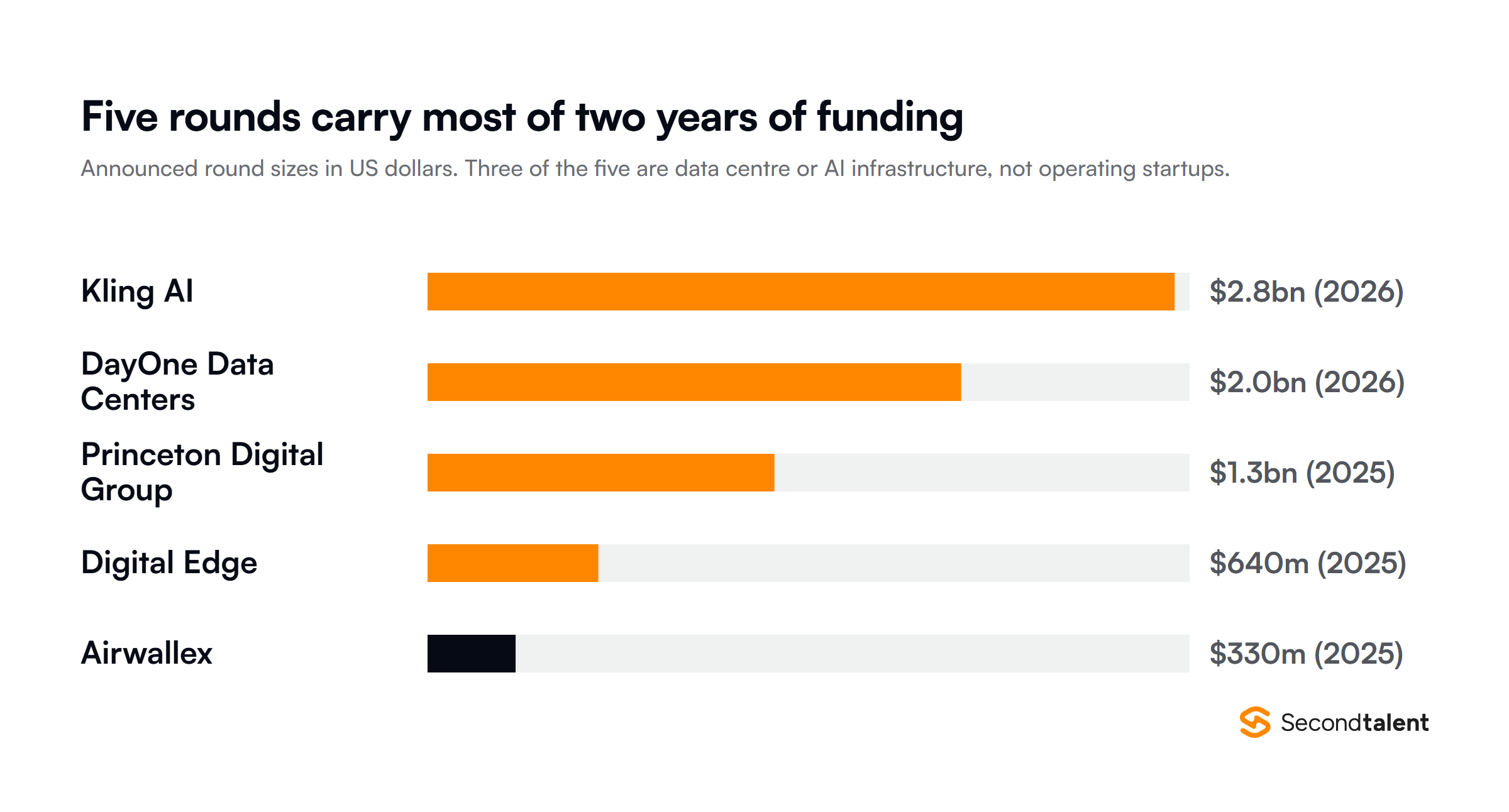
DayOne Data Centers announced over $2bn in Series C financing on 5 January 2026. It is Singapore-headquartered and it is a spin-out of Shanghai-listed GDS Holdings, building capacity in Finland, Johor, Batam, Thailand and Japan.
Kling AI is the larger distortion. Kuaishou raised $2.8bn for its AI video unit in July 2026 at a $15bn pre-money valuation, backed by Alibaba, Tencent and Baidu.
It is a Chinese product with a Chinese market that reaches regional AI tallies through its offshore round.
Domicile is not operations
Funding trackers assign a round to the country where the raising entity sits, not where the business operates. Several of the region’s largest rounds are Singapore-domiciled holding companies for assets located elsewhere.
Neither company tells you whether a Jakarta fintech can raise a Series A this quarter, which is the question behind most reads of a regional funding headline.
The AI numbers carry the same problem. Regional AI funding reads $4.1bn across 23 rounds to July 2026, against $2bn across 41 rounds in 2025 and $869m across 35 in 2024.
Strip Kling AI and 2026 falls to roughly $1.3bn, below the 2025 full year, spread across 18 fewer rounds.
What 2025 looked like underneath
2025 closed at $5.37bn across 461 deals, among the lowest annual totals in more than six years. The half-year split shows where the megadeals landed: $1.85bn across 229 deals in H1, then $3.51bn across 233 deals in H2.
- Singapore took more than 60% of deal count, and $1.21bn of the region’s $1.85bn in the first half, about two thirds. Full-year concentration ran higher still: the two largest rounds of 2025, Princeton Digital Group at $1.3bn and Digital Edge at $640m, were both booked there.
- Fintech led on activity with 111 deals worth $1.3bn, which the report still calls historically weak. Green tech came second on count at 39 deals worth $189.6m, then healthtech at 35 deals worth $393m. Data analytics and AI fell to 20 deals from 35 in 2024.
- Four new unicorns arrived, up from one the year before, alongside 57 acquisitions and 15 tech listings.
- The Philippines drew about $120m across the entire year, less than a single mid-size Series B in a deeper market.
Malaysia is the one country that moved up. It took second place regionally by deal volume for the first time in Q1 2026, helped by data center adjacency and a cost base well below Singapore’s.
The digital economy is not the funding market
Consumer demand kept compounding while venture capital pulled back. The e-Conomy SEA 2025 report from Google, Temasek and Bain put regional gross merchandise value at $300bn on revenue of $135bn in 2025, both growing 15% year on year.
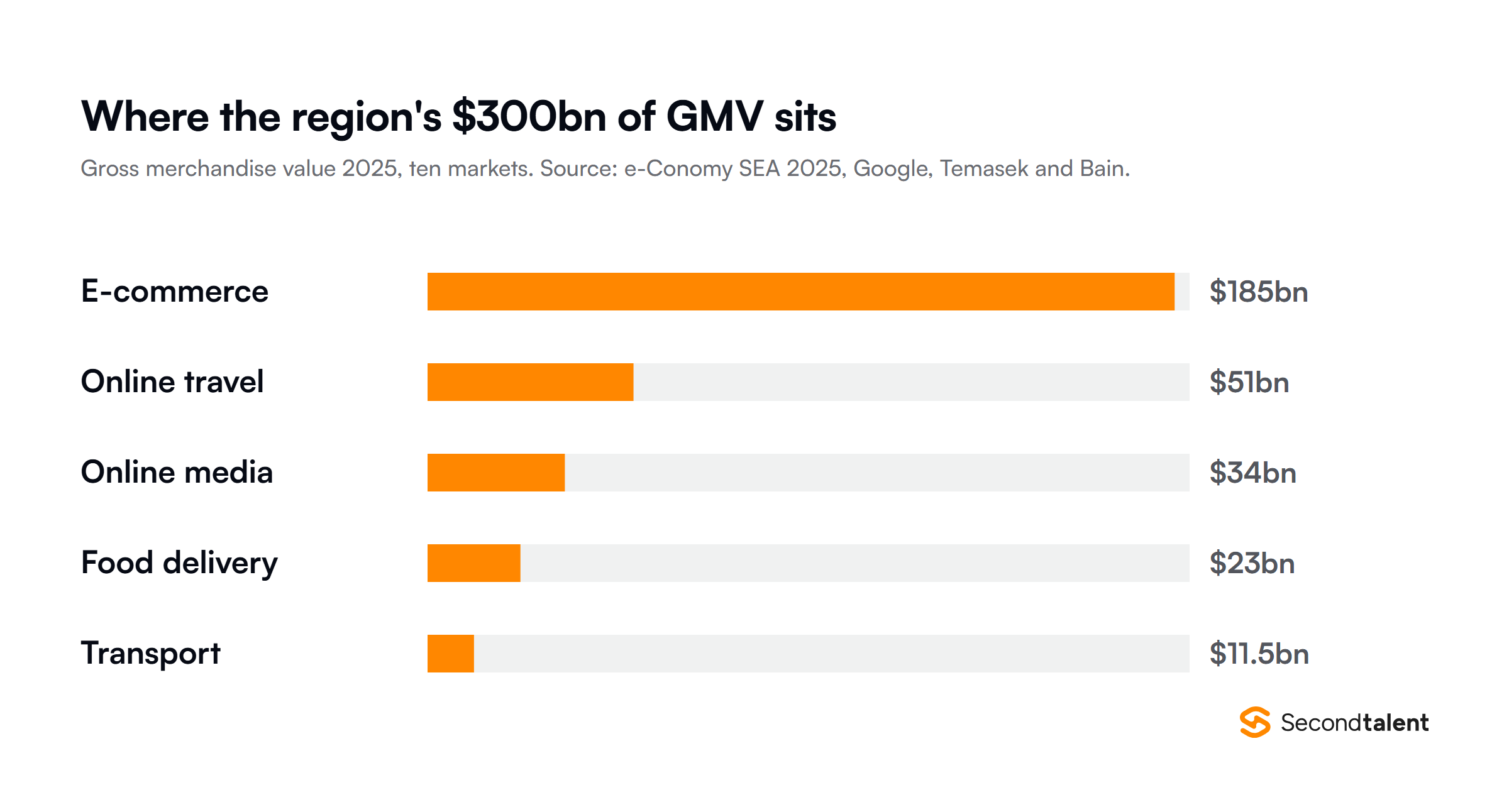
Across the decade that is 7.4x GMV growth and 11.2x revenue growth on $120bn of private funding and 200 million new internet users. The operating businesses got bigger and more profitable while the number of new ones getting funded shrank.
The AI layer is real and early. The region holds 680 or more AI startups and drew $2.3bn of private AI funding over twelve months, more than 30% of all private funding in the first half of 2025.
Set that against a planned 180% increase in data center capacity worth 4,600 MW. Investors are financing capacity years ahead of the applications that will run on it.
One number in that report sits awkwardly beside every other total here. e-Conomy puts private funding into the region at $8bn for 2025, up 15%, while DealStreetAsia counts $5.37bn over the same year. Neither is wrong.
They count different instruments and draw the regional line in different places, so read any single regional total as one methodology answer rather than the answer.
That gap between infrastructure spend and application revenue explains the funding concentration better than any story about investor sentiment. Money is going where the asset is bankable.
Which sectors still clear a round
Fintech, still. It ran 111 deals worth $1.3bn in 2025, roughly a quarter of every deal done in the region, and no other sector came close on count.
Healthtech took second place on capital at 35 deals worth $393m, and green tech placed second on activity. E-commerce, the sector that defined the last cycle here, kept losing ground.
That rotation matters more than it looks. Fintech and healthtech both sell into regulated markets where a license takes years, which favors incumbents and later-stage rounds over the seed-stage volume the region used to run.
The e-commerce decline is not a demand story. Regional e-commerce GMV reached $185bn in 2025 on $41bn of revenue, growing faster than the market that funds it.
Investors stopped paying for growth in a category whose winners are already public.
The exit window is the real constraint
Exits set the pace of everything upstream, and Southeast Asia’s are thin. The region logged 31 public listings and 81 acquisitions in the first seven months of 2026, against 82 and 164 across the whole of 2025.
DealStreetAsia counted 15 tech IPOs and 57 acquisitions in 2025 using a narrower definition of a startup exit. Either way, the region produces about one meaningful tech listing a month across ten countries.
Two consequences follow for anyone hiring here. Employee equity is worth less than the same grant in a market with an open listing window, so cash weighting has to be higher.
Your investors also hold positions longer, which makes them more conservative on follow-on rounds.
The one bright spot is that acquisitions are holding up better than listings. 81 in seven months against 164 across all of 2025 is close to flat, while listings are running well behind.
Six hubs, six different jobs
Ranking these cities against each other hides the point. They are not competing for the same role, and a team that treats them as interchangeable ends up incorporated in the wrong one.
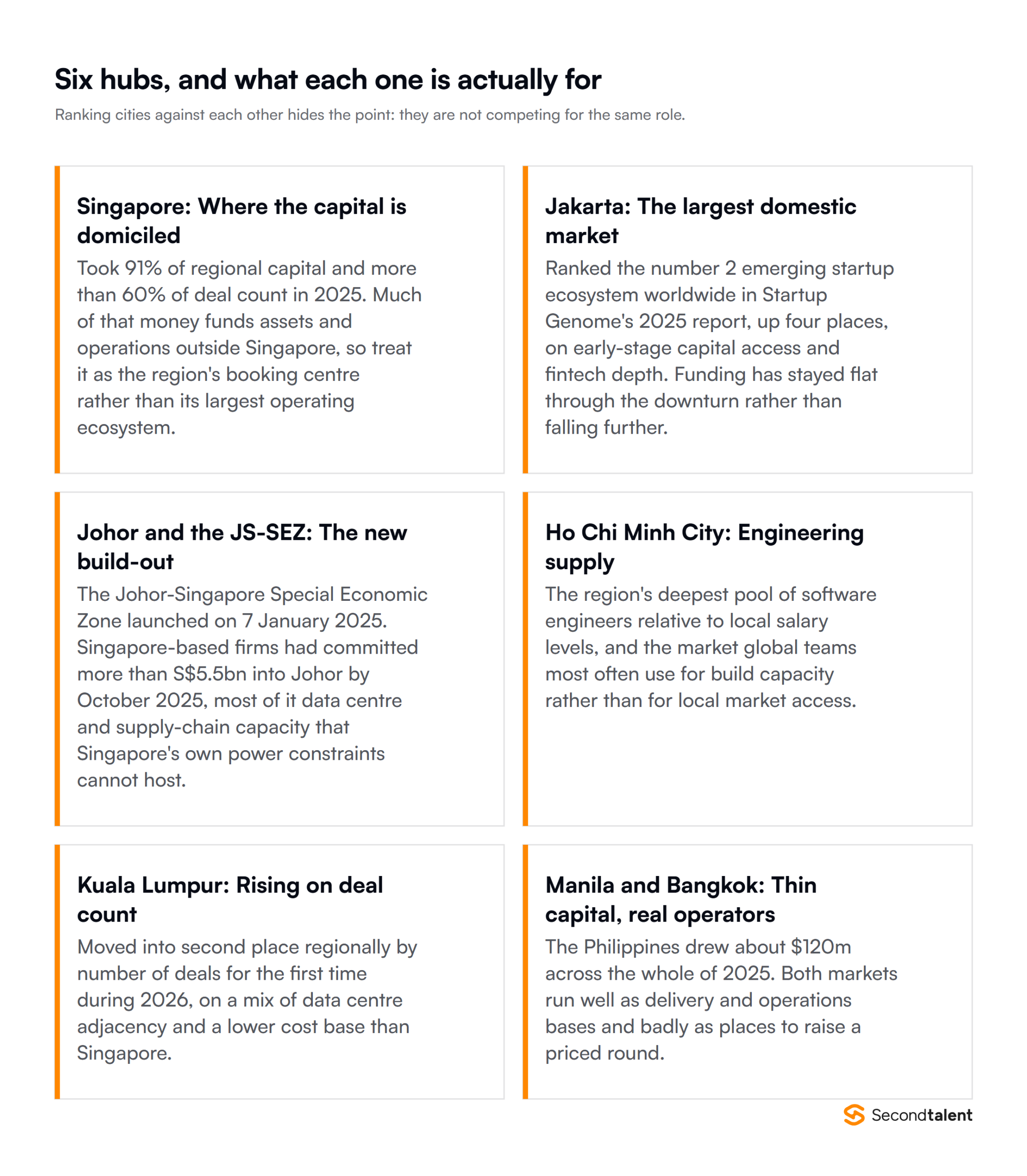
Johor is the newest entry and the least covered.
The Johor-Singapore Special Economic Zone launched on 7 January 2025, and Singapore-based firms had committed more than S$5.5bn into Johor by October 2025, most of it capacity that Singapore’s own power and land constraints cannot host.
Jakarta moved the other way and is worth watching for the opposite reason. Startup Genome ranked it the number 2 emerging startup ecosystem worldwide in 2025, up four places, on early-stage capital access and fintech depth.
For engineering supply rather than market access, Vietnam and the Philippines remain the two markets global teams use most.
Our guide to sourcing engineering talent in Southeast Asia covers how those pipelines differ, and the AI engineering talent data report carries the salary bands by country.
What this market rewards, and what it punishes
Plan to reach revenue on the round you already closed. With 178 rounds in seven months across ten countries, a plan whose next step is a priced Series A has one point of failure and no backup.
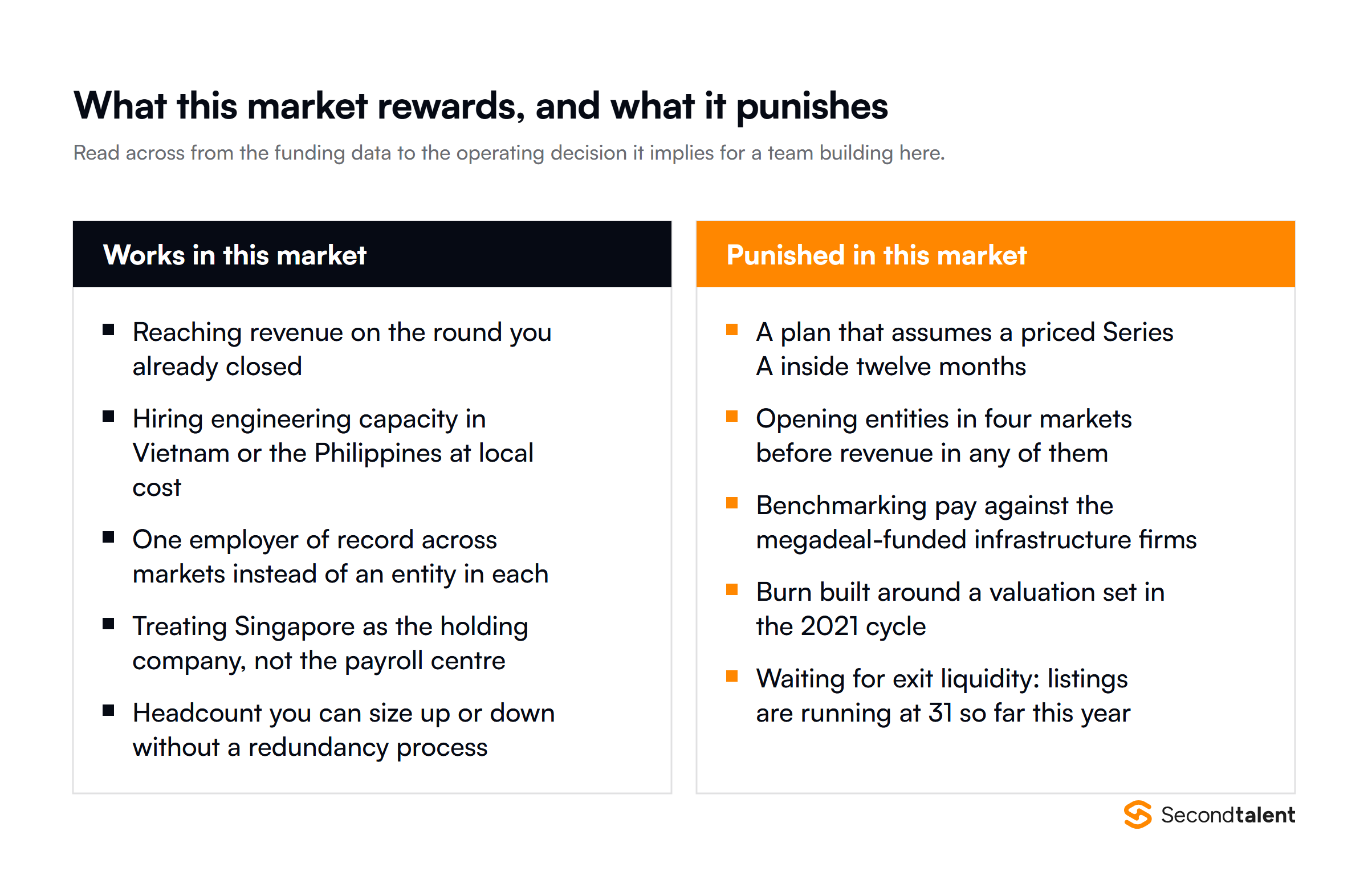
Separate where you incorporate from where you employ. Singapore holds a cap table well and prices payroll badly.
The same seniority of engineer costs a fraction of the Singapore number in Vietnam, Indonesia or the Philippines, and our developer rate card shows the spread by market.
Do not open four entities before you have revenue in any of them. Each one carries a resident director, a corporate secretary, statutory filings and an annual audit that run whether or not the market works out.
The hiring mistake this cycle punishes hardest
Committing to fixed local headcount in a market you have not validated. Incorporating, hiring five employees onto that entity and then discovering the market is 18 months away leaves you running a redundancy process under termination rules you have never read. An employer of record carries the same employees at the same cost with a notice period instead of an entity wind-down.
Assume the exit window stays narrow. Thirty-one listings and 81 acquisitions to July, against 82 and 164 across the whole of 2025, is a market where secondary liquidity arrives late and rarely on schedule.
Ignore the megadeal comps when you set pay. Data center and AI infrastructure firms funded at this scale are not your salary benchmark, and matching them ends your runway well before it ends theirs.
Download the full report
The PDF carries every table in this article plus the method notes, the classification caveats on each megadeal, and the full source list. No email required.
The State of the Startup Ecosystem in Southeast Asia 2026
Second Talent research, August 2026. Funding, exits, hub roles and the operating consequences, with every figure sourced.
How to act on this
Treat the regional total as background and your own market as the number that matters. A $12.8bn headline and a 30% drop in funded companies describe the same market, and only one of them is about you.
If the constraint is engineering capacity rather than capital, the answer sits in the countries the funding data barely mentions.
Vietnam and the Philippines have the deepest supply relative to cost, and neither requires you to incorporate there. Our EOR versus entity calculator models the crossover for a specific headcount.
Second Talent sources, vets and employs engineers across nine APAC markets on our own entities, with a 92% talent retention rate and most roles matched within 24 hours.
If you are sizing a team for the next twelve months, tell us the roles and we will come back with candidates and the full employment cost per market.
Frequently asked questions
How much did Southeast Asian startups raise in 2026?
$12.8bn across 178 equity rounds between 1 January and 31 July 2026, according to Tracxn, which puts the rise at 136.7% on the same period in 2025. Rounds fell 30% over the same window.
Why is funding up when deal count is down?
A handful of infrastructure rounds carried the total. Kling AI at $2.8bn and DayOne Data Centers at over $2bn together exceed the region’s entire January to July figure for 2025.
Strip those two out and the picture is a market still contracting on both capital and count, which is what founders raising a Series A report from the room.
Which Southeast Asian country gets the most startup funding?
Singapore, by a wide margin. It took more than 60% of regional deal count in 2025 and about two thirds of the capital in the first half, $1.21bn of $1.85bn.
Much of that money funds assets and operations in other countries, so read it as a domicile share rather than an operating one.
How many unicorns does Southeast Asia have?
67 created to date as at August 2026, of which 52 still hold the status, from about 170,000 tracked companies, according to Tracxn.
DealStreetAsia counted 58 at mid-2025 on a narrower definition and four new ones during 2025, up from one in 2024. The three counts measure different things and should not be subtracted from one another.
Is Southeast Asia a good place to start a company in 2026?
It depends on whether you need local capital or local customers. Consumer demand is growing 15% a year toward $300bn of GMV, so the market is there.
Early-stage capital to chase it is scarcer than at any point in six years, so the businesses that work are the ones that reach revenue without a second round.
Where should a startup hire engineers in Southeast Asia?
Vietnam and the Philippines carry the deepest engineering supply relative to salary, and neither requires a local entity if you employ through an employer of record.
Singapore suits the holding company and senior commercial hires, and costs several times more for the same engineering seniority.




![Engineering Productivity Metrics to Track. Top 10 Key Engineering Productivity Metrics to Track [2026], by Second Talent.](https://www.secondtalent.com/wp-content/uploads/2026/09/top-10-engineering-productivity-metrics-featured-v2-768x403.jpg)