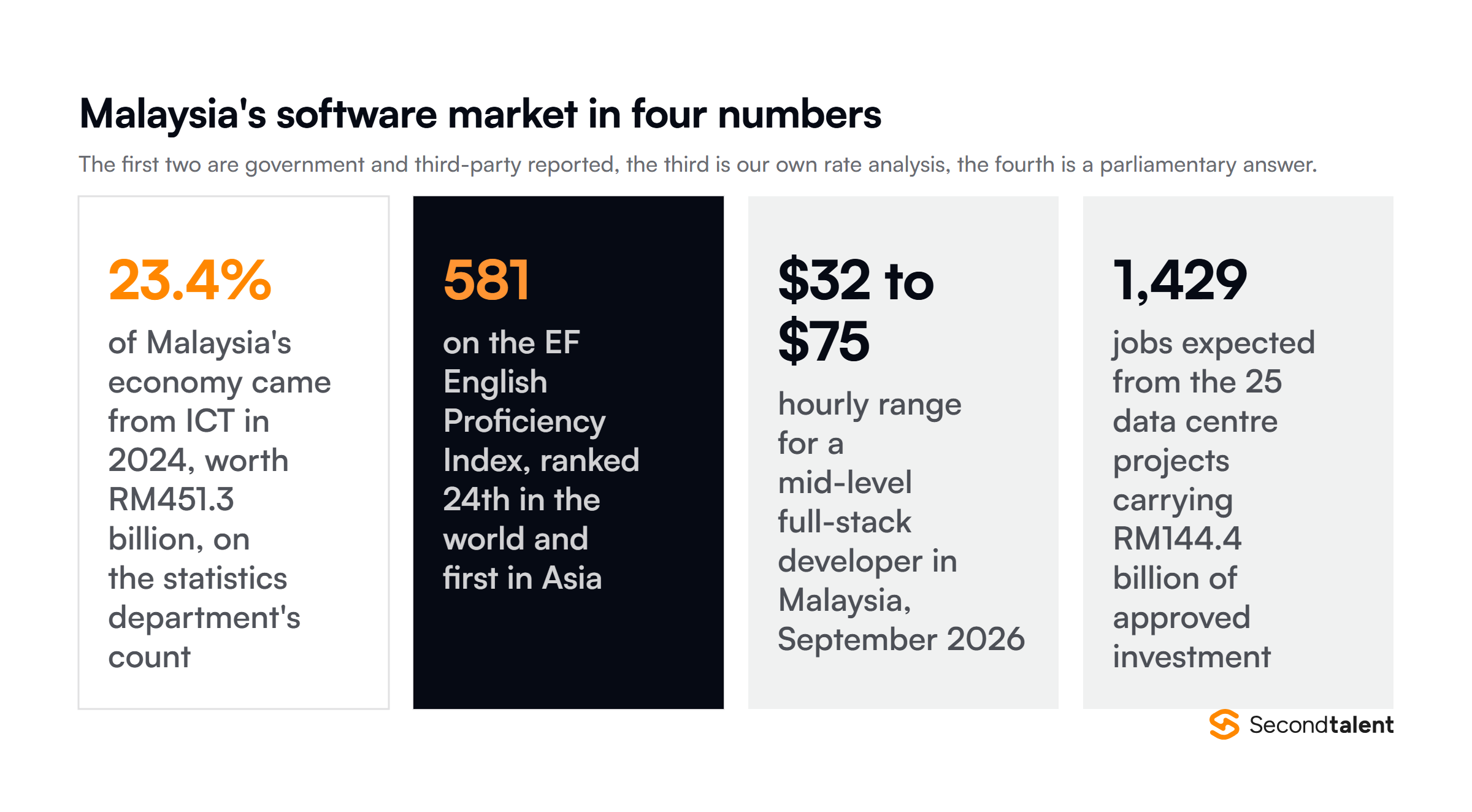
TL;DR: Malaysia is the second most expensive place to buy engineering in Southeast Asia, behind Singapore. What it sells instead of a discount is English: 581 on EF’s index, first in Asia.
The ten companies below split into two groups that rarely overlap: listed enterprise firms built around Malaysian government programmes, and product studios that will take a foreign client.
Most Malaysia vendor lists open with a cost saving, pad the ranking with global consultancies that will not return a mid-market call, and quote headcounts no source carries.
I have spent the last few years placing engineers across nine Asian markets, and Malaysia is the one buyers most often shortlist for the wrong reason. Every figure below is either a company statement or a Bursa Malaysia filing.
Each entry says who it suits, what to watch for, and what scale it publishes.
Quick comparison of the ten companies
| Company | Base | Listed | Published scale | Best fit for |
|---|---|---|---|---|
| HeiTech Padu | Subang Jaya | Bursa Main Market | 1,239 employees, Dec 2025 | Malaysian public sector programmes |
| Mesiniaga | Subang Jaya | Bursa Main Market | 1,482+ customers, 800+ projects | Enterprise apps plus the infrastructure under them |
| Infomina | Kuala Lumpur | Bursa ACE Market | RM196.7m FY2025 revenue, 200 staff | Core system and mainframe modernisation |
| Agmo Studio | Petaling Jaya | Bursa ACE Market | 100+ complex apps published | Super-apps and agentic AI builds |
| Snappymob | Kuala Lumpur | Private | 100+ projects delivered since 2012 | Consumer fintech products and applied AI |
| Lizard Global | KL and Rotterdam | Private | 100+ products in production | European buyers wanting an EU contract |
| Advisory Apps | Kuala Lumpur | Private | 200+ projects since 2012 | Government and enterprise systems, in-house team only |
| VeecoTech | Penang and KL | Private | Team of nearly 100 | SME web, commerce and e-invoicing |
| XIMNET | Kuala Lumpur | Private | 20+ years, Malaysia Digital status | AI layered onto a regulated institution’s platform |
| Terato Tech | Kuala Lumpur | Private | Named work for Air Selangor, Domino’s, CIMB | Consumer mobile for the Malaysian market |
What decides this, in four points
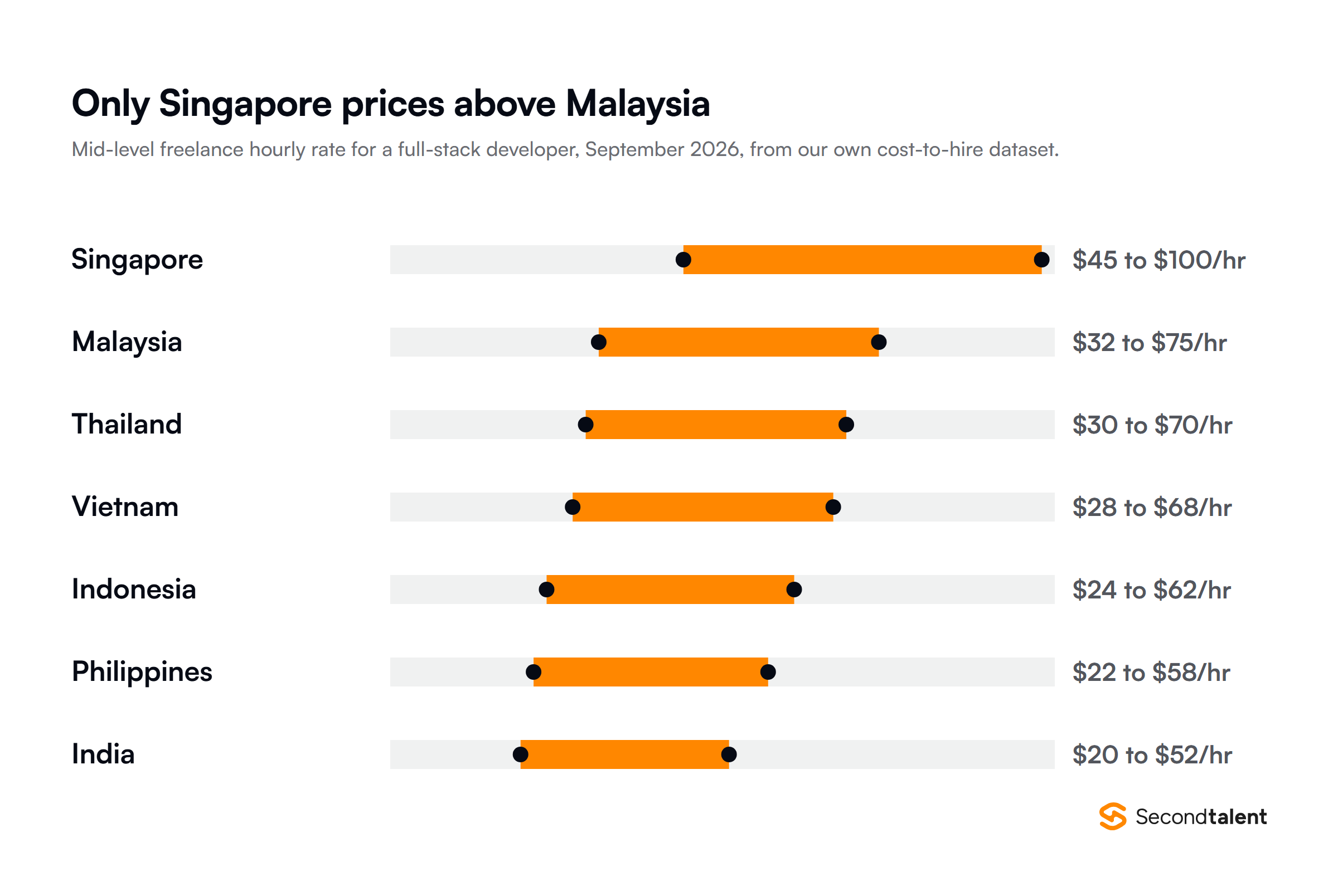
- Malaysia is the second most expensive market in Southeast Asia. Our September 2026 rates put a mid-level full-stack developer at $32 to $75 an hour, above Vietnam, Indonesia, the Philippines and India.
- The reason to pay it is English. Malaysia scores 581 on the EF English Proficiency Index, the highest in Asia.
- The list splits in two. Listed firms sell multi-year Malaysian programmes; studios sell product builds. Almost nobody sells both well.
- A vendor contract does not give you an employee. If the engineer has to still be there in three years, employ them directly through an entity or an EOR.
1. HeiTech Padu
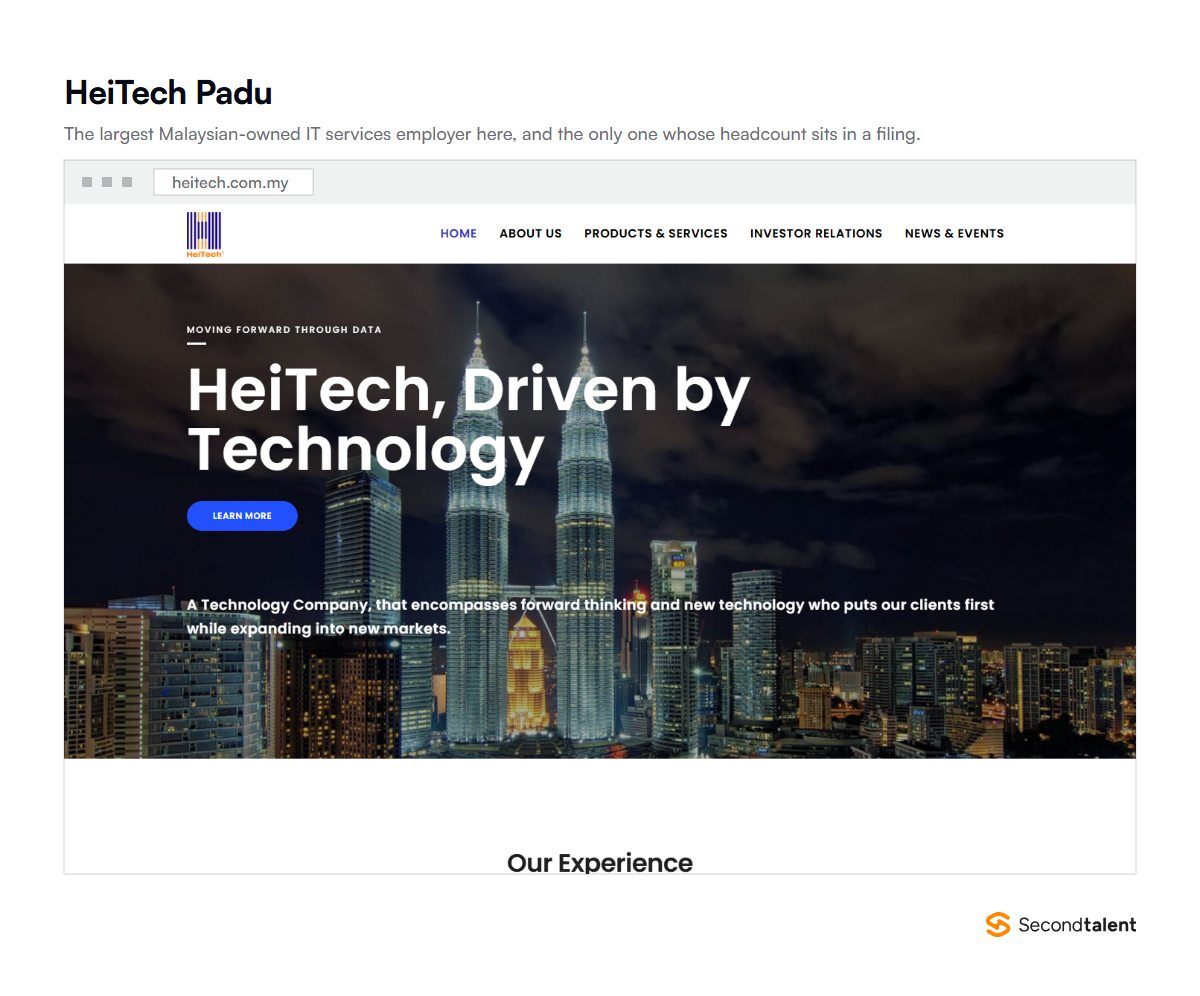
HeiTech Padu is the biggest Malaysian-owned IT services employer on this list and the only one whose headcount sits in a filing rather than a brochure.
It reported 1,239 employees at the end of 2025, up 277 in a year and more than double its 2023 figure of 509.
That growth came from the public sector. HeiTech states more than 25 years of delivery.
Its core capabilities read like the plumbing of Malaysian government IT: the i-Sentrix data centre facilities, mainframe technical services, business recovery, and PaduNet, which it calls the largest non-telco network service provider holding an NSP licence.
Being listed on Bursa’s Main Market changes what you can check before a call. Audited revenue, headcount and contract announcements are public. A private studio gives you a project count and little else.
Buy from HeiTech when your project touches a Malaysian agency, a national dataset, or infrastructure that has to sit in-country. Do not buy from it when you want a product team.
The procurement weight that makes a government programme safe is friction on a six-person build.
- Best for: Malaysian government and agency programmes, data centre and network work, systems that must stay in-country.
- Watch out: enterprise procurement rhythm. A small product build will move at the speed of its governance, not yours.
- Published scale: 1,239 employees at December 2025, Bursa Main Market listed, 25+ years of delivery.
2. Mesiniaga
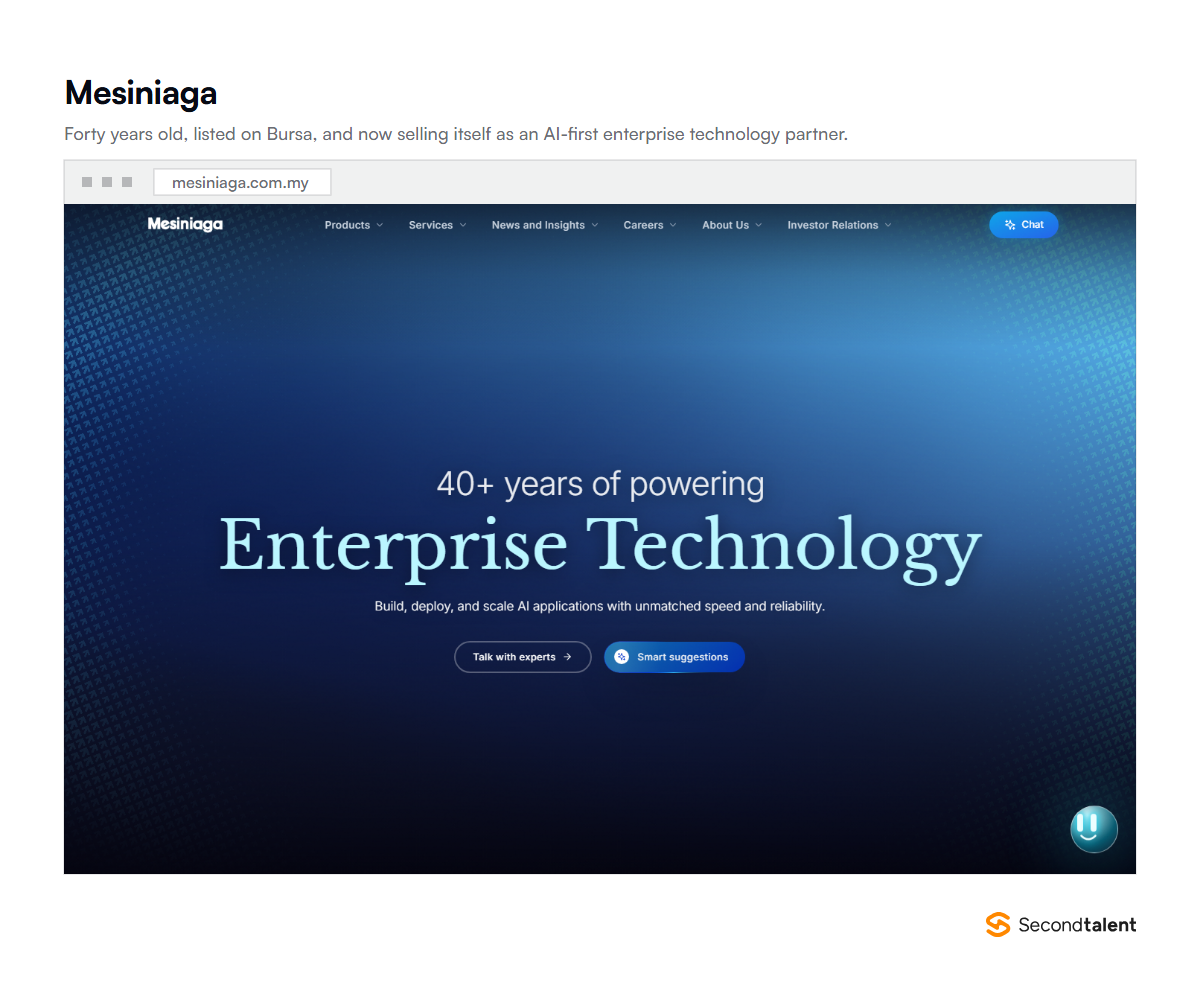
Mesiniaga has been running for over 40 years and states 1,482 customers served and more than 800 projects delivered. It is listed on Bursa Malaysia, so the financials behind those claims are public.
Its software engineering practice sits next to cybersecurity, networks and IT maintenance, and that combination is the point.
Mesiniaga sells mission-critical application development, maintenance and support alongside the engineers who keep the servers under it running, under one contract.
The company now presents itself as an AI-first enterprise technology partner, with security operations and cloud platforms leading the service list ahead of application work.
Read that ordering as a signal of where the revenue is: this is an infrastructure business that also writes software, not a studio that also racks servers.
That suits a Malaysian enterprise replacing a system it cannot take offline. It suits a foreign startup badly, because you are paying for an operations capability you already have.
- Best for: enterprise applications where the same vendor should own the infrastructure, security and support beneath them.
- Watch out: you are buying a bundle. Unpicking the application scope from the managed services around it takes work.
- Published scale: 40+ years, 1,482 customers, 800+ projects, Bursa Main Market listed.
3. Infomina
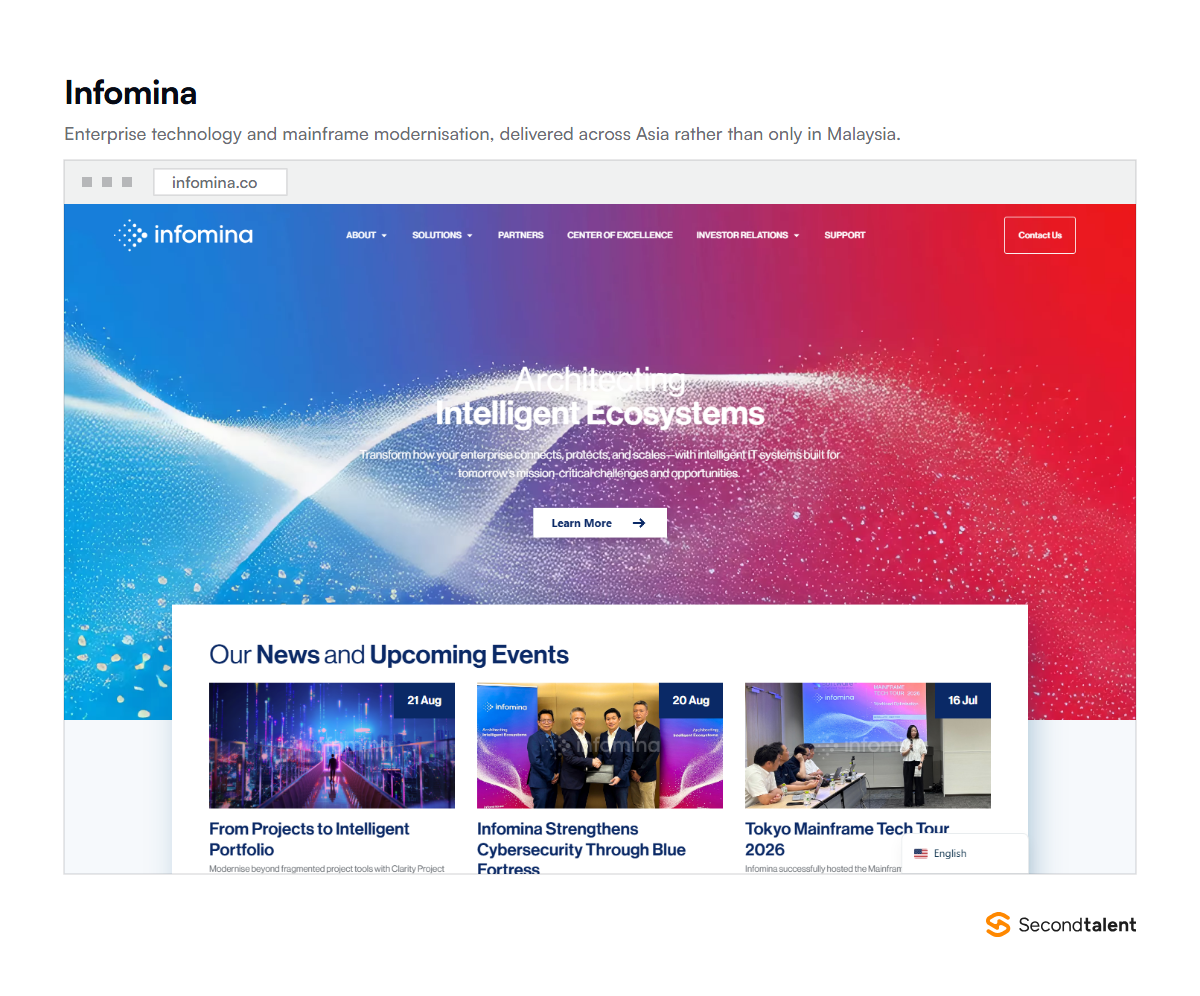
Infomina reported RM196.7 million of revenue for FY2025 and a five-year profit CAGR of 28%, supported by what it calls a 200-strong ASEAN workforce.
Its own site claims over 15 years of enterprise technology work across Asia, which makes it the most regional company here.
The specialisation is narrow and hard to copy. Infomina designs, deploys and maintains mission-critical infrastructure with a focus on mainframe systems.
Most offshore vendors cannot staff that work, because the engineers who know it are retiring.
Divide that revenue by that headcount and you get close to RM1 million per person, on our own arithmetic from Infomina’s two figures. That ratio is turnkey systems work with hardware and licences inside it, not staff augmentation.
It also tells you how the commercial conversation will go.
If your problem is a core banking platform written before your CTO was born, this is the shortlist. If it is a React app, it is not.
- Best for: mainframe and core system modernisation, and regional rollouts that cross more than one Asian market.
- Watch out: revenue per head says turnkey programme. Expect a solution price rather than a day rate.
- Published scale: RM196.7m FY2025 revenue, about 200 staff, Bursa ACE Market listed.
4. Agmo Studio
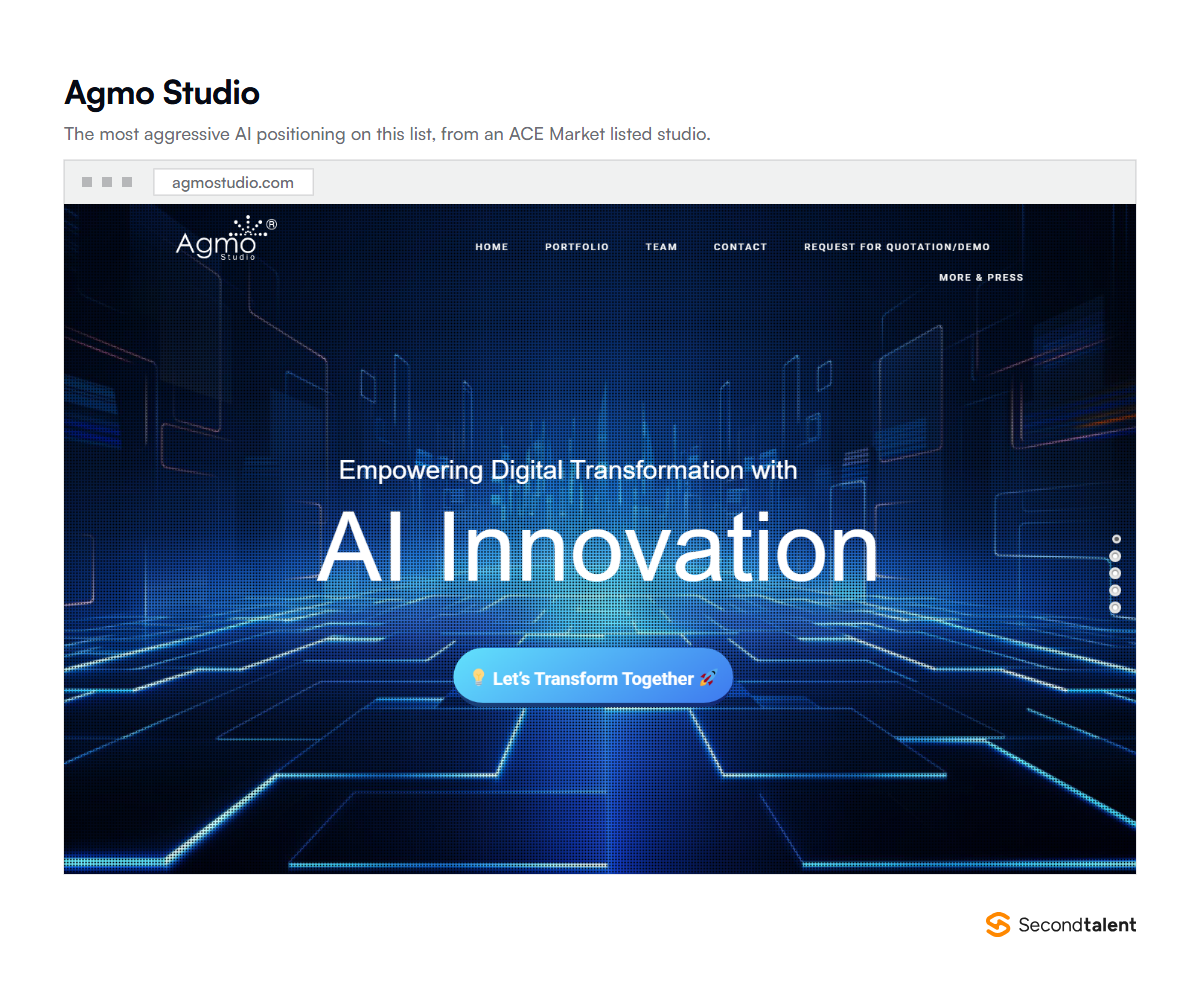
Agmo Studio is the delivery arm of Agmo Holdings Berhad, which listed on Bursa Malaysia’s ACE Market on 18 August 2022, raising RM22.1 million. It states more than 100 high-complexity apps published across mobile platforms.
The client list is the Malaysian consumer economy: the Perodua P-Circle super-app, Golden Screen Cinemas, Baskin-Robbins, Alpro Pharmacy, plus MyMahir for TalentCorp and the MYStartup platform. Awards include APICTA, ASEAN ICT and WITSA.
Agmo has moved harder into agentic AI than anyone else here. It publishes itself as both an Anthropic Claude partner and an OpenAI partner in Malaysia, with named customer stories behind both.
Its own site now leads with AI rather than with mobile, which is a repositioning worth testing rather than accepting.
Treat partner badges as evidence of investment rather than of outcome. Ask which engineers hold the certification, and whether they are the ones who would be on your account.
- Best for: consumer super-apps for a Malaysian audience, and agent builds where a named local reference matters.
- Watch out: the AI positioning is newer than the mobile track record. Ask what shipped before 2024 and what shipped after.
- Published scale: 100+ complex apps, Bursa ACE Market listed since August 2022.
5. Snappymob
Snappymob has been building since 2012 and states more than 100 successful projects. Its published work includes MoneyLion, CIMB, Honeywell and CoinGecko, an unusually international spread for a Kuala Lumpur studio of this size.
The service list reads like a product team rather than an agency: applied AI, systems engineering, mobile engineering, product and design, technical leadership and engineering enablement. That last one is the interesting one.
It is what you buy when you have your own developers and they are slow.
It is also the entry here that reads as built for a foreign buyer. The site is written for an international client, the case studies name overseas brands, and the engagement shapes on offer include a squad rather than only a fixed scope.
This is the one I would put in front of a Series A company that wants a team rather than a delivery. The trade-off is scale: a studio this size can staff one or two teams well and will struggle past that.
- Best for: venture-backed product companies wanting a squad, consumer fintech, and applied AI on an existing product.
- Watch out: capacity. Two teams is a realistic ceiling, so plan the second hire before you need it.
- Published scale: 100+ projects since 2012, clients including MoneyLion, CIMB, Honeywell and CoinGecko.
6. Lizard Global
Lizard Global runs from Rotterdam, Kuala Lumpur and Bali, and puts its track record at 13 years and more than 100 products in production. Its first client relationship, started in 2013, is still running.
The structure is the product. A European buyer signs in the Netherlands, under European contract law and European data expectations, while the build happens in Malaysia.
That removes the objection that kills most Asian outsourcing conversations inside a European procurement team.
The current positioning is enterprise modernisation and AI integration rather than app studio work. That fits the target buyer: a European mid-market company with a system it cannot replace wholesale.
Published clients include Heineken Drinkies and Hitachi. If you are buying from the EU or the UK and your legal team is the blocker rather than your engineering team, start here.
- Best for: European buyers who need a European contracting entity with offshore delivery underneath it.
- Watch out: you pay something for that structure. Compare the rate against a Malaysia-only vendor and decide what the contract is worth.
- Published scale: 13 years, 100+ products in production, offices in Rotterdam, Kuala Lumpur and Bali.
7. Advisory Apps
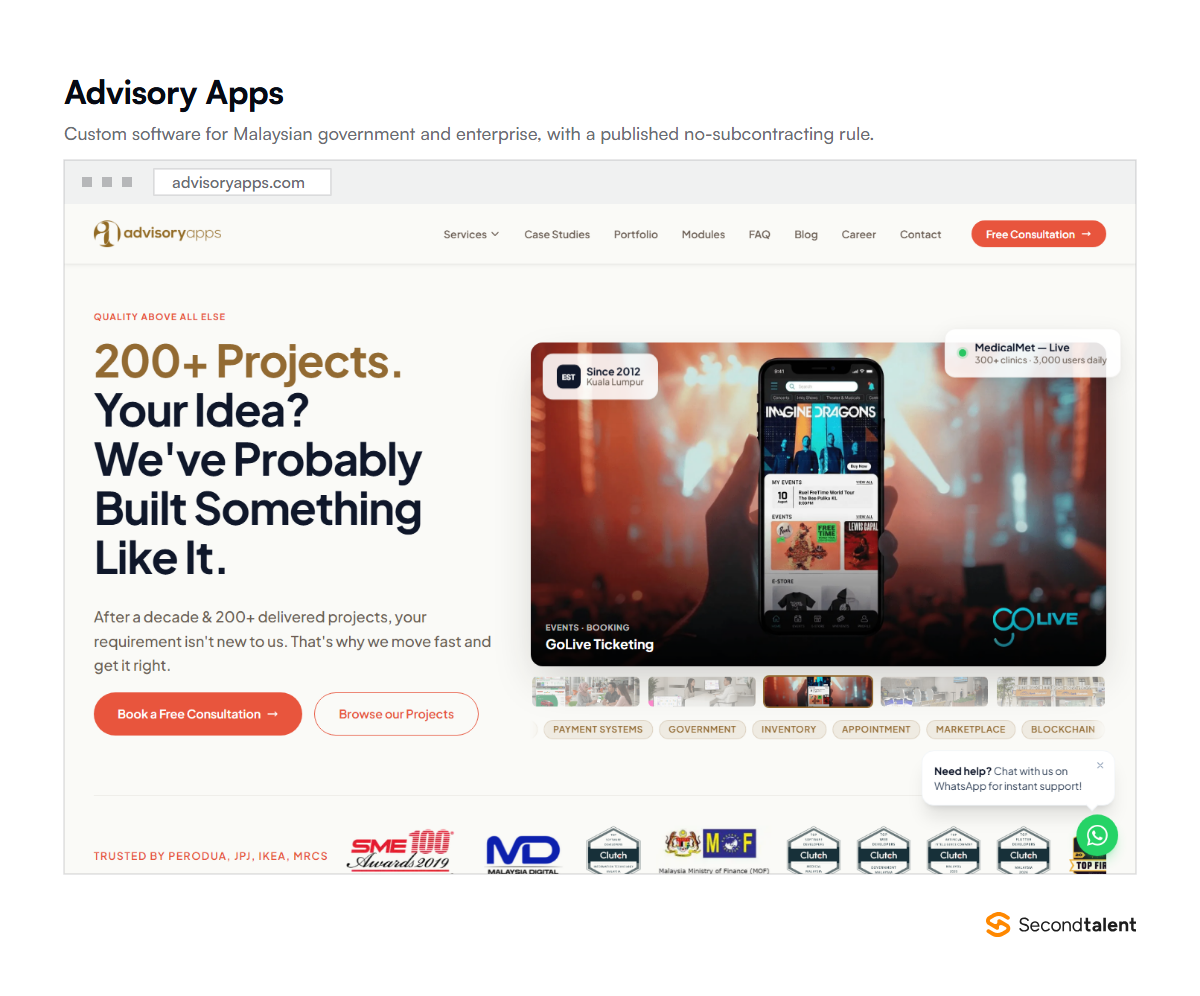
Advisory Apps has worked from Kuala Lumpur since 2012 and states more than 200 delivered projects. The published portfolio spans government and enterprise: MyJPJ for the road transport department, MyLPS, Perodua SA and Bank Muamalat.
It also names a clinic platform running across 300 clinics with 3,000 daily users.
It makes one commitment most agencies avoid putting in writing: the team is in-house only, and the people who pitch are the people who build. Put that question to every vendor here on the first call.
It is checkable, and the opposite is the complaint buyers raise most often.
It also builds a clickable prototype before writing production code. For a buyer who has been burned by a fixed-price scope negotiated from a document, that sequencing matters more than the day rate.
The limit is the same as the promise. An in-house-only team cannot surge, so a deadline that needs twenty engineers next month is the wrong brief for this firm.
- Best for: Malaysian government and enterprise systems where you want the builders in the room from the first call.
- Watch out: no subcontracting also means no surge capacity. Match the scope to the standing team.
- Published scale: 200+ projects since 2012, in-house delivery only.
8. VeecoTech
VeecoTech was established in 2011, runs from Penang, Kuala Lumpur and Singapore, and states a team of nearly 100 across Southeast Asia. It started with one developer and four interns.
The work is bread-and-butter business software: bespoke systems, mobile, web, commerce, ERP and CRM, plus e-invoicing. That last one is not filler.
Malaysia has been phasing in mandatory e-invoicing since August 2024, so every mid-sized company there has a compliance deadline that needs code behind it.
Digital marketing and SEO sit in the same service menu as the engineering. For an SME buying one supplier that can ship a site and then run it, that is convenient.
For a company buying engineering alone, it is a signal to ask how the delivery team is split.
Penang is also the one Malaysian city where an engineering hire competes with semiconductor employers rather than banks. That changes the available skill mix, usually in favour of embedded and hardware-adjacent work.
- Best for: SME systems, commerce builds, ERP integration and Malaysian e-invoicing compliance work.
- Watch out: the agency services sit beside the engineering. Confirm who is actually assigned to your build.
- Published scale: established 2011, team of nearly 100, offices in Penang, Kuala Lumpur and Singapore.
9. XIMNET
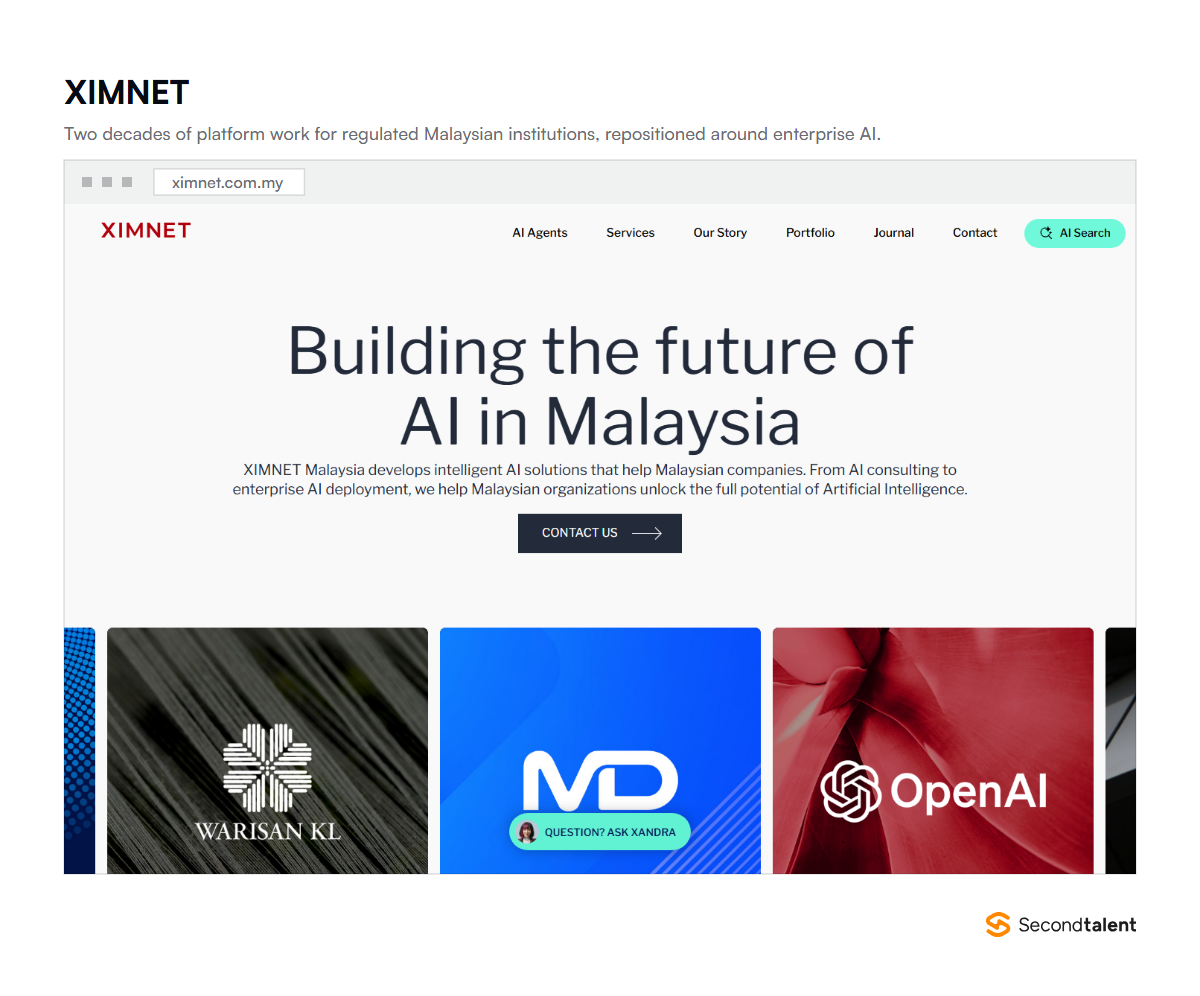
XIMNET has built mission-critical digital platforms across Malaysia and Southeast Asia for more than 20 years, and has repositioned around enterprise AI: agents, integration and governance rather than chatbots alone.
It was awarded Malaysia Digital status in August 2026 and named an OpenAI partner a month earlier.
Its recent client work sits in regulated Malaysian institutions: Labuan FSA, the Asian Institute of Chartered Bankers and Malaysia’s consumer credit regulator.
Regulators take months to procure and they audit what they buy, so that list carries information a logo wall does not.
The site now calls the company the leading AI company in Malaysia, which is a claim about positioning rather than a measurable one. The underlying platform history is the part that would survive a reference check.
The caution is the obvious one for any firm that rebranded around AI inside two years. Ask what shipped before 2024 and what shipped after, and whether the same engineers built both.
- Best for: AI layered onto an existing platform inside a regulated Malaysian institution.
- Watch out: a two-year-old AI identity on a twenty-year-old company. Check the engineering continuity.
- Published scale: 20+ years, Malaysia Digital status awarded August 2026, named regulator clients.
10. Terato Tech
Terato Tech is a Kuala Lumpur mobile and web product company. Its published portfolio carries names a Malaysian reader will recognise: Air Selangor, Domino’s Pizza, CIMB Clicks, Invest Smart and Kitajaga.
It is founder-led and does not publish a headcount, which is why it ranks last here rather than on quality. The work is checkable in a way a headcount is not: those apps are in the stores and you can use them before you take a call.
Download two of them and look at what the team had to solve. Local payment rails, telco billing and Malay-language interfaces are the parts that quietly consume a discovery phase when the vendor has not met them before.
Terato is a fit for a consumer product aimed at Malaysian users. It is the wrong fit for an enterprise programme that needs an audited balance sheet behind the contract.
- Best for: consumer mobile and web products for the Malaysian market, where local payment and language behaviour matters.
- Watch out: no published headcount or financials, so due diligence has to run on the work itself.
- Published scale: named work for Air Selangor, Domino’s Pizza, CIMB Clicks, Invest Smart and Kitajaga.
What Malaysia costs and what the premium buys
A mid-level full-stack developer in Malaysia bills $32 to $75 an hour as a freelancer. Those are observed figures from our Malaysia rate card, current to September 2026. Only Singapore prices above it.
Vendor rates sit above that band, and they should. Our Malaysian agency range is $80 to $135 an hour at mid-level, which buys bench cover, delivery management and somebody else’s problem when an engineer resigns mid-sprint.
Against the United States, Malaysia lands at 0.49x.
What the premium buys is English. Malaysia scored 581 on the 2025 EF English Proficiency Index, the highest score in Asia.
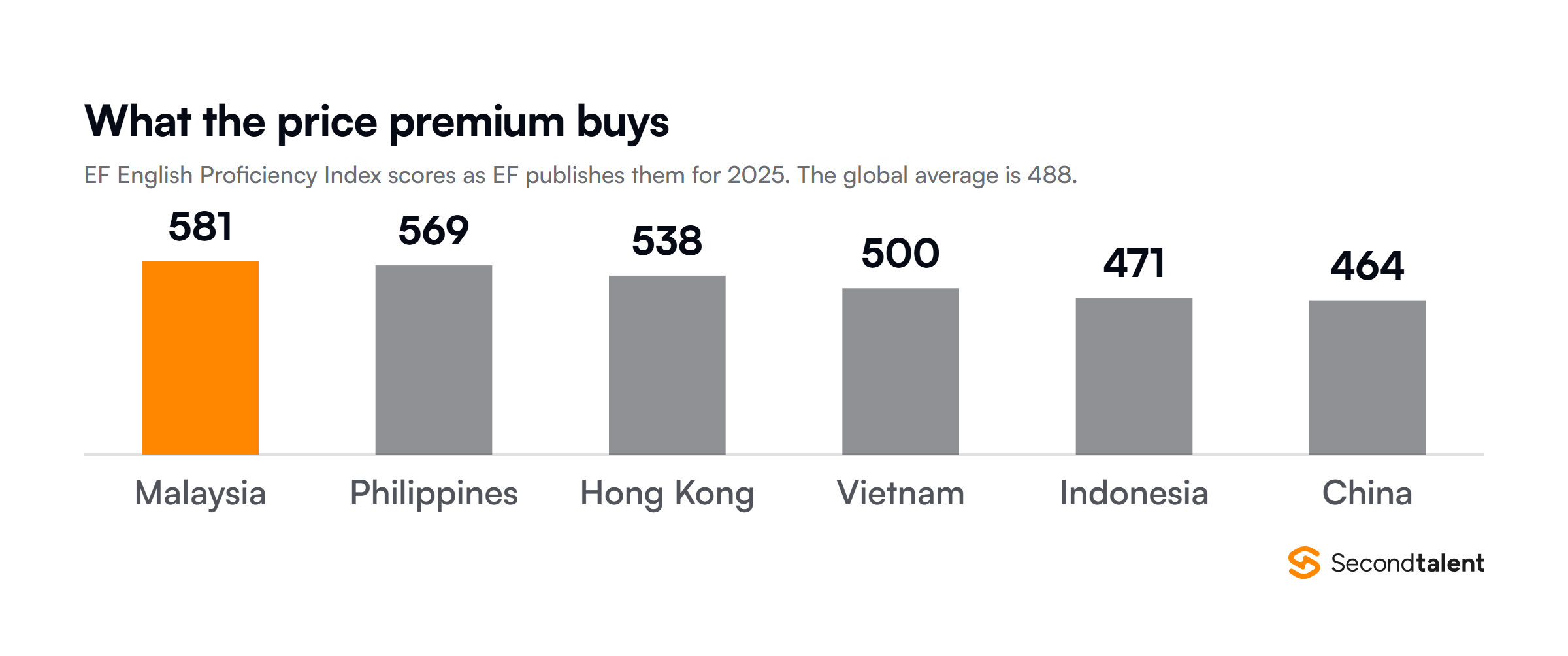
The gap that matters is the 81 points against Vietnam, where the same work costs less. English decides the roles that talk: business analysts, product owners, architects running discovery with your customers.
Against a clear specification it changes little. Compare the two in our Vietnam vendor guide.
How to run the selection
- Check the company still files. For the four listed firms, Bursa announcements give you audited revenue and headcount. For the private ones, a live site, recent releases and current job postings are the cheapest proxy.
- Ask who will be on your team. Names, seniority, current allocation, in the statement of work. Advisory Apps publishes a no-subcontracting rule; ask everyone else the same question.
- Test English where it matters. Interview the business analyst and the tech lead, not the account manager.
- Own the code from day one. Repository, cloud accounts and CI in your name from the first commit. Prising them out of a vendor later is where projects die.
Awards are not a solvency check
Fusionex was Malaysia’s best-known data company, backed by Hitachi. It wound up on a court order in December 2023, affecting more than 500 employees. It held awards and sat near the top of most 2023 Malaysia rankings. A Bursa filing search and a look at whether the company is still posting jobs cost you ten minutes.
Pick the engagement model before the vendor. The common failure is buying a squad when you needed employees, and finding two years later that the engineers who understand your system are still on somebody else’s payroll.
That last option is the gap we work in. Second Talent recruits and vets the engineer, then employs them in Malaysia on your behalf through an employer of record, carrying payroll, EPF and SOCSO.
Start with hiring developers in Malaysia, the developer rate card, or our framework for evaluating staffing companies.
Want the engineers on your team, not a vendor’s?
Tell us the roles and the seniority. We will come back with vetted Malaysian engineers and a compliant way to employ them, usually within a week.
Frequently asked questions
Which is the largest software development company in Malaysia?
By published headcount among Malaysian-owned IT services firms, HeiTech Padu, with 1,239 employees at December 2025.
Global consultancies run larger Malaysian delivery centres but do not publish country headcounts, and Malaysia has no vendor at the scale of Vietnam’s FPT Software, which states more than 54,000 staff.
How much does it cost to outsource software development to Malaysia?
Budget $80 to $135 an hour at mid-level for a Malaysian agency or dev shop, against $32 to $75 for a freelancer. That is roughly half a comparable United States rate and above Vietnam, Indonesia, the Philippines and India.
What is the difference between outsourcing and an EOR in Malaysia?
An outsourcing vendor sells you delivery and employs the engineers itself. An employer of record employs your chosen engineer on your behalf, so the person sits on your team and the retention, knowledge and loyalty stay with you.
Buy the first for a scoped system, the second for a permanent team.