
TL;DR: Outsourcing a mid-level developer in Vietnam costs $3,500-$5,300/month direct hire or $4,200-$6,300/month through an agency. That is 55-70% less than the US. Total project savings: 50-65%.
Vietnam ranks in the top 6 globally on the Kearney Global Services Location Index. The country has 530,000-560,000 software developers. IT outsourcing revenue hit $694 million in 2024 and is projected to reach $1.24 billion by 2029. Intel, Samsung, Microsoft, and Google all have engineering operations in Vietnam.
But the cost data online is outdated or misleading. Most guides quote local salaries without adjusting for the remote premium that international companies actually pay. They skip employer contributions. They ignore the 40-60% agency markup. They leave out the 13th month salary, social insurance, and EOR fees.
We have placed over 100 developers from Vietnam with startups and scale-ups worldwide. This guide covers what you will actually pay to outsource software development to Vietnam in 2026. Every model. Every hidden cost. Real numbers.
Which outsourcing model fits your startup?
Click your situation below to see the best model and cost range.
Best for full control at the lowest cost. You manage the developer directly. An EOR handles payroll and compliance. Budget: $3,500-$5,300/month for a mid-level developer + $400-$600/month EOR fee. Learn about EOR →
Best for scaling quickly without building your own recruiting pipeline. The agency sources, vets, and replaces developers if needed. Budget: $4,200-$6,300/month per mid-level developer (includes 40-60% agency markup). Learn about talent sourcing →
Best for a defined scope with clear deliverables. You pay per project, not per person. Budget: $25,000-$150,000+ depending on scope. Watch for change-order costs and unclear specs driving the price up.
Best for companies that want a dedicated Vietnam office long-term. A partner builds the team, runs it for 12-24 months, then transfers it to you. Budget: 20-30% premium during the build phase, then full ownership. Minimum commitment: 5-10 developers.
Best for short engagements or specialized one-off tasks. Lowest commitment. Budget: $20-$60/hour depending on skill level. Risk: no backup if the freelancer leaves mid-project. Hire Vietnam developers →
Vietnam Developer Rates by Role (2026)
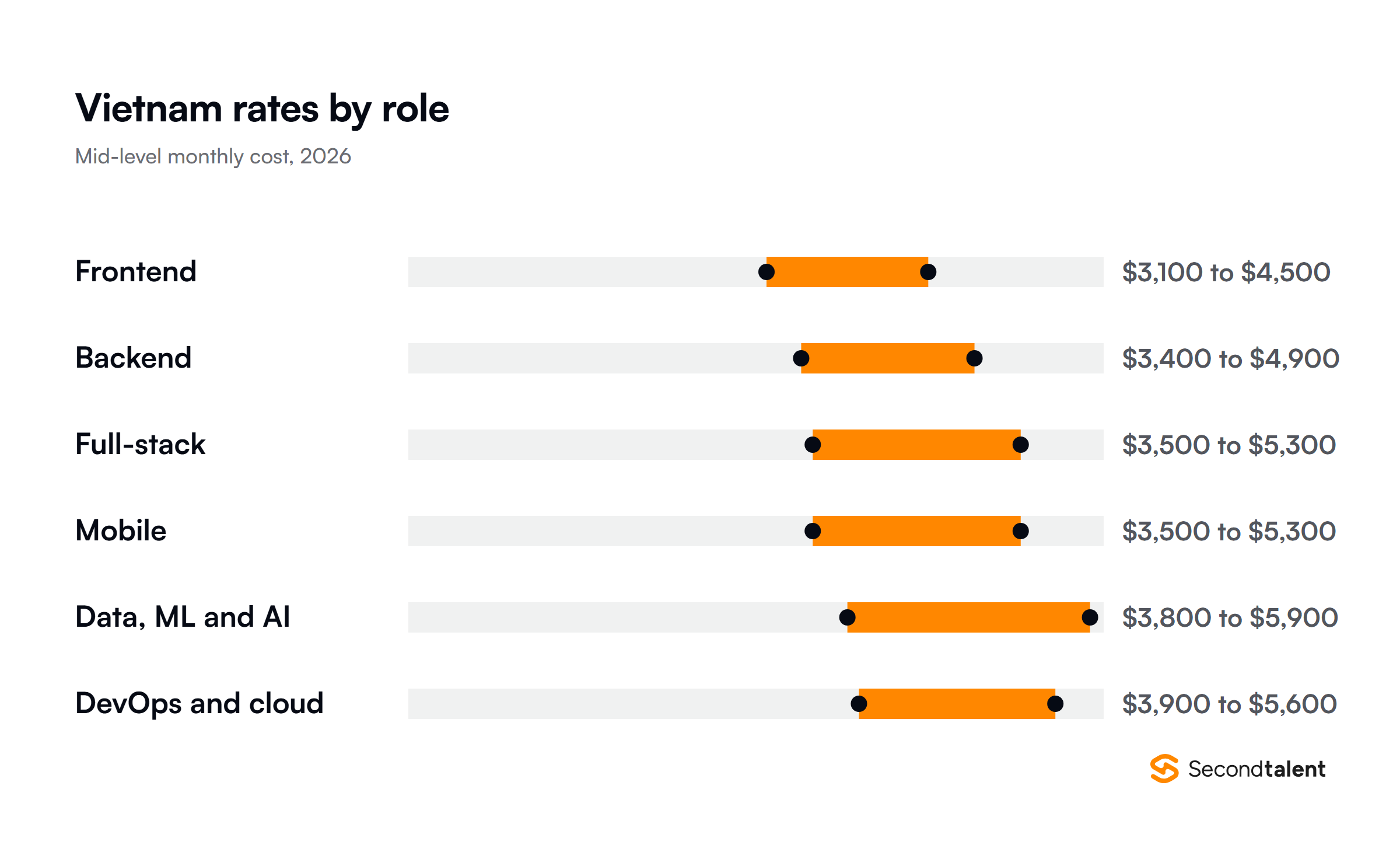
These are monthly rates for Vietnamese developers working remotely for international companies. Remote rates are 40-100% higher than local Vietnamese company salaries. If you are hiring for a US, European, or Australian company, these are the numbers to budget for.
| Role | Junior (1-3 yrs) | Mid (3-5 yrs) | Senior (5-8 yrs) | Lead/Architect (8+) |
|---|---|---|---|---|
| Frontend (React, Vue, Angular) | $2,100-$3,100 | $3,100-$4,500 | $4,500-$6,300 | $6,300-$8,400 |
| Backend (Node.js, Python, Java, Go) | $2,200-$3,400 | $3,400-$4,900 | $4,900-$7,000 | $7,000-$9,800 |
| Full-Stack | $2,500-$3,500 | $3,500-$5,300 | $5,300-$7,000 | $7,000-$10,500 |
| Mobile (iOS, Android, RN, Flutter) | $2,500-$3,500 | $3,500-$5,300 | $5,300-$6,600 | $6,600-$9,100 |
| DevOps / Cloud | $2,800-$3,900 | $3,900-$5,600 | $5,600-$7,700 | $7,700-$10,500 |
| Data / ML / AI Engineer | $2,800-$3,800 | $3,800-$5,900 | $5,900-$8,500 | $8,500-$11,200 |
| QA Automation | $1,700-$2,500 | $2,500-$3,900 | $3,900-$5,600 | $5,600-$7,700 |
| QA Manual | $1,400-$2,100 | $2,100-$3,100 | $3,100-$4,200 | $4,200-$5,600 |
| UI/UX Designer | $1,700-$2,500 | $2,500-$3,900 | $3,900-$5,600 | $5,600-$7,700 |
| Project Manager / Scrum Master | $2,100-$3,100 | $3,100-$4,900 | $4,900-$7,000 | $7,000-$9,800 |
Sources: VietnamDevs 2026 Salary Guide, ITviec Vietnam IT Salary Report 2025-2026, Arc.dev Vietnam Remote Rates, and Second Talent placement data.
Stack premiums matter. Go and .NET seniors command 10-20% above these ranges. Java remains the highest-demand backend language in Vietnam. Node.js and Python are growing fastest. PHP/Laravel sits at the lower end of backend ranges. QA automation engineers (Selenium, Cypress, Playwright) earn 40-60% more than manual testers.
The single biggest salary differentiator in Vietnam is English. Developers with strong English skills access international remote jobs and earn 50-100% more than those limited to local companies. When you hire for international work, you are paying for that English premium.
Four Outsourcing Models and What They Cost
There is no single way to outsource to Vietnam. Each model has different pricing, control, and risk profiles.
Model 1: Direct Hire via EOR (Employer of Record)
You hire Vietnamese developers as full-time employees through an EOR provider. The EOR is the legal employer in Vietnam. You manage the work directly.
| Cost Component | Monthly (Mid-Level Developer) |
|---|---|
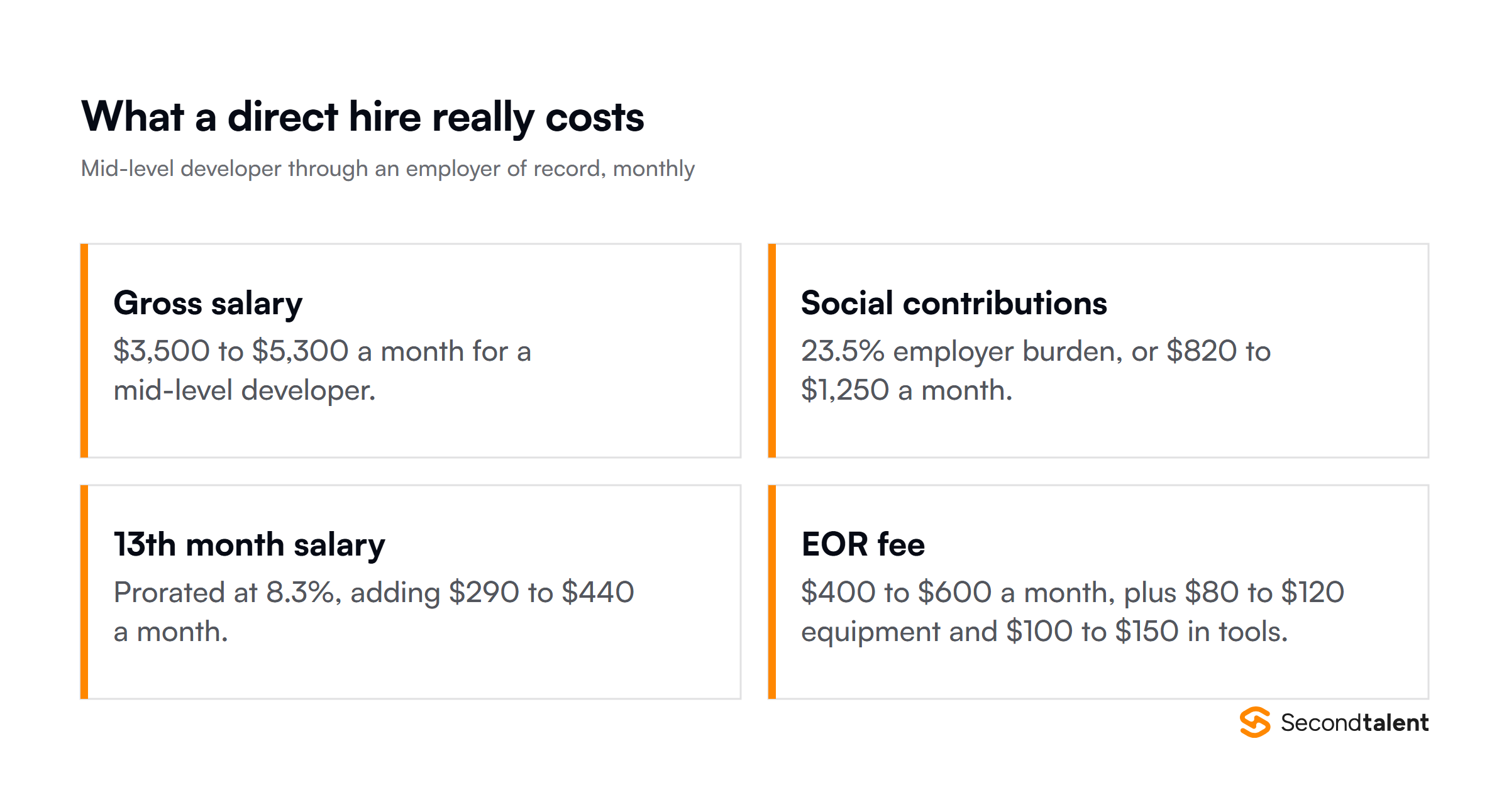
| Gross salary | $3,500-$5,300 |
| Employer social contributions (23.5%) | $820-$1,250 |
| 13th month salary (prorated 8.3%) | $290-$440 |
| EOR fee | $400-$600 |
| Equipment (amortized) | $80-$120 |
| Tools and licenses | $100-$150 |
| Total monthly cost | $5,190-$7,860 |
Best for: Long-term hires (6+ months). Full control over the developer. Lowest cost per developer. You manage directly.
EOR providers for Vietnam: Deel ($599/month), Remote ($599/month), Multiplier ($400/month), RemoFirst ($199/month). The market average is $350-$500 per employee.
Model 2: Staff Augmentation via Agency
An outsourcing agency provides dedicated developers who work on your project full-time. The agency handles recruitment, payroll, and HR. You manage the daily work.
| Developer Level | Monthly Rate (Billed) | Hourly Rate |
|---|---|---|
| Junior | $2,800-$4,200 | $17-$25 |
| Mid-Level | $4,200-$6,300 | $25-$39 |
| Senior | $6,300-$9,100 | $39-$56 |
| Lead/Architect | $9,100-$12,600 | $56-$77 |
| Tech Lead/PM | $7,000-$10,500 | $42-$64 |
The agency markup is real. These rates include a 40-60% margin on top of the developer’s actual salary. A mid-level developer earning $3,500/month gets billed to you at $4,200-$6,300. The agency keeps the difference to cover recruitment, office space, management, and profit.
Best for: Teams that need to scale fast (1-2 weeks). No legal setup required. Higher cost but lower administrative burden.
Agency hourly rates vary by vendor tier:
| Agency Tier | Hourly Rate (USD) | Examples |
|---|---|---|
| Smaller / newer agencies | $28-$42 | TECHVIFY, Designveloper |
| Mid-tier established firms | $39-$56 | KMS Technology, NashTech |
| Premium agencies | $49-$70 | Saigon Technology, Rikkeisoft |
| Large enterprise firms | $56-$91 | FPT Software, TMA Solutions |
Model 3: Project-Based Outsourcing
You pay a fixed price or time-and-materials rate for a defined project scope. The agency manages the team, timeline, and delivery.
| Project Type | Vietnam Cost | US Cost (Comparison) |
|---|---|---|
| Simple mobile app (MVP) | $14,000-$42,000 | $50,000-$150,000 |
| Medium web application | $42,000-$112,000 | $120,000-$350,000 |
| Complex enterprise application | $112,000-$350,000 | $300,000-$900,000 |
| Custom e-commerce platform | $70,000-$210,000 | $200,000-$600,000 |
| AI/ML-powered application | $140,000-$420,000 | $400,000-$1,200,000 |
Best for: Well-defined projects with clear requirements. Less control but less management overhead. Pricing models include fixed-price, time-and-materials, and cost-plus.
Warning: 40% of companies report surprise hidden fees when outsourcing projects to Vietnam. Always negotiate a detailed statement of work with change request pricing before signing. Post-handover maintenance typically costs 20-30% of the original development cost per year.
Model 4: Build-Operate-Transfer (BOT)
A partner sets up a development center in Vietnam on your behalf. They build the team, operate it for 1-3 years, then transfer full ownership to you.
| Phase | Duration | Cost |
|---|---|---|
| Build (setup, legal, recruitment) | 3-6 months | $42,000-$112,000 |
| Operate (monthly team cost + 15-25% mgmt fee) | 1-3 years | $21,000-$42,000/month (5-person team) |
| Transfer (legal handover, knowledge transfer) | 3-6 months | $28,000-$70,000 |
Best for: Companies planning a permanent Vietnam engineering center with 10+ developers. Highest upfront cost but lowest long-term cost per developer. You end up owning the entity.
Model 5: Freelancers
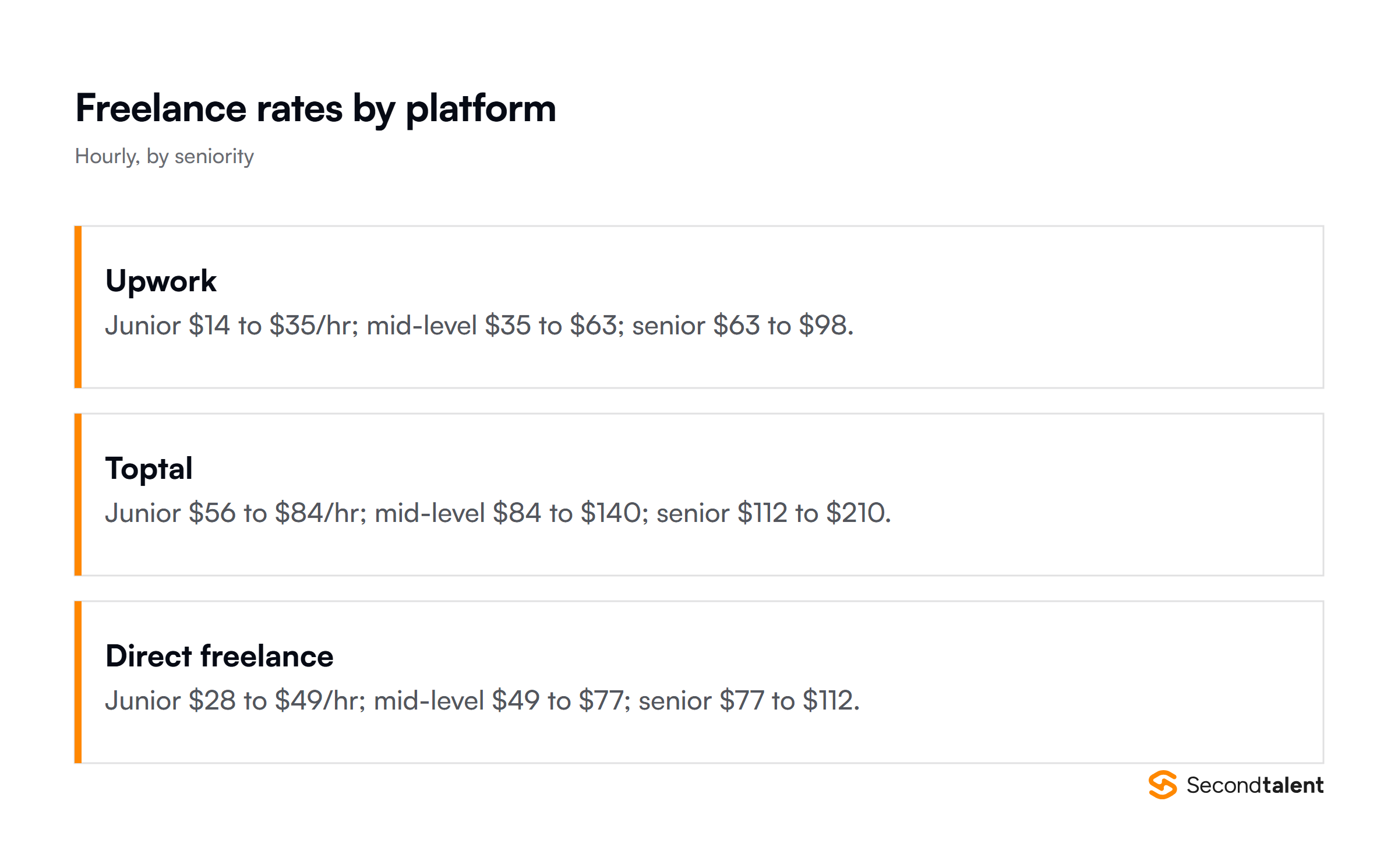
| Platform | Junior ($/hr) | Mid-Level ($/hr) | Senior ($/hr) |
|---|---|---|---|
| Upwork | $14-$35 | $35-$63 | $63-$98 |
| Toptal | $56-$84 | $84-$140 | $112-$210 |
| Direct freelance | $28-$49 | $49-$77 | $77-$112 |
Best for: Short-term projects (1-3 months). Specific skill needs. No commitment. Toptal rates are 2-3x Upwork because of their vetting process and platform premium.
The Hidden Costs: What Nobody Tells You
The developer rate is not the full cost. Vietnam has mandatory employer contributions, cultural expectations, and operational overhead that add 50-80% on top of base salary. Here is every line item.
Vietnam Social Insurance (Employer Contributions)
| Contribution | Employer Rate | Employee Rate | Total |
|---|---|---|---|
| Social Insurance (BHXH) | 17.5% | 8% | 25.5% |
| Health Insurance (BHYT) | 3% | 1.5% | 4.5% |
| Unemployment Insurance (BHTN) | 1% | 1% | 2% |
| Trade Union Fee (common) | 2% | 0% | 2% |
| Total Employer Burden | 23.5% | 10.5% | 34% |
For a developer earning $4,000/month, the employer pays $940/month in mandatory contributions. That is an additional $11,280 per year on top of base salary. Contributions are capped at 20x the reference salary level. From July 2025, new guidance aligns with updated Social Insurance Law provisions.
13th Month Salary (Tet Bonus)
The 13th month salary is not legally mandatory. But it is near-universal in Vietnam. Every Vietnamese company pays it. Every developer expects it. If you skip it, your developers will leave for a company that pays it.
The minimum is one full month’s salary, paid before Tet (Vietnamese New Year, usually January or February). High performers often receive a 14th or 15th month bonus. Budget 8.3% of annual salary as a minimum. Some companies budget 12-15% to stay competitive.
Equipment and Tools
| Item | One-Time Cost | Monthly Cost |
|---|---|---|
| Developer laptop | $1,000-$2,000 | – |
| External monitor | $200-$500 | – |
| Software licenses (IDE, tools) | – | $50-$200 |
| Cloud/SaaS tools | – | $50-$150 |
| VPN/security | – | $10-$30 |
| Total per developer | $1,200-$2,500 | $110-$380 |
Onboarding and Ramp-Up
| Timeline | Productivity Level |
|---|---|
| Week 1-2 | 10-20% (orientation, access setup) |
| Week 3-4 | 30-50% (codebase familiarization) |
| Month 2 | 50-70% (contributing with guidance) |
| Month 3 | 70-90% (near full productivity) |
| Month 4+ | 90-100% (full output) |
Budget 1-2 months of salary in lost productivity per new developer. That is $3,500-$10,000 depending on seniority. Well-documented codebases and good onboarding processes cut this in half.
Management Overhead
Project management adds 10-20% to labor costs. Communication and cultural bridge training adds 10-15%. QA overhead adds 5-10%. Total management overhead for a Vietnam team: 15-25% on top of developer costs.
If you use an agency, this is built into their markup. If you hire directly, you need someone internally to manage the team. That is either your CTO’s time (free in salary, expensive in opportunity cost) or a dedicated remote engineering manager ($4,900-$7,000/month in Vietnam).
True Cost Formula: What You Actually Pay
Here is the complete cost breakdown for a mid-level full-stack developer hired directly via EOR.
| Cost Component | Monthly (USD) | Annual (USD) |
|---|---|---|
| Gross salary | $4,200 | $50,400 |
| Employer social insurance (23.5%) | $987 | $11,844 |
| 13th month salary (8.3%) | $349 | $4,183 |
| EOR fee | $450 | $5,400 |
| Equipment (amortized over 2 years) | $83 | $1,000 |
| Tools and licenses | $120 | $1,440 |
| Total | $6,189 | $74,267 |
The true cost is 1.5x the gross salary. A developer you pay $4,200/month actually costs $6,189/month. That is $74,267 per year.
Through an agency, the same developer costs $4,200-$6,300/month billed. But the agency handles all overhead. Your total cost is the billed rate. No EOR, no social insurance, no equipment. The agency markup covers it.
Through an agency, the true cost is 2-3x the developer’s actual take-home pay. The developer takes home roughly $2,800-$3,200/month after taxes. You pay $4,200-$6,300. The agency keeps the margin.
Vietnam vs. Other Markets
How does Vietnam compare to other outsourcing destinations? Here is a mid-level developer comparison across all major markets.
| Market | Monthly Rate (Direct Hire) | Agency Hourly Rate | vs. US Savings |
|---|---|---|---|
| United States | $10,000-$15,600 | $120-$240 | Baseline |
| Western Europe | $6,600-$14,000 | $80-$180 | 10-40% |
| Poland | $5,700-$8,300 | $54-$102 | 40-55% |
| Ukraine | $3,500-$4,100 | $48-$72 | 55-65% |
| Vietnam | $3,500-$5,300 | $25-$56 | 55-70% |
| Philippines | $3,100-$4,500 | $21-$49 | 60-72% |
| India | $1,700-$3,600 | $18-$48 | 65-80% |
Sources: Index.dev 2025 Developer Salary Data, Devilink Germany vs Vietnam Cost Report, and Second Talent placement data.
Vietnam vs. India
India is 10-30% cheaper. But Vietnam has advantages that matter for product teams.
| Factor | Vietnam | India |
|---|---|---|
| Mid-level monthly rate | $3,500-$5,300 | $1,700-$3,600 |
| Developer pool | 560,000 | 5,000,000 |
| IT graduates/year | 57,000 | 400,000+ |
| English (EF EPI rank) | 64th (Moderate) | 60th (Low-Moderate) |
| Average turnover | 1.5-2.5 year tenure | 1-2 year tenure |
| AI tool adoption | 80%+ of IT professionals | High |
| Quality consistency | More consistent (smaller pool) | Wide range (massive pool) |
Vietnam’s smaller talent pool means less variance in quality. India’s massive pool has excellent developers at the top. But screening takes more effort. Vietnamese teams tend to have lower turnover and more consistent delivery. For a 5-person team, Vietnam often delivers better results despite the 10-30% price premium.
Vietnam vs. Philippines
| Factor | Vietnam | Philippines |
|---|---|---|
| Mid-level monthly rate | $3,500-$5,300 | $3,100-$4,500 |
| Developer pool | 560,000 | 200,000+ |
| English proficiency | 64th globally (Moderate) | 28th globally (High) |
| Engineering depth | Stronger (hardware + software ecosystem) | Strong (BPO-trained, web-focused) |
| Top tech stacks | Java, React, Node.js, Python, Go | React, Laravel, Node.js, .NET |
| Timezone (GMT) | +7 | +8 |
The Philippines has better English. Vietnam has a deeper engineering culture. Samsung, Intel, and Qualcomm chose Vietnam for hardware and software R&D. That creates a pipeline of engineers with strong CS fundamentals. If English communication is your top priority, choose the Philippines. If engineering depth matters more, choose Vietnam. We help clients hire in both markets.
Vietnam vs. Eastern Europe
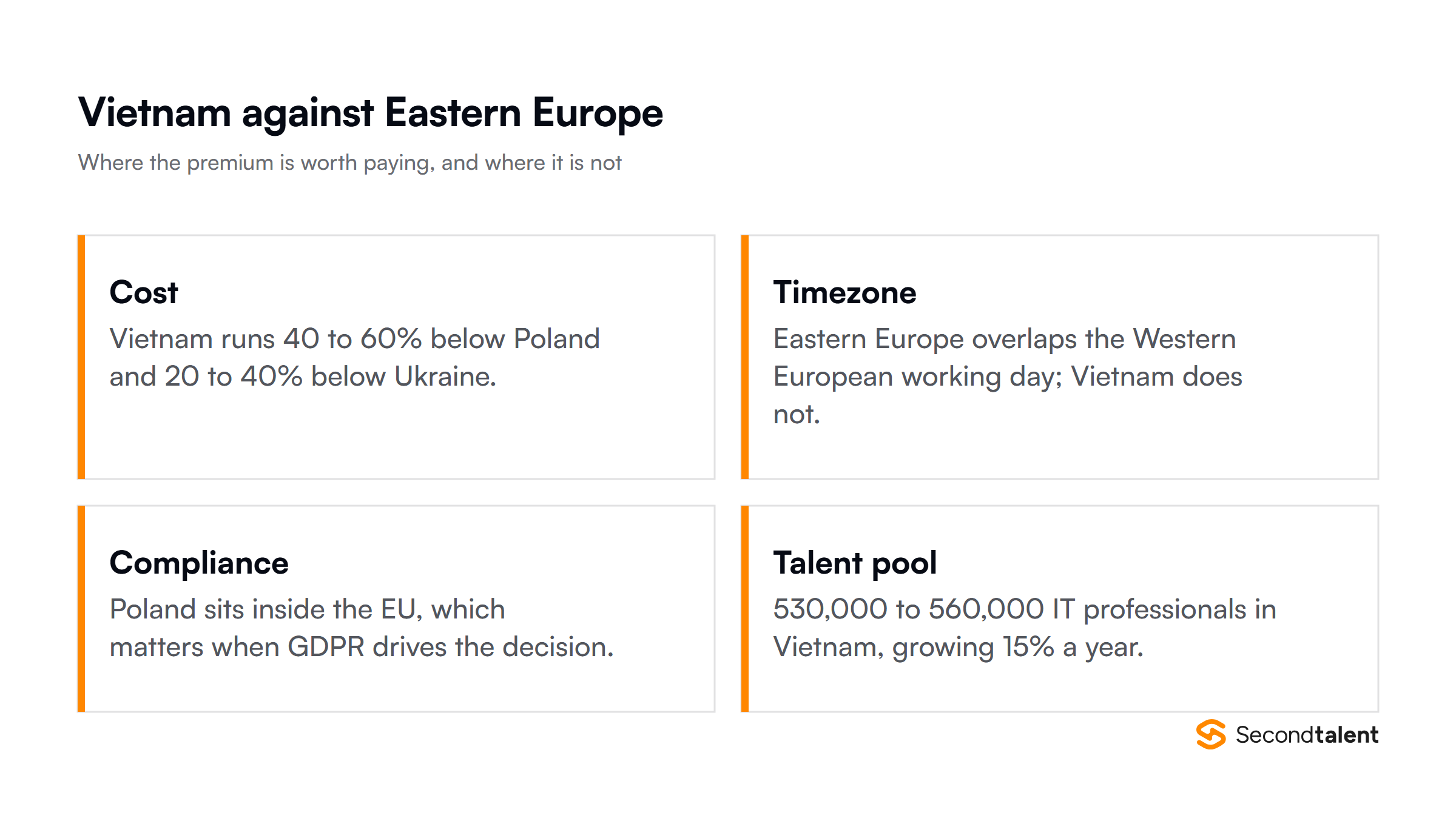
Vietnam is 40-60% cheaper than Poland and 20-40% cheaper than Ukraine. Eastern Europe’s advantages are timezone overlap with Western Europe and EU data compliance (for Poland). If you are a European company that needs GDPR compliance and real-time collaboration, Poland or Romania may justify the premium. For everyone else, Vietnam offers significantly better value.
Vietnam’s Tech Ecosystem in 2026
Vietnam is not a scrappy emerging market. It is a scaled, government-backed tech ecosystem.
By the Numbers
- 530,000-560,000 IT professionals. Growing 15% year-over-year.
- 57,000+ software engineering graduates per year.
- $2.37 billion IT services market. Projected to reach $4 billion by 2030.
- Top 6 on the Kearney Global Services Location Index.
- Internet speed: 261.8 Mbps fixed broadband. Global top 10. 5G coverage at 90.2%.
Three Tech Hubs
| City | Workforce Share | Strengths | Cost Level |
|---|---|---|---|
| Ho Chi Minh City | ~60% of IT workforce | Largest talent pool. Intel, Samsung, FPT HQ. Most outsourcing firms. | Highest |
| Hanoi | ~30% | Strong university pipeline. Government and enterprise clients. | 10-15% below HCMC |
| Da Nang | ~10% (growing) | Emerging hub. FPT R&D center. Lower costs. Better quality of life. | 30-50% below HCMC |
Da Nang is the one to watch. FPT just opened a High-Tech and Semiconductor R&D Center there. Over 70 tech businesses operate in the city. Salaries are 30-50% lower than HCMC. If you want the best value in Vietnam, Da Nang developers offer it.
Government Incentives for IT
The Vietnamese government actively supports the IT sector with tax breaks and incentives.
| Incentive | Details |
|---|---|
| Corporate Income Tax | 10% for 15 years (vs. standard 20%) for software production |
| Tax holiday | 4 years exemption + 9 years at 50% reduction |
| Software export VAT | 0% (tax-free) |
| R&D fund | Up to 20% of pre-tax profits (tax-deductible) |
| Personal Income Tax | 5-year PIT exemption for digital technology personnel (new 2025) |
These incentives do not directly reduce your cost as a foreign client. But they make it cheaper for Vietnamese companies to operate and invest in developer training. That keeps the talent pool growing and rates competitive.
Popular Tech Stacks
Vietnam’s developer ecosystem is modern. Java is the most in-demand backend language. React dominates the frontend. Here is what Vietnamese developers work with.
- Frontend: React.js (dominant), Angular, Vue.js, Next.js
- Backend: Java (highest demand), Node.js, Python, PHP/Laravel, .NET, Go
- Mobile: React Native, Flutter, native iOS/Android
- Cloud: AWS (most common), Azure, GCP
- DevOps: Docker, Kubernetes, Jenkins, Terraform
- Database: PostgreSQL, MySQL, MongoDB, Redis
80% of Vietnamese companies search for JavaScript skills. React + Node.js + PostgreSQL is the most common full-stack combination. If your product runs on this stack, you will have no trouble finding talent.
Real Cost Scenarios
Scenario 1: One Senior Full-Stack Developer (Direct via EOR)
| Cost Item | Monthly | Annual |
|---|---|---|
| Gross salary | $5,600 | $67,200 |
| Employer contributions (23.5%) | $1,316 | $15,792 |
| 13th month (8.3%) | $465 | $5,578 |
| EOR fee | $500 | $6,000 |
| Equipment + tools | $200 | $2,400 |
| Total | $8,081 | $96,970 |
The same developer in the US costs $180,000-$264,000/year fully loaded. Vietnam saves 55-63%.
Scenario 2: 5-Person Team via Staff Augmentation Agency
| Role | Monthly Billed Rate |
|---|---|
| 2x Senior developers @ $7,700/mo | $15,400 |
| 2x Mid-level developers @ $5,300/mo | $10,600 |
| 1x QA automation engineer @ $4,500/mo | $4,500 |
| PM allocation (partial) | $2,800 |
| Total monthly | $33,300 |
| Total annual | $399,600 |
The same team in the US costs $960,000-$1,440,000/year. Vietnam saves 58-72%.
Scenario 3: 5-Person Team via Direct Hire (EOR)
| Line Item | Monthly Cost |
|---|---|
| Tech Lead (7 years, React + Node.js) | $6,300 |
| Mid-Level Engineer #1 (4 years, Python) | $4,200 |
| Mid-Level Engineer #2 (3 years, Java) | $3,800 |
| Junior Engineer (2 years, Full-stack) | $2,800 |
| QA Automation (3 years, Cypress) | $3,200 |
| Subtotal: Salaries | $20,300 |
| Employer contributions (23.5%) | $4,771 |
| 13th month (8.3%) | $1,685 |
| EOR fees (5 x $450) | $2,250 |
| Equipment + tools (5 devs) | $1,000 |
| Total Monthly | $30,006 |
| Total Annual | $360,072 |
Direct hire via EOR saves roughly $40,000/year compared to the agency model for the same team. The trade-off is you handle management, recruitment, and onboarding yourself. One startup we worked with started with agency staff augmentation for the first 6 months, then transitioned their best developers to direct hire via EOR. That hybrid approach let them validate talent before committing.
Risks and How to Manage Them
English proficiency. Vietnam ranks 64th globally in the EF English Proficiency Index. That is “Moderate Proficiency.” Below the Philippines (28th) and Malaysia. English is significantly better among IT professionals than the general population. But always run a 30-minute English interview. Test written communication. Poor English causes more project delays than poor code.
Timezone. Vietnam is GMT+7. That is 12 hours ahead of US East Coast and 7 hours ahead of London. You get 2-4 hours of overlap with US teams and 4-5 hours with European teams. Vietnamese developers are used to flexible hours. Many work split shifts to accommodate Western clients.
IP protection. Vietnam is a member of the Berne Convention and WTO/TRIPS. Software copyright is protected automatically. Major IP law amendments passed in December 2025 strengthen digital economy protections. Register your IP with Vietnam’s National Office of Intellectual Property. Use strong NDAs and IP assignment clauses in contracts.
Turnover. Average IT tenure in Vietnam is 1.5-2.5 years. Shorter than Western norms. Wage inflation is 15-20% annually. Developers get recruited aggressively. Pay competitive remote-market rates. Offer career growth. Budget for annual raises of 10-15%. One client we work with offers a retention bonus at 12 months. Their turnover dropped from 25% to 8%.
Infrastructure. No longer a concern. Vietnam’s fixed broadband speed is 261.8 Mbps. That ranks in the global top 10. 5G coverage reaches 90.2% of the population. The government is investing in 15 international submarine cable systems with 350 Tbps capacity. Internet reliability in HCMC, Hanoi, and Da Nang is excellent.
How to Get Started
Choose Your Model
For 1-3 developers, long-term: Direct hire via EOR. Lowest cost. Full control. For a quick-start team of 5+: Staff augmentation agency. Fast setup, higher cost. For a one-time project: Project-based outsourcing. Fixed scope, fixed price. For a permanent Vietnam office: BOT. Highest upfront cost, lowest long-term cost.
Start in HCMC or Hanoi
Ho Chi Minh City has the largest talent pool. Hanoi is 10-15% cheaper with a strong university pipeline. Da Nang is the budget option but the talent pool is smaller. Start where the talent is deepest. Optimize for cost later.
Budget for the True Cost
Multiply the gross salary by 1.5x for direct hires (to cover social insurance, 13th month, EOR, and tools). Through an agency, the billed rate is the total cost. Do not budget based on local Vietnamese salaries. Budget based on remote-market rates.
Use a Talent Partner
Vietnam has 530,000+ developers but finding the right one takes time. A talent sourcing partner screens for English, technical skills, and remote-work readiness. Check the developer rate card for current Vietnam benchmarks. Explore our Vietnam hiring page for available developers.
The Bottom Line
Outsourcing software development to Vietnam costs 55-70% less than the US. A mid-level developer costs $3,500-$5,300/month in salary, or $5,200-$7,900/month fully loaded with all employer costs. Through an agency, expect $4,200-$6,300/month billed.
The hidden costs are real. Social insurance adds 23.5%. The 13th month salary adds 8.3%. EOR fees add $400-$600/month. Equipment and tools add $200/month. Budget 1.5x the gross salary for the true cost.
Vietnam’s advantages go beyond cost. 560,000 developers. Top 6 on Kearney’s global services index. 261 Mbps internet. Government tax incentives. Intel, Samsung, and Google already operate here. The talent pipeline is deep and getting deeper every year.
The risk is manageable. English is moderate but improving. Timezone requires async workflows. Turnover requires competitive compensation. IP laws are strengthening. None of these are deal-breakers. They are planning considerations.
For startups and scale-ups building product teams, Vietnam offers the strongest combination of engineering talent, cost savings, and ecosystem maturity in Southeast Asia.
Hire vetted remote developers from Vietnam with Second Talent to build your engineering team at 55-70% lower cost than US hires.
Hiring contractors rather than employees changes the arithmetic. The freelance developer rate index prices 14 roles across nine regions, benchmarked against North America and sourced from published wage data.






![Countries With the Highest Software Engineer Salaries. Top 10 Countries With the Highest Software Engineer Salaries [2026], by Second Talent.](https://www.secondtalent.com/wp-content/uploads/2026/09/countries-with-highest-software-engineer-salaries-featured-v2-768x403.jpg)