
TL;DR: Seven trends shape software development in Singapore in 2026, led by AI coding tools becoming standard and tech hiring moving into banks, government and logistics. Every hire got more expensive: the Employment Pass salary floor rises to S$6,000 in 2027 and the CPF wage ceiling reached S$8,000 in January. A senior engineer with AI skills earns a median S$10,000 a month.
Most of Singapore's software engineers do not work for tech companies.
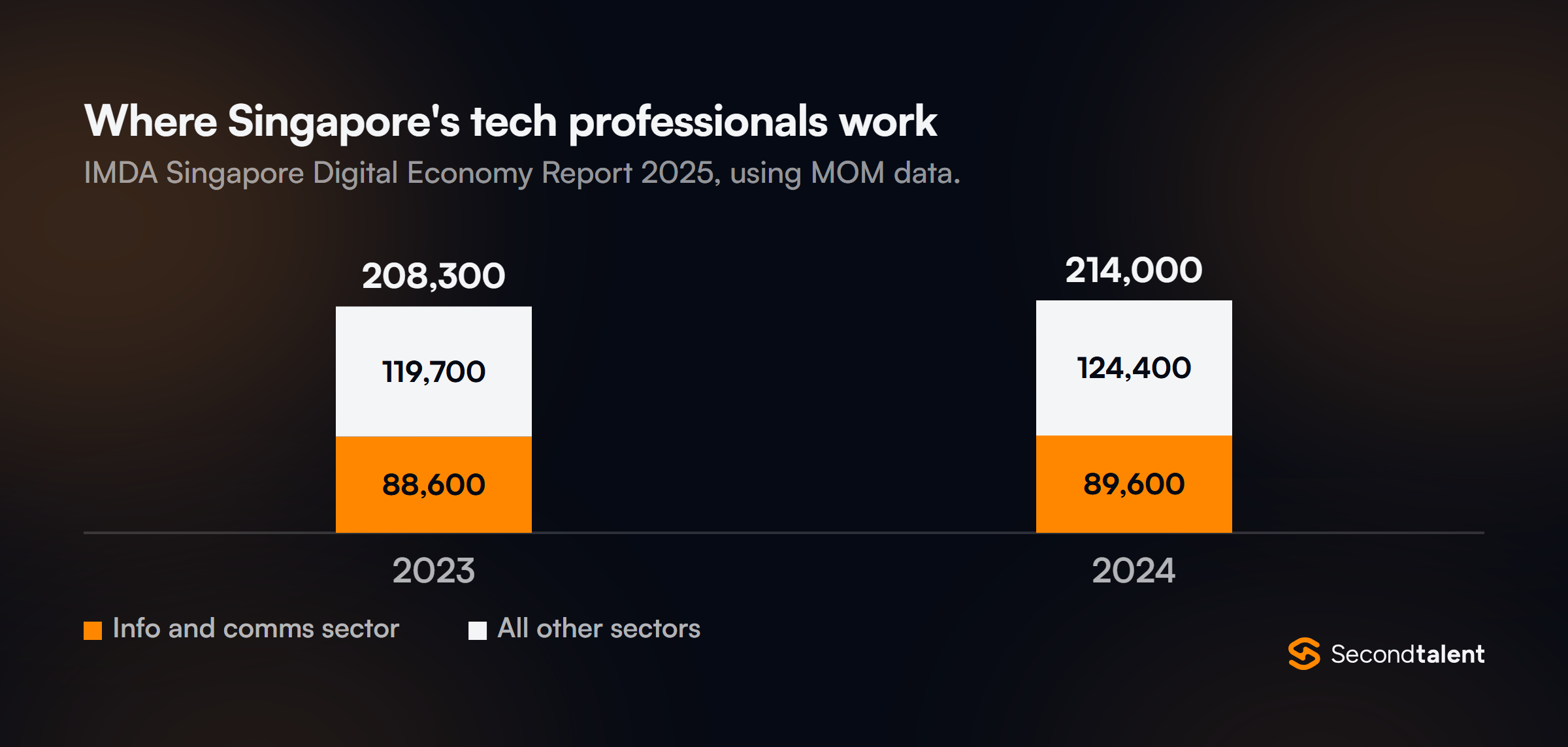
Of the 214,000 tech professionals counted in 2024, 124,400 worked outside the information and communications sector, in banks, government, logistics and other industries. Tech jobs grew 3.9% there, against 1.1% inside the tech sector.
- 1Python appeared in 24% of Singapore tech job postings in 2024, up 9 points in five years.
- 2AI use among SMEs more than tripled in a year, from 4.2% to 14.5%, while larger firms went from 44.0% to 62.5%.
- 3Mid-level pay rose only 1.7% in a year while senior pay rose 12.6%. The market is paying for experience, not for headcount.
- 495% of employers report difficulty hiring tech talent, and data roles are the hardest to fill.
The 7 Trends Shaping Software Development in Singapore in 2026
1. AI coding tools are the default, and they now set pay
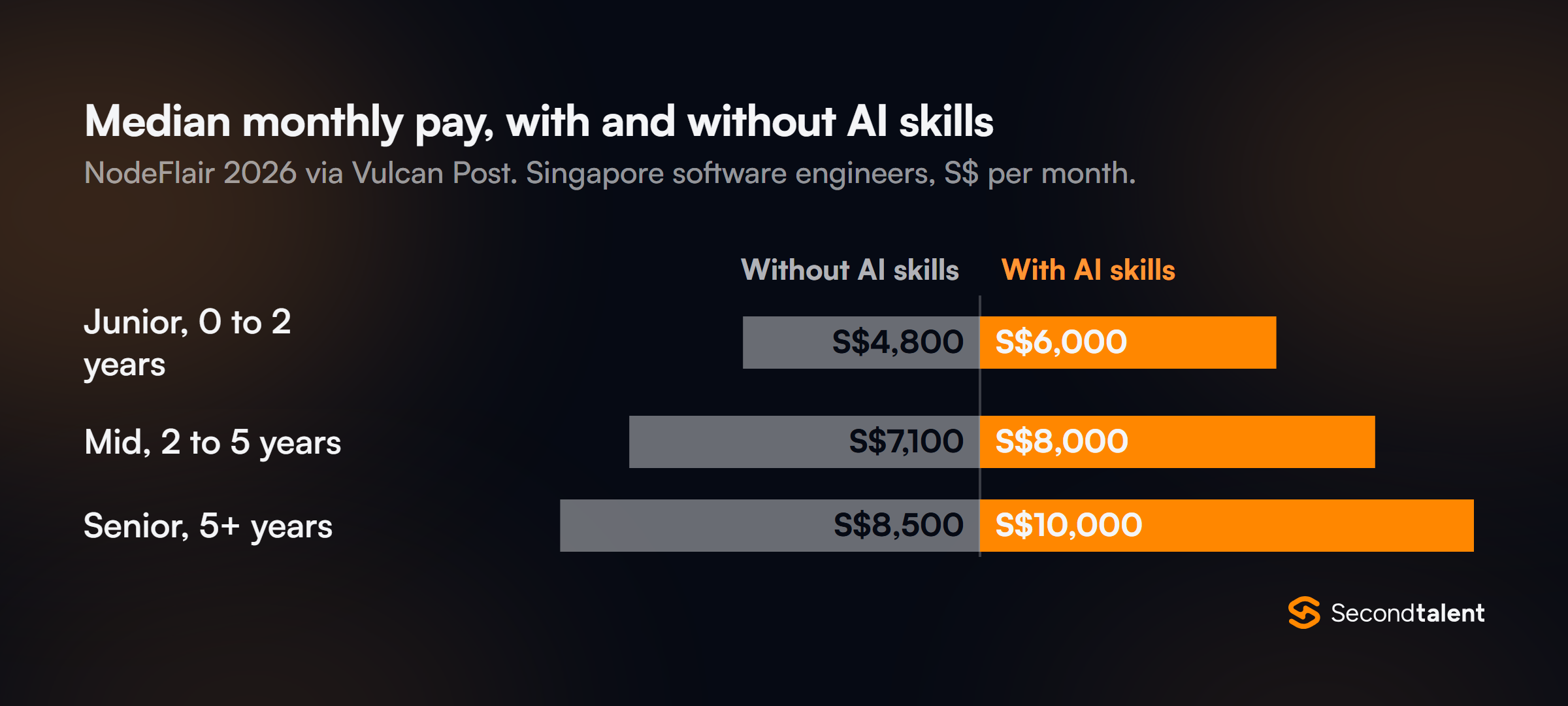
NodeFlair's 2026 salary data put a price on AI fluency. A junior engineer with AI skills earns a median S$6,000 a month, against S$4,800 without, a 25% premium.
The premium is 13% at mid level and 18% at senior level, Vulcan Post reported in May 2026.
The tools are close to universal. In the 2025 Stack Overflow Developer Survey, 84% of developers used or planned to use AI tools, and 51% of professional developers used them every day.
Trust has not kept pace: 46% said they distrust the accuracy of AI output, against 33% who trust it.
That gap is what the premium pays for. Generating code is cheap; reviewing it, testing it and catching what the model got wrong is the scarce skill. Agents are still early, with 14% of developers using them at work daily.
Sentiment has cooled as use has grown: 60% of respondents viewed AI tools favourably in 2025, down from more than 70% in the two years before, though 52% said the tools had improved their productivity.
2. Software is now built outside the tech sector
The tech workforce grew 2.7% in 2024, from 208,300 to 214,000, and most of that growth came from companies whose main business is not technology.
Tech jobs outside the information and communications sector rose from 119,700 to 124,400, according to IMDA's Singapore Digital Economy Report 2025, whose latest figures describe 2024.
The money followed. Singapore's digital economy reached S$128.1 billion in 2024, 18.6% of GDP. Digitalisation in the rest of the economy produced S$86.8 billion of that, up 12.2% in a year.
For a software startup, this means the competition for a senior engineer is often a bank or a government agency, not another startup.
Pay has moved with the jobs. The median monthly wage for resident tech workers rose 13.6% in 2024, to S$7,950, against 6.8% growth for all resident workers. Tech jobs now make up 5.3% of total employment.
3. Smaller firms have started buying AI
AI adoption among SMEs more than tripled in 2024, from 4.2% to 14.5%, driven mainly by micro and small companies. Among larger firms it rose almost 20 points, from 44.0% to 62.5%. Both figures come from the same IMDA report.
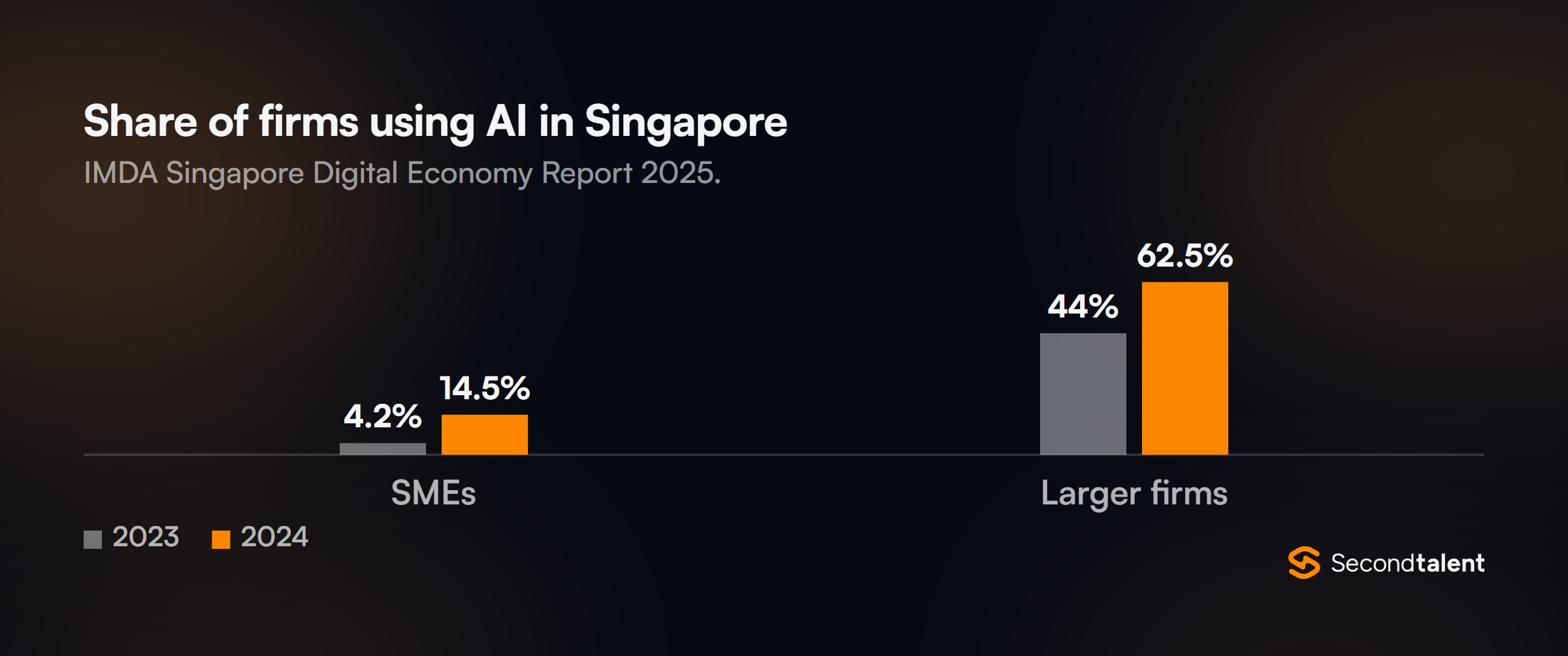
SME adoption is still low, and that is the opportunity. At 14.5%, most small companies have not yet integrated AI into their systems, so most of that integration work is still ahead.
Workers who use AI report clear gains. In IMDA's 2025 survey, 85% of AI-using workers said it made them more efficient, 48% more creative and 33% better at learning new skills.
The report also found firms spreading AI across more functions: an average of five for larger firms and three for SMEs.
4. Python, SQL and cloud skills dominate job postings
IMDA analysed tech job postings from Lightcast to see which skills employers ask for. Employers asked for Python in 24% of tech postings in 2024, 9 points more than in 2019, and SQL in 20%. Cloud platform skills rose almost as fast.
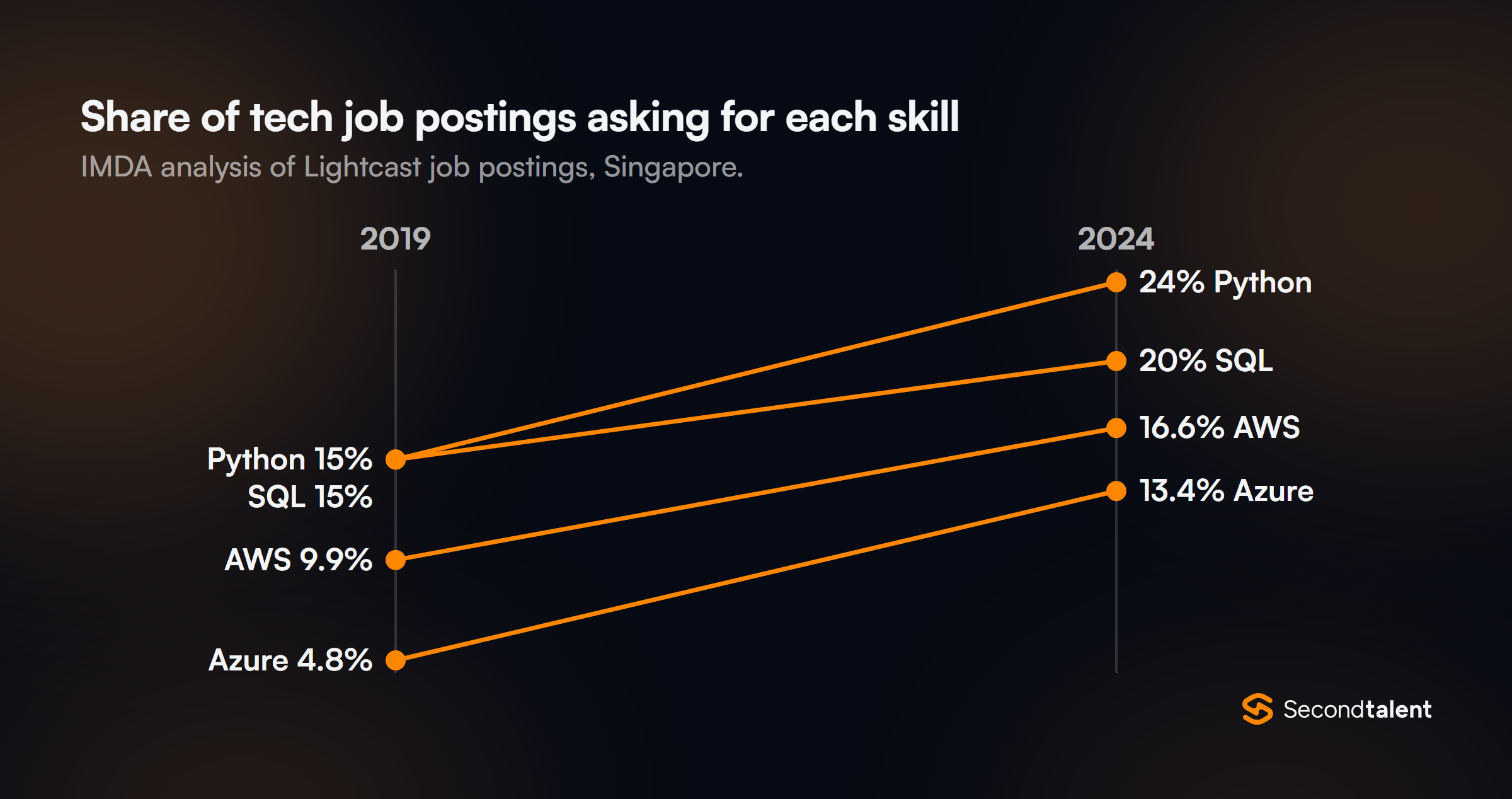
AWS appeared in 16.6% of postings in 2024, up from 9.9% in 2019, and Microsoft Azure in 13.4%, up from 4.8%.
The report also names containers, orchestration and automation, meaning Docker, Kubernetes, Ansible and Jenkins, as skills employers increasingly want.
5. Compute is rationed, so efficiency is an engineering skill
Singapore controls data centre growth tightly. Its Green Data Centre Roadmap releases at least 300 MW of new capacity, plus 200 MW for operators using green energy, with a power usage effectiveness target of 1.25 or better for new capacity.
New capacity also comes with conditions. Applicants must draw at least half their power from green sources, and the first tranche of new capacity deploys between 2026 and 2028.
For most software teams, training large models locally is off the table; running and serving them is not.
The effect reaches ordinary software teams as a premium on efficiency. Engineers who cut compute use through caching, batching, right-sized instances and smaller models lower what a product costs to run.
Our AI trends in Singapore piece covers the data centre pipeline in more detail.
6. The government is paying for AI projects
Budget 2026 extended the Enterprise Innovation Scheme to AI, so qualifying AI spending now attracts a 400% tax deduction, capped at S$50,000 of spend a year for the 2027 and 2028 years of assessment, CNBC reported.
The Enterprise Compute Initiative pairs companies with cloud and AI providers for credits and advice. Together these cut the cost of compute and tooling for an AI build.
They do nothing for salaries, which is where most of a software budget goes.
Private money followed the public money. OpenAI committed more than S$300 million to Singapore's AI ecosystem in May 2026, and Microsoft announced US$5.5 billion of spending in April.
Singapore now hosts more than 70 AI Centres of Excellence, from NVIDIA, KPMG, Sea and Temus among others, EDB counts. Each one hires engineers from the same pool.
7. Every hire costs more, local or foreign
Foreign engineers first. An Employment Pass needs a salary of at least S$5,600 a month today, rising with age to S$10,700 for candidates aged 45 and over.
From 1 January 2027 the floor rises to S$6,000 for new applications, and from 2028 for renewals, according to the Ministry of Manpower. Candidates must also pass the COMPASS points framework.
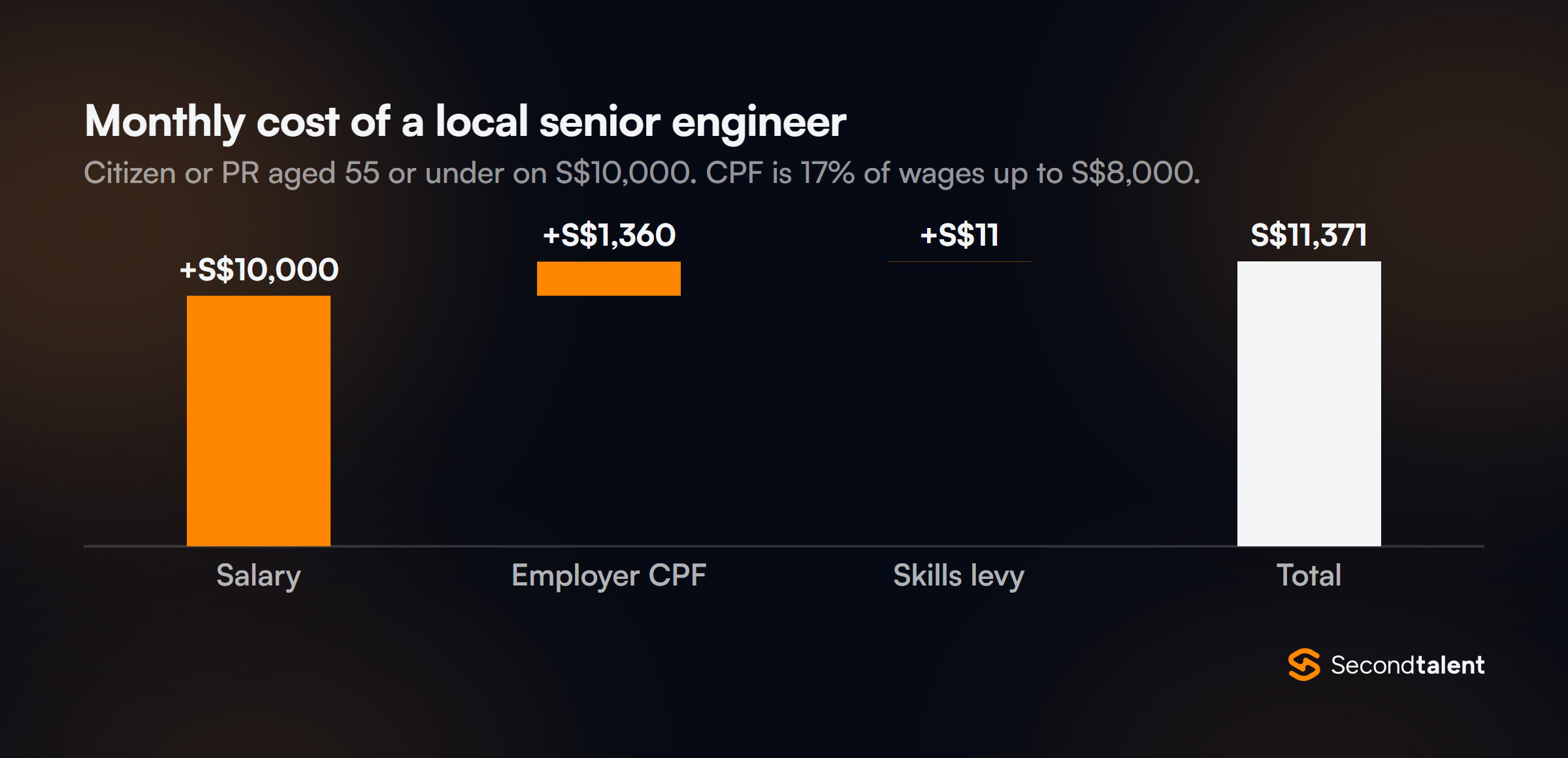
Local hires cost more too. The CPF Ordinary Wage ceiling rose to S$8,000 on 1 January 2026, and employers pay 17% on wages up to it for Citizens and Permanent Residents aged 55 and under.
For a senior engineer on S$10,000 a month, employer CPF is now S$1,360, as our Singapore payroll and tax guide works through.
- No CPF: only the Skills Development Levy, up to S$11.25 a month
- Salary floor S$5,600, rising with age
- Must pass COMPASS unless paid S$22,500 or more
- Employer CPF 17% of wages up to S$8,000
- Up to S$1,360 a month on top of salary
- No work pass, no salary floor
Demand keeps the squeeze on.
In General Assembly's State of Tech Talent report, 95% of Singapore employers reported at least some difficulty hiring tech talent, and 58% named data analytics and data science as the hardest roles to fill, HRD Asia reported in May 2026.
Four dates in this cycle change what a Singapore engineering team costs to run.
What Software Developers Earn in Singapore in 2026
Pay is rising fastest at the top. NodeFlair's 2026 data showed senior salaries up 12.6% year on year and lead salaries up 11.6%, while mid-level pay rose 1.7%.
At the top of the market, NodeFlair put lead data scientists at a median S$25,000 a month and software engineering managers at S$20,100.
Across all tech occupations, the resident median was S$7,950 a month in 2024, against S$4,860 for all resident workers, according to IMDA using MOM data.
AI specialists sit higher still. Our rate card puts dedicated mid-level AI engineers in Singapore at S$10,000 to S$15,000 a month and senior AI engineers at S$15,000 to S$22,000.
For AI roles, our Singapore AI engineer rate card breaks pay down by seniority, and the cost to hire in Singapore adds employer contributions and fees. The Asia Tech Salary Index compares the same roles across the region.
Building a Team in Singapore, or Around It
Most companies we work with keep leads and architects in Singapore, close to customers and regulators, and build the wider team in Vietnam, the Philippines or Malaysia, all within an hour of Singapore time.
That saves 50% to 70% on the same seniority. We match vetted developers in Singapore and across the region, and our Singapore employer of record employs them without a local entity.
Tell us what you are building and we will send profiles within 24 hours.
Frequently Asked Questions
How big is Singapore's tech workforce?
214,000 tech professionals in 2024, 5.3% of total employment, according to IMDA. The number grew 2.7% in 2024, down from 3.4% the year before.
What does a software engineer earn in Singapore?
On NodeFlair's 2026 data, a median S$8,500 a month for a senior engineer without AI skills and S$10,000 with them. Juniors start around S$4,800 to S$6,000.
Can a foreign company hire developers in Singapore without an entity?
Yes, through an employer of record, which employs the developer, runs payroll and CPF, and handles work pass applications. It is the usual route for the first few hires.
Which programming languages are most in demand in Singapore?
Python and SQL, which appeared in 24% and 20% of tech job postings in 2024 on IMDA's analysis. AWS and Azure skills grew fastest between 2019 and 2024.


![How to Hire Developers in Asia Remotely. How to Hire Developers in Asia Remotely from the USA [2026], by Second Talent.](https://www.secondtalent.com/wp-content/uploads/2026/09/hire-developers-in-asia-remotely-featured-v2-768x403.jpg)
![AI Outsourcing in Singapore. Top 10 AI Outsourcing Companies in Singapore [2026], by Second Talent.](https://www.secondtalent.com/wp-content/uploads/2026/09/ai-outsourcing-companies-singapore-featured-v2-768x403.jpg)
![AI Outsourcing in India. Top 10 AI Outsourcing Companies in India [2026], by Second Talent.](https://www.secondtalent.com/wp-content/uploads/2026/09/ai-outsourcing-companies-india-featured-v2-768x403.jpg)