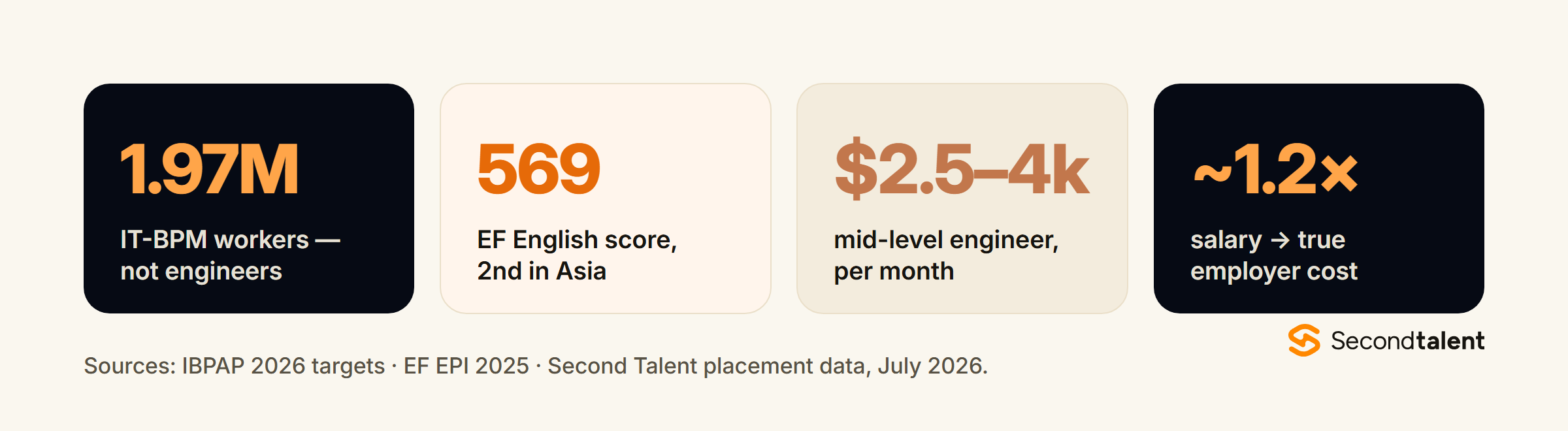
TL;DR — Yes, with conditions. The Philippines has genuine depth in frontend, backend, full-stack, QA and mobile engineering, and the strongest business English in Southeast Asia after Malaysia. It does not have depth in senior DevOps, cloud security or AI research. Mid-level engineers cost $2,500–$4,000 a month remotely, and a $3,200 salary is really a $4,100+ monthly commitment once the 13th month, statutory contributions and employment costs are counted. The single biggest misconception is timezone: a normal Manila workday overlaps a US workday by zero hours. US coverage is bought with night shifts, and night shifts are the main reason Filipino engineering hires churn.
Ask a founder in San Francisco or London what they think about hiring engineers in the Philippines and you will usually get one of two answers. Either it is “cheap offshore support, not real engineering,” or it is “1.9 million tech workers and everyone speaks English.” Both are wrong, and they are wrong in the same way: they treat a diverse labour market as a single product.
The Philippines is a serious engineering market with specific strengths and specific limits. The companies that do well there have matched their roles to those strengths. The companies that come away disappointed usually bought on price, hired through a vendor model designed for call centres, and then concluded that the country cannot produce senior engineers. This guide sets out what the 2026 data actually shows.
The headline number describes an industry, not an engineering pool
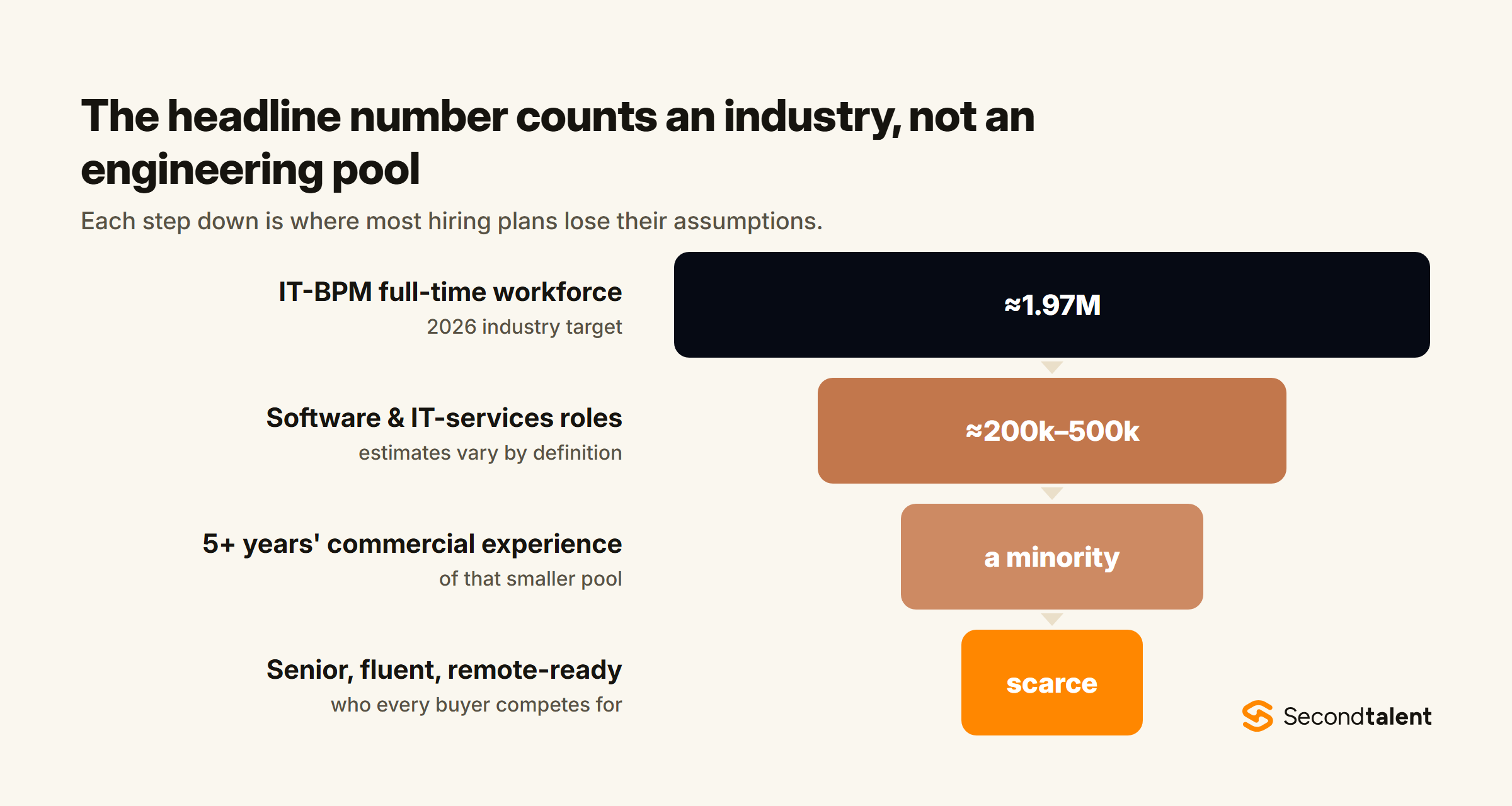
The number quoted in almost every article about Philippine tech talent is the IT-BPM workforce. The industry association, IBPAP, targets roughly 1.97 million full-time employees and about $42.3 billion in revenue by the end of 2026, after closing 2025 at around 1.9 million workers and $40 billion. Those are real numbers and the industry is genuinely large.
They are also not a count of software engineers. IT-BPM covers contact centres, healthcare information management, finance and accounting outsourcing, animation and game development, and IT services. Software and IT-services roles are a minority slice of it. Published estimates of the country’s developer population range from about 200,000 to over 500,000 depending on whether the definition includes IT support, QA, data entry adjacent roles, and freelancers — a spread wide enough that no single figure should be trusted on its own.
The direction of travel is up. GitHub’s Octoverse 2025 report put the Philippines inside the top 20 developer communities globally for the first time, overtaking Australia. But growth is concentrated at the entry level, which is precisely where hiring is already easy and where the value of an offshore hire is lowest.
The number you should plan against
Do not size your hiring plan against 1.97 million. Size it against the number of engineers who have five or more years of commercial experience in your stack, write clear English, and are willing to work your hours. That pool is small, it is contested by every other international buyer, and it does not respond to below-market offers.
What Filipino engineers actually cost in 2026
“Developer” is not a price point. A QA engineer and an AI/ML engineer in the same city differ by more than two and a half times. The chart below shows what an international employer pays a mid-level engineer — three to five years of experience — working remotely, per month, in USD.
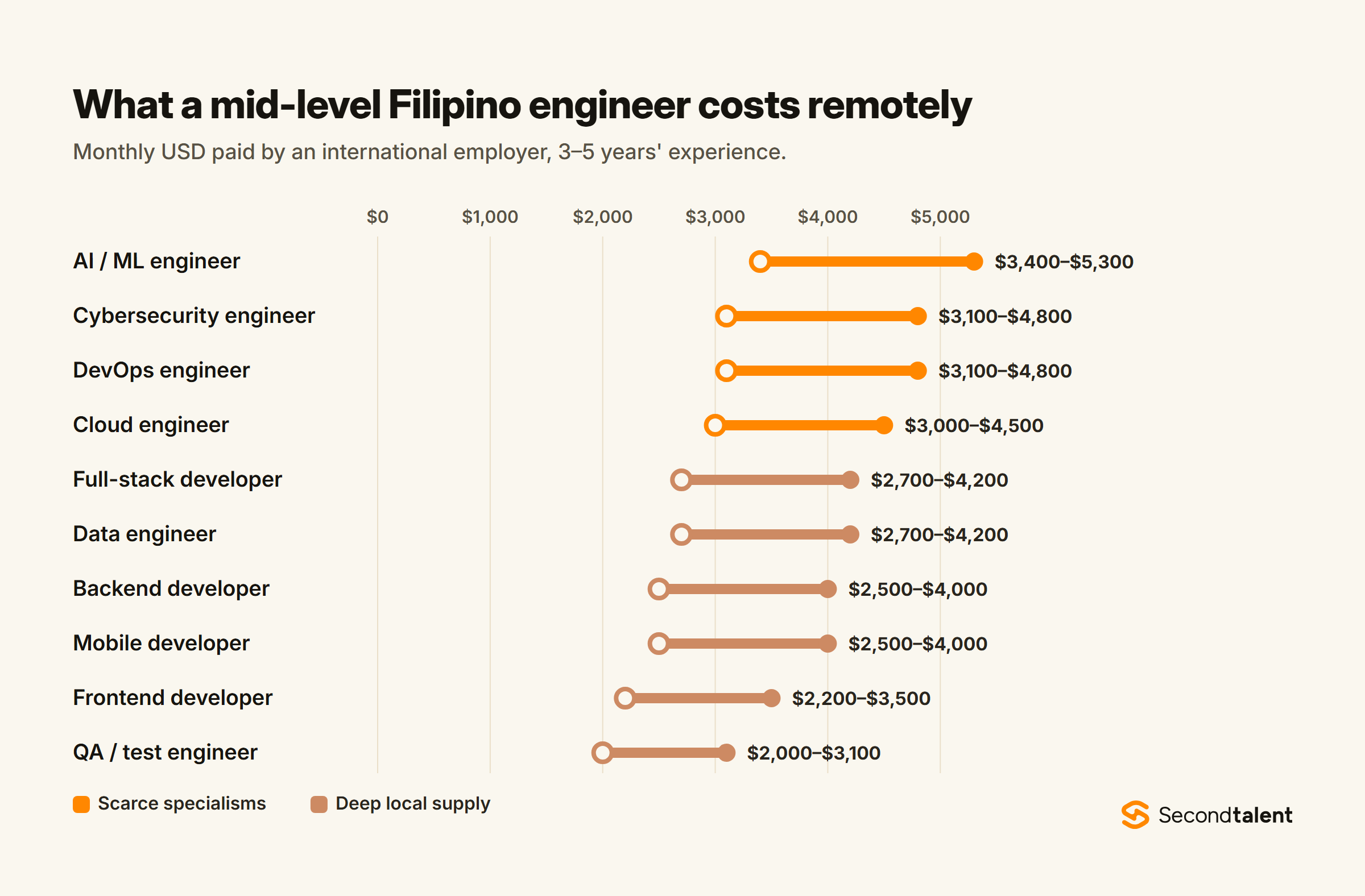
These are remote rates, not local ones. An engineer employed by a Philippine company in Makati earns roughly 20–30% less than the same engineer working for a foreign employer. That premium is smaller than in Vietnam or Indonesia because the Philippines has a longer remote-work history through its outsourcing sector, but it is real and you should budget for it. Our full cost breakdown by role covers all twelve roles with local and remote figures side by side.
Seniority moves the number far more than specialisation does.
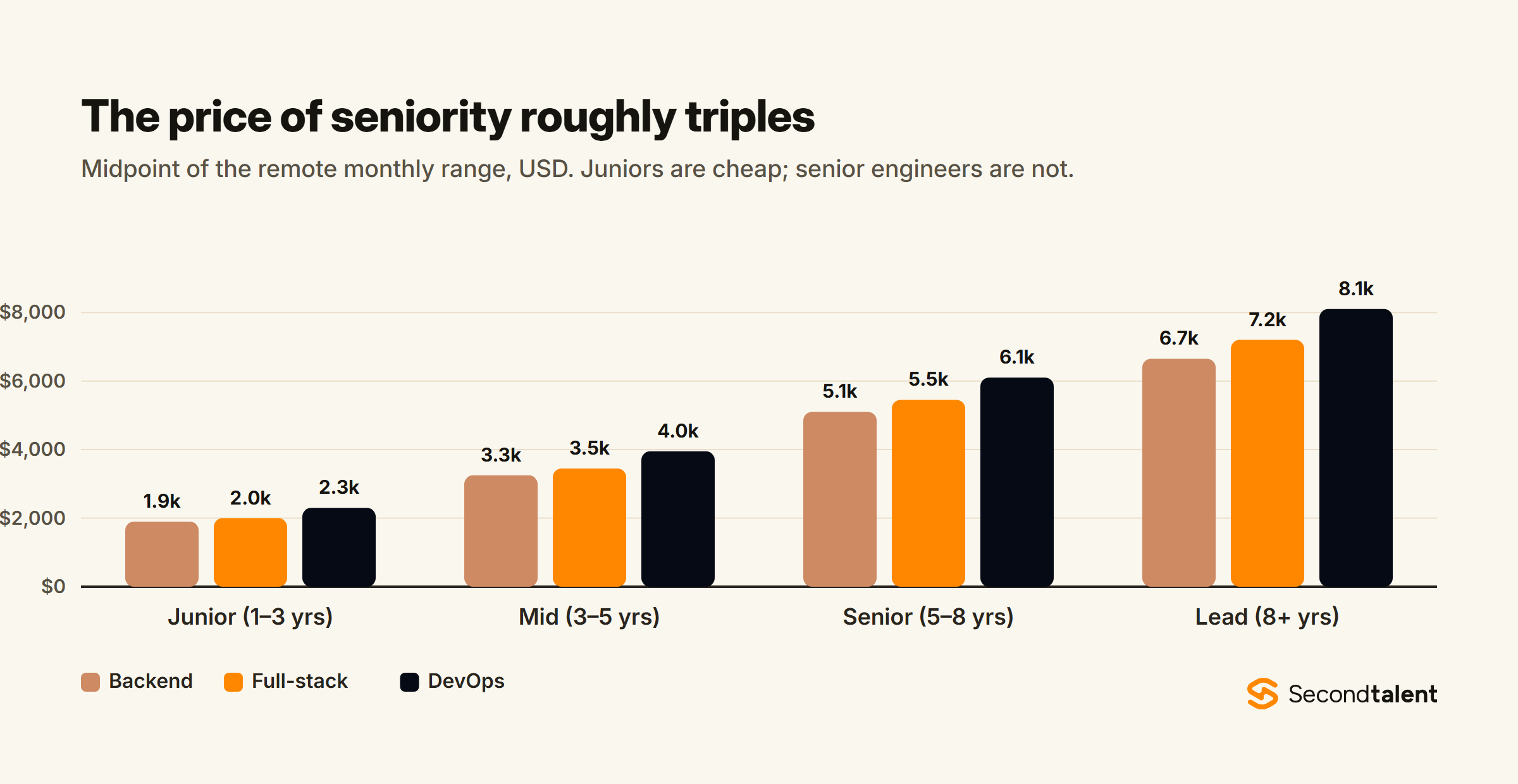
A junior backend developer at $1,900 and a lead DevOps engineer at $8,100 are both “Philippine rates.” Between them sits every disappointing offshore engagement ever run: a budget set at the junior end, expectations set at the lead end.
Pay the remote market, not the local market
Anchoring an offer to Philippine domestic salary surveys is the most common self-inflicted wound in this market. The engineers you want already have offers from Singaporean, Australian and American employers. If you offer $1,800 for a mid-level full-stack role, you will not get a cheaper version of that engineer — you will get a different, weaker candidate pool and a 12-month replacement cycle.
English is the advantage, and it is measurable
Most claimed advantages in offshore hiring are unfalsifiable. This one is not. The EF English Proficiency Index scored the Philippines at 569 in its 2025 edition — 28th of 123 countries, second in Asia behind Malaysia, and well clear of the 488 global average.
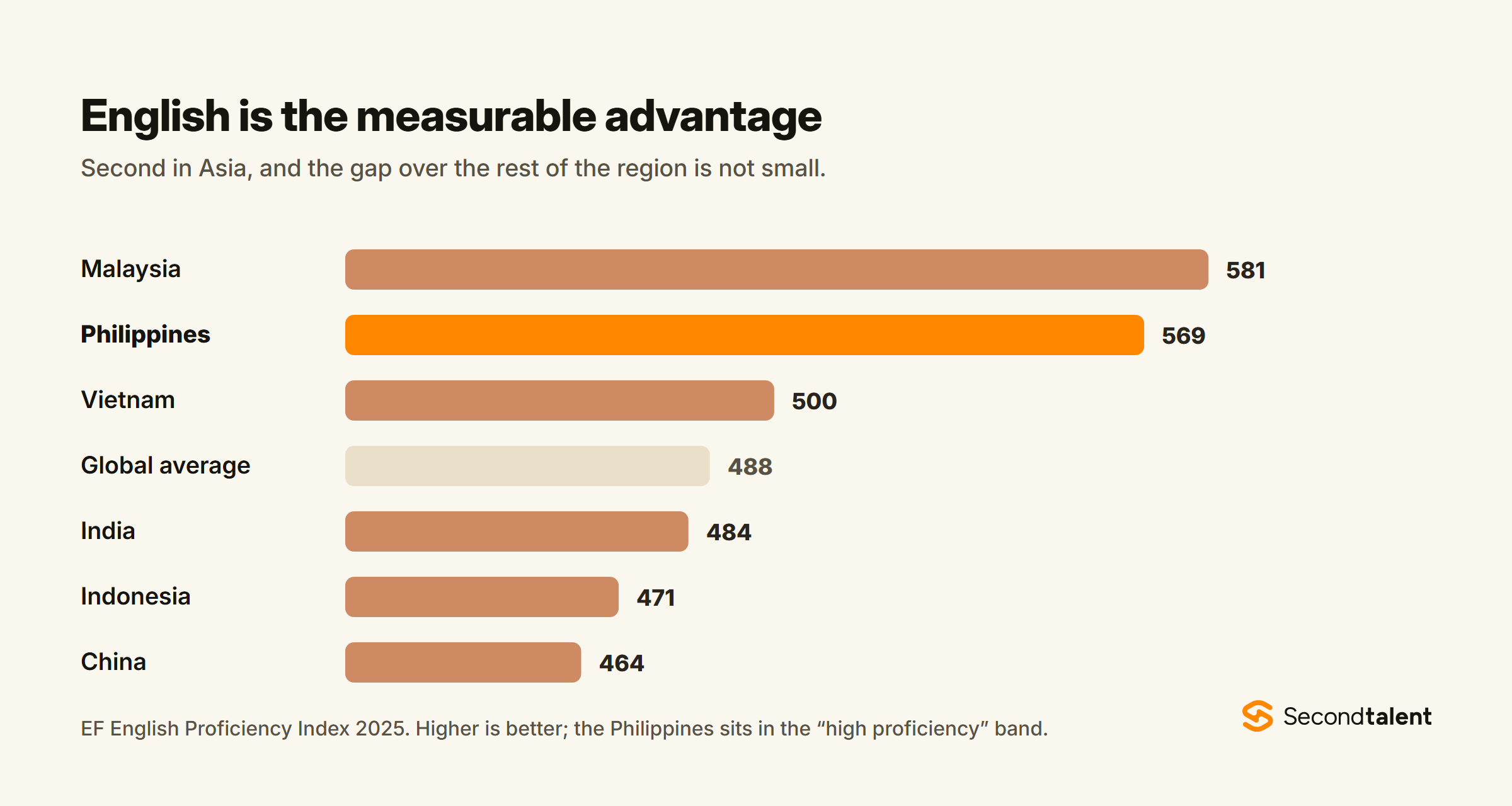
What that buys you is specific and worth naming. Code review comments land the first time. Incident write-ups are readable without a translation pass. An engineer can join a customer call, take the technical question directly, and answer it. You do not need a bilingual team lead acting as a permanent interface, which is a real salaried cost in markets where English is a second skill rather than a working language.
It also has a limit worth stating plainly. Conversational fluency is near-universal among Philippine engineers; precise technical writing is not, in any market. Test for the writing you actually need — a design document, a bug report, a post-incident summary — rather than assuming the country score covers it. Our guide to evaluating engineering quality remotely covers how to structure that.
The timezone claim is mostly wrong
Philippine Standard Time is UTC+8 and the country does not observe daylight saving. Marketing copy across this industry claims “convenient overlap with US business hours.” Run the arithmetic and it disappears.
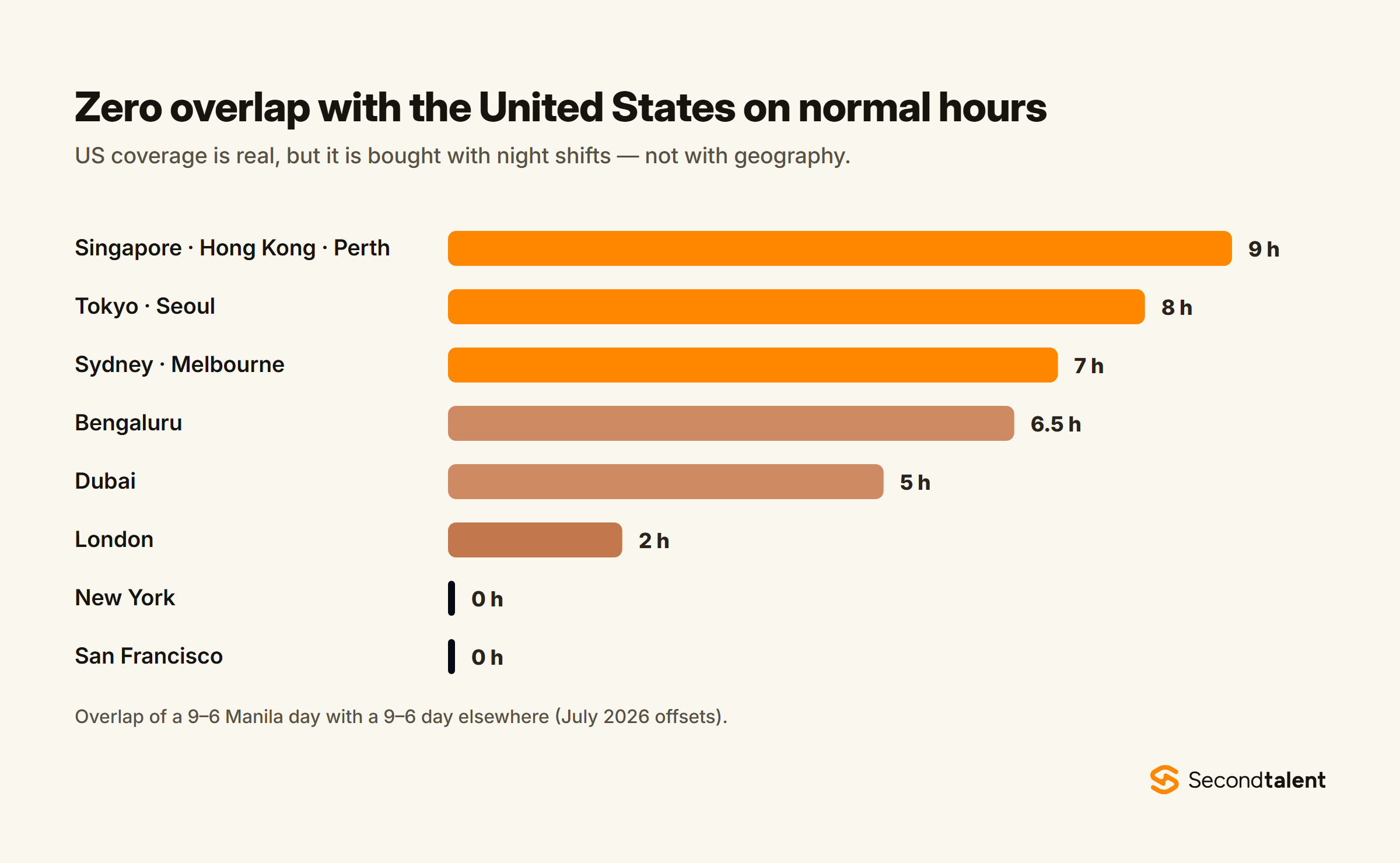
A 9-to-6 Manila day overlaps a 9-to-6 New York day by zero hours, and a San Francisco day by zero hours. It overlaps Singapore and Hong Kong completely, Tokyo and Seoul by eight hours, Sydney by seven, and London by two. For Asia-Pacific and Middle East companies, the Philippines is genuinely same-day. For American companies it is not — and pretending otherwise sets up the failure.
Filipino engineers do work US hours, in large numbers, because the outsourcing sector normalised night shifts two decades ago. That is a real option and you should price it as one. It carries a premium, and it carries attrition: industry attrition in Philippine IT-BPM runs at roughly 30–40% a year, and night-shift roles sit at the high end of that range. If your team is in Europe or Australia, you can get the same engineers on daylight hours and keep them longer.
Night shift is a retention decision, not a scheduling detail
If you need live US-hours coverage, say so in the job description, pay a night differential, and expect a shorter average tenure. If you do not strictly need it — and most product engineering teams do not — run the role asynchronously on Manila daylight hours. The same budget buys a materially better engineer who stays materially longer.
Where the pool is deep, and where it runs out
This is the part most country guides refuse to write, because admitting a market has gaps costs them placements. The Philippines has real depth in web and application engineering, and thin supply in infrastructure-heavy and research-heavy specialisms.

The pattern behind that grid is historical. Two decades of outsourced web development, application maintenance and QA built enormous supply in React, Node, PHP, Java, .NET, manual and automated testing, and mobile. Cloud-native infrastructure work and security engineering arrived later and mostly inside multinational capability centres, which absorb the senior tier locally at salaries that are competitive with what you were planning to offer. AI and machine learning research is genuinely scarce; the Philippines trails Vietnam and Singapore on that specific axis, as our Southeast Asia AI talent report sets out.
The practical reading: hire product engineering teams there with confidence. Hire a single senior platform or security engineer there only if you are prepared for a longer search and a rate at the top of the published band, and consider comparing against India or Vietnam for those specific roles.
What it actually costs to employ someone, compliantly
Salary is the number that goes into the budget. It is not the number that leaves the bank account. Philippine employment law is protective and prescriptive, and the obligations are not optional.
| Obligation | Employer cost | Notes |
|---|---|---|
| 13th month pay | +8.33% of annual basic salary | Mandatory under Presidential Decree 851; payable on or before 24 December. |
| SSS (social security) | 10% of the monthly salary credit | Total rate 15%, split 10% employer / 5% employee. Salary credit is capped. |
| PhilHealth | 2.5% of monthly basic salary | 5% total, split evenly with the employee, subject to a ceiling. |
| Pag-IBIG (housing fund) | Up to ₱200 per month | Matched by the employee. |
| Probation limit | — | Six months maximum. Miss the deadline and the employee becomes regular automatically. |
| Security of tenure | — | After regularisation, dismissal requires just or authorised cause and due process. |
Added together, employer cost lands at roughly 1.18–1.22 times gross salary before you have bought a laptop. Here is what that looks like for one mid-level engineer.
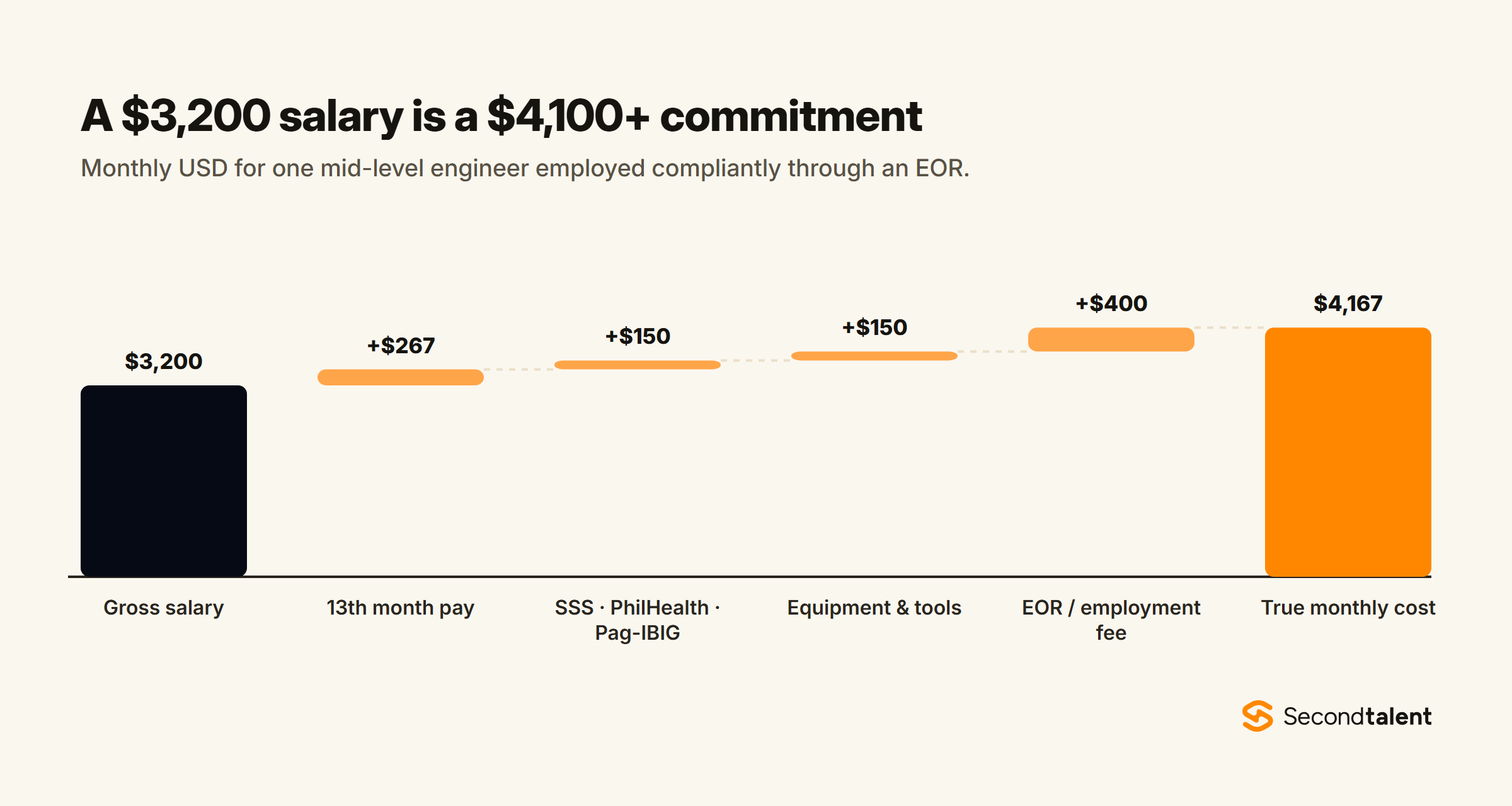
Even fully loaded, that engineer costs 60–70% less than an equivalent hire in the United States. The point of the chart is not that the Philippines is expensive — it is that the savings are smaller than the headline salary suggests, and budgets built on the salary alone come up short in month one.
Four mistakes that make Filipino engineers look worse than they are
1. Buying engineering through a body-shop contract
The country’s outsourcing infrastructure is optimised for volume staffing: headcount, seat rates, utilisation. Buy engineering that way and you get engineers selected for availability rather than for judgement, rotated between accounts, and paid a fraction of what you are billed. The output is exactly what you would expect, and it gets attributed to the country rather than to the contract. Direct employment — via your own entity or an employer of record in the Philippines — changes who you are hiring, not just how you are paying.
2. Misclassifying employees as contractors
Paying a full-time engineer as an independent contractor to skip statutory contributions is common and it is a liability. Philippine labour authorities look at control and economic dependence, not at what the contract is titled. A worker who works your hours, on your systems, under your direction, for you alone, is an employee. The exposure is back contributions, back 13th month pay, and a regularisation claim.
3. Treating a six-month probation as informal
Probation is capped at six months and the standards for regularisation must be communicated at hiring. Let the window lapse without a decision and the employee is regular by operation of law, with full security of tenure. Diarise month five for every Philippine hire.
4. Assuming politeness is agreement
Filipino workplace culture is generally deferential to seniority and avoids direct contradiction, especially in group settings. A senior engineer who thinks your architecture is wrong may well say “we can try that.” This is a management problem with a management fix: ask for written dissent, make disagreement an explicit part of design review, and give the objection a named owner. Teams that do this get the same engineering candour they would get anywhere. Teams that do not find out about the objection at the retrospective.
Philippines versus the alternatives
| Philippines | India | Vietnam | Indonesia | Poland | |
|---|---|---|---|---|---|
| Mid-level full-stack, remote | $2,700–$4,200 | $2,400–$4,000 | $2,800–$4,500 | $2,300–$3,800 | $5,500–$8,500 |
| EF English score, 2025 | 569 | 484 | 500 | 471 | High band |
| Overlap with US hours | None (night shift) | None (night shift) | None (night shift) | None (night shift) | Partial (afternoon) |
| Overlap with Australia | 7 hours | 4.5 hours | 6 hours | 6 hours | None |
| Senior AI/ML depth | Thin | Deep | Moderate | Thin | Deep |
| 13th month pay | Mandatory | Bonus Act (varies) | Customary (Tet) | Mandatory (THR) | None |
On price the Philippines, India, Vietnam and Indonesia sit in one band. The differentiators are English, timezone fit and where each market is deep. That is why the sensible comparison is never “which country is cheapest” but “which country is cheapest for this role, on these hours, at this seniority.” We have run that comparison in detail for the Philippines against India and against US and Canadian costs.
So — is it worth hiring there?
For most companies building product engineering capacity, yes. Specifically:
- Strong fit: full-stack, frontend, backend, mobile and QA teams; documentation-heavy and customer-facing engineering; companies headquartered in Australia, New Zealand, Singapore, Hong Kong, Japan or the Gulf; teams that want English-first async collaboration.
- Workable with planning: data engineering and cloud engineering at mid-level; US-headquartered teams willing to run asynchronously or pay a night differential; single senior hires where you can accept a longer search.
- Poor fit: frontier AI or machine learning research; senior cloud security architecture on a short timeline; any plan whose economics depend on paying below the remote market rate.
Key takeaways
- The 1.97 million IT-BPM figure is an industry headcount, not an engineering pool. Plan against the senior, remote-ready slice, which is small and contested.
- Mid-level engineers cost $2,500–$4,000 a month remotely; seniority roughly triples the number, specialisation moves it far less.
- English is the market’s real, measurable edge — 569 on the EF EPI 2025, second in Asia.
- A normal Manila workday has zero overlap with US hours. Night shifts buy the coverage and cost you retention.
- Depth is in web, mobile and QA engineering. DevOps, security and AI research are thin at the senior end.
- Budget 1.18–1.22× gross salary for statutory costs, and treat the six-month probation deadline as a hard date.
How to actually employ someone there
| Route | Time to first hire | Best for | Watch out for |
|---|---|---|---|
| Own local entity | 3–6 months | 15+ headcount, long horizon | Setup cost, ongoing filings, dissolution is slow |
| Employer of record | 5–10 business days | 1–15 employees, market testing, first hires | Per-employee monthly fee; check who holds IP assignment |
| Independent contractor | Days | Genuinely project-based, multi-client specialists | Misclassification exposure if the role is really full-time |
| Staffing / outsourcing vendor | 2–6 weeks | Volume support functions | You do not choose or keep the engineer; margin is opaque |
For a first engineering hire, an employer of record is usually the right instrument: the employee is a compliant full employee from day one, contributions and the 13th month are handled, and you are not carrying an entity for a team of three. If you already know you are building fifteen or more roles and intend to stay, run the entity maths — our EOR versus entity calculator does the comparison directly.
Frequently asked questions
Are Filipino software engineers good?
The question is not answerable at country level, and asking it that way is the root of most bad outcomes. The Philippines produces strong web, mobile and QA engineers in volume, and a smaller number of strong infrastructure and data engineers. Quality within any given band tracks how you hired, what you paid, and how you managed — not geography.
How much does a software engineer cost per month in the Philippines?
Remotely, for an international employer: $2,000–$3,100 for QA, $2,500–$4,000 for a mid-level backend developer, $2,700–$4,200 for full-stack, and $3,400–$5,300 for AI/ML. Seniors run roughly 60–70% above mid-level. Add about 20% for statutory employer costs.
Can Filipino engineers work US hours?
Yes, and many do — but it is a night shift, not an overlap. A 9-to-6 Manila day has zero hours in common with a 9-to-6 US day. Expect to pay a differential and to see higher turnover on those roles.
Do I need a local entity to hire in the Philippines?
No. An employer of record can employ staff on your behalf in about a week. An entity makes sense once headcount and time horizon justify the setup and the ongoing compliance burden.
Is the 13th month pay really mandatory?
Yes. Presidential Decree 851 requires it for rank-and-file employees, payable on or before 24 December, equal to one twelfth of basic salary earned in the year. Accrue it monthly rather than absorbing it as a December shock.
Philippines or Vietnam for engineering?
Vietnam is marginally stronger for deep technical and AI-adjacent work and marginally cheaper at the junior end. The Philippines is clearly stronger on English and on any role that involves writing, explaining or client contact. If your bottleneck is communication, choose the Philippines; if it is scarce technical depth, look at Vietnam first.
Hiring engineers in the Philippines
Second Talent sources, vets and employs engineering staff across the Philippines and the rest of Southeast Asia — directly employed, compliant from day one, and paid at remote-market rates so they stay. If you want to see the specific candidates and rates for your role before committing to anything, tell us what you are hiring for and we will come back with a shortlist and a fully loaded monthly cost.




![Singapore AI Companies Leading Southeast Asia. Top 10 Singapore AI Companies Leading Southeast Asia [2026], by Second Talent.](https://www.secondtalent.com/wp-content/uploads/2026/09/singapore-ai-companies-featured-v2-768x403.jpg)
![AI Recruiting Tools. Top 7 AI Recruiting Tools in 2026 [Tried & Tested], by Second Talent.](https://www.secondtalent.com/wp-content/uploads/2026/09/top-ai-recruiting-tools-featured-v2-768x403.jpg)