Top 30 Ember.js Interview Questions and Answers [2026]
October 10, 2026
9 min read
TL;DR: Ember.js interviews in 2026 test Glimmer components in the template-tag (.gjs) format, tracked state, services, the router's model hooks and the Vite-based build. The current release is Ember 7.3 (September 14, 2026); Ember 7.0 removed the APIs deprecated during 6.x, and 6.12 is the LTS.
Ember 6.8, released in October 2025, changed how a new Ember app is built: Vite and Embroider replaced the Broccoli build, and components are generated as .gjs files that import everything they use.
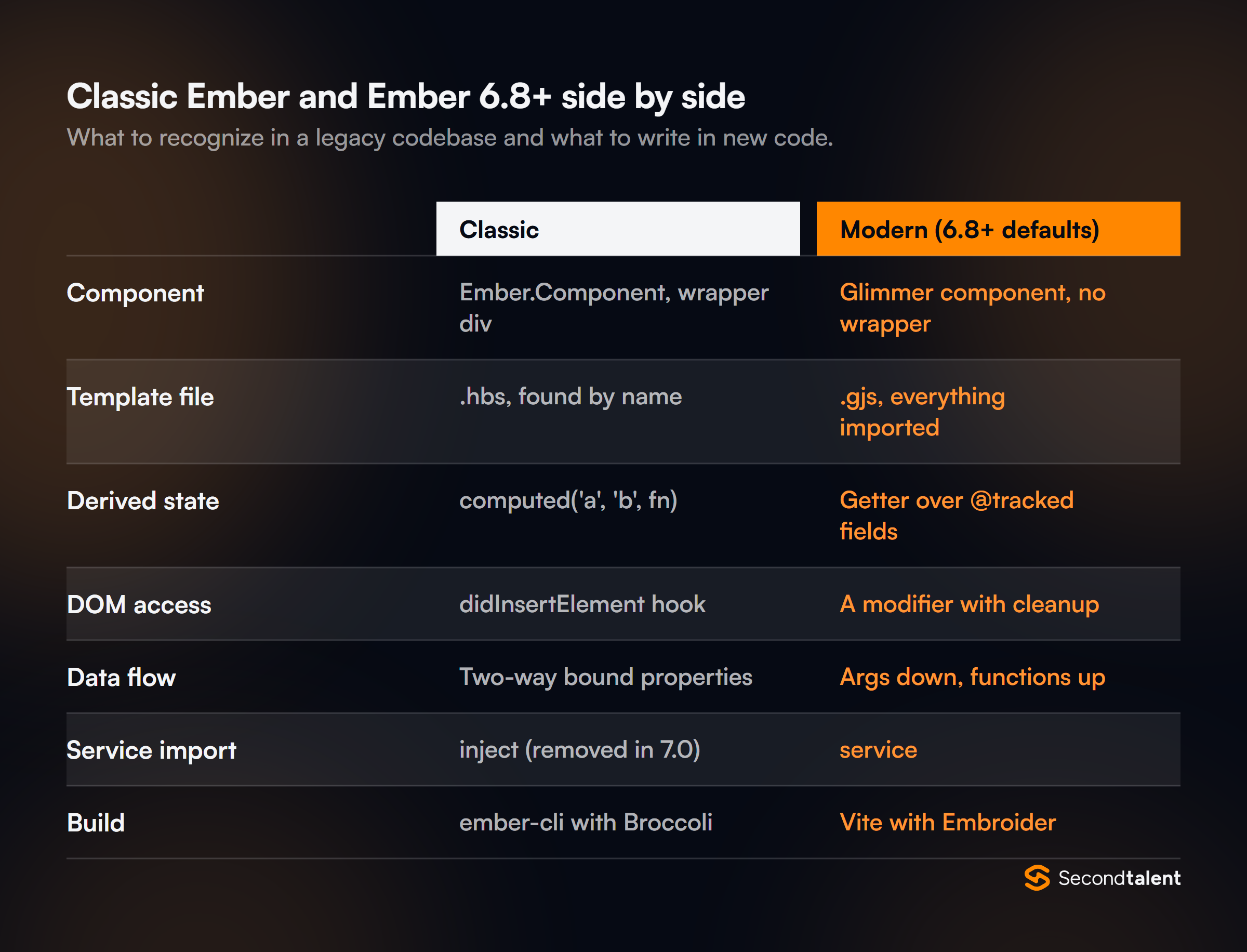
A candidate who still writes didInsertElement, computed properties with dependency keys and two-way bindings learned Ember from a codebase that is two editions old.
Many teams still maintain one, which is why good Ember interviews test both.
Key takeaways
1Ember ships a minor release about every six weeks, and a major only removes what was deprecated in the previous series. Ember 7.0 added no new public API.
2Ember 7.1 built in {{eq}}, {{and}}, {{or}} and {{element}}, replacing the ember-truth-helpers addon most apps installed.
3Marking ember-source side-effect free in 7.3 made a hello-world app 42.5% smaller, per the release changelog.
4EmberData is now developed as WarpDrive; the ember-data package still ships, at 5.9.1 since September 5, 2026.
Ember Fundamentals
How the samples were checked. Every template below compiled in strict mode with the template compiler from ember-source 7.3.0, which fails on any component, helper or modifier that is not imported, and every JavaScript file parsed with decorators enabled.
1. What is Ember.js, and what does it give you out of the box?
Ember is a JavaScript framework for large single-page applications that ships the whole stack: router, component model, services for shared state, a data layer (EmberData, now WarpDrive), a test framework and a CLI with generators.
Its principle is convention over configuration: files live in known places and teams do not have to agree on a router or a folder layout.
The other half of the pitch is stability. Ember releases a minor version about every six weeks and treats a major as a cleanup: Ember 7.0 only removed APIs deprecated during 6.x.
An app with no deprecation warnings on the last 6.x release upgrades to 7.0 without code changes. For a product maintained for ten years, that policy means upgrades stay small and routine.
2. How does Ember's router map URLs to routes?
The router file declares a tree of routes; nesting routes nests URLs and templates, and a dynamic segment such as :post_id passes a parameter to the route.
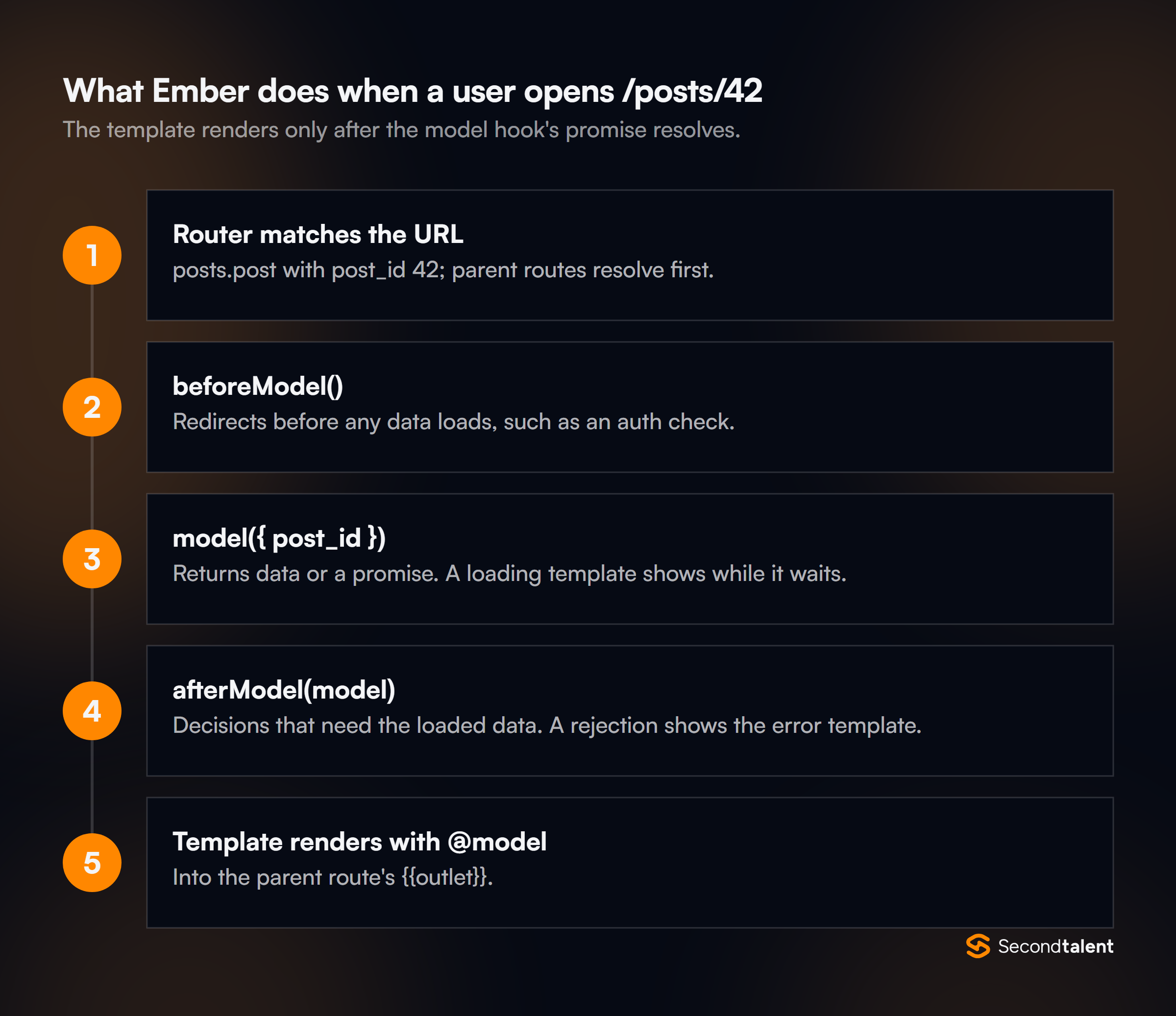
Each route has a template, and a parent route's template renders its child through {{outlet}}, so /posts/42 shows the posts layout with the post inside it. The /*path wildcard catches unknown URLs for a 404 page.
Candidates should know that the URL is the source of truth: reloading any URL rebuilds the same state, which is why Ember apps rarely need client state for "which page am I on".
3. What does a route's model hook do?
The model hook loads the data a route needs. If it returns a promise, Ember waits for it before rendering the template, which receives the result as @model.
// app/routes/posts/post.js
import Route from "@ember/routing/route";
import { service } from "@ember/service";

export default class PostRoute extends Route {
  @service store;
  @service session;
  @service router;

  beforeModel() {
    if (!this.session.isAuthenticated) this.router.transitionTo("login");
  }

  model({ post_id }) {
    return this.store.findRecord("post", post_id); // template waits for this
  }
}
While the promise is pending, Ember shows a loading template if one exists; if it rejects, an error template. beforeModel is the place for redirects such as an auth check, and afterModel for decisions that need the loaded data.
The routing guide covers all three. A weak answer fetches data in a component's constructor and loses the loading and error states the router provides.
4. Are controllers still needed in modern Ember?
Rarely, but yes: query parameters are still declared on controllers, so a page with ?sort=date&page=2 in its URL needs one. Most other state that used to live on controllers now belongs in components or services.
A candidate who says "controllers are gone" has not built a filterable list in Ember; one who puts all page state in a controller is writing Ember 2.
5. What is a service, and when do you use one?
A service is a singleton that lives as long as the app, injected with @service into routes, components and other services. Use one for state or behavior shared across the app: the current user, a cart, a WebSocket connection, feature flags.
// app/services/cart.js
import Service from "@ember/service";
import { tracked } from "@glimmer/tracking";

export default class CartService extends Service {
  @tracked items = [];

  get count() {
    return this.items.length; // recomputes when items is reassigned
  }

  add(product) {
    this.items = [...this.items, product];
  }
}
Ember 7.0 removed the old import, import { inject } from "@ember/service"; the decorator is service.
Reassigning this.items rather than pushing to it is deliberate: a plain array is not tracked, so a push would not update the page (question 10 covers the tracked collections that fix that).
Components and Templates
6. What is a Glimmer component, and how does it differ from a classic component?
A Glimmer component is a native JavaScript class extending @glimmer/component. It receives arguments as read-only this.args (@name in the template), has no wrapper element, and has two lifecycle hooks: the constructor and willDestroy.
// app/components/cart-button.gjs
import Component from "@glimmer/component";
import { service } from "@ember/service";
import { action } from "@ember/object";
import { on } from "@ember/modifier";

export default class CartButton extends Component {
  @service cart;

  @action addToCart() {
    this.cart.add(this.args.product);
    this.args.onAdded?.(this.args.product);
  }

  <template>
    <button type="button" class="btn" ...attributes {{on "click" this.addToCart}}>
      Add {{@product.name}} ({{this.cart.count}} in cart)
    </button>
  </template>
}
Classic components (Ember.Component) had a wrapper div, a dozen lifecycle hooks such as didInsertElement, and two-way bound properties.
In a Glimmer component data flows down through arguments and changes flow up through functions passed in, like @onAdded above. ...attributes places the caller's HTML attributes, such as class, on the chosen element.
7. What is the template-tag (.gjs) format?
A .gjs file puts the component's template inside a <template> tag in the JavaScript module.
The template is compiled in strict mode: it can only use components, helpers and modifiers that are in the module's scope, imported or defined in the file.
// app/components/greeting.gjs: a template-only component
import { LinkTo } from "@ember/routing";
import formatDate from "../helpers/format-date.js";

<template>
  <p>Hello {{@name}}, last seen {{formatDate @lastSeen}}.</p>
  <LinkTo @route="profile" @model={{@userId}}>Profile</LinkTo>
</template>
That is why LinkTo and formatDate are imported. Before .gjs, a template named <FancyButton /> and the resolver found the file by naming convention, which made it hard to tell which addon a component came from.
Since Ember 6.8, generators create .gjs files by default, and the RFC #779 is the design record. We checked this: compiling the template without the imports fails with "not in scope".
8. What are tracked properties, and how does autotracking work?
A property marked @tracked tells Ember to re-render anything that read it when it changes. Getters that read tracked properties update automatically, with no dependency list.
import Component from "@glimmer/component";
import { tracked } from "@glimmer/tracking";
import { on } from "@ember/modifier";

export default class Counter extends Component {
  @tracked count = 0;

  get isEven() {
    return this.count % 2 === 0; // no dependency keys: autotracked
  }

  increment = () => this.count++;

  <template>
    <button type="button" {{on "click" this.increment}}>
      {{this.count}} ({{if this.isEven "even" "odd"}})
    </button>
  </template>
}
isEven is a plain getter: during render Ember records every tracked value it reads, so when count changes, both the count and the "even/odd" label update.
Classic computed properties needed computed("count", ...) with every dependency spelled out, and a missing key was a silent bug. The autotracking guide explains the model.
An arrow-function class field, as in increment, keeps this bound without the @action decorator.
9. How do you handle user events in a template?
With the {{on}} modifier, which calls addEventListener on the element, and the {{fn}} helper to pass extra arguments:
<button {{on "click" (fn this.remove item)}}> calls this.remove(item, event). The function must keep its this, which is what the @action decorator or an arrow-function field does.
Since Ember 7.1, on and fn no longer need an import in strict templates, per the 7.1 release post; code that imports them explicitly still works and runs on older versions.
The old {{action}} helper is the classic-era version and a sign of legacy code.
10. Why does push on an array not update the page, and what fixes it?
Because @tracked tracks the property, not the contents of the array in it. this.items.push(x) changes the array but never sets this.items, so nothing re-renders.
The fixes are reassigning (this.items = [...this.items, x]) or a tracked collection, built into Ember since 6.8:
import { trackedArray } from "@ember/reactive/collections"; // Ember 6.8+
import { on } from "@ember/modifier";
import { fn } from "@ember/helper";

const todos = trackedArray(["Write tests"]);
const add = (text) => todos.push(text); // push re-renders: the array is tracked

<template>
  <ul>
    {{#each todos as |todo|}}
      <li>{{todo}}</li>
    {{/each}}
  </ul>
  <button type="button" {{on "click" (fn add "Ship it")}}>Add</button>
</template>
trackedArray, trackedObject, trackedMap, trackedSet and their weak versions come from @ember/reactive/collections. Before 6.8 the same thing needed the tracked-built-ins addon.
This snippet also shows that a .gjs file can export a template-only component with module-level state, which is fine for a demo but shared by every instance, so real components keep state on the class.
11. What is the difference between @arguments and HTML attributes on a component?
Names starting with @ are arguments, passed to the component's JavaScript as this.args; plain names such as class, aria-label or data-test-id are HTML attributes, applied wherever the component's template puts ...attributes. <CartButton @product={{p}} class="w-full" /> passes one of each.
A component without ...attributes silently drops the caller's class and ARIA attributes, a common accessibility bug in shared component libraries.
12. How do you access the DOM element in modern Ember?
With a modifier: a function applied to an element in the template that receives the element, runs when it is inserted, and returns a cleanup function. The ember-modifier package provides the modifier function.
This replaces didInsertElement and willDestroyElement in classic components, and it is reusable across components.
The cleanup function prevents the timer from firing on an element that is gone. @ember/render-modifiers (did-insert) also exists, but its README positions it as a way to migrate quickly away from classic lifecycle hooks, not as the end state.
13. What is a helper, and how do you write one?
A helper is a function called from a template to compute a value. Since Ember 4.5, a plain JavaScript function works as a helper, so there is no special class to extend.
// app/helpers/format-date.js: a plain function is a helper
export default function formatDate(date, { locale = "en-US" } = {}) {
  return new Intl.DateTimeFormat(locale, { dateStyle: "medium" }).format(date);
}
Positional arguments arrive as normal parameters and named arguments as an object in the last position: {{formatDate @lastSeen locale="de-DE"}}. We ran this function in Node and it returned "Sep 28, 2026" and "28.09.2026".
Because helpers are functions, they are easy to unit test without rendering anything.
14. How do blocks and named blocks work?
A component renders the caller's content with {{yield}}. Named blocks let the caller fill several slots, and (has-block) checks whether one was passed.
import Card from "./card.gjs";

<template>
  <Card class="featured">
    <:title>Quarterly report</:title>
    <:footer>Updated today</:footer>
    <:default>Revenue grew in every region.</:default>
  </Card>
</template>
{{yield}} can also pass values back, as in {{yield this.isOpen}}, received with as |isOpen|. A strong candidate uses named blocks for layout components instead of a long list of string arguments such as @title and @footerText.
Data, Async and Testing
15. What does EmberData (WarpDrive) do?
It is Ember's data layer: a store that caches records, tracks their state and keeps one copy of each record so every part of the app sees the same data. store.findRecord("post", 42) returns the cached record or fetches it; adapters and serializers translate between the API's format and the store's.
The library is now developed as WarpDrive, framework-agnostic, with a RequestManager and store.request() as the modern way to fetch, while the ember-data package keeps existing apps working.
Interview for the concepts, cache identity and request handling, rather than a specific adapter API, since both styles exist in production code.
16. How do you handle a search box that fires a request on every keystroke?
With a restartable task from ember-concurrency: each new keystroke cancels the running task, so a short timeout at the start becomes a debounce and stale responses never render.
import Component from "@glimmer/component";
import { service } from "@ember/service";
import { task, timeout } from "ember-concurrency";
import { on } from "@ember/modifier";
import perform from "ember-concurrency/helpers/perform";

export default class UserSearch extends Component {
  @service store;

  search = task({ restartable: true }, async (event) => {
    await timeout(250); // debounce: a new keystroke cancels this run
    return this.store.query("user", { q: event.target.value });
  });

  <template>
    <input type="search" {{on "input" (perform this.search)}} />
    {{#if this.search.isRunning}}Searching...{{/if}}
    {{#each this.search.lastSuccessful.value as |user|}}
      <p>{{user.name}}</p>
    {{/each}}
  </template>
}
The task also exposes its state, isRunning and lastSuccessful, to the template, so there is no hand-written isLoading flag.
Cancellation also happens when the component is destroyed, which prevents the classic "set on destroyed object" error. The async-arrow syntax needs ember-concurrency's Babel transform configured in the app.
17. How do you clean up resources when a component goes away?
In a Glimmer component, override willDestroy(), or call registerDestructor(this, fn) from @ember/destroyable in the constructor, which keeps setup and teardown next to each other.
For element-level work, the modifier's returned cleanup function (question 12) is the right place.
Listeners on window, intervals and WebSocket subscriptions are what leak when this is skipped, and in tests they surface as errors after the test has finished.
18. How do you test an Ember component?
With a rendering test: render the component, interact with helpers such as click and fillIn, and assert on the DOM with qunit-dom. Every helper waits for rendering and pending async work to settle.
// tests/integration/components/counter-test.gjs
import { module, test } from "qunit";
import { setupRenderingTest } from "ember-qunit";
import { render, click } from "@ember/test-helpers";
import Counter from "my-app/components/counter";

module("Integration | Component | counter", function (hooks) {
  setupRenderingTest(hooks);

  test("it counts clicks", async function (assert) {
    await render(<template><Counter /></template>);
    await click("button");
    assert.dom("button").hasText("1 (odd)");
  });
});
In a .gjs test file, the <template> passed to render imports Counter like any other module. Application tests use visit("/posts/42") to drive the whole app through the router.
A candidate who knows what "settled" means can explain why Ember tests rarely need manual waits.
19. How do you redirect users who are not logged in?
In the route's beforeModel hook, with the router service: this.router.transitionTo("login"), as in question 3. For a whole section of the app, put the check in the parent route so every child inherits it.
The follow-up: store the attempted transition so the login route can retry it after a successful sign-in.
And the caveat a senior candidate adds unprompted: a client-side redirect is user experience, not security, so the API must still reject the request.
Build and Upgrades
20. What changed in Ember's build system?
Since Ember 6.8, new apps build with Vite and Embroider instead of the Broccoli pipeline in ember-cli. Code is plain ES modules, so Vite's dev server, import.meta.glob and ordinary Vite plugins work.
Existing apps can move with the Vite codemod, or stay on a legacy classic-build blueprint. The practical effects a candidate should name are faster startup, real tree-shaking and fewer Ember-specific build concepts to learn.
21. What is the difference between a v1 and a v2 addon?
A v1 addon runs code inside ember-cli's build, with hooks that can change the app's build, which made builds slow and hard to analyze. A v2 addon is a static npm package of standard JavaScript that any bundler can consume.
Since Ember 6.1, ember-source itself is published as a v2 addon.
New addons should be v2; an app that depends on many v1 addons with build hooks will find the move to Vite harder, and that is worth checking before quoting an upgrade estimate.
22. How do you use TypeScript with Ember templates?
With Glint, which type-checks templates against component signatures. A component declares a Signature with its Args, Blocks and Element, and Glint reports a wrong argument name or type in the template as a TypeScript error.
The 7.0 release post notes that Glint 2 is what allowed .gjs to become the default. Strict-mode templates help here: because every invokable is imported, the type checker knows exactly what each name refers to.
23. How do you upgrade an Ember app across several versions?
Step through the LTS releases, clearing deprecations at each one.
The 7.0 release post recommends going 6.4, then 6.8, then 6.12, fixing every deprecation warning on 6.12, and only then moving to 7.0. npx ember-cli-update --to 6.12 updates the blueprint files, and ember-cli-deprecation-workflow lets a team silence known deprecations and fix them one at a time.
Crossing 6.8 needs build configuration changes because of the new build system. Asking a candidate about the largest upgrade they have done reveals more than any API question.
24. What does the Strict Resolver in Ember 7.2 change?
It lets an app give Ember an explicit map of its modules, usually built with Vite's import.meta.glob, instead of looking up service:current-user by name under a modulePrefix.
Everything the resolver can return is then visible in one file, which helps tree-shaking.
The 7.2 release post is candid that it is not the default yet: addons still come through a module list that uses the prefix, so real apps keep ember-resolver for now. 7.2 also published ember-source with "type": "module".
What Changed Recently
Nov 12, 2024
Ember 6.0: start of the 6.x series
Oct 13, 2025
Ember 6.8: Vite and Embroider by default, .gjs by default, tracked collections
May 12, 2026
Ember 7.0: removes APIs deprecated in 6.x; 6.12 becomes LTS
Jun 22, 2026
Ember 7.1: built-in comparison helpers, auto-imported on and fn
Aug 9, 2026
Ember 7.2: built-in Strict Resolver, ESM-only ember-source
Sep 14, 2026
Ember 7.3:tracked() outside classes, smaller builds
25. What did Ember 6.8 change for new apps?
It made Vite with Embroider the default build, made .gjs the default component format, added renderComponent (from @ember/renderer) to render a component into any DOM element, and built in the tracked collections from question 10.
The 7.0 release post calls 6.8 "the biggest change to how an Ember project is built in recent memory". renderComponent is worth asking about: it lets a team embed an Ember component inside a grid library, an editor or a page that is not an Ember app.
26. What did Ember 7.0 remove?
No new API, only removals of 6.x deprecations. The notable ones: import Ember from "ember" (the global namespace object), the AMD bundles of ember-source, and inject from @ember/service, replaced by service.
Code still using Ember.get, Ember.run or Ember.A through the global breaks, and the deprecations guide lists the replacement for each.
27. What helpers did Ember 7.1 build in?
{{element}}, which renders a tag chosen at runtime, and the logic and comparison helpers {{and}}, {{or}}, {{eq}}, {{neq}}, {{lt}}, {{lte}}, {{gt}} and {{gte}}.
The {{element}} RFC dates back to 2018, and the set replaces ember-truth-helpers, which the release post calls one of the most popular Ember addons.
7.1 also made on, fn, hash and array, and these new helpers, available in strict templates without an import. Dropping the addon removes one more v1 dependency from an app.
28. What does Ember 7.3 add?
The ability to call tracked as a function outside a class, per RFC #1071. It returns an object with a reactive .value:
import { tracked } from "@glimmer/tracking";
import { on } from "@ember/modifier";

const clicks = tracked(0); // Ember 7.3: tracked outside a class

<template>
  <button type="button" {{on "click" inc}}>{{clicks.value}}</button>
</template>

function inc() {
  clicks.value++;
}
The 7.3 changelog also marks ember-source as free of side effects so bundlers can drop unused parts, making a hello-world app 42.5% smaller, and stops small apps from pulling in the old renderer.
The RFC itself warns that reactive state at module level is not reset between tests, so this is best inside helpers, modifiers and functions rather than as app-wide globals.
29. Where is Ember's data layer heading?
EmberData is now developed as WarpDrive in its own repository, described as working "in any Framework", with Ember as one integration. The latest release is 5.9.1 (September 5, 2026), shipped as both ember-data and the @warp-drive packages.
For a hiring manager this means a candidate's EmberData experience transfers, and that the request-based APIs are the direction for new code, while model classes with adapters and serializers remain in most existing apps.
30. Which Ember version should a project be on in 2026?
ember-sourceSep 14, 2026
7.3.0
Current release, npm latest tag
ember-source LTSMar 31, 2026
6.12
Last 6.x minor, npm lts tag
ember-dataSep 5, 2026
5.9.1
Published from the WarpDrive repository
Ember 7.3 for new work, or the 6.12 LTS for teams that upgrade on a slower cycle; the LTS page lists the supported versions. An app below 6.8 is still on the old build system unless it migrated by hand.
A good candidate asks which version the codebase is on before the interview ends, because the answer decides whether the job is building features or running an upgrade.
Signs of a Strong Answer
They write Glimmer components in .gjs, and can also read a classic component with didInsertElement and computed properties.
They explain autotracking and know why push on a plain tracked array does nothing.
They load data in route hooks and use the loading and error substates instead of spinners in every component.
They reach for modifiers for DOM work and ember-concurrency for cancelable async.
They can describe an upgrade path through the LTS versions and the deprecation workflow.
They know what 6.8 and 7.x changed and which of those changes their last app had adopted.
Hiring Ember.js Developers
Ember developers are a smaller pool than React or Vue, and many strong ones maintain long-lived products.
Second Talent matches companies with pre-vetted front-end developers in Asia, including Ember specialists, screened with questions like these. The front-end developer cost guide lists typical rates by country.