I have hired engineers in the Philippines for years, and the question I get most from founders is not “is the talent good.” It is “where do I actually go.” The honest answer is that no single site wins. A job board and a vetted marketplace solve different problems, and picking the wrong category costs you a month.
Here are the ten I would use in 2026, what each one is good at, and where each one fails.
One disclosure up front: I co-founded Second Talent, which sits at number two. I have put it where I think it earns its place, and I have written the limitations section for it the same way I wrote everyone else’s.
First, the Market Context
The Philippine IT and business process sector closed 2025 with roughly 1.9 million workers and about $40 billion in export revenues, according to IBPAP. Jobs grew 4% and revenue grew 5%, against global industry growth of around 3%. IBPAP expects 1.97 million jobs and $42 billion in revenue for 2026.
That growth matters for a practical reason. Demand for senior Filipino engineers now comes from global capability centres as much as from foreign startups, so you are competing with well funded local employers, not just other remote teams.
The Three Categories
Before the list, the thing that saves the most time:
- Direct job boards. You post, you screen, you hire, you handle payroll yourself. Cheapest per hire, most work.
- Freelance marketplaces. Fast for project work, priced per hour, weak for building a team that stays.
- Vetted networks and staffing partners. Someone else screens and often employs the person for you. Highest sticker price, lowest time cost.
Match the category to your constraint. If your constraint is money, go direct. If it is time or compliance, do not.
The Ten at a Glance
The whole list in one grid, before the detail. Prices are what each platform publishes; “not published” means the platform quotes on request rather than listing a rate.
| Platform | Category | Best for | What it costs | Main limitation |
|---|---|---|---|---|
| 1. OnlineJobs.ph | Direct job board | Hiring and paying someone yourself | Free tier, then $69 or $99 a month | Skews to VA and admin; you screen and run payroll |
| 2. Second Talent | Vetted network with managed employment | A senior engineer with no entity of your own | $3,000 to $6,000 a month flat | Engineering led bench; wrong fit under three months |
| 3. Kalibrr | Job board with ATS and EOR | Several roles at once in one system | Not published | General platform; engineering is one vertical of many |
| 4. JobStreet by SEEK | General job board | Volume, and roles based in Manila or Cebu | Not published | Large unfiltered applicant pool; indexes toward local employment |
| 5. Bossjob | Chat first job board | Speed of first contact with candidates | Not published | Published reach figures date from 2023 |
| 6. LinkedIn | Professional network | Senior and lead roles, and passive candidates | Paid recruiter seats | Low reply rates on cold outreach to senior engineers |
| 7. Upwork | Freelance marketplace | Defined, scoped projects | 5% client fee on Basic, 3% for eligible US clients | Optimised for transactions, not retention |
| 8. Toptal | Premium vetted network | A critical role where a bad hire costs more | Well above Philippine market rates | Global pool, so a Filipino engineer is not guaranteed |
| 9. Arc.dev | Remote developer marketplace | A shortlist without a retainer | Nothing until you hire | Global pool, so Philippine supply is thinner |
| 10. Cloudstaff | Offshore staffing provider | A managed team of five or more | One monthly rate per staff member | Overhead does not pay for itself on one or two hires |
1. OnlineJobs.ph
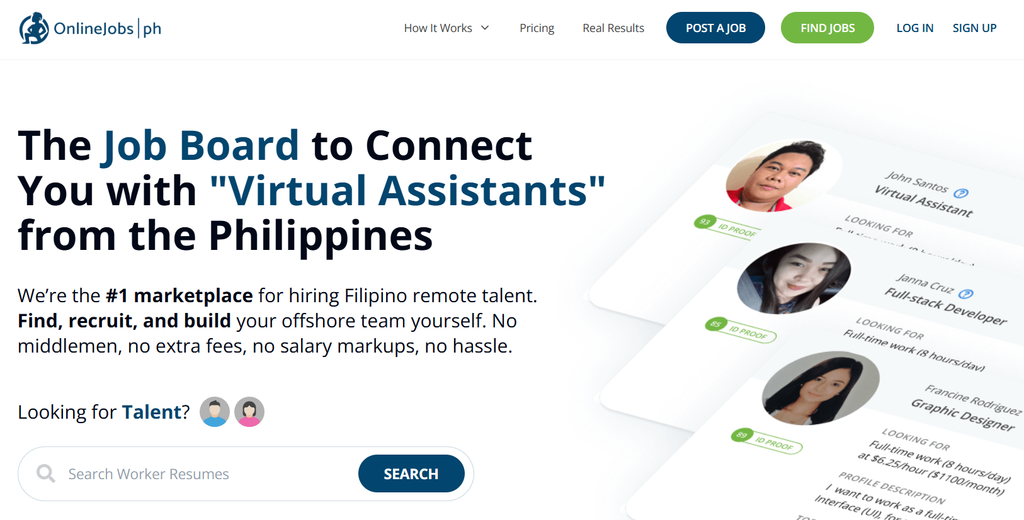
The default starting point for hiring Filipino talent directly, and the only major platform built exclusively for it.
Best for: founders who want to hire and pay someone directly, with no ongoing commission.
Cost: a free tier plus paid employer plans at $69 and $99 a month, per a February 2026 review by RemoteWork.ph. Plans differ by how many job posts you get and how many workers you can contact.
The catch: the database skews heavily toward virtual assistants, customer support and general admin. Strong senior engineers exist there but you will dig for them, and you screen every one yourself. You also become the employer of record by default, which means you handle contracts, payroll and the compliance that comes with it.
2. Second Talent

An APAC engineering network with managed employment attached, covering nine markets including the Philippines, Vietnam, Indonesia, Singapore, Malaysia, Thailand, Hong Kong, Taiwan and China.
Best for: teams that want a vetted senior engineer and do not want to set up an entity or run payroll.
Cost: $3,000 to $6,000 a month flat per engineer, all in. That covers sourcing, vetting and managed employment, so there is no separate agency percentage stacked on top.
What is different: AI tool fluency gets tested during vetting rather than assumed from a CV, which matters more every quarter. We publish a 92% talent retention rate and work with 200+ companies. You can search the talent directory yourself or hand over a brief.
The catch: the bench is engineering led. Design, sales development, data annotation and operations are covered, but if you want a broad non technical hire, a general job board will serve you better. The flat rate also means we are the wrong answer for a two week project. Below roughly a three month engagement, a marketplace is cheaper.
3. Kalibrr
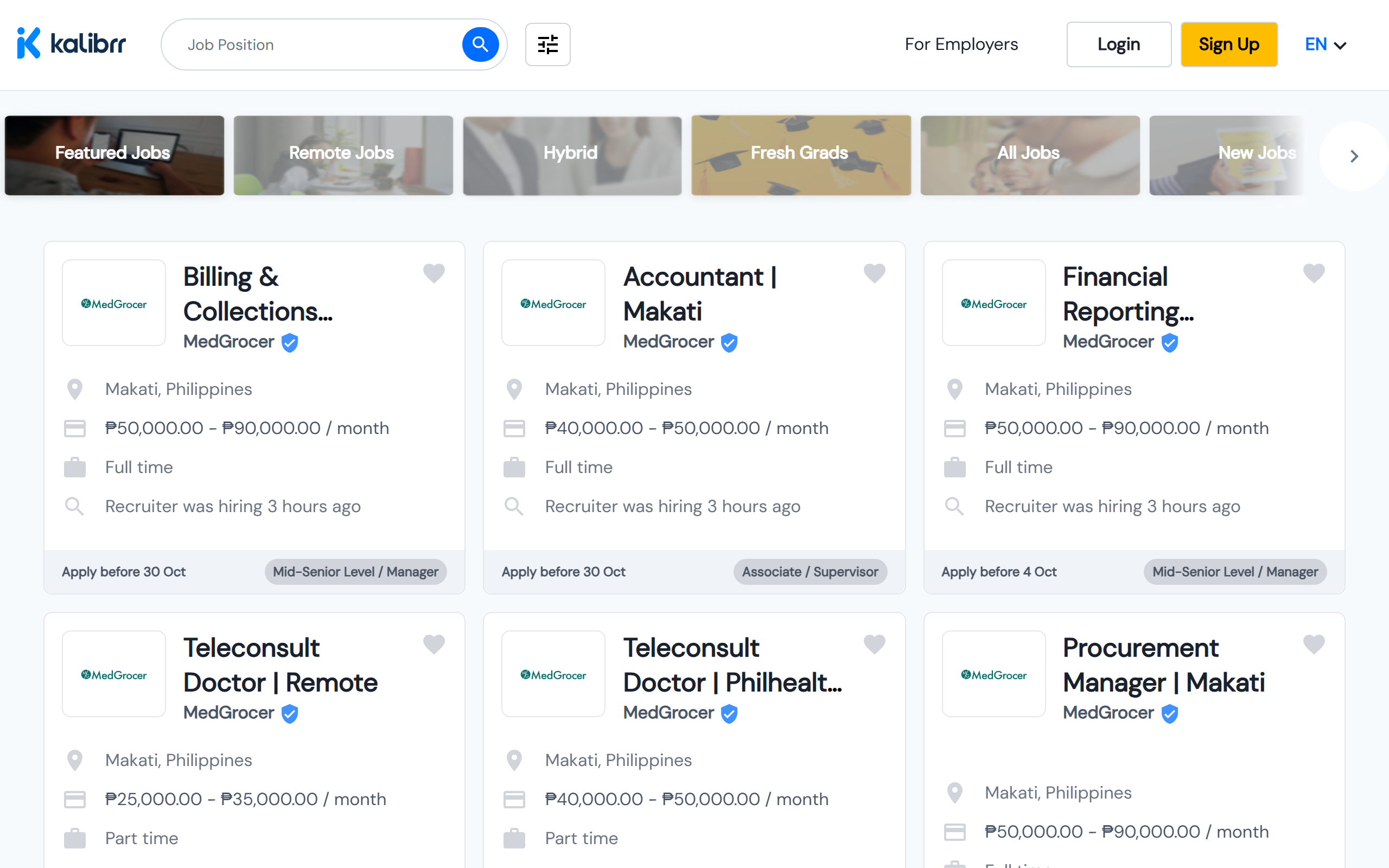
A Philippine hiring platform that grew into a full stack product, with an applicant tracking system and employer of record services alongside the job board.
Best for: companies hiring several roles at once who want the pipeline and the ATS in one place.
Reach: Kalibrr reported more than 6 million registered job seekers as of January 2023.
The catch: it is a general platform, so engineering is one vertical among many. For a single senior backend hire you are paying attention tax on a lot of unrelated applicants.
4. JobStreet by SEEK
The largest general job board in the Philippines and the one most local candidates check first.
Best for: volume, brand visibility and roles that need people on the ground in Manila or Cebu.
The catch: volume is the problem as well as the point. Expect a large, unfiltered applicant pool and budget real screening hours. It also indexes toward candidates who want a local employer, so pitch remote roles carefully.
5. Bossjob

A chat first platform where candidates and employers message each other directly instead of trading applications and silence.
Reach: Bossjob reported over 2.9 million registered Philippine users and more than 10,000 companies on the platform as of May 2023.
Best for: speed of first contact. The chat model cuts the dead time between an application and a conversation, which is where most Philippine hiring pipelines leak.
The catch: the numbers above are three years old and I have not found a more recent verified figure. Treat it as a strong second channel rather than your only one.
6. LinkedIn

Worth listing even though you are reading this on it. NapoleonCat estimates around 25.2 million LinkedIn members in the Philippines as of July 2026, roughly a fifth of the population.
Best for: senior and lead roles, and for reaching people who are employed and not actively looking. That group does not sit on job boards.
The catch: the passive candidates worth reaching are the ones getting the most messages. Response rates on cold outreach to senior Filipino engineers are low unless your role or brand stands out. Recruiter seats also cost real money.
7. Upwork

The largest general freelance marketplace, with deep Philippine supply.
Cost: clients on the Basic plan pay a 5% marketplace fee on payments, or 3% for eligible US clients paying by checking account. Business Plus is 10%, or 8% with the same discount. A one time contract initiation fee of $0.99 to $14.99 applies per new contract.
Best for: defined, scoped projects where you can judge the output.
The catch: the fee is the small part. The real cost is that Upwork optimises for transactions, not retention. For a long running product team, you are rebuilding context every time someone leaves.
8. Toptal

A premium vetted network at the top of the price range.
What it states: the top 3% of freelance talent, a 98% trial to hire success rate, an average time to match under 24 hours, hiring possible in under 48 hours, and a trial period where you pay only if satisfied.
Best for: a critical role where a bad hire costs more than the premium.
The catch: the price. Toptal rates sit well above Philippine market rates, which undercuts most of the reason you were looking at the Philippines. Also note that Toptal is global, so you are not guaranteed a Filipino engineer unless you specify it.
9. Arc.dev
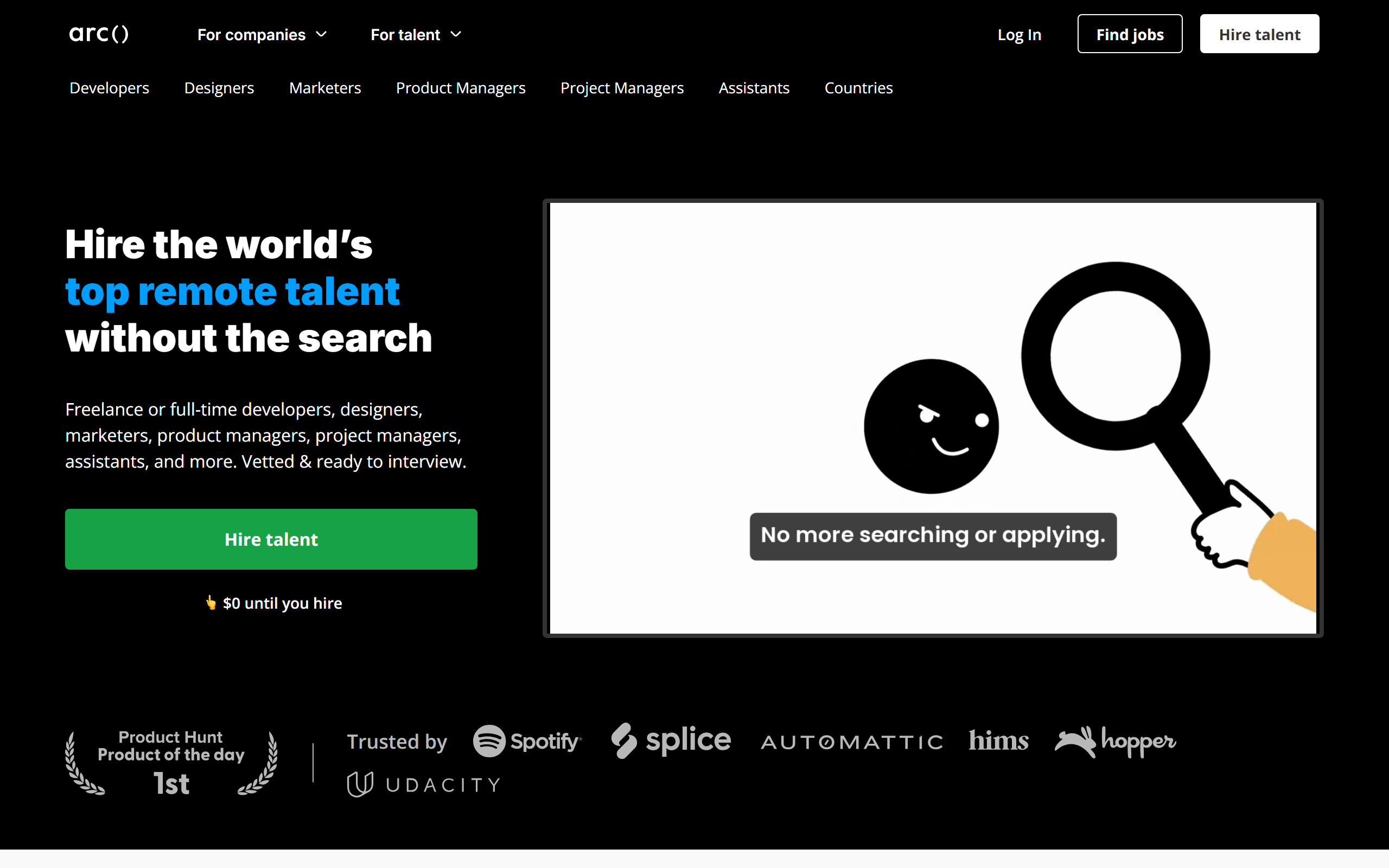
A remote developer marketplace with both freelance and full time tracks.
What it states: around 450,000 people across 190 countries, a top 2% vetting claim, freelance matches in 72 hours, full time hires in 14 days, and no cost until you hire.
Best for: remote first companies that want a shortlist without a retainer.
The catch: like Toptal, the pool is global rather than Philippine. You can filter by location, but you are using a worldwide platform to reach one country, so the Philippine supply is thinner than on a local board.
10. Cloudstaff

An offshore staffing provider with Philippine operations, also running teams in Colombia, India and Kenya. It states 1,000+ client companies.
Best for: building a managed team of five or more where you want someone else handling recruitment, onboarding, payroll, hardware and support.
Cost: one monthly rate per staff member, with no setup fee stated.
The catch: built for scale. For one or two engineers the overhead does not pay for itself, and the model leans toward support and operations roles more than senior product engineering.
What You Should Expect to Pay
Sticker prices across these platforms mean little without the underlying market rate. Based on our 2026 Philippine rate card, remote engineers working for international employers run roughly:
- Junior, 0 to 2 years: $8 to $18 an hour
- Mid level, 3 to 5 years: $18 to $30 an hour
- Senior, 5 to 8 years: $30 to $55 an hour
- Lead or architect, 8+ years: $50 to $80 an hour
Locally, the national average for a software engineer sits near ₱42,370 a month, with senior developers at ₱90,000 to ₱160,000.
Two things follow from this. First, if a platform quotes you $90 an hour for a Philippine mid level developer, you are paying for the platform, not the engineer. Second, if you are paying at the bottom of the junior band, you are not competing with the global capability centres now hiring the same people, and your retention will show it.
How to Choose in One Paragraph
Hiring one engineer for a defined project: Upwork or Arc.dev. Hiring one senior engineer to stay: a vetted network, or OnlineJobs.ph if you have the time to screen and the appetite to run payroll. Hiring five or more: a staffing partner or an employer of record, because the compliance overhead becomes the binding constraint well before the recruiting does. Hiring locally in Manila with people in an office: JobStreet and Kalibrr.
The mistake I see most is founders picking on price per hire and discovering the real cost was six weeks of their own time.
Common Questions
Do I need a Philippine entity to hire there?
No, but you need something. Either you engage the person as a contractor and accept the misclassification risk, or you use an employer of record that already holds an entity. Direct employment without an entity is the option that does not exist.
Which of these is free?
JobStreet, Kalibrr, Bossjob and OnlineJobs.ph all have free tiers or free posting in some form. Free posting is rarely the expensive part of hiring.
How long does hiring take?
Two to six weeks through a job board once you include screening, which is the step people forget to budget for. Vetted networks quote days, and largely deliver on it, because the screening already happened.
Is the talent good enough for senior product work?
Yes, and the competition for those people is the proof. Global capability centres are hiring the same senior engineers you are, which is exactly why a lowball offer fails.
If you are weighing these options for your own team, I am happy to compare notes. We publish our Philippine developer rate card publicly, so you can sanity check any quote you have been given against it, whether or not you hire through us.

![How to Hire Developers in Asia Remotely. How to Hire Developers in Asia Remotely from the USA [2026], by Second Talent.](https://www.secondtalent.com/wp-content/uploads/2026/09/hire-developers-in-asia-remotely-featured-v2-768x403.jpg)
![AI Outsourcing in Singapore. Top 10 AI Outsourcing Companies in Singapore [2026], by Second Talent.](https://www.secondtalent.com/wp-content/uploads/2026/09/ai-outsourcing-companies-singapore-featured-v2-768x403.jpg)
![AI Outsourcing in India. Top 10 AI Outsourcing Companies in India [2026], by Second Talent.](https://www.secondtalent.com/wp-content/uploads/2026/09/ai-outsourcing-companies-india-featured-v2-768x403.jpg)
![AI Outsourcing in the Philippines. Top 10 AI Outsourcing Companies in the Philippines [2026], by Second Talent.](https://www.secondtalent.com/wp-content/uploads/2026/09/ai-outsourcing-companies-philippines-featured-v2-768x403.jpg)

![Software Development Outsourcing in Vietnam. Top 10 Software Development Outsourcing Companies in Vietnam [2026], by Second Talent.](https://www.secondtalent.com/wp-content/uploads/2026/09/software-development-outsourcing-companies-vietnam-featured-v2-768x403.jpg)