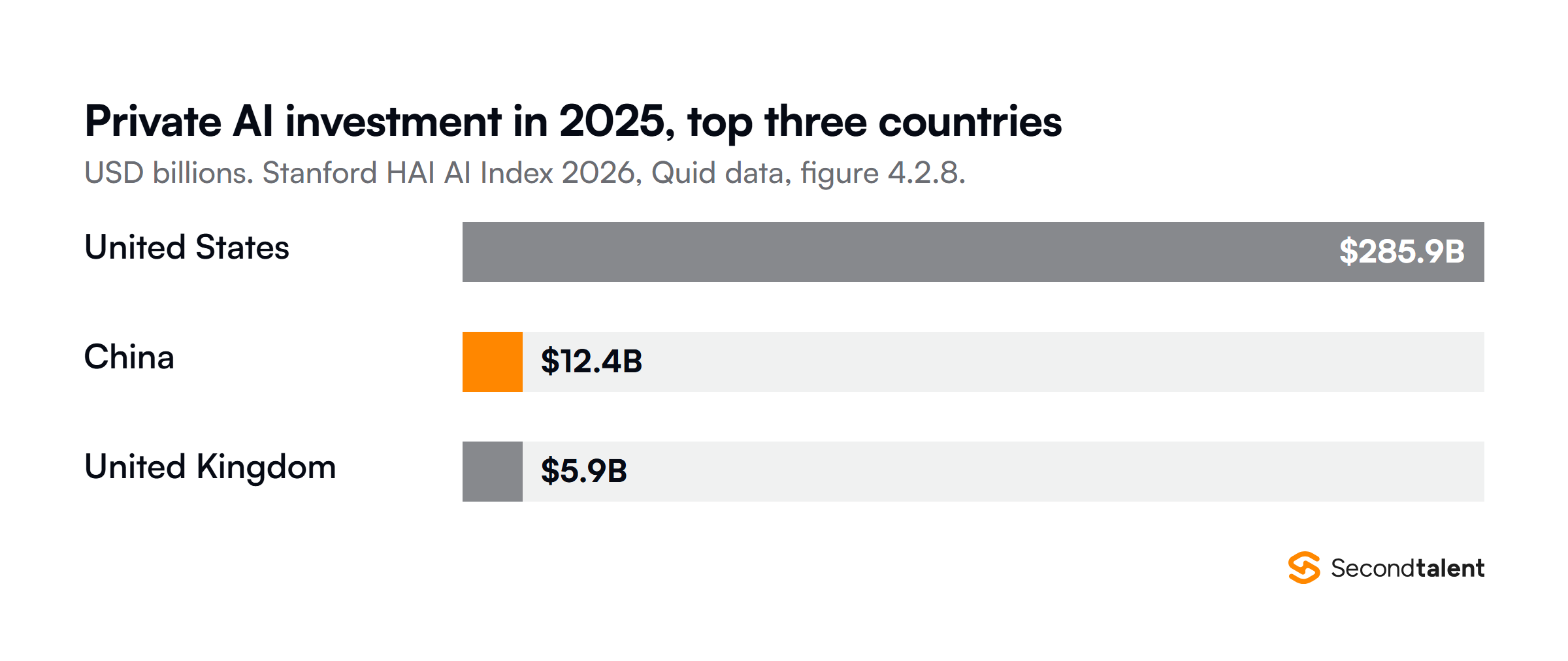
TL;DR: Most of the money going into Chinese AI in 2026 comes from big tech and the state, not venture funds. Stanford's AI Index counts $12.4 billion of private investment in Chinese AI in 2025, against $285.9 billion in the US. Tencent alone spent RMB84.7 billion on capital expenditure in the first half of 2026.
DeepSeek turned down outside money for years. In June 2026 it closed its first round, about 50 billion yuan, and founder Liang Wenfeng put in roughly 20 billion of it himself. The state’s national AI fund came away with a stake of about 0.28%.
- 1The “1 trillion yuan” state venture fund is 100 billion yuan of central money. The trillion is what it is meant to draw in from local governments and private investors.
- 2Zhipu AI closed its first trading day in Hong Kong worth HK$57.9 billion and passed HK$1 trillion on June 22, 2026.
- 3Nvidia’s August 2026 outlook assumes zero data center compute revenue from China.
- 4China’s industry ministry puts the core AI industry at more than 1.2 trillion yuan in 2025, across 6,200+ companies.
How Much Private Money Goes Into Chinese AI?
Stanford HAI’s AI Index 2026 counts $12.41 billion of private investment in Chinese AI companies in 2025. That ranks China second in the world, up 32.2% on 2024. The US total grew 160.2% to $285.88 billion, 23.1 times China’s.
The gap is widest in generative AI, where the same report has US companies raising $163.64 billion and Chinese ones $1.48 billion. China also ranks third, not second, on newly funded AI companies: 161 in 2025, behind 1,953 in the US and 172 in the UK. From 2013 to 2025 Chinese AI companies raised $131.83 billion in total.
Four trackers, four totals
No two venture trackers agree on 2025, because each defines an AI company and a deal in its own way. These are their own figures, not converted or combined.
ITJuzi’s total is not comparable with the dollar trackers: it counts in yuan, and its tallies include corporate deals. Its 2024 total of 105.3 billion yuan contained a single 23 billion yuan round for Huawei’s car unit Yinwang.
The OECD’s Preqin data adds a detail the others lack: China-based investors put $17.2 billion into AI companies outside China in 2025, more than went into China-based AI firms.
Foreign investors left, the state moved in
PitchBook data reported by Fortune shows government-linked investors doing fewer than 10 AI deals a year before 2018 and more than 140 in 2025. Foreign investors’ share of Chinese AI deal value fell to 7.1% in 2025, and they appeared in under 3% of deals.
“The state recognizes they can’t really match what Nvidia or the rest of the world’s AI giants are doing.”
Kaidi Gao, senior VC analyst at PitchBook, to Fortune, May 2026
The door is closing from both sides. Beijing’s planning agency told Moonshot AI and StepFun to refuse US investment without explicit government approval, Bloomberg reported in April 2026. US rules limit American money going the other way, as the section on restrictions below shows.
Embodied AI is the fastest-growing category
Humanoid robot and embodied AI companies raised 39.8 billion yuan across 325 deals in 2025, on ITJuzi’s count reported by Jiemian. That is 326% more money than in 2024. The first half of 2026 already passed it: 46 billion yuan across 288 deals, with about 70% going to the top 20 companies.
Seed rounds have grown to growth-stage size. Crunchbase recorded a $513 million seed round for TARS Robotics, led by Hillhouse and HSG. Across all sectors, KPMG’s Venture Pulse counted $35.1 billion of Chinese venture investment in the second quarter of 2026, the most since 2021.
What Are the Largest Funding Rounds in Chinese AI?
DeepSeek’s round is the largest. A regulatory filing puts its post-money valuation above 350 billion yuan, according to Caixin. After Liang’s own stake, Tencent put in 10 billion yuan and battery maker CATL 5 billion, with NetEase and JD.com also in the round.
| Company | Date | Amount | Valuation | Named investors |
|---|---|---|---|---|
| DeepSeek | Jun 2026 | About 50B yuan ($7.4B) | Above 350B yuan | Liang Wenfeng, Tencent, CATL, national AI fund |
| Moonshot AI | Jul 2026 | $3.5B | $35B | National AI fund among the leads |
| StepFun | May 2026 | Nearly $2.5B | Not disclosed | Pre-IPO round |
| Moonshot AI | May 2026 | About $2B | $20B | Meituan’s Long-Z Investments |
| Baichuan | Jul 2024 | 5B yuan | 20B yuan | Alibaba, Tencent, Xiaomi, Beijing, Shanghai and Shenzhen state funds |
| TARS Robotics | By May 2026 | $513M seed | Not disclosed | Hillhouse, HSG |
| Galbot | Mar 2026 | 2.5B yuan ($362M) | Not disclosed | National AI fund, per Caixin |
DeepSeek’s owner may need the money. “As DeepSeek’s capital and compute needs grow, it may be unable to rely on High-Flyer, whose revenue has become ‘unstable,'” Rhodium Group analyst Ciel Qi told CNBC in August. Our DeepSeek statistics cover its users, prices and model downloads.
Moonshot AI: from $2.5 billion to $35 billion
Moonshot, the company behind the Kimi models, shows how fast private valuations moved once Chinese open-weight models caught on. It was worth about $2.5 billion after an Alibaba-led round in February 2024 and $4.3 billion after its Series C at the end of 2025.
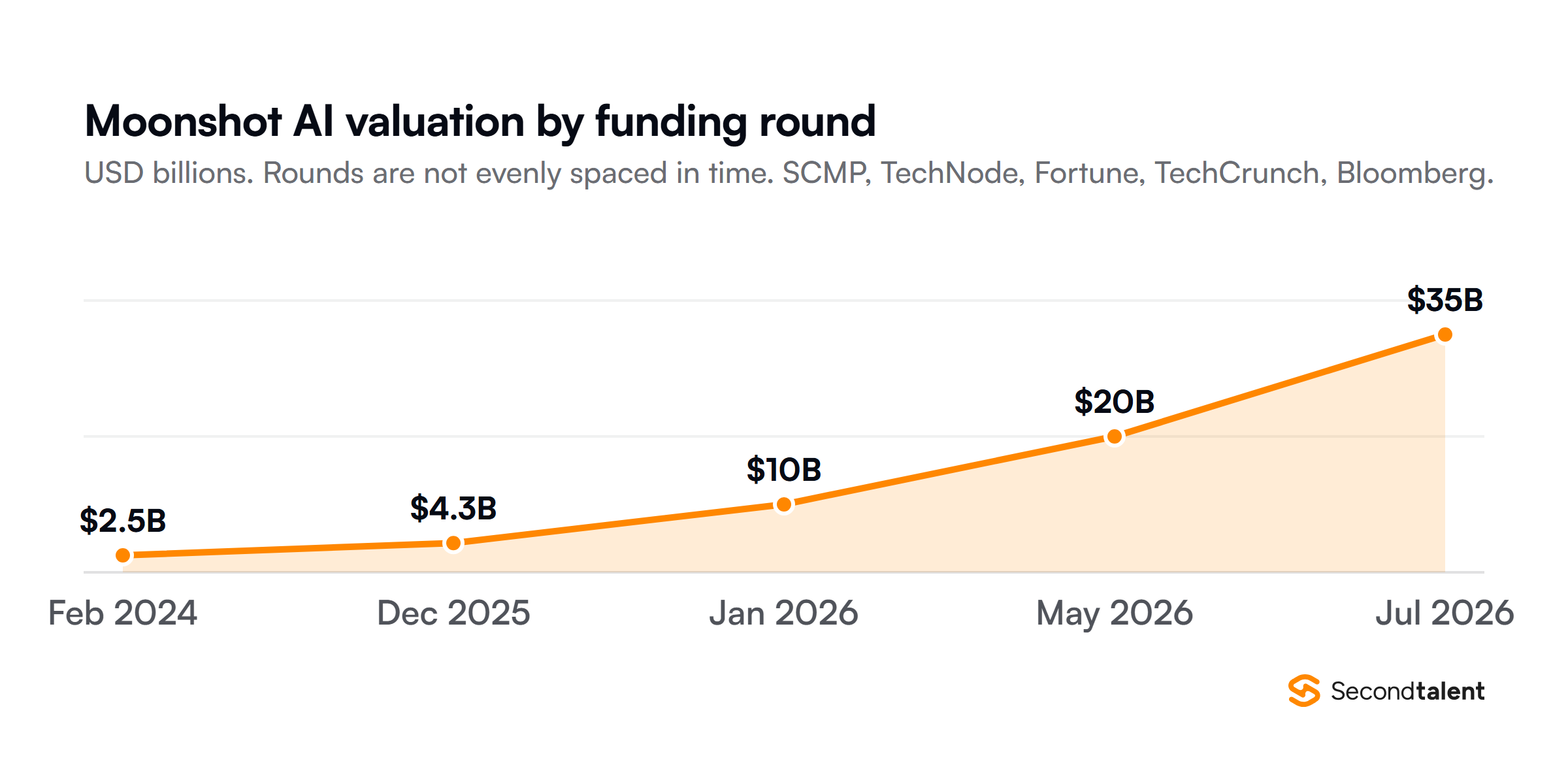
Five months later TechCrunch reported a $2 billion raise at $20 billion. By July the national AI fund was helping lead a $3.5 billion round at $35 billion, Bloomberg reported. TechNode has reported plans for a final pre-IPO round at up to $50 billion. The Kimi model lineup is what investors were paying for.
StepFun followed the same path. Yicai reported a Series B+ above 5 billion yuan in early 2026, then a round of nearly $2.5 billion in May ahead of a Hong Kong listing. For the wider field, see our list of Chinese AI startups to watch.
How Much Does the Chinese Government Invest in AI?
Beijing publishes no total. The best estimate is academic: an NBER working paper by economists at MIT, Harvard and Oxford found that government venture funds put $184 billion into 9,623 AI firms between 2000 and 2023. That was 23% of the $912 billion those funds invested across all industries.
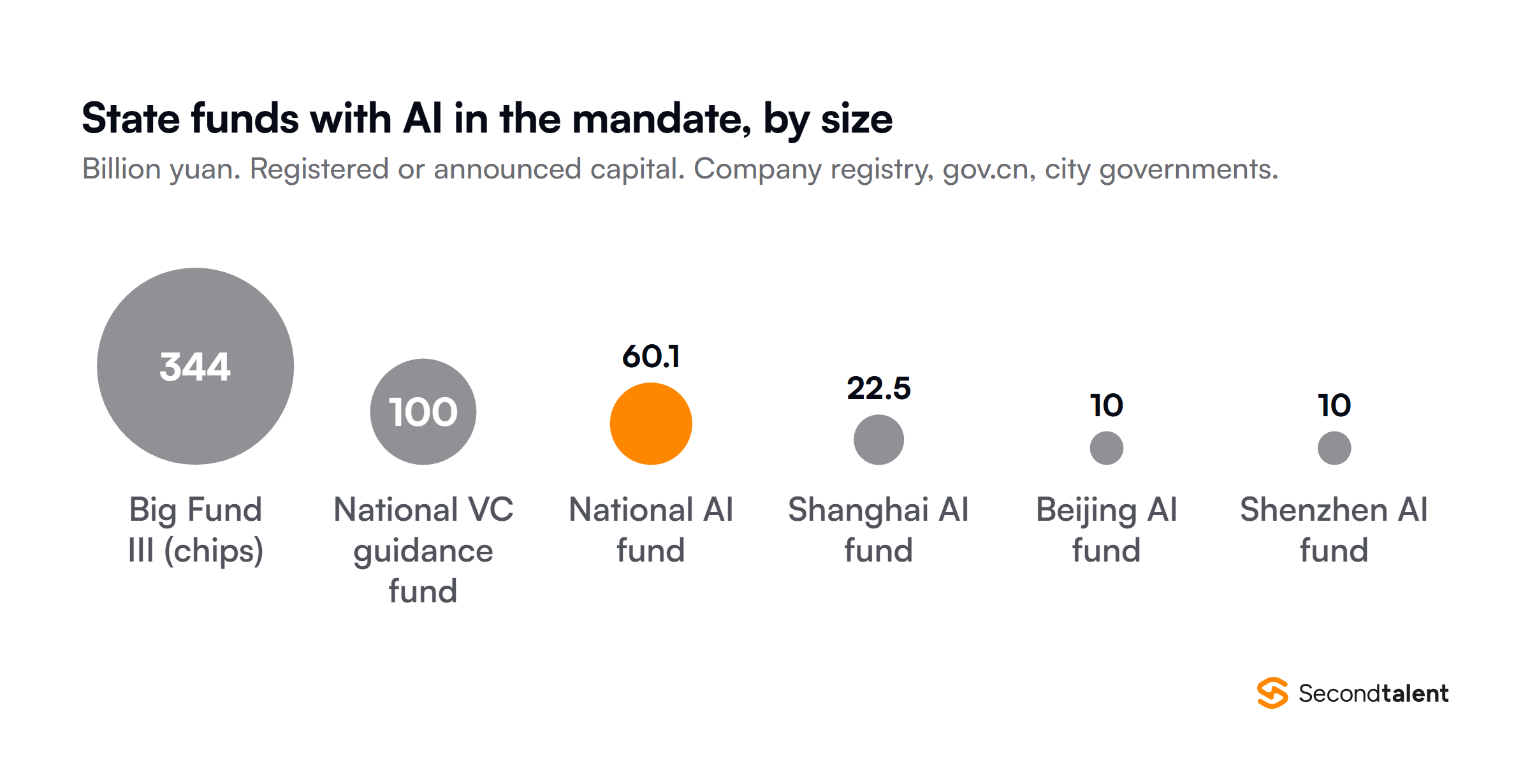
The funds set up since 2024 are easier to size, but they overlap: Big Fund III is a chip fund, and it is also the main backer of the national AI fund, so the sizes below should not be added together.
The trillion-yuan fund is 100 billion
Headlines in March 2025 called the national venture guidance fund a $138 billion fund. The December 2025 launch notice sets central funding at 100 billion yuan, raised through ultra-long special treasury bonds. The trillion is the local and private capital it is meant to attract.
Its rules point it at small, early companies. At least 70% goes to seed and early-stage rounds, no single investment may exceed 50 million yuan, and the money flows through 600+ sub-funds.
The three regional funds carry registered capital of 29.6, 47.1 and 45.05 billion yuan, 21st Century Business Herald reported, against an official target of more than 50 billion each.
City governments pay for compute directly
Local money is smaller but closer to the companies. The most common tool is the compute voucher, a subsidy a startup spends on GPU time.
- Beijing: a 100 billion yuan, 15-year government fund covering AI, robotics and other sectors, and a separate 10 billion yuan AI fund that put 200 million yuan into Zhipu in April 2025.
- Shanghai: a 22.5 billion yuan AI mother fund, plus vouchers worth 600 million yuan for compute, 300 million for model use and 100 million for training data.
- Shenzhen: a planned 10 billion yuan fund for AI and robotics, about 200 million yuan of compute vouchers to about 40 firms in its first batch, and 4.5 billion yuan of policy funds in 2025.
- Hangzhou: a target of more than 100 billion yuan in AI industry funds by the end of 2025, and 250 million yuan a year in city compute vouchers.
The AI+ plan sets adoption targets but no spending figure, and the 2026 government work report has no AI budget line either. The new five-year plan instead backs hyper-scale intelligent computing clusters and government purchases of compute.
How Much Are Chinese Tech Giants Spending on AI?
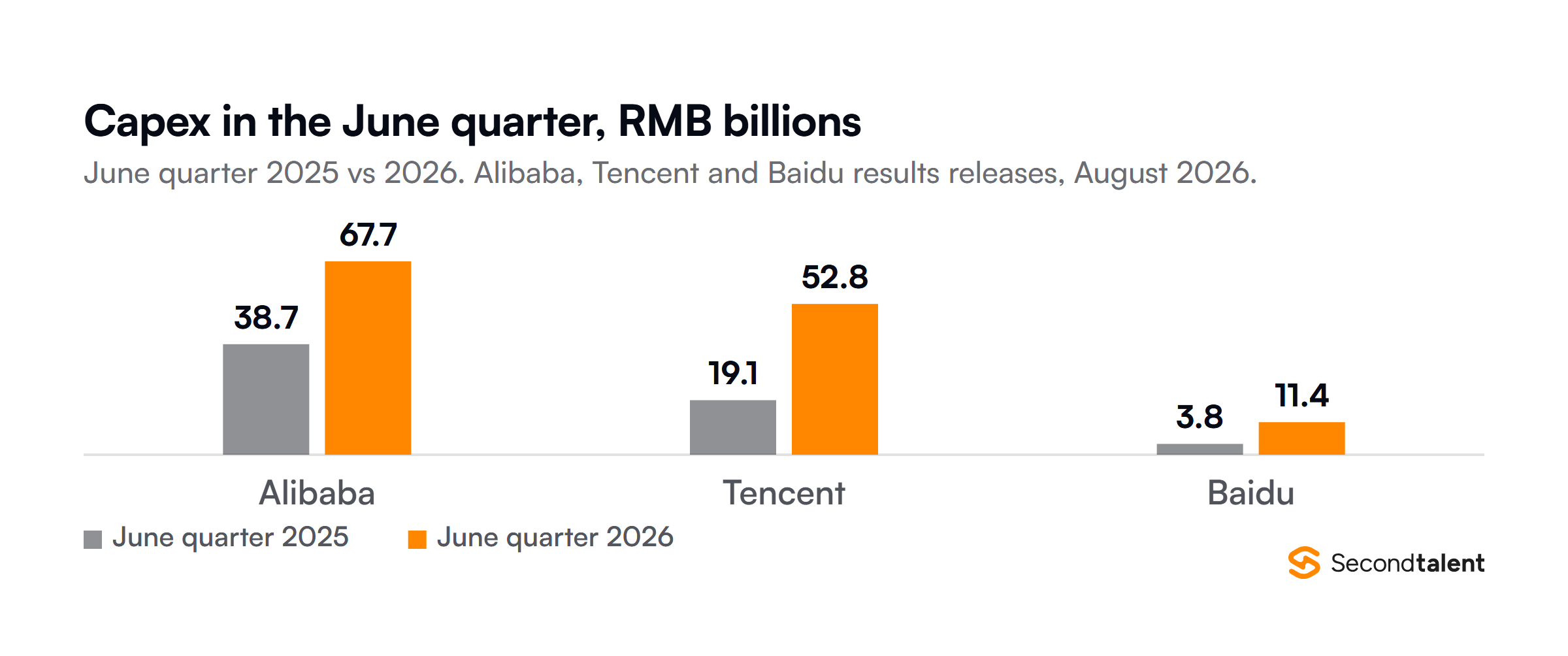
Tencent’s free cash flow turned negative in the second quarter of 2026, at minus RMB13.8 billion, because it paid RMB59.3 billion for capital equipment in three months. Its results release ties the spending to prepayments for AI compute. Alibaba and Baidu also stepped up their spending in the June quarter.
Alibaba
In February 2025 Alibaba pledged at least RMB380 billion over three years for cloud and AI infrastructure, more than it spent on both in the previous decade. Its capex for the fiscal year to March 2026 was RMB126.1 billion. Then the June 2026 quarter alone came in at RMB67.7 billion, up 75%.
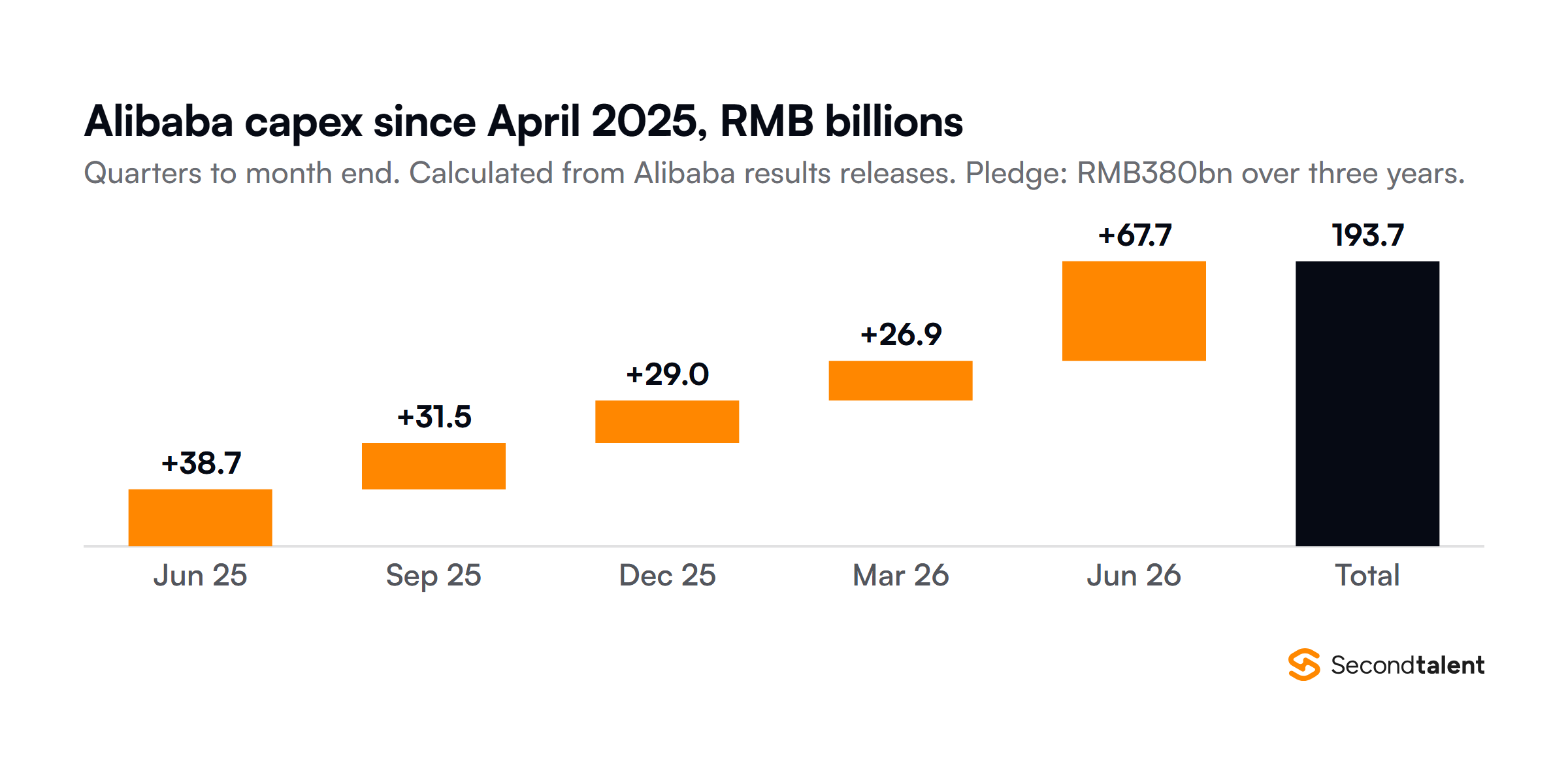
Chief executive Eddie Wu told analysts in May that Alibaba would likely “overshoot the original CAPEX figure,” and that “today there isn’t a single card on our servers that is idle,” according to the earnings call transcript.
Cloud revenue grew 45% to RMB48.4 billion in the June quarter, and AI product revenue grew at triple digits for the 12th quarter running.
Tencent
Tencent’s capex rose 221% to RMB76.8 billion in 2024, then only 3% to RMB79.2 billion in 2025. The pause ended in 2026: RMB31.9 billion in the first quarter and RMB52.8 billion in the second, up 176%.
“The CapEx that we allocate for building the AI native business, it is more of a sort of a lump sum that we are going to be investing this year and next year.”
Martin Lau, Tencent president, earnings call, August 12, 2026
ByteDance
ByteDance does not publish results, and the capex plans reported by people familiar with them have kept rising. Reuters reported a 2025 plan of more than 150 billion yuan. The Financial Times put the 2026 plan at 160 billion yuan in December 2025, with 85 billion for AI processors.
In May 2026 SCMP reported that ByteDance had raised the 2026 plan to more than 200 billion yuan. Weeks later Bloomberg said it was discussing up to $70 billion. A General Atlantic stake sale in February 2026 valued the company at $550 billion.
Baidu, Xiaomi, Huawei and Kuaishou
Baidu’s GPU cloud revenue grew 283% in the second quarter of 2026, and its AI cloud infrastructure business reached RMB7.3 billion, up 50%, Baidu reported. Its chip unit Kunlunxin filed confidentially to list in Hong Kong in January. Our Baidu vs Alibaba comparison covers the two companies’ AI businesses.
Xiaomi committed at least RMB60 billion to AI over three years in March 2026. Huawei spent CNY192.3 billion on R&D in 2025, 21.8% of revenue, its annual report says. Kuaishou’s Kling video model earned more than RMB850 million in the second quarter, up over 200% on the year.
China vs the US on capex
- About $65B of capex in 2025
- $140B to $165B a year in 2026 and 2027
- More than $785B in 2026, roughly six times China
- Nearing $1 trillion in 2027
Other banks draw the line differently, so their figures cannot be swapped into the Moody’s comparison. Moody’s does not name the Chinese companies it counts, and Goldman Sachs and UBS each count a different set.
How Are Chinese AI Companies Doing on the Stock Market?
Hong Kong was the world’s top IPO market in 2025, with HK$286.9 billion raised across 119 listings. That was 226% more than in 2024, and the exchange’s own review credits the rebound partly to the “DeepSeek moment”.
| Company | What it makes | Market | Listed | Raised |
|---|---|---|---|---|
| Horizon Robotics | Driving chips | Hong Kong | Oct 24, 2024 | HK$5.4B |
| Moore Threads | GPUs | STAR | Dec 5, 2025 | CNY8B |
| MetaX | GPUs | STAR | Dec 17, 2025 | CNY4.2B |
| Biren Technology | GPUs | Hong Kong | Jan 2, 2026 | HK$5.58B |
| Zhipu AI | GLM models | Hong Kong | Jan 8, 2026 | HK$4.35B |
| Iluvatar CoreX | GPUs | Hong Kong | Jan 8, 2026 | About HK$3.7B |
| MiniMax | Models and apps | Hong Kong | Jan 9, 2026 | HK$4.8B |
| CXMT | Memory chips | STAR | Jul 27, 2026 | CNY57.92B |
| Zhongji Innolight | Optical modules | Hong Kong | Jul 30, 2026 | HK$53.41B |
| Unitree Robotics | Humanoid robots | STAR | Aug 19, 2026 | CNY6.1B |
| Enflame | AI chips | STAR | Sep 11, 2026 | CNY6.12B |
Shanghai’s STAR Market reopened to loss-making tech companies after the securities regulator’s “1+6” reforms of June 2025, which revived its fifth listing standard. MetaX and Moore Threads were reviewed under it. The first-day gains there have been far larger than in Hong Kong.
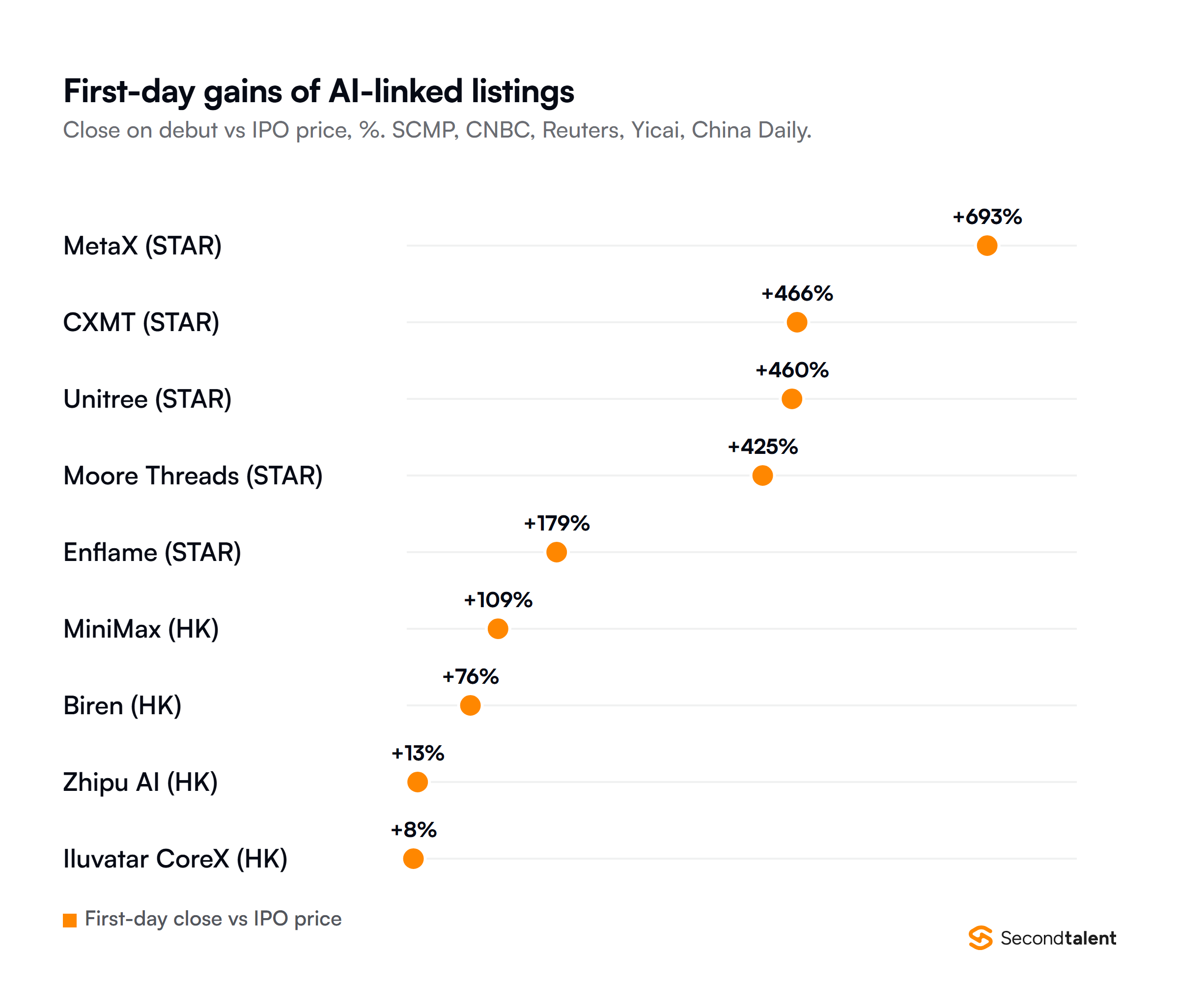
Retail investors piled in. Enflame’s retail tranche was subscribed 4,073 times, and MiniMax’s Hong Kong retail book 1,837 times. Zhongji Innolight’s HK$53.41 billion share sale, Hong Kong’s largest since Alibaba in 2019, closed 2% down on its first day.
Zhipu and Cambricon pass a trillion
Zhipu AI was worth HK$57.9 billion at its first close. On June 22, 2026, its market value passed HK$1 trillion. Eight days later AI chip designer Cambricon became the first STAR Market stock worth CNY1 trillion.
Cambricon has the revenue to show for it. It made its first annual profit in 2025, CNY2.06 billion, then reported first-half 2026 revenue of CNY6 billion, up 108%, and profit of CNY2.3 billion. Some fund managers doubt the model makers have earned their prices.
“Valuation expectations for a handful of language model players are running ahead of fundamentals.”
Bush Chu, Aberdeen Investments, May 14, 2026, via Bloomberg
The rally started with a loss. Nvidia shed $589 billion of market value on January 27, 2025, and Goldman Sachs forecast $200 billion of portfolio inflows into Chinese stocks weeks later. The Hang Seng Tech index finished 2025 up 23.5%.
The pipeline is still full. Kunlunxin, AgiBot and StepFun have started Hong Kong processes, and Moore Threads plans a second listing there. Hong Kong IPOs raised HK$210.2 billion in the first half of 2026, and KPMG counts 13 specialist technology listings supplying 14% of the funds. Our top Chinese AI companies list profiles the model makers.
Where Does the Money Go: Chips, Compute and Restrictions
Nvidia is no longer counting on any of that spending. It took a $4.5 billion charge on its H20 China chip in the quarter to April 2025, and its August 2026 results said: “NVIDIA is not assuming any Data Center compute revenue from China in its outlook.”
Domestic chips are filling the gap. ByteDance and Alibaba plan to order Huawei’s Ascend 950PR, Reuters reported. The industry ministry’s 2030 plan pairs its compute target with 3.8 trillion yuan of information infrastructure investment, a figure that covers telecoms as well as AI.
US limits on investing in Chinese AI
Since January 2, 2025, the US Treasury’s outbound investment rule bars US persons from investing in Chinese companies developing AI systems trained on more than 10^25 computational operations. Investors must notify Treasury of deals involving models trained above 10^23 operations.
Congress wrote the program into law in the COINS Act, signed on December 18, 2025, and added hypersonics and high-performance computing. Treasury has 450 days to issue new rules. Our breakdown of which countries build the most AI models shows what that capital has produced so far.
Hiring AI Engineers in China and Hong Kong
These data centers need engineers who can train, serve and fine-tune models on domestic chips. Second Talent matches companies with pre-vetted AI developers in China, and our AI engineer rate card for China shows what the role costs.
If you have no entity in China, our employer of record service in China handles contracts, payroll and social insurance. Tell us what you are building and we will send matching profiles.
Frequently Asked Questions
How much does China invest in AI each year?
No official annual total exists. The measurable parts are private investment ($12.41 billion in 2025, Stanford AI Index), big tech capex (about $65 billion in 2025, Moody’s) and state funds such as the 60.06 billion yuan national AI fund. They overlap, so they cannot be added up.
Does China invest more in AI than the US?
Not on any published measure. The US leads on private investment by 23 times (Stanford) and on hyperscaler capex by about six times (Moody’s). China’s state venture funds have no published US equivalent to compare against.
Can US investors buy into Chinese AI companies?
Partly. The Treasury rule prohibits investment in Chinese developers of the largest models and requires notice for mid-sized ones. Beijing has also told Moonshot AI and StepFun not to take US money without approval.
Which Chinese AI company is worth the most?
Among listed AI chip and model companies, Cambricon passed CNY1 trillion on June 30, 2026, and Zhipu AI passed HK$1 trillion on June 22. Among private AI labs, DeepSeek’s June 2026 round valued it above 350 billion yuan. ByteDance, at $550 billion, is larger but is not an AI lab.


![Singapore AI Companies Leading Southeast Asia. Top 10 Singapore AI Companies Leading Southeast Asia [2026], by Second Talent.](https://www.secondtalent.com/wp-content/uploads/2026/09/singapore-ai-companies-featured-v2-768x403.jpg)