TL;DR: PyTorch has the strongest open-source community in deep learning: 647 people landed code in the last 90 days, and a vendor-neutral foundation runs it. TensorFlow, Hugging Face Transformers, JAX and Keras complete the top five, ranked by active human contributors.
TensorFlow still has more GitHub stars than any other deep learning framework, 200,229 on September 21, 2026. Yet Google engineers wrote 80% of the commits that reached its repository this summer inside Google's own code base. I ranked the five biggest frameworks on the people who ship code, using the GitHub API, then checked downloads, governance and release pace.
The 5 Frameworks Compared
| Rank | Framework | Commit authors, 90 days | Contributors, all time | GitHub stars | PyPI downloads, 30 days | Steward |
|---|---|---|---|---|---|---|
| 1 | PyTorch | 647 | 7,031 | 103,152 | 63.2M | PyTorch Foundation (Linux Foundation) |
| 2 | TensorFlow | 378 | 5,331 | 200,229 | 12.1M | |
| 3 | Hugging Face Transformers | 209 | 4,129 | 166,473 | 99.9M | Hugging Face |
| 4 | JAX | 141 | 1,125 | 36,321 | 9.2M | |
| 5 | Keras | 65 | 1,569 | 64,326 | 12.2M | Google (keras-team) |
- 1Hugging Face made Transformers v5 PyTorch-only in December 2025, dropping TensorFlow and Flax support.
- 2Keras now gets more PyPI downloads than TensorFlow, because Keras 3 also runs on JAX and PyTorch.
- 3Google put TensorFlow into maintenance mode with release 2.21 in March 2026, and now points new generative AI work to Keras 3, JAX and PyTorch.
- 4JAX calls itself "a research project, not an official Google product", yet 91% of its recent commits come from google.com addresses.
The Top 5, Ranked by Active Contributors
1. PyTorch: the widest contributor base, run by a foundation

PyTorch is for teams that want the framework vLLM, DeepSpeed and Hugging Face build on first. No single company controls it. Meta moved it to the Linux Foundation on September 12, 2022, with AMD, AWS, Google Cloud, Microsoft Azure and NVIDIA as founding members.
The foundation has since grown past PyTorch itself. In May 2025 it became an umbrella foundation and took in vLLM and DeepSpeed. At that point it counted more than 30 member companies and 120 related projects. Its GitHub repository has 103,152 stars, about half of TensorFlow's, a reminder that stars say little about who is still building.
Ray joined in October 2025. The pitch is now a full open stack: PyTorch to build a model, vLLM to serve it, Ray to spread the work across machines.
The activity matches the governance. Users opened 7,262 issues in the year to September 21. That is more than the other four frameworks combined. The last two feature releases landed eight weeks apart: 2.13 on July 8 and 2.14 on September 2, 2026.
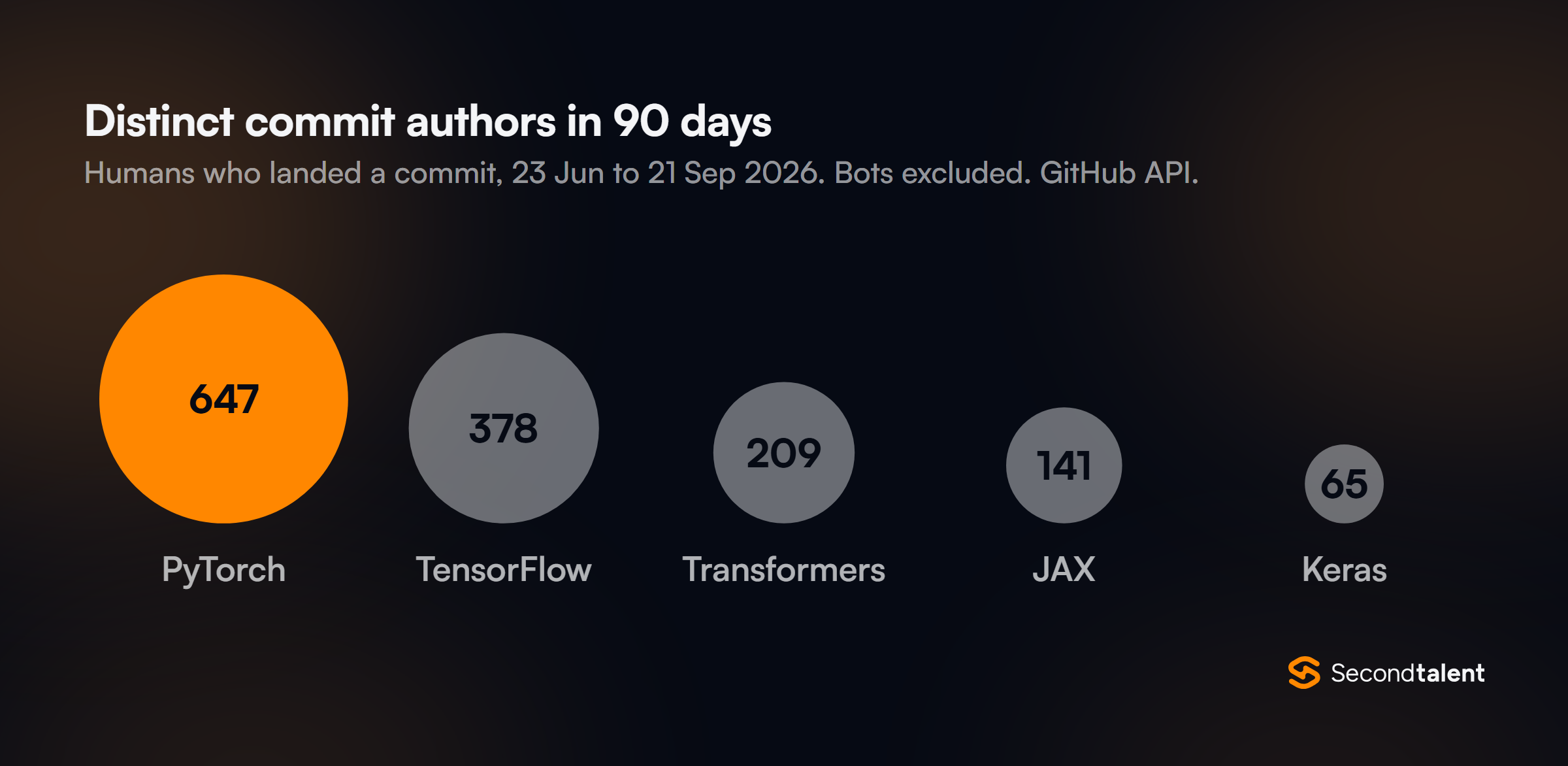
One trap if you check this yourself. PyTorch lands pull requests through a merge bot that closes them rather than marking them merged. GitHub search shows only 396 merged PRs in a year, which badly undercounts the work. Commits and authors are the fair measure here.
- Best for: research code, LLM training and fine-tuning, and anything built on Hugging Face, vLLM or DeepSpeed.
- Community signal: the most distinct human authors of the five, backed by a foundation with 30+ member companies.
- Watch out: 17,551 open issues and pull requests, so a niche bug can wait a long time for a fix.
2. TensorFlow: the biggest audience, built mostly inside Google
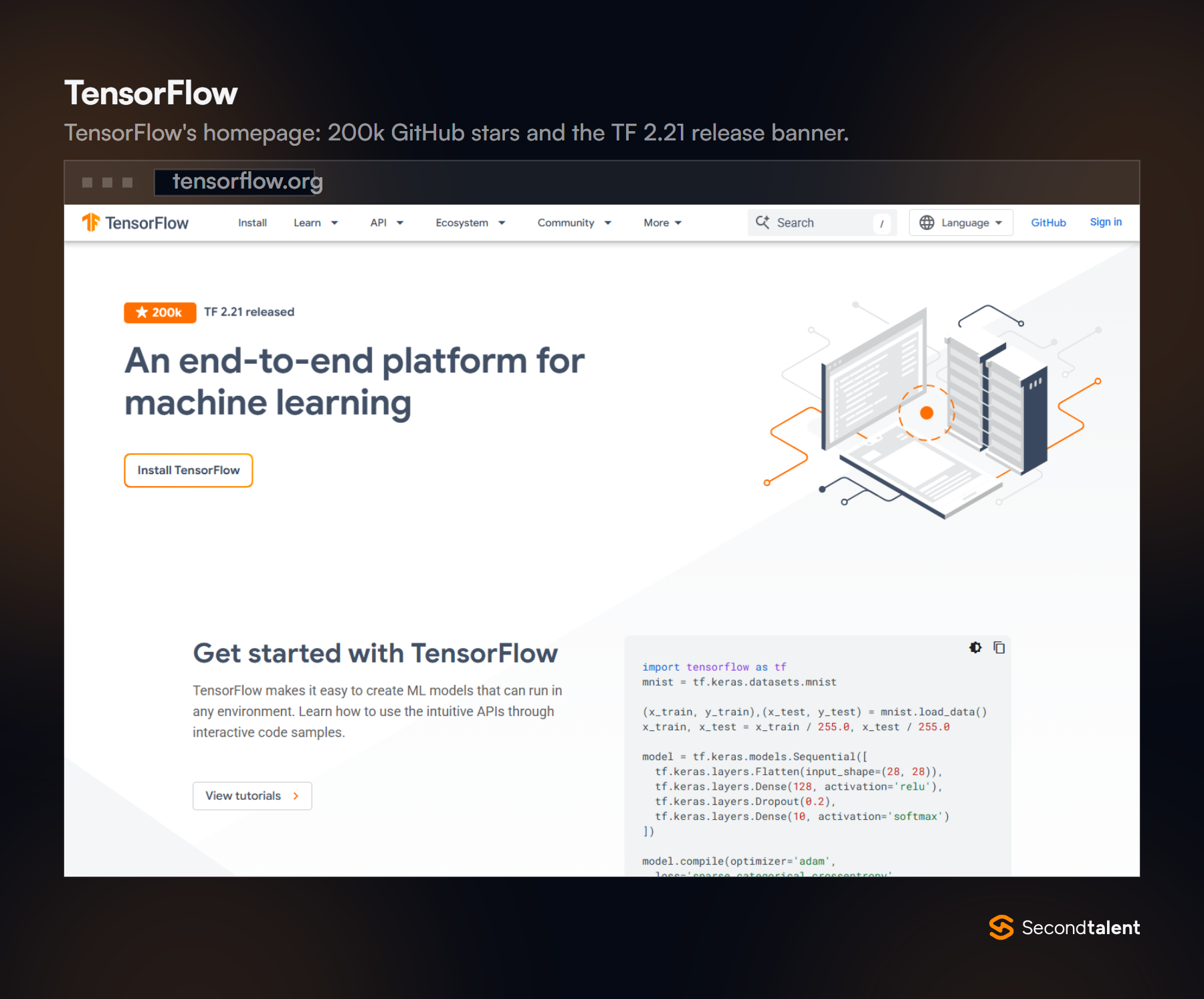
TensorFlow is for teams shipping models onto phones, browsers and small devices. Its mobile runtime, renamed LiteRT in September 2024, had shipped in more than 100,000 apps and ran on about 2.7 billion devices at the time. Google now uses LiteRT to run PyTorch, JAX and Keras models on devices as well.
The community numbers are large but reflect its early years. TensorFlow has 5,331 all-time contributors, yet only 378 people committed in the last 90 days. Of the 3,760 commits in that window, 2,990 carry a PiperOrigin-RevId line. That line marks a change made in Google's internal code base and copied out to GitHub.
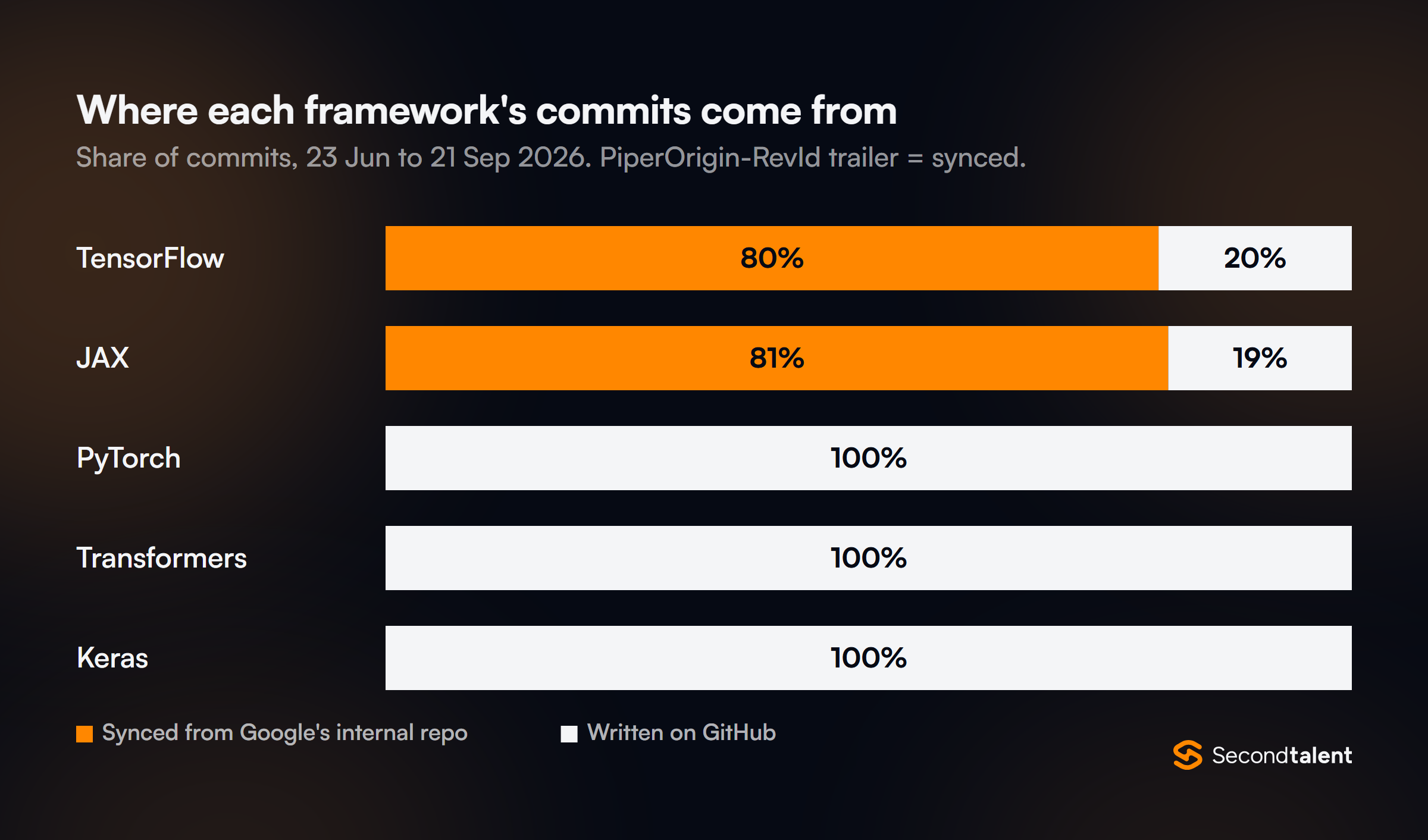
Outsiders can still send pull requests, and plenty do. But Google engineers write most of the code and review it inside Google first.
Its backlog is smaller than PyTorch's, at 3,232 open issues and pull requests. That shows in the demand signals too. Users opened 990 issues in a year, against 7,262 for PyTorch.
The last release, 2.21.0, came with a change of course. In its TensorFlow 2.21 announcement on March 6, 2026, Google said it will "exclusively focus on" security and bug fixes, dependency updates and critical fixes from the community. For new generative AI work, it recommends "Keras 3, JAX, and PyTorch".
Keras 3 has been TensorFlow's default high-level API since TF 2.16. For a head-to-head on speed and memory, see our PyTorch vs TensorFlow comparison.
- Best for: existing TensorFlow production systems, on-device inference and TensorFlow Serving setups.
- Community signal: the largest audience on GitHub, with 200,229 stars, but a Google-led code stream.
- Watch out: no new features are planned, and Hugging Face dropped TensorFlow support in Transformers v5.
3. Hugging Face Transformers: where most model code now lives
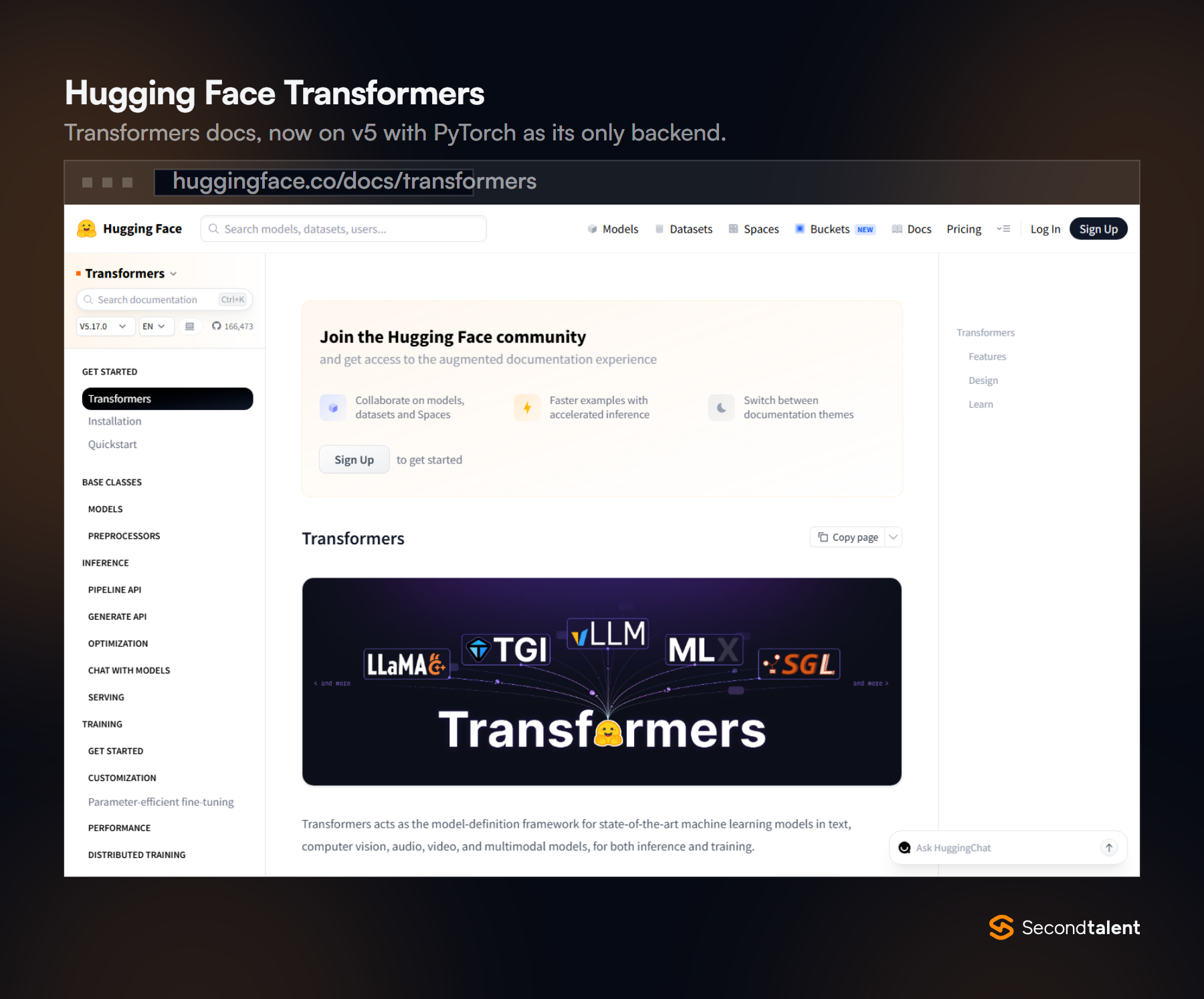
Transformers is for anyone who loads a pretrained model rather than designing one from scratch. It sits on top of PyTorch, so it is not a framework in the same sense as the other four. It earns a place because it calls itself "the model-definition framework" for current models, and 400+ architectures live in one repository.
The v5 release on December 1, 2025 was a community decision with teeth. Hugging Face cut TensorFlow and Flax and kept PyTorch as the only backend. The same post put installs at 3 million a day, against 20,000 a day in the v4 era, with more than 750,000 checkpoints on the Hub.
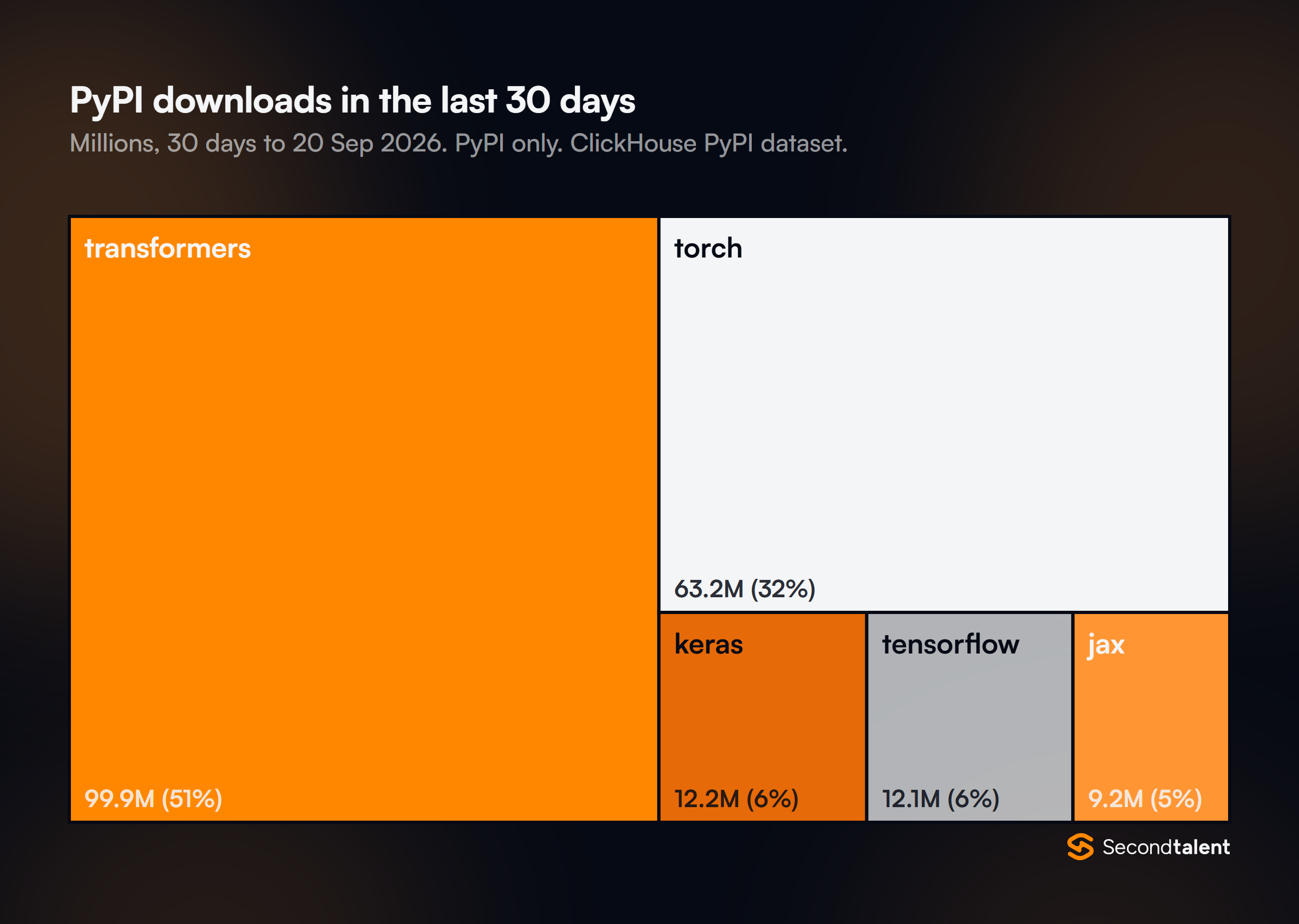
On PyPI, transformers logged 99.9 million downloads in the 30 days to September 20, per ClickHouse's public PyPI data. Read that with care. Automated test runs count as downloads, and PyTorch also serves its GPU builds from its own package index, which PyPI does not count.
The contributor base is wide for a single company's project: 209 authors in 90 days. Releases come fast too: v5.16.0 on August 26 and v5.17.0 on September 9, 2026. Hugging Face puts total installs at 1.2 billion. If you want to adapt those models, our guides to fine-tuning platforms and open small language models pick up from here.
- Best for: using, fine-tuning and serving pretrained language, vision and audio models.
- Community signal: the PyTorch Foundation calls it "a source of truth and foundation for modeling across the field".
- Watch out: Hugging Face sets the direction, as the v5 backend cut showed, and v4 code needs migration work to run on v5.
4. JAX: small, fast-moving and Google-heavy
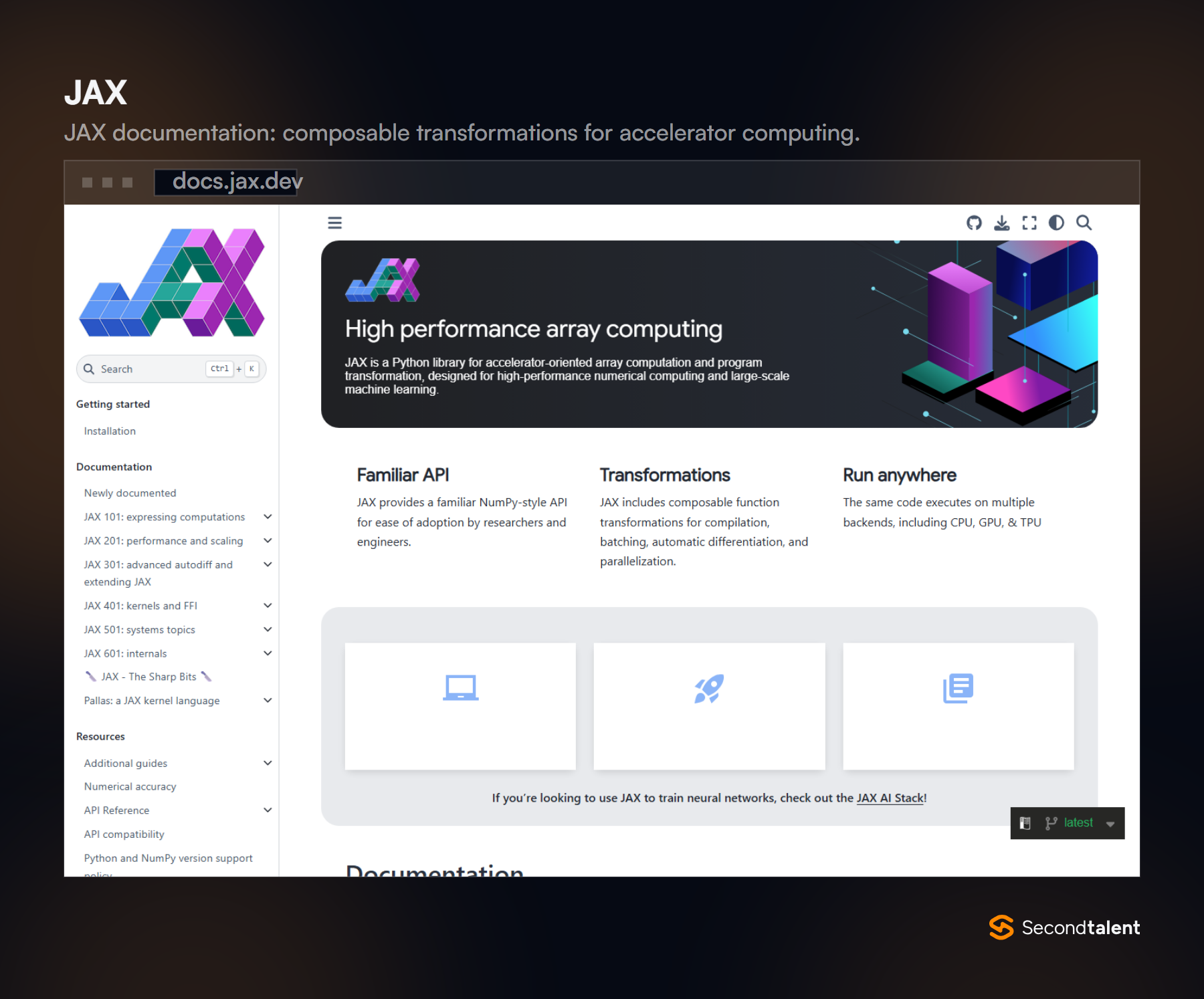
JAX is for research teams training large models on TPUs or big GPU clusters. You write NumPy-style Python, and three transforms do the heavy work: grad for gradients, jit for compilation through XLA, and vmap to batch work across inputs. It runs on CPUs, NVIDIA GPUs and Google TPUs, with AMD, Apple and Intel GPUs marked experimental. The repository moved from the google organisation to its own jax-ml organisation, and old links redirect.
The README still says: "This is a research project, not an official Google product. Expect sharp edges." The commit log tells a different story about who builds it. Of 1,859 commits in the last 90 days, 1,696 came from google.com addresses, and 1,512 carried Google's internal-sync marker.
That makes JAX the most active of the Google projects for its size. It produced 7,789 commits in a year and ships monthly: 0.11.0 on July 16, 0.11.1 on August 17 and 0.11.2 on September 17, 2026. Only 141 people committed in 90 days, though, and the outside community is thin.
The Transformers v5 decision hurt here too. Dropping Flax meant JAX users lost first-class access to the biggest model library. The JAX team now points people to its own "JAX AI Stack" for neural network training instead.
- Best for: large-scale training on TPUs, numerical research and custom model math.
- Community signal: fast release pace and deep docs, but outside contributors are a small minority.
- Watch out: Flax lost Transformers support in v5, so many pretrained models need porting before they run in JAX.
5. Keras: one API, three backends
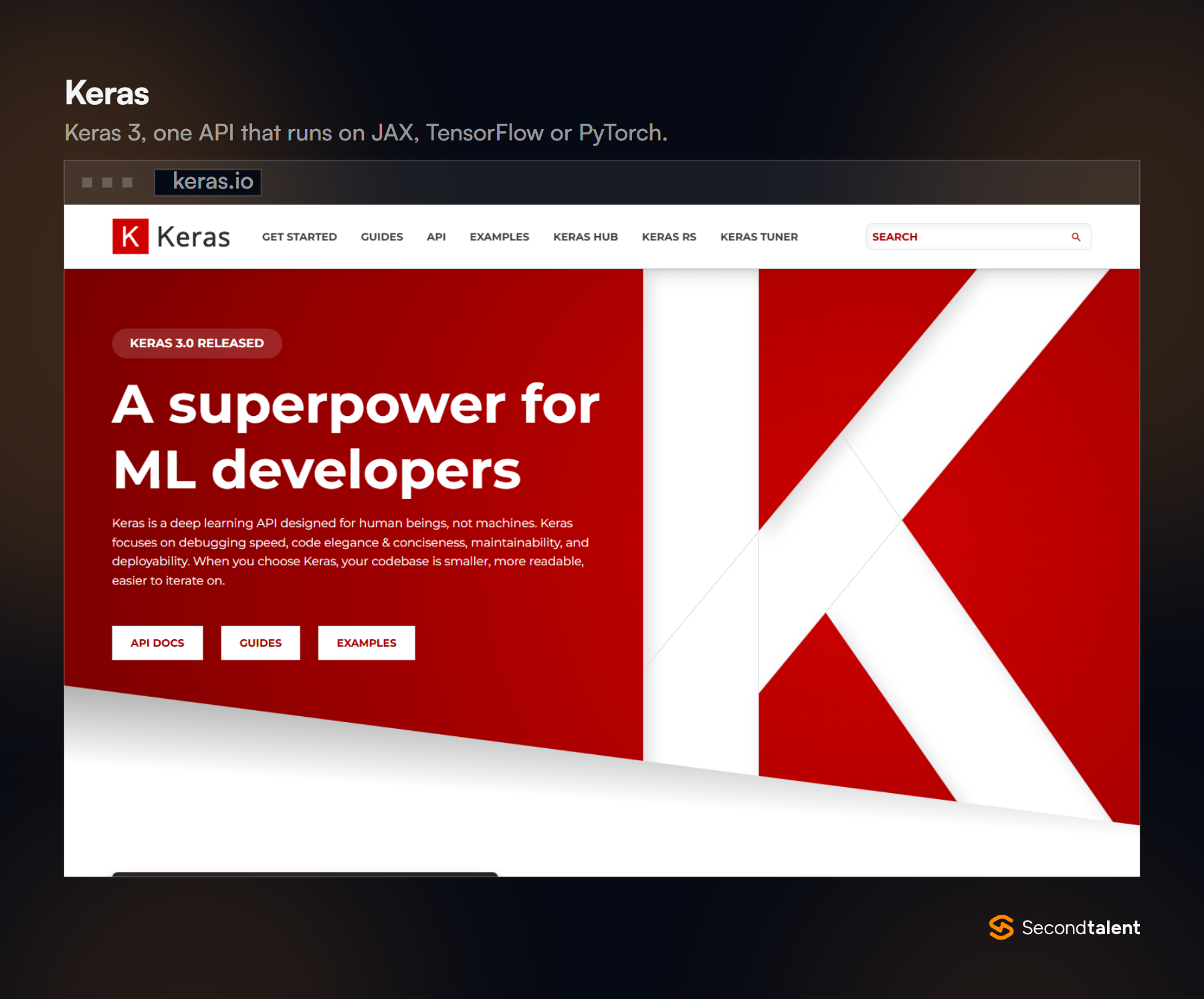
Keras is for teams who want one high-level API and the freedom to change backend later. Keras 3 runs the same model code on JAX, TensorFlow or PyTorch, with full training and inference on all three. Since release 3.8 it can also export to OpenVINO for inference.
Keras says 2.5 million developers use it, and names Waymo and YouTube among the users. The backend switch changed who downloads it. Keras had 12.2 million PyPI downloads in the 30 days to September 20, ahead of TensorFlow's 12.1 million. People now install it without TensorFlow at all.
The contributor base is the smallest here: 65 authors in 90 days and 1,044 commits in a year. The upkeep is the tidiest, though. The keras-team repository has 221 open issues and pull requests, against 17,551 for PyTorch and 3,232 for TensorFlow. A bug report here is far more likely to get an answer.
- Best for: fast prototyping, teaching, and teams that want to keep their backend options open.
- Community signal: a small, responsive core team and the lowest open-issue backlog of the five.
- Watch out: custom training loops and new research ideas still need backend-specific code.
Hiring Engineers Who Know These Frameworks
A framework's community is also its hiring pool. We vet PyTorch developers, machine learning engineers and LLM engineers across Asia and match them to your stack. For the wider tool landscape, see our AI frameworks and tools guide. Tell us what you are building and profiles follow within 24 hours.
Frequently Asked Questions
Which deep learning framework has the largest community?
PyTorch, if you count the people writing code. TensorFlow still leads on GitHub stars and forks, which reflect its first years as the default choice.
Why are PaddlePaddle, MXNet and MindSpore not on the list?
Apache archived MXNet in 2023. MindSpore develops on Gitee, and its GitHub mirror stopped updating in July 2024. PaddlePaddle is active and strongest in China, but had 45 commit authors in 90 days, well behind Keras.
Is TensorFlow dead?
No. It still gets about 12 million PyPI downloads a month and runs on-device through LiteRT. Since 2.21 in March 2026, though, Google ships only security, bug and dependency fixes, and recommends Keras 3, JAX or PyTorch for new generative AI work.

![Singapore AI Companies Leading Southeast Asia. Top 10 Singapore AI Companies Leading Southeast Asia [2026], by Second Talent.](https://www.secondtalent.com/wp-content/uploads/2026/09/singapore-ai-companies-featured-v2-768x403.jpg)



![AI Coding Assistant Statistics & Trends. AI Coding Assistant Statistics & Trends [2025], by Second Talent.](https://www.secondtalent.com/wp-content/uploads/2026/09/ai-coding-assistant-statistics-featured-v2-768x403.jpg)