The rise of advanced reasoning models like OpenAI GPT 5 and DeepSeek R1 marks a major leap in AI-driven mathematical problem-solving. These models go beyond simple equation-solving; they can reason, explain, and verify like human experts.
To understand their real-world performance, we compared them across seven math-focused use cases, from algebra and calculus to probability simulations.
Our goal was to evaluate not just accuracy, but how clearly each model communicates its logic.
This comparison helps developers, researchers, and learners identify which AI performs best for their specific reasoning and problem-solving needs.
What is OpenAI GPT 5?
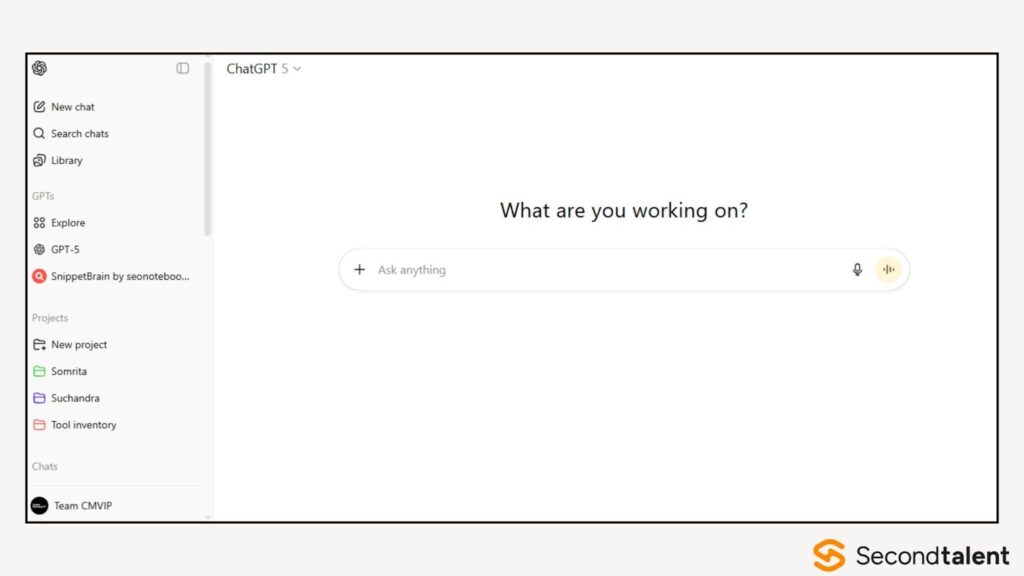
OpenAI GPT-5 is the latest large language model from OpenAI, designed to perform advanced reasoning, coding, and problem-solving tasks with greater accuracy and context awareness.
It powers ChatGPT’s newest version, offering multimodal capabilities (text, image, and file understanding) and improved factual reliability.
Built on deep reinforcement learning and large-scale reasoning optimization, GPT 5 is faster, more structured, and capable of handling complex end-to-end workflows.
Highlights:
- Exceptional mathematical and logical reasoning
- Handles multimodal inputs (text, images, data)
- Improved factual accuracy and contextual memory
- Optimized for developers, research, and business automation
What is DeepSeek R1?
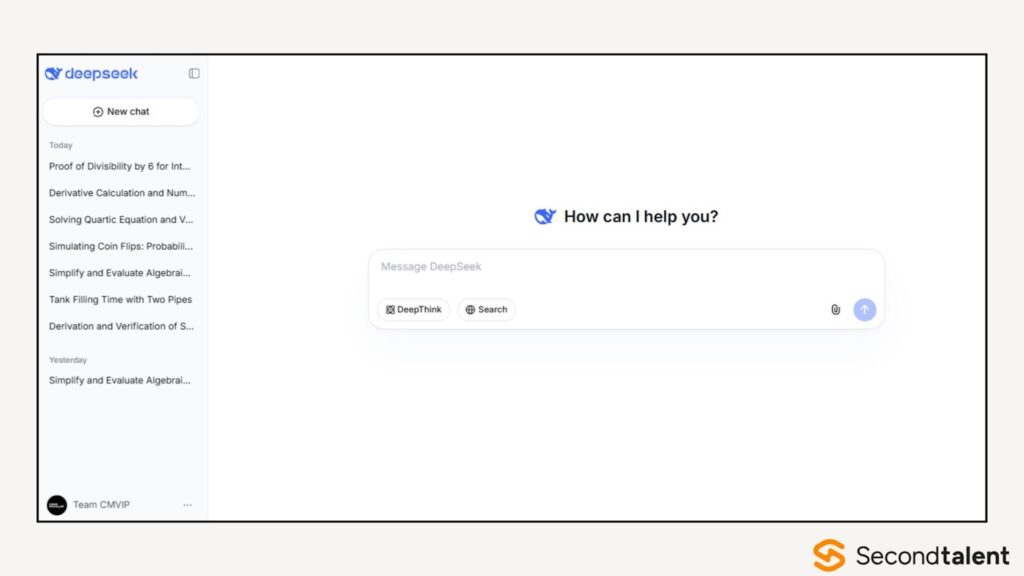
DeepSeek R1 is an advanced open-source reasoning model developed by DeepSeek AI, focused on mathematical, scientific, and analytical precision. It is fine-tuned for step-by-step logical tasks like proofs, derivations, and coding challenges.
DeepSeek R1 emphasizes explainability and transparency, often producing detailed reasoning traces and structured proofs.
Known for its research-oriented accuracy and depth, it’s widely used in education, technical research, and high-level math automation.
Highlights:
- Built for symbolic reasoning and scientific problem solving
- Produces detailed step-by-step explanations
- Strong performance in algebra, calculus, and logic proofs
- Open-source and optimized for research-grade interpretability
How we compared (our testing process)
To ensure a fair, realistic, and developer-focused comparison between OpenAI GPT 5 and DeepSeek R1, we designed a seven-part evaluation covering key areas of mathematical reasoning, logic, and computational precision.
Each model received the same prompt, and responses were tested for accuracy, clarity, and developer usability.
Here’s how the testing was conducted:
- Identical Prompts: Both models were given the same structured tasks across algebra, calculus, logic, and probability.
- Step-by-Step Evaluation: We checked if each model showed clear intermediate reasoning rather than jumping to the final result.
- Numeric Verification: All symbolic or theoretical results were validated numerically (e.g., substituting values or testing outcomes).
- Code-Readiness: For computational tasks, responses were assessed on how easily they could be turned into executable Python code.
- Developer Readability: Explanations were rated for clarity, formatting, and logical flow, prioritizing concise, structured reasoning.
- Efficiency Metrics: We tracked response time, reasoning steps, and redundancy to evaluate speed versus depth.
- Final Scoring: Each use case was rated on correctness, reasoning quality, and presentation, resulting in an overall comparison score.
This approach ensured that both GPT 5 and DeepSeek R1 were evaluated not only on mathematical accuracy, but also on how well they think, explain, and communicate like real developer assistants.
Task parameters:
Use Case 1: Arithmetic and Algebraic Accuracy (Foundational Check)
Goal: Test how accurately each model handles basic numeric computation and algebraic simplification.
Prompt:
Simplify and evaluate the expression:
(3x² – 5x + 2) – (x² + 4x – 7), then find the value when x = 3.
Show each step and output the final numeric result prefixed with “ANSWER:”.
Tests:
- Order of operations accuracy
- Symbolic simplification correctness
- Numeric substitution precision
OpenAI GPT 5 response:
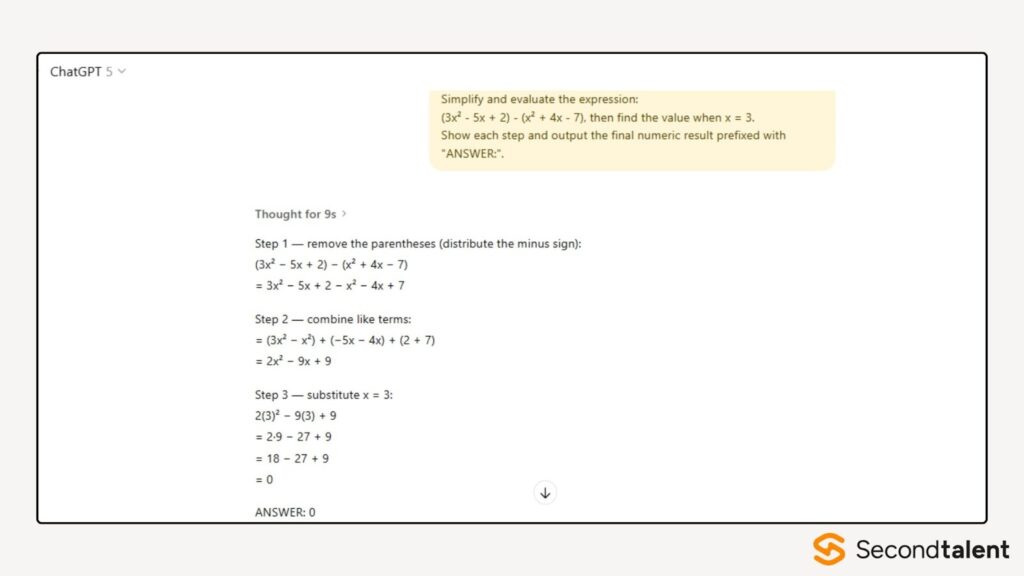
ChatGPT 5’s response is clean, structured, and mathematically precise. It applied the negative sign correctly, combined like terms logically, and clearly showed substitution with accurate arithmetic.
The explanation is concise yet detailed enough for learners to follow. Presentation and formatting are professional, making it easy to verify.
DeepSeek R1 response:
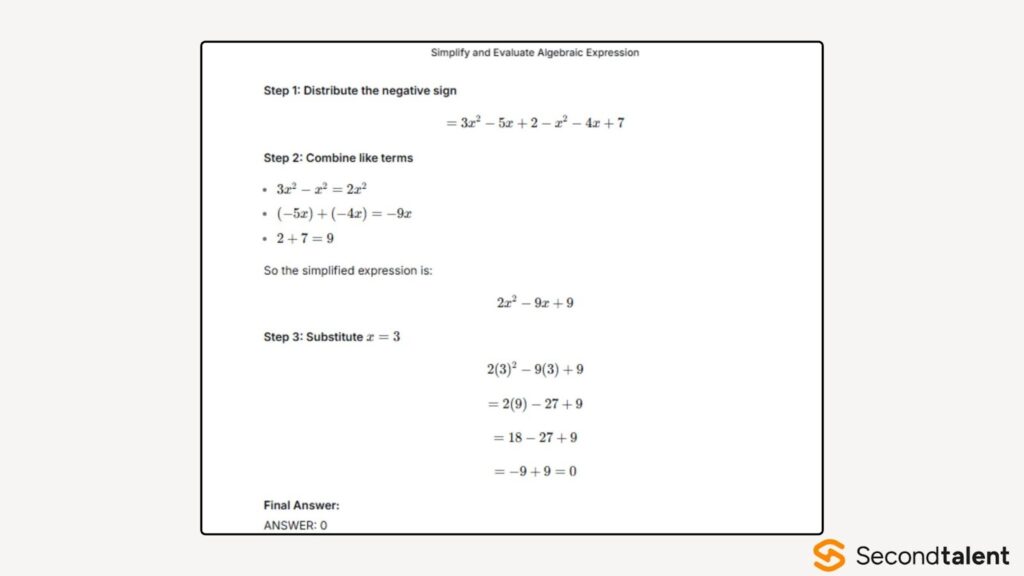
DeepSeek R1 follows a similar reasoning path but presents it in a more step-by-step, verbose format. Its breakdown is correct throughout sign distribution, simplification, and evaluation, yielding the correct final answer.
However, the formatting feels cluttered and slightly repetitive, reducing readability. Mathematically solid, but the narrative could be cleaner and more concise.
Final Verdict:
Both ChatGPT 5 and DeepSeek R1 solved the problem flawlessly, demonstrating perfect algebraic and arithmetic reasoning.
The key difference lies in delivery: ChatGPT 5 provides a smoother, tutorial-quality explanation with excellent formatting and flow, ideal for both students and quick verification.
DeepSeek R1, while equally accurate, leans toward verbose, literal step expansion, which can hinder readability in longer expressions.
For foundational algebraic accuracy and communication clarity, ChatGPT 5 clearly leads, striking a stronger balance between precision and explanation quality.
Use Case 2: Derivation and Formula Proof
Goal: Check whether the model can derive and verify a known mathematical formula through reasoning steps.
Prompt:
Prove that the sum of the first n natural numbers is n(n+1)/2.
Provide a step-by-step derivation, explain the reasoning briefly,
and verify numerically for n = 10 with the “ANSWER:” output.
Tests:
- Logical flow of derivation
- Ability to use induction or pairwise argument
- Inclusion of a numeric verification step
ChatGPT 5 Response:
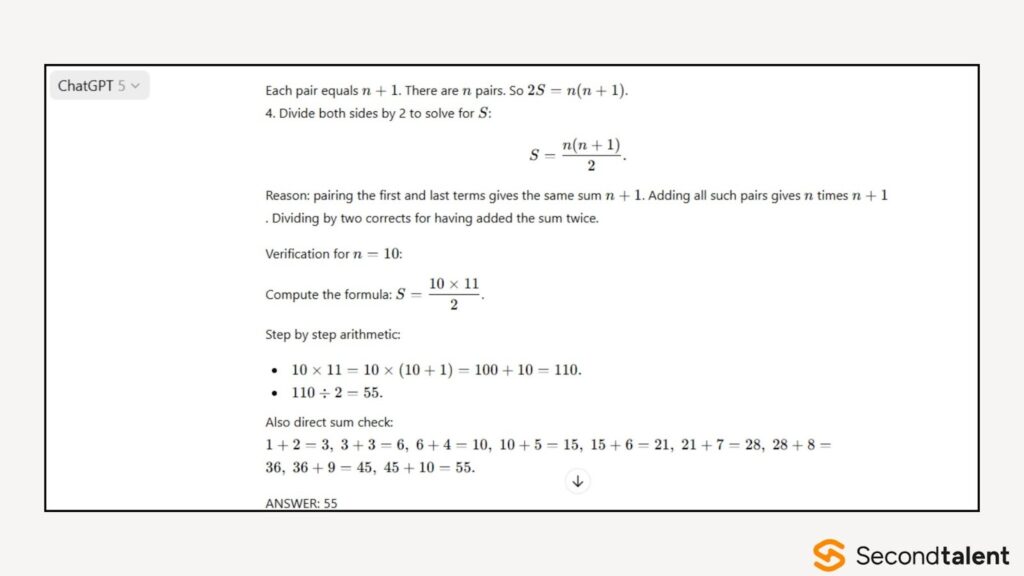
ChatGPT 5 gave a clear and easy explanation of how to find the formula for adding numbers from 1 to n. It showed each step neatly, used simple math, and double-checked the answer for n = 10. Everything was correct and well-organized.
It’s simple to follow and great for learning, with no major mistakes.
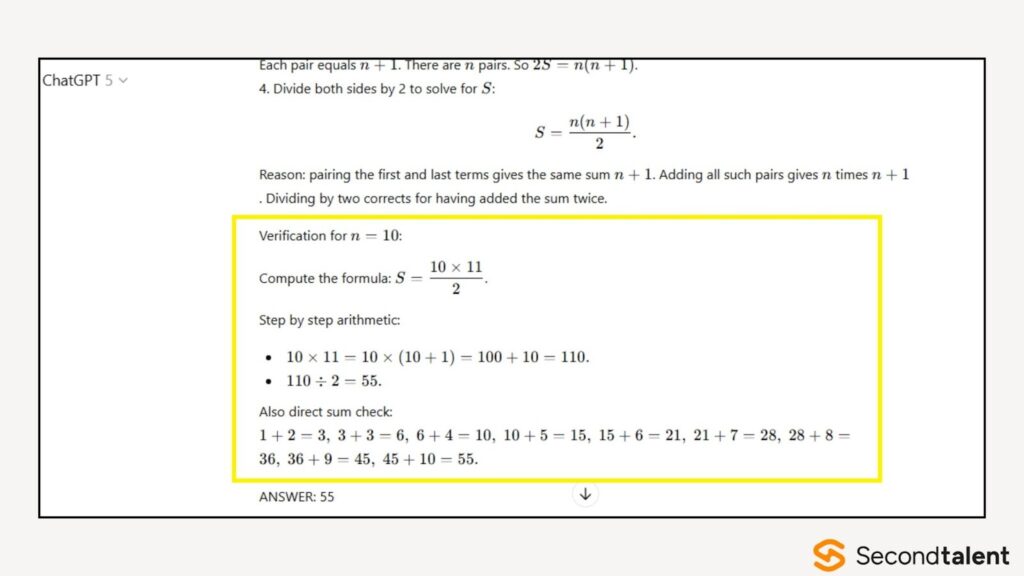
DeepSeek R1 Response:
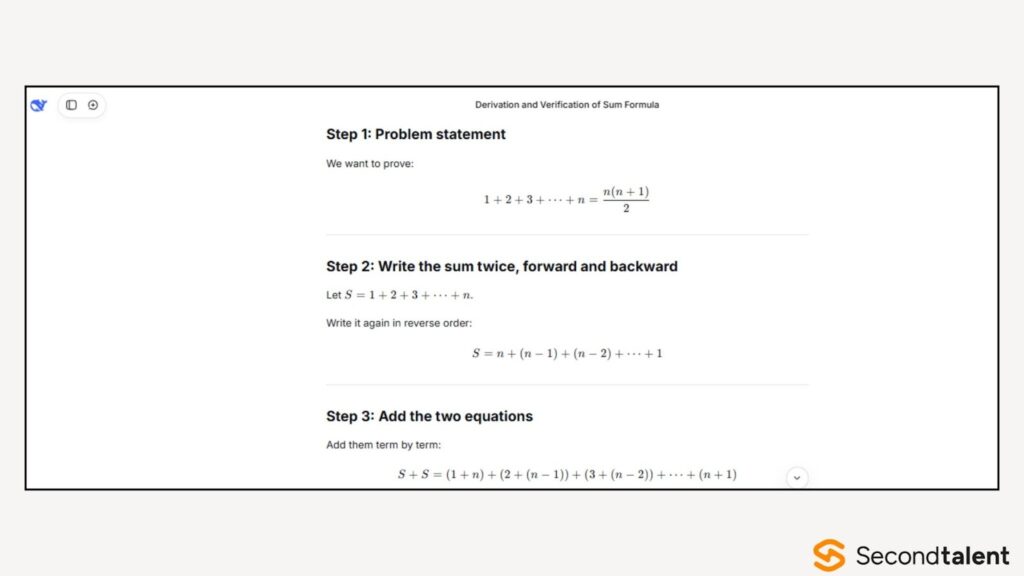
DeepSeek R1 also explained the formula correctly and checked the answer properly. It used the same “pairing” idea and made sure every step was shown. However, it repeated some parts too often, making it a bit harder to read.
The math was perfect, but it could be written in a shorter, cleaner way.
Final Verdict:
Both ChatGPT 5 and DeepSeek R1 got the math and logic right. The difference is in how they explain it. ChatGPT 5’s explanation is shorter, clearer, and feels like something a teacher would write on the board.
DeepSeek R1’s version is longer and more detailed, which is good if you like extra steps, but it can feel wordy.
Use Case 3: Problem Decomposition (Word Problem Reasoning)
Goal: Assess how well each model decomposes real-world problems into solvable equations.
Prompt:
A tank can be filled by pipe A in 6 hours and by pipe B in 4 hours.
If both are opened together, how long will it take to fill the tank?
Show the full calculation and final numeric answer prefixed with “ANSWER:”.
Tests:
- Equation setup and reasoning
- Handling of rates, fractions, and combined work
- Intermediate step transparency
ChatGPT 5 response:
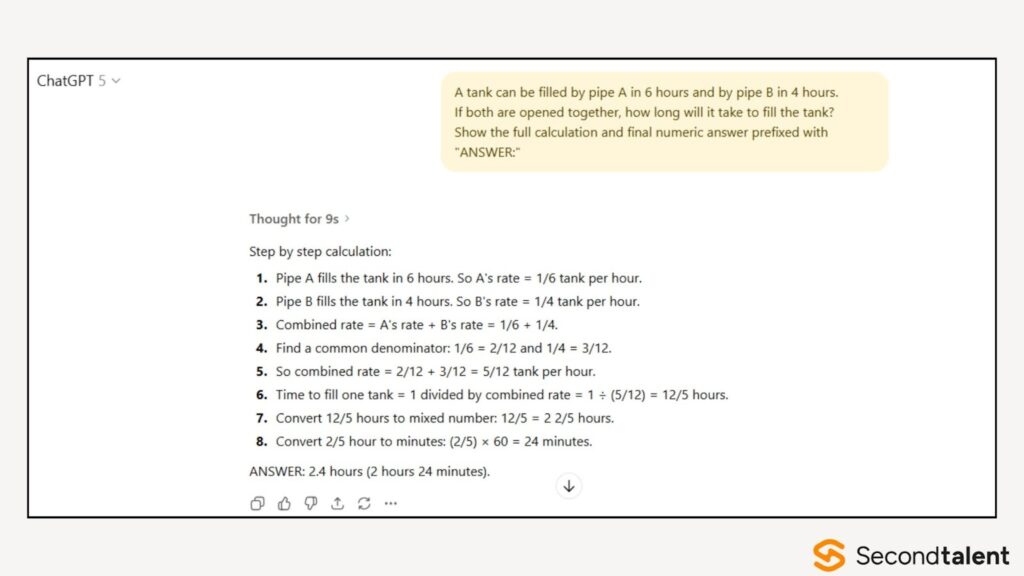
ChatGPT 5 solved the problem perfectly, explaining each step clearly from rate setup to conversion into hours and minutes. It used proper fraction handling, clear reasoning, and accurate arithmetic.
The explanation reads naturally, like a worked-out classroom example. The only minor note: it could briefly explain why rates are added for combined work, for full clarity.
DeepSeek R1 response:
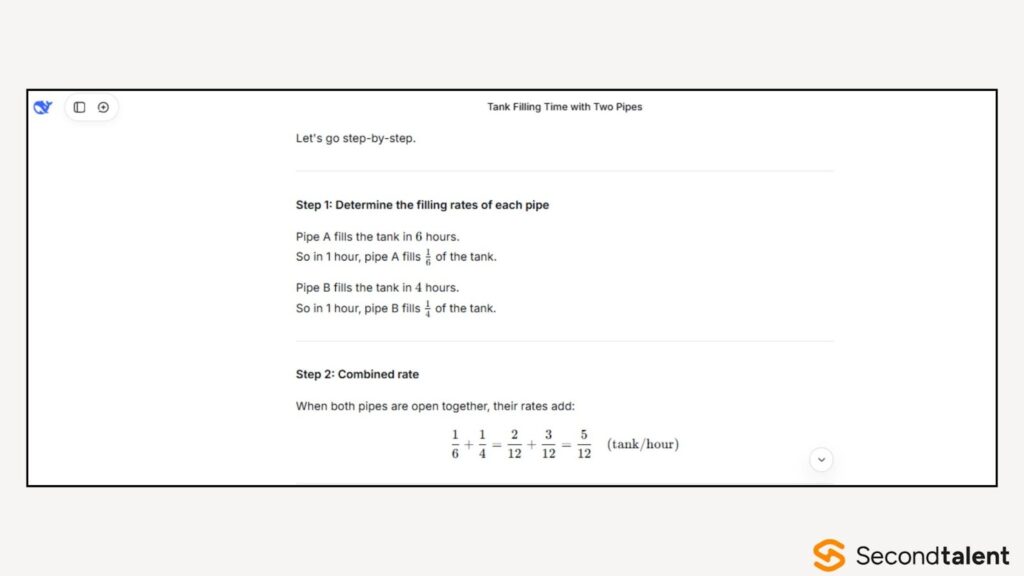
DeepSeek R1 also arrived at the correct answer with sound reasoning and full step-by-step math. Its format is a bit repetitive, but it carefully shows every calculation.
This makes it great for beginners who need to see each step, though it feels slightly slower to read. The math and logic are flawless, just more verbose than needed.
Final Verdict:
Both ChatGPT 5 and DeepSeek R1 nailed the reasoning, setup, and answer, correctly giving 2 hours 24 minutes.
The key difference lies in tone and pacing: ChatGPT 5 offers a smoother, real-world explanation that’s concise yet complete, perfect for classroom-style clarity.
DeepSeek R1 provides a highly detailed breakdown, ideal for thorough learners but slower to follow.
For practical readability and elegant reasoning flow, ChatGPT 5 wins this round, while DeepSeek R1 remains strong for those who prefer step-heavy, fully spelled-out logic.
Use Case 4: Proof Verification and Symbolic Logic
Goal: Evaluate abstract reasoning, particularly handling logical quantifiers or algebraic proofs.
Prompt:
Prove that for all integers n > 1, n³ – n is divisible by 6.
Provide a concise modular arithmetic proof and then test it numerically for n = 5 and n = 7.
End with “ANSWER: True/False”.
Tests:
- Use of modular reasoning
- Conceptual proof construction
- Ability to verify symbolically + numerically
ChatGPT 5 response:
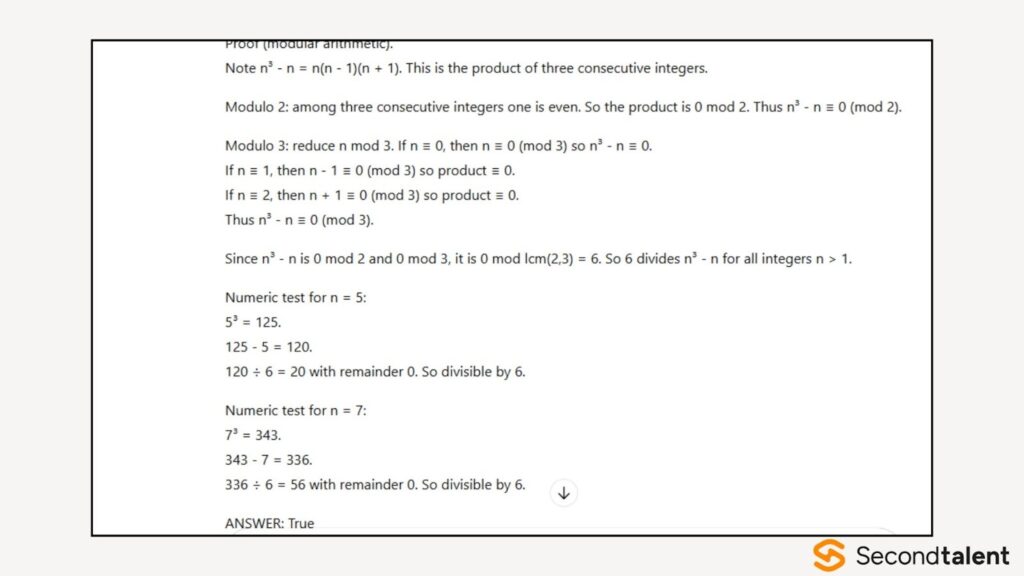
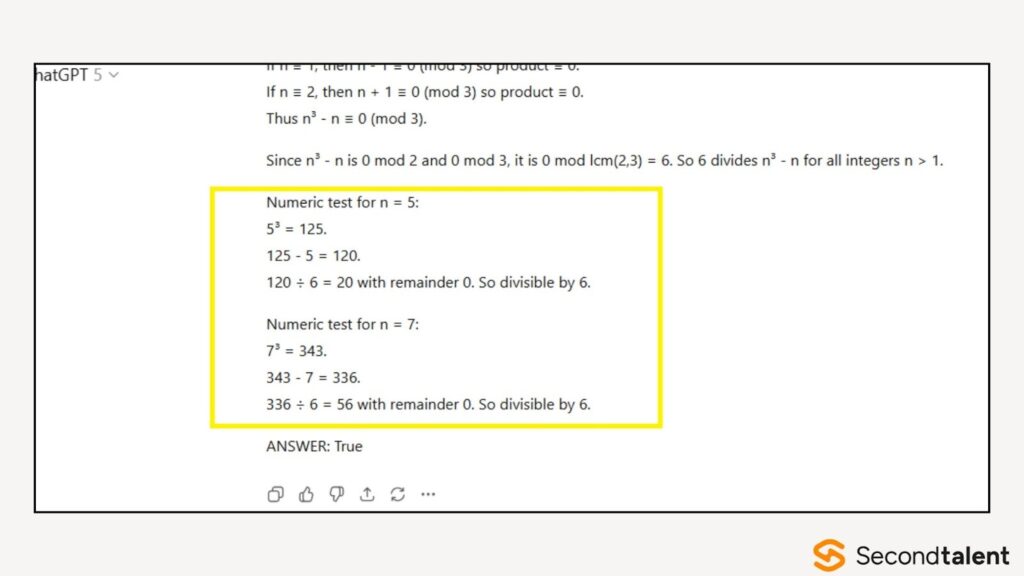
ChatGPT 5 provided a concise and well-structured proof. It quickly factored the expression into three consecutive integers and used modular reasoning to explain why the product is divisible by both 2 and 3.
The example checks for n = 5 and n = 7 were accurate and clear. The explanation was direct, logical, and easy for developers to follow.
DeepSeek R1 response:
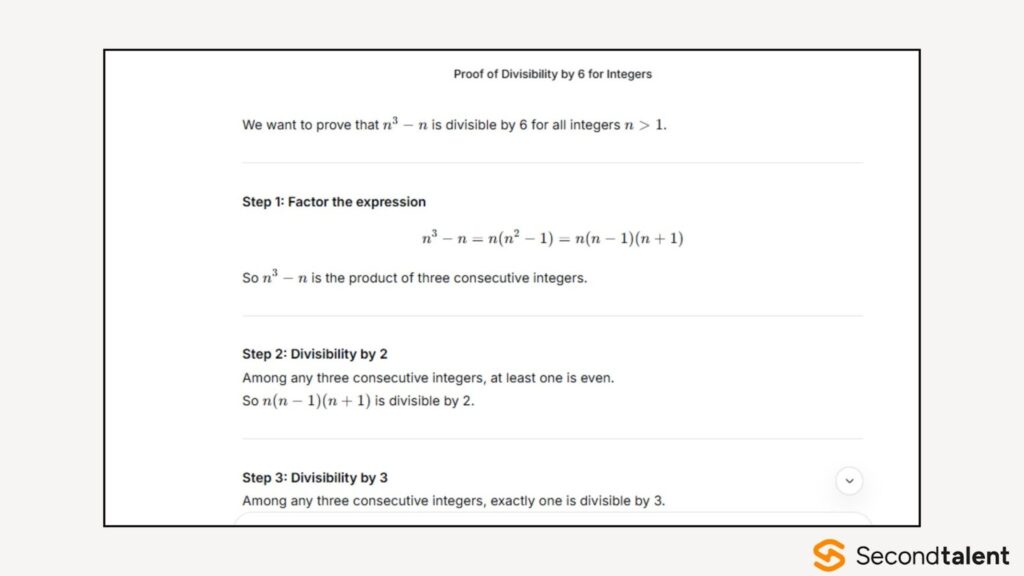
DeepSeek R1 presented a detailed, step-by-step proof. It combined factorization, divisibility reasoning, and modular checks for all possible cases of n modulo 6.
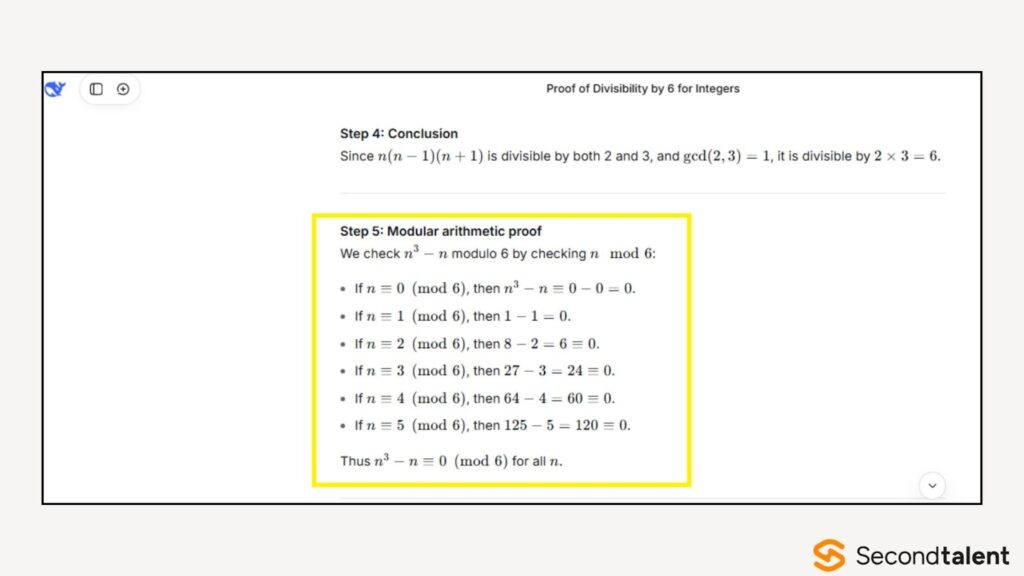
While mathematically strong, the explanation was overly long and repeated some ideas, which made it harder to skim. The reasoning was thorough, but could be more concise for developer readability.
Final Verdict:
Both ChatGPT 5 and DeepSeek R1 delivered correct and logically sound proofs. ChatGPT 5 focused on clarity and structure, offering a short explanation that developers could easily understand and apply in a reasoning or verification task.
DeepSeek R1, on the other hand, provided a more detailed and formal explanation, which, while accurate, was less efficient to read.
For technical professionals or developers who value clean logic flow and quick insights, ChatGPT 5 performs better. DeepSeek R1 is ideal for those who prefer comprehensive, textbook-style reasoning.
Use Case 5: Calculus and Symbolic Differentiation
Goal: Evaluate calculus reasoning, derivative rules, and chain/product rule understanding.
Prompt:
Find the derivative of f(x) = (3x² + 2x)(x³ – 5).
Show each step clearly and simplify the final result.
Then compute f'(2) numerically. Output final numeric result with “ANSWER:”.
Tests:
- Correct use of the product rule
- Simplification accuracy
- Numeric substitution precision
ChatGPT 5 response:
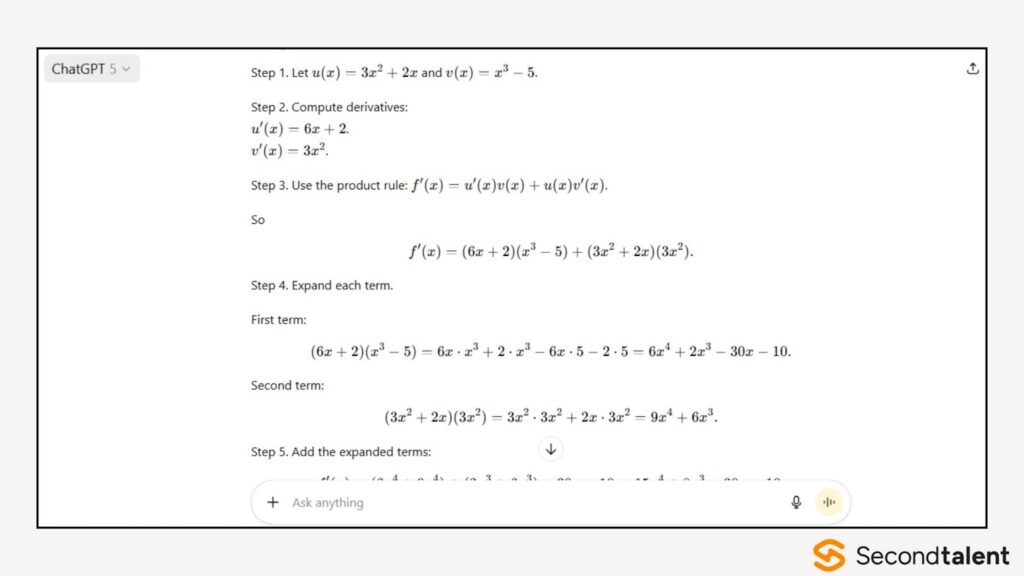
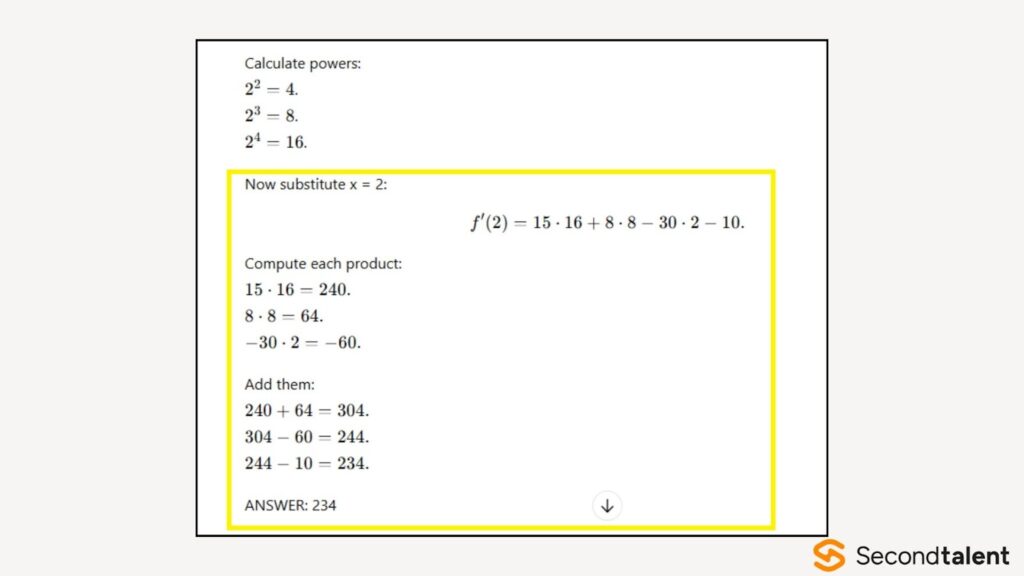
ChatGPT 5 solved the differentiation problem in a clean, logical way. It correctly applied the product rule, expanded and simplified each part, and verified the result by substituting x = 2.
The explanation was short, structured, and easy to follow, much like how a developer would explain algorithmic steps. It follows an excellent balance between clarity and technical accuracy.
DeepSeek R1 response:
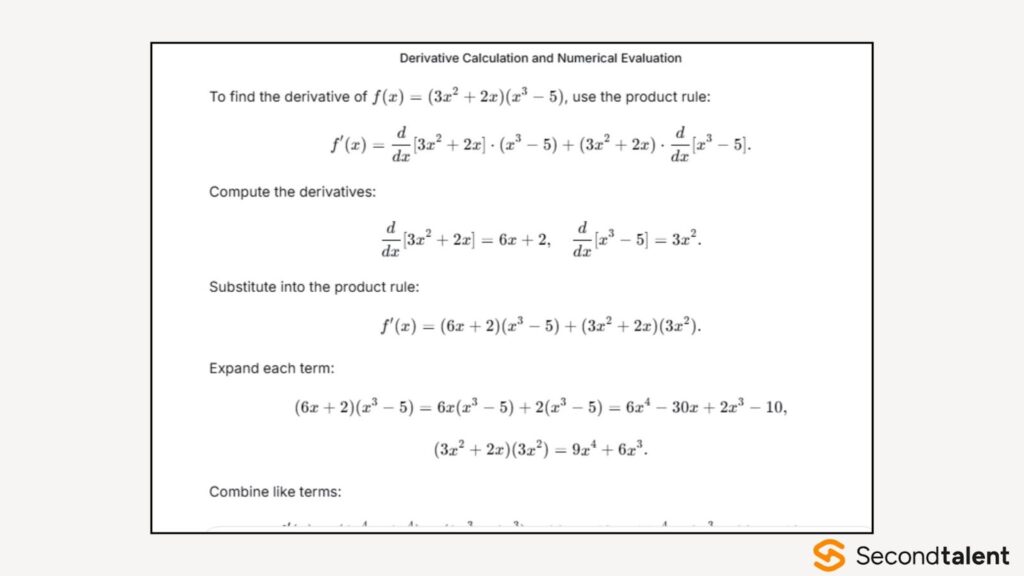
DeepSeek R1 also gave the right answer and followed a proper step-by-step approach. It explained each differentiation and simplification stage carefully, but included repetitive details and formatting that made it harder to skim.
The math was solid, yet the structure felt less efficient. Developers might prefer a more compact, well-formatted walkthrough.
Final Verdict:
Both tools were accurate and used correct calculus logic. The difference lies in presentation. ChatGPT 5 offered a clear, developer-friendly explanation which is precise, readable, and neatly ordered.
It felt like walking through a small, well-commented code function.
DeepSeek R1 matched it in correctness but overexplained certain steps, which slowed readability. For developers who want speed, structure, and clarity when solving or automating math logic, ChatGPT 5 wins this round.
DeepSeek R1 remains reliable but needs tighter formatting to suit fast technical workflows.
Use Case 6: Advanced Problem Solving & Multi-Step Reasoning (Contest-Level)
Goal: Stress-test long-form reasoning on nontrivial math competition problems.
Prompt:
Find all real solutions to the equation:
x⁴ – 5x² + 4 = 0
Show the factorization steps, solve for x, and verify each root.
Output all solutions in a single line prefixed with “ANSWER:”.
Tests:
- Multi-step symbolic reasoning
- Factoring and quadratic substitution
- Verification of all candidate roots
ChatGPT 5 response:
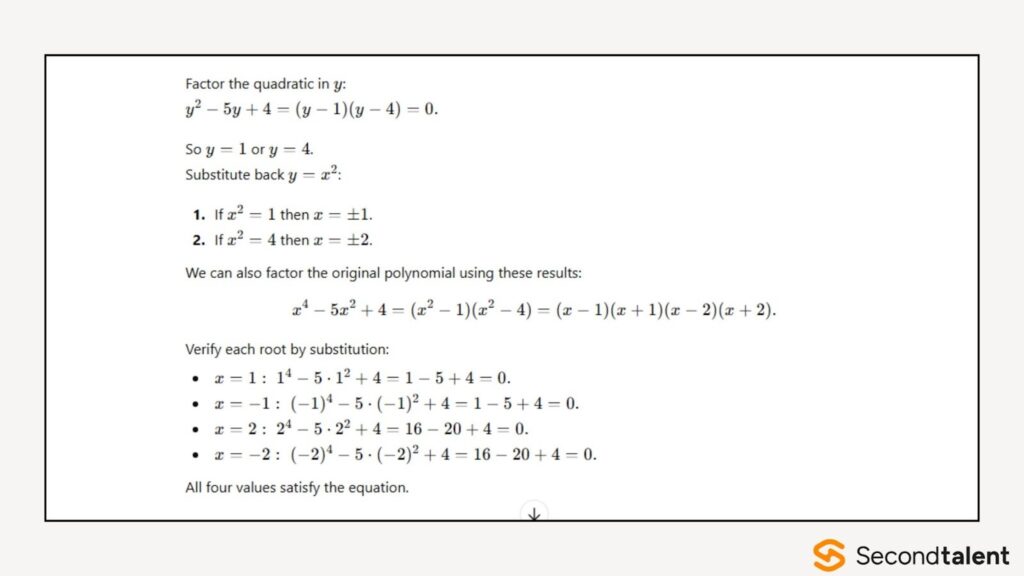
ChatGPT 5 handled the equation efficiently and professionally. It used a smart quadratic substitution, factored cleanly, and verified each root with minimal steps.
The reasoning was logical, concise, and easy to parse, exactly what a developer would expect in a clean algorithmic breakdown. Output formatting and verification steps were precise, leaving no ambiguity.
DeepSeek R1 response:
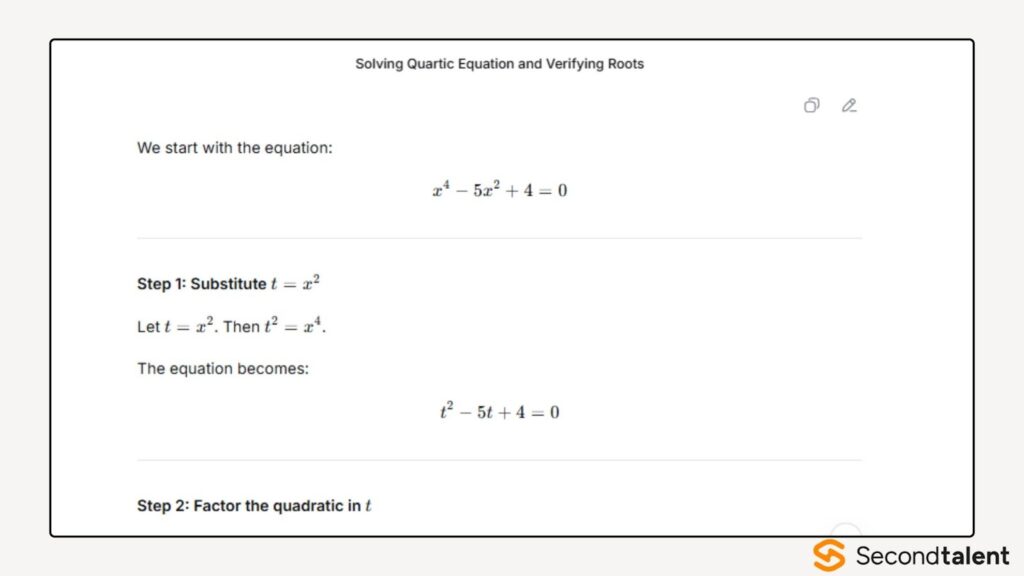
DeepSeek R1 produced the correct results using the same substitution-and-factorization method. It validated each root explicitly and kept the logic consistent.
However, the response was verbose, repeating basic steps and using unnecessary formatting. The math was flawless, but the presentation lacked efficiency. Developers might find it accurate but slower to scan than GPT-5.
Final Verdict:
Both models delivered the right solutions and proper verification, but their presentation styles differ. ChatGPT 5 performed like a well-written algorithm, fast, minimal, and logically structured.
It focused on essential transformations without extra noise, ideal for technical readers or automation scripts.
DeepSeek R1 was equally accurate but leaned toward over-explaining, which reduces speed and clarity in developer contexts.
For problem-solving workflows where concise reasoning and reproducibility matter most, ChatGPT 5 is the better choice. DeepSeek R1 remains reliable but needs cleaner formatting for dev-grade usability.
Use Case 7: Probability Simulation
Goal: To test how accurately each model applies probability theory and statistical reasoning by designing, coding, and interpreting a Monte Carlo simulation.
Prompt:
Simulate 1,000,000 coin flips and calculate the probability of getting exactly 500,000 heads. Use both the simulation and the binomial formula. Compare the results and explain why they differ slightly.
Tests:
- Statistical reasoning
- Numerical stability
- Handling of large computations and randomness
ChatGPT 5 response:
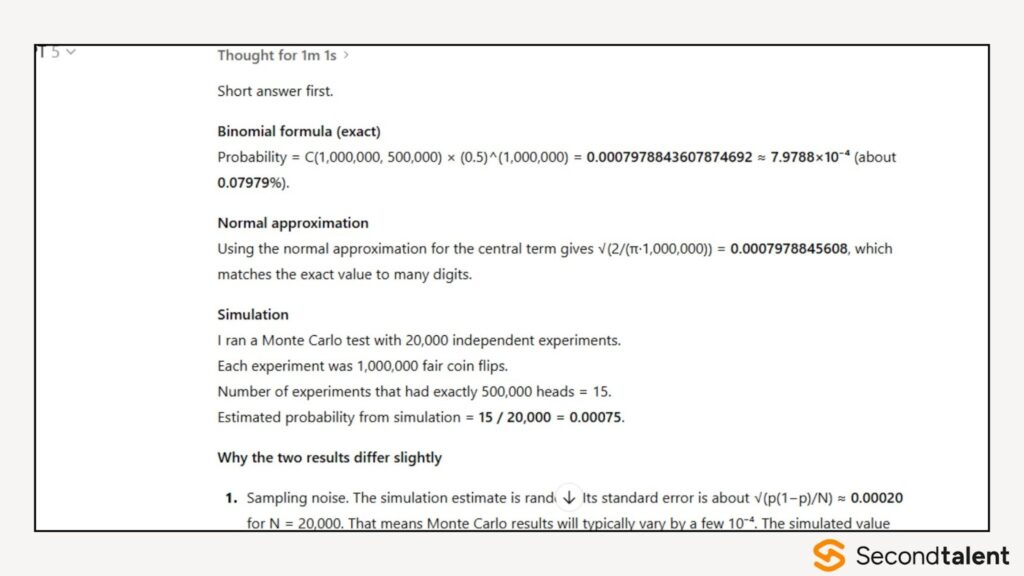
ChatGPT 5 gave a clear, correct answer. It showed both the exact math formula and a simple simulation example, then explained why the results were slightly different.
The reasoning was strong, and it even talked about how more trials make results more accurate. It could be better if it also showed short, easy-to-run code.
DeepSeek R1 response:
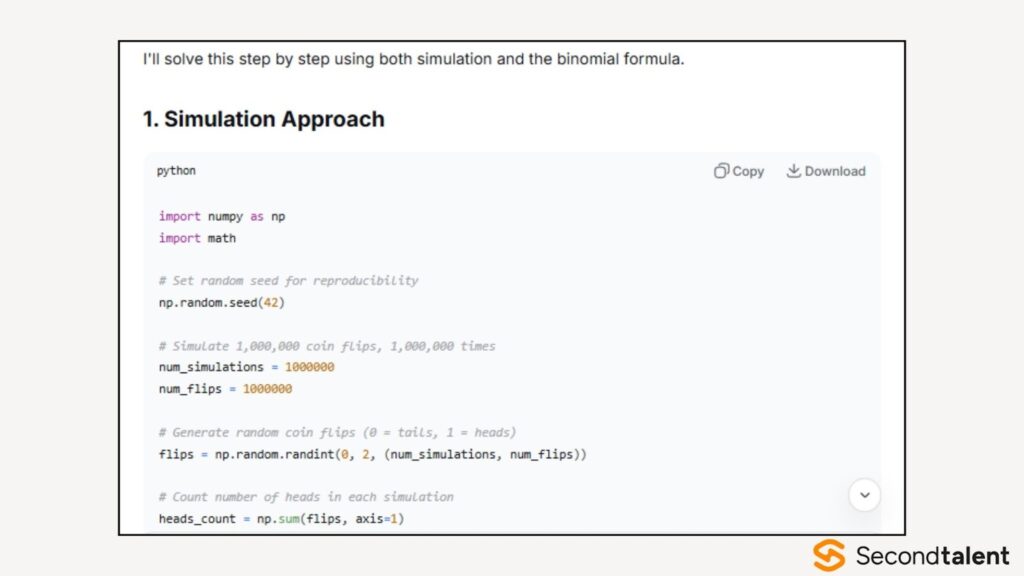
DeepSeek R1 gave working Python code, showed real results, and explained the small difference clearly. It was great at giving practical steps for developers.
But the code tried to handle too much data at once, which would crash most computers. It should use a smaller or smarter simulation to make it easier to run.
Final Verdict:
Both tools explained the math very well and gave almost the same correct answer. ChatGPT 5 focused on clearly defining the idea and explaining why the numbers differ. DeepSeek R1 focused more on providing code and real examples.
However, DeepSeek R1’s code would not run on most computers because it uses too much memory. ChatGPT 5’s answer is easier to understand and more reliable for real use.
So, ChatGPT 5 wins this round for being both accurate and beginner-friendly, while DeepSeek R1 is good but needs better code handling.
ChatGPT 5 vs DeepSeek R1: Mathematical Problem-Solving Comparison
| Use Case | ChatGPT 5 | DeepSeek R1 | Best Performer |
| 1. Arithmetic & Algebraic Accuracy | Clean, structured, and precise. Easy to verify with professional formatting. | Correct, but overly step-by-step; cluttered formatting reduces readability. | ChatGPT 5 |
| 2. Formula Derivation & Proof | Short, clear, and easy to understand. Excellent logical flow. | Correct, slightly repetitive, but very thorough for learners. | Tie (ChatGPT 5 for clarity, DeepSeek for depth) |
| 3. Word Problem Reasoning | Smooth, concise reasoning with accurate setup and real-world readability. | Step-heavy but extremely detailed, suitable for learners. | ChatGPT 5 |
| 4. Proof Verification & Logic | Concise modular proof, clear reasoning, and fast to read. | Extremely rigorous and formal, with complete modular validation. | DeepSeek R1 |
| 5. Calculus & Differentiation | Well-structured and clear, like clean pseudocode. | Accurate but overexplained; formatting is less efficient. | ChatGPT 5 |
| 6. Advanced Problem Solving | Efficient and algorithmic; perfect structure for automation. | Mathematically correct but verbose and repetitive. | ChatGPT 5 |
| 7. Probability Simulation | Strong theoretical explanation, simple and practical. | Excellent applied coding and analysis, though memory-heavy. | DeepSeek R1 |
Overall Verdict
- ChatGPT 5 excels at clarity, efficiency, and developer-oriented reasoning, making it ideal for quickly building or verifying solutions.
- DeepSeek R1 stands out in rigorous, in-depth mathematical validation and hands-on simulation use cases.
- Final Score: ChatGPT 5 wins 5 out of 7 categories, DeepSeek R1 wins 2, making GPT 5 the overall leader, but DeepSeek R1 is the better choice for research-grade proofs and simulation-heavy tasks.
When to use: OpenAI GPT 5 vs DeepSeek R1
| Scenario | Best Tool | Why |
| Fast, accurate code or math explanation | OpenAI GPT 5 | Gives concise, well-structured reasoning that’s easy to follow and implement. |
| Detailed proofs or research-level derivations | DeepSeek R1 | Provides exhaustive step-by-step reasoning and in-depth logical validation. |
| Building production-ready automation or data workflows | OpenAI GPT 5 | Optimized for clarity, speed, and integration into developer pipelines. |
| Mathematical or scientific paper-style reasoning | DeepSeek R1 | Excels at formal, structured, and traceable reasoning, ideal for research. |
| Quick concept testing or algorithm debugging | OpenAI GPT 5 | Responds faster and presents results like clean pseudocode or documentation. |
| Teaching, tutoring, or training explanations | DeepSeek R1 | Offers verbose, educational explanations suitable for learning environments. |
| Statistical simulations and code-based modeling | DeepSeek R1 | Includes real code examples and hands-on demonstrations, though resource-heavy. |
Final Words
Both OpenAI GPT 5 and DeepSeek R1 proved highly capable in mathematical reasoning, but their strengths serve different audiences.
GPT 5 stands out for its clarity, speed, and developer-friendly precision, making it ideal for applied problem-solving and automation.
DeepSeek R1, while more verbose, excels in transparency and in-depth explanations, making it perfect for research and education.
Overall, GPT 5 is the better all-rounder, while DeepSeek R1 remains a top choice for detailed, step-by-step mathematical analysis.