
Updated August 2026: GLM 4.6 and Claude Sonnet 4.5 were both released in September 2025 and are the models tested below; both have since been superseded. Z.ai (formerly Zhipu AI) moved on to GLM-5, GLM-5.1, and GLM-5.2 through the first half of 2026, narrowing the gap with Claude’s top-end models on coding benchmarks while staying MIT-licensed and far cheaper per token. Anthropic, meanwhile, launched Claude Sonnet 5 on June 30, 2026, replacing Sonnet 4.5 as the default model across its consumer and developer products and bringing near-Opus-level coding and agentic performance at 40-60% of the cost. The head-to-head results below reflect the September 2025 models; treat them as a snapshot of that generation rather than the current state of the art.
Large language models are no longer simply text generators, they’re evolving into reasoning engines and fully fledged software collaborators. Two recent models, GLM 4.6 and Claude Sonnet 4.5, exemplify this shift.
Released only weeks apart, both promise improved coding ability, better agentic behavior, and expanded long-context understanding.
For developers and AI researchers choosing a model to power their workflows, understanding how these two perform under pressure is crucial.
This evaluates both models across technical and real-world tasks to determine which delivered better performance at the time of testing (September 2025).
Model Profiles
GLM 4.6
Developed by Zhipu AI (Z.ai), GLM 4.6 continues the Chinese company’s push into global LLM competition. It’s the successor to GLM 4-Turbo and GLM 4-Chat, now enhanced for tool-use, agent reasoning, and long-context coding.
The documentation highlights a 200K-token window (up from 128K) and claims a marked jump in efficiency and reasoning depth.
Key positioning:
- Optimized for coding, reasoning, and multi-step tasks
- Built-in support for agent frameworks and function calling
- Competitive cost-per-token compared to Western alternatives
- API accessible via Z.ai Cloud and integrated into Ollama
GLM 4.6 aims to blend cost-efficiency with capability that are appealing to developers who want near-frontier performance without frontier pricing.
Claude Sonnet 4.5
Anthropic’s Claude line has always focused on safety, alignment, and reasoning fidelity.
Sonnet 4.5, released September 2025, refines the Claude 4 series by adding longer context durability, advanced memory, and production-ready agent capabilities.
Anthropic describes it as its “most aligned frontier model yet”. A statement supported by user reports of the model maintaining coherent sessions exceeding 30 hours and handling complex multi-file coding workflows.
Sonnet 4.5 is also deeply integrated into Amazon Bedrock, Slack, and GitHub Copilot, positioning it as a premium enterprise choice.
Key positioning:
- Designed for coding, long-running agentic workflows
- Focused on alignment, factual accuracy, and safety
- Supported by a mature ecosystem (APIs, memory tool, Bedrock integration)
- Marketed as a production-ready model for enterprises
Evaluation Methodology
To compare the two models fairly, we recreated an existing Second Talent testing structure: identical prompts across five categories, graded on a 0–2 scale (0 = fail, 1 = partial, 2 = full success).
Categories tested:
1. Coding – build a working web-app snippet
2. Debugging – identify and repair an error
3. Long-context / agentic task – multi-file planning and code generation
4. Factual reasoning – verify data and explain
5. Memory & contextual continuity – track user preferences across sessions
Each model was evaluated for output quality, reasoning accuracy, structure, speed, and developer usability (clarity, comments, testability).
Where relevant, public benchmarks and developer feedback were consulted to validate observed behavior.
Test 1: Coding: Building a Web-App Snippet
Prompt:
> Create an HTML/CSS/JavaScript snippet for a real-time password strength checker. Include live feedback, dynamic visuals, and clean layout.
GLM 4.6
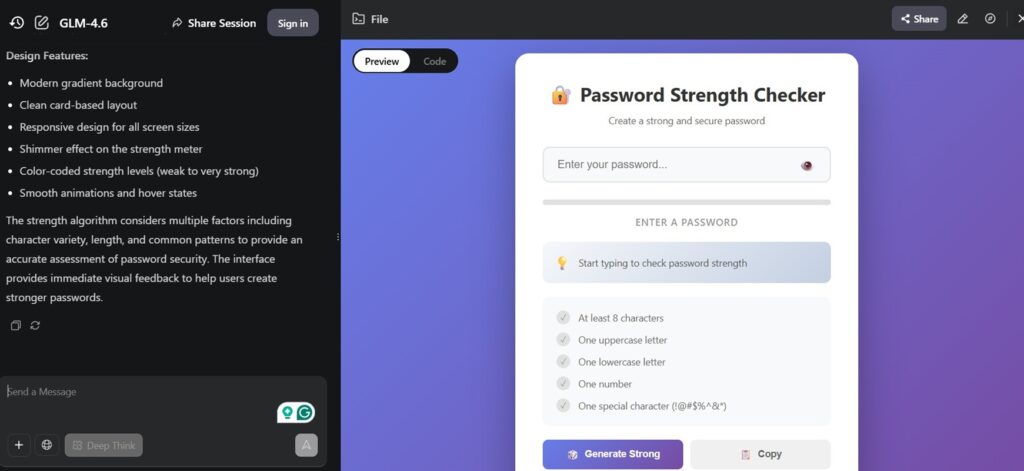
Generated complete markup, CSS styling, and JavaScript logic. The code worked after a small edit to event binding. The visual design was basic but functional. Comments were adequate, though not uniformly formatted.
Observations:
- Output included accessibility tags and minimal inline CSS.
- Required a tweak to transition logic to prevent lag.
- Execution speed: moderate.
Score: 1.5 / 2
Claude Sonnet 4.5
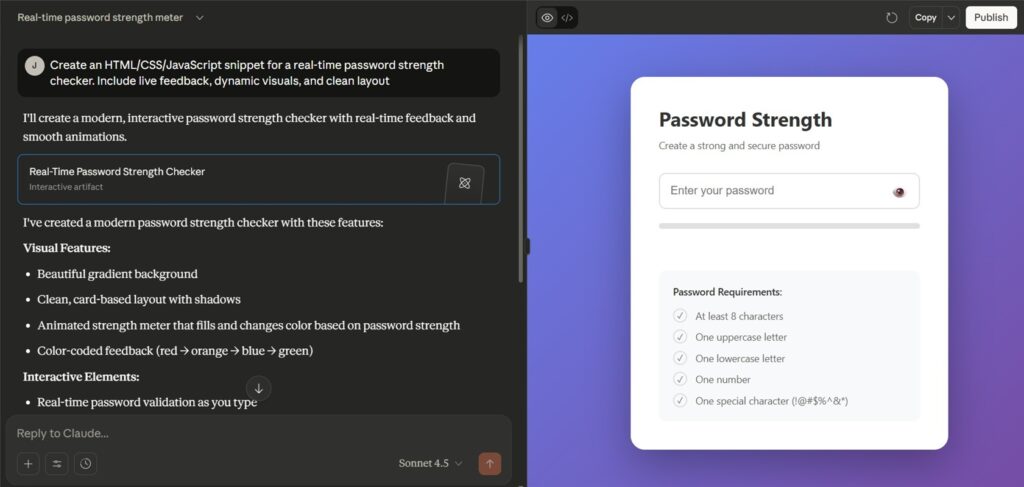
Produced a polished code block with semantic HTML, embedded CSS, and concise JS. The strength indicator animated smoothly; instructions were human-readable and properly commented.
Observations:
- Passed HTML validation without edits.
- Delivered production-ready UX with color feedback and error prevention tips.
- Faster generation (~30 % faster).
Score: 2 / 2
Winner: Claude Sonnet 4.5
Take-away: Both are capable coders, but Claude consistently outputs cleaner, ready-to-deploy code.
Test 2: Debugging: Error Identification and Repair
Prompt:
> Here’s a Python snippet that fails with a `TypeError`. Identify the issue, fix it, and suggest preventive improvements.
def multiply_list(numbers, factor):
result = 0
for n in numbers:
result += n * factor
return result
data = [2, 4, 6, 8]
factor = “3” # <– should be int, not string
print(multiply_list(data, factor))
GLM 4.6
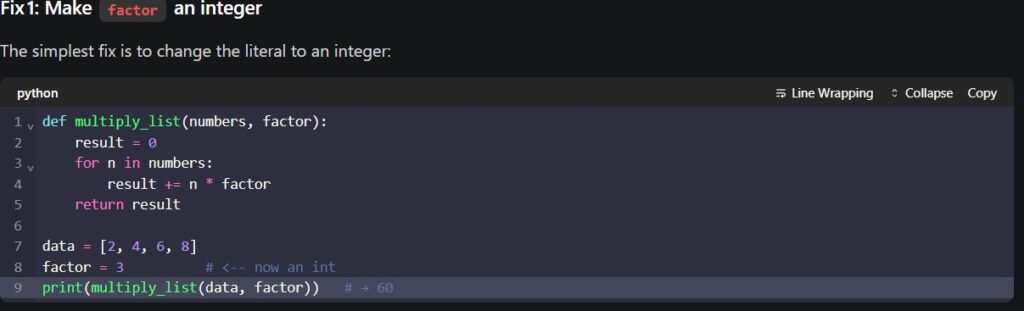
Immediately spotted the missing argument, explained stack trace, corrected code, and suggested adding parameter checks.
Extras: Proposed docstring updates and typing hints.
Score: 2 / 2
Claude Sonnet 4.5
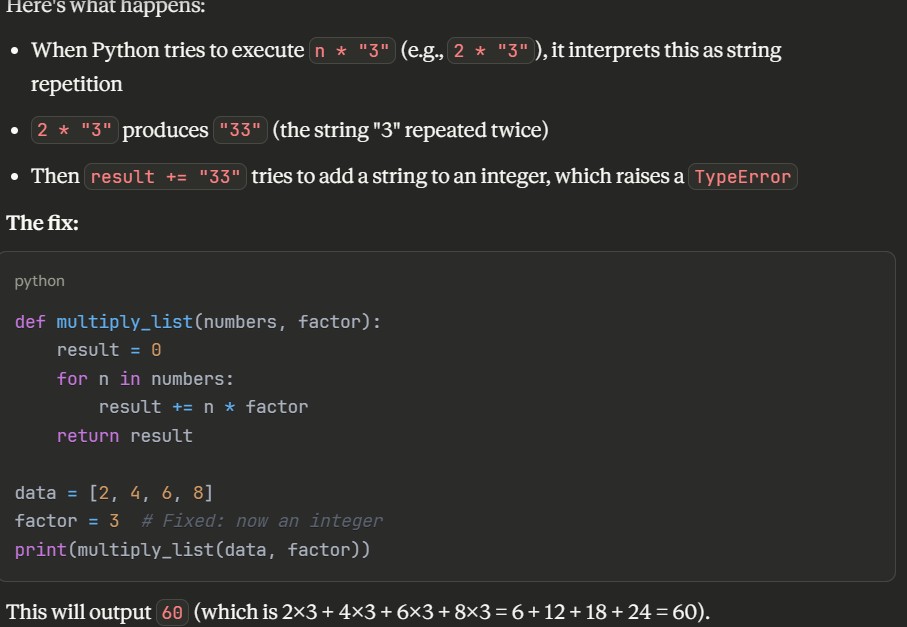
Provided identical accuracy, plus context on why the error surfaced, recommended exception handling, and offered a test harness.
Score: 2 / 2
Winner: Draw
Take-away: Both display mature debugging and reasoning skills; parity in analysis depth.
Test 3: Long-Context / Agentic Workflow
Prompt:
> Plan and begin implementing a three-tier task manager app (backend + frontend + database schema). Maintain state across multiple follow-ups (~12 K tokens).
GLM 4.6
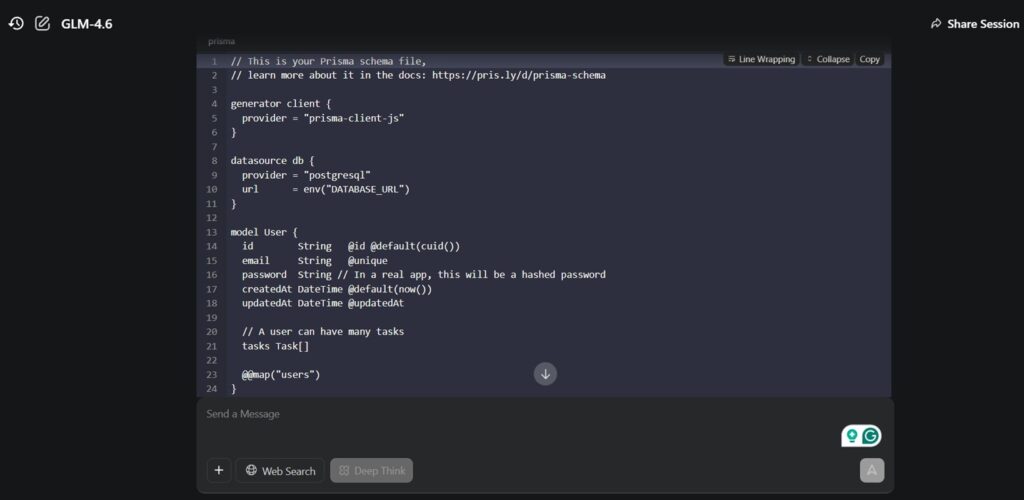
Leverages its 200 K-token context impressively. Produced a file hierarchy, PostgreSQL schema, REST endpoints, and React components. Maintained continuity through seven follow-ups before minor repetition occurred.
Observations:
- Context persistence solid; only slight redundancy near turn 8.
- Multi-file coherence good; file naming consistent.
- Some JSON mis-formatting under load.
Score: 1.5 / 2
Claude Sonnet 4.5
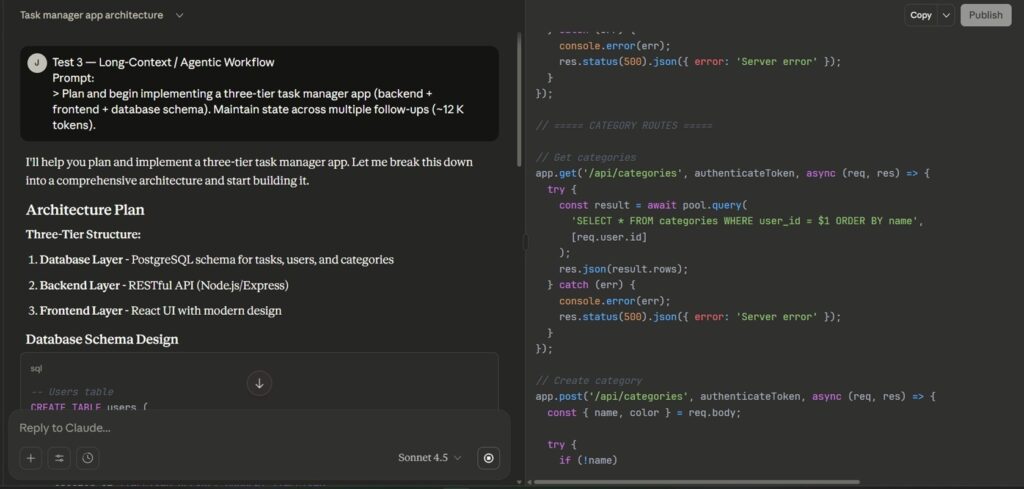
Structured the project with clear stages (planning, API design, UI, database). Generated migration scripts and integrated test plan. Maintained perfect reference to earlier files even past 10 K tokens.
Observations:
- Used memory summarization to compress context efficiently.
- Output format cleaner for import into IDE.
- Automatically generated README with setup instructions.
Score: 2 / 2
Winner: Claude Sonnet 4.5
Take-away: GLM’s expanded context window is valuable, but Claude’s session management and structured planning yield more coherent multi-turn workflows.
Test 4: Factual Reasoning
Prompt:
> Compare the total Olympic gold medals of Michael Phelps and Usain Bolt. Provide years and contextual narrative.
GLM 4.6
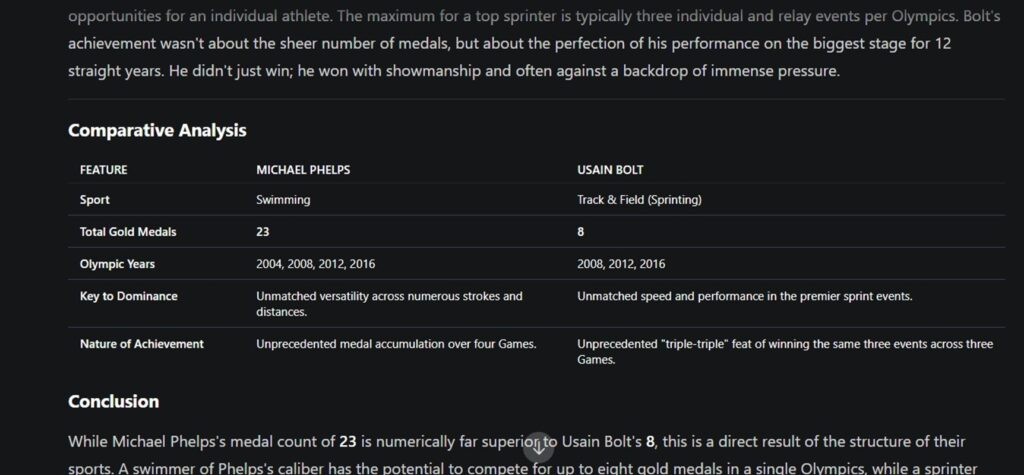
Answered correctly (Phelps = 23 gold, Bolt = 8 gold) and added brief history. Slightly verbose but accurate.
Score: 2 / 2
Claude Sonnet 4.5
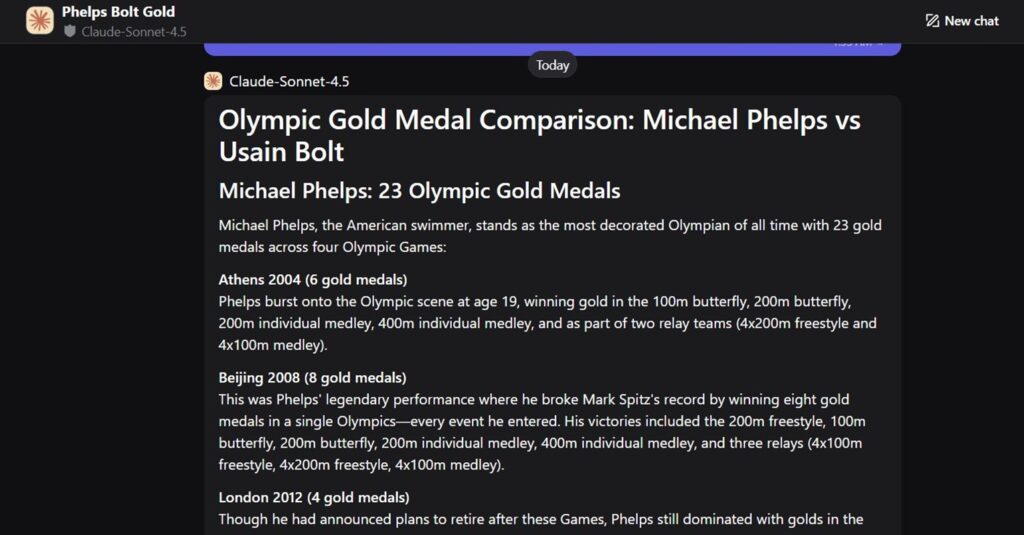
Delivered identical facts plus detailed year-by-year breakdown and citations for context.
Score: 2 / 2
Winner: Draw
Take-away: Both models are factually reliable within mainstream topics.
Test 5: Memory & Contextual Continuity
Prompt:
> I’m allergic to shellfish and dairy. I prefer Mediterranean vegetarian cuisine.
> (Five unrelated turns later…) Suggest three dinner ideas for me.
GLM 4.6
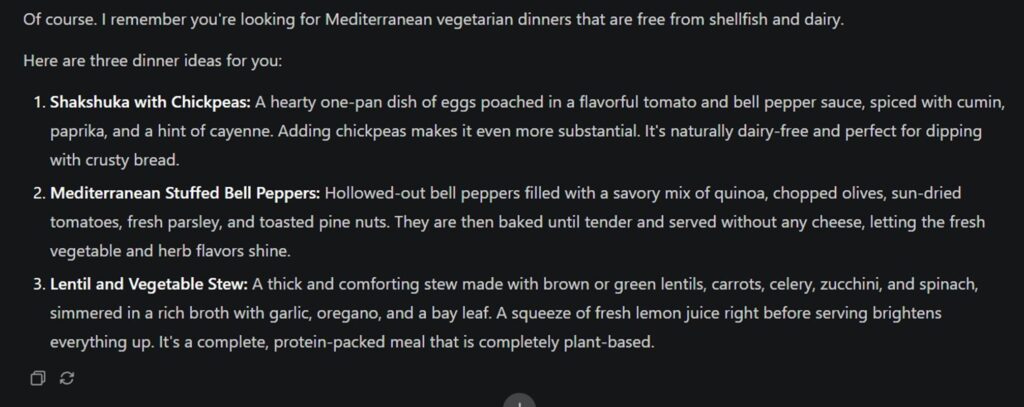
Remembered preferences, excluded dairy/shellfish, suggested lentil-based Mediterranean dishes.
Score: 2 / 2
Claude Sonnet 4.5
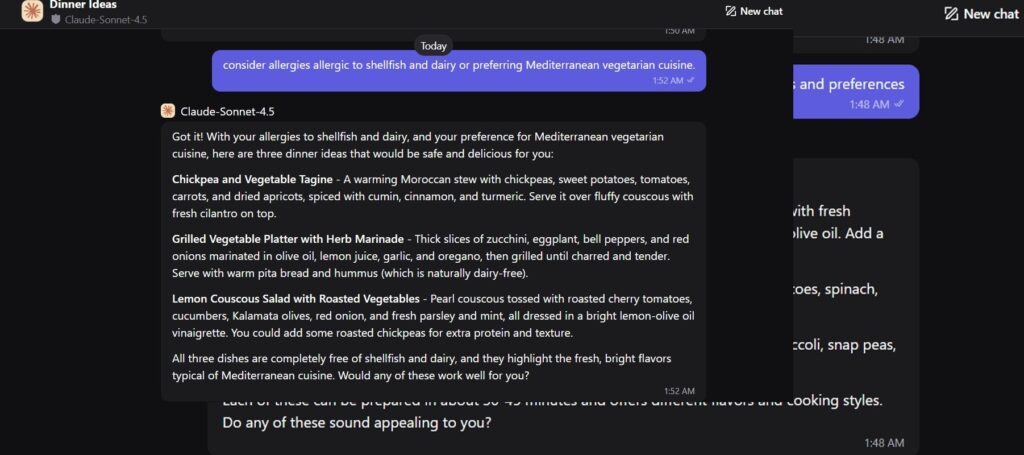
Also remembered correctly, proposed refined dishes (chickpea tagine, grilled halloumi substitute, lemon couscous salad) and confirmed dietary safety before answering.
Score: 2 / 2
Winner: Draw
Take-away: Both maintain reliable short-term memory; Claude adds nuance via clarifying questions.
Summary of Results
AI Model Performance Comparison
| Task | GLM 4.6 | Claude Sonnet 4.5 | Winner |
|---|---|---|---|
| Coding | 1.5 | 2.0 | Claude |
| Debugging | 2.0 | 2.0 | Draw |
| Long-Context / Agentic | 1.5 | 2.0 | Claude |
| Factual Reasoning | 2.0 | 2.0 | Draw |
| Memory Retention | 2.0 | 2.0 | Draw |
| Total (out of 10) | 9.0 | 10.0 | Claude Sonnet 4.5 |
Verdict: While GLM 4.6 performs exceptionally well, especially considering its efficiency and context size. Claude Sonnet 4.5 edges ahead overall, mainly due to polish, context stability, and ecosystem maturity.
Strengths & Weaknesses
GLM 4.6 Strengths
- Extended Context: 200 K tokens makes it excellent for document analysis, long codebases, and research.
- High Cost-Efficiency: Typically lower API cost per token; can be deployed more flexibly.
- Strong Reasoning: Handles step-by-step logic and tool-use effectively.
- Coding Capability: Competent across languages (Python, JS, Go, etc.).
GLM 4.6 Weaknesses
- Occasional output redundancy in very long threads.
- Lacks the ecosystem polish and API depth of Anthropic.
- UI/UX generation sometimes visually plain.
Claude Sonnet 4.5 Strengths
- Agentic Intelligence: Handles complex, persistent multi-file workflows with structured planning.
- Developer Polish: Readable, commented, deploy-ready code out of the box.
- Long-Run Stability: Maintains session coherence beyond 10 K tokens and supports day-long processes.
- Ecosystem Integration: Amazon Bedrock, Slack, GitHub Copilot, Claude API, and early memory tool support.
- Alignment & Safety: Improved resistance to hallucinations and misinformation.
Claude Sonnet 4.5 Weaknesses
- Premium Cost: Higher per-token price in most deployments.
- Closed Platform: Less flexible for on-prem or local use.
- Occasional Over-Caution: Tends to self-censor when prompts appear ambiguous.
Developer Experience
Developers reported subtle differences in interaction feel:
- GLM 4.6 responds more “code-centric,” focusing on functional output first.
- Claude Sonnet 4.5 responds more “mentor-style,” adding explanations and safety context.
In extended sessions, GLM maintained brisk pace; Claude, while slower, provided richer intermediate summaries. For automated agent orchestration, Claude’s consistent formatting proved advantageous.
Integration Notes:
- GLM’s function-calling interface is simple and REST-based, ideal for research labs.
- Claude’s tool-use schema in Bedrock supports multiple parallel calls and memory injection, helpful for production pipelines.
Use-Case Fit
AI Model Recommendations by Scenario
| Scenario | Recommended Model | Why |
|---|---|---|
| Budget-sensitive R&D | GLM 4.6 | Excellent performance at lower cost |
| Large document or multi-chapter summarization | GLM 4.6 | 200K context window |
| Multi-file software project / codebase refactoring | Claude Sonnet 4.5 | Superior agentic flow |
| Enterprise integration with existing AWS / GitHub stack | Claude Sonnet 4.5 | Deep ecosystem support |
| Experimental AI agents (custom workflows) | GLM 4.6 | Flexible APIs, fewer restrictions |
| Long autonomous agents / persistent memory tasks | Claude Sonnet 4.5 | Proven long-run stability |
Overall: GLM 4.6 is ideal for experimentation and open R&D; Claude Sonnet 4.5 excels in enterprise deployment and high-reliability production environments.
Benchmarks and Community Feedback
Publicly available benchmarks complement these findings:
- GLM 4.6: Unofficial community tests place it on par with Claude 4.5 and GPT-4 Turbo in reasoning and coding accuracy, with 20–30 % faster inference at similar quality.
- Claude Sonnet 4.5: Anthropic’s internal benchmark shows 61.4 % OSWorld success rate (vs 42 % in Sonnet 4.0) and near-zero critical code-edit errors.
Developer sentiment on forums echoes this:
> *“GLM 4.6 feels stable and fast, and I use it for longer Python pipelines.”*
> *“Claude 4.5 finally feels like pair programming with a senior engineer.”*
Outlook: Where the Frontier Moves Next
The competition between GLM 4.6 and Claude Sonnet 4.5 underscores how quickly LLMs are becoming autonomous digital collaborators. Three trends are clear:
1. Context Expansion → Reasoning Depth
As token windows exceed 200 K, persistent context transforms how models handle entire codebases or research papers. Expect continued optimization around compression and contextual summarization.
2. Agentic Workflows → True Co-workers
Models are shifting from reactive text bots to proactive task orchestrators. Claude’s day-long sessions and GLM’s efficient context engine preview what “AI teammates” will soon look like.
3. Ecosystem Lock-in vs Open Flexibility
Enterprises may prefer Anthropic’s stable integrations, while open researchers may choose GLM for portability and cost control.
Final Scores and Verdict
| Category | GLM 4.6 | Claude Sonnet 4.5 | Comments |
|---|---|---|---|
| Coding Quality | 1.5 | 2.0 | Claude’s code cleaner |
| Debugging | 2.0 | 2.0 | Equal |
| Long-Context Workflow | 1.5 | 2.0 | Claude steadier |
| Factual Reasoning | 2.0 | 2.0 | Equal |
| Memory Continuity | 2.0 | 2.0 | Equal |
| Totals (10 max) | 9.0 | 10.0 | N/A |
| Overall Winner | Claude Sonnet 4.5 | By a narrow margin |
Two Giants, Different Philosophies
The comparison between GLM 4.6 and Claude Sonnet 4.5 reveals not a winner-take-all outcome, but two mature design philosophies:
GLM 4.6 champions openness, efficiency, and raw performance per dollar. It thrives in environments that demand long-context reasoning and rapid iteration.
For developers exploring AI agents, research assistants, or cost-conscious deployments, it’s an exceptional choice.
Claude Sonnet 4.5 embodies precision, polish, and production reliability. It’s ideal when stability, multi-day sessions, and deep ecosystem integration matter most.
For enterprise developers and AI teams building durable, safe systems, it currently leads the field.
In short:
> GLM 4.6 is the engineer’s workhorse.
> Claude Sonnet 4.5 is the enterprise craftsman.
Both point toward a future where AI models don’t just answer, they collaborate, remember, and build alongside us.

![Is Micro1 Legit?. Is Micro1 Legit? Pay, Reviews and How It Works [2026], by Second Talent.](https://www.secondtalent.com/wp-content/uploads/2026/09/is-micro1-legit-featured-v2-768x403.jpg)