Hundreds of recruiting platforms have surfaced in the past year, each claiming to refine how companies identify and secure talent. For hiring leaders, this deluge creates confusion, separating passing gimmicks from enduring tools requires discernment and strategic clarity.
Manual hiring remains prone to bias, inconsistency, and exhausting delays, often undermining culture and long-term performance. What emerges instead is a rewiring of recruitment are smart tools to decode resumes, schedule interviews, and reduce missteps rooted in unconscious bias.
The real challenge isn’t adopting technology; it’s discerning which platforms actually sharpen judgment, reduce bias, and withstand the pace of modern hiring. Hence, in this market, only a handful of tools truly stand resilient. We’ve tested them. Here’s the shortlist.
What’s your biggest hiring challenge?
Select your situation below.
AI tools narrow a pile of CVs, but someone still has to vet the people. Second Talent matches you with vetted engineers for your stack in 24 hours, or you can search our talent directory yourself. Browse vetted developers →
AI tools help, but a consistent process matters more. Every Second Talent engineer passes the same four vetting stages: a technical assessment, an AI-native tooling check, English at C1 or above, and a behavioural interview. See our sourcing process →
Second Talent engineers in Vietnam and eight other Asian markets cost a flat $3,000 to $6,000 a month, all-in, with 50-70% payroll savings. Our rate card breaks salaries down by country and role, so you can budget before posting a job. Compare Asia developer rates →
Second Talent matches you with vetted engineers in 24 hours, and our EOR lets you employ them in Vietnam, the Philippines or Indonesia without setting up an entity. Payroll, compliance and benefits run through one platform. Get EOR pricing →
Types of AI Recruiting Tools
| Category | Purpose in Recruitment | Key Functions | Representative Tools |
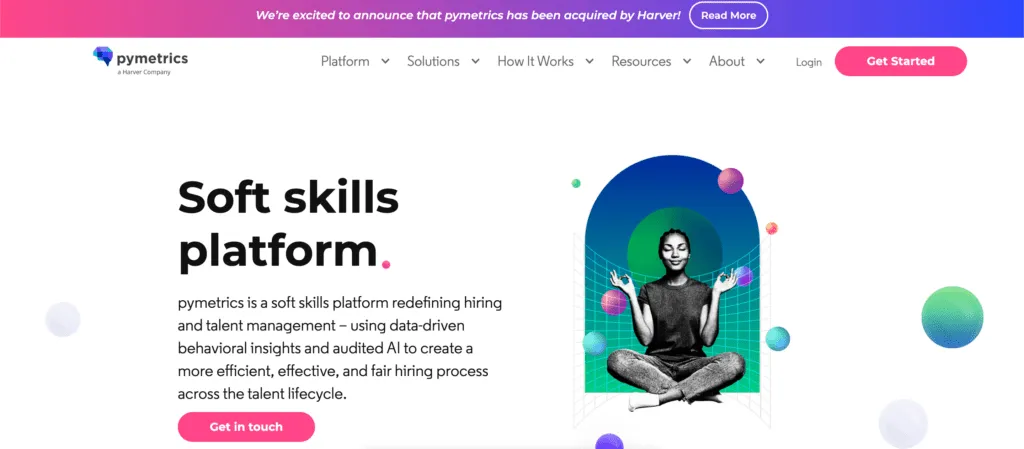
| Resume Screening Solutions | Expedite the initial candidate evaluation by assessing large volumes of applications accurately | – Parse and evaluate resumes- Match qualifications to role requirements- Reduce human bias in shortlisting | Pymetrics: Uses neuroscience-based assessments to align cognitive and emotional traits with organizational needs |
| Interview Scheduling Platforms | Facilitate interview coordination across diverse schedules and geographies, ensuring efficiency for both candidates and hiring teams | – Manage scheduling across time zones- Integrate with corporate calendars- Issue confirmations and reminders | Workable: Integrates scheduling tools within its applicant tracking system for seamless coordination |
| Recruitment Chat Assistants | Maintain consistent, real-time engagement with applicants, reducing administrative load while preserving candidate experience | – Address candidate inquiries- Guide applicants through the hiring process- Provide 24/7 availability | Paradox’s Olivia: Converses with candidates and answers questions in real time |
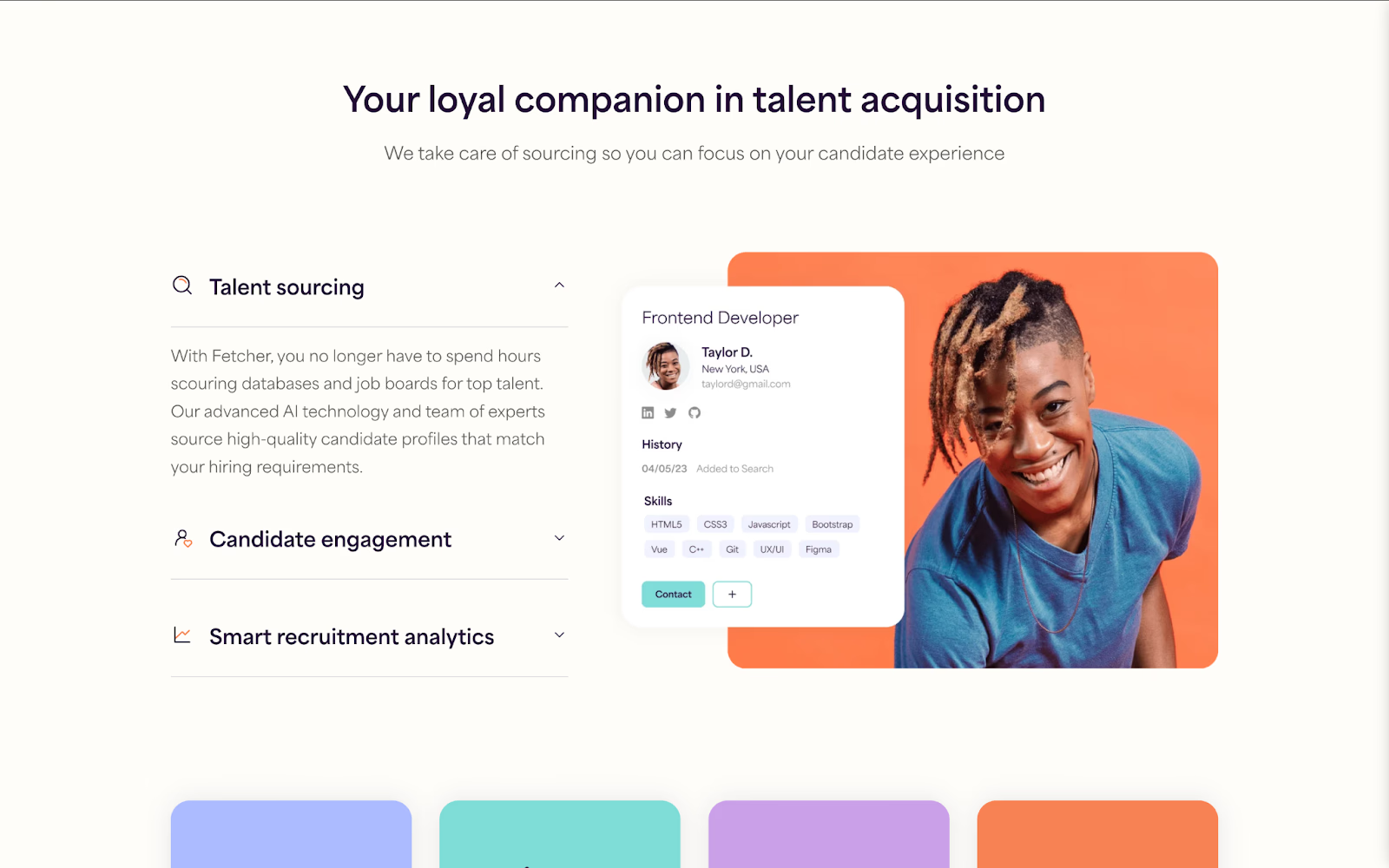
| Candidate Engagement Systems | Strengthen long-term talent relationships by delivering relevant and personalized communication throughout the hiring cycle | – Send personalized communications – Conduct targeted follow-ups- Maintain ongoing connections with prospective talent | Fetcher: Sources and engages passive candidates with personalized outreach |
| Assessment and Testing Platforms | Objectively evaluate skills, aptitudes, and job-specific competencies to inform high-quality hiring decisions | – Conduct technical or role-based tests- Analyze and score candidate performance- Provide actionable feedback | Xobin: Runs AI-driven skills and aptitude assessments to score candidates objectively |
How is AI used in the Hiring Process?
Hiring today requires speed, fairness, and a clear view of candidate potential. Companies are using modern recruitment tools like application tracking system to sift through large numbers of applications, cut time spent on reviews, and focus on the best-fit talent. With remote and hybrid work attracting applicants from many regions, these tools help assess skills, personality, and cultural fit more effectively. They also support fairer hiring by reducing bias and improving how information is managed.
- Refined Interviewing: Asynchronous video formats reduce screening time by up to 80%.
- Contextual Screening: NLP assesses qualifications, communication style, and cultural fit.
- Predictive Analytics: Historical data forecasts hiring success and retention.
- Integrated Platforms: Standardised APIs ensure unified recruiter and candidate experiences.
- Ethical Safeguards: Built-in bias detection and strict data protection compliance.
“In 2025, AI was responsible for 20% of all hiring decisions, making it an essential tool for recruiters and hiring managers.”
Jason Lauritsen, Workplace Futurist
Top 8 AI Recruiting Tools in 2026
Recruitment today is no longer a paper resume and polite interview. It’s a melting pot of neuroscience games, predictive assessments, and data-rich evaluations shaping both candidate experience and business outcomes. If you’re looking for better tech hiring needs, here’s the list for you.
- Workable:
 Website: https://www.workable.com/ Rating: 4.4/5 |
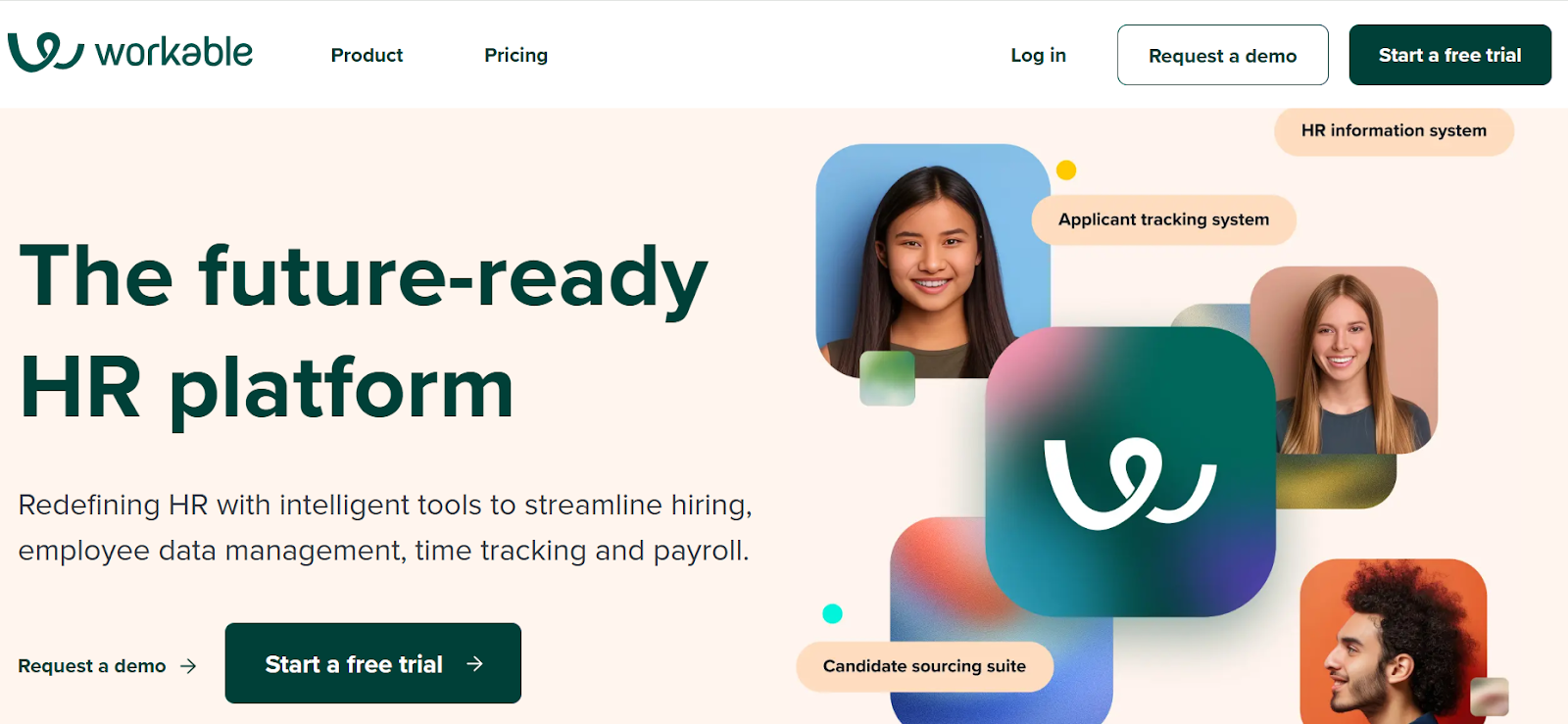
Workable is a cloud-based recruitment solution recognized for balancing simplicity with depth, making it suitable for organizations of every size. Its intuitive dashboard and enhanced ATS functions help teams advertise roles, manage candidates, and schedule interviews without prolonged delays.
Further, Workable integrations with hundreds of job boards extend hiring reach, while analytics provide clarity for hiring decisions. So, with effective compliance safeguards, a mobile app, and customizable hiring options, Workable becomes a valuable asset for collaborative teams of both growing startups and established enterprises.
Key Features
- Automated job advertising across multiple channels
- One-click posting to hundreds of job boards
- Built-in candidate sourcing and pool management
- Custom hiring pipelines tailored to team workflows
- Collaborative scheduling and structured feedback tools
Pros & Cons
| Pros | Cons |
| Intuitive and easy-to-use interface | Costly for organizations hiring at scale |
| Fast to implement with minimal setup | Limited video interview functionality |
| Reliable customer support is praised by users | Automation features remain basic |
➡ Pricing: Plans start at $299 a month for Standard (1 to 20 employees, recruiting and HR bundled), with Premier at $599. Texting, video interviews and assessments are paid add-ons, and the Workable Agent runs on AI credits, with 3,000 free.
- Metaview:
 | |
| Website: https://www.metaview.ai/ | Rating: 4.5/5 |
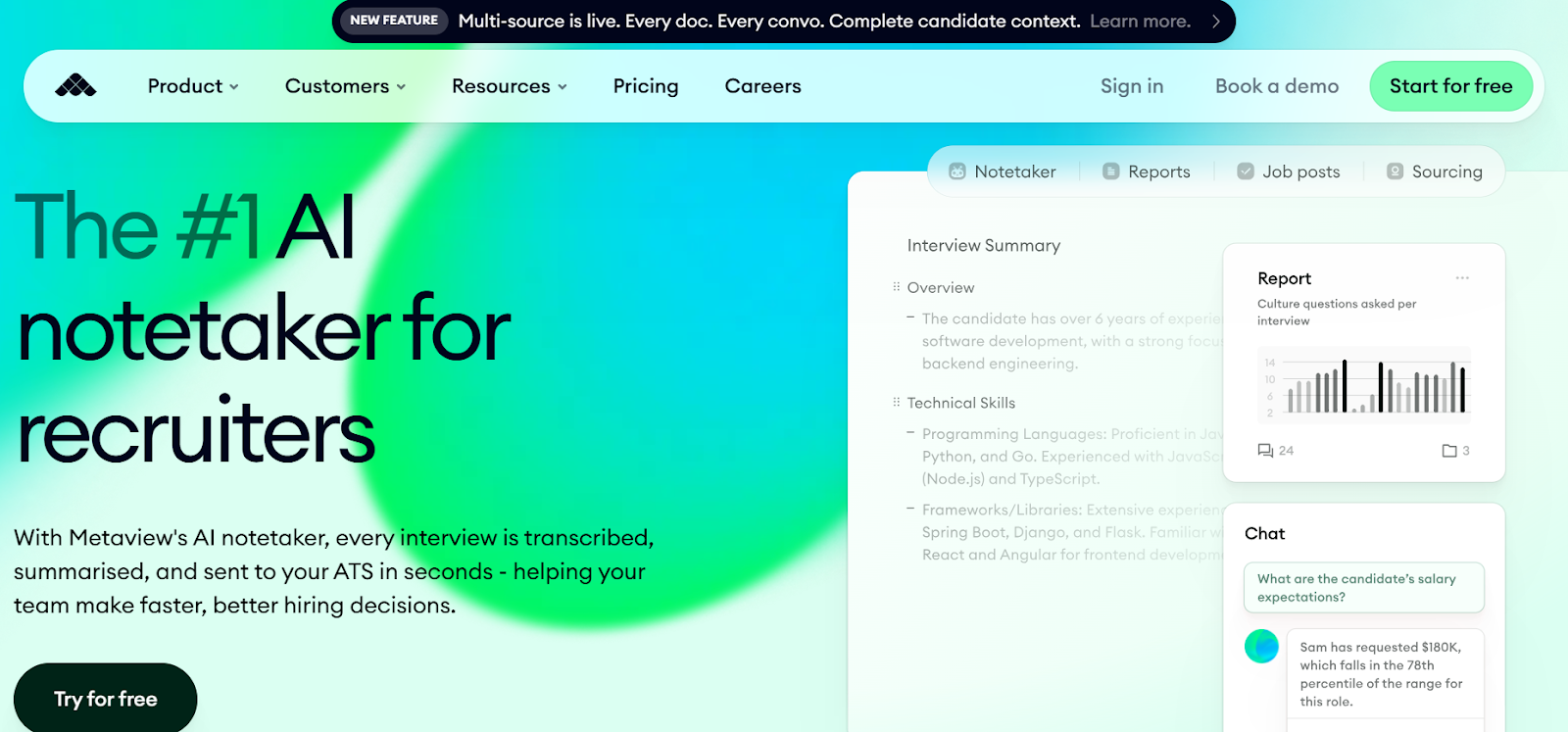
Metaview automates note-taking and generates instant summaries for interview calls, freeing recruiters from manual documentation. This AI-recruiting platform integrates with leading video call tools and calendars, allowing teams to record, transcribe, and share feedback smoothly.
Its dashboard analytics highlight trends in candidate performance, helping organizations improve the quality and speed of hiring. Metaview also prioritizes data privacy and security, making it a trusted choice for growing businesses seeking structured, reliable interview insights. It has since grown beyond note-taking into AI agents for candidate sourcing and application review.
Key Features
- Automatic summaries from interview conversations
- Real-time, accurate transcript generation
- Prompted scoring for structured evaluations
- Analytics dashboard for hiring insights
- Integration with leading calendars and video tools
Pros & Cons
| Pros | Cons |
| Reduces recruiter workload | Lacks job posting functions |
| Provides structured, reliable insights | Requires connected tools |
| Consistent transcription quality | Limited ATS capabilities |
➡ Pricing: A free plan, then Pro at $100 and Max at $300 per user per month. Enterprise and the full agentic recruiting platform are priced on request.
- Xobin: AI-Powered Talent Assessment Platform
| Website: https://www.xobin.com | Rating: 4.7/5 |
Xobin is a comprehensive AI-powered talent assessment software built for companies that want to hire with speed, accuracy, and confidence. With 3,400+ skills-based and 2,500 role-specific assessments, 180,000+ validated questions, and support across 60+ countries, it handles everything from pre-employment testing to internal employee evaluations on a single secure platform.
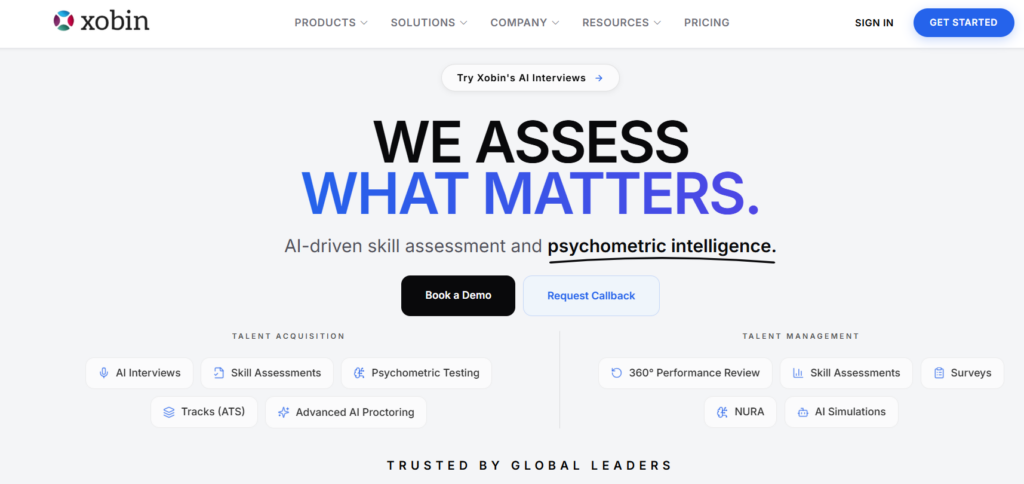
The platform combines advanced AI proctoring, agentic interviews, video-based assessments, and automated resume screening into one unified hiring workflow. Whether you’re a fast-scaling startup or a Fortune 500 enterprise, Xobin adapts to your volume and structure, reducing time-to-hire significantly while keeping assessment integrity intact through multi-layered fraud detection and compliance certifications including SOC2 Type-2, ISO 27001, and GDPR.
Key Features
- 3,400+ pre-built skills and 2,500 role-specific tests across tech and non-tech domains
- AI-powered resume parsing with automated candidate fitment scoring
- Agentic AI interviews that conduct and evaluate L1/L2 rounds autonomously
- Multi-layer proctoring with face tracking, eye-gaze detection, and audio analysis
- Coding simulator supporting 50+ languages with real-time IDE environment.
Pros & Cons
| Pros | Cons |
| Broad assessment library covering tech and non-tech roles | Pricing isn’t listed publicly, and needs a quick call |
| Strong AI proctoring with multiple fraud-detection layers | Takes a little time to explore all features given the breadth |
| Scales from startups to large enterprises seamlessly | Mobile experience could be smoother for some assessment types |
➡ Pricing: Custom pricing based on team size and selected modules. Free trial available; enterprise plans include dedicated SLAs and account management.
- Qureos:
 Website: https://www.qureos.com/ Rating: 4.3/5 |
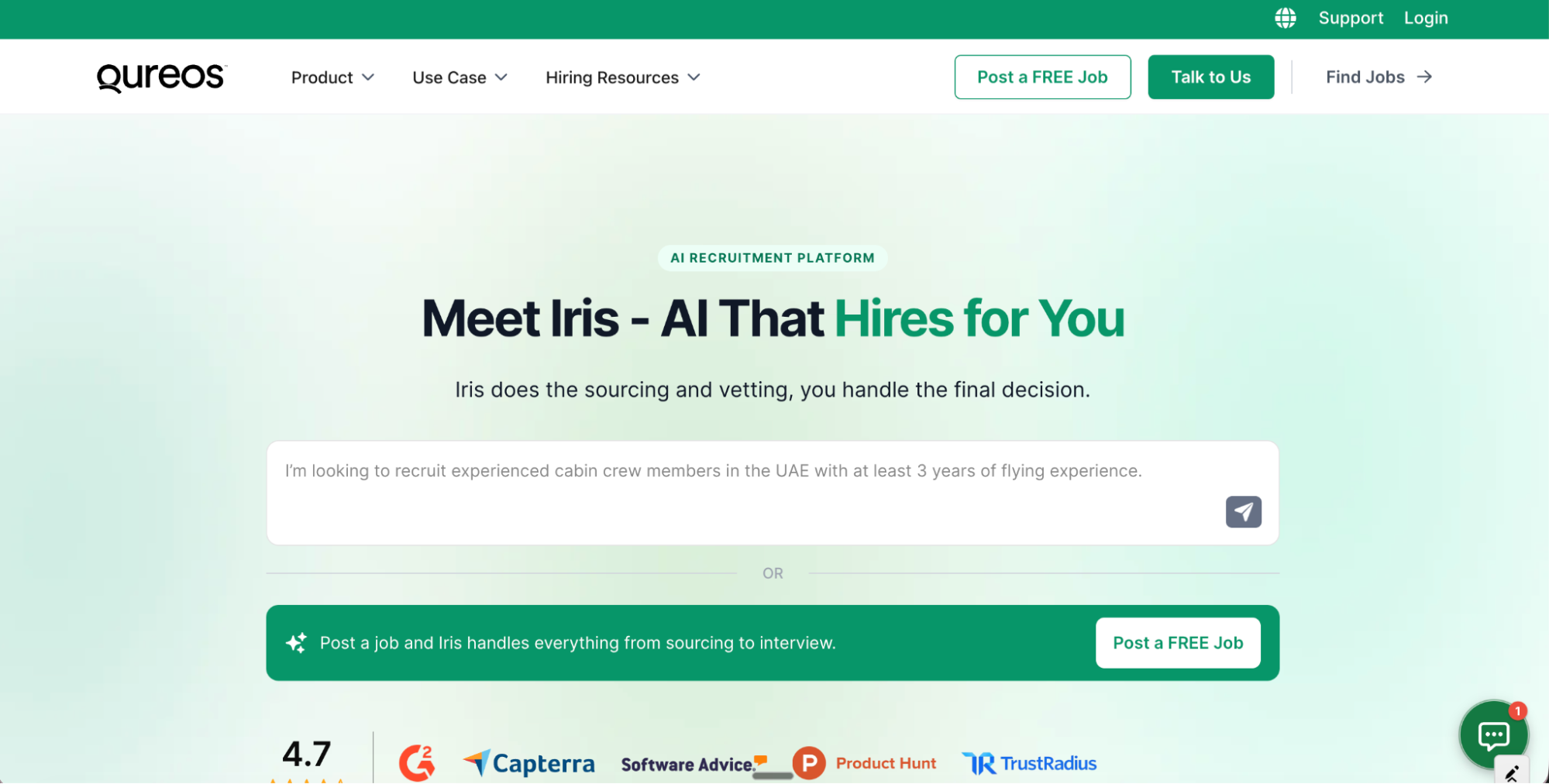
Qureos helps hiring teams fill roles faster without adding more recruiters. Instead of spending hours searching through CVs, recruiters and hiring managers describe the role they are hiring for and get matched with qualified candidates right away. From sourcing and outreach to screening and shortlisting, Qureos removes the manual work that slows hiring down.
Teams can assess candidates with AI video interviews, rank applicants automatically, manage talent pipelines, and post jobs across many channels from one platform. Companies that want to hand off hiring entirely can also use Qureos as a fully managed recruitment partner. Built for companies hiring across the GCC and beyond, it supports multilingual workflows and integrates with existing ATS, CRM, and HR systems.
Key Features
- AI-powered candidate sourcing and matching
- Candidate screening and shortlisting
- AI video interviews with evaluation reports
- Talent pool management
- Automated candidate outreach campaigns
- Job distribution across multiple channels
- Multilingual hiring support
- ATS, CRM, and HR system integrations
- Psychometric testing
Pros & Cons
| Pros | Cons |
| Describe a role in plain language and get matched candidates fast | Strongest fit for GCC and Middle East hiring |
| AI video interviews with evaluation reports and automatic ranking | Fewer public reviews than older, established ATS tools |
| Option to fully outsource hiring through a managed service | Managed service may be more than small in-house teams need |
➡ Pricing: Qureos offers free job posting plus paid plans for its AI recruiter, and a fully managed recruitment option. Contact Qureos for pricing matched to your hiring volume.
- iSmartRecruit:
 Website: https://www.ismartrecruit.com/ Rating: 4.6/5 |
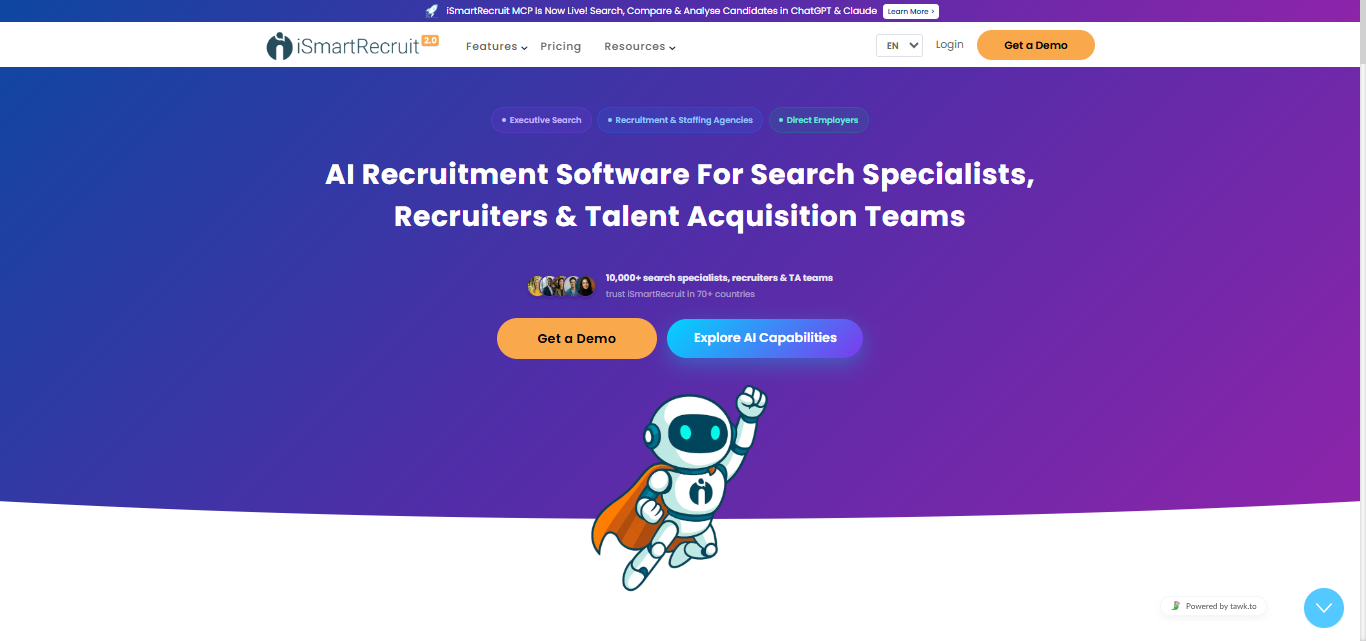
iSmartRecruit is an AI-powered applicant tracking system (ATS), executive search software and recruiting CRM in one platform. It is built for recruitment agencies, staffing firms, executive search firms and in-house talent acquisition teams, and covers the hiring process from sourcing to placement.
Beyond applicant tracking, it adds AI recruitment agents, candidate and job matching, automated workflows and conversational AI. Recruiters use it to write job descriptions, summarize candidates, improve emails and interview feedback, and source talent. It also handles job distribution, interview scheduling, talent pools, analytics and GDPR compliance, and syncs with email and calendar tools.
Its newest addition is an MCP connector, which lets recruiters search, compare and analyze candidates from inside ChatGPT and Claude. iSmartRecruit says 10,000+ search specialists, recruiters and talent acquisition teams in 70+ countries use the platform.
Key Features
- AI-powered candidate and job matching
- AI recruitment agents for sourcing, research and headhunting
- Automated resume parsing and candidate screening
- Customizable recruitment workflows and autopilot automation
- Recruiting CRM with centralized candidate and client management
- Job posting across free and sponsored job boards
- AI-generated job descriptions, emails, notes and candidate summaries
- Interview scheduling with email and calendar sync
- Talent pool management and advanced candidate search
- MCP connector for candidate search in ChatGPT and Claude
- Recruitment analytics, reporting and GDPR compliance
Pros & Cons
| Pros | Cons |
| ATS, CRM and AI capabilities in one platform | No fixed prices published |
| Strong automation and AI candidate matching | Advanced features take time to learn |
| Highly customizable workflows for different recruitment models | Migration, training and customization may cost extra |
| Responsive support and onboarding help | The wide feature set may feel heavy for very small teams |
➡ Pricing: Custom pricing based on business size, users, hiring needs and chosen features. iSmartRecruit offers plans for startups, agencies, executive search firms and in-house teams, with prices available on request.
- Paradox:
 | |
| Website: https://www.paradox.ai/ | Rating: 4.2/5 |
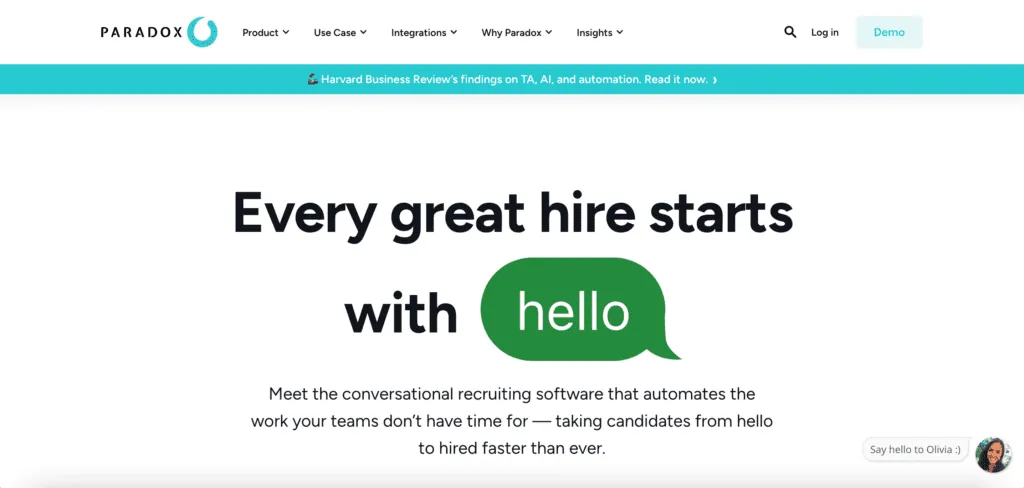
Paradox centers on Olivia, a conversational assistant that changes recruitment through instant candidate interaction, screening, and interview scheduling. Applicants receive real-time updates and answers, while recruiters save hours once lost to repetitive administration. Its mobile-first design makes applications simple and responsive, meeting candidate expectations for clear and timely communication.
The platform integrates with leading ATS systems, supports compliance checks, and offers multi-language options. With rapid setup, 24/7 availability, and a clean dashboard, Paradox helps hiring teams strike a balance between speed and efficiency.
Key Features
- Conversational assistant answers applicant questions at any time
- Automated screening with integrated interview scheduling
- Instant scheduling through text and chat options
- 24/7 candidate communication and real-time updates
- Works with leading ATS and HR systems
Pros & Cons
| Pros | Cons |
| Saves significant recruiter time | Analytics remain basic |
| Consistently fast response rates | Candidate interactions feel less personalized |
| Optimized for mobile interactions | Requires upfront configuration |
➡ Pricing: Customized pricing based on hiring and technology needs; proposals available on request.
- Fetcher:
 | |
| Website: http://www.fetcher.ai/ | Rating: 4.4/5 |
Fetcher combines automated sourcing with human insight to help recruiters connect with qualified passive candidates quickly. The platform delivers curated candidate batches, personalizes outreach for stronger engagement, and offers analytics to measure campaign performance.
Its integrations with ATS and email systems centralize hiring activity, while expert support ensures sourcing campaigns remain effective. Suitable for organizations needing scalable sourcing without managing a full ATS, Fetcher strikes a balance between automation and human judgment, making it a valuable partner in modern recruitment strategies.
Key Features
- Automated sourcing of qualified, passive candidates
- Personalized outreach with follow-up capabilities
- Batch delivery for quick candidate evaluations
- Pipeline analytics for sourcing campaign tracking
- Integrations with ATS and email platforms.
Pros & Cons
| Pros | Cons |
| Faster access to suitable candidates | Plans can limit scale |
| Effective outreach and engagement | Not a complete ATS |
| Clear reporting and analytics | Training required for full adoption |
➡ Pricing: Plans are listed from $115 a month for Self-serve, with Growth at $379 and Amplify at $649. Annual payment saves 30%, and Enterprise is quoted.
- pymetrics:
 | |
| Website: https://harver.com/?utm_source=pymetrics | Rating: 3.4/5 |
pymetrics, now part of Harver, revises recruitment by using neuroscience-based assessments to evaluate cognitive, social, and emotional attributes. Rather than relying solely on resumes, the platform measures soft skills to align candidates with roles where they succeed.
Designed to reduce bias, it supports diversity and inclusion while offering predictive insights into job suitability. The game-like tests are mobile-friendly, engaging, and accessible to a wide candidate pool. Employers gain instant, data-rich feedback and analytics, while integrations with existing HR systems keep processes consistent and organized.
Key Features
- Neuroscience-based games to measure cognitive and soft skills
- Matching engine provides fair, bias-reducing job-fit insights
- Instant candidate data for predictive role suitability
- Employer dashboards for diversity and workforce planning
- Mobile-first assessments are accessible to global applicants.
Pros & Cons
| Pros | Cons |
| Reduces hiring bias | Varies in fit across industries |
| Engaging and accessible candidate experience | Requires candidate and recruiter adoption |
| Science-backed evaluation methods | Limited ATS functionalities |
➡ Pricing: Custom pricing based on assessment volume, company size, integrations, and enterprise features.
What Makes the Best AI Recruiting Tool?
A truly effective recruiting tool does more than manage resumes. It should change the hiring journey into a fair and efficient process.
1. Functionality
The best platforms combine candidate tracking, interview coordination, collaboration, and reporting in one place, designed with recruitment at the center.
2. Utility
It should fit naturally into hiring workflows. From resume checks to scheduling, every feature must serve recruitment-specific needs.
3. Integration
Connection with existing HR systems is essential. Proper integration reduces errors, preserves continuity, and strengthens efficiency across the hiring process.
4. Accuracy
Precision is non-negotiable. The tool must assess skills reliably, minimize unconscious bias, and align talent with the right opportunities.
5. Intuitive Design
A clean, user-friendly interface matters. Short learning curves, adaptable workflows, and flexible scoring systems encourage confident use by hiring teams. You can also browse a wider range of AI tools and agents in the AI Agent Store directory.
Recruitment isn’t losing its human pulse; it’s being rewired into something sharper, faster, and more discerning. Algorithms don’t replace intuition; they refine it by filtering noise, reducing bias, and amplifying judgment.
The modern recruiter remains the navigator, steering through oceans of talent with new instruments at hand. At SecondTalent, we illustrate this shift, combining technology with human discernment to create hiring outcomes that feel precise and deeply human. Technology does not diminish recruiters. It gives them back time, authority and focus where it matters most.

![Singapore AI Companies Leading Southeast Asia. Top 10 Singapore AI Companies Leading Southeast Asia [2026], by Second Talent.](https://www.secondtalent.com/wp-content/uploads/2026/09/singapore-ai-companies-featured-v2-768x403.jpg)