Malaysia‘s tech ecosystem has reached a pivotal milestone in 2025, with 21,400+ startups collectively raising $18.9 billion in funding and producing its first two unicorns, Carsome and Edotco.
The nation’s ambitious MyDigital blueprint targets 5,000 startups and five unicorns by 2030, with the ICT sector already contributing 23.2% to GDP and projected to reach 25.1% by 2025.
Despite challenges in local funding and talent retention, Malaysia‘s strategic position, government support through initiatives like the AI Sandbox program, and thriving sectors from fintech to healthtech position it as Southeast Asia’s emerging innovation powerhouse.
This comprehensive analysis profiles 20 leading tech companies driving Malaysia’s digital transformation.
Market Overview
Malaysia’s digital economy has undergone remarkable transformation, with the Information and Communication Technology (ICT) industry contributing 23.2% to GDP in 2021 and projections reaching 25.1% by 2025.
The ecosystem now encompasses 21,393 startups, of which 2,120 are funded companies that have collectively raised $18.9 billion in venture capital and private equity.
This growth reflects Malaysia’s strategic positioning as a regional tech hub, bridging markets across Southeast Asia.
Growth & Market Metrics
| Company | Users/Customers | Revenue/GMV | Growth Rate | Market Position |
|---|---|---|---|---|
| TNG Digital | 20M+ users | Undisclosed | 40% YoY | #1 E-wallet |
| Funding Societies | 100K+ SMEs | $4B+ disbursed | 31% YoY | SEA Leader |
| Carsome | 300K+ transactions | $10M profit | 50% YoY | Profitable Unicorn |
| GXBank | Launching | RM 607M capital | New | First Digital Bank |
| EasyParcel | 50K daily orders | Growing | 41% YoY | Logistics Leader |
| Pandai | 700K+ students | Growing | 100% YoY | EdTech Leader |
| Naluri | 100K+ users | Growing | 75% YoY | Health Tech Pioneer |
| Aerodyne | Global clients | RM64M (FY21) | 30% YoY | #1 Drone Services |
| StoreHub | 15K+ outlets | Growing | 40% YoY | Regional SaaS |
| BigPay | 1M+ users | Growing | 50% YoY | Neobank Challenger |
The government’s MyDigital blueprint demonstrates unprecedented commitment, targeting the creation of 5,000 startups within five years and attracting two to five unicorns with Malaysian headquarters.
The recent launch of the AI Sandbox program, led by MRANTI, aims to create 900 AI startups by 2026, signaling Malaysia’s ambition to lead in emerging technologies.
Top 20 Malaysian Tech Startups (2025)
1. Carsome
Sector: Automotive Marketplace
Valuation: $1.3 billion (Unicorn)
Total Funding: $590+ million
Latest Milestone: First full-year profitability ($10M profit in FY24)
Carsome revolutionized Southeast Asia’s used car market through its C2B marketplace model. The platform collects vehicle data, conducts inspections, holds dealer auctions, and manages end-to-end delivery.
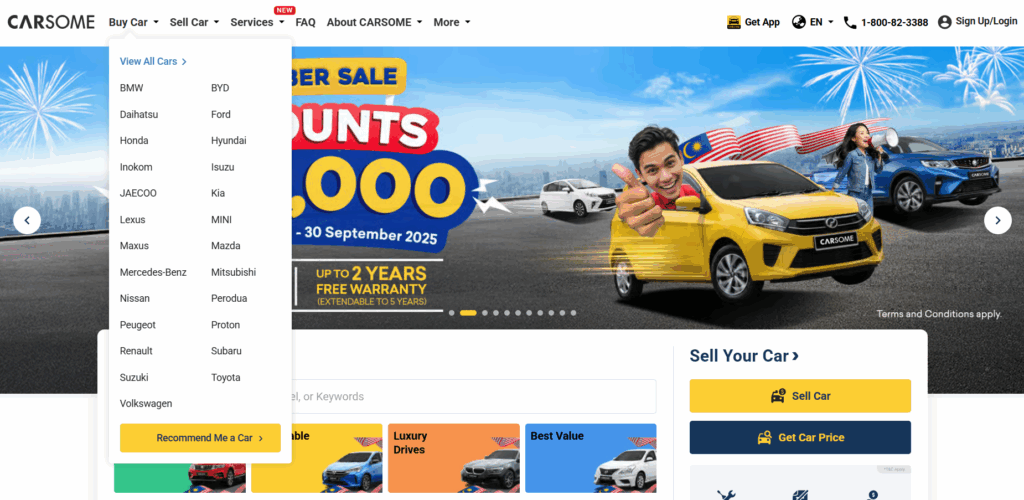
Achieving unicorn status in September 2021 with a $170 million Series D led by MediaTek, Carsome posted its first full-year profit of $10 million in FY24.
The company’s April 2025 partnership with Google Cloud for AI integration positions it at the forefront of automotive tech innovation.
2. Grab (Malaysian Heritage)
Sector: Super App / Mobility
Valuation: $40 billion (Listed via SPAC)
Origin: Malaysian-founded, now Singapore-based
Impact: Southeast Asia’s leading super app
While Grab relocated its headquarters to Singapore, its Malaysian roots remain significant. Founded in Malaysia and incubated locally, Grab’s $40 billion valuation represents what Malaysian startups can achieve.
The company’s departure served as a wake-up call for the ecosystem, spurring government initiatives to retain future unicorns.
Grab continues significant operations in Malaysia, contributing to the digital economy through ride-hailing, food delivery, and financial services.
3. TNG Digital
Sector: Digital Payments / Fintech
Target Funding: RM 1.3 billion (next 2-3 years)
Users: 20+ million
Merchant Touchpoints: 2+ million
TNG Digital stands as Malaysia’s most funded fintech, with over 20 million users and 2 million merchant touchpoints.
The e-wallet platform has evolved beyond payments into a comprehensive financial ecosystem, offering remittances, investments, and insurance.
Its ambitious RM 1.3 billion fundraising target over the next three years signals expansion into digital banking and regional markets.
4. Funding Societies
Sector: SME Digital Lending
Total Funding: $250 million
SME Loans Disbursed: $4+ billion
Businesses Served: 100,000+
Southeast Asia’s largest SME digital financing platform, Funding Societies recently raised $25 million from Cool Japan Fund, bringing total equity to $250 million.
The platform has disbursed over $4 billion to 100,000+ businesses across five countries.
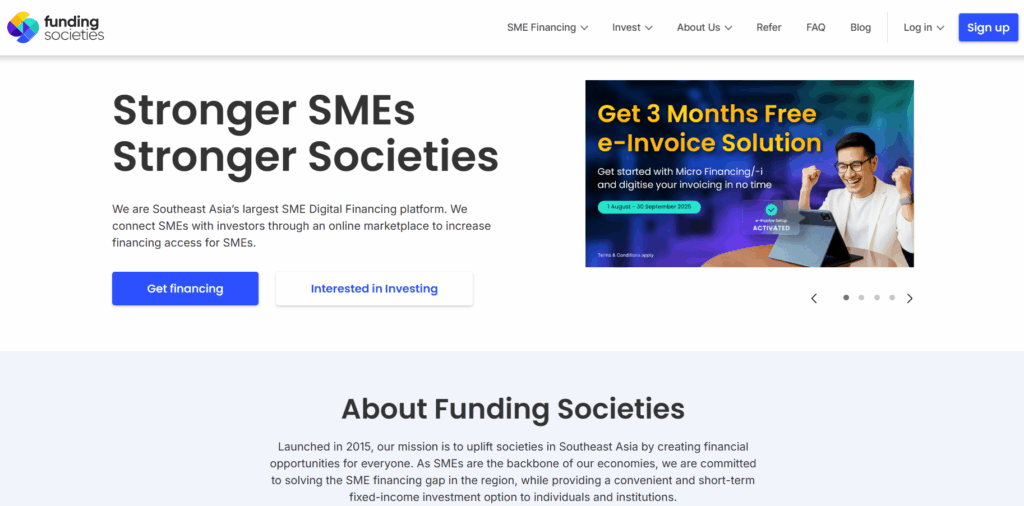
With Maybank’s $40 million investment and achieving operational profitability, Funding Societies leads Malaysia’s alternative lending revolution.
5. GXBank
Sector: Digital Banking
Share Capital: RM 607.55 million
Investment Commitment: RM 1.5 billion (5-year)
Backers: Grab, Singtel, Kuok Brothers
Malaysia’s first operational digital bank, GXBank represents a joint venture between Grab Holdings and Singapore’s Singtel.
With RM 607.55 million in share capital and a RM 1.5 billion five-year investment commitment, GXBank aims to build a regional fintech center of excellence.
The digital bank leverages Grab’s ecosystem to offer seamless financial services to underserved segments.
6. BigPay
Sector: Digital Finance / Neobank
Total Funding: RM 475 million
Parent: Capital A (formerly AirAsia)
Lead Investor: SK Group
BigPay has evolved from a travel-focused payment solution to a comprehensive digital financial platform.
With RM 475 million raised primarily through Series A funding led by SK Group, BigPay offers international transfers, personal loans, and micro-insurance.
The company’s digital banking license application positions it to compete directly with traditional banks.
7. Boost Holdings
Sector: Digital Payments / Banking
Total Funding: RM 308 million (external)
Parent: Axiata Group
Key Partnership: RHB (Boost Bank)
Boost Holdings, Axiata’s fintech arm, has secured RM 308 million in external funding from Great Eastern Holdings. The launch of Boost Bank with RHB marks a transformation from e-wallet provider to full-service digital bank.
The platform spans payments, lending, insurtech, and now deposit-taking, positioning Boost as one of Malaysia’s most comprehensive fintech ecosystems.
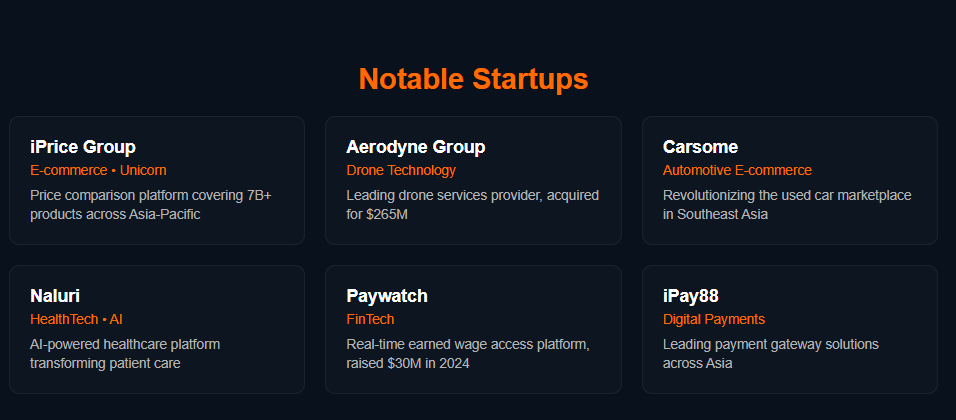
8. Aerodyne
Sector: Drone Technology / AI
Valuation: $260 million
Total Funding: $86.1-276 million (varying reports)
Global Ranking: #1 drone service provider (3 consecutive years)
Aerodyne has established itself as the world’s leading drone service provider for three straight years.
With a valuation of $260 million and record revenue of RM64.22 million in FY2021, the company provides drone-as-a-service solutions across agriculture, infrastructure inspection, and mapping.
Its AI-powered analytics platform processes aerial data for enterprise clients globally.
9. Edotco
Sector: Telecommunications Infrastructure
Status: Unicorn
Services: Tower services, energy, transmission
Coverage: Regional presence across Asia
Malaysia’s second unicorn, Edotco provides end-to-end telecommunications infrastructure solutions. The company offers tower co-locations, built-to-suit services, energy management, and network operations across multiple Asian markets.
As 5G deployment accelerates, Edotco’s infrastructure plays a critical role in Malaysia’s digital connectivity.
10. StoreHub
Sector: Retail Technology / SaaS
Outlets Served: 15,000+
Markets: Malaysia, Thailand, Philippines
Solution: All-in-one retail management
StoreHub’s cloud-based platform serves over 15,000 retail and restaurant outlets across Southeast Asia. The comprehensive solution includes POS systems, inventory management, customer engagement tools, and analytics.
StoreHub’s expansion across multiple markets demonstrates the scalability of Malaysian B2B SaaS solutions.
11. EasyParcel
Sector: Logistics Marketplace
Total Funding: $12.3 million
Daily Deliveries: 100,000+
Pgeon Network: 4,000 outlets
EasyParcel has revolutionized courier services through its marketplace model, connecting users with multiple courier partners. The platform processes 50,000 daily deliveries with targets of 100,000.
Its Pgeon last-mile service, with 4,000 drop-off points at MyNews and 99 Speedmart outlets, solves critical logistics challenges for e-commerce growth.
12. iStore iSend
Sector: E-commerce Fulfillment
Total Funding: $5.5 million
Annual Revenue: $14.2 million (2020)
Employees: 172
iStore iSend provides comprehensive e-commerce fulfillment solutions across Southeast Asia. With $5.5 million raised including Series B funding, the company offers warehouse management systems and automation for B2B and B2C operations.
Partnerships with EasyParcel and global investors like Kuroneko Innovation Fund validate its technology platform.
13. Pandai
Sector: EdTech
Accelerator: Y Combinator (S21)
Users: 700,000+ students
Markets: Multiple Southeast Asian countries
Pandai leverages AI to help students improve academic performance across Southeast Asia. As a Y Combinator alumnus (S21 batch), Pandai has rapidly scaled to 700,000+ registered students.
The platform’s adaptive learning technology and comprehensive curriculum coverage address critical education gaps in emerging markets.
14. Naluri
Sector: Digital Health / Wellness
Total Funding: $7.8 million
Clinical Results: 75% user health improvement
Focus: Mental and physical health
Naluri combines AI and human coaching to deliver comprehensive health solutions.
With $7.8 million raised and clinical results showing 75% of users experiencing significant health improvements, Naluri leads Malaysia’s digital health transformation.
The platform’s B2B2C model partners with insurers and employers to provide accessible wellness programs.
15. BookDoc
Sector: Healthcare Marketplace
Services: Appointment booking, health rewards
Network: Doctors, specialists, wellness providers
Markets: Malaysia and regional expansion
BookDoc connects patients with healthcare professionals through its comprehensive booking platform. The marketplace includes general practitioners, specialists, dentists, and wellness providers.
Its ActiHealth rewards program incentivizes healthy behaviors, creating a unique health ecosystem that bridges medical services and preventive care.
16. Doc2Us
Sector: Telemedicine
Model: Pay-per-consultation
Services: Text, audio, video consultations
Focus: Affordable, accessible healthcare
Doc2Us democratizes healthcare access through its mobile-first telemedicine platform. Users connect with healthcare professionals via paid consultations across text, picture, and audio formats.
The platform’s affordable pricing and 24/7 availability address healthcare accessibility challenges in underserved communities.
17. Revenue Monster
Sector: Payment Solutions
Services: Mobile payments, POS systems
Target Market: SMEs
Technology: QR payments, e-wallets integration
Revenue Monster provides comprehensive payment solutions for Malaysian SMEs. The platform integrates multiple payment methods including QR codes, e-wallets, and cards into a unified system.
Its white-label solutions enable businesses to launch branded payment platforms quickly.
18. MRANTI Ventures
Sector: Innovation Catalyst / Accelerator
Type: Government Agency (MOSTI)
Target: 900 AI startups by 2026
Programs: AI Sandbox, Deep Tech acceleration
While not a traditional startup, MRANTI plays a crucial role as Malaysia’s national innovation catalyst. Leading the AI Sandbox program targeting 900 startups by 2026, MRANTI accelerates R&D commercialization.
Its participation in Expo Osaka 2025 showcases Malaysian innovation globally, facilitating international partnerships and investment.
19. TheLorry
Sector: Logistics / On-demand Transport
Services: Lorry booking platform
Coverage: Malaysia, Singapore, Thailand
Model: Uber for lorries
TheLorry digitalizes traditional logistics through its on-demand lorry booking platform. Operating across three countries, the platform connects businesses with verified transporters for efficient goods movement.
Its transparent pricing and real-time tracking solve traditional logistics pain points.
20. PolicyStreet
Sector: Insurtech
Products: Digital insurance distribution
Partners: Major insurers
Innovation: Embedded insurance
PolicyStreet modernizes insurance distribution through digital channels and embedded solutions. The platform partners with e-commerce, logistics, and financial services providers to offer contextual insurance at point of sale.
Its API-first approach enables seamless integration across digital ecosystems.
Funding Landscape and Challenges
While Malaysia has attracted significant international investment, the local funding ecosystem presents challenges.
In 2025, through August, only $18.1 million was raised across 19 equity funding rounds—a marked slowdown from previous years.
This reflects a broader issue: local investors often prefer placing capital outside Malaysia, creating dependence on foreign investment.
However, strategic investors are stepping up. Maybank’s $40 million investment in Funding Societies, Cool Japan Fund’s $25 million commitment, and Sun Life’s $70 million investment in digital initiatives demonstrate growing confidence.
The ecosystem has attracted 1,414 investors participating in 1,309 funding rounds, with 101 startups securing early-stage funding and 38 raising late-stage capital.
Funding Distribution by Sector
| Sector | Number of Startups | Total Funding Range | Leading Company | Status |
|---|---|---|---|---|
| Fintech | 6 | $2.5B+ | TNG Digital | Market Leader |
| Digital Banking | 3 | $1.5B+ | GXBank | Licensed Operations |
| Logistics/Mobility | 4 | $500M+ | Grab (Heritage) | Regional Expansion |
| E-commerce/Retail | 2 | $50M+ | StoreHub | Growing |
| HealthTech | 4 | $30M+ | Naluri | Scaling |
| EdTech | 1 | $10M+ | Pandai | Y Combinator-backed |
| Automotive | 1 | $590M+ | Carsome | Unicorn |
| Telecom Infra | 1 | Undisclosed | Edotco | Unicorn |
| Deep Tech/AI | 2 | $260M+ | Aerodyne | Global Leader |
| Insurtech | 1 | Undisclosed | PolicyStreet | Emergin |
Investment Trends and Opportunities
Fintech Dominance
Malaysia’s fintech sector leads startup activity with over 600 companies, growing at 20% annually. The issuance of digital banking licenses to GXBank, Boost Bank, and pending approvals signal regulatory progressiveness.
Digital payment adoption exceeds 80%, while alternative lending platforms like Funding Societies address the $40 billion SME financing gap.
The sector’s maturity attracts strategic investors like Maybank and international funds like SoftBank.
Government-Led Innovation
The government’s proactive stance through MyDigital, AI Sandbox, and MRANTI programs creates structured pathways for startup growth. The target of 5,000 startups contributing 25.1% to GDP by 2025 drives policy support.
Tax incentives, grants totaling RM300,000 per startup, and regulatory sandboxes reduce barriers to innovation. The Deep Tech Xccelerator program specifically targets AI startups with 12-week acceleration and RM300,000 in value.
Regional Expansion Focus
Malaysian startups increasingly adopt regional strategies from inception. Carsome operates across multiple countries, StoreHub serves three markets, and Funding Societies spans five nations.
This regional DNA attracts investors seeking Southeast Asian exposure through Malaysian headquarters. The 650 million population of ASEAN provides massive scalability for proven models.
How We Selected These Startups
Our selection of these 20 Malaysian tech startups was based on a comprehensive evaluation framework designed to identify companies that best represent Malaysia’s innovation ecosystem and potential for impact.
Here are the key criteria we used:
Primary Selection Criteria
Market Impact & Scale: We prioritized startups that have achieved significant market penetration, user adoption, or industry transformation.
Companies like Carsome (unicorn status), TNG Digital (20M+ users), and Funding Societies ($4B+ in loans disbursed) demonstrate tangible market impact.
Funding & Financial Performance: Startups with substantial funding rounds, strategic investor backing, or demonstrated profitability were given priority.
This includes unicorns, companies with Series B+ funding, or those showing strong revenue growth and path to profitability.
Innovation & Technology: Companies leveraging cutting-edge technology, AI, or digital transformation in traditional industries.
Aerodyne’s drone technology, Pandai’s AI-powered education platform, and GXBank’s digital banking infrastructure exemplify this criterion.
Regional Presence: Startups with multi-market operations or clear expansion strategies across Southeast Asia. StoreHub’s presence in three countries and Grab’s regional super app model demonstrate scalability beyond Malaysia.
Secondary Considerations
Sector Representation: We ensured coverage across key sectors driving Malaysia’s digital economy—fintech, healthtech, edtech, logistics, automotive, and emerging technologies—to provide a comprehensive ecosystem overview.
Government Recognition: Companies participating in government programs like the AI Sandbox, MSC status holders, or those receiving regulatory approvals (such as digital banking licenses) were considered for their strategic importance.
Industry Recognition: Startups recognized by international accelerators (Y Combinator), global rankings (Aerodyne’s #1 drone services), or major industry partnerships received additional consideration.
Growth Trajectory: Companies showing exceptional growth rates, expanding user bases, or increasing transaction volumes, indicating strong momentum and future potential.
This methodology ensures our list represents both established market leaders and emerging innovators that collectively showcase Malaysia’s position as Southeast Asia’s rising tech hub.
Conclusion
Malaysia’s tech ecosystem stands at an inflection point in 2025. With 21,400 startups, $18.9 billion in cumulative funding, and two unicorns, the foundation for explosive growth exists.
The profiled 20 companies represent diverse sectors from fintech to deep tech, demonstrating ecosystem breadth. Government commitment through MyDigital and various funding programs provides crucial support.
Challenges remain, particularly in local funding and talent retention. The dependency on foreign capital and brain drain to regional hubs require strategic solutions.
However, Malaysia’s strengths—multicultural talent, regional connectivity, government support, and sector specializations—position it advantageously.
For investors, Malaysia offers early-stage opportunities in a growing ecosystem with government backing. The combination of reasonable valuations, regional scalability, and sector expertise creates attractive risk-reward profiles.
As Southeast Asia’s digital economy explodes toward $300 billion by 2030, Malaysia’s startups are well-positioned to capture significant value.