
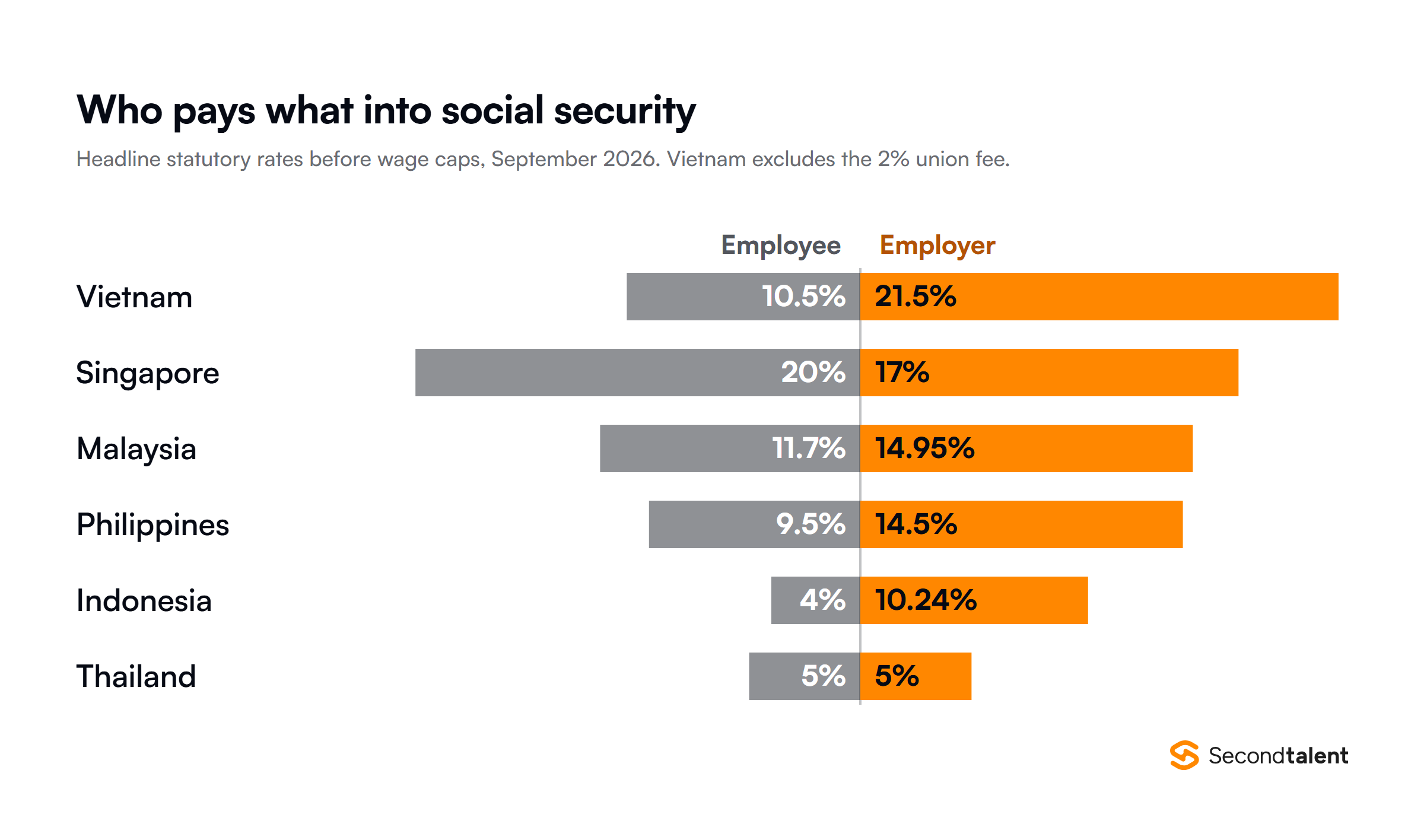
TL;DR: Singapore and Malaysia give employees a right to request flexible or remote work, and Thailand lets employers and staff agree work-from-home terms in writing. Thailand, Malaysia and Indonesia run digital nomad visas, while the Philippines has one on paper that is not yet taking applications. Mandatory employer contributions run from 5% of wages in Thailand to 21.5% in Vietnam.
Vietnam’s standard working week is still 48 hours. Proposals to cut it to 44 hours surfaced in June 2025 and again in June 2026, and neither has become law.
The changes that did happen are easier to miss. Malaysia made EPF compulsory for foreign employees in October 2025, and Thai embassies now ask digital nomad visa applicants for a police clearance.
- 1Singapore’s Employment Pass salary floor rises to S$6,000 a month for new applications from 1 January 2027.
- 2Malaysia has capped the working week at 45 hours since January 2023, and its minimum wage is RM1,700 a month.
- 3Indonesia’s severance ceiling fell from about 32 months of pay to 19 under the 2020 Job Creation Law, not in 2025.
- 4Vietnam’s Personal Data Protection Law took effect on 1 January 2026, and a data breach must now be reported within 72 hours.
Employment Compliance Requirements: Country Comparison
A remote developer brings a different set of obligations in each of the region’s six largest economies. This is how the core rules compare in September 2026.
| Country | Flexible Work Rights | Maximum Work Hours | Minimum Wage/Salary | Social Security Obligation | Remote Work Agreement Required |
|---|---|---|---|---|---|
| Singapore | Right to request; written decision within 2 months | 44 hours/week (Part 4 employees) | No national minimum wage; Local Qualifying Salary S$1,800 | CPF for citizens and PRs | No |
| Malaysia | Right to request in writing; reply within 60 days | 45 hours/week | RM1,700/month | EPF, SOCSO and EIS | No |
| Thailand | By agreement | 48 hours/week | THB 337 to 400/day (400 in Bangkok) | Social Security Fund | Written or electronic, if work from home is agreed |
| Philippines | Voluntary, by mutual agreement | 8 hours/day | PHP 695/day in Metro Manila; lower elsewhere | SSS, PhilHealth, Pag-IBIG | Mutually agreed telecommuting terms |
| Indonesia | By agreement | 40 hours/week | IDR 5,729,876/month (Jakarta 2026) | BPJS Ketenagakerjaan & Kesehatan | No specific rule |
| Vietnam | By agreement | 48 hours/week | VND 3.70M to 5.31M/month (4 regions) | Social, health and unemployment insurance, plus 2% union fee | Written labor contract; no separate remote-work rule |
Social security is where the six markets differ most. Vietnam’s employer pays 21.5% on top of the insurance salary. Thailand’s pays 5% on wages capped at THB 17,500, so never more than THB 875 a month per employee.
The State of Remote Work in Southeast Asia
Globally, about 28% of employees worked remotely in 2023, up from 20% in 2020 (Splashtop, 2025). Asia-specific data is thinner and older.
M Moser Associates surveyed 120 client organizations across 15 Asia-Pacific hubs in 2020, and 56% said they would “most likely” keep flexible arrangements.
Their staff ranked internet connection (52%), uncomfortable home furniture (41%) and poor technology support (37%) as the top problems (M Moser Associates, 2020).
Southeast Asia, Latin America and Eastern Europe are upgrading digital infrastructure to attract remote workers (JobsPikr, 2025). Governments here have also rewritten labor and visa rules, mostly since 2023:
Singapore: Employers Must Consider Flexible Work Requests
Key Regulations (Effective December 2024)
Singapore’s rules on flexible work are guidelines rather than statute, but employers are expected to follow them. The Tripartite Guidelines on Flexible Work Arrangement Requests took effect on 1 December 2024.
They create a right to request, not a right to be approved.
Core requirements include:
- Employers must properly consider every formal flexible work arrangement (FWA) request
- The employer answers in writing within two months
- A rejection must give reasons based on reasonable business grounds, such as cost or feasibility; “we don’t do FWAs” does not count
- TAFEP handles complaints and guides employers to comply; MOM can issue warnings and require corrective workshops only where an employer wilfully refuses
- The separate Platform Workers Act 2024, in force since 1 January 2025, brings ride-hail, taxi and delivery workers into CPF and work injury compensation
Tax and Immigration Considerations
Non-residents who work in Singapore for 60 days or fewer in a calendar year are exempt from income tax on that employment. The IRAS exemption does not cover company directors, public entertainers or professionals.
There is no extra tax or levy on Employment Pass (EP) holders. The cost sits in the eligibility rules: MOM has raised the EP salary floor four times since 2020.
A new EP needs at least S$5,600 a month today, rising with age to S$10,700 at 45 and over (S$6,200 to S$11,800 in financial services).
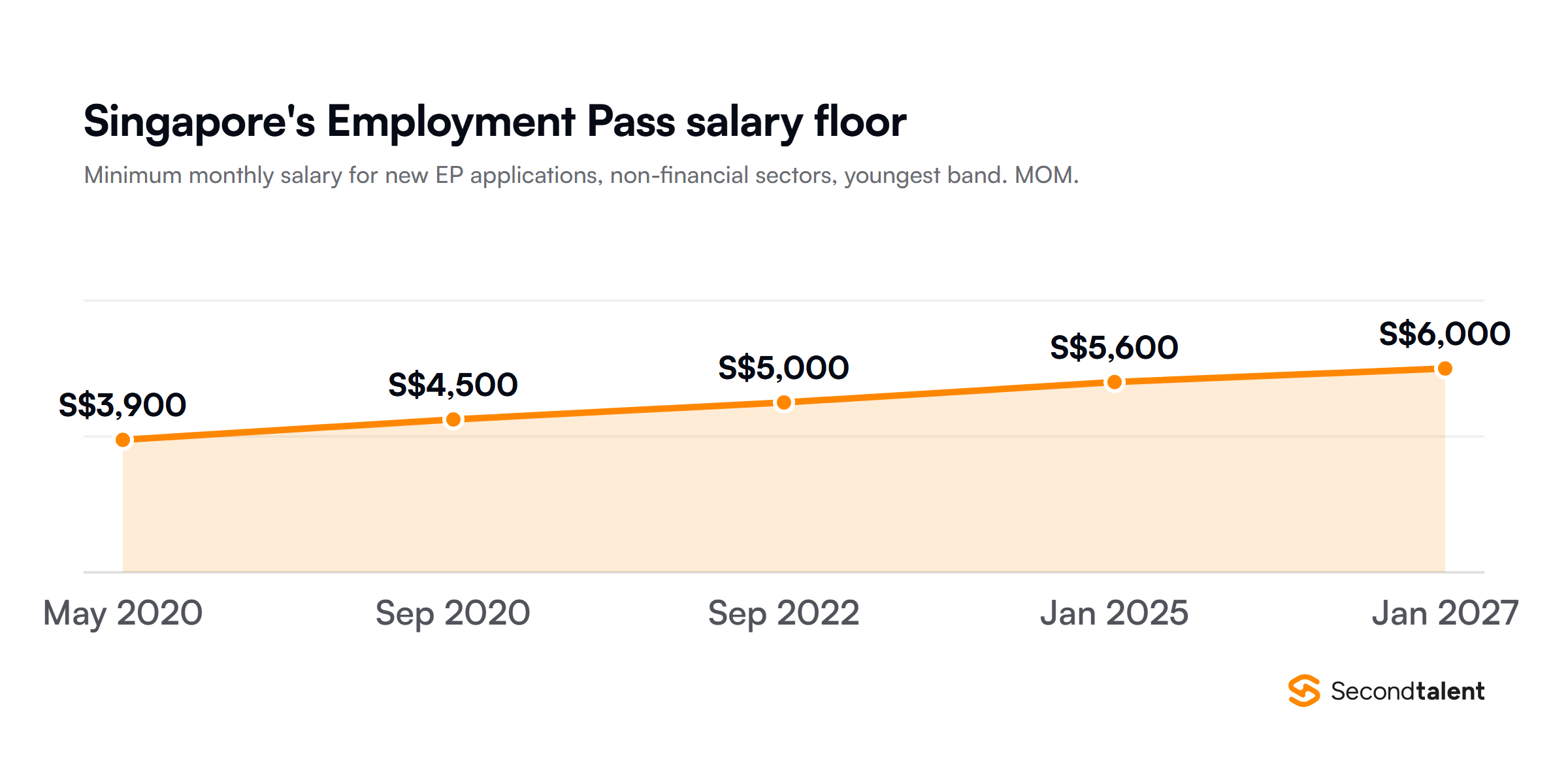
From 1 January 2027, new applications need S$6,000 (S$6,600 in financial services). Candidates also need 40 points under the COMPASS framework unless they earn S$22,500 or more a month.
Under the Fair Consideration Framework, the job must first be advertised on MyCareersFuture for 14 consecutive days, unless the firm has fewer than 10 employees.
CPF applies only to citizens and permanent residents. Up to age 55, the employer pays 17% and the employee 20%, on an Ordinary Wage ceiling of S$8,000 a month.
EP holders pay no CPF, but the 0.25% Skills Development Levy applies to every employee.
For employers hiring remote developers in Singapore, the EP salary floor is the first number to check, whether you hire directly or through an employer of record in Singapore.
Malaysia: A Legal Right to Request Flexible Work
Current Legal Framework
Malaysia put flexible work into law before Singapore did. Sections 60P and 60Q of the Employment Act, added by the 2022 amendment, have applied since 1 January 2023. The same amendment cut the maximum working week from 48 to 45 hours.
Employer obligations include:
- Replying in writing within 60 days to a written request to change working hours, days or place of work
- Giving the grounds for any refusal (approval itself stays at the employer’s discretion)
- Paying at least RM1,700 a month, the national minimum since 1 February 2025 (1 August 2025 for employers with fewer than five staff)
- Contributing to EPF (11% employee; 13% employer on wages up to RM5,000, 12% above), SOCSO and EIS. EPF has also covered foreign employees, at 2% each, since 1 October 2025
- Decision in writing within 2 months
- Refusal needs reasonable business grounds
- Enforced through TAFEP guidance, not fines
- Decision in writing within 60 days
- Refusal must state its grounds
- Written into the Employment Act itself
For companies hiring remote developers in Malaysia, keep every written reply. It is the record that proves you met the 60-day rule.
Digital Nomad Visa: DE Rantau Nomad Pass
Malaysia’s DE Rantau Nomad Pass needs a minimum income of USD 24,000 a year for tech professionals or USD 60,000 for non-tech professionals (The Digital Nomad Asia, 2026).
The non-tech band covers managers, consultants, HR, sales and legal roles, not only chief officers.
The pass runs 3 to 12 months and can be renewed once for 12 more. Spouses, children under 18 and parents can come as dependants, though a spouse cannot work.
The MDEC program page quotes 6 to 8 weeks to process, plus about a week for the e-Pass, and RM1,080 per applicant.
That is slower than Thailand‘s visa or Indonesia’s E33G, which immigration processes in five working days after payment. The pass is valid in Peninsular Malaysia and Labuan, not Sabah or Sarawak.
Thailand: Five-Year Nomad Visa and Written WFH Terms
Destination Thailand Visa (DTV)
Thailand opened the Destination Thailand Visa on 15 July 2024. It is a five-year, multiple-entry visa for remote workers and a few other groups, with a 10,000 baht fee.
Key features include:
- Minimum savings: 500,000 THB (about $15,200), shown on three months of bank statements
- Dependants: a spouse and children under 20 can hold their own DTV, with the same financial documents
- Stays of up to 180 days per entry, extendable once by 180 days; after that the holder leaves and re-enters
- Stricter from late August 2026: Thai embassies such as London and Washington now require a recent police clearance. Applicants must also apply in their country of nationality or residence
- Tax: the 0% band is still the first 150,000 THB of net income. Since 2024, tax residents (180 days or more a year) owe tax on foreign income they bring into Thailand
A proposed exemption for foreign income brought in within the year it was earned, or the year after, had not been enacted as of September 2026. A DTV holder who stays 180 days is therefore a tax resident on anything they remit.
Labor Protection Act Amendments (2023)
The Labour Protection Act (No. 8), in force since 18 April 2023, added Section 23/1 on work from home. Employer and employee “may agree” to it, so remote work stays optional.
Once agreed, the terms must be in writing or electronic form, covering the period, hours, overtime, leave, supervision, equipment and expenses.
Remote workers keep the same rights as office staff. They can also refuse contact after agreed working hours unless they consented in writing in advance.
For companies hiring remote developers in Thailand, that agreement is the document to get right on day one.
Pay rules moved too. Since 1 July 2025 the daily minimum wage runs from 337 to 400 baht, with 400 in Bangkok, Phuket and a handful of other areas.
The Social Security Fund takes 5% from each side, and its wage ceiling rose from 15,000 to 17,500 baht on 1 January 2026.
Philippines: A Nomad Visa on Paper and Established Telecommuting Rules
Digital Nomad Visa (DNV), April 2025
The Philippines created its Digital Nomad Visa through Executive Order 86 of President Ferdinand “Bongbong” Marcos Jr., which took effect on April 24, 2025.
It lets non-immigrant foreigners live temporarily in the Philippines while working remotely for employers or clients outside the country (Business Standard, 2025).
EO 86 sets a stay of up to one year, renewable once. Applicants must be 18 or over, with income from abroad, health insurance and a clean record. It also requires reciprocity: the applicant’s country must offer Filipinos a similar visa.
The order gave the Department of Foreign Affairs 30 days to issue guidelines. More than a year later, none have been published, the visa is not taking applications, and the income threshold, fee and dependant rules are still unknown.
Telecommuting Act (Republic Act No. 11165)
The Philippines regulated telecommuting before the pandemic. Republic Act No. 11165, approved on 20 December 2018, lets employers offer telecommuting on a voluntary basis, on terms both sides agree.
Its current implementing rules are Department Order 237-22 of September 2022.
Compliance requirements include:
- Telecommuting terms agreed with the employee, who cannot be forced into it
- Fair treatment: the same pay, benefits, workload and training access as office staff
- Adherence to the Labor Code’s 8-hour working day
- Contributions: SSS at 15% (10% employer, 5% employee), PhilHealth at 5% split evenly, and Pag-IBIG at 2% each on up to PHP 10,000 of salary
Metro Manila’s minimum wage has been PHP 695 a day since 18 July 2025. On 8 September 2026 the regional wage board approved a PHP 60 increase, which takes effect after publication.
For businesses looking to hire remote developers in the Philippines, the voluntary framework means employees cannot demand remote work as a right.
Indonesia: Lower Severance Caps and Mandatory Social Security
Severance and the Pending Manpower Law
Comrise’s March 2025 roundup tracks tax, labor-law, minimum-wage and visa changes across Indonesia and its neighbors (Comrise, 2025).
The biggest change for Indonesian employers is older: the 2020 Job Creation Law and Government Regulation 35/2021.
Under the old Manpower Law 13/2003, a non-fault dismissal could cost about 32 months of wages. The current rules cap the employer’s share at 19 months, and BPJS pays up to six months of job-loss benefit on top.
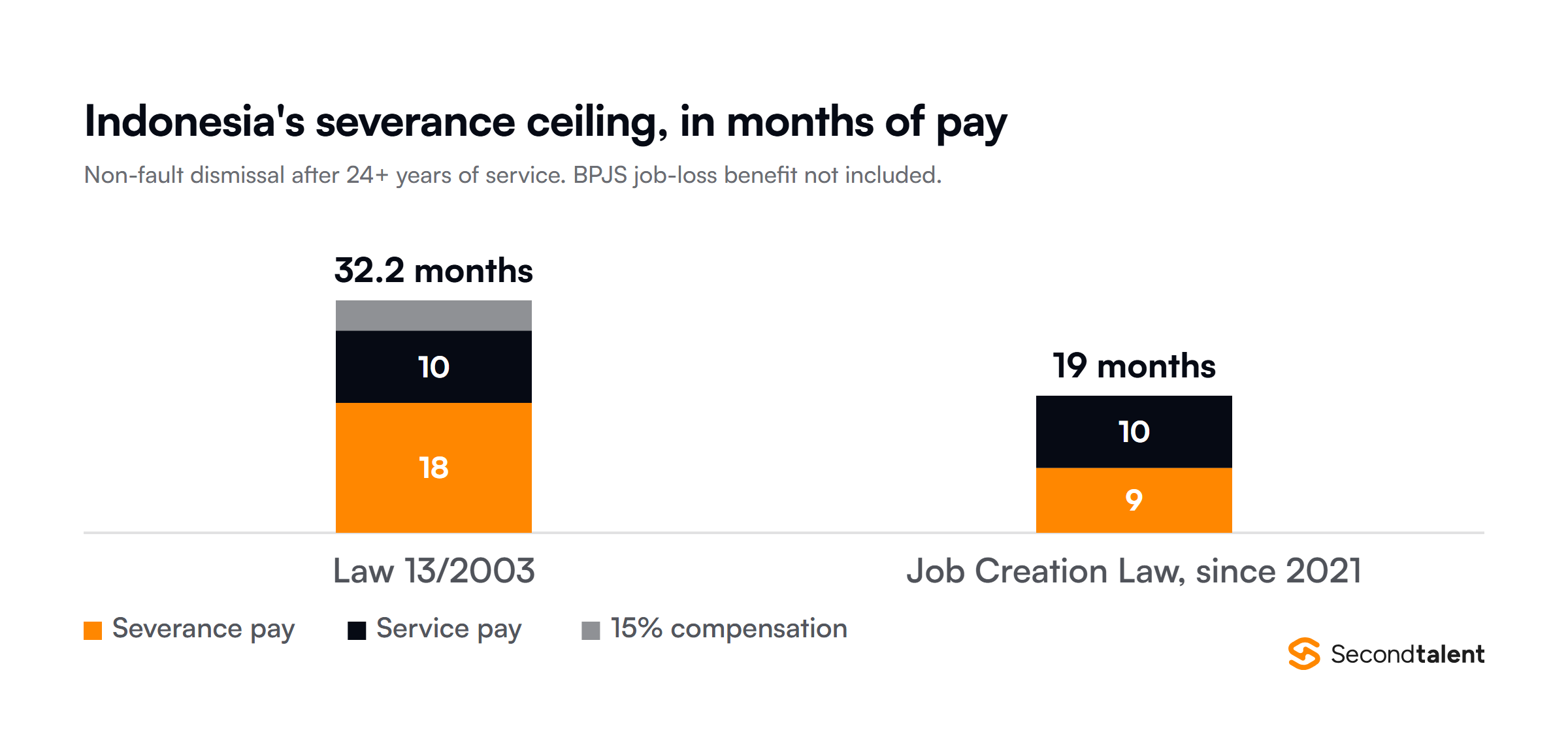
That regime is on borrowed time. A Constitutional Court ruling of 31 October 2024 ordered a new manpower law within two years.
Parliament adopted a draft as its own bill on 27 August 2026 and aims to pass it in October, so severance rules may change again.
Law 4/2024 on Maternal and Child Welfare, in force since July 2024, applies to employers of every size.
It requires time and facilities for breastfeeding, and maternity leave of at least three months, extendable to six with a medical certificate.
Minimum Wage and BPJS Requirements
Indonesian remote workers are entitled to provincial minimum wages, which vary by region. Jakarta’s 2026 minimum wage is IDR 5,729,876 a month, up 6.17% on 2025. Most provinces raised theirs by roughly 5 to 7% (Remote People, 2026).
BPJS (Social Security) obligations include:
- BPJS Ketenagakerjaan (employment social security) and BPJS Kesehatan (health insurance) enrollment within 30 days of hire
- Employer contribution of 10.24% to 11.74% of salary, depending on the work-accident risk band; employee contribution of 4%
- Healthcare contribution split: employer 4%, employee 1%, on wages capped at IDR 12 million
- Pension (JP) contributions capped at a wage of IDR 11,086,300 since March 2026
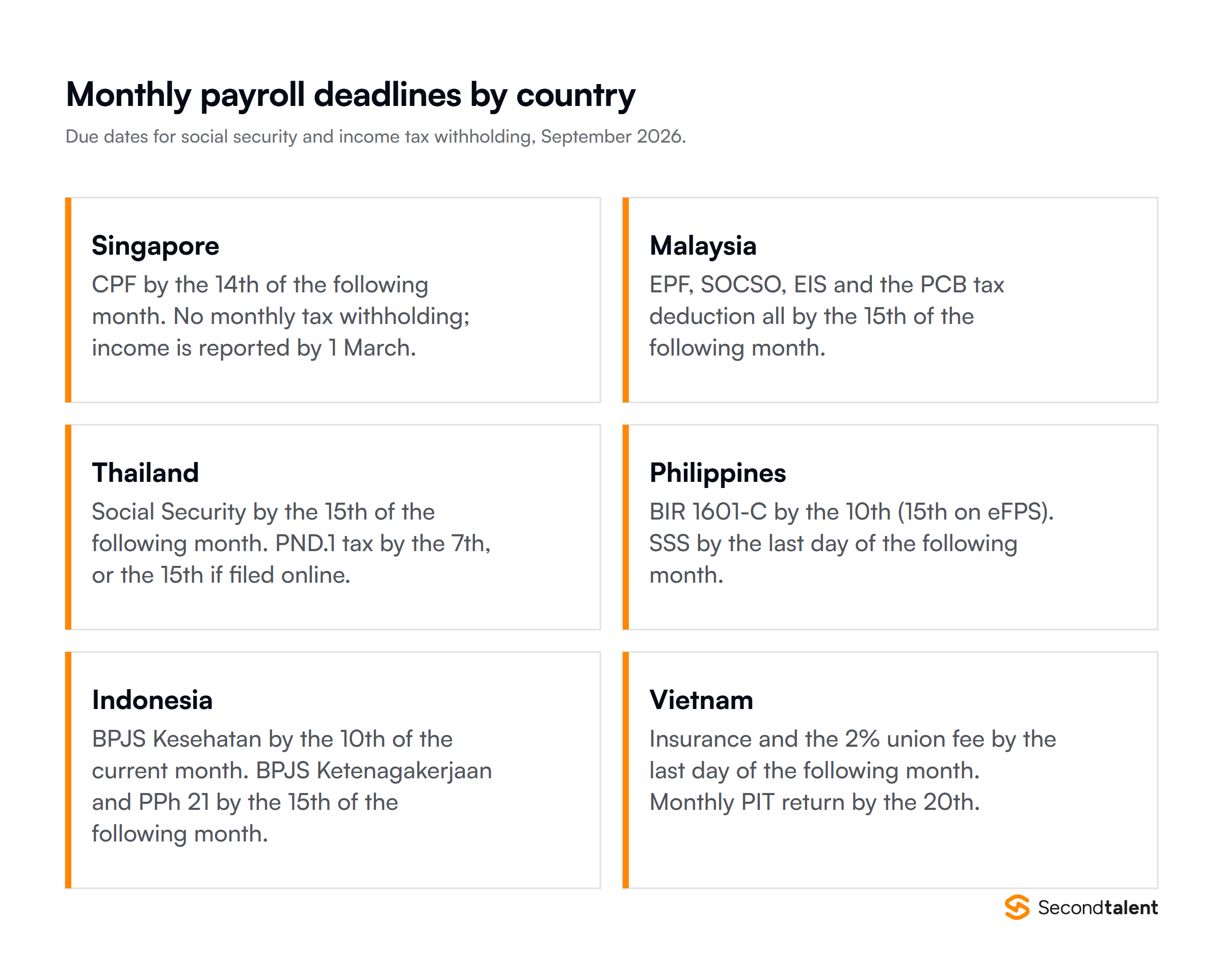
- BPJS Kesehatan due by the 10th of each month; BPJS Ketenagakerjaan by the 15th of the following month
Remote Work Entitlements
All Indonesian employees, on-site or remote, get 12 days of paid annual leave after 12 months of service. They also get THR (Tunjangan Hari Raya), one month’s wage paid at least seven days before their own religious holiday.
Staff with less than a year’s service get a prorated amount.
For employers using Indonesia’s large tech talent pool, BPJS compliance is not optional. Partnering with an Employer of Record (EOR) in Indonesia takes the registrations, contributions and THR off your hands.
Vietnam: A 48-Hour Week, New Employment and Data Laws
The 2025 Employment Law, in Force Since January 2026
Vietnam’s Law on Employment 2025 (No. 74/2025/QH15) took effect on 1 January 2026.
It extends unemployment insurance to short-term and part-time workers, moves labor contracts and registration online, and adds employee data-consent rules (Vietnam Briefing, 2025).
Key changes include:
- Unemployment insurance now covers contracts of one month or more (previously three), part-time staff earning at least the minimum, and salaried managers
- The 1% employer and 1% employee unemployment contribution becomes a ceiling the government can lower
- Working hours are unchanged: the 2019 Labor Code still sets 8 hours a day and 48 a week, and proposals for 44 hours have not been enacted
- Overtime stays capped at 40 hours a month and 200 a year (300 in listed sectors such as textiles and electronics), with employee consent
Remote Work Compliance Requirements
Remote or not, Vietnamese staff need a written labor contract (electronic contracts are allowed), lawful working hours and full insurance contributions.
Employee data now falls under the Law on Personal Data Protection (No. 91/2025/QH15), which replaced Decree 13/2023 on 1 January 2026.
Data protection measures include:
- A lawful basis, usually consent, for processing employee and applicant data
- Deleting data on unsuccessful applicants
- Impact assessments for processing and for transfers abroad, which can include a foreign parent company accessing HR files
- Breach notification within 72 hours, with fines of up to 5% of prior-year revenue for cross-border transfer violations
Social Security Contributions (2025 and 2026 Updates)
The Social Insurance Law 2024, in force since 1 July 2025, widened coverage to part-time workers, managers and foreign staff on contracts of 12 months or more.
Employers pay 21.5% (17.5% social, 3% health, 1% unemployment insurance) and employees 10.5%.
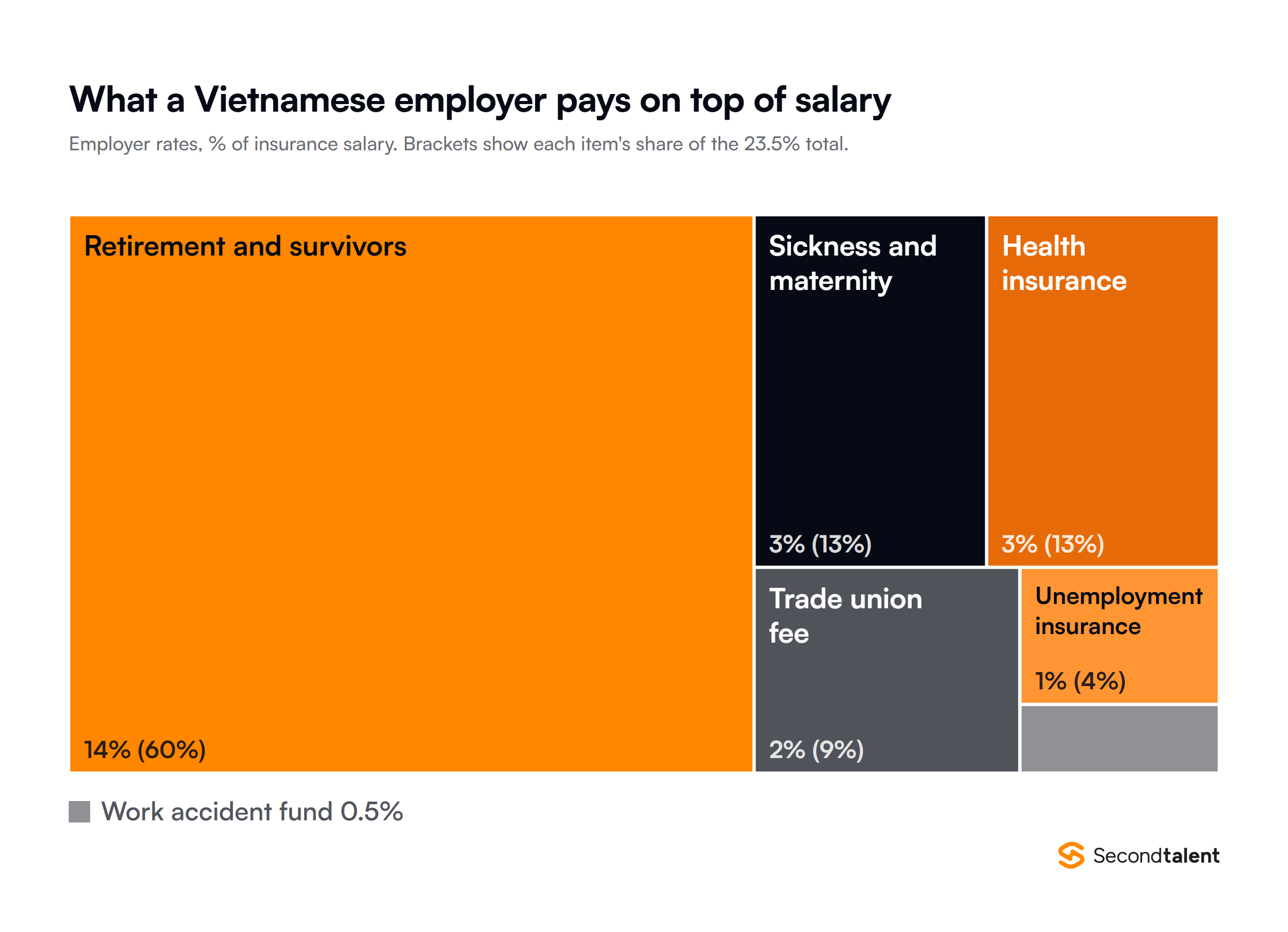
The 2% trade union fee is separate from insurance: the employer pays it under the Law on Trade Unions 2024, whether or not staff join. Members pay 0.5% dues.
Insurance is capped at 20 times the base salary, VND 50.6 million a month since 1 July 2026, when pensions also rose 8%.
Regional minimum wages rose 7.2% on 1 January 2026, to VND 5,310,000 a month in Region I and VND 3,700,000 in Region IV. For companies hiring remote developers in Vietnam, the insurance salary, not the minimum wage, drives the real cost.
Comparative Analysis: Digital Nomad Visa Programs
| Country | Visa Name | Duration | Income or Funds Requirement | Fee and Processing | Dependents Allowed |
|---|---|---|---|---|---|
| Thailand | Destination Thailand Visa (DTV) | 5 years, multiple entry (180 days per entry, extendable once) | 500,000 THB (~$15,200) in savings | 10,000 THB | Yes (spouse & children under 20) |
| Indonesia | KITAS E33G | 1 year, renewable | $60,000 annual income plus $2,000 balance | IDR 7,000,000; 5 working days after payment | Not stated by immigration |
| Malaysia | DE Rantau Nomad Pass | 3 to 12 months, renewable once for 12 | $24,000 (tech) or $60,000 (non-tech) a year | RM1,080; 6 to 8 weeks | Yes (spouse, children under 18, parents) |
| Philippines | Digital Nomad Visa (DNV) | Up to 1 year, renewable once | Not yet published | Not yet accepting applications | Not yet published |
| Singapore | No dedicated digital nomad visa | N/A | ONE Pass needs S$30,000 a month | N/A | N/A |
| Vietnam | No dedicated digital nomad visa | 90-day e-visa only | N/A | N/A | N/A |
These visas are built for people paid from abroad. The Philippine and Indonesian schemes bar local employment outright. A job with a Thai employer still needs a work permit, so none of them replaces a local hire.
Key Compliance Challenges for Employers
Cross-Border Employment Complexity
Letting employees work from another country can trigger permanent-establishment and withholding-tax exposure, depending on how long they stay (Pinsent Masons, 2025).
Labor law follows the worker too: the mandatory protections of the country where the work happens usually apply whatever the contract says.
For example, a Singaporean company hiring a remote developer in Vietnam still owes that developer Vietnam’s working-hour limits, insurance contributions and termination rules. Singapore law alone will not cover it.
Tax Implications and Permanent Establishment Risk
Remote workers can trigger permanent establishment (PE) rules, creating corporate tax obligations in countries where the employer has no office.
The risk grows when a remote employee signs contracts or negotiates deals on the company’s behalf.
Mitigation strategies include:
- Engaging Employer of Record (EOR) services to maintain compliance without establishing legal entities
- Consulting with tax advisors familiar with Southeast Asian PE rules
- Documenting the nature and scope of remote work to demonstrate lack of PE indicators
- Using tax treaties where they apply to avoid double taxation
If you employ U.S. persons working from Southeast Asia, their local bank and investment accounts can create a filing duty of their own.
Any U.S. person whose foreign financial accounts exceed $10,000 in aggregate at any point in the calendar year has to file FinCEN Form 114, the FBAR.
It goes to FinCEN rather than to the IRS with the tax return, and it is due on 15 April with an automatic extension to 15 October.
The duty sits with the employee rather than with you, so the useful thing an employer can do is raise it at onboarding. If it applies to you, E-file your FBAR rather than leaving it until the extension runs out.
Data Protection and Security
Every country in this guide now has a general data protection law.
They are Singapore’s PDPA (2012), Malaysia’s PDPA (2010), Thailand’s PDPA (2019), the Philippines’ Data Privacy Act (2012), Indonesia’s PDP Law (2022) and Vietnam’s PDPL (2025).
All of them cover employee records, which remote teams tend to scatter across personal laptops and chat apps.
Best Practices for Hiring Remote Talent in Southeast Asia
Use Employer of Record (EOR) Services
For companies without regional legal entities, EOR services provide compliant hiring without the cost of setting up subsidiaries.
Second Talent’s EOR covers nine Asian markets, including all six in this guide, so contracts, payroll and statutory contributions stay compliant while you focus on the team.
Standardize Remote Work Policies with Local Variations
Create a baseline remote work policy covering working hours, communication, equipment and data security.
Then add each country’s requirements: a written work-from-home agreement in Thailand, FWA request handling in Singapore and Malaysia, and BPJS enrollment within 30 days in Indonesia.
Implement Reliable Payroll and Benefits Administration
Each country runs its own social security, health insurance and retirement schemes, with their own monthly deadlines.
Late payment carries interest or penalties everywhere; Vietnam, for one, charges 0.03% a day on late insurance contributions.
Conduct Regular Compliance Audits
Rules in this region change every few months. Between July 2025 and July 2026, Thailand, the Philippines, Malaysia, Indonesia and Vietnam all changed a minimum wage or a contribution ceiling.
Quarterly reviews of contracts, social security enrollment and working hours catch the gaps before an inspector does.
Document Everything
Written records protect both sides. Keep remote work agreements, FWA requests and replies, policy acknowledgments, equipment records and performance reviews.
Singapore and Malaysia both require FWA decisions in writing, so those records double as your evidence.
The Business Case for Southeast Asian Remote Talent
ASEAN’s population reached 684.1 million in 2024, and almost a third of it is under 20, according to ASEAN’s Key Figures 2025. The region’s median age is about 31.
Cost is the other half. Companies hiring engineers through Second Talent save 50 to 70% on payroll, with all of the compliance in this guide included in the monthly fee.
The time zones help too. The six capitals sit at UTC+7 or UTC+8, sharing a working day with Hong Kong, Tokyo and Sydney and overlapping European mornings. US teams usually work across the gap with early-morning or evening handovers.
Conclusion
Singapore and Malaysia now make employers answer flexible work requests, and Thailand and the Philippines put remote work terms on paper. Indonesia and Vietnam are rewriting their labor and data laws.
Governments here are writing remote work into law, one country at a time.
Ready to build a remote engineering team without the compliance work? Second Talent helps companies hire vetted remote developers across Southeast Asia with full regulatory compliance through our EOR services.
We handle local employment contracts, social security enrollment, payroll administration and ongoing compliance monitoring. Tell us who you need and we will send matched profiles within 24 hours.
This article reflects employment regulations as of September 2026 and should not be construed as legal advice. Consult with qualified legal counsel for guidance on specific hiring situations.