TL;DR: The United States is at the forefront of AI development in 2026, scoring 100 on The Observer Global AI Index against China's 74. Singapore (40), the United Kingdom (36) and South Korea (36) complete the top five, a long way behind the two leaders. The US leads on talent, research, development and commercial activity, and China comes closest on infrastructure.
Investors put $285.9 billion into American AI companies in 2025, more than 23 times the $12.4 billion that went into Chinese ones.
Yet China was granted 74.2% of the world's AI patents in 2024, and its state guidance funds had already put an estimated $184 billion into AI firms by 2023. The top of AI development is a two-country race, and the next three leaders are small, wealthy and deliberate about it.
- 1The US held about three-quarters of global GPU cluster performance in May 2025, on Epoch AI's count.
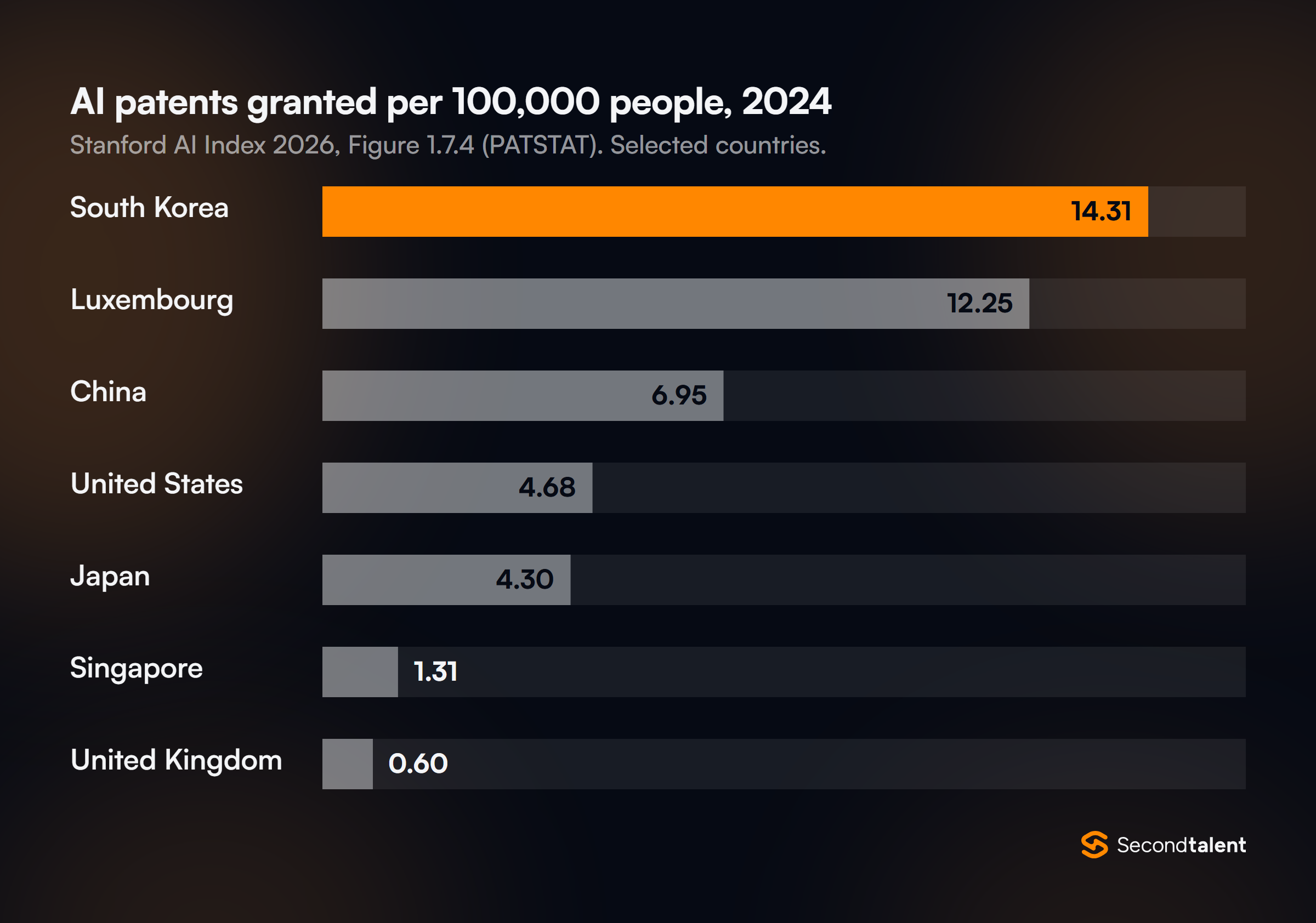
- 2South Korea was granted 14.3 AI patents per 100,000 people in 2024, the most in the world.
- 31.82% of Singapore's LinkedIn members work in AI, second only to Israel.
- 4The UK had 172 newly funded AI companies in 2025, second only to the US.
The 5 Countries Leading AI Development in 2026
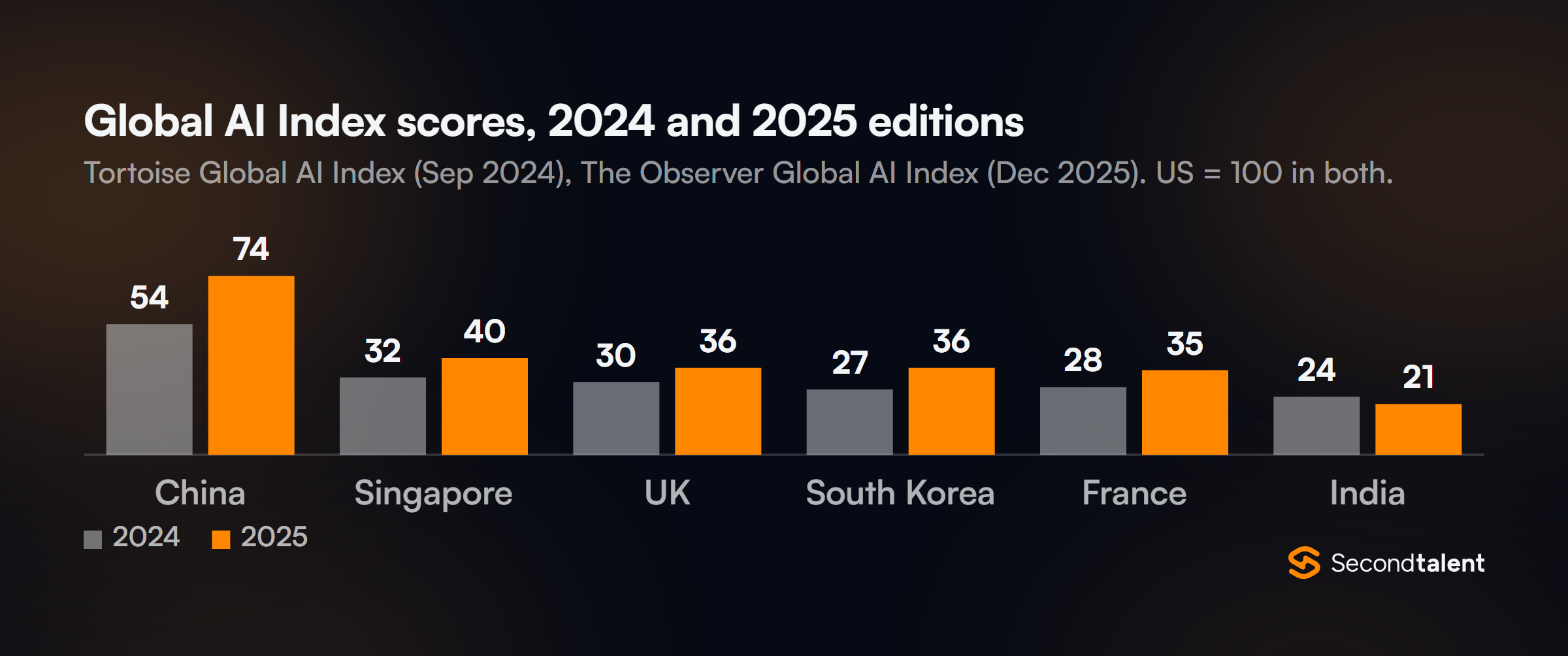
The five countries at the forefront of AI development in 2026 are the United States, China, Singapore, the United Kingdom and South Korea. That is the top five of The Observer Global AI Index, published on 4 December 2025, which scores 94 countries on their capacity to build AI.
| Country | Observer score | Stanford vibrancy rank | Govt readiness rank | Private AI investment, 2025 |
|---|---|---|---|---|
| 1. United States | 100 | 1 | 1 | $285.9B |
| 2. China | 74 | 2 | 8 | $12.4B |
| 3. Singapore | 40 | 6 | 7 | $1.8B |
| 4. United Kingdom | 36 | 5 | 3 | $5.9B |
| 5. South Korea | 36 | 4 | 5 | $1.8B |
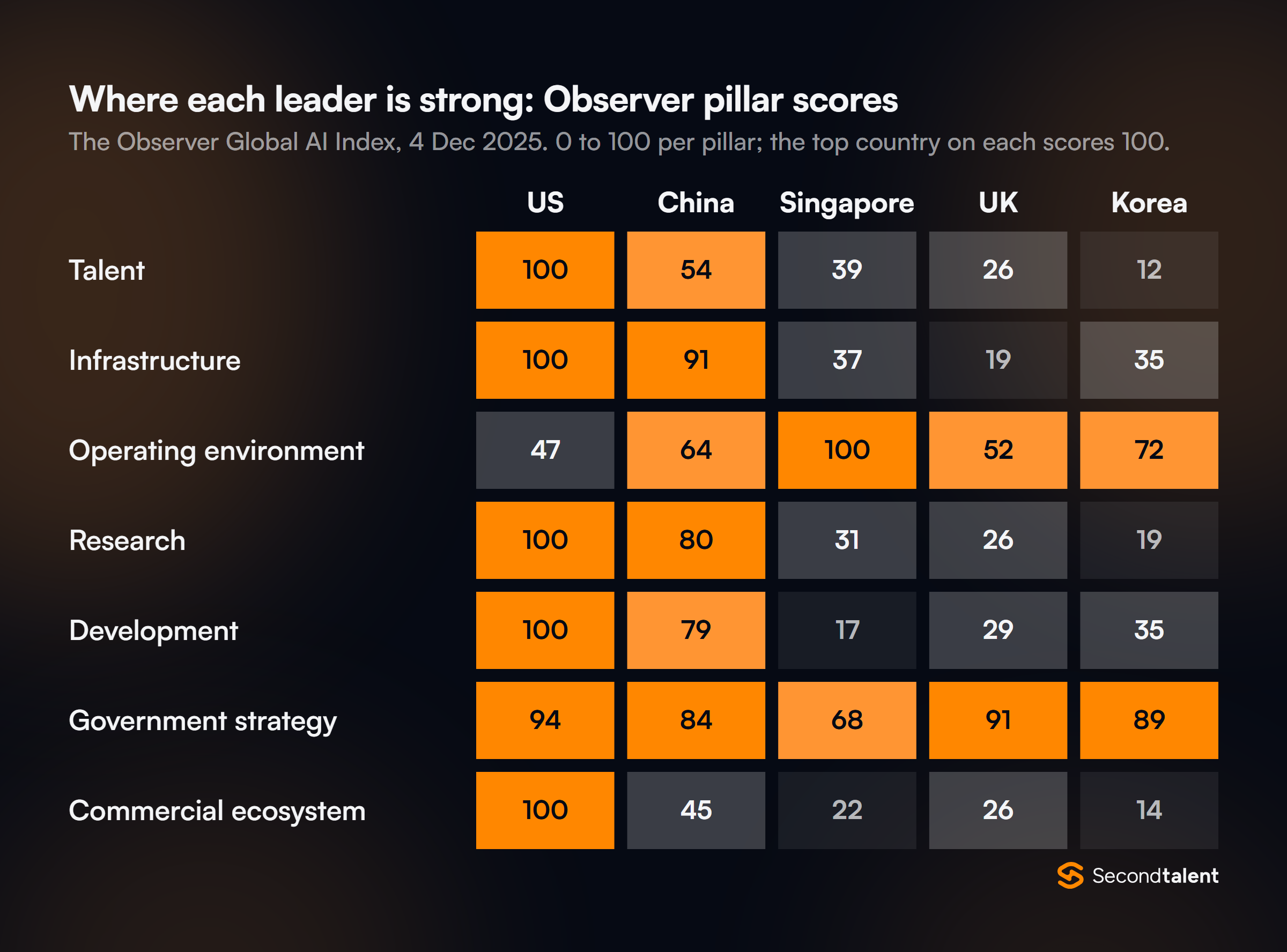
Each leader got there by a different route: the US tops five of the seven pillars, while China is close behind on infrastructure and research. Singapore, the UK and South Korea all score high on government strategy and low on talent or development, which is why they sit so far below the top two.
1. United States: 100
The US held about three-quarters of the world's GPU cluster performance as of May 2025, and China 15%, according to Epoch AI. Most of the leading AI model builders are American as well. The US produced 59 notable models in 2025 to China's 35, per the Stanford AI Index 2026.
The same report flags the weak spot. The number of AI researchers and developers moving to the US has fallen 89% since 2017, with an 80% drop in the last year alone. Operating environment is the only Observer pillar where the US scores below 50.
On physical infrastructure the lead is wider still. The US has 5,427 data centres, more than ten times any other country, although the Cloudscene count behind that figure ignores facility size. Stanford's vibrancy tool scores the US at 78.6 and China at 37.0, a bigger gap than the Observer index shows.
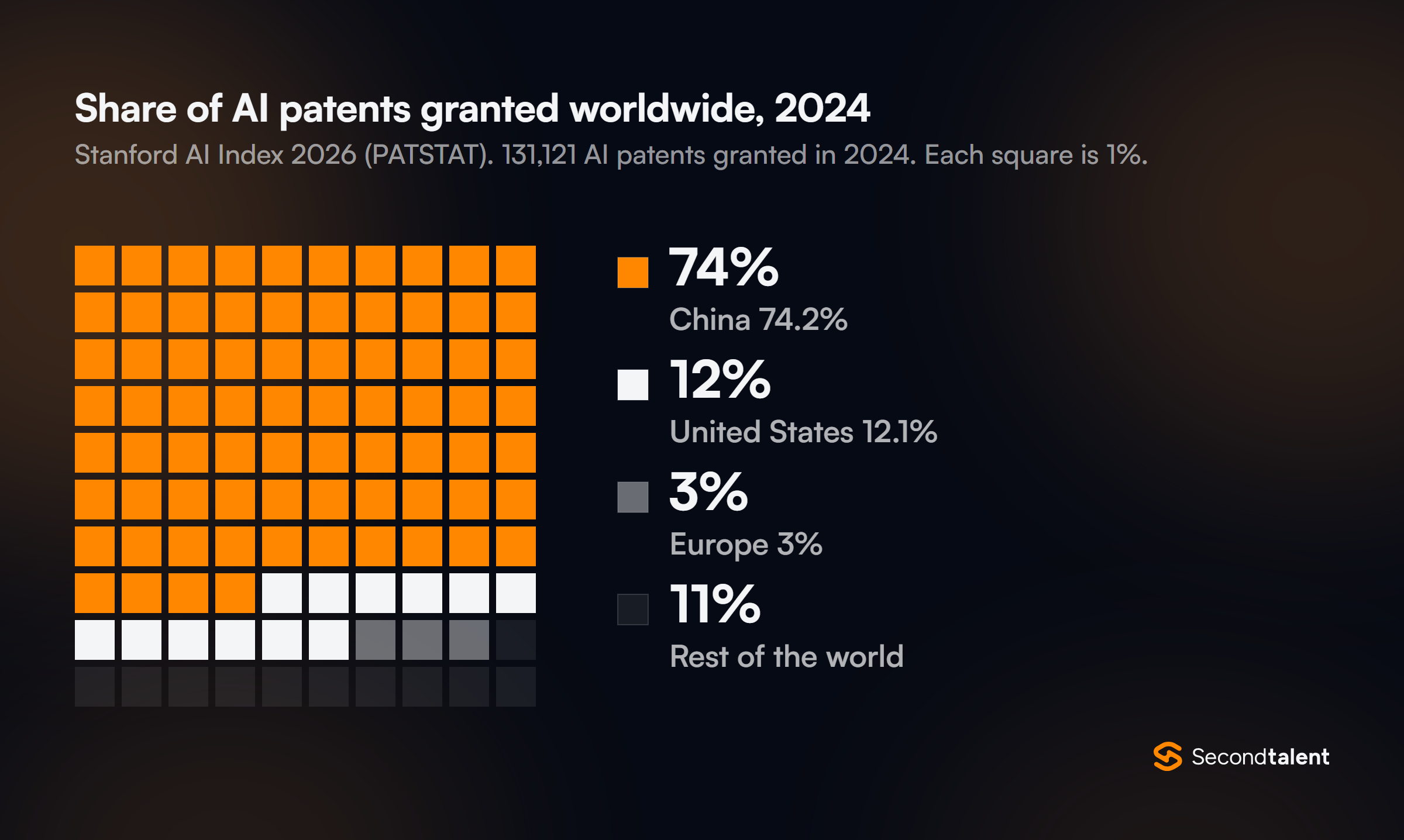
Patents are the one volume measure the US does not lead. It was granted 12.1% of AI patents in 2024, against China's 74.2%, but US patents draw more than half of all forward citations, the AI Index's proxy for influence. Washington's policy is set by America's AI Action Plan, released in July 2025 with more than 90 federal actions.
2. China: 74
In March 2026 the best American model led the best Chinese model by only 2.7%, according to the AI Index, and the two have traded the lead several times since DeepSeek-R1 in early 2025. Chinese labs got there with a fraction of the private money, backed by 85 public or public-private AI supercomputers, more than any other country.
- 59 notable models, 2025
- $285.9B private AI investment
- 5,427 data centres
- 35 notable models, 2025
- $12.4B private AI investment
- 449 data centres
China rose from 54 in the 2024 edition of the index to 74, the biggest gain among the leaders. Its 91 on infrastructure is the closest any country comes to the US on a pillar the US leads. Its weakest pillar is the commercial ecosystem, at 45.
Chinese labs lead on open models. They released 28 open-weight notable models in 2025 against 11 from the US, in our count of Epoch AI's model data. China ranks lower on government readiness, eighth in the Oxford Insights index with 76.3, one place behind Singapore.
The State Council's "AI+" plan of August 2025 targets over 70% use of intelligent terminals and agents by 2027 and over 90% by 2030. Our guides to AI trends in China and US and Chinese AI models on cost and performance cover what that looks like model by model.
3. Singapore: 40
Measured against its size, Singapore has more AI capacity than any other country. It scores 100 on the Observer's intensity measure, which adjusts for population and economy, and 100 on operating environment. On raw scale it scores 24, level with Germany and Japan.
Singapore also draws the talent: 1.82% of its LinkedIn members work in AI, second only to Israel's 2.10%, and it has a net inflow of 1.36 AI workers per 10,000 LinkedIn members, more than the US. That builds on more than S$1 billion over five years for AI compute, talent and industry, announced in Budget 2024. In January 2026 the government added over S$1 billion for AI research from 2025 to 2030.
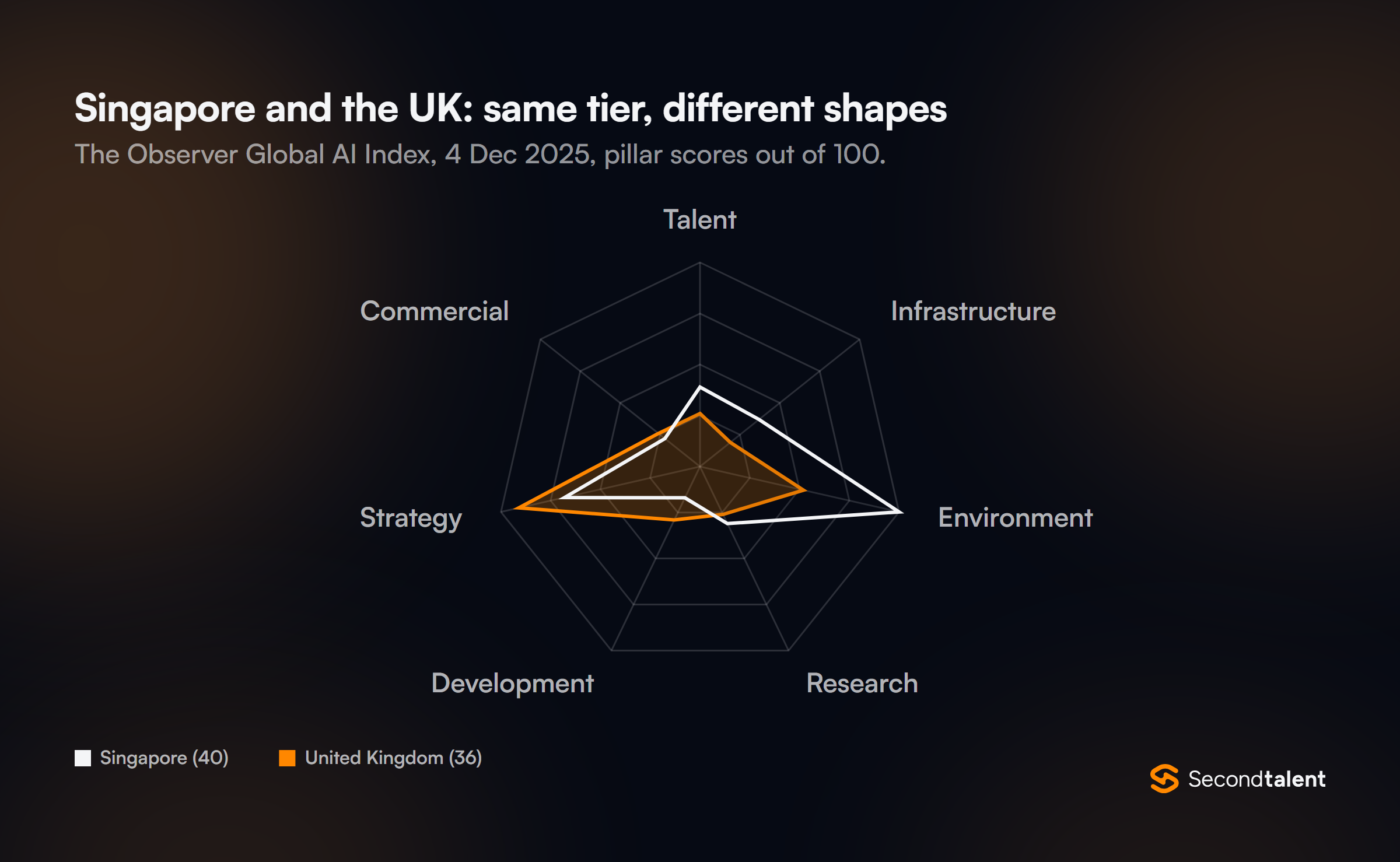
Development is the gap: Singapore scores 17 and had one notable model in 2025. Its flagship is SEA-LION, AI Singapore's open model family for 11+ Southeast Asian languages. Version 4.8, built with NVIDIA, came out on 18 September 2026. See our lists of Singapore AI companies and AI trends in Singapore.
4. United Kingdom: 36
The UK attracts AI companies more than it builds AI infrastructure. It ranked second for newly funded AI firms in 2025 and third for private AI investment, but scores 19 on the Observer's infrastructure pillar. Oxford Insights ranks its government third for AI readiness.
The government has set out to close the compute gap. Its AI Opportunities Action Plan progress report lists the Isambard-AI supercomputer, launched in Bristol in July 2025, and £2 billion to expand UK compute twentyfold by 2030. Five AI Growth Zones have drawn £28.2 billion of investment commitments, and a Sovereign AI Unit backed by up to £500 million funds UK AI companies.
Talent is still arriving. The UK had a net inflow of 1.04 AI workers per 10,000 LinkedIn members in 2025, close to the US figure of 1.22. Patents are its weakest output: 0.60 AI patents per 100,000 people, the lowest of the five leaders.
Private compute has been harder. OpenAI announced Stargate UK in September 2025, then halted it in April 2026 over regulation and energy prices, CNBC reported.
5. South Korea: 36
South Korea was granted more AI patents per person than any other country in 2024, twice China's rate and three times America's. It also produced eight notable AI models in 2025, the most after the US and China.
Seoul is running a contest for a national model. In the sovereign AI foundation model project, Naver Cloud and NC AI were cut in January 2026, Naver for fine-tuning overseas models rather than building from scratch, the Korea Herald reported.
Korea's AI Basic Act took effect on 22 January 2026, with fines deferred for at least a year. Talent is the weak pillar, at 12, though Stanford's vibrancy tool still ranks Korea fourth overall.
Private money is modest for a country this productive. Private AI investment in South Korea was $1.78 billion in 2025, and 59 new AI companies were funded, against 172 in the UK. The government scores 89 on the Observer's strategy pillar, and Oxford Insights ranks it fifth for AI readiness with 76.9.
Who Is Close Behind
France missed the top five by one point. Behind it, five more countries stand out, each for one strength:
Leading AI development and using AI are different races. The UAE, 10th here, has the highest AI adoption rate in the world, and Singapore is near the top of both lists. The global AI talent shortage and AI startup funding numbers show where the next shifts may come from.
Hiring AI Engineers Outside the Top Two
AI skills are the hardest to hire for worldwide in 2026, according to ManpowerGroup's survey of 39,063 employers. Second Talent matches companies with vetted AI and machine learning engineers across Asia within 24 hours, at 50-70% below equivalent US payroll, with a 92% retention rate across 200+ companies. Teams also hire engineers in Singapore and across Southeast Asia through us.
Tell us the role you need to fill and we will send a shortlist.
Frequently Asked Questions
Which country is leading in AI in 2026?
The United States leads in AI development. It ranks first on The Observer Global AI Index, Stanford's Global AI Vibrancy Tool and the Oxford Insights Government AI Readiness Index.
Is China ahead of the US in AI?
No, but the gap is small on some measures. China scores 74 to the US's 100 on the Observer index and leads on AI patents and research papers. In March 2026 the best US model led the best Chinese model by 2.7%, per the Stanford AI Index.
Which Asian country leads AI development after China?
Singapore, third on the Observer index with 40, followed by South Korea at 36. Japan is 11th with 25.



![Singapore AI Companies Leading Southeast Asia. Top 10 Singapore AI Companies Leading Southeast Asia [2026], by Second Talent.](https://www.secondtalent.com/wp-content/uploads/2026/09/singapore-ai-companies-featured-v2-768x403.jpg)