TL;DR: Asian tech teams cost 50-70% less than US local teams and match in about 24 hours. US senior developers run $8K-$18K a month, and local roles take 35-45 days to fill.
For most US startups in 2026, an Asian tech team wins on cost and speed, while a local team wins on same-room collaboration and full time-zone overlap. A senior developer in the US costs $8,000 to $18,000 a month all-in.
The same seniority in Vietnam or the Philippines costs $3,000 to $6,000. US software developers earn a median of about $132,684 a year, per the U.S. Bureau of Labor Statistics, and open roles take 35 to 45 days to fill.
This guide compares the two models on cost, speed, talent supply, English, time zones, and compliance.
The numbers come from 2025 and 2026 reports, including the Stack Overflow Developer Survey 2025, the CompTIA State of the Tech Workforce 2025, and our own placement data.
We will not cover freelance marketplaces or one-off contractors, since this is about building a real team.
This matters more in 2026 than it did two years ago. AI work is pulling US salaries up, with nearly 125,000 active AI job postings in a single month last year.
At the same time, the global developer base passed 180 million on GitHub, and Asia is the fastest-growing part of it. Supply and cost now point in different directions. Full breakdown below.
Key takeaways
- A senior Asian engineer costs $3K-$6K a month, against $8K-$18K for the same role in the US.
- US tech roles take 35-45 days to fill. A pre-vetted Asian engineer can be matched in about 24 hours.
- India alone added 5.2 million developers in 2025, and Asia leads global developer growth (GitHub Octoverse 2025).
- US tech unemployment sits near 2.8%, so local hiring stays a seller’s market for candidates.
- The strongest model is usually blended: a small local core plus an Asian team for scale.
Asian tech teams vs local teams at a glance
Before the detail, here is the side-by-side. A “local team” here means engineers you hire in-house in the US.
An “Asian tech team” means engineers in markets like Vietnam, the Philippines, Indonesia, or Malaysia, hired directly or through a partner.
| Factor | Local US team | Asian tech team |
|---|---|---|
| Senior dev cost (monthly, all-in) | $8,000-$18,000 | $3,000-$6,000 |
| Time to first hire | 35-45 days | About 24 hours to match |
| Talent availability | Tight, near 2.8% unemployment | Large and growing fast |
| English proficiency | Native | High in PH and Vietnam |
| Time-zone overlap with US | Full | 2-5 hours of daily overlap |
| Payroll and compliance | Simple but costly | Handled by an EOR partner |
What is pushing you toward an Asian team?
Select your situation below.
Moving senior roles to Asia cuts cost by 50-70% without cutting seniority. A US senior at $12,000 a month becomes a senior in Vietnam at $4,000-$5,000. See current rates by role and seniority on our developer rate card →
Local roles take weeks. We match pre-vetted engineers in about 24 hours so you can start in days, not months. Hire full-stack developers →
You need AI/ML, DevOps, or strong backend talent. Asia’s pool runs deep in these areas and keeps growing. Hire developers in Vietnam →
Payroll, tax, and labor rules differ in every country. An Employer of Record handles all of it so you stay compliant from day one. See how EOR works →
Cost: the gap that changes your runway
Cost is the first reason most founders look abroad. A US senior developer costs $8,000 to $18,000 a month once you add salary, benefits, payroll tax, and equipment. An engineer at the same level in Southeast Asia costs $3,000 to $6,000.
That is a 50% to 70% saving on your single largest line item.
The gap holds across every seniority level. The table below shows monthly all-in cost for both markets. These are real ranges we place at, not list prices.
| Seniority | US local team (monthly) | Asian tech team (monthly) | Approx. saving |
|---|---|---|---|
| Junior (1-3 yrs) | $6,000-$9,000 | $1,000-$2,000 | ~75% |
| Mid (3-5 yrs) | $8,000-$12,000 | $2,000-$3,000 | ~70% |
| Senior (5-8 yrs) | $10,000-$16,000 | $3,000-$6,000 | ~60% |
| Lead (8+ yrs) | $14,000-$18,000+ | $6,000+ | ~55% |
We worked with a seed-stage fintech that was about to hire two US seniors at a combined $26,000 a month. They moved both roles to Vietnam and paid about $9,000 for the pair. That one decision added almost a year of runway.
For a full market-by-market breakdown, see our Vietnam vs US developer cost guide.
The gap compounds as you grow. Picture a team of five senior engineers. In the US, that team costs about $60,000 a month, or $720,000 a year. The same five in Southeast Asia cost about $22,500 a month, or $270,000 a year.
You save $450,000 in a single year without dropping a level of seniority.
That saving is not just cash in the bank. It buys more hires, more runway between raises, and more room to take product risks. For a founder, the cost gap is really a speed-of-learning gap. You can run more experiments on the same budget.
Speed: weeks to hire versus hours
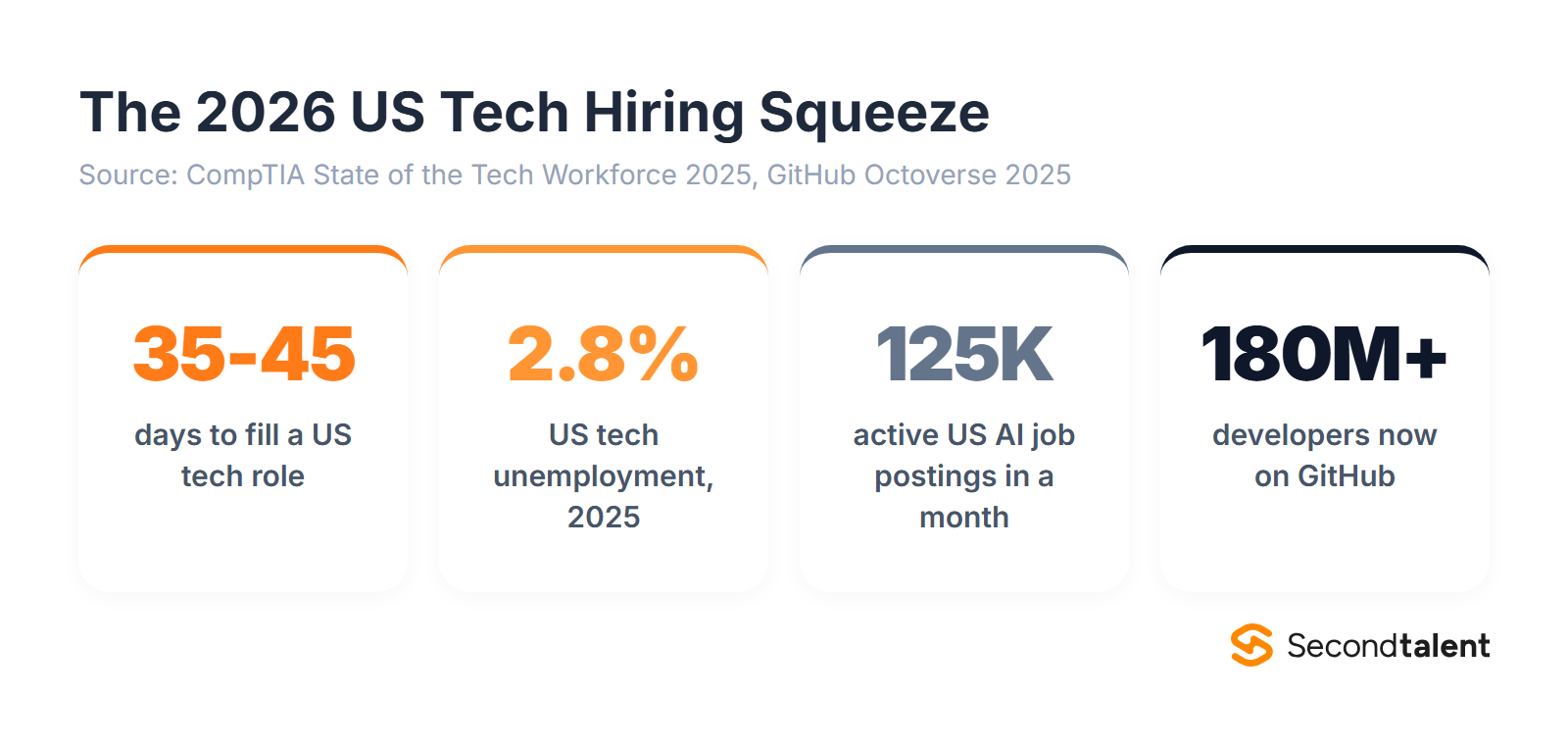
Cost matters, but speed often matters more for a startup. The average US software role takes 35 to 45 days to fill, and senior roles run longer. Each week a role stays open is a week of slipped roadmap.
The US market is also tight. CompTIA put tech unemployment near 2.8% in 2025, which means strong candidates have several offers at once. You are not just slow, you are competing with bigger budgets.
The numbers below show how hard the local market has become.
An Asian team flips the timeline. Because the talent is pre-vetted, we match engineers in about 24 hours and onboard them within days.
A US logistics startup we work with filled three backend roles in one week after a two-month local search had stalled. You can see the full process on how Second Talent works.
Speed also lowers the cost of a wrong hire. When a role takes 45 days to fill, a bad fit sets you back three months once you restart. When matching takes a day, you can correct course in a week.
The faster loop makes each hiring decision less risky, which matters most for small teams that cannot absorb a long miss.
Talent pool: where the engineers actually are
The supply story is the part most cost comparisons miss. The global developer base passed 180 million on GitHub in 2025, and the growth is no longer centered in the US.
India added 5.2 million developers in a single year, and other Asian markets are close behind.
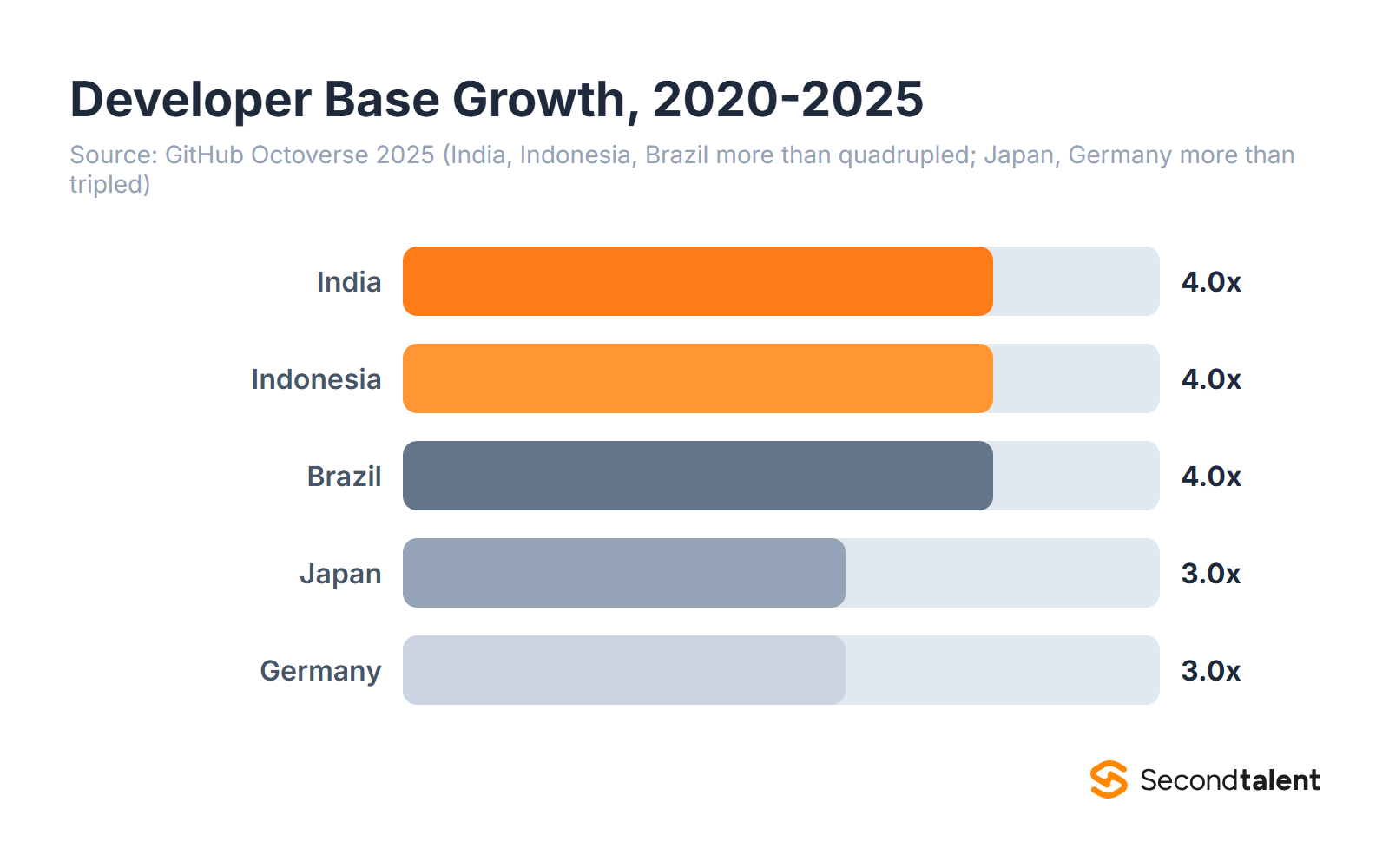
The GitHub Octoverse 2025 report shows India, Indonesia, and Brazil have more than quadrupled their developer base since 2020.
The World Economic Forum Future of Jobs 2025 report points the same way, with technology roles growing fastest in emerging markets. The talent you cannot find at home is often plentiful in Asia.
This depth shows up in specialist roles too. Vietnam has a strong base in backend, AI, and blockchain. The Philippines leads in support and operations.
If you need a hard-to-find skill like an AI/ML model deployment engineer, the pool is wider abroad than in most US cities outside the top hubs.
Quality, English, and time zones
The old worry was quality. That worry is dated. Top Asian engineers ship the same modern stacks as US teams, and the best partners screen to a top 1% acceptance rate before you ever meet a candidate.
The difference is not skill, it is price.
English is rarely a blocker in the main markets. The Philippines ranks among the top countries worldwide for English proficiency, and Vietnam’s developer community works in English every day.
You can check country scores on the EF English Proficiency Index.
Time zones are the real trade-off. A US team gives you full overlap. An Asian team gives you 2 to 5 hours of daily overlap, depending on the coast. Many teams treat that as a feature, since work continues after the US day ends.
The Stack Overflow Developer Survey 2025 found about a third of developers now work fully remote, so async habits are already normal.
Compliance and payroll: the part founders forget
Hiring abroad sounds risky until you understand the Employer of Record model. An EOR is the legal employer in-country. It runs payroll, withholds tax, and provides benefits that meet local law, while the engineer works only for you.
This removes the biggest reason teams avoid global hiring. You do not open a foreign entity. You do not learn the labor code of four countries.
A SaaS company we support hired across Vietnam and the Philippines through one EOR contract instead of three local setups. See how the model works on our Employer of Record page.
When a local team still wins
An Asian team is not always the answer. A local team is the better call in a few clear cases, and it helps to name them honestly.
- Same-room product discovery. Early founders who whiteboard daily may want their first two hires in the room.
- On-site or regulated work. Some defense, health, or hardware roles require staff on US soil.
- Real-time, customer-facing work in US hours. Roles that need full overlap every hour fit a local hire better.
For most other engineering work, the case for an Asian team is strong. And you do not have to pick one side.
Common mistakes when building an Asian team
The model works, but teams that rush it hit the same problems. We see four mistakes again and again, and all four are easy to avoid.
- Hiring the cheapest, not the best fit. Price is the draw, but the lowest rate often means weaker skills. Anchor on output, then optimize cost.
- Skipping the overlap hours. Pick a daily window where both sides are online. Two hours of real overlap beats a full day of pure async for most teams.
- Treating the team as a vendor. Embedded engineers who join your standups and own features outperform a hands-off contractor every time.
- Ignoring local compliance. Direct contracts across borders create tax and labor risk. An EOR removes it, so use one from day one.
Avoiding these four keeps the savings real. The goal is not a cheaper contractor. It is a senior engineer who works like a member of your team, at a cost your runway can carry.
The blended team model: take both
The teams that get the most out of this do not choose local or Asian. They blend. A small local core owns product direction and customer-facing work. An Asian team handles the bulk of the build at a fraction of the cost.
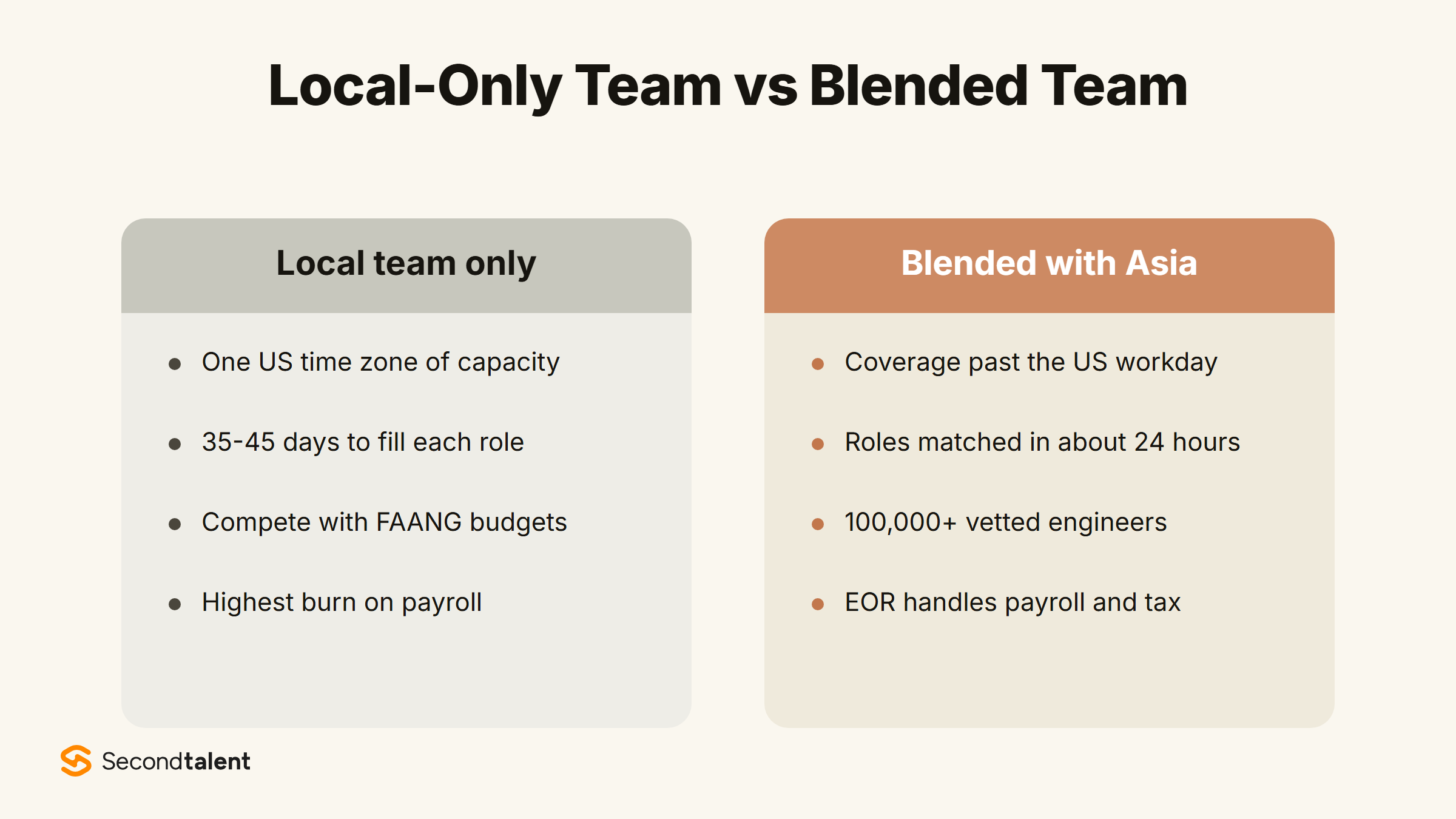
This is how most of our clients run. A few US leaders set the direction, and pre-vetted engineers in Asia ship the roadmap. The result is faster delivery, lower burn, and a team that scales up or down without a hiring freeze.
If you are weighing the decision for a specific role, this simple flow helps. The question is rarely “local or Asia forever.” It is “what does this next role need.”
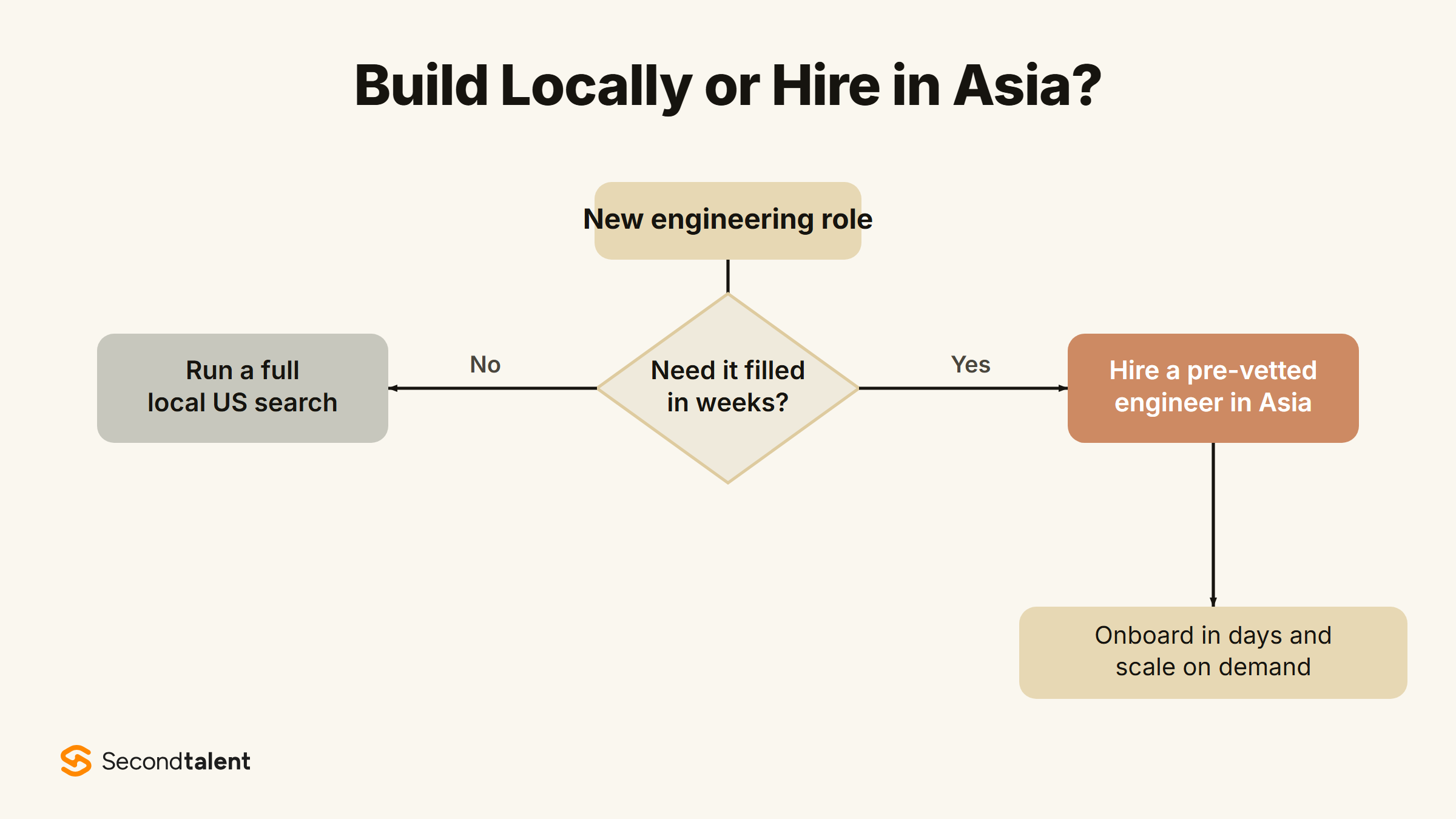
Start with one role you have struggled to fill at home. Hire it in Asia, measure the output for a quarter, and expand from there.
For a deeper market comparison, our Philippines vs India ROI guide breaks down the two largest offshore options.
Build your blended team with Second Talent
Second Talent connects you with the top 1% of engineers across nine Asian markets. We match pre-vetted developers in about 24 hours, handle payroll and compliance through our EOR, and keep retention at 92%.
You get senior talent at $3,000 to $6,000 a month, with zero upfront cost. Tell us what you need and start hiring →
Hiring contractors rather than employees changes the arithmetic. The freelance developer rate index prices 14 roles across nine regions, benchmarked against North America and sourced from published wage data.