
TL;DR: LATAM offers time zone alignment. APAC delivers 30-40% lower costs and 3x larger talent pools. Companies hiring at enterprise scale usually run both. The right choice depends on your priorities.
US companies will face 1.2 million unfilled developer positions by 2026. The talent shortage is real. Global hiring is no longer optional. It is a survival strategy.
Two regions dominate the conversation. Latin America gets the headlines. Nearshore. Same time zones. Cultural fit. But APAC quietly powers engineering teams at thousands of companies. Lower costs. Massive talent pools.
Round-the-clock development.
We work with over 100,000 developers across APAC. We also see clients who tried LATAM first. This guide shares what the data actually shows. No hype. Just numbers and real hiring outcomes.
One definition before the numbers. When this guide says APAC, it means the markets we hire in Vietnam, the Philippines, Indonesia, Malaysia and Singapore.
The salary, talent pool and time zone figures below describe those countries, not Japan, Australia or India.
What’s your top priority right now?
Select your situation below.
Your budget is fixed and you need to stretch every dollar. APAC delivers senior developers at $3,000-5,000/month versus $6,000-8,000 in LATAM. That’s $36,000-60,000 saved per developer annually. Our clients typically hire 2-3 APAC developers for the cost of 1 LATAM hire. Compare APAC salary rates →
You value real-time collaboration and need developers in your working hours. LATAM offers EST-aligned schedules with afternoon standups and live code reviews. But you’ll pay 30-40% more than APAC. If sync communication is non-negotiable, LATAM fits your workflow better. Explore nearshore hiring →
You’re hiring for niche skills or scaling fast and need access to massive talent pools. Our five APAC markets alone graduate 500,000+ tech professionals a year versus 220,000 across LATAM. Finding your exact tech stack, whether it’s AI/ML, cloud, or mobile, is significantly faster with 3x more candidates. Hire APAC specialists →
You want code shipping while your US team sleeps. APAC’s 12-hour time difference means your Vietnam or Philippines developers start when you log off. Deploy features overnight. Cut release cycles in half. This follow-the-sun model accelerates product velocity by 40-50%. Get Vietnam dev rates →
Above 50 engineers the question stops being cost per hire. Procurement wants one MSA, one invoice, audit rights and insurance certificates. Security wants SOC 2 or ISO 27001 evidence, device management and access reviews. And you need a plan for the country where you cross 15 to 25 people and an entity starts to beat an EOR. We run both regions for companies at that size. See how our EOR works →
Quick Comparison: APAC vs LATAM
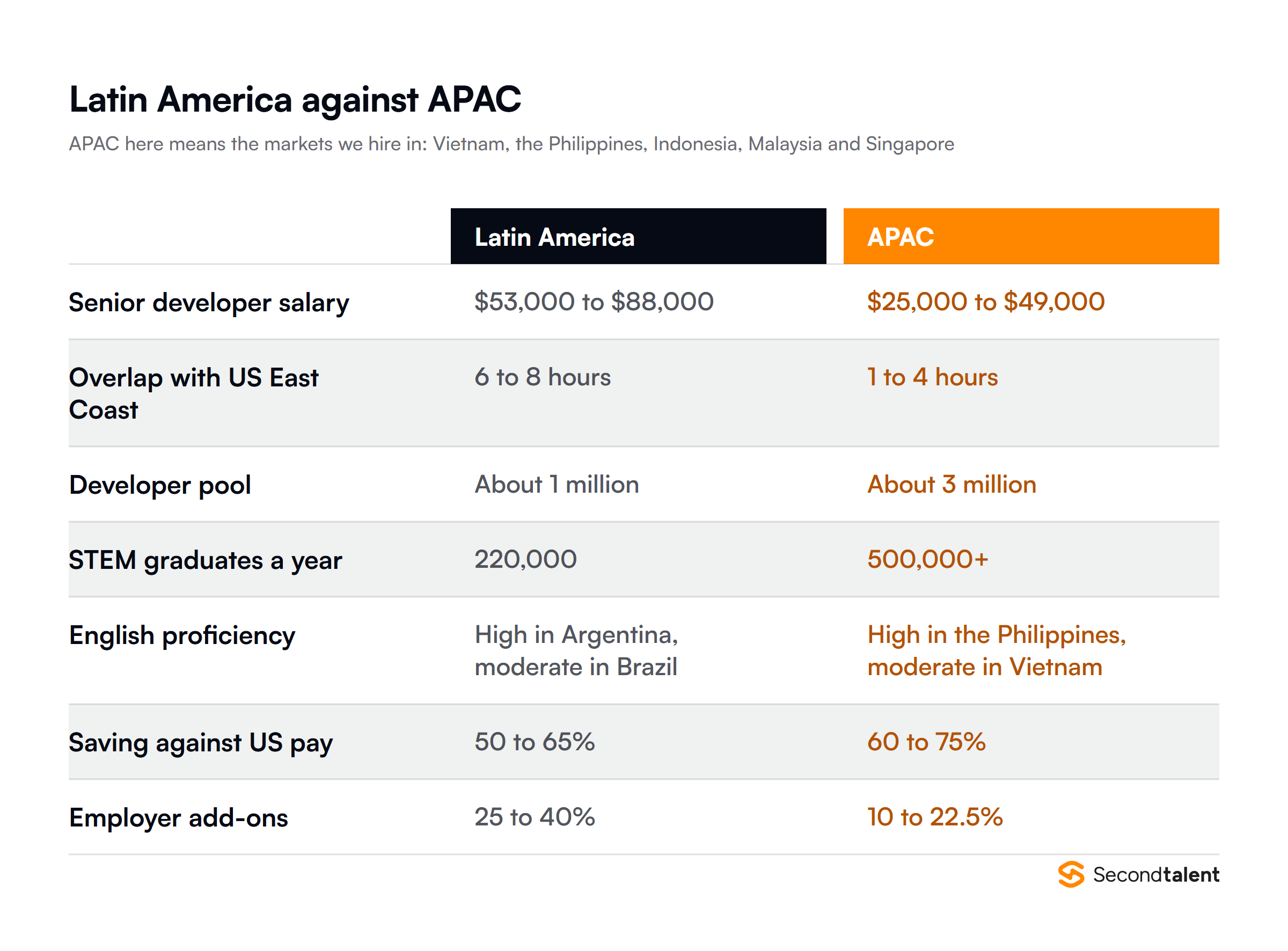
| Factor | Latin America | APAC | Winner |
|---|---|---|---|
| Senior Developer Salary | $53,000-$88,000 | $25,000-$49,000 | APAC |
| Time Zone Overlap (US) | 6-8 hours | 1-4 hours | LATAM |
| English Proficiency | High (Argentina), Moderate (Brazil) | High (Philippines), Moderate (Vietnam) | Tie |
| Talent Pool Size | ~1M developers | ~3M developers | APAC |
| Annual STEM Graduates | 220,000 | 500,000+ | APAC |
| Cost Savings vs US | 50-65% | 60-75% | APAC |
The Cost Reality: 30-40% Difference
Salary data tells a clear story. LATAM costs more than APAC. The gap is significant.
According to Howdy’s verified payroll data, average software engineer salaries in Latin America range from $53,000 to $63,000 USD annually. Senior engineers can reach $80,000 to $88,000.
In APAC, the numbers are different. Vietnam developers earn $25,000 to $42,000 annually. Philippines developers earn $28,000 to $50,000. Indonesia ranges from $25,000 to $49,000.
Salary Comparison by Role
| Role | US (Annual) | LATAM (Annual) | APAC (Annual) |
|---|---|---|---|
| Junior Developer | $75,000 | $25,000-$35,000 | $15,000-$25,000 |
| Mid-Level Developer | $120,000 | $40,000-$55,000 | $25,000-$38,000 |
| Senior Developer | $160,000 | $55,000-$88,000 | $38,000-$55,000 |
| Tech Lead | $185,000 | $70,000-$100,000 | $45,000-$70,000 |
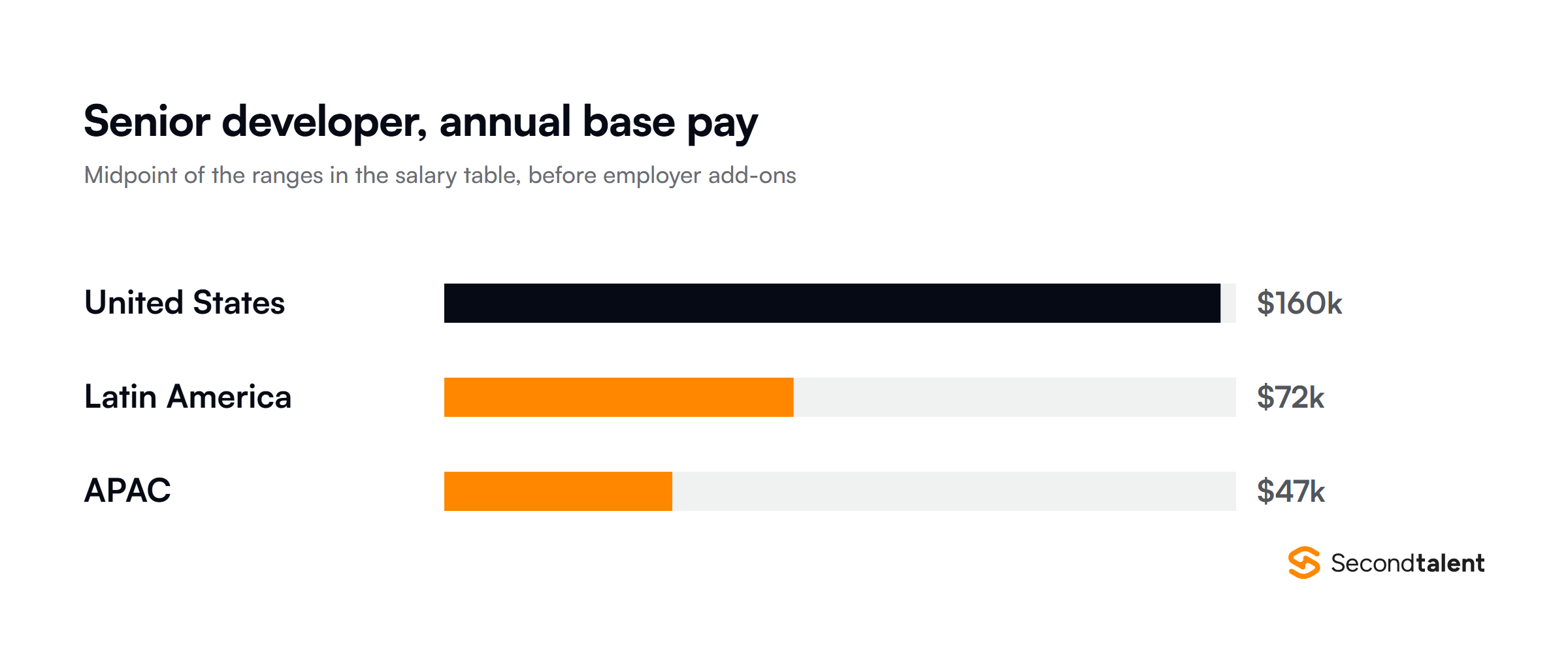
The math is simple. A US company paying $160,000 for a senior developer saves 50-65% with LATAM. They save 60-75% with APAC. On a 5-person engineering team, that difference adds up to $75,000 to $150,000 per year.
One of our clients ran the numbers before choosing. They needed 8 senior developers. LATAM quotes came in at $520,000 annually. Our Vietnam team cost $320,000 for the same skill level. They saved $200,000 in year one.
Talent Pool Size: APAC Has 3x More Developers
Latin America produces 220,000 STEM graduates annually from 437 universities. That sounds impressive. Until you compare it to APAC.
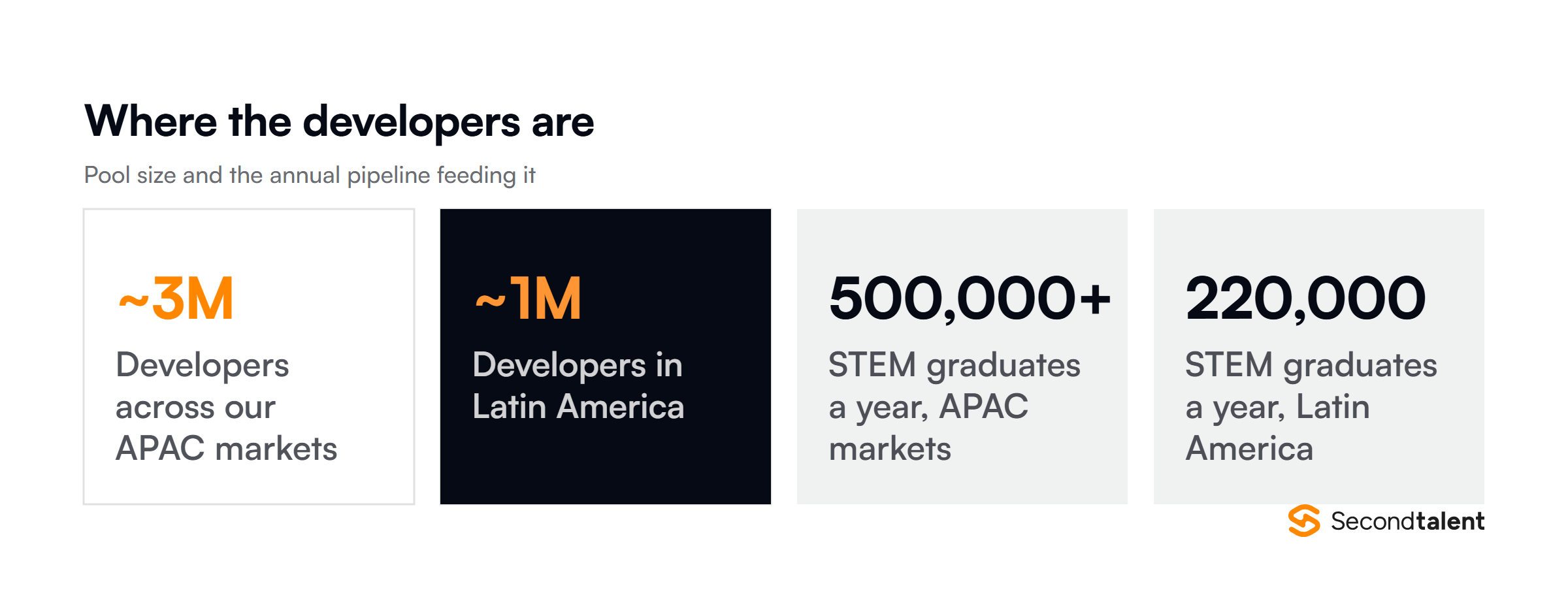
Vietnam alone has over 530,000 software engineers. The country graduates 50,000 to 57,000 new IT professionals every year. The Philippines has 1.3 million workers in IT and BPO services.
Indonesia hosts Southeast Asia’s largest digital economy.
According to industry statistics, the wider Asia region produces over 50% of the world’s STEM graduates annually. The talent pipeline is simply larger.
Why Talent Pool Size Matters
Larger pools mean more choices. More specialists. Faster hiring. When you need a developer with specific skills, the odds improve with scale.
LATAM’s developer shortage is real. Over 60% of large US firms now hire in three or more LATAM countries. Competition drives up wages. Hot skills like AI and DevOps command 15-25% premiums. Salaries can jump 5-10% in a single quarter.
We saw this with a fintech client last year. They spent 3 months trying to hire a senior Go developer in Argentina. Offers kept getting matched by competitors. They found a qualified candidate in Vietnam within 2 weeks through our network.
Time Zone Tradeoffs: Sync vs 24/7 Coverage
Time zones are LATAM’s biggest advantage. Mexico City is 1 hour behind New York. Buenos Aires is 2 hours ahead. Real-time collaboration happens during US business hours.
APAC works differently. Ho Chi Minh City is 12 hours ahead of New York. Manila is 13 hours ahead. Live meetings require early mornings or late evenings for one team.
Time Zone Overlap with US East Coast
| Location | UTC Offset | Overlap with 9-5 ET |
|---|---|---|
| Mexico City | UTC-6 | 8 hours |
| Bogota, Colombia | UTC-5 | 8 hours |
| Buenos Aires, Argentina | UTC-3 | 6 hours |
| Ho Chi Minh City, Vietnam | UTC+7 | 2-3 hours |
| Manila, Philippines | UTC+8 | 1-2 hours |
| Jakarta, Indonesia | UTC+7 | 2-3 hours |
But here is what the time zone argument misses. Async work is the norm now. According to Remote’s workforce trends, 82% of companies offer remote work options. Most have learned async communication.
APAC’s time difference becomes an advantage for some teams. Code ships overnight. Bugs get fixed while the US team sleeps.
We worked with a SaaS company that uses this model. Their US team handles product and design during the day. Their full-stack team in APAC builds features overnight. They ship twice as fast as competitors with single-timezone teams.
English Proficiency: Where Each Region Is Strong
English matters for communication. LATAM and APAC both have strong and weak performers.
Argentina ranks highest in LATAM for English proficiency. The EF English Proficiency Index puts it in the “High” band. Uruguay and Chile follow. But Brazil and Mexico score “Moderate” on average.
Across APAC, the Philippines stands out among the cost-competitive markets. It ranks #2 in Asia and #22 globally on the EF English Proficiency Index. 92% of Filipino professionals speak fluent English.
The country’s $38.7 billion BPO industry was built on this advantage.
Vietnam scores lower on general English metrics. But technical English is different. Vietnamese developers read documentation, write code comments, and communicate about technical topics effectively. The same applies to Indonesia.
English Proficiency by Country
| Country | EF EPI Band | Notes |
|---|---|---|
| Argentina | High | Strongest in LATAM, bilingual education |
| Philippines | High | #2 in Asia, 92% fluent professionals |
| Uruguay | High | Strong but smaller talent pool |
| Colombia | Moderate | Improving rapidly in tech hubs |
| Vietnam | Moderate | Strong technical English |
| Brazil | Moderate | Large pool, English varies by region |
| Indonesia | Low-Moderate | Growing English education investment |
For technical roles, both regions work. The Philippines is the safest bet in APAC for English-critical roles at these price points. Vietnam and Indonesia require some communication process adjustments.
Developer Quality: Education and Skills
Quality concerns come up in every global hiring conversation. The data challenges some assumptions.
Vietnam ranked 8th globally in the OECD’s PISA assessment for science and math. That is higher than Korea and the United States. Students learn coding starting in grade 8. Over 153 institutions offer professional IT training.
According to HackerRank’s Developer Skills Report, Vietnam ranks among the top 10 countries globally for developer skills. The country is no longer just “low-cost outsourcing.” It hosts R&D centers for Intel, Samsung, and other tech giants.
LATAM also produces strong developers. Argentina and Brazil have mature tech ecosystems. The region benefits from cultural proximity to US business practices. Developers understand agile workflows and US business culture.
Technical Specialization
Certain skills cluster by region. Understanding these patterns helps you hire faster.
- Vietnam: Strong in Java, Python, mobile development, and AI/ML
- Philippines: Full-stack JavaScript, React, Node.js, and mobile (Android/iOS)
- Indonesia: Fintech, e-commerce, and cloud infrastructure
- Argentina: Backend systems, data engineering, and DevOps
- Brazil: Enterprise Java, fintech, and cybersecurity
- Colombia: Full-stack web development and QA automation
We placed an AI engineer from Vietnam with a Series A company last quarter. They had 6 years of experience in computer vision. Their previous clients included a Fortune 500 company. The company paid $48,000 annually.
A comparable hire in the US would cost $180,000 or more.
Retention and Turnover: The Hidden Cost
Hiring is expensive. Losing hires is more expensive. Retention matters.
LATAM staffing firms report strong retention numbers. Some claim 95-98% retention rates. Average tenure for nearshore LATAM teams is 2.8 to 4.2 years. The region has a healthy work culture that supports long-term employment.
APAC data varies more by country. The Philippines has a large BPO workforce accustomed to international employment. Vietnam’s tech sector is growing fast. This creates competition for talent.
But it also creates opportunity for companies that offer good conditions.
The key factor is how you hire. Contract workers churn faster everywhere. Full-time employees with benefits stay longer. That is true in LATAM, APAC, and the US.
Our Employer of Record service handles this. We manage payroll, benefits, and compliance. Developers get full employment status. They stay longer because they are treated as team members, not contractors.
Compliance and Legal Complexity
Hiring internationally means navigating local labor laws. Both regions have complexity.
LATAM countries have strong labor protections. Argentina requires severance payments. Brazil has mandatory 13th-month salaries. Colombia has detailed contract requirements. Getting this wrong creates legal risk.
APAC has similar challenges. Vietnam requires social insurance contributions of 22.5% on top of gross wages. The Philippines adds 13% for employer costs. Indonesia has evolving digital economy regulations.
Employer Cost Add-Ons by Country
| Country | Additional Employer Costs | Notes |
|---|---|---|
| Vietnam | 22.5% | Social insurance, health, unemployment |
| Philippines | 13% | SSS, PhilHealth, Pag-IBIG |
| Indonesia | 10-11% | BPJS health and employment |
| Argentina | ~30% | High employer contributions, 13th month |
| Brazil | ~40% | Heavy payroll taxes, 13th month, FGTS |
| Colombia | ~25% | Health, pension, ARL insurance |
EOR services solve this problem in both regions. You pay one invoice. The EOR handles local compliance. According to Toku’s global hiring guide, EOR and AOR solutions are now standard for international remote teams.
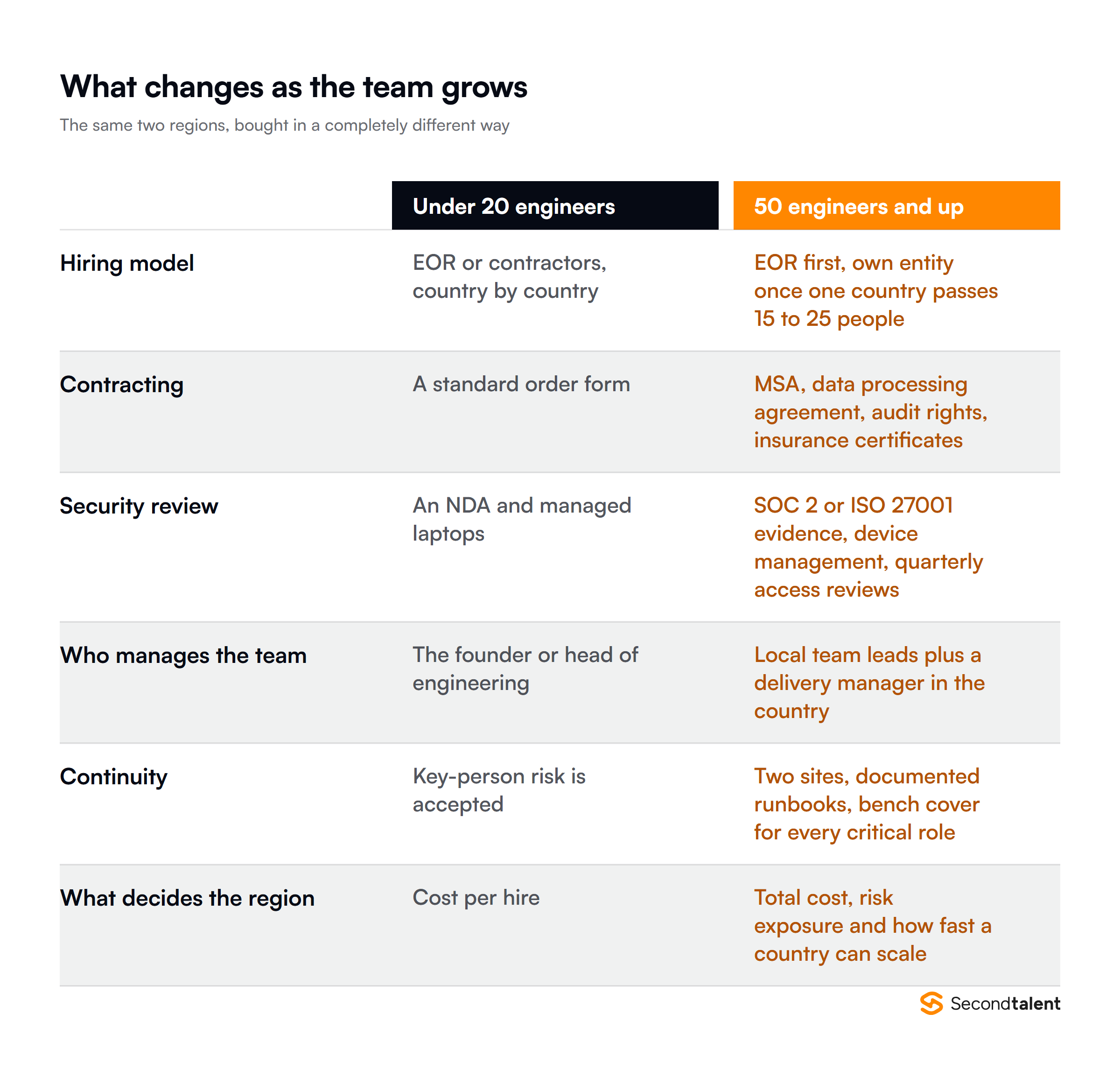
Enterprise Hiring: What Changes Above 50 Engineers
Everything above assumes you are adding engineers one at a time. Companies buying at enterprise scale run a different process. The regional trade-offs do not change. The questions that decide the contract do.
Entity or EOR: the threshold question
An EOR costs 10-15% of salary. That is cheap for five employees and expensive for fifty. Most enterprise teams we work with cross the line somewhere between 15 and 25 employees in a single country.
Below that line, the EOR absorbs registration, payroll, tax filings, benefits administration and termination risk for less than the fully loaded cost of running your own entity. Above it, the entity usually wins on unit cost.
Registration takes months rather than weeks in both regions, so the practical pattern is the same everywhere, i.e., hire through an EOR now, register the entity in parallel, transfer the staff once it is live.
Security, IP and data residency
At enterprise scale the security review arrives before the hiring plan.
Expect questions on SOC 2 Type II or ISO 27001 evidence, device management and disk encryption, joiner-mover-leaver process, quarterly access reviews, and where source code and customer data are allowed to sit.
IP assignment deserves specific attention. In every country in this comparison, work created by an employee needs an explicit assignment clause in the local employment contract. A US master agreement on its own does not move it.
Whoever employs the engineer, your entity or an EOR, has to carry that clause in the local contract.
If you serve EU customers, the data processing agreement and standard contractual clauses need to name the country the engineer actually works from. That is process, not a blocker, and it applies to LATAM and APAC equally.
Procurement and vendor consolidation
Enterprise procurement does not want six vendors across six countries.
It wants one master services agreement, one invoice, one set of insurance certificates and audit rights, and defined service levels for payroll accuracy and replacement time.
That preference often settles the regional question on its own. The region where a single partner covers every country on your roadmap wins, even when a point solution looks marginally cheaper in one market.
Our EOR covers Vietnam, the Philippines, Indonesia, Malaysia and Singapore under one agreement.
Continuity and key-person risk
A five-person team can carry key-person risk. A fifty-person programme cannot.
Enterprise teams document runbooks, pair every critical system across two engineers in different locations, and keep a named backup for any role that can stop a release.
This is also why large programmes end up in both regions. LATAM covers the roles that need a response inside US hours. APAC carries build capacity and overnight coverage. At that size the split is a risk decision as much as a cost one.
The enterprise buyer checklist
- Ask for the security package up front. SOC 2 or ISO 27001 status, penetration test summary, device policy, sub-processor list.
- Read the local employment contract, not just the MSA. IP assignment, confidentiality, notice periods and termination costs all live there.
- Model the entity crossover. Ask at what headcount an entity beats the EOR fee in each country, and who handles the transfer when you get there.
- Fix the replacement service level. How fast a departing engineer is backfilled matters more at fifty employees than the monthly rate does.
- Price the exit, not just the run rate. Argentina and Brazil carry the most expensive severance in this comparison. Model the downside before you commit headcount to a country.
When to Choose LATAM
LATAM makes sense for specific situations. Here is when to prioritize the region.
- Real-time collaboration is critical. If your product development requires constant sync meetings, LATAM’s time zone alignment helps.
- Your team cannot adapt to async work. Some companies struggle with delayed communication. LATAM removes that friction.
- Cultural proximity matters for the role. Customer-facing positions or roles requiring deep US market knowledge benefit from LATAM backgrounds.
- Budget allows for higher costs. If saving 50% versus 70% does not change your runway, LATAM offers convenience.
When to Choose APAC
APAC fits different priorities. Here is when to look east.
- Cost optimization is a priority. Companies stretching a fixed engineering budget save another 30-40% versus LATAM.
- You need specialized skills at scale. AI, mobile, and cloud engineers are abundant in Vietnam and the Philippines.
- Your team already works async. If you use Slack, Notion, and Loom effectively, time zones become less relevant.
- 24/7 development coverage helps. APAC teams can ship features and fix bugs while the US sleeps.
- You are building a large engineering team. APAC’s 3x larger talent pool makes scaling easier.
The Hybrid Approach
Some companies use both regions. This is increasingly common.
A typical pattern looks like this. Product managers and a few senior engineers are in LATAM for sync overlap. The majority of the development team is in APAC for cost efficiency. The US team handles strategy and customer relationships.
We helped a dev tools company implement this model. Their engineering manager is in Colombia. Four senior developers are in Argentina. Eight mid-level developers are in Vietnam.
The Colombia and Argentina team handles architecture and code review. The Vietnam team builds features. Total cost is 55% less than an all-US team.
What We See in 2026
The data tells a nuanced story. LATAM is not objectively better. APAC is not objectively better. The right choice depends on your constraints.
But trends are shifting. LATAM salaries are rising fast. Over 60% of large US firms now compete for LATAM talent. This drives up costs and makes hiring harder. Hot skills command premiums that change quarterly.
APAC offers more stability on cost. Vietnam’s tech sector is maturing. The Philippines has decades of experience serving international companies. Both countries invest heavily in technical education.
According to global hiring trend data, 87% of tech companies now hire globally. The question is not whether to hire internationally. It is where. The answer depends on your team, your budget, and your work style.
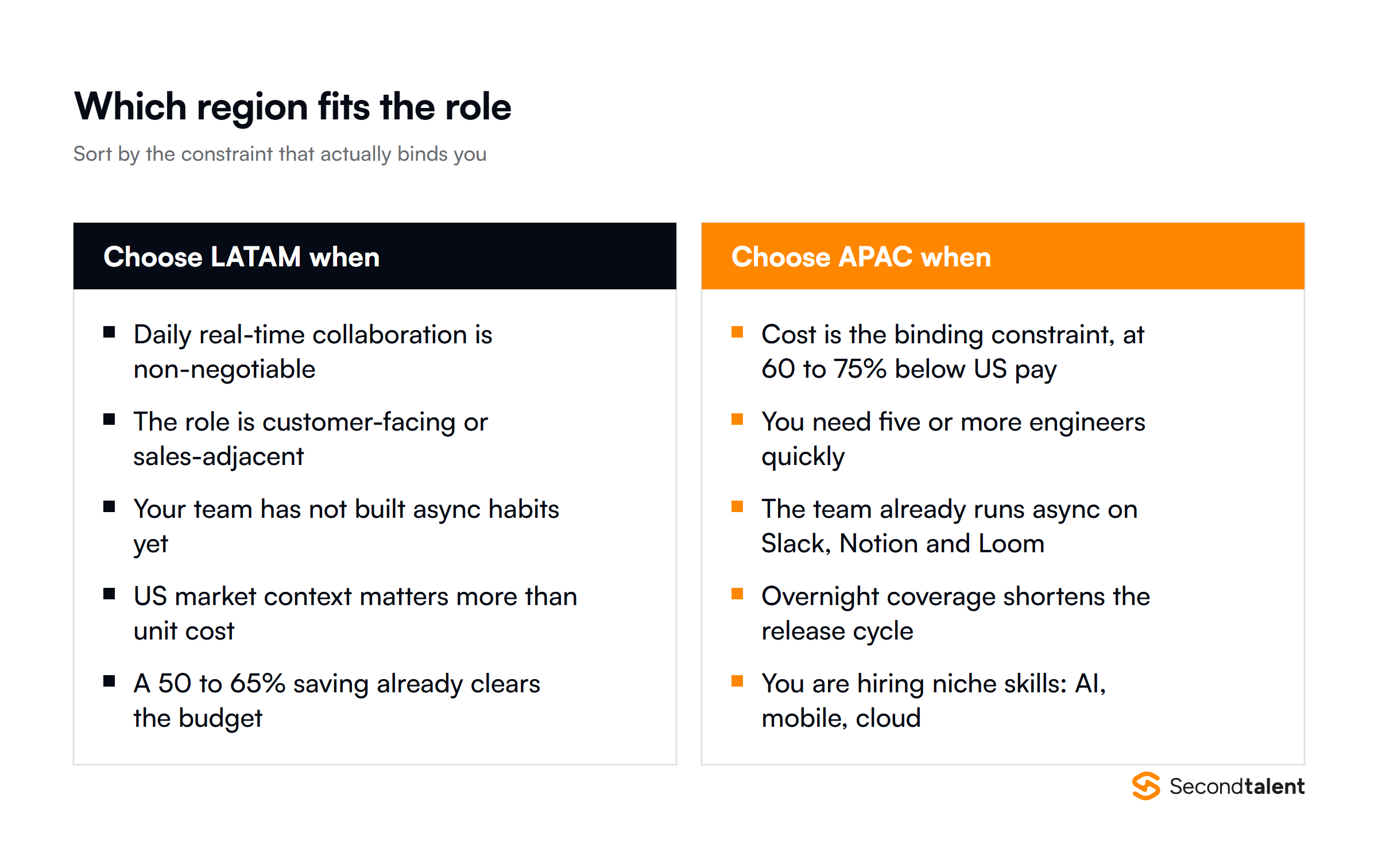
Making the Decision
Here is a simple framework. Answer these questions.
- Is real-time collaboration required daily? If yes, lean LATAM.
- Is cost savings above 60% important? If yes, lean APAC.
- Do you need to hire 5+ developers quickly? If yes, lean APAC.
- Is the role customer-facing or sales-related? If yes, lean LATAM.
- Does your team already work async effectively? If yes, APAC works well.
- Will procurement need an MSA, audit rights and SOC 2 evidence? If yes, shortlist on who can produce them, not on rate alone.
Most companies we work with choose APAC. The cost difference is too significant to ignore, whether the budget belongs to a seed-stage team or a business unit inside a public company. They adapt their communication processes.
They learn async work. They build strong teams at half the cost.
Hire vetted remote developers from APAC with Second Talent to build your engineering team faster and reduce costs by up to 70%.