TL;DR: Staff augmentation adds skilled professionals to your team temporarily. Costs range from $15-200/hour depending on region and expertise. Choose this model for flexibility and control.
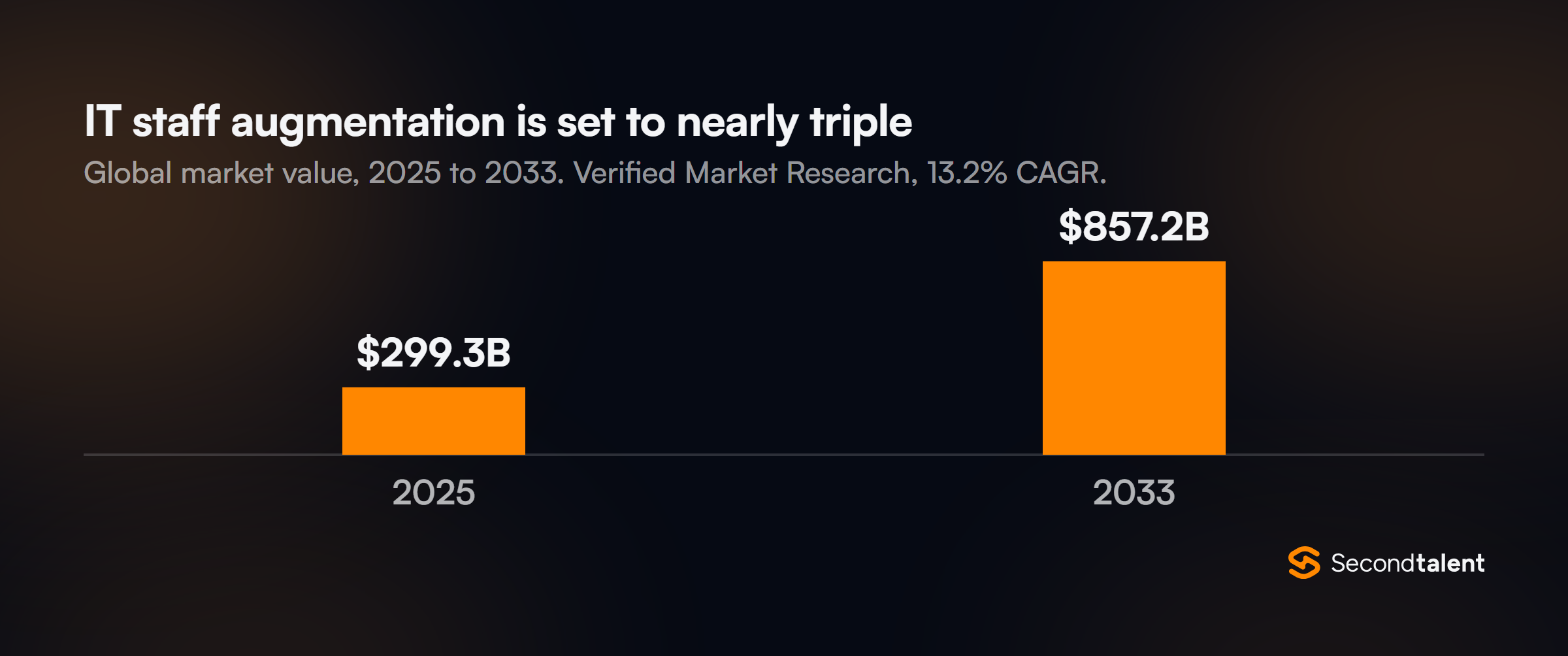
The global IT staff augmentation market was worth $299.3 billion in 2025, and Verified Market Research projects it will reach $857.2 billion by 2033, a 13.2% compound annual growth rate. That growth is not coming from bigger in-house teams. It is coming from companies adding vetted external engineers to teams they already have, instead of running a full hiring cycle each time a project needs a skill they do not have on staff.
- 1The global staff augmentation market is growing at a 13.2% CAGR, from $299.3 billion in 2025 to a projected $857.2 billion by 2033.
- 2Traditional hiring takes 30 to 90 days; staff augmentation typically compresses that to 1 to 2 weeks.
- 3Onboarding time, management overhead, and tooling access can add 20 to 30% to the base rate if you do not negotiate them upfront.
- 4Companies augmenting with vetted talent in Asia typically save 50 to 70% versus equivalent US salaries.
What’s your staff augmentation priority?
Select your situation below.
You’re racing against deadlines and need experienced developers who can start immediately. Our pre-vetted talent pool includes senior developers from Vietnam, Philippines, and Indonesia at rates 50-70% lower than Western markets. Get matched with developers who fit your tech stack within 48 hours. Browse developer talent →
You need accurate cost data to justify your staffing budget. Our rate card shows real-world developer salaries across Southeast Asia, from $15/hour for junior roles to $80/hour for senior specialists. See exactly what you’ll pay before committing to any provider. View 2026 rate card →
You want to augment staff internationally but don’t have legal entities in target countries. Our Employer of Record service handles payroll, compliance, and benefits in Vietnam, Philippines, and across Southeast Asia. Onboard remote developers in days, not months. Get EOR pricing →
You’re evaluating which Southeast Asian country offers the best value for your specific roles. Our 2026 salary index compares compensation across Vietnam, Philippines, Indonesia, Malaysia, and Singapore with data from 500+ placements. Make location decisions backed by real market data. Check Asia salary index →
Staff Augmentation Services
| Aspect | Details |
|---|---|
| Definition | Temporarily adding external professionals to your existing team |
| Market Size (2025) | $299.3 billion globally |
| Projected Growth | $857.2 billion by 2033 (13.2% CAGR) |
| Average Time to Hire | 1-2 weeks vs. 30-90 days traditional |
| Cost Savings | 50-70% compared to US hiring |
| Management | Client retains full control |
| Best For | Skill gaps, scaling needs, specialized projects |
What Are Staff Augmentation Services?
Staff augmentation is a hiring model where organizations bring in temporary professionals to work alongside their existing teams. Unlike traditional contractors or consultants, augmented staff integrate directly into your workflows, attend your meetings, and follow your development processes.
The key distinction from outsourcing is control. With staff augmentation, you manage the work directly. The external professionals report to your team leads, use your tools, and build your product under your supervision. This model suits companies that want additional capacity without surrendering project control.
This shift has made staff augmentation far more practical, since geographic barriers no longer limit talent access.
- You manage the work: sprints, code review, direction
- Augmented staff use your tools and follow your process
- Best when you already have technical leadership in place
- The provider manages the work and owns the outcome
- The provider's own tools and process apply, not yours
- Best when you lack the technical leadership to direct the work
Types of Staff Augmentation Services
Staff augmentation services vary by scope, duration, and specialization. Understanding these types helps you select the right service for your specific needs.
Commodity Staff Augmentation
This type fills general roles that do not require highly specialized skills. Examples include general administrative support, basic data entry, or standard QA testing. Rates tend to be lower because the talent pool is larger.
Commodity augmentation works well for scaling routine operations quickly. However, it provides less value for technical roles where expertise directly impacts output quality.
Skill-Based Staff Augmentation
Skill-based augmentation targets specific technical competencies your team lacks. You might need a DevOps engineer to set up CI/CD pipelines, or a mobile developer to build your iOS application.
This type commands higher rates because it requires matching specific technical requirements. The value proposition is access to skills that would take months to develop internally or hire permanently.
Highly Specialized Staff Augmentation
Some projects require rare expertise that few professionals possess. AI specialists, blockchain architects, and security researchers fall into this category. Finding these professionals through traditional channels can take 6+ months.
Highly specialized augmentation often costs more but delivers proportionally greater value. A single expert can solve problems that entire teams of generalists cannot address.
Staff Augmentation Pricing Models
Pricing structures set both total costs and budget predictability. Each model offers distinct advantages depending on your project characteristics and financial preferences.
| Pricing Model | Best For | Advantages | Disadvantages |
|---|---|---|---|
| Hourly Rate | Variable workloads, uncertain scope | Maximum flexibility, pay only for work done | Less budget predictability |
| Fixed Price | Well-defined deliverables | Budget certainty, risk transfer to provider | Less flexibility for changes |
| Monthly Retainer | Long-term engagements | Predictable costs, typically 15-20% discount | Paying for unused capacity |
| Hybrid | Complex projects with mixed needs | Optimized for different work types | More complex to manage |
Hourly Rate Model
The hourly model is the most common and straightforward approach. You pay for actual hours worked at predetermined rates. This structure provides maximum flexibility, allowing you to scale resources based on fluctuating project demands.
Hourly pricing works particularly well for projects with uncertain scope. If requirements change or you need to pivot, you adjust hours accordingly without renegotiating contracts.
The main drawback: budget predictability drops. Monthly costs swing with workload, which makes financial planning harder for finance teams.
Fixed Price Model
Fixed price arrangements establish a predetermined cost for well-defined deliverables. This approach transfers risk to the service provider, who commits to delivering specific outcomes regardless of actual time required.
This model suits projects with well-documented requirements and stable scope. Fixed price engagements work best when both parties can accurately estimate effort upfront.
The limitation: flexibility drops. Changes to scope typically require contract amendments and additional fees, and fixed price models get cumbersome fast once requirements shift a lot mid-project.
Monthly Retainer Model
Retainer arrangements involve paying a flat monthly rate for dedicated resources. This model provides budget predictability while ensuring talent availability when you need it.
Long-term retainers typically include discounts of 15-20% compared to hourly rates. Providers value the predictable revenue stream and pass savings to clients.
The risk is paying for unused capacity during slower periods. Retainers work best when you have consistent, ongoing work that justifies dedicated resources.
Hybrid Model
Many organizations combine elements from multiple pricing structures. You might have core team members on retainer while paying hourly for additional support during peak periods.
Hybrid models optimize costs based on work characteristics. Predictable work goes on retainer for discount benefits, while variable work uses hourly billing for flexibility.
Staff Augmentation Costs by Role
Experience level, technical specialization, and geographic location drive most of the difference in what you pay. Understanding these ranges helps you budget accurately and evaluate proposals.
Developer Rates by Experience
Experience level is the primary cost driver within any given region or specialization. Junior developers cost far less but require more oversight and produce less independently.
- Junior Developers (0-2 years): $15-50/hour globally, best for routine tasks under supervision
- Mid-Level Developers (3-5 years): $30-80/hour globally, handle most tasks independently
- Senior Developers (6+ years): $50-150/hour globally, lead features and mentor others
- Architects and Tech Leads: $80-200/hour globally, design systems and guide technical direction
According to Clutch's staff augmentation pricing guide, the blended average sits at $25 to $49 an hour, with country of hire doing most of the work: the Philippines runs under $25 an hour, Poland runs $50 to $99, and Canada runs $100 to $149.
Mid-level developers offer the best value for most projects. They work independently at $30 to $80 an hour, well under the $50 to $150 senior band.
Regional Cost Comparison
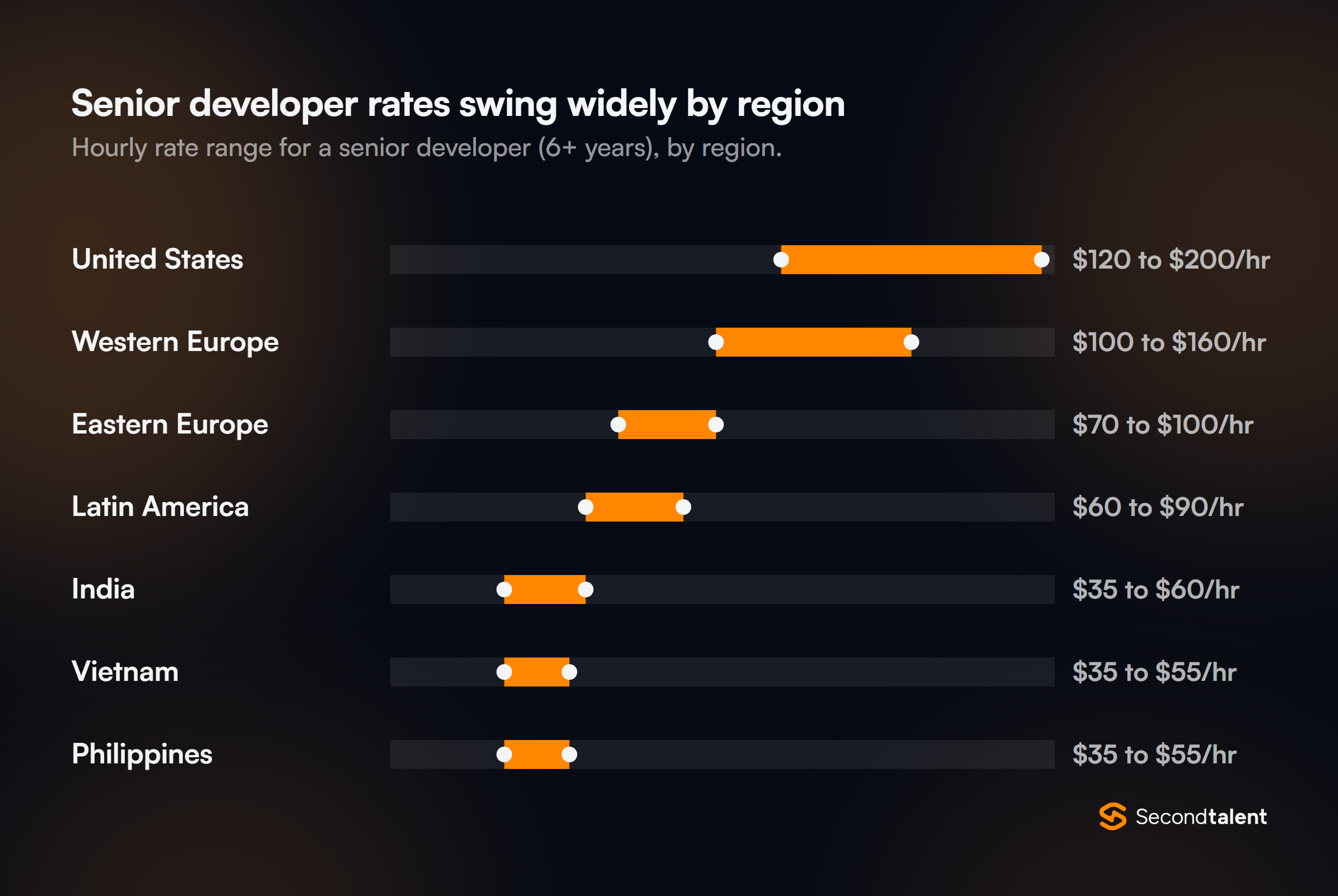
Geographic location creates the most dramatic cost differences. A senior developer in San Francisco might cost $150/hour while an equally skilled professional in Vietnam costs $40/hour.
| Region | Junior Rate | Mid-Level Rate | Senior Rate |
|---|---|---|---|
| United States | $50-80/hr | $80-120/hr | $120-200/hr |
| Western Europe | $45-70/hr | $70-100/hr | $100-160/hr |
| Eastern Europe | $25-40/hr | $40-70/hr | $70-100/hr |
| Latin America | $25-45/hr | $40-70/hr | $60-90/hr |
| India | $15-25/hr | $25-40/hr | $35-60/hr |
| Vietnam | $15-25/hr | $25-40/hr | $35-55/hr |
| Philippines | $15-25/hr | $25-40/hr | $35-55/hr |
The Asia Tech Salary Index provides detailed regional breakdowns. Southeast Asian markets like Vietnam and the Philippines offer strong value with growing talent pools. Heading into 2026, expect mid-level and senior offshore rates to climb 3-6% as demand outpaces supply, while junior rates stay largely flat. Locking in relationships now protects you from the increases ahead.
Specialty Premium Rates
Certain technical specializations command premium rates regardless of geography. PwC's 2026 Global AI Jobs Barometer puts the average wage premium for AI skills at 62%, up from 25% two years earlier. Separately, Robert Half's Technology Salary Guide found that 87% of technology and IT leaders now pay more for candidates with specialized skills than for generalists doing the same role.
Other high-demand specializations, cybersecurity, cloud architecture (AWS/GCP/Azure), blockchain, and DevOps/SRE, see the same treatment. Employers price these candidates individually against the live shortage in that niche rather than off a standard rate card.
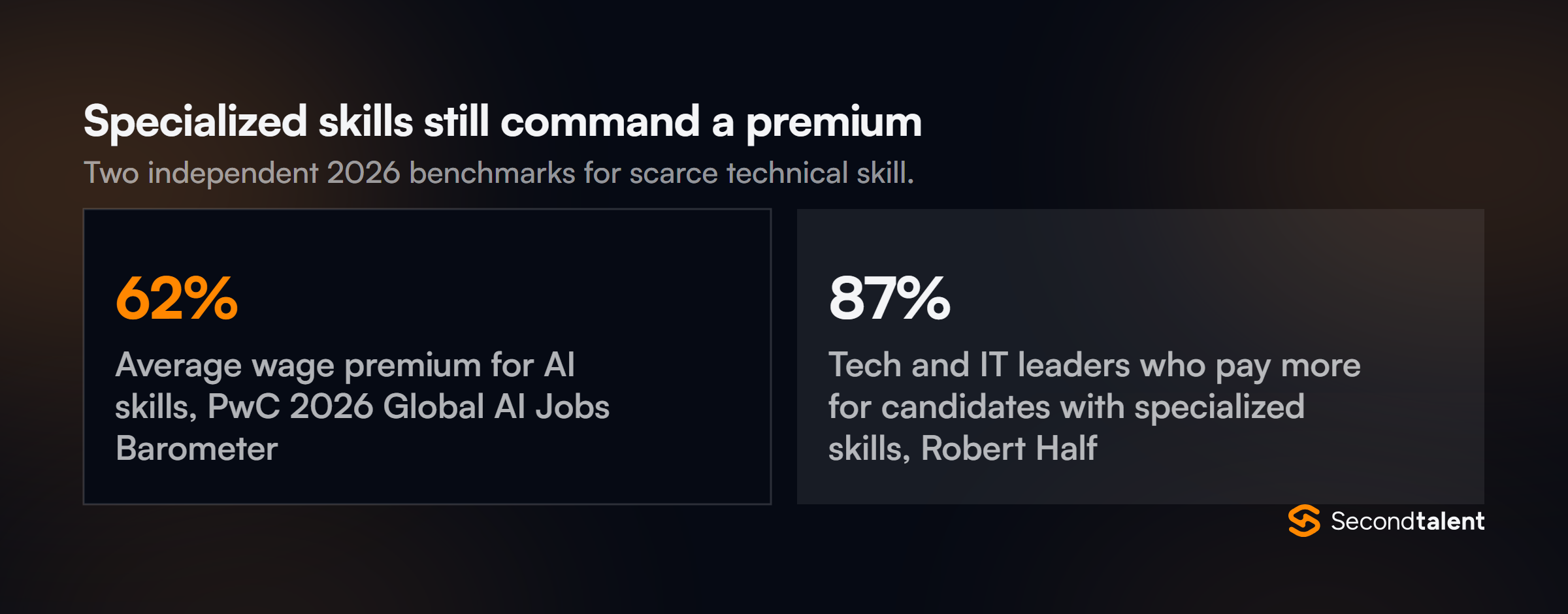
These premiums reflect real market conditions. Scarcity in one specialization pushes up rates for the adjacent ones too, from cloud to security.
Hidden Costs to Consider
Base rates do not capture total engagement costs. Several additional factors can add 20-30% to your final bill if not anticipated and negotiated upfront.
Onboarding and Training
Even experienced professionals need time to understand your codebase, tools, and processes. This ramp-up period typically takes 1-2 weeks for standard projects and up to 4 weeks for complex systems.
During onboarding, productivity remains below full capacity. Budget for this learning curve when calculating total project costs. Some providers include onboarding time in their quotes while others bill separately.
Management Overhead
Augmented staff require management attention from your existing team. Sprint planning, code reviews, and coordination meetings all consume internal resources.
Plan for 2-4 hours weekly of manager time per augmented team member. If you are adding multiple people, ensure your management has bandwidth to support them effectively.
Tools and Infrastructure
External team members need access to your development environment, communication tools, and potentially specialized software. License costs add up, especially for expensive tools like Jira, GitHub Enterprise, or cloud development environments.
Security provisions for external access may require additional investment. VPN licenses, enhanced authentication, and compliance measures protect your systems but increase costs.
Timezone Overlap Requirements
If you require augmented staff to work specific hours for real-time collaboration, expect higher rates. Developers in Asia working US hours command premiums because they sacrifice personal convenience.
Alternatively, establish asynchronous workflows that reduce overlap requirements. The time zone coordinator helps identify optimal collaboration windows across regions.
Contract Terms
Watch for unfavorable contract provisions that increase costs. Early termination penalties, replacement fees for departed staff, and minimum commitment periods can all impact total expenditure.
Negotiate these terms before signing. Reputable providers offer flexible arrangements without punitive clauses.
When to Use Staff Augmentation
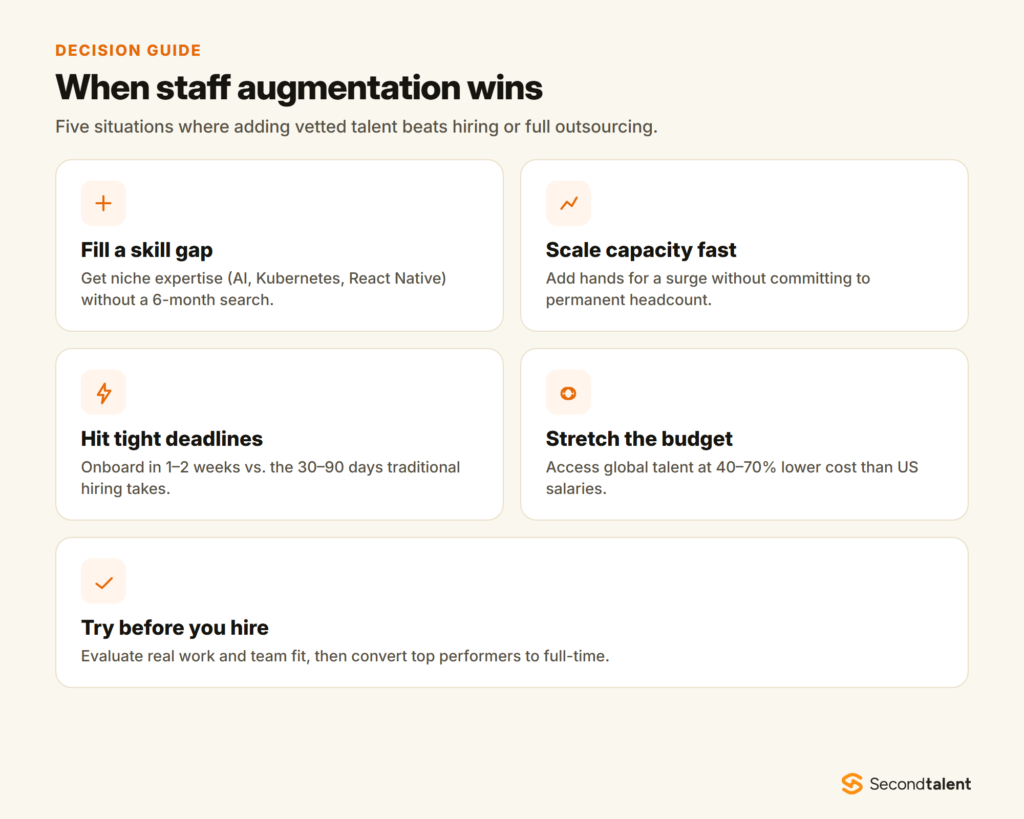
Staff augmentation delivers the best results in specific scenarios. Understanding these use cases helps you determine whether augmentation fits your current situation.
Filling Skill Gaps
Your team lacks specific expertise needed for a project. Rather than spending months recruiting a permanent hire or training existing staff, augmentation provides immediate access to required skills.
This scenario is particularly common for emerging technologies. Augmentation fills the gap when a project suddenly requires Kubernetes expertise or React Native development, while you assess long-term needs.
Scaling Development Capacity
You have more work than your current team can handle, but uncertain whether this demand will persist. Augmentation lets you scale up quickly without committing to permanent headcount.
The pool of flexible talent keeps getting deeper. Business Research Insights puts the global offshore software development market at $198.48 billion in 2026, on its way to $509.45 billion by 2035. As our resources library documents, skilled professionals increasingly prefer flexible, remote-first arrangements, which gives you fast access to specialists ready to plug into a growing team.
Meeting Tight Deadlines
A critical deadline approaches and your team cannot deliver alone. Traditional hiring takes 30-90 days, far too slow for urgent needs. Augmentation compresses this to 1-2 weeks.
Time-to-hire matters enormously in competitive markets. Companies that use augmentation gain a real edge when speed decides the outcome.
Managing Budget Constraints
You need development capacity but cannot afford US-market salaries. Global augmentation provides access to quality talent at 50-70% lower costs.
Startups between seed and Series A particularly benefit from this cost advantage. Limited budgets stretch further when you can access skilled developers in regions like Indonesia or Malaysia at competitive rates.
Testing Before Permanent Hiring
You want to evaluate a potential permanent hire before making a long-term commitment. Augmentation arrangements can transition to employment if both sides want to continue.
This try-before-you-hire approach cuts hiring risk before you commit to a salary. You observe actual work quality and team fit before offering permanent positions.
When NOT to Use Staff Augmentation
Despite its benefits, staff augmentation is not universally appropriate. Certain situations call for different approaches.
Lacking Internal Technical Leadership
Augmentation requires someone on your team to direct the work. If you lack technical leadership to define requirements, review code, and guide architecture, augmented staff will struggle without direction.
In this situation, project outsourcing might serve you better. The external team brings their own management and delivers complete solutions rather than additional hands.
Highly Confidential Work
Some projects involve intellectual property or data too sensitive for external access. While NDAs and security measures provide protection, certain organizations prefer limiting exposure to permanent employees.
Evaluate your risk tolerance and compliance requirements. Regulated industries may face additional constraints on using external staff.
Core Competency Development
If the skills you need represent your company’s core competitive advantage, building internal capability may make more strategic sense than relying on external talent.
Companies should generally keep core competencies in-house while augmenting supporting functions.
How to Choose a Staff Augmentation Provider
Provider selection determines whether the engagement succeeds or drags. Evaluate potential partners across several dimensions before committing.
Technical Vetting Capabilities
Ask how providers assess candidate technical skills. Generic staffing firms often lack ability to evaluate programming competence. Specialized providers like Second Talent maintain rigorous technical vetting processes.
Request details about their assessment methodology. Coding tests, technical interviews, and portfolio reviews all indicate serious vetting.
Talent Pool Quality and Size
Larger talent pools enable faster matching. Providers with strong presence in multiple regions can source candidates more quickly than those limited to single markets.
Quality matters more than quantity. A provider with 500 thoroughly vetted developers delivers better results than one claiming 50,000 with minimal screening.
Track Record and References
Request references from companies similar to yours. Ask about placement quality, responsiveness to issues, and replacement policies when matches do not work out.
Review case studies and client reviews to understand typical outcomes. Patterns in feedback reveal provider strengths and weaknesses.
Contract Flexibility
Evaluate contract terms carefully. Look for reasonable notice periods, clear replacement policies, and absence of punitive clauses.
The best providers offer flexibility because they are confident in their placements. Rigid terms often indicate providers who expect problems.
Making Staff Augmentation Work
Success requires more than adding people. Organizations that get the best results from augmentation follow specific practices.
Invest in Onboarding
According to SHRM, employees are 69% more likely to stay with a company for at least three years after a great onboarding experience, and organizations with a standard onboarding process see 50% greater new-hire productivity. Prepare documentation, assign mentors, and include augmented staff in team activities from day one.
Well-onboarded augmented staff contribute meaningfully within the first sprint. Poorly onboarded ones spend that same stretch still figuring out where things live, which stretches timelines far more than the onboarding time itself.
Treat Augmented Staff as Team Members
Integration drives performance. Include augmented staff in relevant meetings, social channels, and team decisions. External professionals who feel like outsiders contribute less than those who feel valued.
Define Clear Expectations
Specify deliverables, communication norms, and working hour expectations upfront. Ambiguity creates friction and reduces productivity.
Plan Knowledge Transfer
Augmented staff will eventually leave. Plan from the start how they will document their work and transfer knowledge to permanent team members.
Staff Augmentation Trends for 2026
Several market trends are shaping staff augmentation this year. Understanding these dynamics helps you anticipate changes and negotiate effectively.
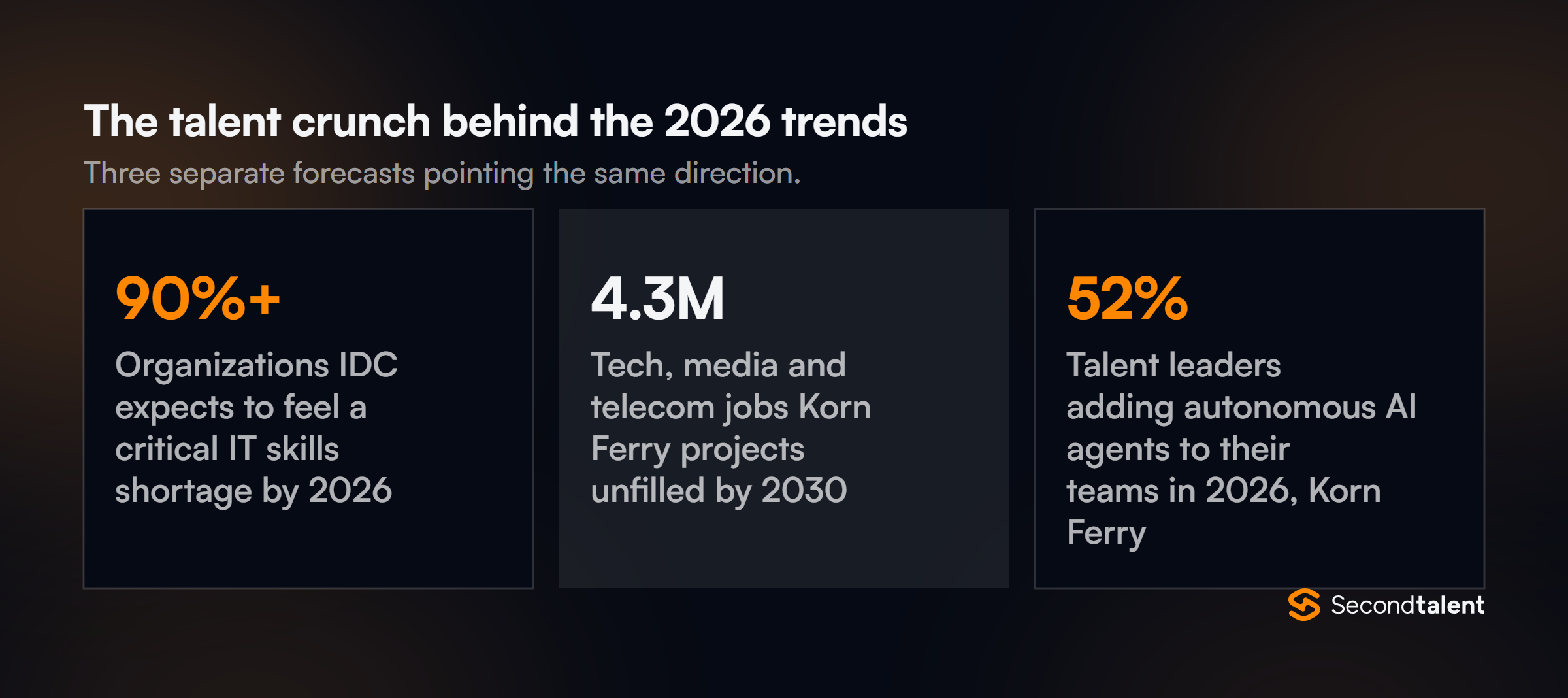
Recruiters now run candidates through AI-assisted matching before a person reviews a single resume. Korn Ferry's 2026 TA Trends research found that 52% of talent leaders plan to add autonomous AI agents to their teams this year, on top of that matching layer. The result is higher-signal shortlists and shorter time-to-match, but it also raises the bar on how providers vet for real, demonstrable ability instead of keyword-matched resumes.
Contracts are shifting from hours to outcomes. Hourly billing remains common, but more engagements now tie payment to measurable deliverables and results. Buyers want proof the work will survive contact with production, not seat-time alone. Expect clearer scopes, defined success metrics, and hybrid structures that keep a core team in-house while augmenting specialized or variable work.
The talent crunch keeps widening. IDC expects 9 in 10 organizations to feel a critical IT skills shortage by 2026, and Korn Ferry projects a shortage of 4.3 million technology, media, and telecom workers by 2030. That pressure, combined with 3-6% annual rate growth in emerging markets like Vietnam, rewards companies that build talent relationships early, before pricing normalizes.
Conclusion
Staff augmentation services offer a powerful way to access skilled talent quickly, flexibly, and cost-effectively. The model works best when you maintain technical leadership internally while augmenting capacity or specialized skills as needed.
Success depends on choosing the right pricing model, selecting quality providers, and investing in proper onboarding and integration. Executed well, staff augmentation delivers real advantages over traditional hiring or full outsourcing.
The projected growth to $857.2 billion by 2033 reflects widespread recognition of these benefits. As the tech-skills gap widens and companies increasingly embrace flexible, AI-assisted work models, staff augmentation will play an ever more central role in building and scaling technical teams.
Hire vetted remote software engineers with Second Talent to scale your team quickly without the overhead of traditional hiring.
Frequently Asked Questions
What is the difference between staff augmentation and outsourcing?
Staff augmentation adds external professionals who work under your direct management, tools, and processes, while outsourcing hands an entire project or function to another company that manages the work itself. Choose augmentation when you want to keep control of how the work gets done; choose outsourcing when you want someone else to own the outcome end to end.
How much does staff augmentation cost per hour?
Rates typically run $15 to $200 an hour, depending mostly on experience level and region. Junior developers run $15 to $50 an hour globally, while architects and tech leads run $80 to $200. Hiring through Southeast Asia rather than the US typically cuts the bill by 50 to 70% for comparable experience.
How fast can I onboard an augmented team member?
Most staff augmentation placements take 1 to 2 weeks from search to start, compared with 30 to 90 days for a traditional hire. Add 1 to 4 weeks of ramp-up time after that before the new team member reaches full productivity, longer for complex codebases.
Is staff augmentation the same as an Employer of Record?
No. Staff augmentation is about sourcing and managing the talent; an Employer of Record is about who legally employs that talent when you have no local entity. Many companies use both together: augmentation to find and manage the developer, EOR to handle payroll, taxes, and local compliance.
When should I avoid staff augmentation?
Skip it when you lack internal technical leadership to direct the work, when the project involves intellectual property too sensitive for external access, or when the skill in question is a core competitive advantage you should be building in-house. In those cases, project outsourcing or a permanent hire usually serves you better.
Can a staff augmentation contract convert to a permanent hire?
Yes. Many providers structure arrangements as a try-before-you-hire path: you evaluate real work and team fit over weeks or months, then convert the person to a full-time offer if both sides want to continue. Confirm the conversion terms, including any placement fee, before the engagement starts.



![Workplace Diversity Statistics. Top 100+ Workplace Diversity Statistics [2026], by Second Talent.](https://www.secondtalent.com/wp-content/uploads/2026/09/workplace-diversity-statistics-featured-v2-768x403.jpg)

![Tech Industry Hiring Statistics. Top 50+ Tech Industry Hiring Statistics: Salaries, Skills Demand [2026], by Second Talent.](https://www.secondtalent.com/wp-content/uploads/2026/09/tech-industry-hiring-statistics-featured-v2-768x403.jpg)