Cost to Hire a Mobile App Developer
A mid-level freelance or contract mobile app developer in the United States costs $108 to $165 an hour, before the payroll, insurance and leave benefits.
 By Jack Ng, General Manager
Data verified by Jack Ng and the Second Talent internal team
By Jack Ng, General Manager
Data verified by Jack Ng and the Second Talent internal team
Updated quarterly · 24 September 2026
United States
$108-$165/hr
$17,280-$26,400 a month
-
-
Difference
-
per month at 160 hours
| Region | Hourly | Per month | vs United States | Spread |
|---|---|---|---|---|
| United States The benchmark benchmark measured | $108-$165 | $17,280-$26,400 | benchmark | |
| Western Europe UK, DE, FR measured | $57-$87 | $9,120-$13,920 | −47% | |
| Latin America BR, AR, MX, CO vendor data | $56-$86 | $8,960-$13,760 | −48% | |
| Southeast Asia VN, PH, ID, MY, TH vendor data | $47-$73 | $7,520-$11,680 | −56% | |
| Australia & NZ Sydney, Melbourne, AKL vendor data | $105-$160 | $16,800-$25,600 | −3% | |
| Northern Europe Nordics, Baltics vendor data | $93-$142 | $14,880-$22,720 | −14% | |
| Eastern Europe PL, RO, UA vendor data | $64-$97 | $10,240-$15,520 | −41% | |
| Africa NG, KE, EG, ZA vendor data | $43-$66 | $6,880-$10,560 | −60% | |
| South Asia IN, PK, BD measured | $24-$36 | $3,840-$5,760 | −78% |
Mobile band. Mobile band. Native iOS and Android both price here; cross-platform React Native sits at the lower end.
Freelance vs in-house vs agency
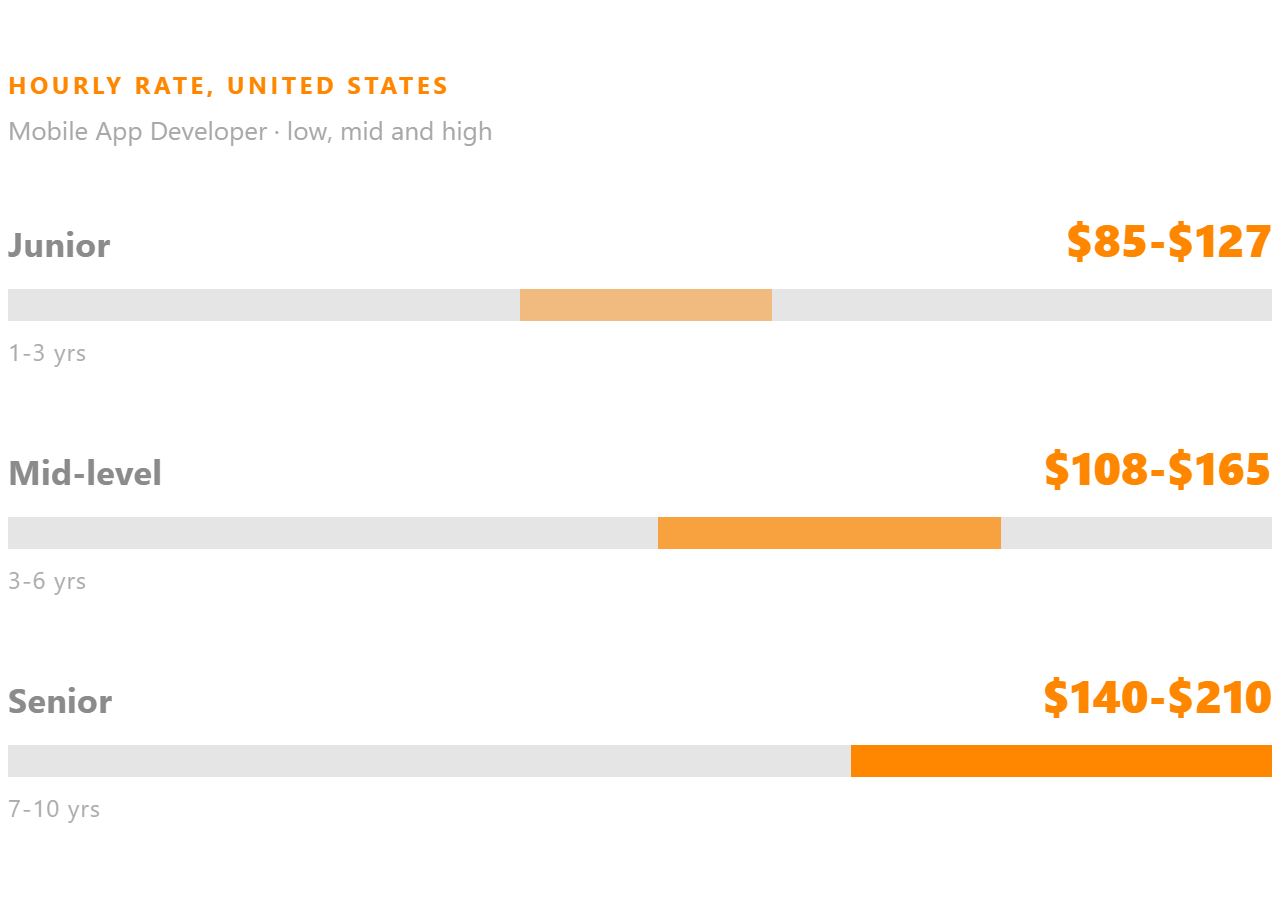
United States, in US dollars per hour, at each seniority level.
| Model | Junior1-3 yrs | Mid-level3-6 yrs | Senior7-10 yrs |
|---|---|---|---|
| Freelance or contract | $85-$127 | $108-$165 | $140-$210 |
| In-house employee | $95-$140 | $120-$180 | $155-$230 |
| Agency or dev shop | $160-$265 | $205-$340 | $265-$440 |
Mobile App Developer rates in the top 10 hiring markets
Mid-level hourly rate, Oct, 2026. Every figure is the United States band scaled by that market's published compensation ratio. Three of the ten have a country median published by name and three carry the rates we quote and place at in that market; the rest carry their region's ratio and are marked as such.
| # | Country | Hourly rate | Monthly at 160 hrs | Basis |
|---|---|---|---|---|
| 1 | United States | $108-$165 | $17,280-$26,400 | country median |
| 2 | Canada | $108-$165 | $17,280-$26,400 | regional |
| 3 | United Kingdom | $67-$102 | $10,720-$16,320 | country median |
| 4 | Germany | $59-$91 | $9,440-$14,560 | country median |
| 5 | Sweden | $93-$142 | $14,880-$22,720 | regional |
| 6 | Denmark | $93-$142 | $14,880-$22,720 | regional |
| 7 | Brazil | $56-$86 | $8,960-$13,760 | regional |
| 8 | Mexico | $56-$86 | $8,960-$13,760 | regional |
| 9 | Vietnam | $35-$85 | $5,600-$13,600 | observed rates |
| 10 | Philippines | $27-$72 | $4,320-$11,520 | observed rates |
| 11 | Poland | $64-$97 | $10,240-$15,520 | regional |
| 12 | India | $25-$65 | $4,000-$10,400 | observed rates |
- United States $108-$165/hr
- A mid-level mobile app developer in the United States costs $108 to $165 an hour, which is $17,280 to $26,400 a month at 160 billable hours. Junior rates run $85 to $127 and senior rates $140 to $210. The benchmark every other market on this list is measured against, and the only one priced from a published US wage median rather than a ratio.
- Canada $108-$165/hr
- A mid-level mobile app developer in Canada costs $108 to $165 an hour, which is $17,280 to $26,400 a month at 160 billable hours. Junior rates run $85 to $127 and senior rates $140 to $210. Time zone overlap rather than rate is the reason teams choose it: it prices level with the United States, is usually billed in USD, and the saving against a US hire is small.
- United Kingdom $67-$102/hr
- A mid-level mobile app developer in the United Kingdom costs $67 to $102 an hour, which is $10,720 to $16,320 a month at 160 billable hours. Junior rates run $53 to $79 and senior rates $87 to $130. The closest large market to US rates anywhere, at a published full-stack median of 0.62x the US figure, the highest ratio here except Canada.
- Germany $59-$91/hr
- A mid-level mobile app developer in Germany costs $59 to $91 an hour, which is $9,440 to $14,560 a month at 160 billable hours. Junior rates run $47 to $70 and senior rates $77 to $115. Deep enterprise and industrial software supply, at a published full-stack median of 0.55x the US figure, concentrated around Berlin and Munich.
- Sweden $93-$142/hr
- A mid-level mobile app developer in Sweden costs $93 to $142 an hour, which is $14,880 to $22,720 a month at 160 billable hours. Junior rates run $73 to $109 and senior rates $120 to $180. The largest Nordic talent market, concentrated around Stockholm, with full overlap with the European working day and consistently high English proficiency.
- Denmark $93-$142/hr
- A mid-level mobile app developer in Denmark costs $93 to $142 an hour, which is $14,880 to $22,720 a month at 160 billable hours. Junior rates run $73 to $109 and senior rates $120 to $180. A small, high-cost Nordic market with deep product and design supply, and the same European working-day overlap as Sweden.
- Brazil $56-$86/hr
- A mid-level mobile app developer in Brazil costs $56 to $86 an hour, which is $8,960 to $13,760 a month at 160 billable hours. Junior rates run $44 to $66 and senior rates $73 to $109. The largest talent market in Latin America and the closest time zone match for US East Coast teams.
- Mexico $56-$86/hr
- A mid-level mobile app developer in Mexico costs $56 to $86 an hour, which is $8,960 to $13,760 a month at 160 billable hours. Junior rates run $44 to $66 and senior rates $73 to $109. Nearshore for the United States, with same-day overlap across every US time zone and supply growing faster than Brazil's.
- Vietnam $35-$85/hr
- A mid-level mobile app developer in Vietnam costs $35 to $85 an hour, which is $5,600 to $13,600 a month at 160 billable hours. Junior rates run $22 to $37 and senior rates $50 to $118. The widest gap to US rates of the Southeast Asian markets, though overlap with US hours requires a shifted schedule.
- Philippines $27-$72/hr
- A mid-level mobile app developer in the Philippines costs $27 to $72 an hour, which is $4,320 to $11,520 a month at 160 billable hours. Junior rates run $20 to $35 and senior rates $40 to $100. The highest English proficiency in Southeast Asia, and night-shift working for US overlap is well established.
- Poland $64-$97/hr
- A mid-level mobile app developer in Poland costs $64 to $97 an hour, which is $10,240 to $15,520 a month at 160 billable hours. Junior rates run $50 to $75 and senior rates $83 to $124. The largest and most established talent market in Eastern Europe, with full overlap with the UK and European working day.
- India $25-$65/hr
- A mid-level mobile app developer in India costs $25 to $65 an hour, which is $4,000 to $10,400 a month at 160 billable hours. Junior rates run $17 to $30 and senior rates $37 to $90. Stack Overflow's India medians run from 0.10x the US figure to 0.26x depending on the role read, so a single India rate means very little on its own.
Hiring Costs by Platforms and Marketplaces
Buyer fees as each channel publishes them, read on 27 August 2026. Hourly rates are market ranges.
| Platform | Buyer fee | Typical hourly rate |
|---|---|---|
| Upwork | 3% to 10%, plus $0.99 to $14.99 per contract | $25 to $150 an hour |
| Fiverr | 5.5%, plus $3.50 under $200 | $25 to $100 an hour |
| Toptal | Not published | $70 to $200 an hour |
| Arc.dev | 0% hourly, 20% of first-year salary permanent | $61 to $100 an hour |
| Agency or dev shop | 0%, margin sits inside the rate | $205 to $340 an hour |
| Recruiter, permanent | 15% to 25% of first-year salary | $25,500 to $42,500 per placement |
| Second Talent | 0% | $3,000 to $6,000 a month |
What really impacts the cost?
Five levers move a mobile app developer rate more than anything else, and specialisation is measurable against a published baseline.
What moves the rate
Effect on the hourly rate, widest to narrowest
Specialisation premiums
US employee medians against a full-stack baseline of $138,000, Stack Overflow 2025
What sets the rate for Mobile App Developers
Mobile prices at the same band midpoint as full-stack but with a much tighter floor, because the work carries obligations that web does not: store review, device fragmentation, OS version support and release cycles you do not control. Native iOS and Android both price here. Cross-platform React Native and Flutter sit at the lower end of the band, which is usually the reason to choose them.
Pushes the rate up
- Anything using device hardware. Bluetooth, camera pipelines, background location and offline sync are all specialist and priced well above the band.
- Taking responsibility for store submission and review. Some freelancers price this separately; confirm which before comparing quotes.
Pulls the rate down
- Cross-platform rather than two native builds, which is the largest single lever on total mobile cost.
- A narrow supported-OS range. Every extra OS version back is real testing time.
Estimated Cost by Project Scope
Whole-project cost at the mid-level United States rate of $108 to $165 an hour. The hour ranges are estimates and the scope, not the rate, is what usually moves a quote.
Basic app or simple MVP
$16,000 – $41,000
150 to 250 hours
standard UI, basic database, authentication
Medium complexity app
$43,000 – $99,000
400 to 600 hours
payment processing, custom APIs, real-time messaging, admin dashboard
Complex or enterprise app
$97,000 – $248,000+
900 to 1500 hours
real-time streaming, proprietary algorithms and AI, hardware and IoT integration, multi-role infrastructure
Freelancer or employee?
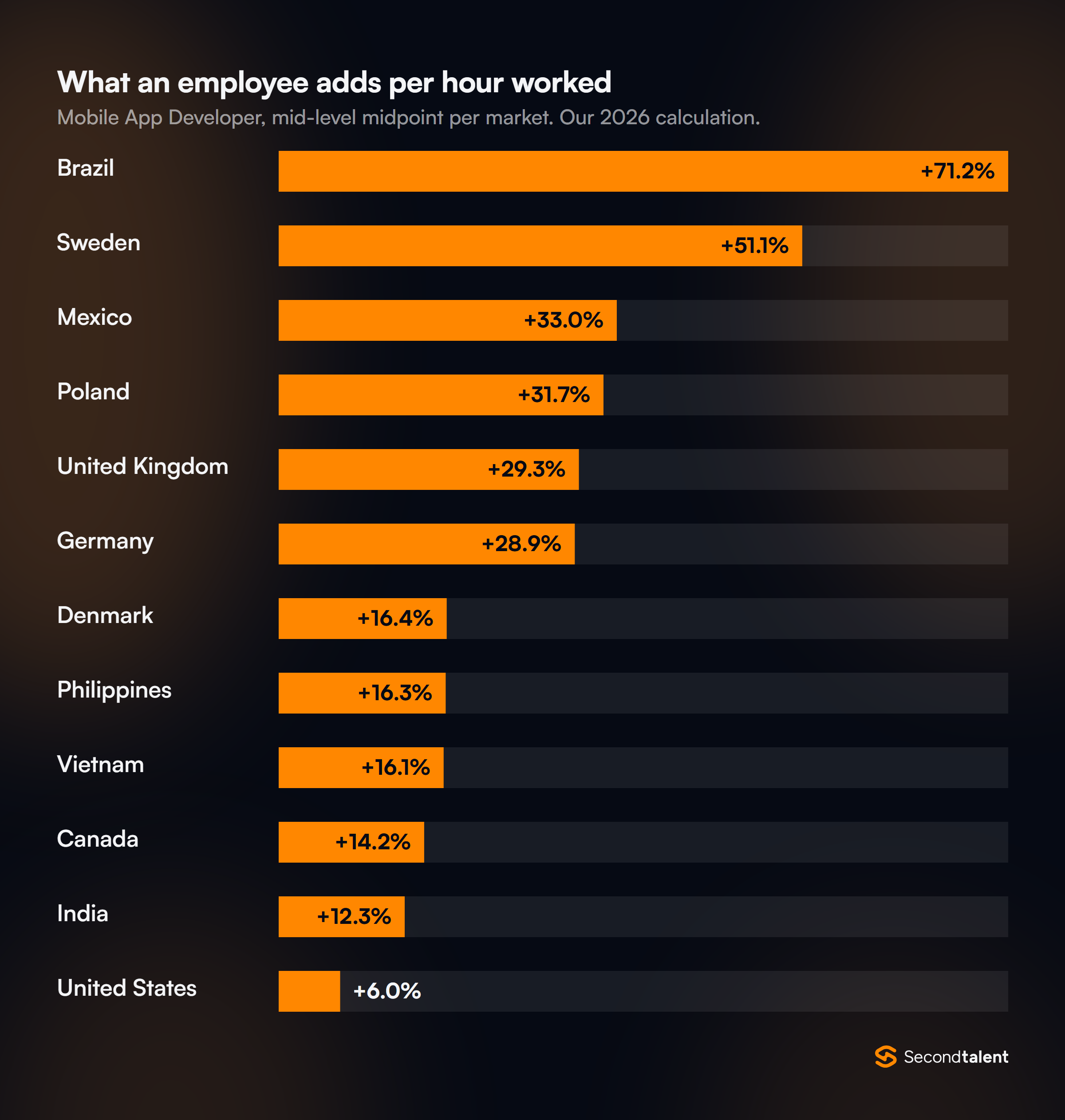
The rates above are contractor rates: you pay for hours worked and nothing else.
Questions buyers ask
How much does it cost to hire a mobile app developer in the United States?
A mid-level freelance mobile app developer in the United States costs $108 to $165 an hour, which is $17,280 to $26,400 a month at 160 billable hours. Junior rates run $85 to $127 and senior rates $140 to $210. The range is derived from a published US employee median of $170,000 a year, loaded with the payroll, insurance and leave costs a contractor carries themselves rather than an employer.
What is the per hour rate of a mobile app developer?
It depends almost entirely on where they are. A mid-level mobile app developer bills $108 to $165 an hour in the United States, $108 to $165 in Canada, and $25 to $65 in India, the cheapest of the ten markets on this page. Seniority moves the rate about 2.5x from junior to staff level, following the wage distribution the US Bureau of Labor Statistics publishes for software developers.
How much does a freelance mobile app developer cost per month?
At 160 billable hours, a mid-level mobile app developer costs $17,280 to $26,400 a month in the United States and $4,000 to $10,400 a month in India. Freelance engagements are billed on hours worked, so a month with fewer billable hours costs proportionally less, which is the main way this differs from a salary.
Is it cheaper to hire a mobile app developer freelance, in-house or through an agency?
At mid-level in the United States a freelancer bills $108 to $165 an hour, an employee costs $120 to $180 once recruiting, equipment and management are loaded on, and an agency bills $205 to $340, which is 1.5 to 2.5 times the individual rate for a project manager and cover if someone leaves. Freelance wins on short or uncertain scope because you can stop paying. Employment wins once the work outlasts a year.
Which platform is cheapest for hiring mobile app developers?
On fees, Arc charges nothing on hourly work and Upwork takes 3% to 10%, the lowest of the channels that publish anything; Toptal publishes none. On rates, Upwork spans $25 to $150 an hour and Fiverr $25 to $100, against $70 to $200 on a vetted network. The channel is the smallest lever you have: fees span 0% to 25%, while on this page geography moves the same hour about 4.3x and seniority about 2.6x.
Why do mobile quotes rarely come in hourly?
Because a meaningful share of mobile effort is not development. Store setup, review cycles, provisioning, certificates and device testing are hard to bill honestly by the hour, so many mobile freelancers quote per milestone instead. Ask for the hourly equivalent so you can compare it against this page, and confirm whether store submission and review turnaround sit inside the quote or outside it.
Does the app store cut affect what I pay a developer?
No, that is a revenue cost rather than a build cost, and it does not touch what you pay a developer. It is worth raising early anyway, because a 15 to 30% platform cut changes whether the monetisation model you are asking to be built makes sense at all. A developer who asks about it before quoting is telling you something useful about how they think.
Other stacks
Hiring a mobile app developer?
These are freelance market rates, published so you can sanity-check a quote. If you are hiring permanently instead, the salary rate cards price employment by country and role. We also place pre-vetted engineers across nine Asian markets.
Compare all roles Salary rate cards