
While most AI headlines still focus on Silicon Valley, the most advanced image generation in 2026 is increasingly coming out of China. Chinese labs no longer just catch up to Western models. On open benchmarks like the Artificial Analysis Text-to-Image leaderboard, their models now sit at the top of the open-source rankings.
Built for multimodal input and trained on massive, culturally tuned datasets, these models are practical production tools. They render flawless Chinese and English text inside images, follow long prompts, and edit existing pictures with precision. Several are fully open source under the Apache 2.0 license, so teams can self-host them at no licensing cost.
This guide lists the five best Chinese image generation models as of June 2026, with a screenshot, key features, pros and cons, and pricing for each. The lineup has changed fast, so we have refreshed it with the current leaders rather than last year’s names.
| Did You Know? Some of the most advanced AI image generation models today are not from Silicon Valley but from China. In late 2025 and early 2026, Alibaba’s Z-Image-Turbo became the top open-source model on the Artificial Analysis Text-to-Image leaderboard, and Tencent’s HunyuanImage 3.0 shipped as an 80 billion parameter open model. |
What’s your AI development priority?
Select your situation below.
Building image generation features or custom AI models requires specialized talent. Our AI developers in Southeast Asia cost 60-70% less than US rates while delivering enterprise-grade ML expertise. You get vetted engineers who’ve shipped production AI systems. Hire AI developers →
When you need to scale quickly without the overhead of entity setup, our EOR service handles compliance, payroll, and benefits across Asia. You focus on building; we handle the legal complexity. Deploy developers in 14 days, not months. Get EOR pricing →
Integrating Chinese image models into your existing systems requires backend engineers who understand API architecture and model deployment. Our backend developers in Vietnam and Philippines average $3,500-$5,000/month with strong Python and cloud experience. Hire backend engineers →
Planning your AI team budget? Our 2026 salary index shows AI/ML engineers in Vietnam cost $42K-$72K annually versus $150K+ in the US. You’ll see real market rates across 5 countries, 15+ roles, and multiple seniority levels. View salary benchmarks →
What Makes Chinese AI Image Models Unique?
China‘s leading tech firms are pushing image generation hard, and several of their 2026 models now match or beat Western systems on quality and text rendering. They produce rich, high-resolution visuals that handle both global and regional styles with ease.
Key traits that set these models apart in 2026:
- Best-in-class rendering of Chinese (Hanzi) and English text directly inside images
- Unified architectures that both generate and edit images in one model
- Native high-resolution output, up to 2K to 4K on the leading models
- Open weights under Apache 2.0 on several models, so teams can self-host with no licensing cost
The 5 Best Chinese Image Models in 2026 at a Glance
| Model | Developer | Type | License | Best for |
|---|---|---|---|---|
| Seedream 5.0 | ByteDance | Proprietary (API + apps) | Commercial | Top overall quality and 4K output |
| Qwen-Image 2.0 | Alibaba (Qwen) | Open weights | Apache 2.0 | Best open model for text and editing |
| HunyuanImage 3.0 | Tencent | Open weights | Open source | Knowledge-heavy, complex scenes |
| Kolors 2.1 | Kuaishou (Kling AI) | Open weights | Apache 2.0 (code) | Photorealism and bilingual text |
| Z-Image-Turbo | Alibaba (Tongyi) | Open weights | Apache 2.0 | Fast, efficient, runs on one GPU |
1. Seedream 5.0
Best for: The highest overall image quality and very high-resolution output
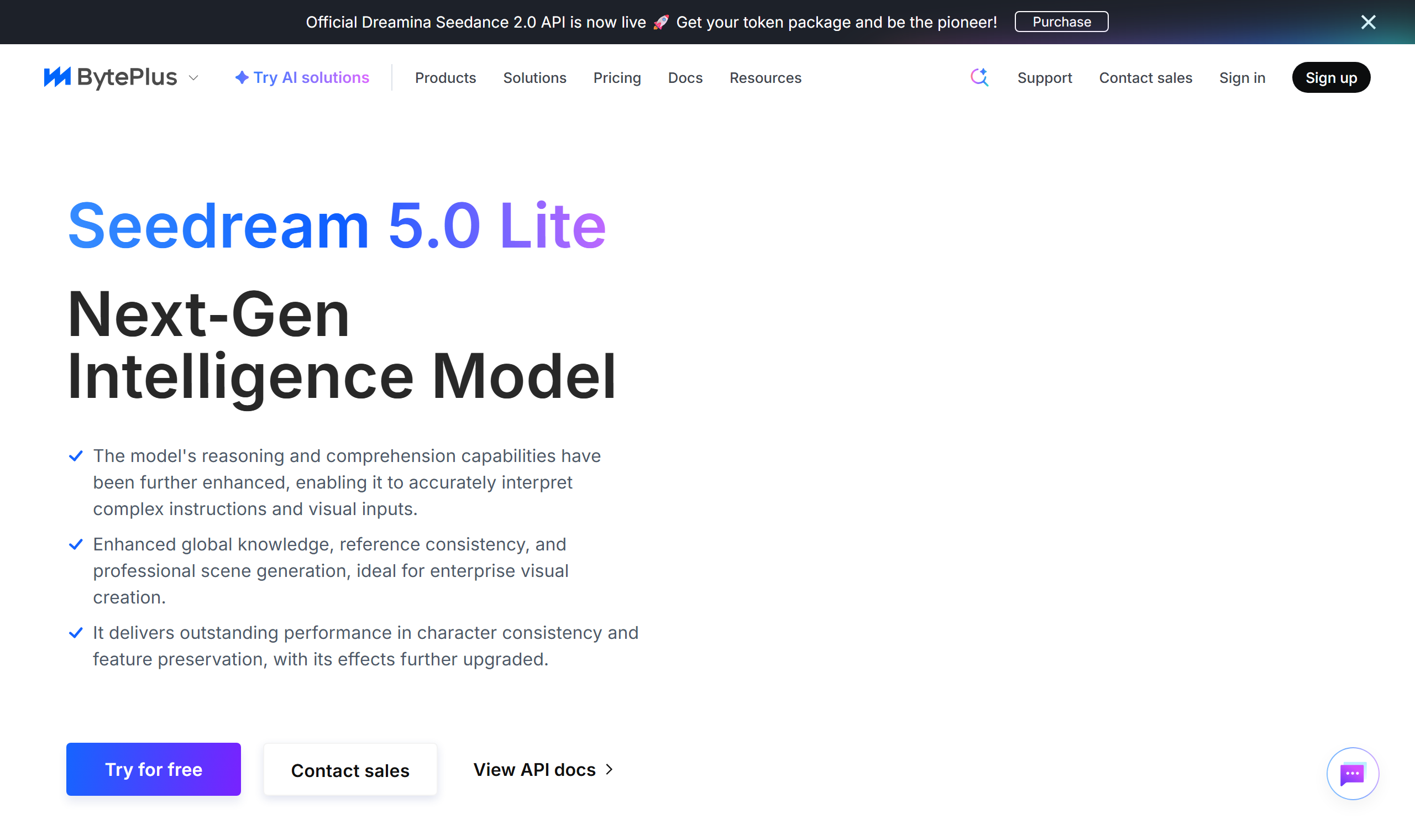
Above: Seedream on BytePlus.
Seedream 5.0 is ByteDance’s flagship image model and the strongest all-round Chinese system in 2026. It ships in several tiers, with 5.0 as the cutting edge alongside the lighter 4.5 and 4.0 versions. The model supports output up to 4096 pixels on the longest edge, which suits print, large displays, and other workflows that need fine detail.
Seedream is closed source. You reach it through ByteDance’s own apps, Doubao and Dreamina, and through the BytePlus API for production use. Its standout features are sharp prompt following, accurate Chinese and English text in images, and strong multi-image editing, where you feed several reference images and combine them in one shot.
Key features:
- Output up to 4096 pixels on the longest edge
- Strong multi-image editing from several reference images
- Accurate Chinese and English text inside images
- Available via the Doubao and Dreamina apps and the BytePlus API
| Pros | Cons |
|---|---|
| Best overall image quality in the group | Closed source, so no self-hosting |
| Very high resolution, up to 4K | Per-image cost adds up at scale |
| Excellent prompt following and editing | Tied to the BytePlus and ByteDance ecosystem |
Pricing: From about $0.035 per image on the Seedream 5.0 Lite API through BytePlus. Consumer access through the Dreamina app starts around $18 per month. The full 5.0 tier costs more per image than Lite.
| ⇨ Seedream 5.0 use cases: High-resolution marketing and ad visuals. Product and e-commerce imagery with clean text. Multi-image composition from several references. Poster, packaging, and print design. Cross-language creative for global campaigns. |
2. Qwen-Image 2.0
Best for: The best open model for text rendering and precise editing
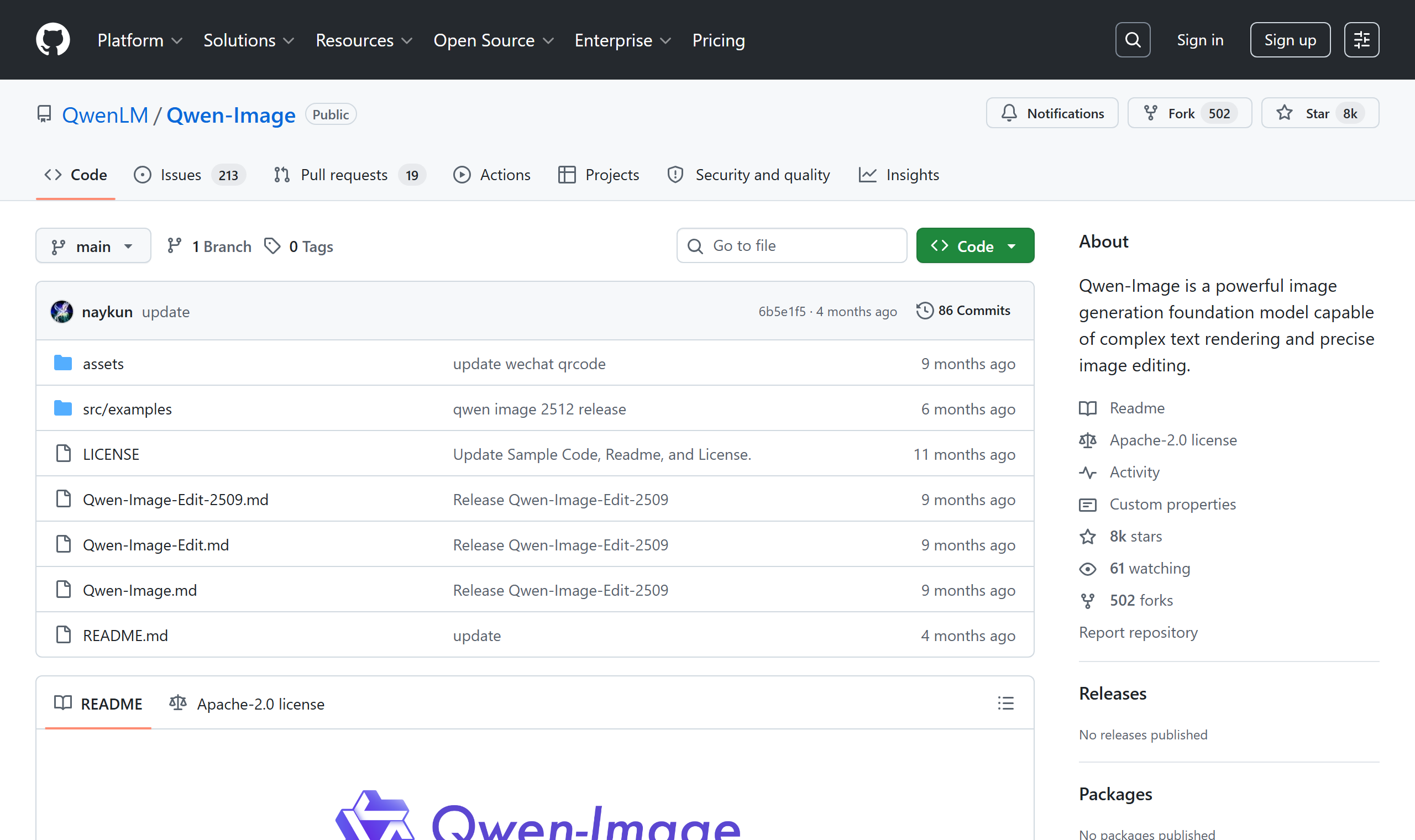
Above: Qwen-Image on GitHub.
Qwen-Image 2.0, released by Alibaba’s Qwen team in February 2026, is the leading open-weight Chinese image model. An earlier build was ranked the strongest open-source image model in AI Arena evaluations, and the 2.0 release builds on that. It is published under the permissive Apache 2.0 license, so teams can run and fine-tune it freely, including for commercial use.
It is built on a 20 billion parameter MMDiT architecture and unifies generation and editing in a single model. Qwen-Image is the model to beat for text. It follows instructions up to 1,000 tokens long, which lets it lay out full infographics, posters, slides, and comics with legible Chinese and English type, and it generates at native 2K resolution.
Key features:
- 20 billion parameter MMDiT, unified generation and editing
- Native 2K resolution output
- Follows instructions up to 1,000 tokens for full layouts
- Apache 2.0 license, free to self-host and fine-tune
| Pros | Cons |
|---|---|
| Best open model for text in images | Needs a capable GPU to self-host |
| Permissive Apache 2.0 license | Slightly behind Seedream on pure photorealism |
| Strong editing and a large ecosystem | Hosted API pricing varies by provider |
Pricing: Free to self-host under Apache 2.0. Pay-per-image on Alibaba Model Studio (DashScope) and third-party hosts such as fal and Replicate, typically a few cents per image.
| ⇨ Qwen-Image 2.0 use cases: Self-hosted image generation with no licensing cost. Infographics, posters, and slides with accurate text. Bilingual Chinese and English design work. Precise edits to existing images. Fine-tuning on a private brand or product dataset. |
3. HunyuanImage 3.0
Best for: Knowledge-heavy prompts and complex, detailed scenes
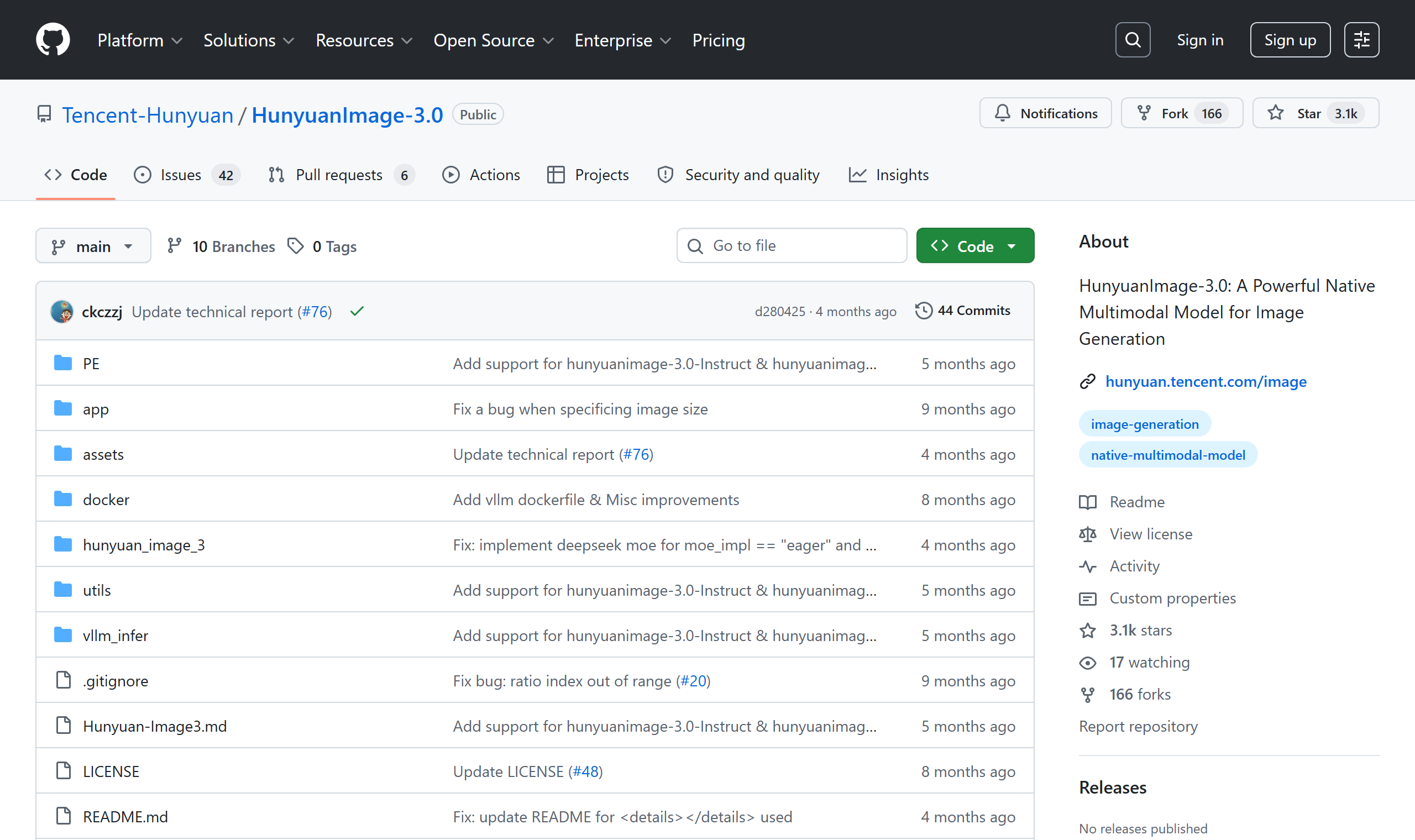
Above: HunyuanImage 3.0 on GitHub.
HunyuanImage 3.0 is Tencent’s open image model, released with a very large 80 billion parameter scale. It uses a mixture-of-experts design that activates about 13 billion parameters at inference, which keeps it usable while giving it deep prompt comprehension and world-knowledge reasoning. It handles prompts that need real understanding of how objects, people, and scenes fit together, not just surface style.
The model is open source, with weights and inference code public, so teams with enough compute can self-host it. Beyond raw generation, it is strong at precise semantic editing, where you describe a change in words and the model applies it to the right part of the image. It is the pick when accuracy and scene logic matter more than speed.
Key features:
- 80 billion parameters, mixture-of-experts with about 13 billion active at inference
- Deep prompt comprehension and world-knowledge reasoning
- Precise, instruction-driven semantic editing
- Open weights and inference code
| Pros | Cons |
|---|---|
| Best for complex, knowledge-heavy scenes | Very large, needs serious GPU compute |
| Open weights you can self-host | Slower generation than lighter models |
| Strong, precise semantic editing | Not tuned for heavy typography work |
Pricing: Free to self-host, though it needs heavy GPU compute. About $0.10 per image on hosted APIs such as Fal.
| ⇨ HunyuanImage 3.0 use cases: Complex scenes with many objects and relationships. Knowledge-intensive prompts that need real-world logic. Precise, instruction-driven semantic edits. Research and benchmarking against frontier models. On-premise deployment for data-sensitive teams. |
4. Kolors 2.1
Best for: Photorealism with reliable Chinese and English text
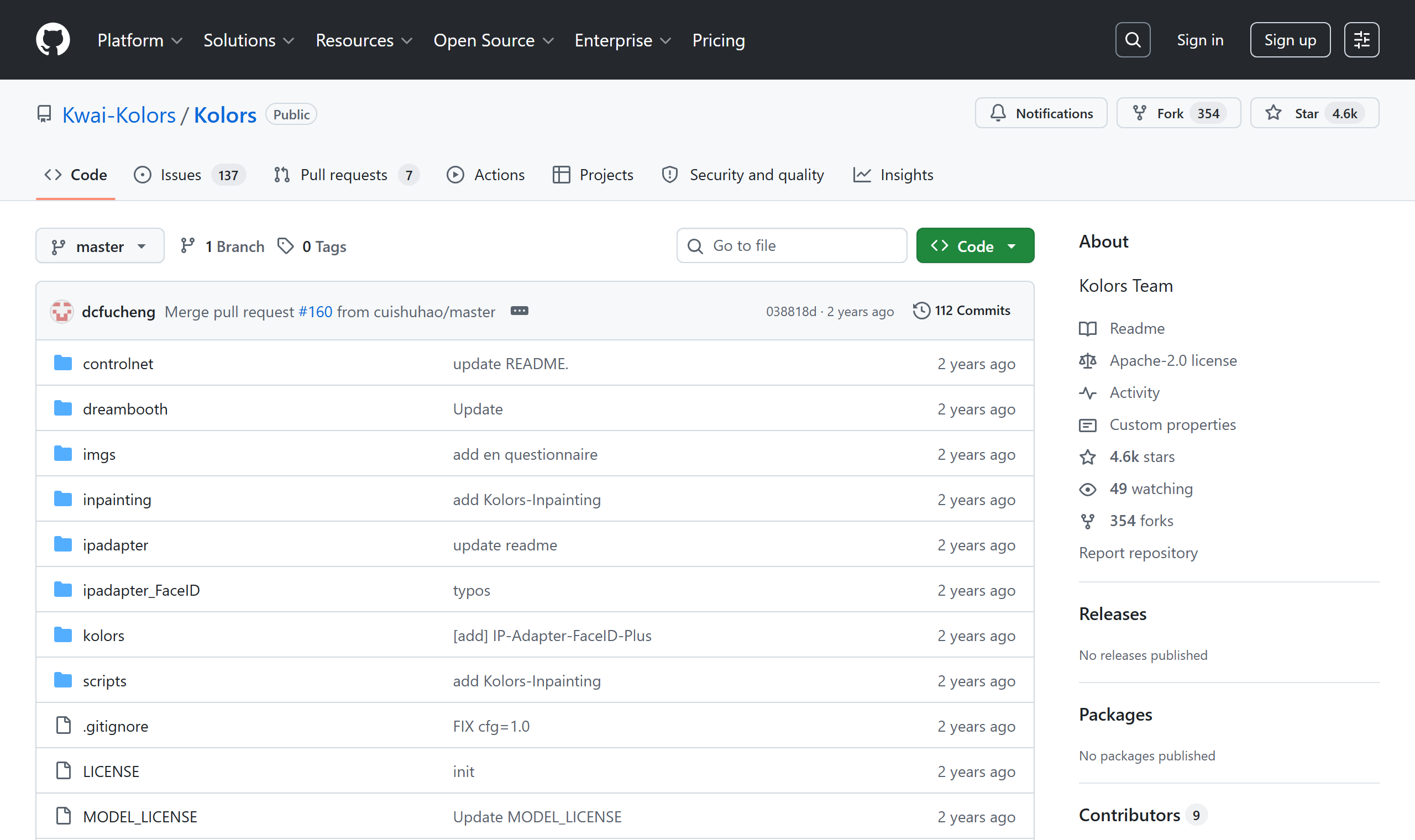
Above: Kolors on GitHub.
Kolors 2.1, from Kuaishou’s Kolors team and offered through Kling AI, is a latent diffusion model trained on billions of text-image pairs. It is known for strong photorealism, accurate complex semantics, and clean text rendering in both Chinese and English. It uses a GLM-based text encoder, which is part of why it reads prompts so well.
The code is open under Apache 2.0. Academic use is fully open, while commercial use asks teams to register with the Kolors team first. Kolors has a large user base and good ecosystem support, including ComfyUI and Diffusers, which makes it easy to slot into existing pipelines.
Key features:
- Latent diffusion trained on billions of text-image pairs
- Strong photorealism and bilingual text rendering
- GLM-based text encoder for accurate prompt reading
- Open weights with strong ComfyUI and Diffusers support
| Pros | Cons |
|---|---|
| Strong, reliable photorealism | Commercial use requires registration |
| Very cheap hosted pricing | Less leading on typography than Qwen-Image |
| Easy to slot into ComfyUI and Diffusers | Smaller than the 80B Hunyuan on complex logic |
Pricing: Free to self-host, with commercial use requiring registration. About $0.01 per image through Kling AI.
| ⇨ Kolors 2.1 use cases: Photorealistic portraits, products, and scenes. Bilingual posters and social graphics. Pipelines built on ComfyUI or Diffusers. Character and style consistency across a set. Cost-controlled self-hosting for steady volume. |
5. Z-Image-Turbo
Best for: Fast, efficient generation that runs on a single GPU
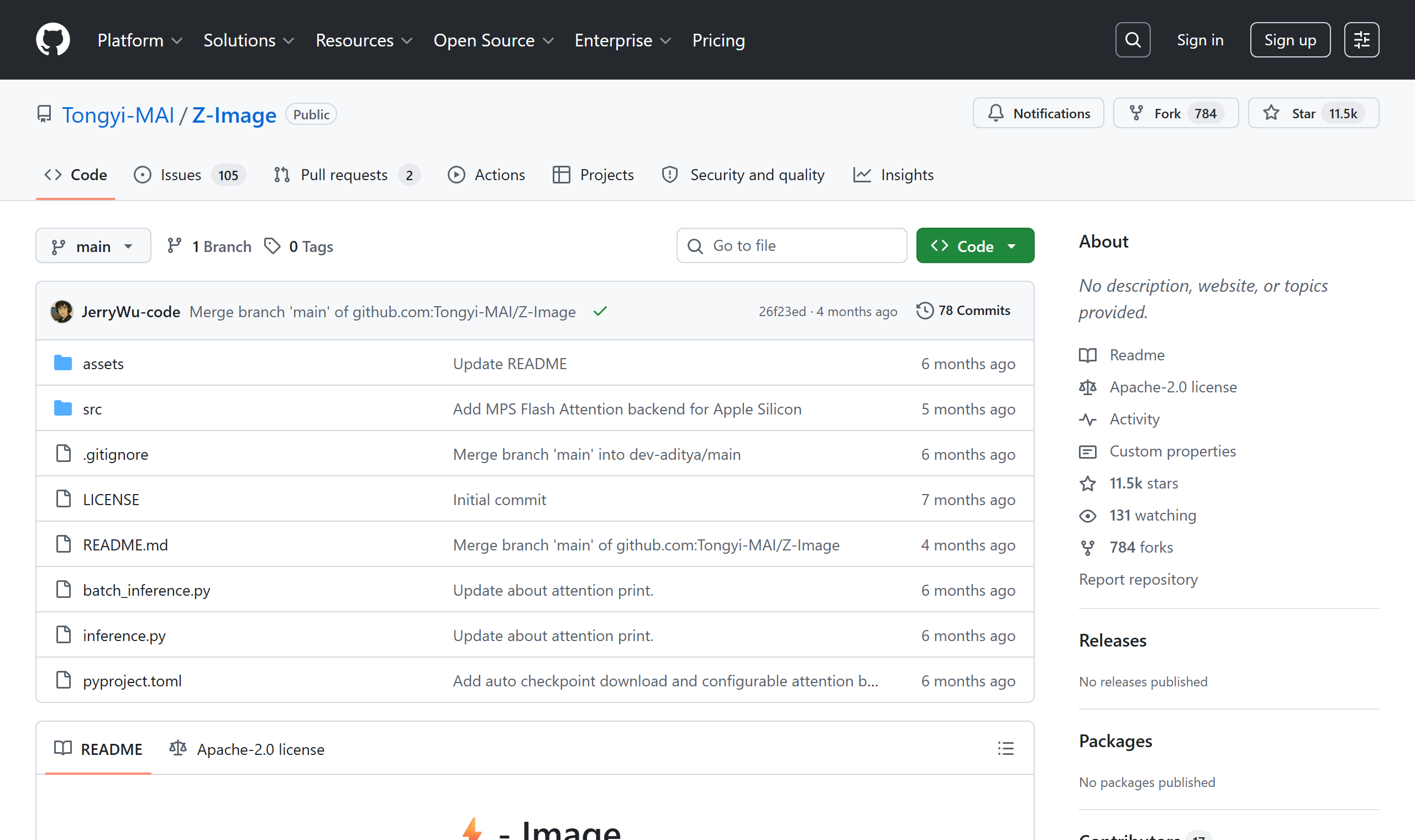
Above: Z-Image on GitHub.
Z-Image-Turbo, from Alibaba’s Tongyi Lab, launched in late January 2026 and quickly became the top open-source model on the Artificial Analysis Image Arena, ranking ahead of FLUX.2 [dev], HunyuanImage 3.0, and Qwen-Image. It is released under Apache 2.0.
Its edge is efficiency. The Turbo build is a compact 6 billion parameter single-stream diffusion transformer that needs only a few sampling steps, so it generates in under a second and runs on a single consumer GPU instead of a server rack. It also renders English and Chinese text with high clarity and stable layout. For teams that want strong quality without heavy hardware, this is the standout.
Key features:
- Compact 6 billion parameter single-stream diffusion transformer
- Sub-second generation on a single consumer GPU
- Number one open-source model on the Artificial Analysis Image Arena
- Apache 2.0 license, with clear English and Chinese text
| Pros | Cons |
|---|---|
| Fastest and most efficient in the group | Smaller model, less depth on very complex scenes |
| Runs on modest, single-GPU hardware | Newer, with a smaller ecosystem so far |
| Top open-source ranking, very low cost | Turbo trades some fidelity for speed |
Pricing: Free to self-host under Apache 2.0. About $0.005 per image on hosted APIs, the cheapest in this lineup.
| ⇨ Z-Image-Turbo use cases: Fast generation on limited hardware. Real-time or high-volume image features. Local and on-device prototypes. Text-heavy graphics in English and Chinese. Cost-efficient self-hosting at scale. |
Pricing Compared
The open models cost nothing to run if you have the hardware. On hosted APIs, prices range from half a cent to about ten cents per image. This table sums up access and cost across the five.
| Model | Access | Pricing (2026) |
|---|---|---|
| Seedream 5.0 | API and apps (closed) | From ~$0.035/image (5.0 Lite, BytePlus); Dreamina from ~$18/mo |
| Qwen-Image 2.0 | Open (Apache 2.0) and API | Free to self-host; a few cents/image hosted |
| HunyuanImage 3.0 | Open source and API | Free to self-host (heavy GPU); ~$0.10/image on Fal |
| Kolors 2.1 | Open weights and API | Free to self-host (commercial reg.); ~$0.01/image via Kling AI |
| Z-Image-Turbo | Open (Apache 2.0) and API | Free to self-host; ~$0.005/image hosted |
| Before you go, Want to know who’s building these powerful image-generation tools? See China’s Top AI Companies |
Which Model Is Right for You?
The right fit comes down to your needs and your hardware. For the best overall quality and the highest resolution, Seedream 5.0 leads, though it is closed and API-only. If you want an open model you can self-host and fine-tune, Qwen-Image 2.0 is the strongest all-round pick, especially for anything with text.
For complex, knowledge-heavy scenes, HunyuanImage 3.0 has the depth, if you have the compute to run an 80 billion parameter model. Kolors 2.1 is a reliable choice for photorealism with good ecosystem support. And if speed and limited hardware are your constraint, Z-Image-Turbo gives you near-frontier quality on a single GPU.
These tools are no longer just for experiments. They are production-ready and are changing how teams automate, customize, and scale visual content across industries. The field moves quickly, so the real edge is knowing which model fits each job, and having engineers who can deploy and tune them well.
If you are building image features and need that talent, our vetted AI and backend engineers across Asia ship production systems at a fraction of US cost. Tell us what you are building and we will match you in about 24 hours.


![How to Hire Developers in Asia Remotely. How to Hire Developers in Asia Remotely from the USA [2026], by Second Talent.](https://www.secondtalent.com/wp-content/uploads/2026/09/hire-developers-in-asia-remotely-featured-v2-768x403.jpg)
![AI Outsourcing in Singapore. Top 10 AI Outsourcing Companies in Singapore [2026], by Second Talent.](https://www.secondtalent.com/wp-content/uploads/2026/09/ai-outsourcing-companies-singapore-featured-v2-768x403.jpg)
![AI Outsourcing in India. Top 10 AI Outsourcing Companies in India [2026], by Second Talent.](https://www.secondtalent.com/wp-content/uploads/2026/09/ai-outsourcing-companies-india-featured-v2-768x403.jpg)