Cost to Hire a Full-Stack Developer
A mid-level freelance or contract full-stack developer in the United States costs $85 to $135 an hour, before the payroll, insurance and leave benefits.
 By Jack Ng, General Manager
Data verified by Jack Ng and the Second Talent internal team
By Jack Ng, General Manager
Data verified by Jack Ng and the Second Talent internal team
Updated quarterly · 25 September 2026
United States
$85-$135/hr
$13,600-$21,600 a month
-
-
Difference
-
per month at 160 hours
| Region | Hourly | Per month | vs United States | Spread |
|---|---|---|---|---|
| United States The benchmark benchmark measured | $85-$135 | $13,600-$21,600 | benchmark | |
| Western Europe UK, DE, FR measured | $45-$72 | $7,200-$11,520 | −47% | |
| Latin America BR, AR, MX, CO vendor data | $44-$70 | $7,040-$11,200 | −48% | |
| Southeast Asia VN, PH, ID, MY, TH vendor data | $37-$59 | $5,920-$9,440 | −56% | |
| Australia & NZ Sydney, Melbourne, AKL vendor data | $82-$131 | $13,120-$20,960 | −3% | |
| Northern Europe Nordics, Baltics vendor data | $73-$116 | $11,680-$18,560 | −14% | |
| Eastern Europe PL, RO, UA vendor data | $50-$80 | $8,000-$12,800 | −41% | |
| Africa NG, KE, EG, ZA vendor data | $34-$54 | $5,440-$8,640 | −60% | |
| South Asia IN, PK, BD measured | $19-$30 | $3,040-$4,800 | −78% |
Application & backend band. The reference band. Full-stack sits at the midpoint of freelance application work.
Freelance vs in-house vs agency
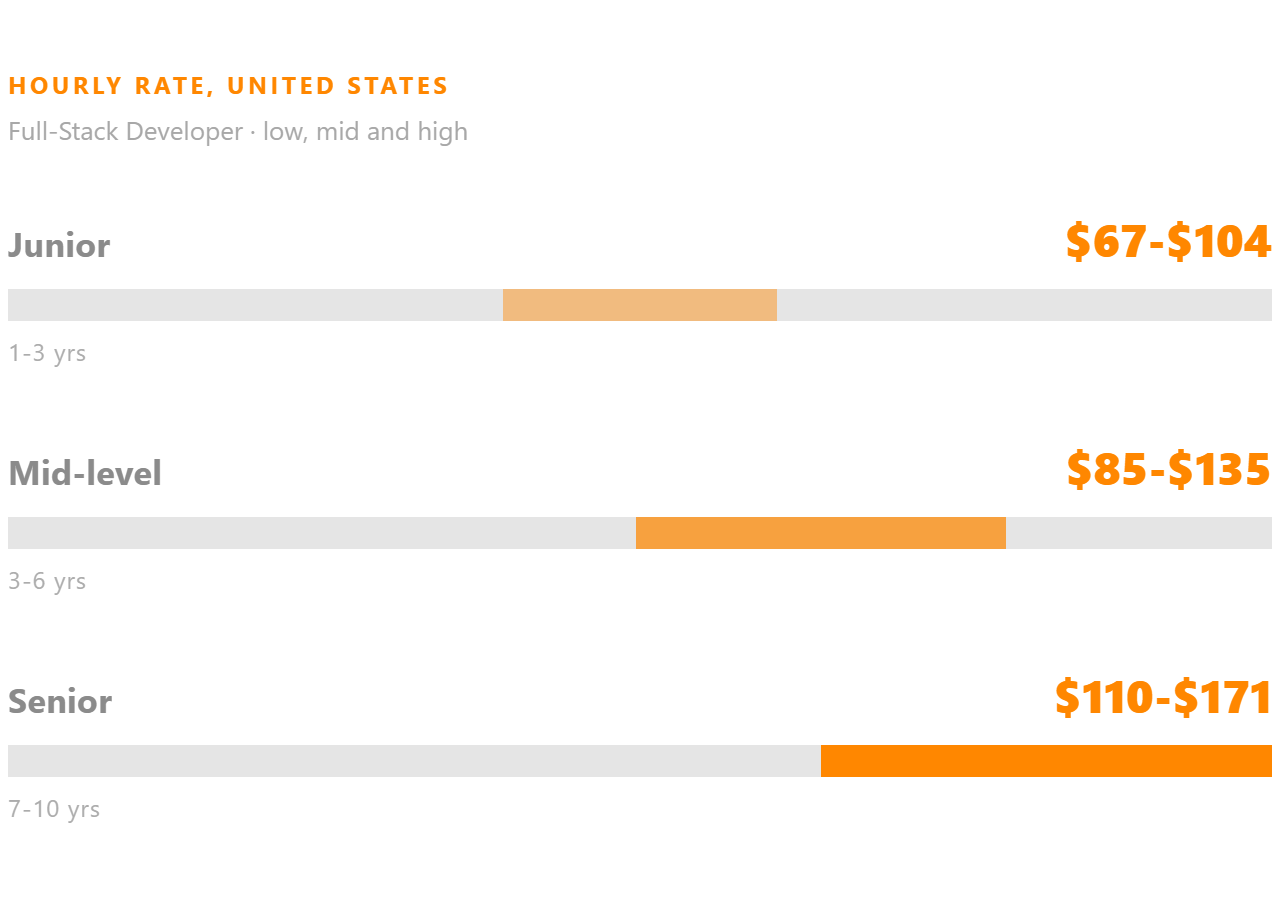
United States, in US dollars per hour, at each seniority level.
| Model | Junior1-3 yrs | Mid-level3-6 yrs | Senior7-10 yrs |
|---|---|---|---|
| Freelance or contract | $67-$104 | $85-$135 | $110-$171 |
| In-house employee | $75-$115 | $95-$150 | $120-$190 |
| Agency or dev shop | $130-$215 | $165-$275 | $210-$350 |
Full-Stack Developer rates in the top 10 hiring markets
Mid-level hourly rate, Sep, 2026. Every figure is the United States band scaled by that market's published compensation ratio. Three of the ten have a country median published by name and three carry the rates we quote and place at in that market; the rest carry their region's ratio and are marked as such.
| # | Country | Hourly rate | Monthly at 160 hrs | Basis |
|---|---|---|---|---|
| 1 | United States | $85-$135 | $13,600-$21,600 | country median |
| 2 | Canada | $85-$135 | $13,600-$21,600 | regional |
| 3 | United Kingdom | $53-$84 | $8,480-$13,440 | country median |
| 4 | Germany | $47-$74 | $7,520-$11,840 | country median |
| 5 | Sweden | $73-$116 | $11,680-$18,560 | regional |
| 6 | Denmark | $73-$116 | $11,680-$18,560 | regional |
| 7 | Brazil | $44-$70 | $7,040-$11,200 | regional |
| 8 | Mexico | $44-$70 | $7,040-$11,200 | regional |
| 9 | Vietnam | $28-$68 | $4,480-$10,880 | observed rates |
| 10 | Philippines | $22-$58 | $3,520-$9,280 | observed rates |
| 11 | Poland | $50-$80 | $8,000-$12,800 | regional |
| 12 | India | $20-$52 | $3,200-$8,320 | observed rates |
- United States $85-$135/hr
- A mid-level full-stack developer in the United States costs $85 to $135 an hour, which is $13,600 to $21,600 a month at 160 billable hours. Junior rates run $67 to $104 and senior rates $110 to $171. The benchmark every other market on this list is measured against, and the only one priced from a published US wage median rather than a ratio.
- Canada $85-$135/hr
- A mid-level full-stack developer in Canada costs $85 to $135 an hour, which is $13,600 to $21,600 a month at 160 billable hours. Junior rates run $67 to $104 and senior rates $110 to $171. Time zone overlap rather than rate is the reason teams choose it: it prices level with the United States, is usually billed in USD, and the saving against a US hire is small.
- United Kingdom $53-$84/hr
- A mid-level full-stack developer in the United Kingdom costs $53 to $84 an hour, which is $8,480 to $13,440 a month at 160 billable hours. Junior rates run $42 to $64 and senior rates $68 to $106. The closest large market to US rates anywhere, at a published full-stack median of 0.62x the US figure, the highest ratio here except Canada.
- Germany $47-$74/hr
- A mid-level full-stack developer in Germany costs $47 to $74 an hour, which is $7,520 to $11,840 a month at 160 billable hours. Junior rates run $37 to $57 and senior rates $61 to $94. Deep enterprise and industrial software supply, at a published full-stack median of 0.55x the US figure, concentrated around Berlin and Munich.
- Sweden $73-$116/hr
- A mid-level full-stack developer in Sweden costs $73 to $116 an hour, which is $11,680 to $18,560 a month at 160 billable hours. Junior rates run $58 to $89 and senior rates $95 to $147. The largest Nordic talent market, concentrated around Stockholm, with full overlap with the European working day and consistently high English proficiency.
- Denmark $73-$116/hr
- A mid-level full-stack developer in Denmark costs $73 to $116 an hour, which is $11,680 to $18,560 a month at 160 billable hours. Junior rates run $58 to $89 and senior rates $95 to $147. A small, high-cost Nordic market with deep product and design supply, and the same European working-day overlap as Sweden.
- Brazil $44-$70/hr
- A mid-level full-stack developer in Brazil costs $44 to $70 an hour, which is $7,040 to $11,200 a month at 160 billable hours. Junior rates run $35 to $54 and senior rates $57 to $89. The largest talent market in Latin America and the closest time zone match for US East Coast teams.
- Mexico $44-$70/hr
- A mid-level full-stack developer in Mexico costs $44 to $70 an hour, which is $7,040 to $11,200 a month at 160 billable hours. Junior rates run $35 to $54 and senior rates $57 to $89. Nearshore for the United States, with same-day overlap across every US time zone and supply growing faster than Brazil's.
- Vietnam $28-$68/hr
- A mid-level full-stack developer in Vietnam costs $28 to $68 an hour, which is $4,480 to $10,880 a month at 160 billable hours. Junior rates run $18 to $30 and senior rates $40 to $95. The widest gap to US rates of the Southeast Asian markets, though overlap with US hours requires a shifted schedule.
- Philippines $22-$58/hr
- A mid-level full-stack developer in the Philippines costs $22 to $58 an hour, which is $3,520 to $9,280 a month at 160 billable hours. Junior rates run $16 to $28 and senior rates $32 to $80. The highest English proficiency in Southeast Asia, and night-shift working for US overlap is well established.
- Poland $50-$80/hr
- A mid-level full-stack developer in Poland costs $50 to $80 an hour, which is $8,000 to $12,800 a month at 160 billable hours. Junior rates run $40 to $61 and senior rates $65 to $101. The largest and most established talent market in Eastern Europe, with full overlap with the UK and European working day.
- India $20-$52/hr
- A mid-level full-stack developer in India costs $20 to $52 an hour, which is $3,200 to $8,320 a month at 160 billable hours. Junior rates run $14 to $24 and senior rates $30 to $72. Stack Overflow's India medians run from 0.10x the US figure to 0.26x depending on the role read, so a single India rate means very little on its own.
Hiring Costs by Platforms and Marketplaces
Buyer fees as each channel publishes them, read on 27 August 2026. Hourly rates are market ranges.
| Platform | Buyer fee | Typical hourly rate |
|---|---|---|
| Upwork | 3% to 10%, plus $0.99 to $14.99 per contract | $25 to $150 an hour |
| Fiverr | 5.5%, plus $3.50 under $200 | $25 to $100 an hour |
| Toptal | Not published | $70 to $200 an hour |
| Arc.dev | 0% hourly, 20% of first-year salary permanent | $61 to $100 an hour |
| Agency or dev shop | 0%, margin sits inside the rate | $165 to $275 an hour |
| Recruiter, permanent | 15% to 25% of first-year salary | $20,500 to $34,500 per placement |
| Second Talent | 0% | $3,000 to $6,000 a month |
What really impacts the cost?
Five levers move a full-stack developer rate more than anything else, and specialisation is measurable against a published baseline.
What moves the rate
Effect on the hourly rate, widest to narrowest
Specialisation premiums
US employee medians against a full-stack baseline of $138,000, Stack Overflow 2025
What sets the rate for Full-Stack Developers
Full-stack is the reference rate for freelance application work: broad enough that supply is deep, senior enough that the good ones are not cheap. Most quotes you receive for "a developer" with no further qualification land in this band. It is also the band where the gap between a $60 quote and a $130 quote says the least about quality, because the title is self-assigned and covers everything from a competent React plus Node generalist to someone who has run production infrastructure.
Pushes the rate up
- Owning infrastructure as well as application code. A freelancer who will take the deploy pipeline, monitoring and on-call prices closer to the DevOps band than this one.
- Being the only engineer. Sole-developer engagements carry a premium because there is nobody to hand off to and the risk sits entirely with one person.
Pulls the rate down
- A well-specified backlog. Ambiguity is the single largest hidden cost in a full-stack quote; arriving with designs and acceptance criteria reliably pulls the number down.
- Longer engagements. Three months booked beats three separate one-month projects on rate, because the freelancer is not repricing for the gap between them.
Estimated Cost by Project Scope
Whole-project cost at the mid-level United States rate of $85 to $135 an hour. The hour ranges are estimates and the scope, not the rate, is what usually moves a quote.
Simple MVP or internal tool
$13,000 – $34,000
150 to 250 hours
standard UI, one database, authentication, a handful of screens
Medium complexity product
$34,000 – $81,000
400 to 600 hours
payments, custom APIs, third-party integrations, an admin dashboard
Complex or enterprise platform
$77,000 – $203,000+
900 to 1500 hours
real-time processing, proprietary algorithms, multi-role permissions, high-availability infrastructure
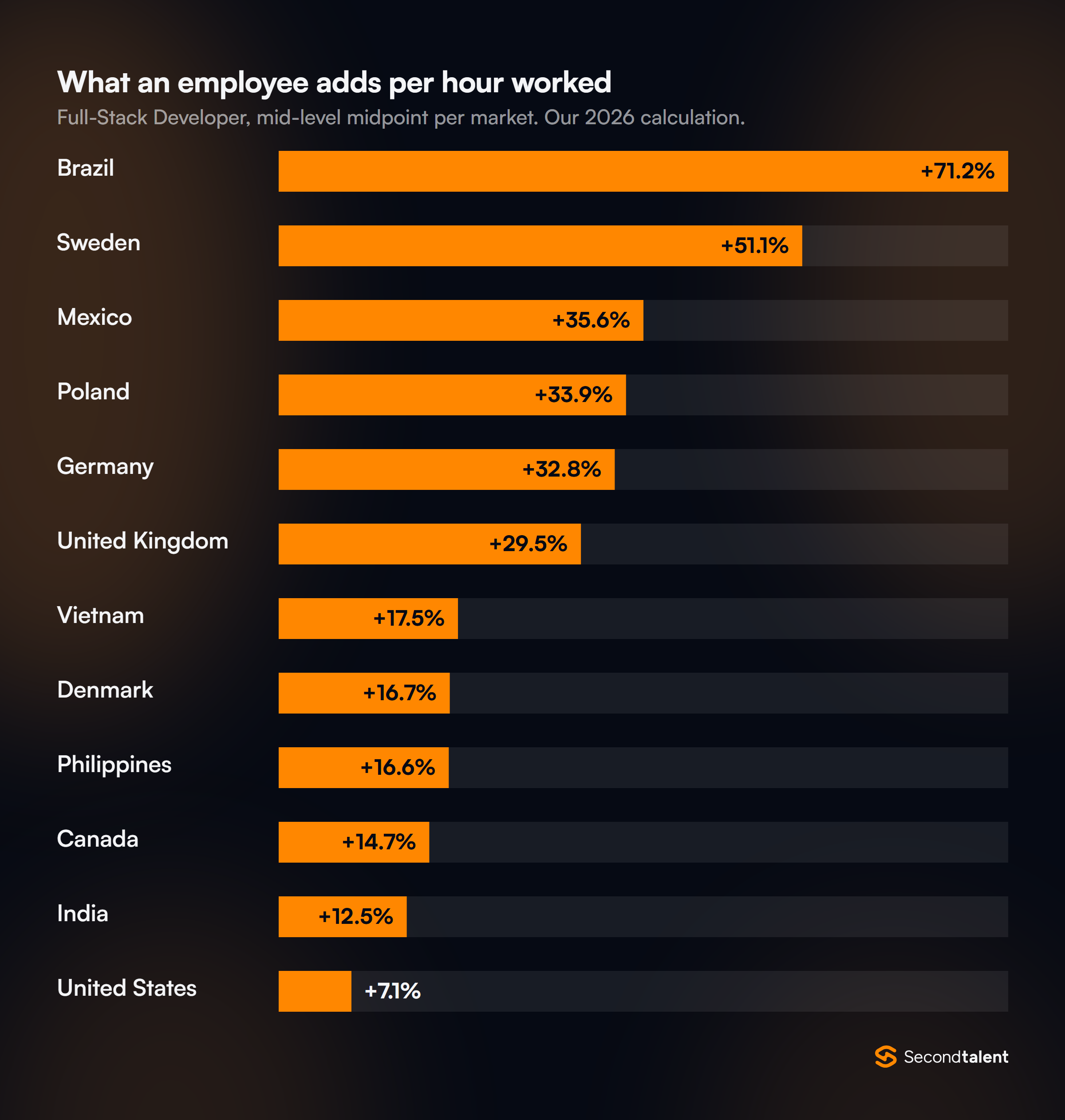
Freelancer or employee?
The rates above are contractor rates: you pay for hours worked and nothing else.
Questions buyers ask
How much does it cost to hire a full-stack developer in the United States?
A mid-level freelance full-stack developer in the United States costs $85 to $135 an hour, which is $13,600 to $21,600 a month at 160 billable hours. Junior rates run $67 to $104 and senior rates $110 to $171. The range is derived from a published US employee median of $138,000 a year, loaded with the payroll, insurance and leave costs a contractor carries themselves rather than an employer.
What is the per hour rate of a full-stack developer?
It depends almost entirely on where they are. A mid-level full-stack developer bills $85 to $135 an hour in the United States, $85 to $135 in Canada, and $20 to $52 in India, the cheapest of the ten markets on this page. Seniority moves the rate about 2.5x from junior to staff level, following the wage distribution the US Bureau of Labor Statistics publishes for software developers.
How much does a freelance full-stack developer cost per month?
At 160 billable hours, a mid-level full-stack developer costs $13,600 to $21,600 a month in the United States and $3,200 to $8,320 a month in India. Freelance engagements are billed on hours worked, so a month with fewer billable hours costs proportionally less, which is the main way this differs from a salary.
Is it cheaper to hire a full-stack developer freelance, in-house or through an agency?
At mid-level in the United States a freelancer bills $85 to $135 an hour, an employee costs $95 to $150 once recruiting, equipment and management are loaded on, and an agency bills $165 to $275, which is 1.5 to 2.5 times the individual rate for a project manager and cover if someone leaves. Freelance wins on short or uncertain scope because you can stop paying. Employment wins once the work outlasts a year.
Which platform is cheapest for hiring full-stack developers?
On fees, Arc charges nothing on hourly work and Upwork takes 3% to 10%, the lowest of the channels that publish anything; Toptal publishes none. On rates, Upwork spans $25 to $150 an hour and Fiverr $25 to $100, against $70 to $200 on a vetted network. The channel is the smallest lever you have: fees span 0% to 25%, while on this page geography moves the same hour about 4.3x and seniority about 2.6x.
Is a full-stack freelancer cheaper than hiring two specialists?
On hourly rate, yes. On delivered work, only up to a point. One person cannot parallelise, so a two-specialist team ships a given scope faster in wall-clock time even though it costs more per hour. Below roughly 400 hours of scope the single full-stack freelancer is usually the better economics; above it the coordination saving stops covering the throughput loss.
Why do full-stack quotes vary so much for the same brief?
Because the title is unregulated and the scope is usually assumed rather than stated. The band spans generalists strongest in the browser and engineers comfortable in a database and a deploy pipeline, and the cheaper quote often excludes infrastructure the dearer one includes. Ask what the candidate shipped most recently and who operated it in production; that separates the two halves of the band faster than any rate negotiation.
Should I pay hourly or a fixed project price?
Hourly when the scope will move, which for full-stack work it usually does. Fixed price transfers scope risk to the freelancer and they price that risk in, typically at 20 to 40% above what the same work bills hourly. Fixed price is worth the premium when the deliverable is genuinely fixed and you would rather not manage the variance yourself. Anything described as a phase one is not fixed.
Other stacks
Hiring a full-stack developer?
These are freelance market rates, published so you can sanity-check a quote. If you are hiring permanently instead, the salary rate cards price employment by country and role. We also place pre-vetted engineers across nine Asian markets.
Compare all roles Salary rate cards