TL;DR: Compare synthetic data and human annotation for AI training. Learn when each approach works best, their cost-quality trade-offs, and how to combine them effectively.
What’s your AI training challenge?
Select your situation below.
You’re working with limited resources but need quality training data. Synthetic data can reduce your annotation costs by up to 70% compared to traditional human labeling. Our Southeast Asian AI teams help you balance cost and quality effectively. See AI developer rates →
Your model accuracy depends on precise, nuanced annotations that synthetic data can’t replicate. You need skilled annotators who understand context and edge cases. Our vetted data engineering teams deliver 95%+ annotation accuracy for complex AI projects. Hire data engineers →
You need thousands of labeled examples quickly to meet your model deployment deadline. Combining synthetic generation with human validation gives you speed without sacrificing quality. Our talent sourcing finds specialized AI teams within 2 weeks. Scale your AI team →
You’re handling sensitive data subject to GDPR or healthcare regulations. Synthetic data eliminates privacy risks while maintaining statistical properties of real data. Our EOR services ensure your global AI team meets all compliance requirements. Get EOR compliance support →
As machine learning models grow more sophisticated, the demand for training data has exploded. Two primary approaches have emerged to meet this demand: synthetic data generation and human annotation. Each has distinct advantages, limitations, and ideal use cases.
This guide compares synthetic data and human annotation across key dimensions including cost, quality, scalability, and compliance. Whether you are building computer vision systems, training language models, or developing autonomous vehicle software, understanding when to use each approach will help you build better models faster.

Quick Comparison: Synthetic Data vs. Human Annotation
| Factor | Synthetic Data | Human Annotation |
|---|---|---|
| Cost per Sample | Very low at scale | Higher, varies by complexity |
| Initial Setup | High (pipeline development) | Low to moderate |
| Scalability | Nearly unlimited | Limited by workforce |
| Edge Case Coverage | Excellent (can generate rare scenarios) | Limited by real-world occurrence |
| Real-World Accuracy | May have domain gap | Reflects actual data distribution |
| Privacy Compliance | No PII concerns | May require anonymization |
| Time to Production | Faster once pipeline exists | Depends on volume and complexity |
| Best For | Pre-training, augmentation, edge cases | Fine-tuning, validation, subjective tasks |
Understanding Synthetic Data
Synthetic data is artificially generated information that mimics the statistical properties of real-world data without being derived from actual events or observations. It can be created through various techniques including rule-based generation, simulation engines, and generative AI models.
Types of Synthetic Data
Fully synthetic data is generated entirely from scratch using mathematical models or simulations. Examples include 3D-rendered images for computer vision, simulated sensor data for robotics, or procedurally generated text for NLP. This approach offers maximum control over data properties but may lack real-world nuances.
Partially synthetic data augments real data by modifying existing samples. Techniques include image transformations (rotation, cropping, color adjustment), text paraphrasing, or audio pitch shifting. This preserves real-world characteristics while expanding dataset size and diversity.
Hybrid synthetic data combines elements of real and generated content. For example, placing 3D-rendered objects into real photographs or injecting synthetic edge cases into real datasets. Hybrid approaches often achieve the best balance of coverage and realism.
Advantages of Synthetic Data
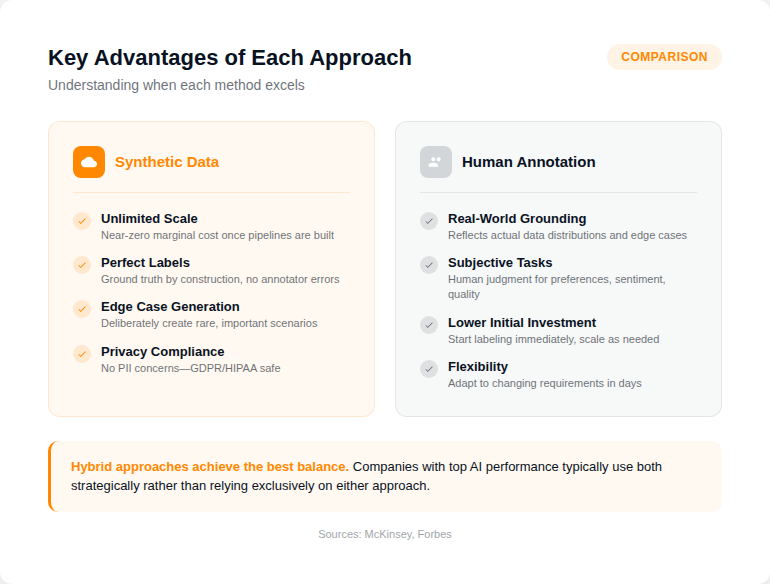
Unlimited scale: Once generation pipelines are built, producing additional samples has near-zero marginal cost. You can generate millions of training examples without the linear cost increase of human annotation.
Perfect labels: Synthetic data comes with ground truth labels by construction. There is no inter-annotator disagreement or labeling errors because the labels are inherent to the generation process.
Edge case generation: Real-world datasets often lack rare but important scenarios. Synthetic data can deliberately generate edge cases, failure modes, and unusual conditions that might take years to collect naturally.
Privacy compliance: Synthetic data contains no personally identifiable information, eliminating GDPR, HIPAA, and other privacy concerns. This is particularly valuable for healthcare, financial, and other regulated industries.
Limitations of Synthetic Data
Domain gap: Models trained on synthetic data may not generalize perfectly to real-world conditions. The statistical distribution of synthetic data, no matter how carefully crafted, differs from reality in subtle ways that can impact model performance.
High initial investment: Building robust synthetic data pipelines requires significant engineering effort. 3D modeling, physics simulation, or training generative models all demand specialized skills and compute resources.
Unknown unknowns: Synthetic generation can only include scenarios that developers anticipate. Real-world data captures unexpected situations that generation pipelines might miss.
Understanding Human Annotation
Human annotation involves trained workers labeling real-world data according to defined guidelines. This can range from simple classification tasks to complex segmentation, entity recognition, or subjective quality assessments.
Types of Human Annotation
Objective annotation involves clear, deterministic labeling where reasonable annotators would agree. Examples include transcribing audio, identifying objects in images, or extracting structured data from documents. Quality can be measured against ground truth.
Subjective annotation requires human judgment on matters where reasonable people might disagree. Examples include sentiment analysis, content moderation, aesthetic ratings, or helpfulness assessments for AI responses. Quality is measured through inter-annotator agreement rather than absolute correctness.
Expert annotation requires domain specialists for tasks like medical image diagnosis, legal document review, or scientific data interpretation. These annotations command premium rates but provide insights that general annotators cannot.
Advantages of Human Annotation
Real-world grounding: Human-annotated data reflects actual data distributions, edge cases, and messy real-world conditions. Models trained on this data often generalize better to production environments.
Subjective tasks: Many AI applications require human judgment that cannot be synthesized. Preference learning, content moderation, and quality assessment inherently require human perspective.
Lower initial investment: Starting human annotation requires minimal infrastructure. You can begin labeling immediately with platforms like those offered through data annotation outsourcing services, scaling up as needs become clearer.
Flexibility: Human annotators can adapt to changing requirements quickly. New annotation types or guideline updates can be implemented within days rather than requiring pipeline rebuilds.
Limitations of Human Annotation
Cost at scale: Each annotation requires human time, creating linear cost scaling. Large datasets require proportionally large budgets, though working with teams in regions like Vietnam or the Philippines can significantly reduce per-annotation costs.
Quality variance: Human annotators make errors and disagree with each other. Maintaining consistent quality requires training, calibration, and quality assurance processes that add overhead.
Rare event coverage: Real-world data may not contain sufficient examples of rare but important scenarios. Waiting for edge cases to occur naturally can delay model development significantly.
Cost Comparison
Understanding the true costs of each approach requires looking beyond per-sample pricing to total cost of ownership.
Cost Breakdown by Approach
| Cost Category | Synthetic Data | Human Annotation |
|---|---|---|
| Initial Setup | $50,000 – $500,000+ | $1,000 – $10,000 |
| Per-Sample Cost (at scale) | $0.001 – $0.01 | $0.05 – $5.00 |
| Quality Assurance | Validation against real data | 10-20% overhead for audits |
| Iteration Cost | Pipeline updates required | Guideline updates, retraining |
| Break-Even Point | ~100,000 – 1,000,000 samples | Immediate value at any scale |
Synthetic data generation becomes cost-effective at around 100,000 samples for simple use cases, but may require millions of samples to justify investment for complex 3D simulation environments.
When to Use Synthetic Data
Synthetic data excels in specific scenarios where its unique advantages outweigh the domain gap concern.
Pre-Training and Initialization
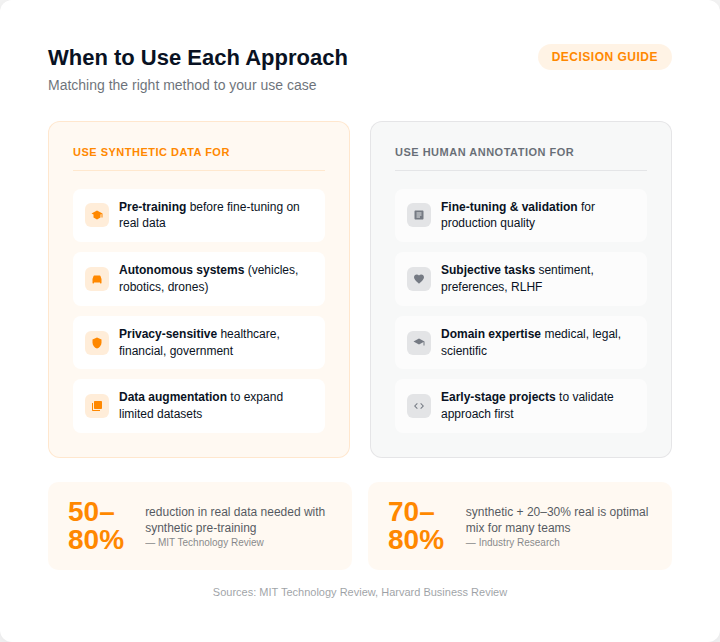
Use synthetic data to pre-train models before fine-tuning on real data. This approach, known as sim-to-real transfer, can dramatically reduce the amount of real annotated data needed.
Autonomous Systems Development
Self-driving cars, robotics, and drones benefit enormously from synthetic simulation. Testing edge cases like vehicle failures, unusual weather, or rare obstacles would be dangerous or impractical in the real world. Leading autonomous vehicle companies generate billions of synthetic driving miles annually.
Privacy-Sensitive Applications
Healthcare, financial, and government applications often cannot use real data due to privacy regulations. Synthetic data that preserves statistical properties without containing actual patient or customer information enables AI development while maintaining compliance. The constraint bites hardest in small-practice settings such as DPC clinics, where the entire patient record sits with one care team and there is no large de-identified warehouse to draw training data from in the first place.
Data Augmentation
Synthetic transformations can expand limited real datasets. Image augmentation, text paraphrasing, and audio modifications create additional training samples that improve model robustness without requiring new annotation.
When to Use Human Annotation
Human annotation remains essential for many AI applications, particularly those requiring real-world grounding or subjective judgment.
Fine-Tuning and Validation
Even models pre-trained on synthetic data need fine-tuning on real, human-annotated data to achieve production-ready performance. The final 10-20% of model quality often requires human annotation to capture real-world nuances.
Subjective and Preference-Based Tasks
Tasks like sentiment analysis, content quality assessment, or AI response helpfulness ratings inherently require human judgment. RLHF (Reinforcement Learning from Human Feedback) for large language models exemplifies this: human preferences cannot be synthesized because they define the ground truth. Human-in-the-loop approaches remain critical for AI systems that interact with people.
Domain-Specific Expertise
Medical diagnosis, legal analysis, scientific research, and other specialized domains require expert annotators. The knowledge embedded in expert annotations cannot be replicated through generation techniques.
Early-Stage Projects
Before investing in synthetic data infrastructure, human annotation validates that your AI approach works. Starting with human-annotated data lets you iterate quickly on model architecture and task definition before committing to pipeline development.
The Hybrid Approach
Most successful AI systems combine synthetic and human-annotated data strategically. Understanding how to blend both approaches maximizes quality while controlling costs.
Common Hybrid Strategies
| Strategy | Description | Best For |
|---|---|---|
| Synthetic Pre-training + Real Fine-tuning | Train on synthetic, fine-tune on real | Computer vision, NLP foundational models |
| Real Base + Synthetic Augmentation | Annotate core data, augment synthetically | Limited data scenarios |
| Synthetic Edge Cases + Real Distribution | Human-annotated common cases, synthetic rare cases | Safety-critical systems |
| Synthetic Draft + Human Verification | Generate labels synthetically, human QA | High-volume, objective tasks |
Balancing the Mix
The optimal ratio of synthetic to human-annotated data varies by application. As a starting point, many teams find success with 70-80% synthetic data for pre-training and 20-30% real data for fine-tuning. Monitor validation metrics on held-out real data to ensure synthetic training transfers effectively.
Companies achieving the best AI performance typically use hybrid data strategies rather than relying exclusively on either approach.
Quality Considerations
Both synthetic and human-annotated data require quality management, but the challenges differ.
Synthetic Data Quality
The primary quality concern for synthetic data is domain gap: the difference between synthetic and real data distributions. Validate synthetic data quality by testing models on held-out real data. If performance drops significantly compared to models trained on real data, your synthetic pipeline may need refinement.
Other quality factors include diversity (does the synthetic data cover the full range of real-world variation?), realism (are there artifacts that models might exploit?), and balance (is the label distribution appropriate for your use case?).
Human Annotation Quality
Human annotation quality depends on annotator training, guideline clarity, and QA processes. Key metrics include accuracy (agreement with gold standard), consistency (inter-annotator agreement), and coverage (handling of edge cases). The Asia tech talent market offers skilled annotators who can maintain high quality standards at competitive rates.
Implementation Roadmap
For teams deciding between synthetic and human annotation, consider this phased approach.
Phase 1: Validate with Human Annotation
Start with a small human-annotated dataset (1,000-10,000 samples) to validate your approach. This confirms the task is learnable, establishes quality baselines, and reveals edge cases that will inform later synthetic generation.
Phase 2: Evaluate Synthetic Potential
Assess whether your use case is amenable to synthetic data. Consider whether you can simulate the data generation process, whether domain gap is acceptable for your application, and whether you have engineering resources for pipeline development.
Phase 3: Build Hybrid Pipeline
If synthetic data is viable, develop generation pipelines while continuing human annotation for validation data. Use real data to calibrate and validate synthetic outputs.
Phase 4: Optimize the Mix
Experiment with different ratios of synthetic to real data. Monitor production metrics to find the optimal balance for your specific application.
Conclusion

Synthetic data and human annotation are complementary approaches, not competitors. Synthetic data excels at scale, edge case coverage, and privacy compliance. Human annotation provides real-world grounding, subjective judgment, and flexibility. The most effective AI systems combine both strategically.
Start with human annotation to validate your approach and establish quality baselines. Invest in synthetic data pipelines when you need scale beyond what human annotation can efficiently provide, particularly for pre-training, augmentation, and edge case generation. Always validate synthetic-trained models on real, human-annotated data before production deployment.
Need high-quality human annotation for your AI project? Second Talent provides expert data annotation services for training, validation, and fine-tuning datasets across computer vision, NLP, and specialized domains.





![Singapore AI Companies Leading Southeast Asia. Top 10 Singapore AI Companies Leading Southeast Asia [2026], by Second Talent.](https://www.secondtalent.com/wp-content/uploads/2026/09/singapore-ai-companies-featured-v2-768x403.jpg)